REVIEW 4 major objections 6 minor 1 cited by
Think Before You Segment: An Object-aware Reasoning Agent for Referring Audio-Visual Segmentation
T0 review · 4 major / 6 minor · reviewed 2026-08-05 · deepseek-v4-flash
Pith's one-line read TGS-Agent contends that referring audio-visual segmentation is best solved by an explicit Think-Ground-Segment pipeline: a reasoning multimodal language model names the object, an open-vocabulary detector boxes it, frozen SAM2 masks it, wit
desk verdict A genuinely new and mostly convincing agentic pipeline for Ref-AVS, but treat the R2-AVSBench SOTA with caution: the same Gemini model that writes the teacher chains also generates that benchmark. read the letter →
The pith
A machine-rendered reading of the paper's core claim, the machinery that carries it, and where it could break.
The reading
What carries the argument
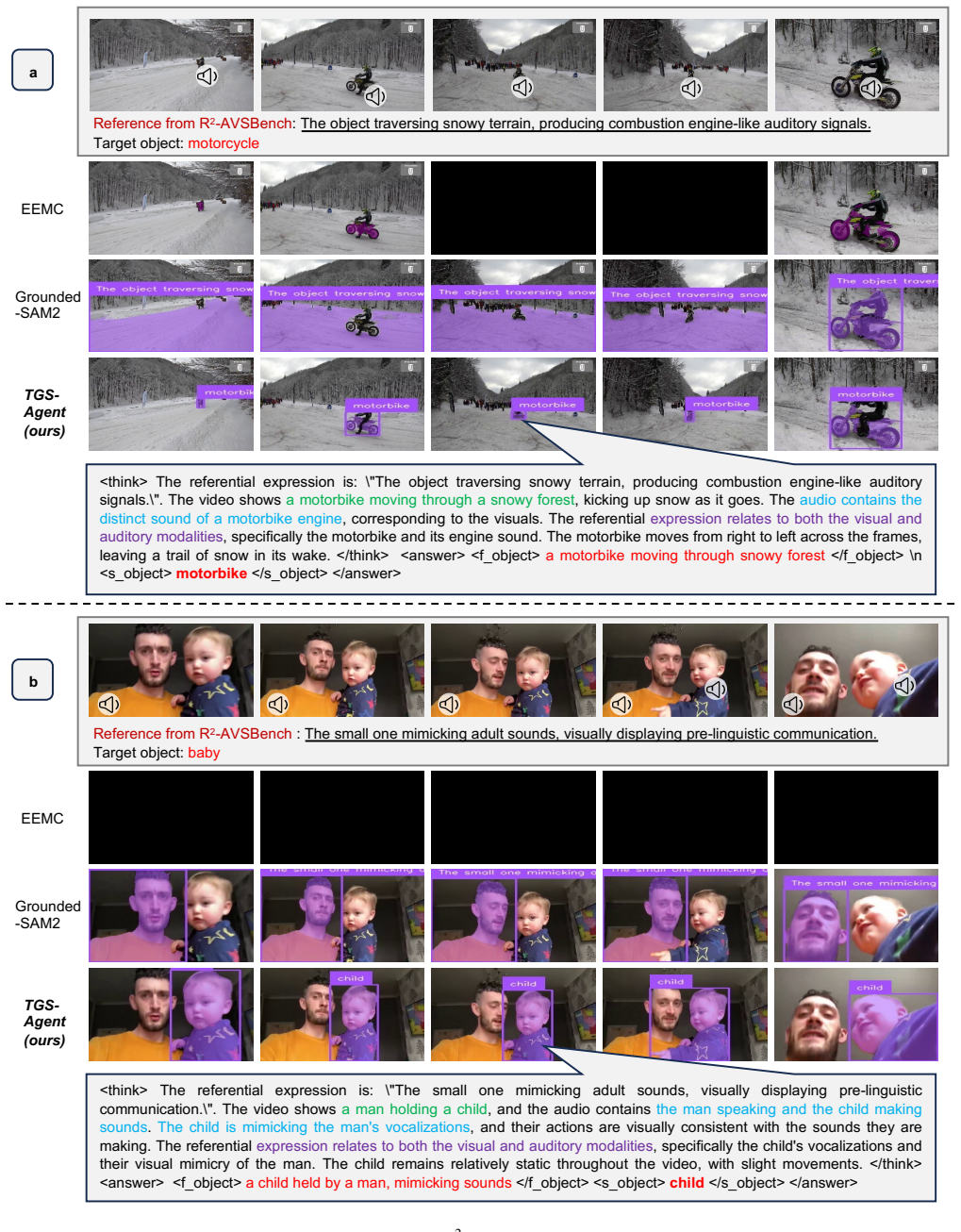
The Think-Ground-Segment (TGS) workflow, with Ref-Thinker as the load-bearing component. Ref-Thinker is a multimodal LLM (LLaMA-2-7b backbone, CLIP-ViT visual encoder, BEATs audio encoder, Q-Former compression, LoRA tuning) trained on Gemini-1.5-Pro-generated instruction chains. Each chain contains a <think> passage analyzing the reference against visible and audible content and an <answer> with two object descriptions: a fine-grained <f object> and a category-only <s object>. This explicit text bottleneck—multimodal inputs collapsed into a natural-language object description—is what gets handed to Grounding-DINO and then to frozen SAM2, converting segmentation into reference → object text →
What would settle it
Have human annotators verify a random sample of the Gemini-generated think-answer chains and compute agreement with ground-truth object labels; then fine-tune Ref-Thinker only on chains judged correct and measure J&F on R2-AVSBench. If the verified-set accuracy is close to chance, or if cleaned training does not change downstream performance, the claim that explicit reasoning quality drives the reported gains is falsified.
Extended reading notes
Core claim
The central claim is that explicit reference understanding can replace implicit multimodal fusion. Once the referred object is named as text, generic frozen tools—Grounding-DINO for grounding, SAM2 for segmentation—suffice and outperform the previous state of the art, SAM2-LOVE, by 7.4 points in mean J&F on the mixed Ref-AVSBench test set (65.9 vs 58.5). Using the simplified object category as the detection prompt beats feeding the original reference or a fine-grained description on average, though fine-grained text helps when multiple instances of the same category appear. The companion R2-AVSBench rewrites references to hide direct object names and force external, comparative, functional,
Load-bearing premise
The load-bearing premise is that the Gemini-1.5-Pro-generated think-answer chains used to fine-tune Ref-Thinker are accurate enough to teach reliable object identification; the paper calls them high-quality without human verification, and later reports exact category match of only 55.1% on Seen and 49.3% on Unseen test splits.
Editorial extensions
If this is right
- If the pipeline is correct, strong Ref-AVS performance does not require pixel-level supervision or tuning of segmentation decoders; frozen open-vocabulary detection plus SAM2 suffice given a good object description.
- The explicit reasoning chain makes outputs auditable: a wrong mask can be traced to a wrong object name in Think, a wrong box in Ground, or a wrong mask given the box in Segment.
- The simplified object category is competitive or better as a grounding prompt than the original natural-language reference, suggesting object identity rather than paraphrase fidelity is the load-bearing information for detection.
- On R2-AVSBench, all models drop when references become reasoning-intensive, but TGS-Agent's drop is smaller, indicating that explicit reasoning helps cross-reference generalization.
- Because Ref-Thinker is open-vocabulary, the pipeline should handle object categories unseen in training as long as the frozen detector recognizes the named object; the Unseen split results support this corollary.
Reading between the lines
- The paper leaves implicit that the quality of its instruction set caps the whole pipeline: exact category match is only 55.1% on Seen and 49.3% on Unseen test splits, so cleaner or human-verified think-answer chains likely have large untapped headroom.
- The decomposed design makes the failure modes separable: the appendix shows a temporal-audio reasoning error in the Think stage and a rare-object detection error in the Ground stage, implying that better temporal audio reasoning and broader detector coverage would improve results roughly additively.
- R2-AVSBench could be used as a diagnostic that separates language robustness from perceptual grounding; methods that fuse latent embeddings may survive template-style references yet degrade sharply when the same object is described through function, comparison, or external knowledge.
- A natural testable extension is to swap Ref-Thinker's teacher for a stronger or human-verified reasoner without changing the Ground and Segment tools; if gains track Think-stage accuracy, the agentic decomposition is validated as the source of the improvement.
Editorial analysis
A structured set of objections, weighed in public.
Referee Report
Summary. The paper proposes TGS-Agent, a training-free-at-segmentation agentic framework for Referring Audio-Visual Segmentation (Ref-AVS). The pipeline decomposes the task into Think (Ref-Thinker, an audio-visual LLM fine-tuned on Gemini-generated reasoning chains), Ground (Grounding-DINO), and Segment (frozen SAM2), using only reference text, video, and audio without pixel-level mask supervision. The authors also introduce R2-AVSBench, a 400-video benchmark with Gemini-transformed, human-verified references intended to be more linguistically diverse and reasoning-intensive. They report state-of-the-art results on both the standard Ref-AVSBench and the proposed R2-AVSBench, with ablations on object-description granularity and detection thresholds.
Significance. If the central claims hold, the paper offers a conceptually different baseline for Ref-AVS: replacing end-to-end multimodal fusion with an explicit, inspectable Think-Ground-Segment chain using frozen foundation models. This is valuable because it decouples reasoning from mask supervision and provides a new stress-test benchmark. The paper is also transparent in reporting failure cases and quantitative object-category accuracy. However, the significance depends on two unresolved issues: the reliability of the Gemini-generated teacher chains used to train Ref-Thinker, and the overlap between the teacher model and the model used to construct R2-AVSBench. Both are fixable with additional experiments and analysis.
major comments (4)
- [Sec. 3.2 and Appendix D] The instruction-tuning set is described as 'high-quality' without human verification or agreement statistics. Appendix D later reports exact category match of only 55.1% (Seen) and 49.3% (Unseen) for the simplified object output. Since this output is the sole prompt passed to Grounding-DINO, the reliability of the Think step directly caps downstream Ground and Segment performance. The CLIPScore argument is only qualitative ('majority in [0.8,1]') with no reported distribution. Please provide human verification of a sample of teacher chains, report exact and semantic accuracy quantitatively, and show whether the low exact-match rate bounds segmentation performance.
- [Sec. 4 vs Sec. 3.2] The same model, Gemini-1.5-Pro, is used both to generate Ref-Thinker's training chains (Sec. 3.2) and to construct R2-AVSBench references (Sec. 4). This creates a distributional alignment: Ref-Thinker is fine-tuned to imitate Gemini's paraphrase style, and the test references come from the same generator. The large margin on R2-AVSBench in Table 2 may therefore reflect familiarity with Gemini's phrasing rather than generalizable multimodal reasoning. Please evaluate on human-written R2-style references, train with a different teacher model, or otherwise demonstrate that the R2 advantage is not an artifact of the shared generator.
- [Sec. 4 benchmark validation] The R2-AVSBench construction states that human annotators revise or reject generated references, but no statistics are given: how many references were rejected, how many were revised, what the inter-annotator agreement was, or how ambiguity was measured. Without these numbers it is difficult to assess whether R2-AVSBench is genuinely unambiguous and reasoning-intensive. Please report these statistics, or at least a human-validation protocol with agreement rates.
- [Sec. 5.4 and Table 3] The fine-grained object description T_f is the interpretable output emphasized in the paper's explainability narrative, yet Table 3 shows it consistently underperforms the simplified T_s (e.g., 49.0 vs 54.9 J&F on Seen, 73.7 vs 76.9 on Unseen). This suggests that the detailed reasoning chain is not what drives the state-of-the-art result, and that the practical benefit of the explicit Think step may be limited to category identification. Please discuss this discrepancy and provide quantitative evidence for when T_f helps beyond the single qualitative example in Fig. 4.
minor comments (6)
- [Figures 4, 10-14] Several figure captions contain stray Chinese text (e.g., '选取12356 张' in Fig. 4 and similar artifacts in Figs. 10-14). These should be removed before submission.
- [Sec. 3.1] The output tags are written as '<f object>' and '<s object>' with a space; this is inconsistent with standard XML/HTML tag conventions and could confuse readers implementing the format. Please define the exact literal tag syntax or use 'f_object' and 's_object' consistently.
- [Table 2] The column heading 'Ref. Source' is unclear; consider renaming to 'Reference set' or 'Benchmark' to distinguish the original Ref-AVSBench references from the transformed R2-AVSBench references.
- [Appendix D] The CLIPScore analysis should report quantitative aggregates (mean, percentiles, or a histogram) rather than the qualitative statement that 'the majority of CLIPScore values fall within [0.8, 1]'.
- [Fig. 5] The y-axis label 'J&F' is ambiguous; specify whether it is the average of J and F over Seen+Unseen, and state the default operating point clearly on the plots.
- [Sec. 5.4] The sentence 'the object detector is confused when recognizing the correct guitar at instance level' is grammatically awkward; rephrase for clarity.
Circularity Check
R2-AVSBench SOTA is partially confounded: the same Gemini-1.5-Pro model generates both the Ref-Thinker instruction-tuning chains and the R2-AVSBench test references, so the proposed benchmark does not independently establish cross-reference reasoning; the standard Ref-AVSBench result remains independent.
-
fitted input called prediction
[Sec. 3.2 (Ref-Thinker training) and Sec. 4 (R2-AVSBench construction); Appendix D]
"Specifically, given a reference expression and a video from the training set of the official Ref-AVSBench dataset ... we leverage Gemini-1.5-Pro ... to analyze the video and generate an object-aware reasoning chain that strictly follows the think-answer format shown in Sec. 3.1. ... We perform the reference transformation with the aid of Gemini-1.5-Pro, and the corresponding prompt is provided in Appendix B."
Ref-Thinker is instruction-tuned to imitate Gemini-1.5-Pro's think-answer chains (Sec. 3.2), and the R2-AVSBench test references are generated by the same Gemini-1.5-Pro model (Sec. 4). The model is therefore fitted to the output distribution of the very generator that produces the proposed benchmark. Its large margin on R2-AVSBench (Table 2) can reflect distributional familiarity with Gemini's paraphrasing style rather than generalizable multimodal reasoning. The standard Ref-AVSBench comparison is not affected, but the R2-AVSBench 'prediction' is not an independent test of the claimed cross-reference generalization.
full rationale
The core Think-Ground-Segment derivation is not definitionally circular: Ref-Thinker outputs object descriptions, Grounding-DINO converts them to boxes, and frozen SAM2 produces masks. The Ref-AVSBench evaluation is independent, uses human-annotated masks and expressions, and shows SOTA against tuned baselines. However, the paper's second benchmark, R2-AVSBench, is built by prompting Gemini-1.5-Pro to transform references, while Ref-Thinker is trained on think-answer chains also produced by Gemini-1.5-Pro. Human verification of R2-AVSBench references reduces factual-error risk but does not remove the stylistic and reasoning-pattern overlap between training supervision and test generation. Appendix D further reports only 55.1% (Seen) and 49.3% (Unseen) exact category matches for Ref-Thinker's simplified object output, which undercuts the claim that the teacher data produces 'high-quality' object-aware reasoning. This is an evaluator-loop problem specific to the R2-AVSBench claim; the standard Ref-AVSBench result retains independent content, so the paper is only partially circular rather than fully forced by definition or self-citation.
Assumptions & free parameters
free parameters (3)
- tau_bbox (Grounding-DINO box confidence threshold) =
0.1
- tau_text (Grounding-DINO text similarity threshold) =
0.25
- Ref-Thinker fine-tuning hyperparameters =
LoRA rank 8, scaling 16, lr 1e-4, batch 4, 6 epochs, 32 query tokens
assumptions (5)
- ad hoc to paper Gemini-1.5-Pro generated think-answer chains are accurate and 'high-quality' without independent verification
- domain assumption Grounding-DINO can localize any object from short open-vocabulary text prompts in RGB frames
- domain assumption SAM2 produces accurate segmentation masks from bounding-box prompts
- domain assumption R2-AVSBench transformed references identify the same target object as the original Ref-AVSBench references
- domain assumption Ref-Thinker's architecture (LLaMA-2-7b-chat + CLIP + BEATs + Q-Former) can learn audio-visual-text reasoning from the constructed instruction set
Cite this review
Pith. "Pith review of Think Before You Segment: An Object-aware Reasoning Agent for Referring Audio-Visual Segmentation." pith.science (2026). https://pith.science/paper/L4UHJG72
@misc{pith2026250804418,
  author       = {Pith},
  title        = {Pith review of: Think Before You Segment: An Object-aware Reasoning Agent for Referring Audio-Visual Segmentation},
  year         = {2026},
  howpublished = {\url{https://pith.science/paper/L4UHJG72}},
  note         = {Machine review of arXiv:2508.04418}
}
read the original abstract
Referring Audio-Visual Segmentation (Ref-AVS) aims to segment target objects in audible videos based on given reference expressions. Prior works typically rely on learning latent embeddings via multimodal fusion to prompt a tunable SAM/SAM2 decoder for segmentation, which requires strong pixel-level supervision and lacks interpretability. From a novel perspective of explicit reference understanding, we propose TGS-Agent, which decomposes the task into a Think-Ground-Segment process, mimicking the human reasoning procedure by first identifying the referred object through multimodal analysis, followed by coarse-grained grounding and precise segmentation. To this end, we first propose Ref-Thinker, a multimodal language model capable of reasoning over textual, visual, and auditory cues. We construct an instruction-tuning dataset with explicit object-aware think-answer chains for Ref-Thinker fine-tuning. The object description inferred by Ref-Thinker is used as an explicit prompt for Grounding-DINO and SAM2, which perform grounding and segmentation without relying on pixel-level supervision. Additionally, we introduce R\textsuperscript{2}-AVSBench, a new benchmark with linguistically diverse and reasoning-intensive references for better evaluating model generalization. Our approach achieves state-of-the-art results on both standard Ref-AVSBench and proposed R\textsuperscript{2}-AVSBench. Code will be available at https://github.com/jasongief/TGS-Agent.
Figures


Figures from the paper (10 more)



Forward citations
Cited by 1 Pith paper
-
MAR3: Multi-Agent Recognition, Reasoning, and Reflection for Reference Audio-Visual Segmentation
A training-free multi-agent system (Delphi recognition, modality-adaptive reasoning, reflective mask correction) reaches 69.2% J&F on Ref-AVSBench, +3.4 over prior SOTA.
Reference graph
Works this paper leans on
-
[1]
As illustrated in Fig
Factual errors at the Think stage. As illustrated in Fig. 14a, both the ukulele and the girl produce sound, and the reference specifies the object making the longest sound duration. Although Ref-Thinker successfully identifies the presence of both the girl’s voice and the ukulele sound, it incorrectly concludes that the ukulele has the longest continu- ou...
-
[2]
Crab: A unified audio-visual scene understanding model with explicit cooperation. In CVPR, 18804–18814. Gao, S.; Chen, Z.; Chen, G.; Wang, W.; and Lu, T. 2024. Avsegformer: Audio-visual segmentation with transformer. In AAAI, volume 38, 12155–12163. Google. 2024. Gemini 1.5: Unlocking multimodal understanding across millions of tokens of context. https://...
arXiv 2024
-
[3]
ABSOLUTELY CRITICAL RESTRICTION: A VOID DIRECT ATTRIBUTES AND SIMPLE MULTIMODAL COMBINATIONS. * DO NOT use explicit, easily identifiable attributes like color (”red car”, ”blue bird”), simple shape (”round ball”, ”square box”), obvious size (”large building”, ”tiny bug”), direct, dominant sounds (”loud alarm”, ”siren”, ”dog barking”, ”engine roaring”), or...
-
[4]
Patch-level sounding object tracking for audio-visual question answering. In AAAI, 5075–5083. Lin, B.; Ye, Y .; Zhu, B.; Cui, J.; Ning, M.; Jin, P.; and Yuan, L. 2023. Video-llava: Learning united visual repre- sentation by alignment before projection. arXiv preprint arXiv:2311.10122. Ling, Y .; Li, Y .; Gan, Z.; Zhang, J.; Chi, M.; and Wang, Y
arXiv 2023
-
[5]
The sounding object near the woman.\
Examples (New Style of HIGHLY CHALLENGING, MULTIMODAL, Reasoning-focused Refs - Concise and Complex): - Target Object: ”hair-dryer” (Pixel mask shows it in hand, pointed at hair, generating sound and hot air movement.) Reasoning-intensive Ref: ”The handheld device creating localized heat and continuous ambient noise.” (11 words) - Target Object: ”emergenc...
-
[8]
Imprecise bounding boxes despite correct reasoning. In Fig. 14b, Ref-Thinker correctly interprets the reference and identifies the target object as marimba. However, during the Ground phase, the object detector (Grounding-DINO) fails to generate accurate bounding boxes. This may stem from limited pre-training data involving rare objects like the marimba. ...
-
[9]
Do not alter the given ref in any way
In <think>, you must: - Start your <think> reasoning with: The referential expression is: ”<ref>”. Do not alter the given ref in any way. - First provide a brief description of the overall visual and audio context. If the audio has been explicitly indicated as silent, state ’The audio is silent.’ directly. Otherwise, analyze the provided audio file. If th...
-
[10]
If the object is unique in the scene, a slightly more detailed description than <s object> is sufficient
In <answer>, output must follow this strict format: <f object> A fine-grained description of the object (appearance, location, attributes, actions) </f object> <s object> The simplified category of the object (e.g., guitar, dog, car) </s object> - Keep the <f object> description concise (6-10 words). If the object is unique in the scene, a slightly more d...
Show all 15 references
-
[11]
This complex ref must unambiguously and accurately refer to the exact target object uniquely identified by the uid and its associated pixel mask in the video
To create a completely newcomplex ref for the target object (”{target object name}”). This complex ref must unambiguously and accurately refer to the exact target object uniquely identified by the uid and its associated pixel mask in the video
-
[12]
Crucially: avoid any simple, direct descrip- tions
Your complex ref must be ABSOLUTELY CONCISE (STRICTLY 5-15 WORDS, NO EXCEPTIONS) and strictly incorporate one or more of these challenging reasoning types. Crucially: avoid any simple, direct descrip- tions. If a direct description (like ”red car” or ”loud dog barking”) can id...
-
[14]
Output Format: Return a JSON object containing the result for the current uid
-
[2021]
We observe that the majority of CLIPScore values fall within the range of [0.8, 1], indicating strong se- mantic similarity
between the predicted descriptions and the ground- truth categories. We observe that the majority of CLIPScore values fall within the range of [0.8, 1], indicating strong se- mantic similarity. For instance, as shown in Fig. 13b, although the annotated label of the referred ob...
-
[2022]
In CVPR, 19108–19118
Learning to answer questions in dynamic audio-visual scenarios. In CVPR, 19108–19118. Li, J.; Li, D.; Savarese, S.; and Hoi, S. 2023a. Blip-2: Boot- strapping language-image pre-training with frozen image encoders and large language models. In ICML, 19730–19742. PMLR. Li, K.; ...
2024
-
[2024]
traditional East Asian melodies
TransA VS: End-to-End Audio-Visual Segmentation with Transformer. In ICASSP, 7845–7849. IEEE. Liu, J.; Wang, Y .; Ju, C.; Ma, C.; Zhang, Y .; and Xie, W. 2024a. Annotation-free audio-visual segmentation. In WACV, 5604–5614. Liu, S.; Zeng, Z.; Ren, T.; Li, F.; Zhang, H.; Yang, ...
2025 arXiv
-
[2025]
In AAAI, volume 39, 15567–15575
Unsupervised audio-visual segmentation with modality alignment. In AAAI, volume 39, 15567–15575. Chen, H.; Xie, W.; Afouras, T.; Nagrani, A.; Vedaldi, A.; and Zisserman, A. 2021. Localizing visual sounds the hard way. In CVPR, 16867–16876. Chen, S.; Wu, Y .; Wang, C.; Liu, S.;...
2021 arXiv
Reviewed August 5, 2026 · model on record in the stance chip above.
Discussion (0). Sign in to comment.