REVIEW 5 major objections 6 minor 44 references
Node Classification With Integrated Reject Option
T0 review · 5 major / 6 minor · reviewed 2026-08-11 · deepseek-v4-flash
Pith's one-line read Integrating a reject option into GNN training lets node classifiers abstain on hard nodes and, the authors report, beat both softmax-threshold and conformal set-size baselines in accuracy at a given coverage on citation benchmarks.
desk verdict Clean transfer of known reject-option losses to GNN node classification, with a useful legal application, but the headline comparison is not made at matched coverage levels and the transductive calibration issue is unaddressed. read the letter →
The pith
A machine-rendered reading of the paper's core claim, the machinery that carries it, and where it could break.
The reading
What carries the argument
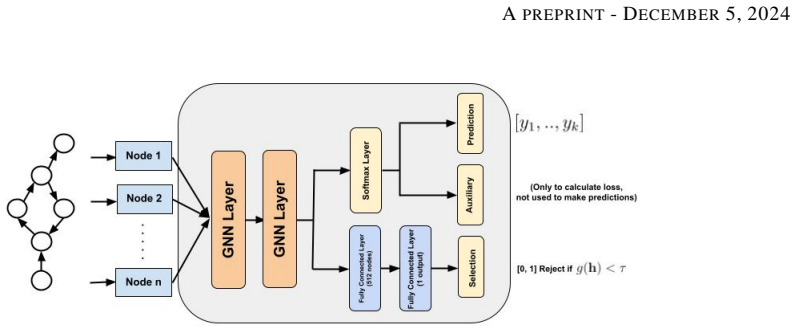
The load-bearing mechanism is treating rejection as a trainable part of the model rather than a post hoc threshold. For NCwR-Cost the key identity is the rejection-augmented cross-entropy loss $l^d_{ce}(f(h), e_y) = -\log f_y(h) - (1-d) \log f_{K+1}(h)$, which interpolates between standard cross-entropy ($d=1$) and a loss that strongly rewards the reject class ($d$ small); because it is calibrated to the 0-d-1 loss, minimizing it is consistent with the intended cost structure. For NCwR-Cov the machinery is the selective-risk objective $r(f,g|S_n) = \frac{1}{n}\sum_i l(f(h_i), y_i) g(h_i) / \phi(g|S_n)$ with a quadratic coverage penalty $\lambda\Psi(c - \phi(g|S_n))$, plus an auxiliary prediction head, and a validation-set threshold calibration to convert the training coverage constraint into a test-time coverage.
What would settle it
A reader could check whether the reported coverage-accuracy curves survive a non-exchangeable split: for example, hold out an entire connected community (or a time-based split on the ILDC citation graph) so that validation and test selection scores come from different structural neighborhoods. If the validation-calibrated threshold then yields test coverage far below target, and NCwR-Cost's advantage over Softmax-Response disappears, the central claim would be shown to depend on transductive exchangeability.
Extended reading notes
Core claim
The central claim is that rejection can be integrated into GNN training itself, and that this yields strictly better selective classifiers than post-hoc rejection heuristics. NCwR-Cost treats abstention as an extra class and optimizes the loss $l^d_{ce}(f(h), e_y) = -\log f_y(h) - (1-d) \log f_{K+1}(h)$, which is calibrated to the 0-d-1 loss: with a small rejection cost $d$, the model is pushed to assign probability mass to the reject class rather than to misclassify. NCwR-Cov instead follows SelectiveNet, learning a selection score $g(h)$ and minimizing selective risk with a quadratic penalty on coverage, then calibrating the selection threshold $\tau$ on validation scores to hit the target coverage on test. The paper reports that NCwR-Cost always beats Softmax-Response on accuracy at a given coverage and beats CF-GNN in all but one Cora setting, and that on ILDC the abstaining models reach high accuracy at low coverage, e.g. 97.55% accuracy at 50% coverage for NCwR-Cov.
Load-bearing premise
The selective-classification guarantees borrowed from SelectiveNet and the loss-calibration results from the 0-d-1 literature assume i.i.d. examples, but node classification here is transductive—train, validation, and test share one graph, and GAT embeddings are computed by message passing over the whole graph—so the paper assumes that calibrating the selection threshold on validation scores transfers to the test set.
Editorial extensions
If this is right
- On Cora, Citeseer, and Pubmed, NCwR-Cost is reported to beat Softmax-Response at every coverage value tested, and to beat CF-GNN except for one Cora case at 50% coverage.
- The cost-based recipe is architecture-agnostic: the appendix shows similar accuracy across GCN, GAT, GraphSAGE, and GATv2 bases, and across 2 to 4 GAT layers.
- On ILDC legal judgment, NCwR-Cov achieves 97.55% accuracy at 50% coverage, showing abstention models can be practically useful in high-stakes domains.
- The same integrated-reject idea extends to tabular medical data converted into KNN graphs, with results reported on UCI Thyroid and Pima Indians Diabetes.
Reading between the lines
- A testable extension would be inductive node classification: if the reject head is trained on one graph and deployed on a graph with unseen topology, the validation-calibrated coverage may fail to transfer; the transductive setup may hide this failure mode.
- The cost-based loss is a generic recipe that could be attached to any differentiable classifier, not just GNNs; its advantage over conformal baselines suggests integrated abstention training is a general principle rather than a graph-specific trick.
- The SHAP analyses in the legal application connect abstention to specific textual evidence (e.g., suspicious FIR delay), suggesting the reject scores carry interpretable signal that could drive human-in-the-loop review pipelines.
Signed reviews
Editorial analysis
A structured set of objections, weighed in public.
Referee Report
Summary. The paper proposes two GAT-based architectures for transductive node classification with an abstention (reject) option: NCwR-Cov, a coverage-constrained selective classifier modeled on SelectiveNet, and NCwR-Cost, which augments the output with a reject class and uses the consistent cost-based cross-entropy loss of CCF+22. The methods are evaluated on Cora, Citeseer, and PubMed, and on the ILDC legal judgment dataset; SHAP is used to illustrate which text segments drive decisions in two legal cases. The central claim is that NCwR-Cost dominates the Softmax-Response baseline at all coverage values and dominates the CF-GNN conformal baseline except at one Cora point, and that the reject-option models are useful for high-risk legal prediction.
Significance. If the dominance claim could be established at matched coverage, the paper would be a useful practical contribution: it would show that an integrated abstention head in a GAT improves over simple softmax thresholding and conformal set-size rejection for transductive node classification. The paper is built on published consistent losses and clearly credits them; the appendices add results across several base GNNs and two medical datasets, which strengthens the generality claim. The main weakness is that the evaluation protocol does not currently support the headline superiority claim: comparisons are made at unmatched coverage values, error bars are missing for key baselines and for Table 1, and the ILDC experiment lacks all baseline comparisons. The strengths of the paper are the clear problem formulation, the use of standard GAT training, and the concrete application domain; the empirical claims, however, are not yet demonstrated.
major comments (5)
- [Section 5.1, Figure 3, Table 2] The headline claim that 'NCwR-Cost always outperforms Softmax-Response based approach ... in terms of accuracy on unrejected samples for all coverage values' is not established by the reported experiment, because the methods are evaluated at different empirical coverage values. NCwR-Cost's coverage is determined by the rejection cost d and takes a small discrete set of values: for Pubmed only d=0.5 (49.3%) and d=0.6 (67.8%) are reported apart from the d=1 full-coverage point, and for Citeseer the d=0.5 point has 9.7% coverage. The baselines are generated by sweeping over thresholds (Softmax-Response) or over alpha (CF-GNN), so their coverage points do not coincide with these values. Comparing interpolated curves in Figure 3 is not a valid empirical test of 'for all coverage values'. I request a matched-coverage re-analysis: calibrate every method's threshold (or alpha) on the validation set to a common grid of target coverages, report the actual test coverage, and compare accuracy only at identical coverage values.
- [Section 4.3, Table 1, Figure 3] The coverage calibration for NCwR-Cov selects tau on the validation set, and the paper assumes that the resulting coverage transfers to the test set; the paper itself notes in Section 4.3 that the training coverage constraint is violated on the test set. The theoretical support for this calibration comes from SelectiveNet [GEY19] and the loss-consistency results in [CCF+22], which are i.i.d. statements, whereas in this transductive setting the GAT embeddings depend on message passing over the whole graph, so validation and test selection scores are dependent. Please report, over repeated random validation/test splits, the achieved test coverage versus target coverage, or provide an exchangeability argument. Without this, the reported coverage rates and the x-axis of Figure 3 are not externally verifiable.
- [Section 6, Table 3] The ILDC application is presented as a contribution in the abstract and Section 1, but Table 3 reports only NCwR-Cost and NCwR-Cov. There is no Softmax-Response or CF-GNN baseline on this dataset, no comparison with the GAT result from [KYK+23], and no un-rejected-set accuracy from the earlier ILDC systems of [MSN+21]. The sentence 'Our results on LJP task show that these models are very effective in such applications' is therefore unsupported by the data. The paper should add the same baselines used in Section 5.1 on ILDC at matched coverage, or explicitly limit the LJP claim to a demonstration of feasibility.
- [Section 5, Tables 1-3, Figure 3] The statistical evidence for the dominance claim is incomplete. The introduction to Section 5 says each experiment is repeated 10 times and average accuracies are reported, but Table 1 gives no standard deviations, Table 4 in Appendix A gives none, and the baseline curves in Figure 3 are shown without any error bars. Table 2 shows nontrivial run-to-run variation (e.g., Citeseer d=0.85 accuracy 75.8 ± 1.61), and the comparisons in Figure 3 are often close, including the single Cora point where CF-GNN is better. The paper should report confidence intervals for every point and a paired comparison over the 10 runs at matched coverage values.
- [Section 4.4, Table 2] The restriction for Pubmed is not justified as written: 'We only experimented with d = [0.5, 0.6] in Pubmed as it has only k = 3 classes and d < k-1/k.' The inequality is not stated correctly or explained, and the omitted values d=0.7, 0.8, and 0.85 are exactly the values that would supply intermediate coverage points for Pubmed. If there is a feasibility condition from [CCF+22], it should be stated with a reference; otherwise the authors should run these values and report the resulting coverage and accuracy points.
minor comments (6)
- [Section 5.2] The sentence 'Label smoothing makes this situation worse for NCwR-Cov due to soft labels' refers to a technique that is not introduced anywhere in Section 4; either describe label smoothing in the experimental setup or remove the reference.
- [Table 2] The columns headed '0-d-1' in Table 2 are never defined in the text; please define the empirical 0-d-1 risk and explain how it is computed.
- [Section 5.3, Figure 4] The text compares coverage '50.4%' for NCwR-Cov with NCwR-Cost, but the experimental tables report 50% target coverage for NCwR-Cov and 42.6% coverage for NCwR-Cost d=0.5 on Cora; the provenance of the 50.4% value in Figure 4 should be clarified.
- [Section 6.2.2] The case presentation says the model's low confidence 'led to rejection,' but the discussion then explains the SHAP output based on a wrong prediction; please clarify whether the example was rejected or accepted with an error.
- [Appendix B] The UCI Thyroid and Pima Indians Diabetes results in Tables 5 and 6 are not referenced in the main text and no conclusion is drawn from them; add a pointer in Sections 4 or 5 and state what these results contribute.
- [Section 4.5] For reproducibility, specify how many runs and which GAT hyperparameters were used for the Softmax-Response and CF-GNN baselines, and how the CF-GNN label-set size was calibrated on the validation set.
Circularity Check
No circularity: the central losses and threshold calibration come from external cited work or validation-set selection, and the reported test accuracies are not forced by construction.
full rationale
I walked the paper's derivation chain. NCwR-Cov's objective is the SelectiveNet selective risk with a coverage penalty, adopted with citation [GEY19]; NCwR-Cost uses the consistent rejection loss from [CCF+22]. Both are external and neither is defined in terms of the paper's own reported accuracies or coverages. Threshold calibration in Section 4.3 selects tau using validation selection scores only, and the test accuracy is then measured on held-out nodes; this is standard calibration, not a fitted input renamed as a prediction. The only overlapping-author citation is [KSM21], which includes coauthor Naresh Manwani, but it is used only as background on instance-dependent rejection and is not load-bearing for any central claim. The paper's strongest claims are empirical comparisons at stated coverage values; concerns about unmatched coverage points between NCwR-Cost and baselines are experimental-comparability issues, not circularity. No step in the derivation reduces by construction to its own inputs, so no circular step is identified.
Assumptions & free parameters
free parameters (3)
- lambda (coverage penalty weight) =
32
- alpha (loss combination weight) =
0.5
- tau (selection threshold) =
calibrated on validation set
assumptions (3)
- domain assumption The loss l_d_ce (Eq. 1) is consistent with the 0-d-1 loss, per CCF+22.
- domain assumption The selective risk minimization framework of SelectiveNet (coverage-constrained training with a separate selection head) is a valid way to learn a reject option.
- domain assumption Validation selection scores are representative of test selection scores after message passing.
Cite this review
Pith. "Pith review of Node Classification With Integrated Reject Option." pith.science (2026). https://pith.science/paper/L4WHS2CV
@misc{pith2026241203190,
  author       = {Pith},
  title        = {Pith review of: Node Classification With Integrated Reject Option},
  year         = {2026},
  howpublished = {\url{https://pith.science/paper/L4WHS2CV}},
  note         = {Machine review of arXiv:2412.03190}
}
read the original abstract
One of the key tasks in graph learning is node classification. While Graph neural networks have been used for various applications, their adaptivity to reject option setting is not previously explored. In this paper, we propose NCwR, a novel approach to node classification in Graph Neural Networks (GNNs) with an integrated reject option, which allows the model to abstain from making predictions when uncertainty is high. We propose both cost-based and coverage-based methods for classification with abstention in node classification setting using GNNs. We perform experiments using our method on three standard citation network datasets Cora, Citeseer and Pubmed and compare with relevant baselines. We also model the Legal judgment prediction problem on ILDC dataset as a node classification problem where nodes represent legal cases and edges represent citations. We further interpret the model by analyzing the cases that the model abstains from predicting by visualizing which part of the input features influenced this decision.
Figures


Figures from the paper (3 more)


Reference graph
Works this paper leans on
-
[1]
A gentle introduction to conformal prediction and distribution-free uncertainty quantification
Anastasios N Angelopoulos and Stephen Bates. A gentle introduction to conformal prediction and distribution-free uncertainty quantification. arXiv preprint arXiv:2107.07511 , 2021
arXiv 2021
-
[2]
Diego Antognini. pygat. https://github.com/Diego999/pyGAT, 2021
work page 2021
-
[3]
Xavier Bresson and Thomas Laurent. Residual gated graph convnets. arXiv preprint arXiv:1711.07553 , 2017
arXiv 2017
-
[4]
Yuzhou Cao, Tianchi Cai, Lei Feng, Lihong Gu, Jinjie GU, Bo An, Gang Niu, and Masashi Sugiyama. Generalizing consistent multi-class classification with rejection to be compatible with arbitrary losses. In S. Koyejo, S. Mohamed, A. Agarwal, D. Belgrave, K. Cho, and A. Oh, editors, Advances in Neural Information Processing Systems , volume 35, pages 521--53...
work page 2022
-
[5]
Classification with rejection based on cost-sensitive classification
Nontawat Charoenphakdee, Zhenghang Cui, Yivan Zhang, and Masashi Sugiyama. Classification with rejection based on cost-sensitive classification. In Marina Meila and Tong Zhang, editors, Proceedings of the 38th International Conference on Machine Learning , volume 139 of Proceedings of Machine Learning Research , pages 1507--1517. PMLR, 18--24 Jul 2021
work page 2021
-
[6]
A survey on legal judgment prediction: Datasets, metrics, models and challenges
Junyun Cui, Xiaoyu Shen, and Shaochun Wen. A survey on legal judgment prediction: Datasets, metrics, models and challenges. IEEE Access , 2023
work page 2023
-
[7]
Fast and accurate deep network learning by exponential linear units (elus)
Djork-Arn \'e Clevert, Thomas Unterthiner, and Sepp Hochreiter. Fast and accurate deep network learning by exponential linear units (elus). arXiv preprint arXiv:1511.07289 , 2015
arXiv 2015
-
[8]
On the equivalence between graph isomorphism testing and function approximation with gnns
Zhengdao Chen, Soledad Villar, Lei Chen, and Joan Bruna. On the equivalence between graph isomorphism testing and function approximation with gnns. Advances in neural information processing systems , 32, 2019
work page 2019
Show all 44 references
-
[9]
Convolutional neural networks on graphs with fast localized spectral filtering
Micha \"e l Defferrard, Xavier Bresson, and Pierre Vandergheynst. Convolutional neural networks on graphs with fast localized spectral filtering. Advances in neural information processing systems , 29, 2016
2016
-
[10]
Legal judgment prediction via relational learning
Qian Dong and Shuzi Niu. Legal judgment prediction via relational learning. In Proceedings of the 44th International ACM SIGIR Conference on Research and Development in Information Retrieval , pages 983--992, 2021
2021
-
[11]
Eta prediction with graph neural networks in google maps
Austin Derrow-Pinion, Jennifer She, David Wong, Oliver Lange, Todd Hester, Luis Perez, Marc Nunkesser, Seongjae Lee, Xueying Guo, Brett Wiltshire, et al. Eta prediction with graph neural networks in google maps. In Proceedings of the 30th ACM international conference on inform...
2021
-
[12]
da Rocha Neto, Ricardo Sousa, Guilherme de A
Ajalmar R. da Rocha Neto, Ricardo Sousa, Guilherme de A. Barreto, and Jaime S. Cardoso. Diagnostic of pathology on the vertebral column with embedded reject option. In Pattern Recognition and Image Analysis , pages 588--595, 2011
2011
-
[13]
On the foundations of noise-free selective classification
Ran El-Yaniv et al. On the foundations of noise-free selective classification. JMLR , 11(5), 2010
2010
-
[14]
Legal judgment prediction: A survey of the state of the art
Yi Feng, Chuanyi Li, and Vincent Ng. Legal judgment prediction: A survey of the state of the art. In Lud De Raedt, editor, Proceedings of the Thirty-First International Joint Conference on Artificial Intelligence, IJCAI-22 , pages 5461--5469. International Joint Conferences on...
2022
-
[15]
Selective classification for deep neural networks
Yonatan Geifman and Ran El-Yaniv. Selective classification for deep neural networks. In NIPS , pages 4878--4887, 2017
2017
-
[16]
Selectivenet: A deep neural network with an integrated reject option
Yonatan Geifman and Ran El-Yaniv. Selectivenet: A deep neural network with an integrated reject option. In ICML , pages 2151--2159, 2019
2019
-
[17]
A survey of uncertainty in deep neural networks
Jakob Gawlikowski, Cedrique Rovile Njieutcheu Tassi, Mohsin Ali, Jongseok Lee, Matthias Humt, Jianxiang Feng, Anna Kruspe, Rudolph Triebel, Peter Jung, Ribana Roscher, et al. A survey of uncertainty in deep neural networks. Artificial Intelligence Review , 56(Suppl 1):1513--1589, 2023
2023
-
[18]
Dougherty
Blaise Hanczar and Edward R. Dougherty. Classification with reject option in gene expression data. Bioinformatics , 24(17):1889--1895, 2008
2008
-
[19]
Uncertainty quantification over graph with conformalized graph neural networks
Kexin Huang, Ying Jin, Emmanuel Candes, and Jure Leskovec. Uncertainty quantification over graph with conformalized graph neural networks. NeurIPS , 2023
2023
-
[20]
Hamilton, Zhitao Ying, and Jure Leskovec
William L. Hamilton, Zhitao Ying, and Jure Leskovec. Inductive Representation Learning on Large Graphs . In NIPS , pages 1024--1034, 2017
2017
-
[21]
Batch normalization: Accelerating deep network training by reducing internal covariate shift
Sergey Ioffe and Christian Szegedy. Batch normalization: Accelerating deep network training by reducing internal covariate shift. arXiv preprint arXiv:1502.03167 , 2015
2015 arXiv
-
[22]
Risan: Robust instance specific deep abstention network
Bhavya Kalra, Kulin Shah, and Naresh Manwani. Risan: Robust instance specific deep abstention network. In Proceedings of the 37th Conference on Uncertainty in Artificial Intelligence , volume 161, pages 1525--1534, 27--30 Jul 2021
2021
-
[23]
Kipf and Max Welling
Thomas N. Kipf and Max Welling. Semi-Supervised Classification with Graph Convolutional Networks . In ICLR , 2017
2017
-
[24]
Exploring graph neural networks for indian legal judgment prediction
Mann Khatri, Mirza Yusuf, Yaman Kumar, Rajiv Ratn Shah, and Ponnurangam Kumaraguru. Exploring graph neural networks for indian legal judgment prediction. arXiv preprint arXiv:2310.12800 , 2023
2023 arXiv
-
[25]
A unified approach to interpreting model predictions
Scott M Lundberg and Su-In Lee. A unified approach to interpreting model predictions. In I. Guyon, U. V. Luxburg, S. Bengio, H. Wallach, R. Fergus, S. Vishwanathan, and R. Garnett, editors, Advances in Neural Information Processing Systems 30 , pages 4765--4774. Curran Associa...
2017
-
[26]
Provably powerful graph networks
Haggai Maron, Heli Ben-Hamu, Hadar Serviansky, and Yaron Lipman. Provably powerful graph networks. Advances in neural information processing systems , 32, 2019
2019
-
[27]
Weisfeiler and leman go neural: Higher-order graph neural networks
Christopher Morris, Martin Ritzert, Matthias Fey, William L Hamilton, Jan Eric Lenssen, Gaurav Rattan, and Martin Grohe. Weisfeiler and leman go neural: Higher-order graph neural networks. In Proceedings of the AAAI conference on artificial intelligence , volume 33, pages 4602...
2019
-
[28]
ILDC for CJPE : I ndian legal documents corpus for court judgment prediction and explanation
Vijit Malik, Rishabh Sanjay, Shubham Kumar Nigam, Kripabandhu Ghosh, Shouvik Kumar Guha, Arnab Bhattacharya, and Ashutosh Modi. ILDC for CJPE : I ndian legal documents corpus for court judgment prediction and explanation. In Chengqing Zong, Fei Xia, Wenjie Li, and Roberto Navi...
2021
-
[29]
On the calibration of multiclass classification with rejection
Chenri Ni, Nontawat Charoenphakdee, Junya Honda, and Masashi Sugiyama. On the calibration of multiclass classification with rejection. In H. Wallach, H. Larochelle, A. Beygelzimer, F. d Alch\' e -Buc, E. Fox, and R. Garnett, editors, Advances in Neural Information Processing S...
2019
-
[30]
Thyroid Disease
Ross Quinlan. Thyroid Disease . UCI Machine Learning Repository, 1986. DOI : https://doi.org/10.24432/C5D010
1986 doi
-
[31]
Rosowsky and Robert E
Yasin I. Rosowsky and Robert E. Smith. Rejection based support vector machines for financial time series forecasting. In Proceedings of International Joint Conference on Neural Networks (IJCNN) , pages 1161--1167, Dallas, Texas, August 2013
2013
-
[32]
Consistent algorithms for multiclass classification with an abstain option
Harish G Ramaswamy, Ambuj Tewari, Shivani Agarwal, et al. Consistent algorithms for multiclass classification with an abstain option. Electronic Journal of Statistics , 12(1):530--554, 2018
2018
-
[33]
Few-shot learning with graph neural networks
Victor Garcia Satorras and Joan Bruna Estrach. Few-shot learning with graph neural networks. In International conference on learning representations , 2018
2018
-
[34]
J. W. Smith, J. E. Everhart, W. C. Dickson, W. C. Knowler, and R. S. Johannes. Using the adap learning algorithm to forecast the onset of diabetes mellitus. In Proceedings of the Annual Symposium on Computer Application in Medical Care , pages 261--265, 1988
1988
-
[35]
The graph neural network model
Franco Scarselli, Marco Gori, Ah Chung Tsoi, Markus Hagenbuchner, and Gabriele Monfardini. The graph neural network model. IEEE transactions on neural networks , 20(1):61--80, 2008
2008
-
[36]
Dropout: a simple way to prevent neural networks from overfitting
Nitish Srivastava, Geoffrey Hinton, Alex Krizhevsky, Ilya Sutskever, and Ruslan Salakhutdinov. Dropout: a simple way to prevent neural networks from overfitting. The journal of machine learning research , 15(1):1929--1958, 2014
1929
-
[37]
Schlichtkrull, Thomas Kipf, Peter Bloem, Rianne van den Berg, Ivan Titov, and Max Welling
M. Schlichtkrull, Thomas Kipf, Peter Bloem, Rianne van den Berg, Ivan Titov, and Max Welling. Modeling relational data with graph convolutional networks. In Extended Semantic Web Conference , 2017
2017
-
[38]
Collective classification in network data
Prithviraj Sen, Galileo Namata, Mustafa Bilgic, Lise Getoor, Brian Galligher, and Tina Eliassi-Rad. Collective classification in network data. AI Magazine , 29(3):93, Sep. 2008
2008
-
[39]
Disease prediction via graph neural networks
Zhenchao Sun, Hongzhi Yin, Hongxu Chen, Tong Chen, Lizhen Cui, and Fan Yang. Disease prediction via graph neural networks. IEEE Journal of Biomedical and Health Informatics , 25(3):818--826, 2021
2021
-
[40]
Graph Attention Networks
Petar Veli c kovi \'c , Guillem Cucurull, Arantxa Casanova, Adriana Romero, Pietro Li \`o , and Yoshua Bengio. Graph Attention Networks . In ICLR , 2018
2018
-
[41]
Uncertainty in graph neural networks: A survey
Fangxin Wang, Yuqing Liu, Kay Liu, Yibo Wang, Sourav Medya, and Philip S Yu. Uncertainty in graph neural networks: A survey. arXiv preprint arXiv:2403.07185 , 2024
2024 arXiv
-
[42]
How powerful are graph neural networks? In International Conference on Learning Representations , 2018
Keyulu Xu, Weihua Hu, Jure Leskovec, and Stefanie Jegelka. How powerful are graph neural networks? In International Conference on Learning Representations , 2018
2018
-
[43]
Geometric graph representation learning on protein structure prediction
Tian Xia and Wei-Shinn Ku. Geometric graph representation learning on protein structure prediction. In Proceedings of the 27th ACM SIGKDD Conference on Knowledge Discovery & Data Mining , pages 1873--1883, 2021
2021
-
[44]
Towards consumer loan fraud detection: Graph neural networks with role-constrained conditional random field
Bingbing Xu, Huawei Shen, Bingjie Sun, Rong An, Qi Cao, and Xueqi Cheng. Towards consumer loan fraud detection: Graph neural networks with role-constrained conditional random field. In Proceedings of the AAAI Conference on Artificial Intelligence , volume 35, pages 4537--4545, 2021
2021
Reviewed August 11, 2026 · model on record in the stance chip above.
Discussion (0). Continue with ORCID to comment.