REVIEW 2 major objections 4 minor 42 references
Orbital dynamics of circumbinary planets
T0 review · 2 major / 4 minor · reviewed 2026-08-14 · deepseek-v4-flash
Pith's one-line read For massive circumbinary planets, stationary tilt and libration are set by binary eccentricity and angular momentum ratio alone.
desk verdict Solid numerical extension of circumbinary planet dynamics to nonzero planet masses, broadly confirming the self-authored analytic model, with a real caveat about using initial eb and j in the high-mass comparisons. read the letter →
The pith
A machine-rendered reading of the paper's core claim, the machinery that carries it, and where it could break.
The reading
What carries the argument
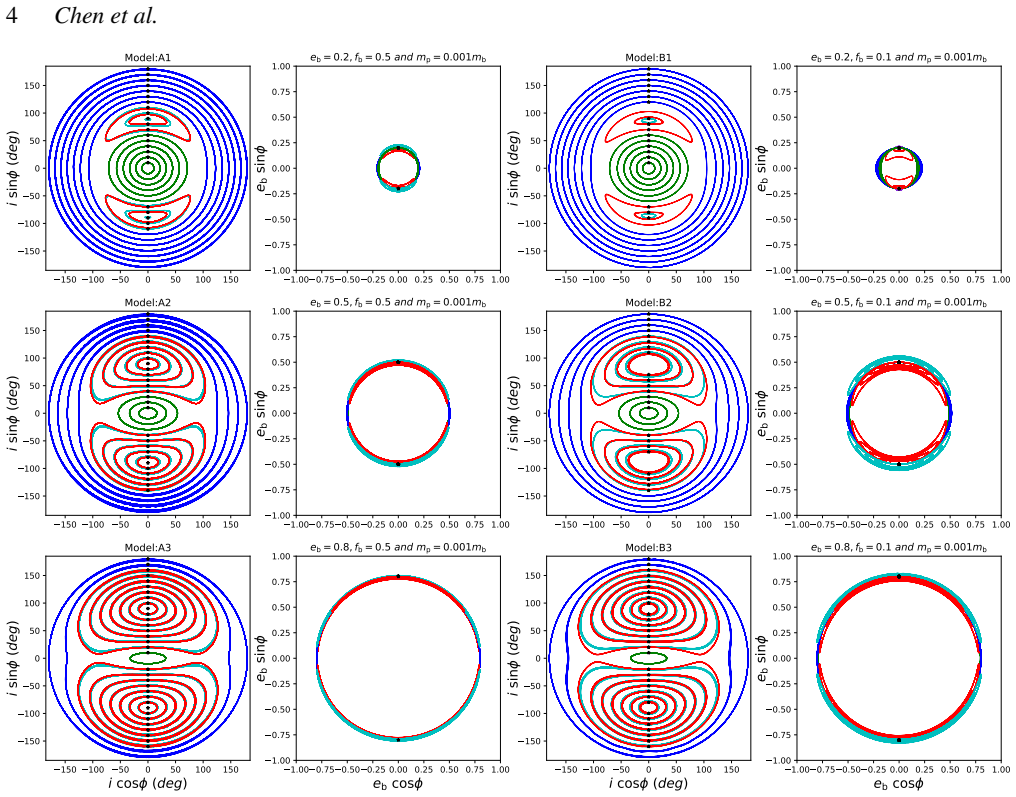
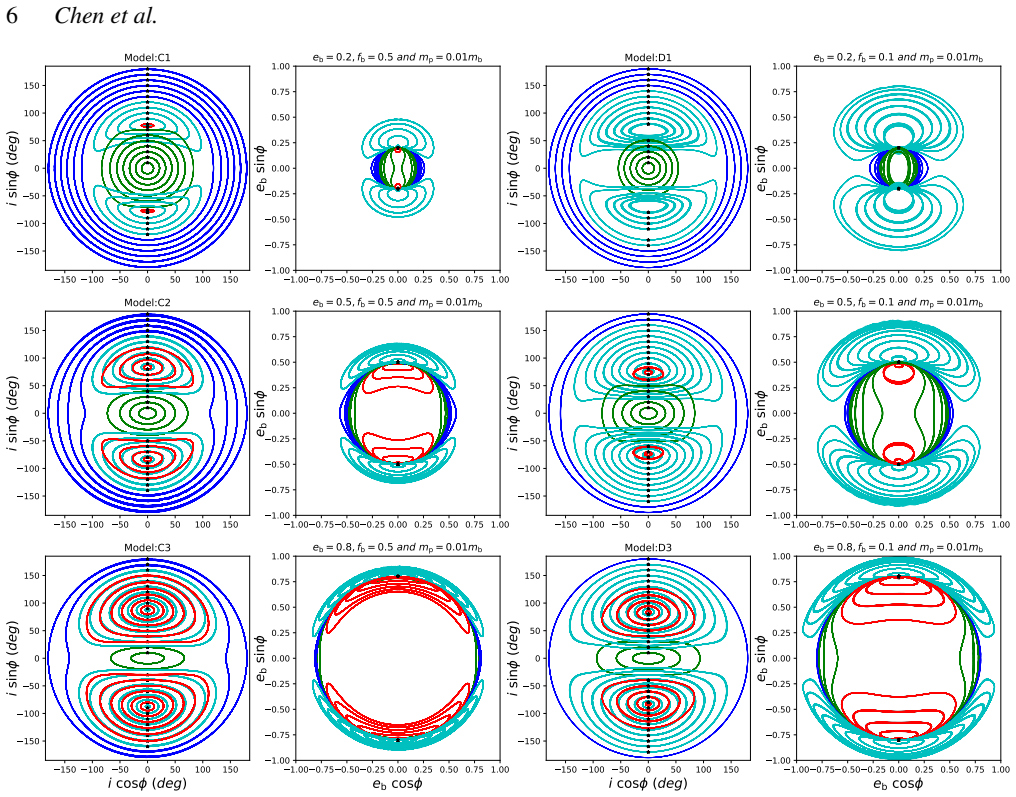
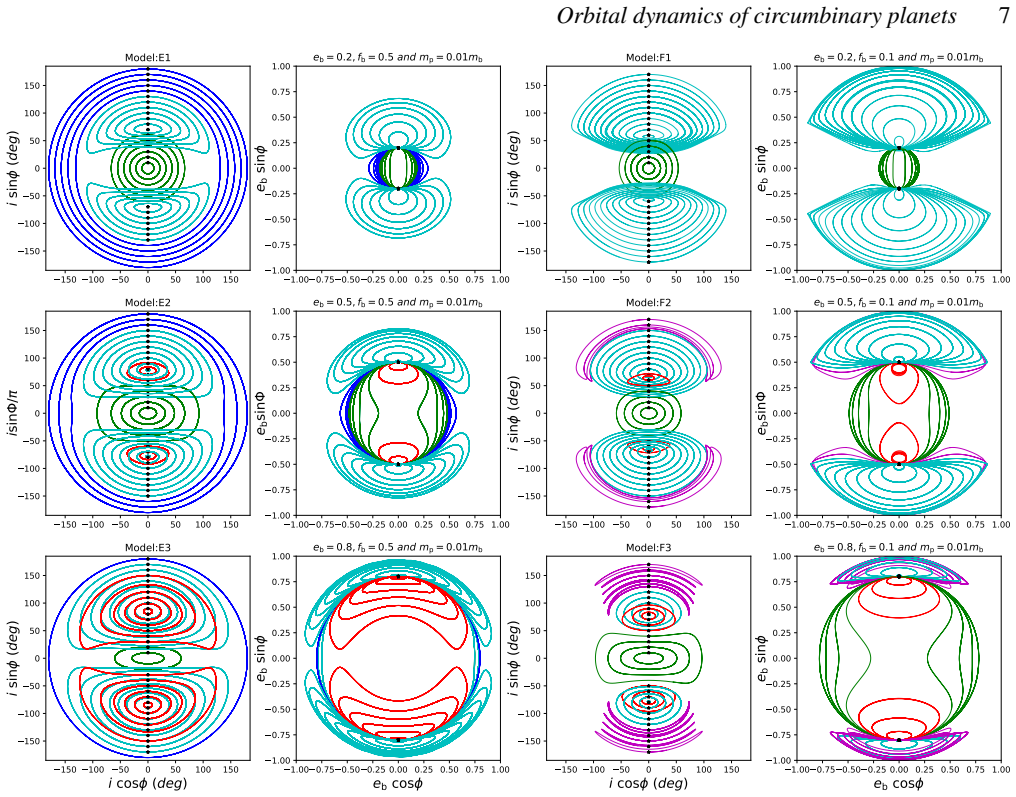
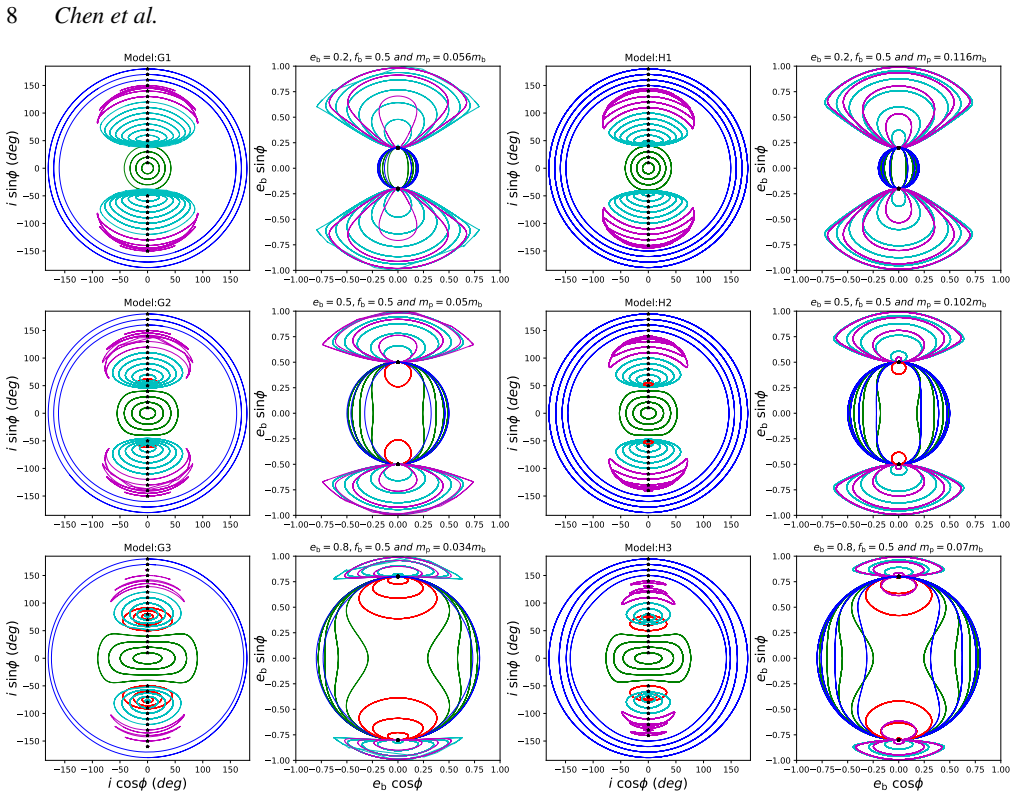
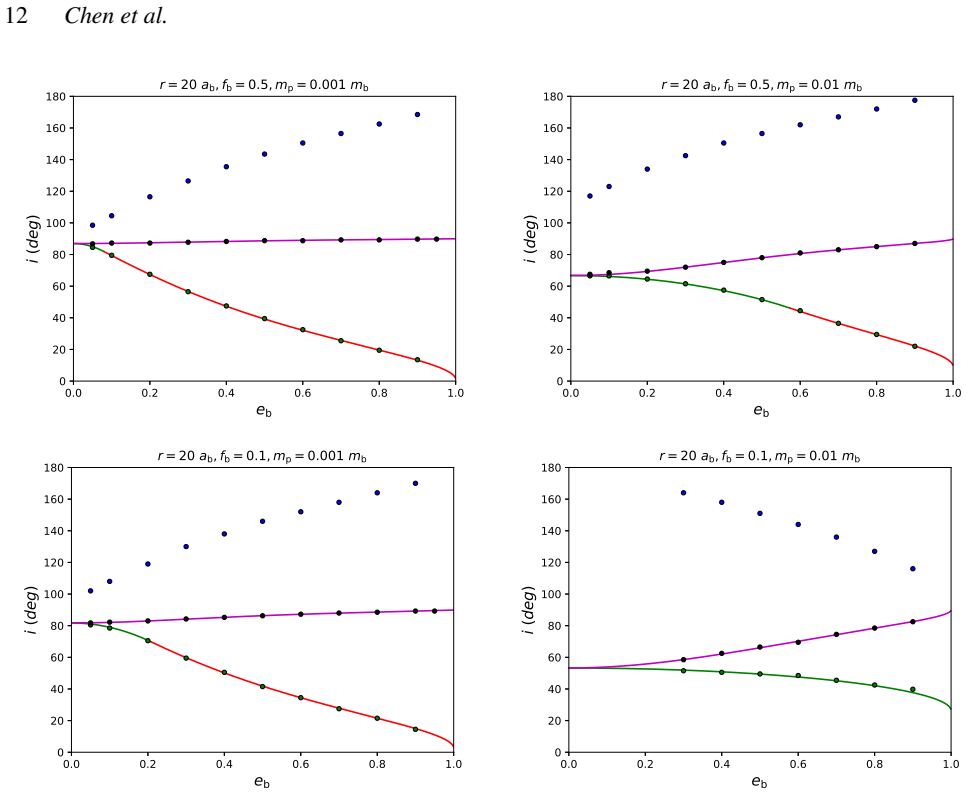
The argument is carried by the secular quadrupole approximation for the binary potential, which reduces the three-body secular problem to equations for the planet's inclination $i$ and nodal phase $\varphi$ relative to the binary's eccentricity and angular-momentum vectors. Within this model, the load-bearing formulas are Eq. (5) for the stationary tilt $\cos i_s$, Eq. (9) defining the branch parameter $\chi$, and Eqs. (10)–(11) for the minimum libration tilt $\cos i_{\rm min}$. The comparison is made by plotting phase-space trajectories in the $i\cos\varphi$–$i\sin\varphi$ plane and reading off the centers and boundaries of libration islands.
What would settle it
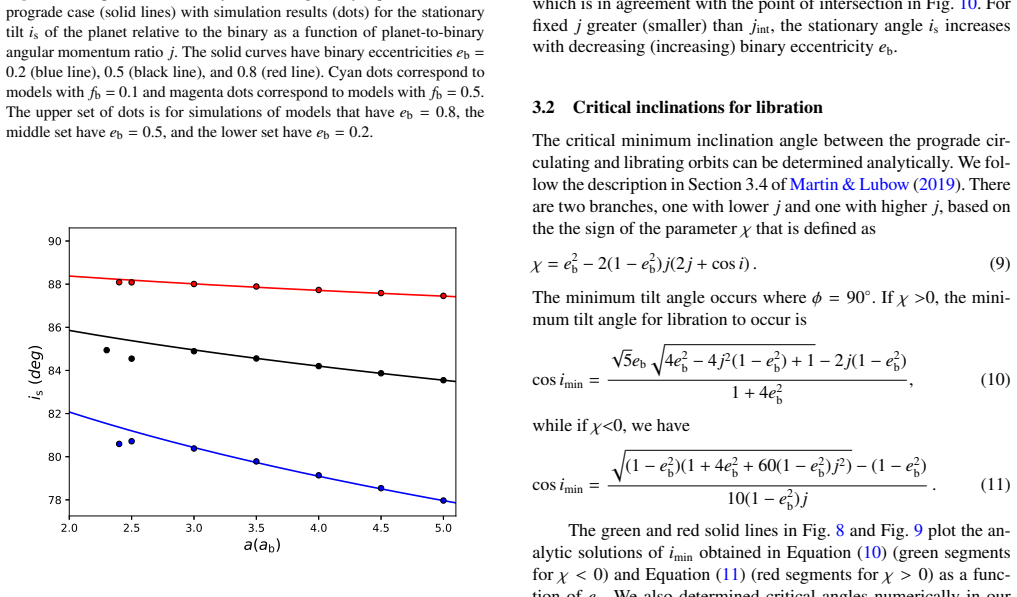
Run direct three-body integrations at a planet separation of $2.0\,a_b$ (inside the unstable boundary but where quadrupole error should be larger) or at angular momentum ratios $j > 2$, measuring $i_s$ and $i_{\rm min}$ and comparing to Eqs. (5), (10), and (11). A systematic offset larger than the scatter in Figs. 6–10, or a measurable dependence of these angles on binary mass fraction at fixed $e_b$ and $j$, would falsify the claim that $e_b$ and $j$ are the only controlling parameters.
Extended reading notes
Core claim
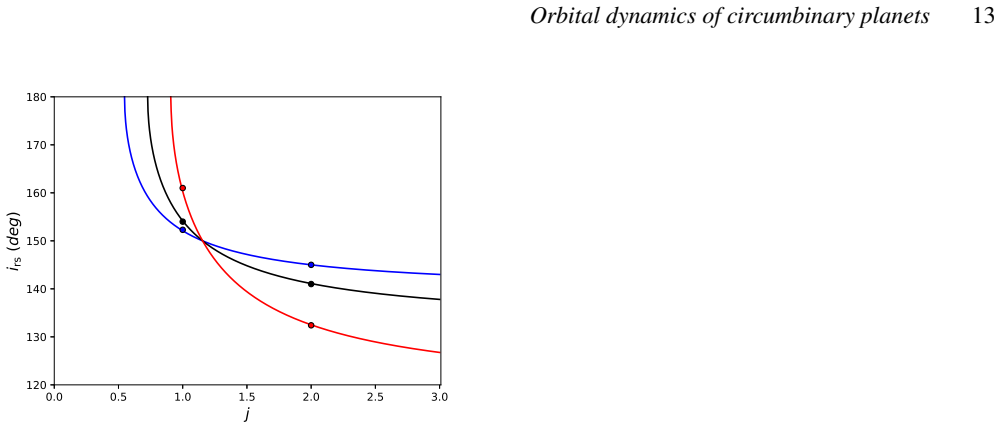
The paper's central claim is that for a nonzero-mass planet on an initially circular circumbinary orbit, the stationary planet-to-binary tilt $i_s$ and the minimum libration tilt $i_{\rm min}$ depend only on the binary eccentricity $e_b$ and the planet-to-binary angular momentum ratio $j = |\mathbf{l}_p|/|\mathbf{l}_b|$; binary mass fraction and planet mass enter only through $j$. Direct N-body integrations spanning $e_b = 0.2, 0.5, 0.8$, binary mass fractions $f_b = 0.1$ and $0.5$, planet masses $m_p = 0.001\,m_b$ to $0.116\,m_b$, and separations $5\,a_b$ to $20\,a_b$ agree quantitatively with Eqs. (5) and (9)–(11). The paper also maps a previously unexplored regime: for $j$ below $j_{\rm cr} = (1+4e_b^2)/(2+3e_b^2)$, no noncoplanar retrograde stationary state exists, and instead retrograde orbits librate in crescent-shaped paths of nonzero phase extent.
Load-bearing premise
The load-bearing premise is that the quadrupole truncation of the binary potential is accurate enough in the tested region that Eqs. (5), (10), and (11) serve as a faithful benchmark; the paper acknowledges the approximation degrades close to the binary, where it already sees deviations.
Editorial extensions
If this is right
- A measured circumbinary planet tilt, combined with known binary eccentricity, fixes the angular momentum ratio $j$ and thereby constrains the planet's mass and semi-major axis.
- The analytic boundary between circulating and librating orbits lets observers predict which systems should show tilted, precessing planets rather than coplanar ones.
- For retrograde planets with $j < j_{\rm cr}$, the absence of a stationary state implies crescent-shaped librations with nonzero phase extent; such orbits may have distinct stability and observational signatures.
- Because the same quadrupole formulas describe massive discs, the verified scalings transfer to circumbinary disc alignment, predicting the final tilt of debris discs and planets formed in them.
Reading between the lines
- If the quadrupole map holds beyond the tested grid, the near-coplanarity of all Kepler-detected circumbinary planets is likely a transit selection effect; wide-orbit binaries should host planets with a continuum of tilts up to and including polar orbits.
- The crescent retrograde orbits found for $j < j_{\rm cr}$ suggest a dynamical boundary that could mark a zone of instability or bifurcation; a dedicated long-time stability map in that region would test this extension.
- The same ratio-symmetric structure might extend to eccentric planet orbits or octupole-order terms, where the stationary tilt would acquire additional dependence on the planet's eccentricity and the binary mass ratio.
Signed reviews
Editorial analysis
A structured set of objections, weighed in public.
Referee Report
Summary. The paper studies the three-body dynamics of a nonzero-mass, initially circular circumbinary planet around an eccentric binary using REBOUND N-body simulations. It maps prograde and retrograde circulating and librating orbits, determines the stationary inclination and the critical minimum (and maximum) libration angles, and compares the results with the analytic secular quadrupole formulas of Martin & Lubow (2019), namely Eq. (5) for the stationary tilt and Eqs. (10) and (11) for the minimum libration tilt. A broad parameter grid is covered, including binary eccentricities eb = 0.2, 0.5, 0.8, mass fractions fb = 0.5, 0.1, planet masses up to ~0.1 mb, and orbital radii 5 ab and 20 ab. The paper reports very good quantitative agreement with the analytic predictions and highlights new crescent-shaped retrograde librating orbits for high-angular-momentum planets. It closes with an application to the HD 106906 system.
Significance. If the claimed agreement holds, the paper provides a valuable numerical validation of the secular quadrupole framework for massive circumbinary planets and shows that the key angles depend only on eb and the angular momentum ratio j, rather than on the binary mass fraction or other parameters. The comparison is a genuine prediction test: the analytic formulas are evaluated without any fitted parameters, and the N-body integrations are independent of the analytic model. The paper also documents a new morphology of retrograde librating orbits and connects the results to circumbinary disc evolution and to a concrete observed system. The strengths are the breadth of the parameter survey, the parameter-free nature of the comparison, and the identification of qualitative features (crescent orbits, the jcr threshold, and the crossing of retrograde stationary curves) that are directly testable.
major comments (2)
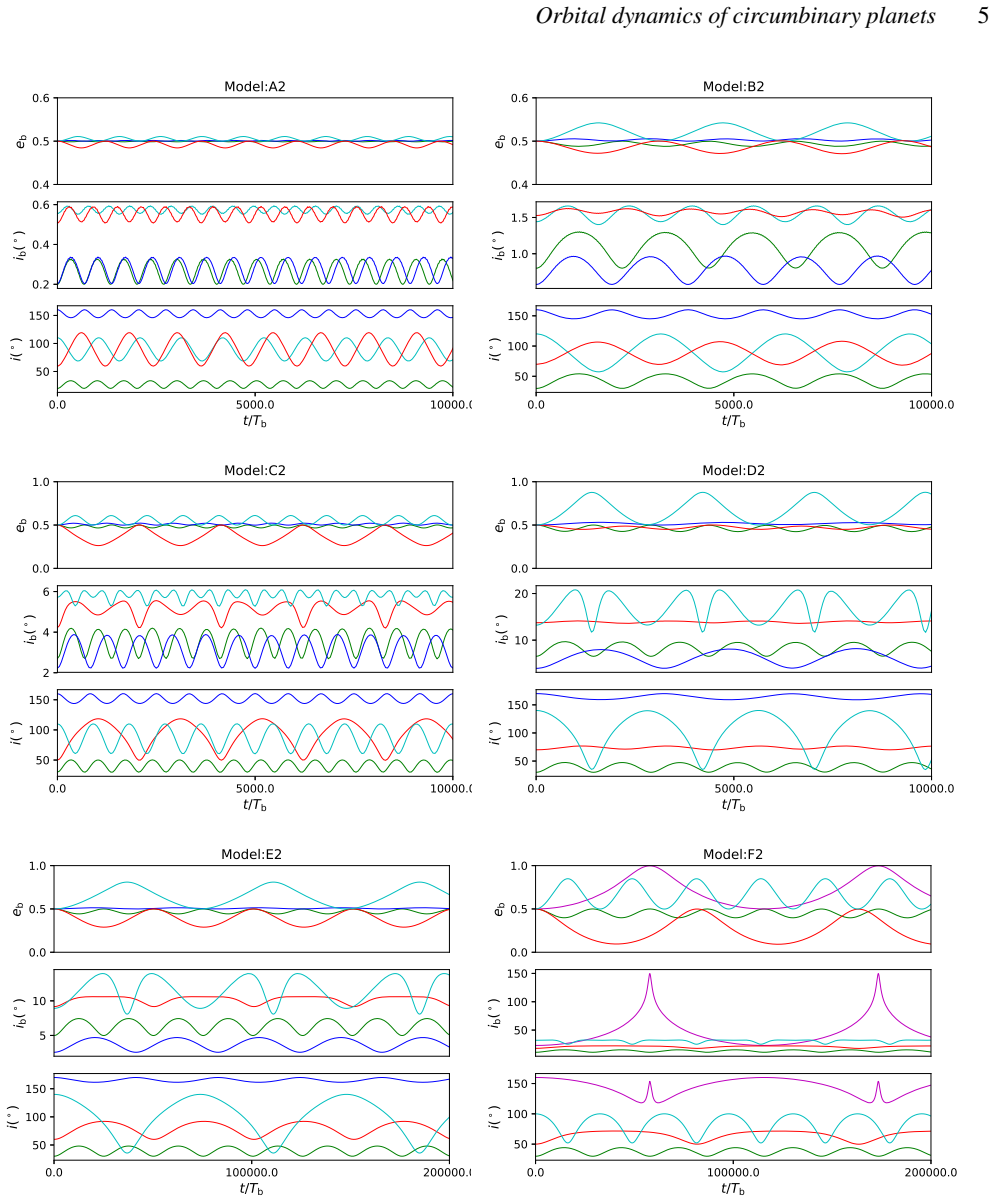
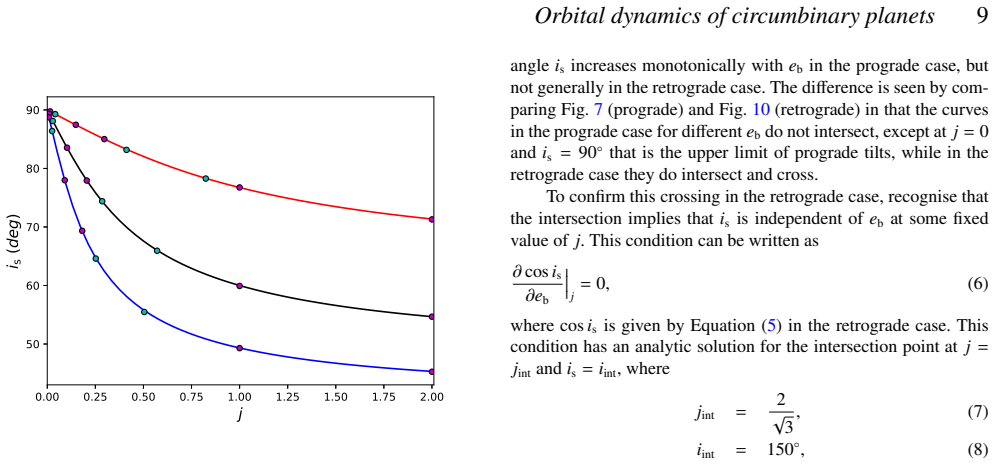
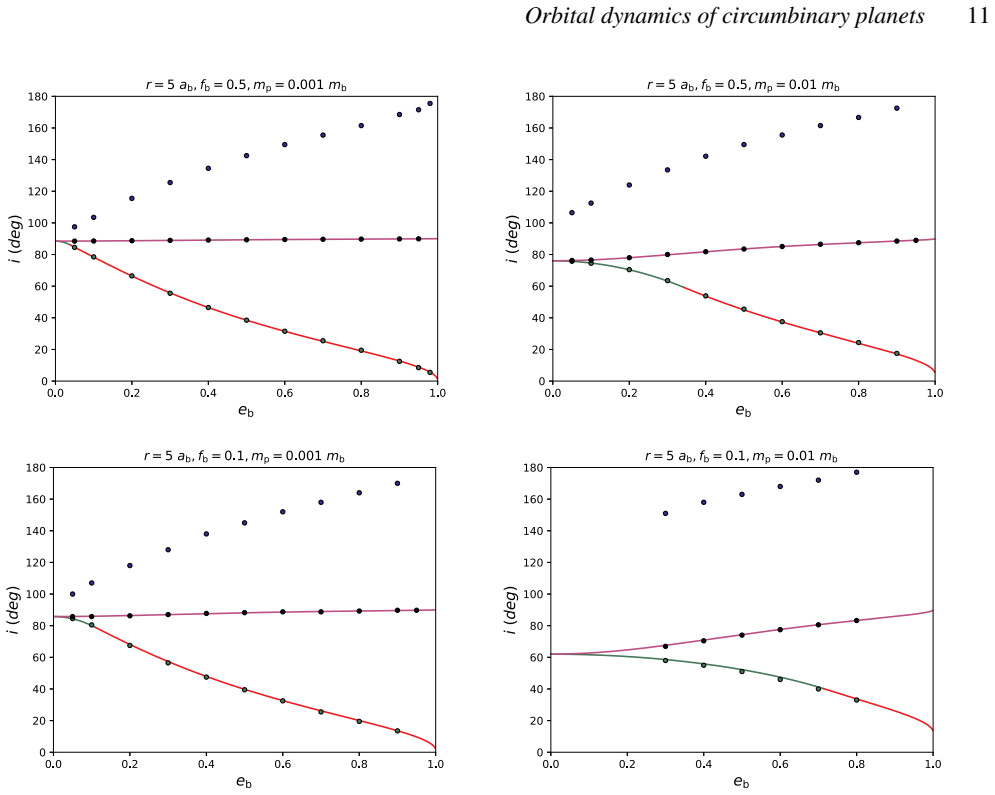
- [§3.1, Fig. 6 and Fig. 2] The analytic formulas (5), (10), and (11) treat eb and j as fixed parameters of a secular Hamiltonian. In the massive-planet simulations used for the comparison, however, eb evolves strongly: Fig. 2 shows eb approaching 1 for Models D2, F2, and related high-j cases, and j = Lp/Lb then changes because Lb is proportional to sqrt(1 - eb^2). The paper does not state whether the dots in Fig. 6 and Fig. 10 were placed using the initial, instantaneous, or cycle-averaged values of eb and j, nor does it justify why the chosen convention is the correct one. Since the central claim of "very good quantitative agreement" is a test of Eqs. (5), (10), and (11), this is load-bearing. Please specify the definition of j used for each dot and either provide a comparison using cycle-averaged values of eb and j or give an explicit argument for why the initial values are the exact parameters of the comparison.
- [§3.1 and §3.2, Figs. 6-10] The numerical extraction of is, imin, and imax is not reproducible from the text. The paper states that these angles were determined from the simulations, but it does not describe the algorithm: how the libration center is identified in the i-phi plane, how the separatrix boundary is interpolated from the finite grid of initial inclinations, or how the green/blue/magenta boundaries are assigned. Without this information, the reader cannot judge whether the quoted agreement is within the numerical uncertainty of the phase-plane classification. Please describe the extraction procedure and provide at least a grid-resolution uncertainty estimate for the plotted numerical points.
minor comments (4)
- [§3.2, text after Eq. (11)] The sentence describing the green and red curves in Figs. 8 and 9 is inconsistent with the definitions of Eqs. (10) and (11): the text labels Eq. (10) as green for chi < 0 and Eq. (11) as red for chi > 0, whereas the preceding paragraph defines Eq. (10) for chi > 0 and Eq. (11) for chi < 0. The figure captions use the correct assignment; please fix the text.
- [§2.1 and §3.1] The ratio j is central to the comparison, but the paper never explicitly defines it in terms of the model parameters. Please give the formula for j, for example j = (mp/mb) sqrt(a/ab) with the appropriate reduced-mass factors, so that the reader can reproduce the values used in Figs. 6 and 10.
- [§2.1, initial conditions] All simulations start with the same initial phase angle phi = 90 deg. Because the libration/circulation separatrix is classified along this single line in phase space, a short convergence test with a different initial phase angle would help confirm that the reported critical angles are independent of the initial phase, especially for the non-nested crescent orbits.
- [Figs. 6, 7, and 10] The simulation-derived points are shown without error bars or point-size information. Given the finite inclination grid used to classify orbits, an uncertainty estimate on each numerical angle would make the claimed "very good quantitative agreement" more quantitative.
Circularity Check
No circularity: analytic formulas are self-cited but independently tested with N-body simulations; no fitted parameter is renamed as a prediction.
full rationale
The paper's central claim is that its three-body simulations agree with the analytic stationary and critical tilt formulas, Eqs. (5), (10), and (11), taken from Martin & Lubow (2019). That is a genuine prediction test: the analytic formulas are derived from the secular quadrupole Hamiltonian (rooted in Farago & Laskar 2010) with no free parameters fitted to the N-body results, and the simulations are independent integrations using REBOUND. The self-citation is disclosed and appropriate: the current paper does not re-derive the formulas, but the formulas do not encode the simulation output. The j and eb entering the comparison are set by the initial conditions, not by the measured stationary/critical angles; the paper reports agreement across a grid of eb, fb, mp, and a, including regions where it explicitly documents quadrupole breakdown at small a (Fig. 7). The only caveats are methodological rather than circular: the extraction of numerical stationary/critical angles from phase-plane plots is not fully specified, and the formulas are evaluated at initial eb and j while those quantities evolve in the massive-planet runs. These concerns bear on reproducibility and on whether initial or cycle-averaged parameters should be used, but they do not make the prediction equivalent to the input by construction. No step in the derivation chain reduces Eq. (5) or Eqs. (10)-(11) to the simulation data, and no fitted parameter is renamed as a prediction.
Assumptions & free parameters
assumptions (3)
- domain assumption The secular quadrupole approximation for the binary potential is sufficiently accurate for the parameter range considered.
- domain assumption The WHfast symplectic integrator in REBOUND accurately solves the three-body equations over the integration timescales (up to 10^5 binary periods).
- domain assumption The initial condition with longitude of ascending node phi = 90 degrees and true anomaly nu = 0 is sufficient to map the orbit families for each parameter set.
Cite this review
Pith. "Pith review of Orbital dynamics of circumbinary planets." pith.science (2026). https://pith.science/paper/L4X7DONH
@misc{pith2026190806331,
  author       = {Pith},
  title        = {Pith review of: Orbital dynamics of circumbinary planets},
  year         = {2026},
  howpublished = {\url{https://pith.science/paper/L4X7DONH}},
  note         = {Machine review of arXiv:1908.06331}
}
abstract
We investigate the dynamics of a nonzero mass, circular orbit planet around an eccentric orbit binary for various values of the binary eccentricity, binary mass fraction, planet mass, and planet semi--major axis by means of numerical simulations. Previous studies investigated the secular dynamics mainly by approximate analytic methods. In the stationary inclination state, the planet and binary precess together with no change in relative tilt. For both prograde and retrograde planetary orbits, we explore the conditions for planetary orbital libration versus circulation and the conditions for stationary inclination. As was predicted by analytic models, for sufficiently high initial inclination, a prograde planet's orbit librates about the stationary tilted state. For a fixed binary eccentricity, the stationary angle is a monotonically decreasing function of the ratio of the planet--to--binary angular momentum $j$. The larger $j$, the stronger the evolutionary changes in the binary eccentricity and inclination. We also calculate the critical tilt angle that separates the circulating from the librating orbits for both prograde and retrograde planet orbits. The properties of the librating orbits and stationary angles are quite different for prograde versus retrograde orbits. The results of the numerical simulations are in very good quantitative agreement with the analytic models. Our results have implications for circumbinary planet formation and evolution.
Figures
Figures from the paper (7 more)
Reference graph
Works this paper leans on
-
[1]
write newline
" write newline "" before.all 'output.state := FUNCTION fin.entry write newline FUNCTION new.block output.state before.all = 'skip after.block 'output.state := if FUNCTION new.sentence output.state after.block = 'skip output.state before.all = 'skip after.sentence 'output.state := if if FUNCTION not #0 #1 if FUNCTION and 'skip pop #0 if FUNCTION or pop #1...
-
[2]
Aly H., Dehnen W., Nixon C., King A., 2015, @doi [MNRAS] 10.1093/mnras/stv128 , http://adsabs.harvard.edu/abs/2015MNRAS.449...65A 449, 65
-
[3]
Bailey V., et al., 2014, @doi [ ] 10.1088/2041-8205/780/1/L4 , https://ui.adsabs.harvard.edu/abs/2014ApJ...780L...4B 780, L4
-
[4]
R., 2018, @doi [ ] 10.1093/mnras/sty169 , 475, 5618
Bate M. R., 2018, @doi [ ] 10.1093/mnras/sty169 , 475, 5618
-
[5]
Bate M. R., Bonnell I. A., Bromm V., 2003, @doi [ ] 10.1046/j.1365-8711.2003.06210.x , http://adsabs.harvard.edu/abs/2003MNRAS.339..577B 339, 577
arXiv 2003
-
[6]
Brinch C., J rgensen J. K., Hogerheijde M. R., Nelson R. P., Gressel O., 2016, @doi [ ] 10.3847/2041-8205/830/1/L16 , http://adsabs.harvard.edu/abs/2016ApJ...830L..16B 830, L16
-
[7]
Chiang E. I., Murray-Clay R. A., 2004, @doi [ ] 10.1086/383522 , http://adsabs.harvard.edu/abs/2004ApJ...607..913C 607, 913
doi:10.1086/383522 2004
-
[8]
Planet formation and stability in polar circumbinary discs
Cuello N., Giuppone C. A., 2019, arXiv e-prints, https://ui.adsabs.harvard.edu/abs/2019arXiv190610579C p. arXiv:1906.10579
work page Pith review arXiv 2019
Show all 42 references
-
[9]
M., Jensen E
Czekala I., Chiang E., Andrews S. M., Jensen E. L. N., Torres G., Wilner D. J., Stassun K. G., Macintosh B., 2019, arXiv e-prints, https://ui.adsabs.harvard.edu/abs/2019arXiv190603269C p. arXiv:1906.03269
2019 arXiv
-
[10]
J., Kalas P., 2019, @doi [ ] 10.3847/1538-3881/ab0109 , https://ui.adsabs.harvard.edu/abs/2019AJ....157..125D 157, 125
De Rosa R. J., Kalas P., 2019, @doi [ ] 10.3847/1538-3881/ab0109 , https://ui.adsabs.harvard.edu/abs/2019AJ....157..125D 157, 125
2019 doi
-
[11]
M., 2011, @doi [ ] 10.1111/j.1365-2966.2011.19657.x , http://adsabs.harvard.edu/abs/2011MNRAS.418.2656D 418, 2656
Doolin S., Blundell K. M., 2011, @doi [ ] 10.1111/j.1365-2966.2011.19657.x , http://adsabs.harvard.edu/abs/2011MNRAS.418.2656D 418, 2656
2011
-
[13]
G., Lubow S
Franchini A., Martin R. G., Lubow S. H., 2019a, , submitted
-
[14]
H., Martin R
Franchini A., Lubow S. H., Martin R. G., 2019b, @doi [ ] 10.3847/2041-8213/ab2fd8 , https://ui.adsabs.harvard.edu/abs/2019ApJ...880L..18F 880, L18
-
[15]
K., Carter B., King R., O'Toole S., 2017, @doi [ ] 10.1093/mnras/stx604 , https://ui.adsabs.harvard.edu/abs/2017MNRAS.468.2932G 468, 2932
Getley A. K., Carter B., King R., O'Toole S., 2017, @doi [ ] 10.1093/mnras/stx604 , https://ui.adsabs.harvard.edu/abs/2017MNRAS.468.2932G 468, 2932
2017 doi
-
[16]
G., et al., 2015, @doi [ ] 10.1088/0004-637X/814/1/32 , https://ui.adsabs.harvard.edu/abs/2015ApJ...814...32K 814, 32
Kalas P. G., et al., 2015, @doi [ ] 10.1088/0004-637X/814/1/32 , https://ui.adsabs.harvard.edu/abs/2015ApJ...814...32K 814, 32
2015 doi
-
[17]
M., et al., 2012, @doi [ ] 10.1111/j.1365-2966.2012.20448.x , http://adsabs.harvard.edu/abs/2012MNRAS.421.2264K 421, 2264
Kennedy G. M., et al., 2012, @doi [ ] 10.1111/j.1365-2966.2012.20448.x , http://adsabs.harvard.edu/abs/2012MNRAS.421.2264K 421, 2264
2012
-
[18]
M., et al., 2019, @doi [Nature Astronomy] 10.1038/s41550-019-0715-1 , https://ui.adsabs.harvard.edu/abs/2019NatAs...3..278K 3, 278
Kennedy G. M., et al., 2019, @doi [Nature Astronomy] 10.1038/s41550-019-0715-1 , https://ui.adsabs.harvard.edu/abs/2019NatAs...3..278K 3, 278
2019 doi
-
[19]
Kley W., Haghighipour N., 2015, @doi [ ] 10.1051/0004-6361/201526648 , http://adsabs.harvard.edu/abs/2015A
2015 doi
-
[20]
Kozai Y., 1962, @doi [ ] 10.1086/108790 , http://adsabs.harvard.edu/abs/1962AJ.....67..591K 67, 591
1962 doi
-
[21]
Lagrange A.-M., et al., 2010, @doi [Science] 10.1126/science.1187187 , 329, 57
2010 doi
-
[22]
D., Nelson R
Larwood J. D., Nelson R. P., Papaloizou J. C. B., Terquem C., 1996, , http://adsabs.harvard.edu/abs/1996MNRAS.282..597L 282, 597
1996
-
[23]
L., 1962, @doi [ ] 10.1016/0032-0633(62)90129-0 , http://adsabs.harvard.edu/abs/1962P
Lidov M. L., 1962, @doi [ ] 10.1016/0032-0633(62)90129-0 , http://adsabs.harvard.edu/abs/1962P
1962 doi
-
[24]
H., Martin R
Lubow S. H., Martin R. G., 2016, @doi [ ] 10.3847/0004-637X/817/1/30 , https://ui.adsabs.harvard.edu/abs/2016ApJ...817...30L 817, 30
2016 doi
-
[25]
H., Martin R
Lubow S. H., Martin R. G., 2018, @doi [ ] 10.1093/mnras/stx2643 , http://adsabs.harvard.edu/abs/2018MNRAS.473.3733L 473, 3733
2018 doi
-
[26]
G., Lubow S
Martin R. G., Lubow S. H., 2017, @doi [ApJ] 10.3847/2041-8213/835/2/l28 , 835, L28
2017 doi
- [27]
-
[28]
G., Lubow S
Martin R. G., Lubow S. H., 2019, arXiv e-prints, https://ui.adsabs.harvard.edu/abs/2019arXiv190411631M p. arXiv:1904.11631
2019 arXiv
-
[29]
G., Lubow S
Martin R. G., Lubow S. H., Nixon C., Armitage P. J., 2016, @doi [ ] 10.1093/mnras/stw605 , http://adsabs.harvard.edu/abs/2016MNRAS.458.4345M 458, 4345
2016 doi
-
[30]
F., Ostriker E
McKee C. F., Ostriker E. C., 2007, @doi [ ] 10.1146/annurev.astro.45.051806.110602 , http://adsabs.harvard.edu/abs/2007ARA
2007 arXiv
-
[31]
Naoz S., 2016, @doi [ ] 10.1146/annurev-astro-081915-023315 , https://ui.adsabs.harvard.edu/abs/2016ARA&A..54..441N 54, 441
2016 doi
-
[32]
C., Di Sisto R
Naoz S., Li G., Zanardi M., de El \' a G. C., Di Sisto R. P., 2017, @doi [ ] 10.3847/1538-3881/aa6fb0 , https://ui.adsabs.harvard.edu/abs/2017AJ....154...18N 154, 18
2017 doi
-
[33]
Picogna G., Marzari F., 2015, @doi [ ] 10.1051/0004-6361/201526162 , http://adsabs.harvard.edu/abs/2015A
2015 doi
-
[34]
P., 2018, @doi [ ] 10.1093/mnras/sty780 , https://ui.adsabs.harvard.edu/abs/2018MNRAS.477.2547P 477, 2547
Pierens A., Nelson R. P., 2018, @doi [ ] 10.1093/mnras/sty780 , https://ui.adsabs.harvard.edu/abs/2018MNRAS.477.2547P 477, 2547
2018 doi
-
[35]
Rein H., Tamayo D., 2015, @doi [ ] 10.1093/mnras/stv1257 , http://adsabs.harvard.edu/abs/2015MNRAS.452..376R 452, 376
2015 doi
-
[36]
M., Galli P
Rodet L., Beust H., Bonnefoy M., Lagrange A. M., Galli P. A. B., Ducourant C., Teixeira R., 2017, @doi [ ] 10.1051/0004-6361/201630269 , https://ui.adsabs.harvard.edu/abs/2017A&A...602A..12R 602, A12
2017 doi
-
[37]
L., Lubow S
Smallwood J. L., Lubow S. H., Franchini A., Martin R. G., 2019, @doi [ ] 10.1093/mnras/stz994 , https://ui.adsabs.harvard.edu/abs/2019MNRAS.486.2919S 486, 2919
2019 doi
-
[38]
E., Evans N
Verrier P. E., Evans N. W., 2009, @doi [ ] 10.1111/j.1365-2966.2009.14446.x , http://adsabs.harvard.edu/abs/2009MNRAS.394.1721V 394, 1721
2009
-
[39]
F., et al., 2012, @doi [ ] 10.1038/nature10768 , http://adsabs.harvard.edu/abs/2012Natur.481..475W 481, 475
Welsh W. F., et al., 2012, @doi [ ] 10.1038/nature10768 , http://adsabs.harvard.edu/abs/2012Natur.481..475W 481, 475
2012 doi
-
[40]
N., Holman M
Winn J. N., Holman M. J., Johnson J. A., Stanek K. Z., Garnavich P. M., 2004, @doi [ ] 10.1086/383089 , http://adsabs.harvard.edu/abs/2004ApJ...603L..45W 603, L45
2004 doi
-
[41]
J., Lai D., 2018, @doi [ ] 10.1093/mnras/stx2375 , http://adsabs.harvard.edu/abs/2018MNRAS.473..603Z 473, 603
Zanazzi J. J., Lai D., 2018, @doi [ ] 10.1093/mnras/stx2375 , http://adsabs.harvard.edu/abs/2018MNRAS.473..603Z 473, 603
2018 doi
-
[42]
C., 2019, arXiv e-prints, https://ui.adsabs.harvard.edu/abs/2019arXiv190510179Z p
Zhang Z., Fabrycky D. C., 2019, arXiv e-prints, https://ui.adsabs.harvard.edu/abs/2019arXiv190510179Z p. arXiv:1905.10179
2019 arXiv
-
[43]
C., Zanardi M., Dugaro A., Naoz S., 2019, @doi [ ] 10.1051/0004-6361/201935220 , https://ui.adsabs.harvard.edu/abs/2019A&A...627A..17D 627, A17
de El \' a G. C., Zanardi M., Dugaro A., Naoz S., 2019, @doi [ ] 10.1051/0004-6361/201935220 , https://ui.adsabs.harvard.edu/abs/2019A&A...627A..17D 627, A17
2019 doi
Reviewed August 14, 2026 · model on record in the stance chip above.
Discussion (0). Continue with ORCID to comment.