REVIEW 4 major objections 5 minor 72 references
Scaling functions in the soft-wall AdS/QCD models
T0 review · 4 major / 5 minor · reviewed 2026-08-06 · deepseek-v4-flash
Pith's one-line read Soft-wall AdS/QCD models reproduce universal mean-field scaling laws for the chiral condensate, and a modified scalar potential brings pseudo-critical temperature scaling in line with Dyson-Schwinger estimates.
desk verdict A thorough mean-field consistency check for soft-wall AdS/QCD that adds useful new tools; the DSE comparison needs a scaling-window test and error bars before it can be taken at face value. read the letter →
The pith
A machine-rendered reading of the paper's core claim, the machinery that carries it, and where it could break.
The reading
What carries the argument
The central objects are the scaling functions $f_G(z)$ and $f_\chi(z)$ of the chiral order parameter, defined near the two-flavor critical point of a five-dimensional soft-wall action with dilaton profile $\Phi = \mu_g^2 r^2$ and scalar potential $V(\chi)$. The chiral condensate $\sigma$ and quark mass $m_q$ enter through the UV boundary expansion $\chi \sim m_q \zeta r + \sigma/\zeta \, r^3$, and the scaling parameter is $z = t/h^{1/(\beta\delta)}$ with mean-field exponents $\beta = 1/2$, $\delta = 3$, $\Delta = 3/2$. The chiral susceptibility is computed by solving a linearized equation for $\delta\chi$ with the same shooting method, giving the exact link between $f_\chi$ and $f_G$. Three scalar potentials, Models I, II, and III, are used to test model independence, with Model III's softened potential making the crossover broader and the $T_c$ slope steeper.
What would settle it
Recompute $f_G(z)$ and $T_c(m_q)$ including the first subleading, Wegner-type correction: if $f_G$ at $m_q/m_{\mathrm{phy}} \approx 1$ deviates from the mean-field curve by more than the model's numerical precision, or if the fitted $\alpha$ fails to predict the directly computed $T_c$ at the physical point, then the claim that the scaling region extends below the physical quark mass is falsified.
Extended reading notes
Core claim
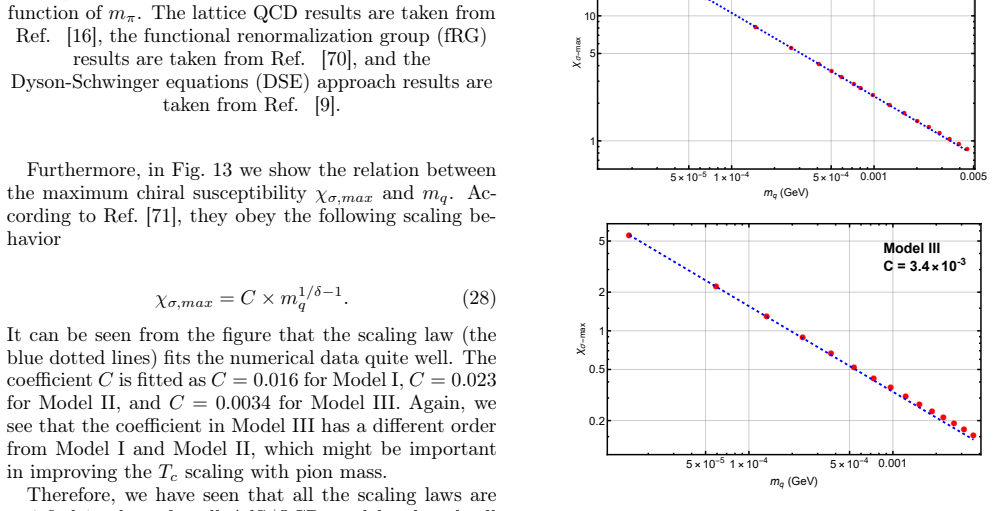
Near the two-flavor chiral critical point, the chiral condensate $\sigma$ in the soft-wall AdS/QCD models obeys $\sigma = A m_q^{1/\delta}$ and $\sigma = B (T_{c0}-T)^{\beta}$ with mean-field exponents $\beta = 1/2$ and $\delta = 3$, and the full scaling function $f_G(z)$ defined by $\sigma = m_q^{1/\delta} f_G(z)$ with $z = t/h^{1/(\beta\delta)}$ matches the four-dimensional mean-field scaling function once $m_q$ is small enough. The paper derives the susceptibility scaling function $f_\chi$ from a perturbed equation of motion and confirms the universal identity $f_\chi(z) = \frac{1}{\delta} f_G(z) - \frac{z}{\beta\delta} f_G'(z)$, with $f_\chi(0)/f_G(0) = 1/3$. It further shows that the pseudo-critical temperature obeys $T_c - T_{c0} = \alpha m_q^{2/3}$, equivalently $T_c - T_{c0} \propto m_\pi^{4/3}$ through the Gell-Mann-Oakes-Renner relation, with $\alpha \approx 4.07$, $3.03$, and $11.7$ for Models I, II, and III. The larger Model III value, produced by a logarithmically softened, $r$-dependent scalar potential, brings the $T_c$ slope into line with Dyson-Schwinger results.
Load-bearing premise
The central assumption is that the leading scaling law $T_c = \alpha m_q^{2/3} + T_{c0}$ holds from the chiral limit all the way to the physical quark mass, so subleading corrections can be ignored across the entire fitted range; the paper does not quantify where the scaling window actually ends, and Model III itself shows a smaller scaling window than the other two models.
Editorial extensions
If this is right
- In the chiral limit, all three soft-wall models give the same mean-field scaling function $f_G(z)$, so universal critical scaling is a property of the holographic construction itself rather than of any particular scalar potential.
- The relation $f_\chi(z) = \frac{1}{\delta} f_G(z) - \frac{z}{\beta\delta} f_G'(z)$ holds in every model, so the soft-wall framework passes a nontrivial self-consistency test for chiral critical dynamics.
- The pseudo-critical temperature rises as $m_q^{2/3}$, equivalently $m_\pi^{4/3}$, above $T_{c0}$; soft-wall models that aim to match QCD should reproduce this slope, not just the exponents.
- Model III's slope $\alpha \approx 11.7$ is comparable with Dyson-Schwinger estimates, suggesting that softening the scalar potential is a viable route toward quantitative $T_c$ scaling in holographic QCD.
- The temperature at which the chiral susceptibility reaches 79% of its maximum approaches $T_{c0}$ much faster than the susceptibility-peak temperature, offering a practical observable for chiral-limit extrapolation.
Reading between the lines
- Because the soft-wall models are locked to mean-field exponents, their $f_\chi$ cannot reproduce $O(4)$ lattice curves; the paper's comparability claim concerns the $T_c$ slope, not the universality class.
- The paper fits the leading scaling law from $m_q = 0$ up to the physical quark mass, while Model III itself shows a smaller scaling window; a testable extension is to include subleading Wegner corrections and locate where the leading-power fit actually breaks.
- The 79% ratio $R = f_\chi(0)/f_{\chi,\max}$ is a concrete mean-field prediction that could be checked against lattice and functional-method data for the susceptibility fraction at the chiral-limit temperature.
- The same scaling-function machinery could be applied to $N_f = 2+1$ soft-wall models and to searches for the critical end point at finite baryon density, where mean-field exponents would again dictate the universality class.
Editorial analysis
A structured set of objections, weighed in public.
Referee Report
Summary. This paper studies the static scaling behavior of the chiral condensate in three soft-wall AdS/QCD models. The authors numerically extract the scaling functions f_G(z) and f_chi(z) from the temperature and quark-mass dependence of the chiral condensate, compare them with mean-field results, derive and verify the relation f_chi = (1/delta) f_G - (z/(beta delta)) f_G', compute the chiral susceptibility through a perturbative equation, and study the scaling of the pseudo-critical temperature Tc = alpha m_q^{1/Delta} + Tc0. A new model ('Model III') is introduced with a softened scalar potential, and its Tc scaling slope is claimed to be comparable to Dyson-Schwinger results.
Significance. The paper provides a detailed internal-consistency check of soft-wall AdS/QCD models: the linear scalings of sigma^2 with T and sigma^3 with m_q (Fig. 2), the collapse of f_G onto the mean-field curve in the chiral limit (Fig. 3), and the verification of Eq. (25) (Fig. 7) are clear numerical tests. The perturbative formalism for the chiral susceptibility (Eqs. 23-24) is a useful technical contribution, and the proposed 'percentage-temperature' observable for extracting Tc0 is interesting. However, the match with the mean-field scaling function is largely built into the quartic Landau-type potential, so the paper mainly demonstrates self-consistency rather than a new universality result. The central quantitative claim about DSE-level Tc scaling rests on a fit of Eq. (27) over a mass range that the paper's own results suggest is too broad, and the reported alpha values are inconsistent. With appropriate revisions to the scaling-window discussion and the quantitative claims, the paper could be a solid benchmark for holographic QCD model building.
major comments (4)
- [Sec. IV B, Eq. (27), Fig. 11] The scaling law Tc = alpha m_q^{1/Delta} + Tc0 is an asymptotic critical scaling relation, but the fits in Fig. 11 are performed over the entire range m_q/m_phy in [0,1], including points far outside the model's scaling window. The paper's own Sec. III B states that 'the scaling window for Model III is smaller' than for Models I and II, and Fig. 3 shows that for Model III the scaling function f_G merges with the mean-field curve only for m_q of order 10^{-2} MeV, orders of magnitude below the physical quark mass. Fitting Eq. (27) up to the physical mass therefore mixes the critical region with the non-scaling crossover region; the extracted alpha is an effective, range-dependent slope rather than the universal coefficient needed for the DSE comparison in Fig. 12. In addition, the text quotes alpha=11.73 for Model III while the Fig. 11 caption gives alpha=12.3, and no goodness-of-fit or error bars are provided. Please restrict the fits to the actual scaling window, quantify the fit range and quality, and reconcile the two values of alpha.
- [Sec. III A-B, Figs. 3-7] The claimed 'precise match' between the holographic f_G(z) and the mean-field scaling function is to a large extent built into the model: the scalar potential (5) is a quartic Landau-type potential, and the mean-field exponents beta=1/2, delta=3 were already established for the same models in the self-cited Ref. [47]. The numerical extraction is therefore a self-consistency check rather than an independent test of universality. The abstract and conclusion should be rephrased to make this distinction explicit, and to state clearly that the scaling functions are a direct consequence of the mean-field nature of the soft-wall model. This does not invalidate the checks, but it changes the significance of the claim.
- [Sec. V, Conclusion] The statement 'the scaling region in these models can extend below the physical quark mass' is not quantified. Given that Fig. 3 shows Model III's f_G deviates from the mean-field curve for m_q above about 0.05 MeV, the conclusion appears to hold only for Models I and II, if at all, and no quantitative criterion is given for any model. Please define the scaling window operationally (e.g., by a tolerance on the deviation of f_G from the mean-field curve or on the residuals of Eq. (27)) and report, for each model, the maximal quark mass inside the window.
- [Sec. IV C, Fig. 14] The claim that the 79% percentage-temperature T_percent converges to Tc0 much faster than Tc is shown for Model III, with the statement 'we have checked that the relation holds in Models I and II as well' but without supporting figures or quantitative data. Since this is proposed as a practical observable for determining Tc0, please show the corresponding results for Models I and II or soften the claim.
minor comments (5)
- [Sec. III A] The constants m_0 and sigma_0 in Eqs. (20a) and (20b) are used before being defined; please define them explicitly.
- [Sec. IV B] The text states 'As proved in [37], the GOR relation ... is satisfied in the soft-wall model,' but Ref. [37] is the original hard-wall model paper; please cite the reference where the GOR relation is proved for the soft-wall model or state explicitly that the proof carries over.
- [Sec. II, Eq. (24b)] The near-horizon expansion of delta chi in Eq. (24b) should be explained; in particular, please justify the coefficient 1/(4 r_h) of (r - r_h) and clarify why the O((r-r_h)^2) term is neglected.
- [Tables II and III] There are typographical and notation issues, including 'Mev' instead of 'MeV' in Table II and inconsistent spacing in quark-mass symbols (m q vs. m_q); please proofread for consistency.
- [Fig. 5] The comparison of Model III's f_G with lattice O(4) results uses different critical exponents in the definition of z, so the comparison is qualitative at best; please describe it as such and avoid implying a quantitative match.
Circularity Check
The f_G(z→−∞) asymptotic in Fig. 4 is fixed by the normalization of m0 and σ0 via Eq. (20), so this confirmation is by construction; the intermediate-z mean-field match and the Tc/DSE comparison retain independent content.
-
self definitional
[Sec. III A, Eqs. (17) and (20); Sec. III B, Fig. 4]
"fG(0) = 1, and fG(z) → z→−∞ (−z)β. ... By substituting the condition from Eq. 17 back into Eq. 20, we can solve for m0 and σ0, and then get the numerical results for fG(z). ... It is shown in Fig. 4 that when z decreases to −8, in the three models, fG(z) can be well described by (−z)^{1/2}."
The constants m0 and σ0 are chosen by enforcing exactly the two conditions of Eq. (17), namely f_G(0)=1 and f_G(z)→(-z)^β as z→−∞. Because f_G=M/h^{1/δ} with h=m_q/m0 and M=σ/σ0, these conditions fix A m0^{1/δ}/σ0=1 and B Tc0^β/σ0=1. The data in Fig. 4 therefore must approach (-z)^{1/2} by definition once the fitted A and B of Table IV are used; it is not an independent confirmation of the asymptotic. The intermediate-z agreement with the mean-field curve is not enforced by this normalization and is a genuine output.
full rationale
The paper's central numerical work is a self-contained solution of the soft-wall EOM (Eq. 12) for σ(m_q,T), followed by extraction of f_G and f_χ. The f_χ-vs-f_G relation (Eq. 25), the susceptibility-peak Tc, Eq. (27) with Δ=3/2, and the 79% rule of Sec. IV C are checked by comparing independently defined quantities, so those parts are not circular. The main circular element is limited to the asymptotic part of f_G: the normalization constants m0 and σ0 are solved from the very conditions f_G(0)=1 and f_G→(-z)^β, so Fig. 4's asymptotic check is imposed rather than predicted. The mean-field character itself is expected because the model uses the quartic Landau-type potential of Eq. (5), with β=1/2, δ=3 imported from the authors' Ref. [47]; however, the paper also re-derives these exponents numerically in Fig. 2, and the shape of f_G in the intermediate z-range is an independent numerical result. The DSE/lattice comparison for Tc is a comparison of fitted scaling slopes; concerns about fitting Eq. (27) up to the physical quark mass despite Model III's smaller stated scaling window are correctness/scaling-window questions, not circularity. Overall partial circularity in one consistency check, with the central claims retaining independent content.
Assumptions & free parameters
free parameters (6)
- Model I potential parameters (m_phy, mu_g, mu_c, lambda) =
3.22 MeV, 0.44 MeV, 1.45 GeV, 80
- Model II potential parameters (m_phy, mu_g, gamma, lambda, kappa) =
3.90 MeV, 0.35 MeV, 6, 25, 0.85
- Model III potential parameters (m_phy, mu_g, mu_c, b, a_0, a_1, a_2) =
3.10 MeV, 0.22 MeV, 1.15 GeV, 50, 20, 5, 0.20
- Critical amplitudes A and B =
A = 0.0367/0.0545/0.00819 GeV^{8/3}; B = 0.0936/0.172/0.0121 GeV^{5/2} (Table IV)
- T_c scaling slope alpha =
4.07 (Model I), 3.03 (Model II), 11.73 (Model III), in MeV with m_q/m_phy dimensionless
- Susceptibility-scaling coefficient C =
0.016 (I), 0.023 (II), 0.0034 (III)
assumptions (7)
- domain assumption AdS/CFT boundary dictionary: chi(r to 0) = m_q r zeta + r^3 sigma/zeta (Eq. 13a) identifies m_q and sigma as quark mass and chiral condensate.
- domain assumption Normalization zeta = sqrt(N_c)/(2 pi) for the scalar operator (from Ref. [61]).
- domain assumption The two-flavor chiral transition in these models is continuous with mean-field exponents beta = 1/2, delta = 3 (proved in Ref. [47]).
- standard math Scaling hypothesis: order parameter M = h^{1/delta} f_G(z) with z = t/h^{1/Delta} (Eq. 15), and a scaling window of finite width exists (Ref. [63]).
- domain assumption GOR relation m_pi^2 f_pi^2 = 2 m_q sigma holds in the soft-wall model (Ref. [37]), so m_pi^2 is proportional to m_q.
- domain assumption The pseudo-critical temperature from the susceptibility peak is the quantity to compare with DSE/FRG/lattice, and N_f=2+1 external data are acceptable benchmarks for an N_f=2 model.
- domain assumption Universality: changing the scalar potential (Model III) preserves the mean-field critical exponents and scaling functions, so only the non-universal slope alpha is modified.
Cite this review
Pith. "Pith review of Scaling functions in the soft-wall AdS/QCD models." pith.science (2026). https://pith.science/paper/L55LERMD
@misc{pith2026250722724,
  author       = {Pith},
  title        = {Pith review of: Scaling functions in the soft-wall AdS/QCD models},
  year         = {2026},
  howpublished = {\url{https://pith.science/paper/L55LERMD}},
  note         = {Machine review of arXiv:2507.22724}
}
read the original abstract
We investigate the static scaling behavior of the chiral condensate near the two-flavor critical point within the framework of the soft-wall AdS/QCD. The scaling functions are extracted from the chiral order parameters and are found to precisely match those obtained through mean-field calculations. Additionally, it is also checked that the scaling functions are independent of the specific construction of the holographic model. Furthermore, we develop the formalism for calculating the chiral susceptibility and demonstrate that the pseudo-critical temperatures obey the scaling law for moderate quark masses. It is shown that the temperature scaling could be comparable with those obtained from Dyson-Schwinger equations and lattice simulations. These findings could help improve the effectiveness of the soft-wall AdS/QCD.
Figures


Figures from the paper (11 more)



Reference graph
Works this paper leans on
-
[47]
H. A. Ahmed, M. Kawaguchi, and M. Huang, Phys. Rev. D110, 046002 (2024), arXiv:2401.04355 [hep-ph]
work page Pith review arXiv 2024
-
[1]
P. Braun-Munzinger, K. Redlich, and J. Stachel, , 491 (2003), arXiv:nucl-th/0304013
arXiv 2003
- [2]
-
[3]
The deviation from this exact value is mainly from the numerical errors, due to the complexity of directly takingm= 0(instead, we take a tiny but finite value). It can also be seen that a peak with its center atz= 1.115, f max χ = 0.406ap- pears in the curve forfχ. The ratiof χ(z= 0)/f χ,max is approximately equal to79%. Later, we will see an inter- estin...
-
[4]
D. H. Rischke, Prog. Part. Nucl. Phys.52, 197 (2004), arXiv:nucl-th/0305030
arXiv 2004
- [5]
-
[6]
R. D. Pisarski and F. Wilczek, Phys. Rev. D29, 338 (1984)
1984
-
[7]
S. Borsanyi, Z. Fodor, C. Hoelbling, S. D. Katz, S. Krieg, C. Ratti, and K. K. Szabo (Wuppertal-Budapest), JHEP 09, 073 (2010), arXiv:1005.3508 [hep-lat]
arXiv 2010
Show all 72 references
- [8]
-
[9]
H.-T. Ding, F. Karsch, and S. Mukherjee, Int. J. Mod. Phys. E24, 1530007 (2015), arXiv:1504.05274 [hep-lat]
2015 arXiv
-
[10]
Z. Bai, L. Chang, J. Chao, F. Gao, and Y.-X. Liu, Phys. Rev. D104, 014005 (2021), arXiv:2007.10176 [hep-ph]
2021 arXiv
-
[11]
J. B. Kogut and D. K. Sinclair, Phys. Rev. D73, 074512 (2006), arXiv:hep-lat/0603021
2006 arXiv
-
[12]
Ejiri, F
S. Ejiri, F. Karsch, E. Laermann, C. Miao, S. Mukherjee, P. Petreczky, C. Schmidt, W. Soeldner, and W. Unger, Phys. Rev. D80, 094505 (2009), arXiv:0909.5122 [hep- lat]
2009 arXiv
-
[13]
Bazavov et al., Phys
A. Bazavov et al., Phys. Rev. D85, 054503 (2012), arXiv:1111.1710 [hep-lat]
2012 arXiv
-
[14]
Burger, E.-M
F. Burger, E.-M. Ilgenfritz, M. Kirchner, M. P. Lom- bardo, M. Müller-Preussker, O. Philipsen, C. Urbach, and L. Zeidlewicz (tmfT), Phys. Rev. D87, 074508 (2013), arXiv:1102.4530 [hep-lat]
2013 arXiv
-
[15]
A. Y. Kotov, M. P. Lombardo, and A. Trunin, Phys. Lett. B823, 136749 (2021), arXiv:2105.09842 [hep-lat]
2021 arXiv
-
[16]
A. Y. Kotov, M. P. Lombardo, and A. Trunin, Symmetry 13, 1833 (2021), arXiv:2111.00569 [hep-lat]
2021 arXiv
-
[17]
H. T. Ding et al. (HotQCD), Phys. Rev. Lett.123, 062002 (2019), arXiv:1903.04801 [hep-lat]
2019 arXiv
-
[18]
Gao and J
F. Gao and J. M. Pawlowski, Phys. Rev. D105, 094020 (2022), arXiv:2112.01395 [hep-ph]
2022 arXiv
-
[19]
J.BernhardtandC.S.Fischer,Phys.Rev.D108,114018 (2023), arXiv:2309.06737 [hep-ph]
2023 arXiv
-
[20]
Braun, B
J. Braun, B. Klein, and P. Piasecki, Eur. Phys. J. C71, 1576 (2011), arXiv:1008.2155 [hep-ph]
2011 arXiv
-
[21]
Braun et al., Phys
J. Braun et al., Phys. Rev. D111, 094010 (2025), arXiv:2310.19853 [hep-ph]
2025 arXiv
- [22]
-
[23]
’t Hooft, Conf
G. ’t Hooft, Conf. Proc. C930308, 284 (1993), arXiv:gr- qc/9310026
1993
-
[24]
Susskind, J
L. Susskind, J. Math. Phys.36, 6377 (1995), arXiv:hep- th/9409089
1995
-
[25]
J. M. Maldacena, AIP Conf. Proc.484, 51 (1999)
1999
-
[26]
Policastro, D
G. Policastro, D. T. Son, and A. O. Starinets, Phys. Rev. Lett.87, 081601 (2001), arXiv:hep-th/0104066
2001 arXiv
-
[27]
Buchel and J
A. Buchel and J. T. Liu, Phys. Rev. Lett.93, 090602 (2004), arXiv:hep-th/0311175
2004 arXiv
-
[28]
Kovtun, D
P. Kovtun, D. T. Son, and A. O. Starinets, Phys. Rev. Lett.94, 111601 (2005), arXiv:hep-th/0405231
2005 arXiv
-
[29]
S. J. Brodsky, G. F. de Téramond, H. G. Dosch, and J. Erlich, Physics Reports584, 1 (2015), light-front holo- graphic QCD and emerging confinement
2015
-
[30]
Gursoy, M
U. Gursoy, M. Jarvinen, and G. Nijs, Phys. Rev. Lett. 120, 242002 (2018), arXiv:1707.00872 [hep-th]
2018 arXiv
-
[31]
S. S. Gubser, A. Nellore, S. S. Pufu, and F. D. Rocha, Phys. Rev. Lett.101, 131601 (2008), arXiv:0804.1950 [hep-th]
2008 arXiv
-
[32]
Gursoy, E
U. Gursoy, E. Kiritsis, L. Mazzanti, and F. Nitti, Phys. Rev. Lett.101, 181601 (2008), arXiv:0804.0899 [hep-th]
2008 arXiv
-
[33]
D. Li, S. He, M. Huang, and Q.-S. Yan, JHEP09, 041 (2011), arXiv:1103.5389 [hep-th]
2011 arXiv
-
[34]
S. I. Finazzo, R. Rougemont, H. Marrochio, and J. Noronha, JHEP02, 051 (2015), arXiv:1412.2968 [hep- ph]
2015 arXiv
-
[35]
Zöllner and B
R. Zöllner and B. Kämpfer, Eur. Phys. J. Plus135, 304 (2020), arXiv:1807.04260 [hep-th]
2020 arXiv
-
[36]
Y.-Q. Zhao, S. He, D. Hou, L. Li, and Z. Li, JHEP04, 115 (2023), arXiv:2212.14662 [hep-ph]
2023 arXiv
-
[37]
Chen and M
X. Chen and M. Huang, Phys. Rev. D109, L051902 (2024), arXiv:2401.06417 [hep-ph]
2024 arXiv
-
[38]
Erlich, E
J. Erlich, E. Katz, D. T. Son, and M. A. Stephanov, Phys. Rev. Lett.95, 261602 (2005), arXiv:hep- ph/0501128
2005
-
[39]
Karch, E
A. Karch, E. Katz, D. T. Son, and M. A. Stephanov, Phys. Rev. D74, 015005 (2006), arXiv:hep-ph/0602229
2006 arXiv
-
[40]
Gherghetta, J
T. Gherghetta, J. I. Kapusta, and T. M. Kelley, Phys. Rev. D79, 076003 (2009), arXiv:0902.1998 [hep-ph]
2009 arXiv
- [41]
-
[42]
Chelabi, Z
K. Chelabi, Z. Fang, M. Huang, D. Li, and Y.-L. Wu, JHEP04, 036 (2016), arXiv:1512.06493 [hep-ph]
2016 arXiv
-
[43]
Chelabi, Z
K. Chelabi, Z. Fang, M. Huang, D. Li, and Y.-L. Wu, Phys. Rev. D93, 101901 (2016), arXiv:1511.02721 [hep- ph]
2016 arXiv
- [44]
-
[45]
S. P. Bartz and T. Jacobson, Phys. Rev. C97, 044908 (2018), arXiv:1801.00358 [hep-ph]
2018 arXiv
-
[46]
Fang, Y.-L
Z. Fang, Y.-L. Wu, and L. Zhang, Phys. Lett. B762, 86 (2016), arXiv:1604.02571 [hep-ph]
2016 arXiv
-
[48]
J. Chen, S. He, M. Huang, and D. Li, JHEP01, 165 (2019), arXiv:1810.07019 [hep-ph]
2019 arXiv
-
[49]
F. R. Brown, F. P. Butler, H. Chen, N. H. Christ, Z.-h. Dong, W. Schaffer, L. I. Unger, and A. Vaccarino, Phys. Rev. Lett.65, 2491 (1990)
1990
-
[50]
Y. Chen, M. Ding, D. Li, K. Bitaghsir Fadafan, and M. Huang, Phys. Rev. D111, 126010 (2025), arXiv:2408.17080 [hep-ph]
2025 arXiv
-
[51]
M. Lv, D. Li, and S. He, JHEP11, 026 (2019), arXiv:1811.03828 [hep-ph]
2019 arXiv
-
[52]
Nishihara and M
H. Nishihara and M. Harada, Phys. Rev. D89, 076001 (2014), arXiv:1401.2928 [hep-ph]
2014 arXiv
-
[53]
X. Chen, D. Li, D. Hou, and M. Huang, JHEP03, 073 (2020), arXiv:1908.02000 [hep-ph]
2020 arXiv
-
[54]
D. Li, M. Huang, Y. Yang, and P.-H. Yuan, JHEP02, 030 (2017), arXiv:1610.04618 [hep-th]
2017 arXiv
-
[55]
D. M. Rodrigues, D. Li, E. Folco Capossoli, and H. Boschi-Filho, Phys. Rev. D98, 106007 (2018), arXiv:1807.11822 [hep-th]
2018 arXiv
-
[56]
Colangelo, J
P. Colangelo, J. J. Sanz-Cillero, and F. Zuo, JHEP11, 012 (2012), arXiv:1207.5744 [hep-ph]
2012 arXiv
-
[57]
X. Cao, H. Liu, and D. Li, Phys. Rev. D102, 126014 14 (2020), arXiv:2009.00289 [hep-ph]
2020 arXiv
-
[58]
X. Cao, S. Qiu, H. Liu, and D. Li, JHEP08, 005 (2021), arXiv:2102.10946 [hep-ph]
2021 arXiv
-
[59]
X. Cao, M. Baggioli, H. Liu, and D. Li, JHEP12, 113 (2022), arXiv:2210.09088 [hep-ph]
2022 arXiv
-
[60]
D. T. Son and M. A. Stephanov, Phys. Rev. Lett.88, 202302 (2002), arXiv:hep-ph/0111100
2002 arXiv
-
[61]
Liang, X
W. Liang, X. Cao, H. Liu, and D. Li, Phys. Rev. D108, 096019 (2023), arXiv:2307.03708 [hep-ph]
2023 arXiv
-
[62]
Cherman, T
A. Cherman, T. D. Cohen, and E. S. Werbos, Phys. Rev. C79, 045203 (2009), arXiv:0804.1096 [hep-ph]
2009 arXiv
-
[63]
J. P. Boyd, Chebyshev and Fourier spectral methods (Courier Corporation, 2001)
2001
-
[64]
L. P. KADANOFF, W. GOTZE, D. HAMBLEN, R. HECHT, E. A. S. LEWIS, V. V. PALCIAUSKAS, M. RAYL, J. SWIFT, D. ASPNES, and J. KANE, Rev. Mod. Phys.39, 395 (1967)
1967
-
[65]
Engels and F
J. Engels and F. Karsch, Physical Review D—Particles, Fields, Gravitation, and Cosmology85, 094506 (2012)
2012
-
[66]
Grossi, A
E. Grossi, A. Soloviev, D. Teaney, and F. Yan, Phys. Rev. D104, 034025 (2021), arXiv:2101.10847 [nucl-th]
2021 arXiv
-
[67]
Engels and F
J. Engels and F. Karsch, Phys. Rev. D85, 094506 (2012), arXiv:1105.0584 [hep-lat]
2012 arXiv
-
[68]
Engels and F
J. Engels and F. Karsch, Phys. Rev. D90, 014501 (2014), arXiv:1402.5302 [hep-lat]
2014 arXiv
-
[69]
Gao and Y.-x
F. Gao and Y.-x. Liu, Phys. Rev. D94, 076009 (2016), arXiv:1607.01675 [hep-ph]
2016 arXiv
-
[70]
Aarts et al., Phys
G. Aarts et al., Phys. Rev. D105, 034504 (2022), arXiv:2007.04188 [hep-lat]
2022 arXiv
-
[71]
Braun, W.-j
J. Braun, W.-j. Fu, J. M. Pawlowski, F. Rennecke, D. Rosenblüh, and S. Yin, Phys. Rev. D102, 056010 (2020), arXiv:2003.13112 [hep-ph]
2020 arXiv
-
[72]
A. Holl, P. Maris, and C. D. Roberts, Phys. Rev. C59, 1751 (1999), arXiv:nucl-th/9808076
1999 arXiv
Reviewed August 6, 2026 · model on record in the stance chip above.
Discussion (0). Sign in to comment.