REVIEW 5 major objections 4 minor 14 references
DeepMath-Creative: A Benchmark for Evaluating Mathematical Creativity of Large Language Models
T0 review · 5 major / 4 minor · reviewed 2026-08-15 · deepseek-v4-flash
Pith's one-line read A new creative-math benchmark tops out at 70 percent for the best AI model, suggesting that LLMs recombine memorized patterns rather than create.
desk verdict The benchmark is a real contribution; the 70% memorization conclusion is not supported by the paper's own data. read the letter →
The pith
A machine-rendered reading of the paper's core claim, the machinery that carries it, and where it could break.
The reading
What carries the argument
The carrier of the argument is the benchmark itself: a unified 'prove it or provide a counterexample' format applied to 179 expert-designed problems, together with a three-level scoring rubric that separates direction accuracy from process accuracy and relies on manual grading by mathematicians. This format operationalizes creativity as constructiveness, which the paper identifies as one of three dimensions of mathematical creativity, alongside inventing new concepts and new methods. The constructed examples are concrete and verifiable, so the benchmark turns the abstract idea of creativity into a measurable score on a defined task.
What would settle it
Run a contamination audit: search the training corpora of the five models for the 179 benchmark problems, their paraphrases, or their solutions, then compare scores on demonstrably novel items with scores on items having near-duplicates in training data. If models score about the same on both groups, the memorization-based explanation loses force; if they score higher on near-duplicates, the paper's conclusion is supported.
Extended reading notes
Core claim
The paper's central empirical claim is that current LLMs show partial constructive proficiency, enough to solve a majority of basic constructive problems, but that this proficiency is brittle and directionally fragile. Each answer is scored 0 for choosing the wrong direction, 0.5 for a reasonable but flawed construction, and 1 for a complete, correct proof or counterexample. Under this lenient rubric, the best model scores about 70 percent, while other tested models score lower, and the dominant failure modes are wrong direction, spurious proofs that reach a correct conclusion through invalid steps, and verbose nonconvergent reasoning. Because the problems were designed to be previously unseen and to require construction rather than recall, the paper attributes the partial success to recombination of memorized patterns rather than to authentic creativity.
Load-bearing premise
The conclusion rests on the benchmark problems being genuinely unseen by the tested models, yet the paper provides no contamination check to rule out that models memorized these problems or near-analogues during pretraining.
Editorial extensions
If this is right
- Mainstream mathematical benchmarks that reward reasoning on known problem types overstate model ability; a creativity-oriented evaluation reveals a lower ceiling on genuine problem-solving.
- At master's-level and open problems, current models do not produce usable research strategies, so they are not yet reliable assistants for frontier mathematical research.
- The sharp drop from undergraduate to harder problems implies that gains from pretraining and reasoning fine-tuning have not generalized to novel constructions.
- The 70 percent figure is an upper bound on constructive ability, since it was awarded under lenient criteria; stricter demands for full rigor would place the best model lower.
Reading between the lines
- If the memorization-recombination reading is right, a contamination audit should find that model accuracy on benchmark items is predictable from textual proximity to training data; scoring near-duplicate and truly novel items separately would test this directly.
- Because the benchmark restricts creativity to construction of examples, it likely under-samples other creative acts named in the paper, such as inventing new concepts or methods; a model could plausibly score low here yet show other forms of generative originality.
- A natural next experiment is to train models on the benchmark and test transfer to a held-out set of newly written constructive problems; flat transfer would support pattern memorization, while positive transfer would suggest the benchmark can drive genuine creative skill.
Signed reviews
Editorial analysis
A structured set of objections, weighed in public.
Referee Report
Summary. The paper introduces DeepMath-Creative, a benchmark of 179 expert-designed constructive mathematics problems in algebra, topology, geometry, and analysis, framed in a bidirectional 'prove or provide a counterexample' format. It proposes a 0/0.5/1 scoring rubric distinguishing direction accuracy from process accuracy, evaluates five LLMs (GPT o3-mini, Claude 3.7 Sonnet, Gemini 2.0 Flash, DeepSeek R1, Qwen QwQ-32B) under manual expert grading, and reports that the best model, O3 Mini, achieves about 70% accuracy, mostly on undergraduate-level items, with sharp declines on harder and open problems. The authors conclude that this performance likely reflects recombination of memorized patterns rather than genuine mathematical creativity.
Significance. If the benchmark is released and the scoring is validated, DeepMath-Creative would fill a genuine gap: existing math benchmarks emphasize multi-step computation and proof, while constructive proof and counterexample generation are underrepresented. The expert curation, the unified problem format, and the qualitative failure analysis are useful contributions. However, the central claims are currently weakened by an internal inconsistency between the reported 70% accuracy and Table 2, by the absence of inter-rater reliability evidence, and by the unsupported causal attribution to memorization rather than creativity. The benchmark has clear potential, but the paper as written does not yet establish the strength of its headline conclusion.
major comments (5)
- [Abstract; Section 4.1.2; Table 2] The abstract and Section 4.1.2 state that O3 Mini achieves 'merely 70% accuracy,' but Table 2 reports 133 one-score responses out of 179, which is 74.3%, and no model row in Table 2 yields 70%. Since this numeric claim directly supports the 'merely' judgment and the interpretation of limited creativity, the inconsistency must be resolved and the reported figure corrected.
- [Section 3.1; Section 3.3; Section 5] The conclusion that performance is 'likely attributable to the recombination of memorized patterns rather than authentic creative insight' (Abstract; Section 4.1.2; Section 5) is not supported by the reported evidence. Section 3.1 asserts that problems are 'previously unseen,' but no contamination check (exact-match or near-duplicate search) is described, and the scoring rubric in Table 1 only evaluates whether the final construction is valid, not whether it is novel or independent of memorized templates. A correct construction assembled from known lemmas and a genuinely novel construction receive the same score. The authors should either reframe this statement as a speculative hypothesis or provide analyses that directly test the memorization explanation.
- [Section 3.3] Manual expert grading is the sole scoring mechanism, but the paper reports no inter-annotator agreement (e.g., Cohen's kappa or percentage agreement), and it is not stated whether each response was independently graded by more than one expert. Given the coarse 0/0.5/1 rubric and the qualitative distinctions required (e.g., between 'significant flaws' and 'minor errors'), the reliability of the headline scores is undemonstrated.
- [Section 3.3; Section 4] The evaluation procedure reports no sampling temperature, no number of independent runs, and no variance measure; the text reads as though each model was queried once per problem. The inter-model differences in Table 2 (e.g., GPT at 74.3% versus DeepSeek at 71.5%) are small relative to the sampling noise expected from single stochastic generations. Please report decoding settings and repeat the evaluation multiple times, or at least provide confidence intervals.
- [Section 3.2; Section 4.1.2] The paper states that roughly 60% of the problems are undergraduate-level and 40% are master's-level, and it claims that O3 Mini's performance was 'primarily attained on undergraduate-level problems,' but no difficulty-stratified results are presented. Table 2 only gives aggregate counts. Without a breakdown by difficulty and domain, the claim that the models succeed mainly on basic undergraduate tasks is not verifiable from the reported data.
minor comments (4)
- [Section 3.2] The dataset composition is given only as approximate percentages ('approximately 50% in algebra, 15% in topology, and 35% in analysis'; 'around 60%' undergraduate and 'approximately 40%' master's). Please provide exact counts and make the full distribution available in the repository.
- [Abstract; Section 4.1.1] Model names are used inconsistently: 'O3 Mini' versus 'GPT o3-mini.' Please standardize the naming throughout, including version identifiers.
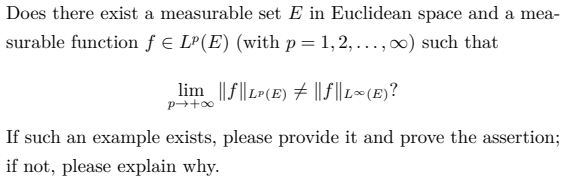
- [Figure 4] The quoted Qwen response contains apparent OCR artifacts such as 'aolocalpproperty' and 'ospreadparound.' If these are verbatim model outputs, state that; if they are transcription errors, correct them.
- [Section 5; Data Release] The paper states that all benchmark problems have standard answers but does not provide an answer key or solution file. To make the benchmark reproducible, please release the full dataset, scoring rubrics, and example solutions at the cited GitHub repository.
Circularity Check
No significant circularity: the benchmark scores are self-contained expert-graded measurements; the 'memorization not creativity' conclusion is an interpretive overreach, not a derivation from the rubric by construction.
full rationale
The paper's central derivation chain is: construct a benchmark of constructive proof/counterexample problems, grade model outputs with an explicit rubric (Table 1), and report resulting score counts. No parameter is fitted to a subset of the data and then renamed as a prediction, no uniqueness theorem from the authors' prior work is invoked to force a choice, and no cited result by the same authors carries the argument. The nearest candidate for circularity is the statement that 'creativity frequently manifests as constructiveness' (Section 3.1) followed by the conclusion that low constructive accuracy indicates 'recombination of memorized patterns rather than authentic creative insight or novel synthesis' (Abstract). But the paper explicitly treats constructiveness as one manifestation of one of three dimensions of creativity, not as a definition of creativity itself, and the scoring rubric evaluates only the validity of the proof/counterexample, not the mechanism by which it was produced. Therefore the low scores do not by construction entail the memorization-versus-creativity attribution; that attribution is an unsupported interpretive claim, which is a validity concern rather than a circular reduction. The 70% figure also does not match Table 2 (133/179 = 74.3% for GPT), and the 'previously unseen' claim lacks a contamination check, but both are reporting and evidential weaknesses, not instances of circular reasoning. Because the measured benchmark results are self-contained and no load-bearing step reduces to its own input, the paper receives a circularity score of 0.
Assumptions & free parameters
assumptions (4)
- domain assumption Mathematical creativity can be operationally measured by success in constructing proofs or counterexamples on this benchmark.
- domain assumption All 179 problems are mathematically correct, unambiguous, and have standard answers.
- domain assumption Manual grading by the author team is consistent and unbiased.
- domain assumption Single API calls per model per problem are representative of model capability.
Cite this review
Pith. "Pith review of DeepMath-Creative: A Benchmark for Evaluating Mathematical Creativity of Large Language Models." pith.science (2026). https://pith.science/paper/L57BWD2X
@misc{pith2026250508744,
  author       = {Pith},
  title        = {Pith review of: DeepMath-Creative: A Benchmark for Evaluating Mathematical Creativity of Large Language Models},
  year         = {2026},
  howpublished = {\url{https://pith.science/paper/L57BWD2X}},
  note         = {Machine review of arXiv:2505.08744}
}
read the original abstract
To advance the mathematical proficiency of large language models (LLMs), the DeepMath team has launched an open-source initiative aimed at developing an open mathematical LLM and systematically evaluating its mathematical creativity. This paper represents the initial contribution of this initiative. While recent developments in mathematical LLMs have predominantly emphasized reasoning skills, as evidenced by benchmarks on elementary to undergraduate-level mathematical tasks, the creative capabilities of these models have received comparatively little attention, and evaluation datasets remain scarce. To address this gap, we propose an evaluation criteria for mathematical creativity and introduce DeepMath-Creative, a novel, high-quality benchmark comprising constructive problems across algebra, geometry, analysis, and other domains. We conduct a systematic evaluation of mainstream LLMs' creative problem-solving abilities using this dataset. Experimental results show that even under lenient scoring criteria -- emphasizing core solution components and disregarding minor inaccuracies, such as small logical gaps, incomplete justifications, or redundant explanations -- the best-performing model, O3 Mini, achieves merely 70% accuracy, primarily on basic undergraduate-level constructive tasks. Performance declines sharply on more complex problems, with models failing to provide substantive strategies for open problems. These findings suggest that, although current LLMs display a degree of constructive proficiency on familiar and lower-difficulty problems, such performance is likely attributable to the recombination of memorized patterns rather than authentic creative insight or novel synthesis.
Figures


Figures from the paper (1 more)

Reference graph
Works this paper leans on
-
[1]
Counterexamples in Real Analysis
Qing Cheng and Yuan Wang. Counterexamples in Real Analysis . Higher Education Press, Beijing, 2004
work page 2004
-
[2]
Training verifiers to solve math word problems
Karl Cobbe, Vineet Kosaraju, Mohammad Bavarian, Mark Chen, Heewoo Jun, Lukasz Kaiser, Matthias Plappert, Jerry Tworek, Jacob Hilton, Reiichiro Nakano, Christopher Hesse, and John Schulman. Training verifiers to solve math word problems. arXiv preprint arXiv:2110.14168, 2021
-
[3]
A benchmark for evaluating advanced mathematical reasoning in ai
Elliot Glazer, Ege Erdil, Tamay Besiroglu, Diego Chicharro, and Evan Chen. A benchmark for evaluating advanced mathematical reasoning in ai. arXiv preprint arXiv:2411.04872, 2024
arXiv 2024
-
[4]
Deepseek-r1: Incentivizing reasoning capability in llms via reinforcement learning
Daya Guo, Dejian Yang, Haowei Zhang, Junxiao Song, Ruoyu Zhang, Runxin Xu, Qihao Zhu, Shirong Ma, Peiyi Wang, Xiao Bi, et al. Deepseek-r1: Incentivizing reasoning capability in llms via reinforcement learning. arXiv preprint arXiv:2501.12948, 2025
arXiv 2025
-
[5]
Measuring massive multitask language understanding
Dan Hendrycks, Collin Burns, Steven Basart, Andy Zou, Mantas Mazeika, Dawn Song, and Jacob Steinhardt. Measuring massive multitask language understanding. arXiv preprint arXiv:2009.03300, 2020
arXiv 2009
-
[6]
Measuring mathematical problem solving with the math dataset
Dan Hendrycks, Collin Burns, Saurav Kadavath, Akul Arora, Steven Basart, Eric Tang, Dawn Song, and Jacob Steinhardt. Measuring mathematical problem solving with the math dataset. arXiv preprint arXiv:2103.03874, 2021
arXiv 2021
-
[7]
Aime 2024 dataset
Maxwell-Jia. Aime 2024 dataset. https://huggingface.co/datasets/Maxwell-Jia/ AIME_2024, 2024
2024
-
[8]
On manifolds homeomorphic to the 7-sphere
John Milnor. On manifolds homeomorphic to the 7-sphere. Annals of Mathematics , 64(2): 399–405, 1956
work page 1956
Show all 14 references
-
[9]
O3 and o4-mini system card, 2025
OpenAI. O3 and o4-mini system card, 2025. URL https://openai.com/index/ o3-o4-mini-system-card/ . Accessed: April 29, 2025
2025
-
[10]
Multi-logieval: Towards evaluating multi-step logical reasoning ability of large language models
Nisarg Patel, Mohith Kulkarni, Mihir Parmar, Aashna Budhiraja, Mutsumi Nakamura, Neeraj Varshney, and Chitta Baral. Multi-logieval: Towards evaluating multi-step logical reasoning ability of large language models. arXiv preprint arXiv:2406.17169, 2024
2024 arXiv
-
[11]
The V alue of Science
Henri Poincaré. The V alue of Science. The Science Press, New York, 1905
1905
-
[12]
Comparison of three large language models as middle school math tutoring assistants
Hamsini Ramanathan and Ramanathan Palaniappan. Comparison of three large language models as middle school math tutoring assistants. Journal of Emerging Investigators, 2024
2024
-
[13]
Trinh, Yuhuai Wu, Quoc V
Trieu H. Trinh, Yuhuai Wu, Quoc V . Le, He He, and Thang Luong. Solving olympiad ge- ometry without human demonstrations. Nature, 625(7995):476–482, 2024. doi: 10.1038/ s41586-023-06747-5
2024
-
[14]
Über continuirliche funktionen eines reellen arguments, die für keinen werth des letzteren einen bestimmten differentialquotienten besitzen
Karl Weierstrass. Über continuirliche funktionen eines reellen arguments, die für keinen werth des letzteren einen bestimmten differentialquotienten besitzen. Königlich Preußische Akademie der Wissenschaften zu Berlin , pages 1–6, 1872. Reprinted in Mathematische Werke, V ol. ...
Reviewed August 15, 2026 · model on record in the stance chip above.
Discussion (0). Continue with ORCID to comment.