REVIEW 3 major objections 5 minor 1 cited by
Conformalized-KANs: Uncertainty Quantification with Coverage Guarantees for Kolmogorov-Arnold Networks (KANs) in Scientific Machine Learning
T0 review · 3 major / 5 minor · reviewed 2026-08-16 · deepseek-v4-flash
Pith's one-line read Conformal prediction gives Kolmogorov-Arnold network ensembles prediction intervals with a distribution-free coverage guarantee.
desk verdict Competent application of split conformal prediction to KAN ensembles; theory is sound, but the empirical claims need repeated-seed statistics to support them. read the letter →
The pith
A machine-rendered reading of the paper's core claim, the machinery that carries it, and where it could break.
The reading
What carries the argument
The load-bearing object is split conformal prediction applied to a KAN ensemble. Conformal prediction is a distribution-free wrapper: it uses a held-out calibration set to estimate how badly the model's own uncertainty measure misses, then widens the ensemble interval by the calibration quantile. The ensemble standard deviation serves as the denominator of the nonconformity score, so the final interval has the shape $\mu_M \pm \hat{q}_\alpha \sigma_M$, and the conformal theorem converts the empirical quantile into the coverage guarantee. For FBKANs the ensemble is built from domain-decomposed sub-KANs stitched by a partition of unity; for MFKANs a frozen low-fidelity KAN feeds an ensemble of linear and nonlinear high-fidelity KANs.
What would settle it
Rerun the conformalized ensemble on exchangeable calibration and test data with a different seed or base model and check whether the empirical coverage on a large test set stays between $1-\alpha$ and $1-\alpha+1/(n+1)$. The claim would be falsified if coverage fell systematically below $1-\alpha$; the paper's own experiments are this check for its four test problems.
Extended reading notes
Core claim
The central claim is that ensembles of KAN-based models, including FBKANs and MFKANs, can be conformalized to yield calibrated prediction intervals with guaranteed coverage without assuming a particular error distribution. Concretely, after training $M$ models from different random initializations, the ensemble mean $\mu_M(x)$ and standard deviation $\sigma_M(x)$ define a heuristic uncertainty. The paper's procedure computes nonconformity scores $s_j = |f(x_j)-\mu_M(x_j)|/\sigma(x_j)$ on held-out calibration data and rescales the ensemble spread by the empirical quantile $\hat{q}_\alpha = \lceil(n+1)(1-\alpha)\rceil/n$ of these scores, producing $C_\alpha(x) = [\mu_M(x)-\hat{q}_\alpha\sigma_M(x),\ \mu_M(x)+\hat{q}_\alpha\sigma_M(x)]$. The paper states that exchangeability of calibration and test data gives $P(f(x_{\mathrm{test}}) \in C_\alpha(x_{\mathrm{test}})) \ge 1-\alpha$, and its four experiments report empirical coverage near the target 95%.
Load-bearing premise
The coverage guarantee rests entirely on the calibration data being exchangeable with the test data; the paper assumes i.i.d. draws, so if the test inputs come from a different distribution, are correlated with the calibration set, or arrive in a non-exchangeable order, the stated coverage can fail.
Editorial extensions
If this is right
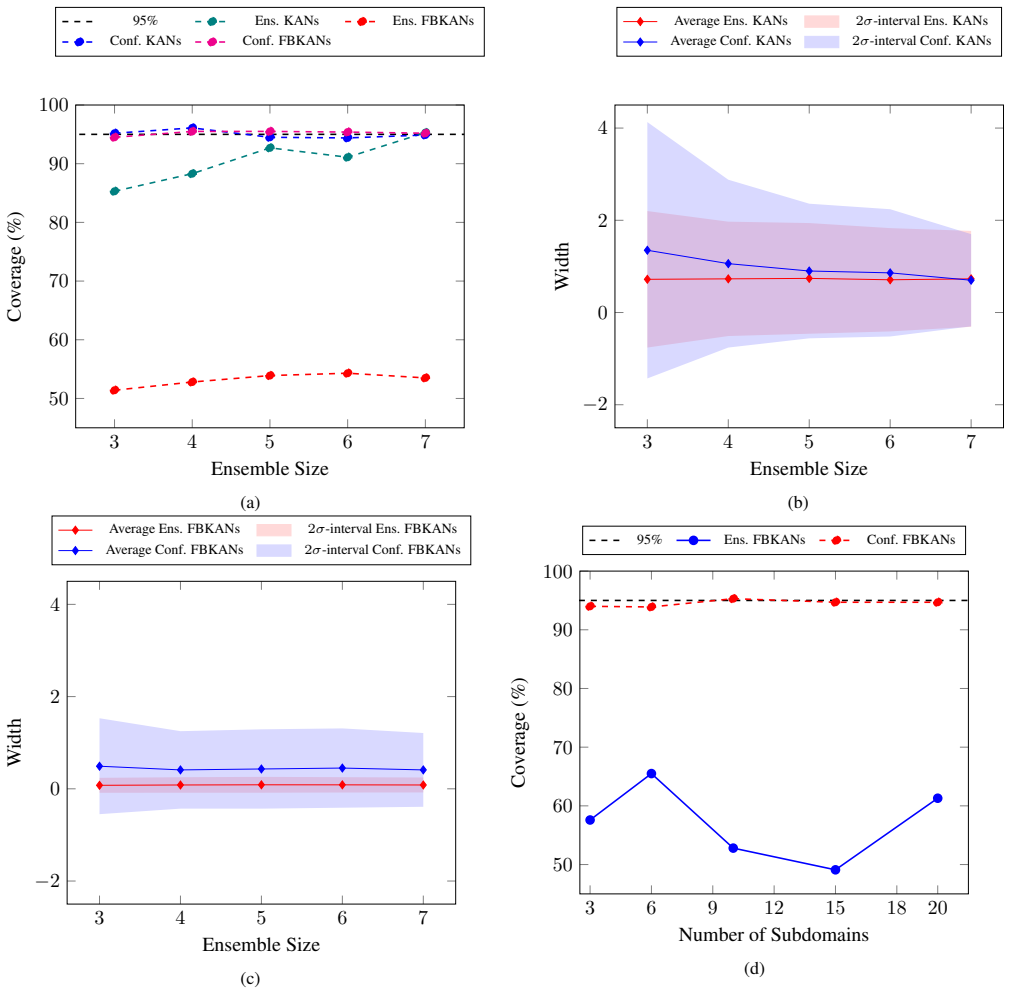
- At miscoverage level $\alpha = 0.05$, conformalized KAN, FBKAN, and MFKAN intervals reach roughly 95% empirical coverage across all four test problems, correcting the under-coverage of raw ensemble intervals.
- With $n$ exchangeable calibration points, coverage is at least $1-\alpha$ and at most $1-\alpha + 1/(n+1)$, independent of the data distribution.
- Because the ensemble standard deviation is the only model-specific ingredient, the same wrapper can be applied to other KAN variants beyond FBKANs and MFKANs.
- Domain decomposition improves interval sharpness: conformalized FBKANs give narrower intervals than standard conformalized KANs at the same coverage.
- Larger calibration sets reduce coverage fluctuations, while ensemble size mainly influences interval width rather than the coverage guarantee.
Reading between the lines
- The wrapper should transfer to any KAN variant that can be ensembled, such as physics-informed or wavelet KANs, as long as the ensemble standard deviation remains a meaningful uncertainty heuristic; a direct test would be to rerun the same conformal procedure with a different base architecture.
- The guarantee is marginal over exchangeability, not conditional on the input; users who need per-input reliability in heterogeneous domains would have to calibrate locally or conditionally, which the paper does not develop.
- A natural extension is local or adaptive calibration: binning calibration points by input region and computing region-specific quantiles could shrink the widest intervals while preserving coverage, especially where FBKAN subdomains localize error.
- For multi-fidelity problems, conformalized MFKAN interval width could serve as an acquisition signal for choosing where to collect new high-fidelity data, since the intervals reflect where the surrogate is least certain.
Signed reviews
Editorial analysis
A structured set of objections, weighed in public.
Referee Report
Summary. The paper proposes Conformalized-KANs, a UQ framework that combines an ensemble of Kolmogorov-Arnold Networks (KANs) with split conformal prediction. The ensemble mean is used as the point predictor and the ensemble standard deviation as a heuristic uncertainty scale; conformal calibration then yields intervals of the form [mu_M(x) - qhat*sigma_M(x), mu_M(x) + qhat*sigma_M(x)] with a claimed coverage guarantee P(f(x_test) in C_alpha(x_test)) >= 1-alpha. The method is applied to standard KANs and to two KAN variants, FBKANs and MFKANs, in four experiments: a 1-D function, a 2-D function, a multi-fidelity problem, and a wave-equation PDE. The reported empirical coverage values are close to 95%, and ablations study the effect of ensemble size, number of subdomains, and calibration-set size. The theoretical content is a correct application of standard split-conformal theory; the main weaknesses are empirical reporting (single-run coverage statistics) and some algorithmic details in the definition of the nonconformity score.
Significance. If the empirical claims are made rigorous, this would be a useful and practical application of established conformal-prediction theory to a popular class of SciML models. The paper's strength is that it correctly identifies the standard split-conformal theorem and applies it in the right way: the ensemble is trained before calibration, the nonconformity scores are computed on held-out calibration data, and the intervals have the correct conformal form. The application to FBKANs and MFKANs broadens the scope of conformal UQ to recent KAN variants. The coverage guarantee itself is not new, so the contribution is primarily empirical and architectural. The current evidence, however, is weakened by the absence of repeated-seed or multi-split statistics: all reported coverage values are single realizations, and under the nominal 95% level with test sets of size 1000 the sampling noise is roughly +/-1.4 percentage points at two standard deviations, which is comparable to the observed differences between methods.
major comments (3)
- [Section 3.2, Algorithm 1] The nonconformity score is defined as s_j = |f(x_j) - mu_M(x_j)| / sigma(x_j). For the conformal guarantee to hold, this score must be a well-defined, fixed function on all calibration and test points. If the ensemble standard deviation is zero or numerically negligible for any point, the score is undefined or extremely large, which can make the conformal quantile and the resulting intervals unstable. The paper should state a safeguard such as sigma_epsilon(x) = max(sigma_M(x), epsilon) and discuss how this affects the coverage guarantee. In addition, Algorithm 1 uses inconsistent notation: line 4 divides by sigma(x_j) and line 8 uses sigma(xtest), while Section 3.1 defines sigma_M; this should be corrected.
- [Section 4, Tables 1-4] Each reported coverage value (e.g., 96.10%, 95.50%, 96.01%, 95.44%) comes from a single data split and a single trained ensemble. For a test set of size 1000 and nominal coverage 0.95, the standard error of the empirical coverage is about 0.7 percentage points, so two-standard-deviation intervals span roughly 1.4 percentage points. The differences between methods and the deviations from 95% in Tables 1-4 are therefore all within ordinary sampling noise. The claims that Conformalized-KANs 'consistently achieve the target 95% coverage' and that FBKANs 'consistently outperform KANs' are not substantiated by single-run statistics. Please report coverage means and standard deviations across multiple independent data splits and model initializations.
- [Appendix A, Figures 6-8] The ablation studies visualize coverage and width curves as functions of ensemble size M and the number of subdomains L, but the paper does not state whether each plotted curve is a single realization or an average over repeated runs. If these are single runs, the same sampling-noise critique applies to the ablation conclusions, including the claim that the conformalized variants 'consistently' maintain coverage near the target. The figure captions and text should clarify the number of independent realizations and include error bars or confidence bands.
minor comments (5)
- [Abstract and Section 2.2] There are typographical errors: 'multifideilty' should be 'multi-fidelity' in the abstract, and 'parition' should be 'partition' in Section 2.2.
- [Section 2.3, Eq. (3)] The penalty term involving lambda_alpha is garbled in the displayed equation ('+ lambda_alpha alpha^n + w' appears as '+ λααn +w'). Please rewrite the equation so that the exponent on alpha is clear.
- [Section 3.1] The text says the 1.96-sigma interval gives 'approximately 95% confidence, assuming the predictions follow a normal distribution.' This is only valid for Gaussian predictive distributions, and the paper correctly notes this limitation; however, the point is stated somewhat informally and could be clarified.
- [Section 4.5] For the PDE experiment, the calibration and test sets should be drawn from the same distribution over (x,t) for the exchangeability assumption to hold. The paper should state explicitly how the 1200 calibration points and 10000 test points are sampled, especially because the training uses physics-informed losses with initial, boundary, and residual data.
- [Section 3.2] The sentence 'Given that the data is exchangeable, the method assures coverage' would be clearer if it specified that the guarantee holds over the randomness in the calibration data for a fixed test point, rather than suggesting a deterministic statement for any test set.
Circularity Check
No significant circularity: the conformal coverage guarantee is a direct application of the external split-conformal theorem, not a restatement of fitted inputs.
full rationale
The claimed derivation chain is: (i) train an ensemble of KANs on training data; (ii) compute nonconformity scores s_j = |f(x_j)-mu_M(x_j)|/sigma(x_j) on a held-out calibration set; (iii) take q_hat as the empirical ceil((n+1)(1-alpha))/n quantile; and (iv) form intervals C_alpha(x_test) = [mu_M(x_test) - q_hat * sigma_M(x_test), mu_M(x_test) + q_hat * sigma_M(x_test)]. The coverage statement in Section 3.2, 'Given that the data is exchangeable, the method assures coverage: P(f(x_test) in C_alpha(x_test)) >= 1-alpha,' is the standard split-conformal theorem imported from external references [40,42]. The quantile is estimated from calibration data, not from the test set, and the model is fixed before calibration, so the guarantee is not a fitted quantity in disguise. Self-citations [28,29] describe the FBKAN and MFKAN architectures, and [43,44] describe previous applications of conformal prediction to DeepONets; neither is used as the source of the coverage theorem. The empirical coverage values in Tables 1-4 are held-out checks of the theorem under synthetic i.i.d. data, not consequences of any fitted parameter. The acknowledged exchangeability assumption is a validity condition, not a circular step. The fact that each experiment reports a single coverage realization is a statistical precision concern, but it does not make the derivation circular.
Assumptions & free parameters
free parameters (4)
- Ensemble size M =
4 (1D, 2D), 5 (MF), 10 (PDE)
- Number of FBKAN subdomains L =
10 (1D), 4 (2D and PDE)
- PDE residual weighting lambda_res =
0.01
- MFKAN exponent n =
4
assumptions (4)
- standard math Kolmogorov-Arnold representation theorem
- domain assumption Calibration and test data are exchangeable (i.i.d. in experiments)
- domain assumption The trained ensemble model is fixed before calibration
- standard math Conformal quantile theorem of Vovk et al. and Angelopoulos and Bates
Cite this review
Pith. "Pith review of Conformalized-KANs: Uncertainty Quantification with Coverage Guarantees for Kolmogorov-Arnold Networks (KANs) in Scientific Machine Learning." pith.science (2026). https://pith.science/paper/L5C6M6YW
@misc{pith2026250415240,
  author       = {Pith},
  title        = {Pith review of: Conformalized-KANs: Uncertainty Quantification with Coverage Guarantees for Kolmogorov-Arnold Networks (KANs) in Scientific Machine Learning},
  year         = {2026},
  howpublished = {\url{https://pith.science/paper/L5C6M6YW}},
  note         = {Machine review of arXiv:2504.15240}
}
read the original abstract
This paper explores uncertainty quantification (UQ) methods in the context of Kolmogorov-Arnold Networks (KANs). We apply an ensemble approach to KANs to obtain a heuristic measure of UQ, enhancing interpretability and robustness in modeling complex functions. Building on this, we introduce Conformalized-KANs, which integrate conformal prediction, a distribution-free UQ technique, with KAN ensembles to generate calibrated prediction intervals with guaranteed coverage. Extensive numerical experiments are conducted to evaluate the effectiveness of these methods, focusing particularly on the robustness and accuracy of the prediction intervals under various hyperparameter settings. We show that the conformal KAN predictions can be applied to recent extensions of KANs, including Finite Basis KANs (FBKANs) and multifideilty KANs (MFKANs). The results demonstrate the potential of our approaches to improve the reliability and applicability of KANs in scientific machine learning.
Figures


Figures from the paper (5 more)




Forward citations
Cited by 1 Pith paper
-
Multi-Exit Kolmogorov-Arnold Networks: enhancing accuracy and parsimony
Augmenting Kolmogorov-Arnold Networks with prediction exits at each layer improves accuracy and often yields more parsimonious models, and a differentiable learning-to-exit algorithm automates the choice of exit weights.
Reference graph
Works this paper leans on
-
[1]
Nathan Baker, Frank Alexander, Timo Bremer, Aric Hagberg, Yannis Kevrekidis, Habib Najm, Manish Parashar, Abani Patra, James Sethian, Stefan Wild, Karen Willcox, and Steven Lee. Workshop Report on Basic Research Needs for Scientific Machine Learning: Core Technologies for Artificial Intelligence. Technical report, USDOE Office of Science (SC), Washington,...
work page 2019
-
[2]
Physics-informed machine learning
George Em Karniadakis, Ioannis G Kevrekidis, Lu Lu, Paris Perdikaris, Sifan Wang, and Liu Yang. Physics-informed machine learning. Nature Reviews Physics, 3(6):422–440, 2021
2021
-
[3]
Kan: Kolmogorov-arnold networks
Ziming Liu, Yixuan Wang, Sachin Vaidya, Fabian Ruehle, James Halverson, Marin Soljaˇci´c, Thomas Y Hou, and Max Tegmark. Kan: Kolmogorov-arnold networks. arXiv preprint arXiv:2404.19756, 2024
arXiv 2024
-
[4]
Kan 2.0: Kolmogorov-arnold networks meet science
Ziming Liu, Pingchuan Ma, Yixuan Wang, Wojciech Matusik, and Max Tegmark. Kan 2.0: Kolmogorov-arnold networks meet science. arXiv preprint arXiv:2408.10205, 2024
arXiv 2024
-
[5]
Andrei Nikolaevich Kolmogorov. On the representations of continuous functions of many variables by superposition of continuous functions of one variable and addition. In Dokl. Akad. Nauk USSR , volume 114, pages 953–956, 1957
work page 1957
-
[6]
Kan or mlp: A fairer comparison
Runpeng Yu, Weihao Yu, and Xinchao Wang. Kan or mlp: A fairer comparison. arXiv preprint arXiv:2407.16674, 2024
arXiv 2024
-
[7]
Kan versus mlp on irregular or noisy functions
Chen Zeng, Jiahui Wang, Haoran Shen, and Qiao Wang. Kan versus mlp on irregular or noisy functions. arXiv preprint arXiv:2408.07906, 2024
arXiv 2024
-
[8]
Khemraj Shukla, Juan Diego Toscano, Zhicheng Wang, Zongren Zou, and George Em Karniadakis. A comprehensive and fair comparison between mlp and kan representations for differential equations and operator networks. arXiv preprint arXiv:2406.02917, 2024. 14 3 4 5 6 7 8 9 1010 20 30 40 50 60 70 80 90 100 Ensemble Size Coverage (%) 95% Ens. KANs Ens. FBKANs Co...
arXiv 2024
Show all 48 references
-
[9]
Kolmogorov arnold informed neural network: A physics-informed deep learning framework for solving pdes based on kolmogorov arnold networks
Yizheng Wang, Jia Sun, Jinshuai Bai, Cosmin Anitescu, Mohammad Sadegh Eshaghi, Xiaoying Zhuang, Timon Rabczuk, and Yinghua Liu. Kolmogorov arnold informed neural network: A physics-informed deep learning framework for solving pdes based on kolmogorov arnold networks. arXiv pre...
2024 arXiv
-
[10]
Adaptive training of grid-dependent physics-informed kolmogorov-arnold networks
Spyros Rigas, Michalis Papachristou, Theofilos Papadopoulos, Fotios Anagnostopoulos, and Georgios Alexandridis. Adaptive training of grid-dependent physics-informed kolmogorov-arnold networks. IEEE Access, 2024
2024
-
[11]
Physics informed kolmogorov-arnold neural networks for dynamical analysis via efficent-kan and wav-kan
Subhajit Patra, Sonali Panda, Bikram Keshari Parida, Mahima Arya, Kurt Jacobs, Denys I Bondar, and Abhijit Sen. Physics informed kolmogorov-arnold neural networks for dynamical analysis via efficent-kan and wav-kan. arXiv preprint arXiv:2407.18373, 2024
2024 arXiv
-
[12]
Tkan: Temporal kolmogorov-arnold networks
Remi Genet and Hugo Inzirillo. Tkan: Temporal kolmogorov-arnold networks. arXiv preprint arXiv:2405.07344, 2024
2024 arXiv
-
[13]
Wav-kan: Wavelet kolmogorov-arnold networks
Zavareh Bozorgasl and Hao Chen. Wav-kan: Wavelet kolmogorov-arnold networks. arXiv preprint arXiv:2405.12832, 2024
2024 arXiv
-
[14]
Unveiling the power of wavelets: A wavelet-based kolmogorov- arnold network for hyperspectral image classification
Seyd Teymoor Seydi, Zavareh Bozorgasl, and Hao Chen. Unveiling the power of wavelets: A wavelet-based kolmogorov- arnold network for hyperspectral image classification. arXiv preprint arXiv:2406.07869, 2024
2024 arXiv
-
[15]
On the study of frequency control and spectral bias in wavelet-based kolmogorov arnold networks: A path to physics-informed kans
Juan Daniel Meshir, Abel Palafox, and Edgar Alejandro Guerrero. On the study of frequency control and spectral bias in wavelet-based kolmogorov arnold networks: A path to physics-informed kans. arXiv preprint arXiv:2502.00280, 2025
2025 arXiv
-
[16]
Gkan: Graph kolmogorov-arnold networks
Mehrdad Kiamari, Mohammad Kiamari, and Bhaskar Krishnamachari. Gkan: Graph kolmogorov-arnold networks. arXiv preprint arXiv:2406.06470, 2024
2024 arXiv
-
[17]
Graphkan: Enhancing feature extraction with graph kolmogorov arnold networks
Fan Zhang and Xin Zhang. Graphkan: Enhancing feature extraction with graph kolmogorov arnold networks. arXiv preprint arXiv:2406.13597, 2024
2024 arXiv
-
[18]
Kolmogorov-arnold graph neural networks
Gianluca De Carlo, Andrea Mastropietro, and Aris Anagnostopoulos. Kolmogorov-arnold graph neural networks. arXiv preprint arXiv:2406.18354, 2024
2024 arXiv
-
[19]
Chebyshev polynomial-based kolmogorov-arnold networks: An efficient architecture for nonlinear function approximation
Sidharth SS, Keerthana AR, Anas KP, et al. Chebyshev polynomial-based kolmogorov-arnold networks: An efficient architecture for nonlinear function approximation. arXiv preprint arXiv:2405.07200, 2024. 15
2024 arXiv
-
[20]
Scaled-cpikans: Domain scaling in chebyshev-based physics-informed kolmogorov-arnold networks
Farinaz Mostajeran and Salah A Faroughi. Scaled-cpikans: Domain scaling in chebyshev-based physics-informed kolmogorov-arnold networks. arXiv preprint arXiv:2501.02762, 2025
2025 arXiv
-
[21]
fkan: Fractional kolmogorov-arnold networks with trainable jacobi basis functions
Alireza Afzal Aghaei. fkan: Fractional kolmogorov-arnold networks with trainable jacobi basis functions. arXiv preprint arXiv:2406.07456, 2024
2024 arXiv
-
[22]
Deepokan: Deep operator network based on kolmogorov arnold networks for mechanics problems
Diab W Abueidda, Panos Pantidis, and Mostafa E Mobasher. Deepokan: Deep operator network based on kolmogorov arnold networks for mechanics problems. arXiv preprint arXiv:2405.19143, 2024
2024 arXiv
-
[23]
Kolmogorov-arnold networks (kans) for time series analysis
Cristian J Vaca-Rubio, Luis Blanco, Roberto Pereira, and Màrius Caus. Kolmogorov-arnold networks (kans) for time series analysis. arXiv preprint arXiv:2405.08790, 2024
2024
-
[24]
Kolmogorov-arnold pointnet: Deep learning for prediction of fluid fields on irregular geometries
Ali Kashefi. Kolmogorov-arnold pointnet: Deep learning for prediction of fluid fields on irregular geometries. arXiv preprint arXiv:2408.02950, 2024
2024 arXiv
-
[25]
Inferring turbulent velocity and temperature fields and their statistics from lagrangian velocity measurements using physics-informed kolmogorov-arnold networks
Juan Diego Toscano, Theo Käufer, Martin Maxey, Christian Cierpka, and George Em Karniadakis. Inferring turbulent velocity and temperature fields and their statistics from lagrangian velocity measurements using physics-informed kolmogorov-arnold networks. arXiv preprint arXiv:2...
2024 arXiv
-
[26]
Suitability of kans for computer vision: A preliminary investigation
Basim Azam and Naveed Akhtar. Suitability of kans for computer vision: A preliminary investigation. arXiv preprint arXiv:2406.09087, 2024
2024 arXiv
-
[27]
Demonstrating the efficacy of kolmogorov-arnold networks in vision tasks
Minjong Cheon. Demonstrating the efficacy of kolmogorov-arnold networks in vision tasks. arXiv preprint arXiv:2406.14916, 2024
2024 arXiv
-
[28]
Finite basis kolmogorov-arnold networks: domain decomposition for data-driven and physics-informed problems
Amanda A Howard, Bruno Jacob, Sarah H Murphy, Alexander Heinlein, and Panos Stinis. Finite basis kolmogorov-arnold networks: domain decomposition for data-driven and physics-informed problems. arXiv preprint arXiv:2406.19662, 2024
2024
-
[29]
Multifidelity kolmogorov-arnold networks
Amanda A Howard, Bruno Jacob, and Panos Stinis. Multifidelity kolmogorov-arnold networks. arXiv preprint arXiv:2410.14764, 2024
2024 arXiv
-
[30]
Raissi, P
M. Raissi, P. Perdikaris, and G. E. Karniadakis. Physics-informed neural networks: a deep learning framework for solving forward and inverse problems involving nonlinear partial differential equations. Journal of Computational Physics, 378:686–707, 2019
2019
-
[32]
Uncertainty quantification in scientific machine learning: Methods, metrics, and comparisons
Apostolos F Psaros, Xuhui Meng, Zongren Zou, Ling Guo, and George Em Karniadakis. Uncertainty quantification in scientific machine learning: Methods, metrics, and comparisons. Journal of Computational Physics, 477:111902, 2023
2023
-
[33]
Scalable uncertainty quantification for deep operator networks using randomized priors
Yibo Yang, Georgios Kissas, and Paris Perdikaris. Scalable uncertainty quantification for deep operator networks using randomized priors. Computer Methods in Applied Mechanics and Engineering , 399:115399, 2022
2022
-
[34]
B-deeponet: An enhanced bayesian deeponet for solving noisy parametric pdes using accelerated replica exchange sgld
Guang Lin, Christian Moya, and Zecheng Zhang. B-deeponet: An enhanced bayesian deeponet for solving noisy parametric pdes using accelerated replica exchange sgld. Journal of Computational Physics, 473:111713, 2023
2023
-
[35]
Deeponet-grid-uq: A trustworthy deep operator framework for predicting the power grid’s post-fault trajectories
Christian Moya, Shiqi Zhang, Guang Lin, and Meng Yue. Deeponet-grid-uq: A trustworthy deep operator framework for predicting the power grid’s post-fault trajectories. Neurocomputing, 535:166–182, 2023
2023
-
[36]
Bayesian deep operator learning for homogenized to fine-scale maps for multiscale pde
Zecheng Zhang, Christian Moya, Wing Tat Leung, Guang Lin, and Hayden Schaeffer. Bayesian deep operator learning for homogenized to fine-scale maps for multiscale pde. Multiscale Modeling & Simulation , 22(3):956–972, 2024
2024
-
[37]
Uncertainty quantification with bayesian higher order relu-kans
James Giroux and Cristiano Fanelli. Uncertainty quantification with bayesian higher order relu-kans. Machine Learning: Science and Technology, 2024
2024
-
[38]
Bayesian kolmogorov arnold networks (bayesian_kans): A probabilistic approach to enhance accuracy and interpretability
Masoud Muhammed Hassan. Bayesian kolmogorov arnold networks (bayesian_kans): A probabilistic approach to enhance accuracy and interpretability. arXiv preprint arXiv:2408.02706, 2024
2024 arXiv
-
[39]
Deep operator learning-based surrogate models with uncertainty quantification for optimizing internal cooling channel rib profiles
Izzet Sahin, Christian Moya, Amirhossein Mollaali, Guang Lin, and Guillermo Paniagua. Deep operator learning-based surrogate models with uncertainty quantification for optimizing internal cooling channel rib profiles. International Journal of Heat and Mass Transfer , 219:124813, 2024
2024
-
[40]
Springer, 2005
Vladimir V ovk, Alexander Gammerman, and Glenn Shafer.Algorithmic learning in a random world , volume 29. Springer, 2005. 16
2005
-
[41]
Conformalized quantile regression
Yaniv Romano, Evan Patterson, and Emmanuel Candes. Conformalized quantile regression. Advances in neural information processing systems, 32, 2019
2019
-
[42]
A gentle introduction to conformal prediction and distribution-free uncertainty quantification
Anastasios N Angelopoulos and Stephen Bates. A gentle introduction to conformal prediction and distribution-free uncertainty quantification. arXiv preprint arXiv:2107.07511, 2021
2021 arXiv
-
[43]
Conformalized-deeponet: A distribution- free framework for uncertainty quantification in deep operator networks
Christian Moya, Amirhossein Mollaali, Zecheng Zhang, Lu Lu, and Guang Lin. Conformalized-deeponet: A distribution- free framework for uncertainty quantification in deep operator networks. Physica D: Nonlinear Phenomena , 471:134418, 2025
2025
-
[44]
Conformalized prediction of post-fault voltage trajectories using pre-trained and finetuned attention-driven neural operators
Amirhossein Mollaali, Gabriel Zufferey, Gonzalo Constante-Flores, Christian Moya, Can Li, Guang Lin, and Meng Yue. Conformalized prediction of post-fault voltage trajectories using pre-trained and finetuned attention-driven neural operators. arXiv preprint arXiv:2410.24162, 2024
-
[45]
Finite basis physics-informed neural networks (fbpinns): a scalable domain decomposition approach for solving differential equations
Ben Moseley, Andrew Markham, and Tarje Nissen-Meyer. Finite basis physics-informed neural networks (fbpinns): a scalable domain decomposition approach for solving differential equations. Advances in Computational Mathematics , 49(4):62, 2023
2023
-
[46]
Multilevel domain decomposition-based ar- chitectures for physics-informed neural networks
Victorita Dolean, Alexander Heinlein, Siddhartha Mishra, and Ben Moseley. Multilevel domain decomposition-based ar- chitectures for physics-informed neural networks. Computer Methods in Applied Mechanics and Engineering , 429:117116, 2024
2024
-
[47]
Elm-fbpinn: efficient finite-basis physics-informed neural networks
Samuel Anderson, Victorita Dolean, Ben Moseley, and Jennifer Pestana. Elm-fbpinn: efficient finite-basis physics-informed neural networks. arXiv preprint arXiv:2409.01949, 2024
2024 arXiv
-
[48]
Multifidelity domain decomposition-based physics-informed neural networks for time-dependent problems
Alexander Heinlein, Amanda A Howard, Damien Beecroft, and Panos Stinis. Multifidelity domain decomposition-based physics-informed neural networks for time-dependent problems. arXiv preprint arXiv:2401.07888, 2024
2024 arXiv
-
[49]
A composite neural network that learns from multi-fidelity data: Application to function approximation and inverse pde problems
Xuhui Meng and George Em Karniadakis. A composite neural network that learns from multi-fidelity data: Application to function approximation and inverse pde problems. Journal of Computational Physics, 401:109020, 2020. 17
2020
Reviewed August 16, 2026 · model on record in the stance chip above.
Discussion (0). Continue with ORCID to comment.