REVIEW 2 minor 54 references
Reviewed by Pith at T0; open to challenge.
T0 means a machine referee read the full paper against a public rubric. The mark states how deep the mechanical check went, never who wrote it. the ladder, T0–T4 →
T0 review · grok-4.3
Exponential low-regularity integrators enable linearly convergent parareal algorithms for NLS equations even with limited regularity solutions.
2026-07-02 08:22 UTC pith:L5G7BOKU
load-bearing objection This paper gives the first proof of linear convergence for parareal on NLS with limited regularity by using exponential low-regularity coarse propagators and verifying the needed stability and truncation assumptions.
Exponential Low-Regularity Parareal Algorithms for Nonlinear Schr\"odinger Equations
The pith
A machine-rendered reading of the paper's core claim, the machinery that carries it, and where it could break.
Core claim
A convergence framework for parareal methods on NLS guarantees linear convergence with contraction factor proportional to the coarse time-step size for solutions of limited regularity whenever the coarse propagator satisfies the stated stability and local truncation error assumptions; the assumptions hold for the selected exponential low-regularity integrators on one-dimensional quadratic and cubic NLS.
What carries the argument
General convergence framework resting on stability and local truncation error assumptions for the coarse propagator, verified for exponential low-regularity integrators.
Load-bearing premise
The chosen exponential low-regularity integrators must satisfy the required stability and local truncation error bounds for the coarse propagator.
What would settle it
Numerical runs in which the observed contraction factor fails to scale linearly with the coarse time-step size or in which the iteration diverges for low-regularity initial data would disprove the claimed convergence.
Editorial analysis
A structured set of objections, weighed in public.
Referee Report
Summary. The paper constructs parareal algorithms for the nonlinear Schrödinger equation that employ exponential low-regularity integrators as coarse propagators. It derives a general linear convergence framework under independent stability and local truncation error assumptions on the coarse propagator (valid for limited-regularity solutions), verifies those assumptions for selected integrators on one-dimensional quadratic and cubic NLS, and reports numerical experiments on quadratic, cubic, and quintic NLS demonstrating faster convergence than variants using Lie/Strang splitting or classical exponential Runge–Kutta coarse propagators.
Significance. If the framework and verifications hold, the result supplies the first provably linearly convergent parareal method for NLS with contraction factor proportional to the coarse step size, even for low-regularity data. The separation of the general convergence argument from the specific integrator analysis, together with the numerical confirmation across multiple nonlinearities, constitutes a substantive advance for parallel-in-time methods on non-diffusive nonlinear PDEs.
minor comments (2)
- [§3.2] §3.2: the statement of the local truncation error assumption would be clearer if the precise dependence on the coarse step ΔT and the regularity index s were written explicitly rather than left implicit in the O(·) notation.
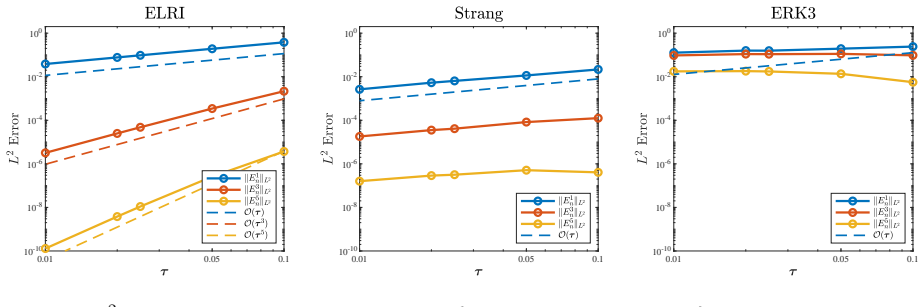
- [Figure 4] Figure 4 caption: the legend does not distinguish the three different NLS nonlinearities shown in the convergence plots; adding a short parenthetical would improve readability.
Simulated Author's Rebuttal
We thank the referee for the positive review, the recognition of the novelty of the convergence framework, and the recommendation to accept the manuscript.
Circularity Check
No significant circularity in derivation chain
full rationale
The paper presents a general convergence framework for parareal methods on NLS that rests on independent stability and local truncation error assumptions for the coarse propagator; these assumptions are stated separately and then verified directly for the selected exponential low-regularity integrators on 1D quadratic and cubic cases. No load-bearing step reduces by construction to a self-definition, a fitted parameter renamed as prediction, or a self-citation chain. The central claim of linear convergence with contraction factor proportional to coarse step size follows from the framework plus the verified assumptions, which are external to the target result and do not presuppose it. The derivation is therefore self-contained against external benchmarks.
Axiom & Free-Parameter Ledger
read the original abstract
The parareal algorithm is one of the most widely studied parallel-in-time methods for the numerical approximation of time-dependent problems. For non-diffusive equations, however, standard parareal methods may converge slowly or even become unstable due to the absence of damping, while nonlinear interactions can transfer and amplify phase errors across Fourier modes. In this work, we consider the nonlinear Schr\"odinger equation (NLS) as a representative non-diffusive model and analyze parareal algorithms with an exact fine propagator, with particular emphasis on the design of suitable coarse propagators. We establish a general convergence framework, valid for solutions with limited regularity, under stability and local truncation error assumptions on the coarse propagator. These assumptions are verified for selected exponential low-regularity integrators designed for one-dimensional quadratic and cubic NLS equations, which achieve optimal approximation orders without derivative loss. To the best of our knowledge, this is the first construction of parareal algorithms for NLS equations that are provably linearly convergent, with a contraction factor proportional to the coarse time-step size even for solutions of limited regularity. Numerical experiments on quadratic, cubic, and quintic NLS equations demonstrate rapid convergence and improved performance over parareal variants using classical coarse propagators, including Lie and Strang splitting methods and first- and third-order exponential Runge--Kutta integrators.
Figures


Reference graph
Works this paper leans on
-
[1]
C. Audouze, M. Massot, and S. V olz. Symplectic multi-time step parareal algorithms applied to molec- ular dynamics, Feb. 2009. HAL preprint, hal-00358459
work page 2009
-
[2]
G. Bal. On the convergence and the stability of the parareal algorithm to solve partial differential equations. InDomain decomposition methods in science and engineering, pages 425–432. Springer, 2005
work page 2005
-
[3]
L. Banjai and D. Peterseim. Parallel multistep methods for linear evolution problems.IMA J. Numer. Anal., 32(3):1217–1240, 2012
work page 2012
-
[4]
I. Bejenaru and T. Tao. Sharp well-posedness and ill-posedness results for a quadratic non-linear Schr¨odinger equation.J. Funct. Anal., 233(1):228–259, 2006
work page 2006
-
[5]
L. Berg ´e. Wave collapse in physics: principles and applications to light and plasma waves.Phys. Rep., 303(5):259–370, 1998
work page 1998
-
[6]
I. Bihari. A generalization of a lemma of Bellman and its application to uniqueness problems of differential equations.Acta Math. Hungar., 7(1):81–94, 1956
work page 1956
-
[7]
I. Bossuyt, S. Vandewalle, and G. Samaey. Micro-macro parareal, from ordinary differential equations to stochastic differential equations and back again.ANZIAM J., 67:Paper No. e13, 23, 2025
work page 2025
-
[8]
C.-E. Brehier and X. Wang. On parareal algorithms for semilinear parabolic stochastic PDEs.SIAM J. Numer. Anal., 58(1):254–278, 2020
work page 2020
-
[9]
T. Buvoli and M. Minion. IMEX Runge-Kutta parareal for non-diffusive equations. In B. Ong, J. Schroder, J. Shipton, and S. Friedhoff, editors,Parallel-in-Time Integration Methods, pages 95–127, Cham, 2021. Springer International Publishing
work page 2021
-
[10]
T. Buvoli and M. Minion. Exponential Runge-Kutta parareal for non-diffusive equations.J. Comput. Phys., 497:Paper No. 112623, 27, 2024
work page 2024
-
[11]
A. Chabchoub, N. P. Hoffmann, and N. Akhmediev. Rogue wave observation in a water wave tank. Phys. Rev. Lett., 106:204502, May 2011. 23
work page 2011
-
[12]
S. M. Cox and P. C. Matthews. Exponential time differencing for stiff systems.J. Comput. Phys., 176(2):430–455, 2002
work page 2002
- [13]
-
[14]
V . A. Dobrev, T. Kolev, N. A. Petersson, and J. B. Schroder. Two-level convergence theory for multigrid reduction in time (MGRIT).SIAM J. Sci. Comput., 39(5):S501–S527, 2017
work page 2017
-
[15]
M. Emmett and M. L. Minion. Toward an efficient parallel in time method for partial differential equations.Commun. Appl. Math. Comput. Sci., 7(1):105–132, 2012
work page 2012
-
[16]
R. D. Falgout, S. Friedhoff, T. V . Kolev, S. P. MacLachlan, and J. B. Schroder. Parallel time integration with multigrid.SIAM J. Sci. Comput., 36(6):C635–C661, 2014
work page 2014
-
[17]
Y . Feng, G. Maierhofer, and K. Schratz. Long-time error bounds of low-regularity integrators for nonlinear Schr¨odinger equations.Math. Comp., 93(348):1569–1598, 2024
work page 2024
-
[18]
P. F. Fischer, F. Hecht, and Y . Maday. A parareal in time semi-implicit approximation of the Navier- Stokes equations. InDomain decomposition methods in science and engineering, volume 40 ofLect. Notes Comput. Sci. Eng., pages 433–440. Springer, Berlin, 2005
work page 2005
-
[19]
M. J. Gander. 50 years of time parallel time integration. InMultiple shooting and time domain decomposition methods, volume 9 ofContrib. Math. Comput. Sci., pages 69–113. Springer, Cham, 2015
work page 2015
-
[20]
M. J. Gander and S. G ¨uttel. PARAEXP: a parallel integrator for linear initial-value problems.SIAM J. Sci. Comput., 35(2):C123–C142, 2013
work page 2013
-
[21]
M. J. Gander, S. G ¨uttel, and M. Petcu. A nonlinear ParaExp algorithm. InDomain decomposition methods in science and engineering XXIV, volume 125 ofLect. Notes Comput. Sci. Eng., pages 261–
-
[22]
Springer, Cham, 2018
work page 2018
-
[23]
M. J. Gander, F. Kwok, and J. Salomon. ParaOpt: a parareal algorithm for optimality systems.SIAM J. Sci. Comput., 42(5):A2773–A2802, 2020
work page 2020
-
[24]
M. J. Gander and S. Vandewalle. Analysis of the parareal time-parallel time-integration method.SIAM J. Sci. Comput., 29(2):556–578, 2007
work page 2007
-
[25]
M. J. Gander and S.-L. Wu. Convergence analysis of aperiodic-likewaveform relaxation method for initial-value problems via the diagonalization technique.Numer. Math., 143(2):489–527, 2019
work page 2019
-
[26]
M. J. Gander, S.-L. Wu, and T. Zhou. Time parallelization for hyperbolic and parabolic problems.Acta Numer., 34:385–489, 2025
work page 2025
-
[27]
E. P. Gross. Structure of a quantized vortex in boson systems.Il Nuovo Cimento, 20(3):454–477, 1961
work page 1961
-
[28]
A. Hasegawa and F. Tappert. Transmission of stationary nonlinear optical pulses in dispersive dielectric fibers. i. anomalous dispersion.Appl. Phys. Lett., 23(3):142–144, 1973
work page 1973
-
[29]
M. Hochbruck and A. Ostermann. Exponential integrators.Acta Numer., 19:209–286, 2010
work page 2010
-
[30]
C. E. Kenig, G. Ponce, and L. Vega. Quadratic forms for the1-D semilinear Schr ¨odinger equation. Trans. Amer. Math. Soc., 348(8):3323–3353, 1996. 24
work page 1996
- [31]
- [32]
- [33]
-
[34]
G. Li, Q. Lin, S.-L. Wu, and Z. Zhou. Linear convergence of parareal algorithm for semilinear parabolic equations.preprint, arXiv:2606.03516, 2026
work page internal anchor Pith review Pith/arXiv arXiv 2026
-
[35]
Y . Li, Y . Wu, and F. Yao. Convergence of an embedded exponential-type low-regularity integrators for the KdV equation without loss of regularity.Ann. Appl. Math., 37(1):1–21, 2021
work page 2021
- [36]
-
[37]
T. P. Mathew, M. Sarkis, and C. E. Schaerer. Analysis of block parareal preconditioners for parabolic optimal control problems.SIAM J. Sci. Comput., 32(3):1180–1200, 2010
work page 2010
-
[38]
M. L. Minion, R. Speck, M. Bolten, M. Emmett, and D. Ruprecht. Interweaving PFASST and parallel multigrid.SIAM J. Sci. Comput., 37(5):S244–S263, 2015
work page 2015
-
[39]
J. Nievergelt. Parallel methods for integrating ordinary differential equations.Comm. ACM, 7:731– 733, 1964
work page 1964
-
[40]
B. W. Ong and J. B. Schroder. Applications of time parallelization.Comput. Vis. Sci., 23(1-4):Paper No. 11, 15, 2020
work page 2020
-
[41]
A. Ostermann, F. Rousset, and K. Schratz. Fourier integrator for periodic NLS: low regularity estimates via discrete Bourgain spaces.J. Eur. Math. Soc. (JEMS), 25(10):3913–3952, 2023
work page 2023
-
[42]
A. Ostermann and K. Schratz. Low regularity exponential-type integrators for semilinear Schr ¨odinger equations.Found. Comput. Math., 18(3):731–755, 2018
work page 2018
-
[43]
A. Ostermann and F. Yao. A fully discrete low-regularity integrator for the nonlinear Schr ¨odinger equation.J. Sci. Comput., 91(1):Paper No. 9, 14, 2022
work page 2022
-
[44]
L. P. Pitaevskii. V ortex lines in an imperfect Bose gas.Sov. Phys. JETP, 13(2):451–454, 1961
work page 1961
-
[45]
F. Rousset and K. Schratz. A general framework of low regularity integrators.SIAM J. Numer. Anal., 59(3):1735–1768, 2021
work page 2021
- [46]
-
[47]
K. Schratz, Y . Wang, and X. Zhao. Low-regularity integrators for nonlinear dirac equations.Math. Comp., 90(327):189–214, 2021
work page 2021
- [48]
- [49]
-
[50]
J. Steiner, D. Ruprecht, R. Speck, and R. Krause. Convergence of parareal for the Navier-Stokes equations depending on the Reynolds number. InNumerical mathematics and advanced applications— ENUMATH 2013, volume 103 ofLect. Notes Comput. Sci. Eng., pages 195–202. Springer, Cham, 2015
work page 2013
-
[51]
Y . Wang and X. Zhao. A symmetric low-regularity integrator for nonlinear klein-gordon equation. Math. Comp., 91(337):2215–2245, 2022
work page 2022
-
[52]
S.-L. Wu, T. Zhou, and Z. Zhou. A uniform spectral analysis for a preconditioned all-at-once system from first-order and second-order evolutionary problems.SIAM J. Matrix Anal. Appl., 43(3):1331– 1353, 2022
work page 2022
- [53]
- [54]
discussion (0)
Sign in with ORCID, Apple, or X to comment. Anyone can read and Pith papers without signing in.