REVIEW 3 major objections 4 minor
TurboRetry: Mitigating Large-Scale QUIC Handshake Floods with Off-the-Shelf DPU Offloading
T0 review · 3 major / 4 minor · reviewed 2026-08-04 · deepseek-v4-flash
Pith's one-line read TurboRetry claims a DPU-split QUIC Retry offload lets one server absorb 3 Mpps handshake floods with negligible latency and 10–20× the throughput of host-side stacks.
desk verdict Solid DPU offload paper with a measured 10-20x gain; just make the off-path threat model explicit in the headline claims. read the letter →
The pith
A machine-rendered reading of the paper's core claim, the machinery that carries it, and where it could break.
The reading
What carries the argument
The load-bearing object is the universal AES-GCM-128 retry token: a plaintext header (issuer, purpose, token ID, 96-bit nonce) authenticated as associated data, plus an encrypted payload binding a timestamp, client IP/port, and original connection ID. Both host and DPU derive identical per-token encryption keys from one rotating pre-shared master key using HKDF, which is what makes split processing possible without cryptographic state synchronization. Around it, the DPA cache—a pair of aging Bloom filters keyed by QUIC connection IDs—authorizes the fast path so verified flows bypass the off-path Arm processor.
What would settle it
Run an attacker with a vantage point between a legitimate client and the server so it can capture a Retry packet; within one second, have it send a spoofed Initial carrying that token from a different source address. If the host proceeds into the handshake, the claimed replay resistance is broken. Separately, sweep attack rates above 3 Mpps to observe the promised throughput ceiling.
Extended reading notes
Core claim
The paper's central claim is that QUIC's Retry mechanism splits cleanly into stateless and stateful halves, and that the stateless half—token generation, integrity-tag computation, and token verification—can run entirely on a DPU's hardware-accelerated AES-GCM pipeline while the host keeps connection management. A universal token format, an AES-GCM-128 encrypted payload bound to a plaintext header, carries both retry state and 0-RTT resumption state; per-token keys are derived from a single rotating pre-shared master key via HKDF, so the host and DPU never synchronize keys or nonces. An on-path data-path accelerator then authorizes verified connections by matching connection IDs, letting dat
Load-bearing premise
The design assumes the attacker cannot observe the server's Retry traffic; an on-path adversary who sees a token can replay it under a spoofed source address within the 1-second validity window and pass the DPU's address check.
Editorial extensions
If this is right
- A DPU-equipped server can sustain flood traffic at 3 Mpps with no packet loss, versus at least an order of magnitude lower for host-side QUIC stacks.
- Host CPUs are almost fully shielded: CPU load stays at the level of benign background traffic even under a 3 Mpps attack, a reduction of over 99 percent.
- Connection setup latency stays effectively flat under attack, adding only ~0.2 ms, where host stacks become unresponsive at 20–150 kpps depending on implementation.
- The fail-open path preserves service on DPU crash: a transient ~30 ms latency spike and no dropped requests.
- 0-RTT resumption keeps working because the same token format handles NEW_TOKEN-based address validation.
Reading between the lines
- Editorial inference: the replay-resistance guarantee holds only against an off-path adversary. An on-path observer that captures a Retry token can replay it with a spoofed copy of the client's source address within the 1-second validity window, and nothing in TurboRetry distinguishes that from the legitimate client's second Initial.
- Editorial inference: the 1 MB dual-table Bloom filter admits roughly 4.25 percent of unverified 1-RTT packets under the stated load, so the system trades a small, bounded leakage of unverified traffic to the host for fast-path forwarding; under real-address short-lived connection floods this leakage could grow within a rotation window.
- Editorial inference: since the design only depends on an AES-GCM engine and on-path packet steering, the split should port to other DPU families, but the DPA/Bloom-filter fast-path cache is the component most tied to a particular NIC architecture.
- Editorial inference: coupling this offload with a proof-of-work or cryptographic challenge would shift the cost asymmetry from simply relocating the defense to making each spoofed attempt genuinely expensive for the attacker.
Signed reviews
Editorial analysis
A structured set of objections, weighed in public.
Referee Report
Summary. The paper presents TurboRetry, a DPU-based system that offloads the QUIC Retry address-validation mechanism to the Arm processor and hardware AES-GCM accelerators of an NVIDIA BlueField-3 DPU. The design partitions Retry into stateless functions (token generation, integrity-tag computation, token verification) on the DPU and stateful connection management on the host, with a universal AES-GCM-protected token format that also supports NEW_TOKEN-based 0-RTT validation. An on-path DPA processor maintains a dual-table Bloom-filter cache of verified DCIDs so that post-handshake traffic bypasses the off-path Arm path. The host cooperator revalidates tokens and recovers connection identifiers from the token payload, preserving QUIC semantics. The evaluation reports that TurboRetry sustains a 3 Mpps handshake-flood attack rate without packet loss (4.2x, 10x, and 20x over TurboRetry-XDP, Quiche, and Aioquic), introduces sub-millisecond connection-setup latency overhead, keeps data-transfer overhead near 1%, shields host CPUs from flood traffic, and fails open when the DPU program terminates.
Significance. If the results hold, TurboRetry is a useful systems contribution: it demonstrates a practical split between stateless DPU-side Retry processing and host-side connection management, and it shows that a commercial DPU with hardware AES-GCM can absorb handshake floods far beyond host-side QUIC stacks. The evaluation is broad in coverage (saturation throughput, setup latency, data latency, host CPU load, fail-open) and the comparison with an XDP-based variant helps isolate the benefit of DPU acceleration. The artifact is promised publicly. The security argument is not circular: token forgery is reduced to AES-GCM CPA security, the Bloom-filter FPR is computed from stated parameters, and the performance gains are measured rather than fitted. The main caveat is that the headline 'fully shields host CPUs' claim is stated more broadly than the off-path adversary model in Section 3.1 actually supports, and the nonce-uniqueness argument in Section 7 is worded too strongly. These are fixable with careful scoping and analysis, and I do not regard them as invalidating the measured results.
major comments (3)
- [§3.1, §7, §8.5] The headline security claims—'fully shields host CPUs from handshake-flood resource exhaustion' (§8.5) and 'strong resilience against adaptive adversaries' (§1)—are not qualified by the threat model. Under the stated off-path adversary (§3.1) the scheme is sound, but the Retry token is a bearer credential bound only to source IP/port, ODCID, and a timestamp. An adversary with any on-path vantage point can observe the Retry packet and replay the token within the 1-second validity window using a spoofed copy of the client's address tuple; the Arm agent will validate it, forward the Initial to the host, and the host will perform expensive TLS processing. §7 rejects only outdated tokens and does not address same-window replay. The abstract, contributions, and security analysis should either state the off-path scope explicitly or the design must add a mechanism that distinguishes replayed tok
- [§5.1 Algorithm 1, §7] The statement in §7 that the key–nonce derivation 'ensuring nonce uniqueness for each key' is not established as written. K_enc is derived only from K_psk and TID; if the same TID occurs under the same K_psk, the only additional entropy in the nonce is the 32-bit random R and the timestamp, which is not unique. A collision in TID and R within the same timestamp granularity would reuse a (key, nonce) pair. The 64-bit TID makes this event negligible, but the paper should say that the uniqueness argument relies on the randomness/uniqueness of TID, not on the timestamp, and should not claim unconditional nonce uniqueness. Please also clarify the relationship between the 96-bit nonce shown in the token header (Figure 8) and N_enc in Algorithm 1: if the same nonce is transmitted in the plaintext header, the security argument should treat it as public input to the AEAD, not as a secret.
- [§5.2, §7] The DPA Bloom filter has a designed false-positive rate of 4.25%. This is acceptable for the stated handshake-flood attack model, because Initial packets are handled by the Arm agent and are not admitted based on the Bloom-filter result. However, the paper also says the DPA 'drops invalid flows before they reach the host' and that TurboRetry 'fully shields host CPUs.' A mixed flood containing crafted 1-RTT packets with random DCIDs would pass roughly 4.25% of its packets through the DPA cache, and the host would then perform AEAD decryption failures on those packets. At 3 Mpps this would be ~127 kpps of traffic reaching the host, which is comparable to the saturation rates of the host baselines. The paper should either bound this effect in the security analysis or explicitly state that the CPU-shielding claim applies only to Initial-only handshake floods.
minor comments (4)
- [Figures 9, 10, 12] The text states that each measurement was repeated 10 times, but no error bars, confidence intervals, or per-run values are shown. Since the headline 3 Mpps number and the CPU-load comparison are point estimates, please report variance (e.g., min–max, standard deviation) or explain why the variation is negligible.
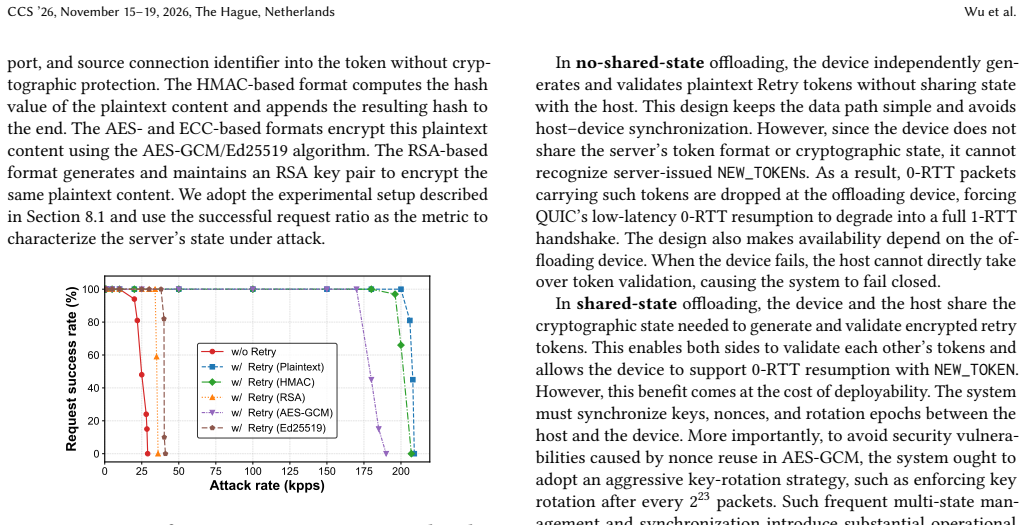
- [§2.2 vs Figure 9] Figure 2 reports Quiche with AES-GCM tokens sustaining 188 kpps in the Retry-related measurement, while Figure 9 shows Quiche at approximately 0.15 Mpps at 15 cores (150 kpps). These two numbers are hard to reconcile as-is. Please clarify the definitions (single-core vs multi-core, success-ratio threshold vs zero-loss saturation, and the role of the token format) so the reader can compare the two baselines.
- [Table 3] The baseline connection-setup latencies (31.77 ms for Aioquic and 22.96 ms for Quiche) are an order of magnitude above typical QUIC 1-RTT setup latencies. Please state explicitly whether the measurement includes the full HTTP/3 request/response exchange or only the QUIC/TLS handshake, and why this is the relevant baseline for the overhead comparison.
- [§6, Fail-open] The fail-open description says the host QUIC stack implements the same stateless Retry logic as the DPU path. Please clarify how the host obtains the master key K_psk and what happens to a partially populated DPA Bloom filter when the DPU program recovers. Stale Bloom-filter entries could forward previously validated DCIDs to the host after failover, and the recovery procedure is not described.
Circularity Check
No significant circularity: throughput claims are measured benchmarks and the security reduction is to standard AES-GCM, not to the paper's own assumptions.
full rationale
The paper's central performance claims are empirical, not derived: the 4.2x/10x/20x speedups and the 3 Mpps sustained attack rate come from testbed measurements (Section 8.2), and the host-CPU shielding claim is supported by MIPS measurements (Section 8.5). The Bloom-filter false-positive rate in Eq. 1 is computed from the stated design parameters (m = 1 MB, k = 3, n = 40000 x 30) using the standard formula; it is not fitted to reproduce a target result. The token-forgery security argument explicitly reduces to the chosen-plaintext security of AES-GCM, citing external proofs (NIST, Iwata et al.), and Algorithm 1's key/nonce derivation is stated independently of the security conclusion. The off-path adversary assumption in Section 3.1 is a threat-model restriction, not a conclusion derived from the defended system; it scopes the 'fully shields host CPUs' claim but does not make the derivation circular. The only self-referential elements are the artifact link [3] and internal cross-references, neither of which is load-bearing evidence for the central claims. No step in the derivation chain reduces, by construction or by self-citation, to its own inputs.
Assumptions & free parameters
free parameters (4)
- Retry token expiration window =
1 second
- Bloom filter parameters =
m = 1 MB bits, k = 3, n = 40,000 × 30 = 1.2×10^6, FPR ≈ 4.25%
- DPA cache aging window T_W =
30 seconds
- Master key rotation interval =
24 hours
assumptions (6)
- standard math AES-GCM is CPA-secure and nonce-reuse-safe under the construction in Algorithm 1
- standard math HKDF with unique per-token TID produces independent per-token keys and nonces
- domain assumption Adversary is off-path and cannot observe return traffic
- domain assumption DPU is not arbitrarily malicious and only holds the pre-shared token secret, not TLS private keys
- domain assumption Host and DPU clocks stay synchronized via NTP within the token freshness window
- domain assumption BlueField-3 DPA supports on-path packet steering and Bloom-filter matching at line rate
invented entities (2)
-
Universal retry token format
-
DPA cache with dual-table Bloom filter
Cite this review
Pith. "Pith review of TurboRetry: Mitigating Large-Scale QUIC Handshake Floods with Off-the-Shelf DPU Offloading." pith.science (2026). https://pith.science/paper/L5TR3J3R
@misc{pith2026260802264,
  author       = {Pith},
  title        = {Pith review of: TurboRetry: Mitigating Large-Scale QUIC Handshake Floods with Off-the-Shelf DPU Offloading},
  year         = {2026},
  howpublished = {\url{https://pith.science/paper/L5TR3J3R}},
  note         = {Machine review of arXiv:2608.02264}
}
abstract
The modern transport protocol QUIC is designed to enhance network performance and security, but it remains vulnerable to handshake flooding attacks. Such attacks exhaust CPU resources by forcing the server to perform expensive cryptographic operations via a large number of handshaking requests. QUIC provides a built-in defense mechanism, the Retry mechanism, to mitigate these attacks. However, our experiments reveal that it can still become a performance bottleneck under large-scale QUIC handshake floods due to substantial computational overhead. In this paper, we design and implement TurboRetry, a split design, that offloads the Retry mechanism onto DPUs to efficiently mitigate QUIC handshake floods. TurboRetry partitions the tasks of the Retry into two categories, and then assigns them to the DPUs and the host, respectively. To preserve QUIC semantics and reduce the coordination overhead, TurboRetry designs an extended Retry token format and an efficient cooperation scheme. In addition, TurboRetry offloads the connection authorization task to the on-path DPA to further improve both performance and security. Our evaluation shows that TurboRetry outperforms the host-side implementation by a wide margin, improving throughput by 10-20$\times$.
Figures


Figures from the paper (9 more)


Reviewed August 4, 2026 · model on record in the stance chip above.
Discussion (0). Continue with ORCID to comment.