REVIEW 3 major objections 6 minor 26 references
Towards Benchmarking Foundation Models for Tabular Data With Text
T0 review · 3 major / 6 minor · reviewed 2026-08-06 · deepseek-v4-flash
Pith's one-line read Text columns reliably boost tabular model accuracy when embedded and downsampled.
desk verdict Useful benchmark corpus with real free-text columns, but the 11/13 'text helps' headline is conditional on an ambiguous SHAP downsampling protocol and best-embedding selection. read the letter →
The pith
A machine-rendered reading of the paper's core claim, the machinery that carries it, and where it could break.
The reading
What carries the argument
The central mechanism is the per-column text-embedding pipeline: embed each free-text field with fastText, Skrub's GapEncoder, or AutoGluon's text encoder, then downsample the resulting high-dimensional vectors to 300 features (often via SHAP importance) before feeding them to a tabular model.
What would settle it
Recompute Table 2 with a single pre-registered embedding method (e.g., fastText only) and a single downsampler across all 13 datasets; if the with-text accuracy does not beat no-text in at least 9 of 13 datasets, the headline claim fails.
Extended reading notes
Core claim
On 11 of 13 curated datasets, text embeddings improve over no-text baselines for all models and frameworks tested; no single embedding method dominates, and SHAP-based feature downsampling is most frequently the best selector.
Load-bearing premise
The 11/13 accuracy claim assumes it is fair to report the best embedding method for each dataset after seeing the test results, rather than a fixed pipeline chosen in advance.
Editorial extensions
If this is right
- Practitioners with free-text columns can expect accuracy gains from embedding them, though the best embedding method varies by dataset.
- Downsampling text embeddings is essential; SHAP-based selection is a strong default but not universal.
- Tabular foundation model evaluations that omit text miss a realistic source of signal.
- Current embedding methods remain brittle, motivating better text encoders for tabular tasks.
Reading between the lines
- The 11/13 result likely overstates what a practitioner would see with a fixed embedding method, since Table 2 reports the best method per dataset after seeing results.
- A testable extension would fix one embedding method and one downsampler and measure the average gain across all 13 datasets.
- The qualitative synthetic failures (synonym OOD, noise, semantic ambiguity) suggest the true bottleneck is not the tabular model but the text encoder's robustness.
Editorial analysis
A structured set of objections, weighed in public.
Referee Report
Summary. The paper proposes TextTabBench, a manually curated set of 13 real-world tabular datasets containing free-text columns, and evaluates four text-embedding routes (FastText, Skrub's TableVectorizer/GapEncoder, AutoGluon's feature generator, and a BERT variant) combined with TabPFNv2, XGBoost, the TabPFNv2 API, and AutoGluon's Tabular Predictor. It reports that adding text embeddings improves accuracy in 11/13 datasets under a protocol that selects the best embedding per dataset after SHAP-based feature downsampling, and it presents a synthetic qualitative study of embedding failure modes plus a detailed critique of the CARTE benchmark. The paper also contributes acquisition scripts, preprocessing notebooks, and a discussion of benchmark-design principles for tabular data with text.
Significance. If the empirical protocol is valid, the paper is a useful step: the curated corpus fills a real gap, the preprocessing is documented in unusual detail, and the qualitative synthetic experiments in Section 3 clearly illustrate distinct embedding failure modes. The claim that text helps tabular models is actionable, and the benchmark itself is likely to be reused by the community. However, the headline 11/13 result is only as strong as the evaluation protocol in Table 2, and the current protocol has two features—post-hoc selection of the best embedding per dataset and a SHAP downsampling step whose nesting inside cross-validation is not specified—that can inflate the with-text advantage. The CARTE critique in Appendix G is thoughtful and useful, but the LLM-based grading of dataset quality has no human agreement check, which weakens the benchmark-construction argument.
major comments (3)
- [Section 5, Table 2 caption; Appendix B] The central claim that textual features boost accuracy in 11/13 datasets depends on SHAP-based downsampling not leaking validation target information. Appendix B states that SHAP 'computes the average absolute SHAP value for each feature across the dataset and selects the top-k most important ones,' but the paper never states that this supervised selection is nested inside the 5-fold cross-validation loop described in Section 5. If SHAP is fit on the full 3000-row subsample before splitting, the selector sees validation-fold labels, while the no-text baseline undergoes no such supervised selection; this biases the comparison in favor of the with-text condition. The same ambiguity applies to the other supervised selectors in Appendix F (t-test, ANOVA, correlation, L1). Please state explicitly whether feature selection is performed per training fold only, and if it is not, rerun the experiments with properly nested selection and report whether the 11/13 result survives.
- [Table 2 and Section 5, result (i)] The headline comparison reports, for each dataset and model, the best performance among all embedding techniques downsampled by SHAP. Because the best embedding is chosen after seeing the cross-validated scores, the 11/13 win rate is an upper bound over methods rather than the performance of a fixed pipeline a practitioner would deploy; for example, on airbnb only AGPIPE reaches 0.692 while FastText under SHAP reaches 0.682, and on osha only AGPIPE gives the reported gain. The paper should report the fixed-embedding comparison (e.g., FastText with SHAP for every dataset) or a nested model-selection procedure, and should accompany the aggregate claim with a paired significance test, since several improvements (e.g., airbnb 0.692±0.048 vs 0.679±0.045 for TabPFNv2) are within one standard deviation.
- [Appendix G.1, G.4, G.10] The benchmark-quality assessment of CARTE and of the authors' own datasets relies on GPT-4o judgments (domain grouping in G.4 and Green/Yellow/Red classification in G.10) without any human inter-annotator agreement check or error analysis. Since Appendix G is used to motivate the new corpus and to criticize an existing benchmark, the LLM judgments should be validated on a sample by human annotators, and the prompts and outputs should be released; otherwise the critique is self-referential and cannot be independently evaluated.
minor comments (6)
- [Section 2 and Section 5] There are several typos: 'pre-column embeddings' should be 'per-column embeddings', 'dowsampling' should be 'downsampling', and Section 3's contribution list says 'show casing' instead of 'showcasing'.
- [Section 5, Experimental Setup] The paper states that rows are restricted to 3000 for all evaluations, but Table 1 lists datasets with far more rows (e.g., mercari 100000, complaints 96935); please clarify whether the 3000-row cap is applied before or after the 100,000-row crop and whether Table 1 reports raw or evaluation sizes.
- [Appendix G.4, Figures 6 and 7] The figure captions say that binary-thresholded coverage at or above 0.5 is highlighted in blue, while the surrounding text says green cells indicate strong similarity; please harmonize the color descriptions.
- [Appendix B, Table 3] The Correlation row is marked as both Zero-Shot and Supervised; since correlation with the target uses target information, the Zero-Shot check appears to be an error and should be corrected.
- [Section 4 and Appendix A] The code repository is mentioned by name ('TextTabBench repository' and 'Towards TextTabBench repository') but no URL is provided in the manuscript; please include a working link for reproducibility.
- [Appendix E and Section 3] The main text says the qualitative study uses five OpenML datasets, while Table 4's caption in Appendix E says four; please correct the inconsistency.
Circularity Check
No significant circularity: the central 'text helps' claim rests on external models and real datasets, but one self-referential Appendix G validation loops back to the authors' own criteria.
-
other
[Appendix G.1, G.4, G.10 (supporting Section 2's critique of CARTE); Listing 8 prompt]
"To approximate this process in a transparent and relatively independent way, we incorporate outputs from a highly capable LLM (ChatGPT-4o via API), along with the corresponding prompts. ... Based on GPT's evaluations, the majority of CARTE's datasets were categorized as either Red or Yellow ... In contrast, our benchmark datasets were predominantly classified as Green."
The 'relatively independent' LLM check is not independent of the paper's own definitions: the prompt in Listing 8 states the authors' five fitness conditions (semantic richness, dual signal, native target, enough signal), and G.1 says these rules were derived from examining CARTE's limitations. GPT-4o's verdict that the authors' datasets are 'predominantly Green' while CARTE's are 'Red/Yellow' is therefore the authors' suitability definition re-applied to both pools by a black-box judge, with no human-agreement check reported. As evidence that the new benchmark is better suited than CARTE, the support reduces to the paper's own stated criteria rather than an external standard.
full rationale
This paper contains no mathematical derivation chain; its claims are empirical benchmark results. The central claim, that text embeddings improve accuracy in 11/13 datasets (Section 5.2, Table 2), is supported by 5-fold CV comparisons of TabPFNv2, XGBoost, TabPFNv2 API, and AutoGluon on 13 real datasets against a no-text baseline, using standard statistics of these external models. This comparison is self-contained and does not reduce to the paper's inputs: the win rate is not guaranteed by construction (permits and houses lose under some frameworks), and the TabPFNv2 citation is to an externally published Nature model co-authored by two of the present authors, which is ordinary co-authorship, not load-bearing circularity. Suspected issues do not rise to pith circularity. First, Table 2's protocol, 'we report best performance amongst all embedding techniques downsampled by SHAP,' gives the with-text condition a best-of-n selection advantage over a single no-text baseline; this can inflate the reported gain but does not force it, and fixed embeddings (e.g., FastText) also beat no-text in most datasets, so this is a claim-strength and statistical-design caveat, not a reduction by construction. Second, Appendix B describes SHAP as computing average absolute SHAP values 'across the dataset' without stating whether selection is nested inside the 5-fold CV; if not nested, validation targets could leak into with-text feature selection but not into the no-text baseline. This is a potential correctness risk that cannot be adjudicated from the text and does not match any circularity pattern. Third, the Section 3 synthetic study builds texts to trigger specific embedding failures; the observed failures follow from the construction, but that is a designed controlled experiment, and the paper acknowledges the tests 'may seem artificial.' The one genuinely self-referential element is Appendix G: GPT-4o certifies the authors' own benchmark as Green and CARTE's as largely Red/Yellow using a prompt that encodes the authors' own selection criteria, making the 'relatively independent' validation an echo of the paper's own definitions. This is minor and not load-bearing for the central empirical claim, so the score sits at the top of the no-significant-circularity band.
Assumptions & free parameters
free parameters (4)
- max_features_cap =
300
- max_rows_cap =
3000
- categorical_threshold =
50 unique values or 5% of rows, manually adjusted
- skrub_gapencoder_components =
30 (default)
assumptions (5)
- domain assumption Each selected dataset has both a meaningful structured signal and a semantic free-text signal (dual-signal criterion).
- ad hoc to paper The best embedding reported per dataset is a legitimate target-independent choice.
- ad hoc to paper SHAP-based feature selection does not leak target information into the 5-fold cross-validation.
- domain assumption GPT-4o assessments are reliable for classifying dataset quality and domain redundancy.
- domain assumption The synthetic dilution tasks in Section 3 are representative of real-world text variability.
invented entities (1)
-
TextTabBench dataset corpus
independent evidence
Cite this review
Pith. "Pith review of Towards Benchmarking Foundation Models for Tabular Data With Text." pith.science (2026). https://pith.science/paper/L6M2TAWU
@misc{pith2026250707829,
  author       = {Pith},
  title        = {Pith review of: Towards Benchmarking Foundation Models for Tabular Data With Text},
  year         = {2026},
  howpublished = {\url{https://pith.science/paper/L6M2TAWU}},
  note         = {Machine review of arXiv:2507.07829}
}
read the original abstract
Foundation models for tabular data are rapidly evolving, with increasing interest in extending them to support additional modalities such as free-text features. However, existing benchmarks for tabular data rarely include textual columns, and identifying real-world tabular datasets with semantically rich text features is non-trivial. We propose a series of simple yet effective ablation-style strategies for incorporating text into conventional tabular pipelines. Moreover, we benchmark how state-of-the-art tabular foundation models can handle textual data by manually curating a collection of real-world tabular datasets with meaningful textual features. Our study is an important step towards improving benchmarking of foundation models for tabular data with text.
Figures
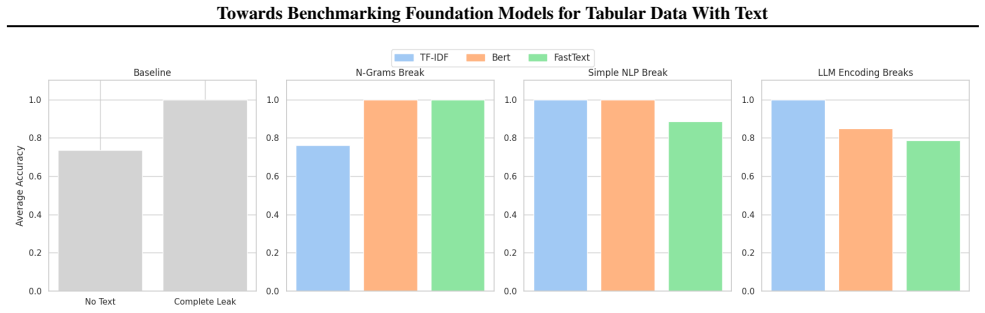


Figures from the paper (4 more)


Reference graph
Works this paper leans on
-
[1]
write newline
" write newline "" before.all 'output.state := FUNCTION n.dashify 't := "" t empty not t #1 #1 substring "-" = t #1 #2 substring "--" = not "--" * t #2 global.max substring 't := t #1 #1 substring "-" = "-" * t #2 global.max substring 't := while if t #1 #1 substring * t #2 global.max substring 't := if while FUNCTION format.date year duplicate empty "emp...
-
[2]
Bischl, B., Casalicchio, G., Feurer, M., Hutter, F., Lang, M., Mantovani, R. G., van Rijn, J. N., and Vanschoren, J. Openml benchmarking suites. arXiv:1708.03731v2 [stat.ML], 2019
arXiv 2019
-
[3]
Enriching word vectors with subword information, 2017
Bojanowski, P., Grave, E., Joulin, A., and Mikolov, T. Enriching word vectors with subword information, 2017. URL https://arxiv.org/abs/1607.04606
arXiv 2017
-
[4]
V., Na, L., Ma, Y., Boussioux, L., Zeng, C., Soenksen, L
Carballo, K. V., Na, L., Ma, Y., Boussioux, L., Zeng, C., Soenksen, L. R., and Bertsimas, D. Tabtext: A flexible and contextual approach to tabular data representation, 2023. URL https://arxiv.org/abs/2206.10381
arXiv 2023
-
[5]
Chen, T. and Guestrin, C. XGBoost : A scalable tree boosting system. In Krishnapuram, B., Shah, M., Smola, A., Aggarwal, C., Shen, D., and Rastogi, R. (eds.), Proceedings of the 22nd ACM SIGKDD International Conference on Knowledge Discovery and Data Mining ( KDD '16) , pp.\ 785--794, 2016
work page 2016
-
[7]
Autogluon-tabular: Robust and accurate automl for structured data, 2020 b
Erickson, N., Mueller, J., Shirkov, A., Zhang, H., Larroy, P., Li, M., and Smola, A. Autogluon-tabular: Robust and accurate automl for structured data, 2020 b . URL https://arxiv.org/abs/2003.06505
arXiv 2020
-
[8]
Gijsbers, P., Bueno, M. L. P., Coors, S., LeDell, E., Poirier, S., Thomas, J., Bischl, B., and Vanschoren, J. Amlb: an automl benchmark, 2022. URL https://arxiv.org/abs/2207.12560
arXiv 2022
-
[9]
Goldberger, A. L., Amaral, L. A., Glass, L., Hausdorff, J. M., Ivanov, P. C., Mark, R. G., Mietus, J. E., Moody, G. B., Peng, C.-K., and Stanley, H. E. Physiobank, physiotoolkit, and physionet: Components of a new research resource for complex physiologic signals. Circulation, 101 0 (23): 0 e215--e220, 2000
work page 2000
Show all 26 references
-
[10]
J., and Varoquaux, G
Grinsztajn, L., Oyallon, E., Kim, M. J., and Varoquaux, G. Vectorizing string entries for data processing on tables: when are larger language models better?, 2023. URL https://arxiv.org/abs/2312.09634
2023 arXiv
-
[11]
Tabllm: Few-shot classification of tabular data with large language models, 2022
Hegselmann, S., Buendia, A., Lang, H., Agrawal, M., Jiang, X., and Sontag, D. Tabllm: Few-shot classification of tabular data with large language models, 2022. URL https://arxiv.org/abs/2210.10723
2022 arXiv
-
[12]
N., Chang, S., Hartvigsen, T., and Singh, H
Hegselmann, S., Parziale, A., Shanmugam, D., Tang, S., Asiedu, M. N., Chang, S., Hartvigsen, T., and Singh, H. Machine learning for health symposium 2023 -- findings track, 2023. URL https://arxiv.org/abs/2312.00655
2023 arXiv
-
[13]
u ller, S., Purucker, L., Krishnakumar, A., K \
Hollmann, N., M \"u ller, S., Purucker, L., Krishnakumar, A., K \"o rfer, M., Hoo, S. B., Schirrmeister, R. T., and Hutter, F. Accurate predictions on small data with a tabular foundation model. Nature, 01 2025. doi:10.1038/s41586-024-08328-6. URL https://www.nature.com/articl...
2025 doi
-
[14]
J., Grinsztajn, L., and Varoquaux, G
Kim, M. J., Grinsztajn, L., and Varoquaux, G. Carte: Pretraining and transfer for tabular learning, 2024. URL https://arxiv.org/abs/2402.16785
2024 arXiv
-
[15]
Llm embeddings for deep learning on tabular data, 2025
Koloski, B., Margeloiu, A., Jiang, X., Škrlj, B., Simidjievski, N., and Jamnik, M. Llm embeddings for deep learning on tabular data, 2025. URL https://arxiv.org/abs/2502.11596
2025 arXiv
-
[16]
Talent: A tabular analytics and learning toolbox
Liu, S.-Y., Cai, H.-R., Zhou, Q.-L., and Ye, H.-J. Talent: A tabular analytics and learning toolbox. arXiv preprint arXiv:2407.04057, 2024
2024 arXiv
-
[17]
Mug: A multimodal classification benchmark on game data with tabular, textual, and visual fields
Lu, J., Qian, Y., Zhao, S., Xi, Y., and Yang, C. Mug: A multimodal classification benchmark on game data with tabular, textual, and visual fields. In Findings of the Association for Computational Linguistics: EMNLP 2023, pp.\ 5332–5346. Association for Computational Linguistic...
2023 doi
-
[18]
Lundberg, S. M. and Lee, S.-I. A unified approach to interpreting model predictions. Advances in neural information processing systems, 30, 2017
2017
-
[19]
C., Golestan, K., Yu, G., Volkovs, M., and Caterini, A
Ma, J., Thomas, V., Hosseinzadeh, R., Kamkari, H., Labach, A., Cresswell, J. C., Golestan, K., Yu, G., Volkovs, M., and Caterini, A. L. Tabdpt: Scaling tabular foundation models, 2024. URL https://arxiv.org/abs/2410.18164
2024
-
[20]
and Ratajczak, W
Maćkiewicz, A. and Ratajczak, W. Principal components analysis (pca). Computers & Geosciences, 19 0 (3): 0 303--342, 1993. ISSN 0098-3004. doi:https://doi.org/10.1016/0098-3004(93)90090-R. URL https://www.sciencedirect.com/science/article/pii/009830049390090R
1993
-
[21]
McElfresh, D., Khandagale, S., Valverde, J., Prasad C , V., Ramakrishnan, G., Goldblum, M., and White, C. When do neural nets outperform boosted trees on tabular data? In Proceedings of the 37th International Conference on Advances in Neural Information Processing Systems ( N ...
2023
-
[22]
P., Feuer, B., Hegde, C., Ramakrishnan, G., Goldblum, M., and White, C
McElfresh, D., Khandagale, S., Valverde, J., C, V. P., Feuer, B., Hegde, C., Ramakrishnan, G., Goldblum, M., and White, C. When do neural nets outperform boosted trees on tabular data?, 2024. URL https://arxiv.org/abs/2305.02997
2024 arXiv
-
[23]
Shi, X., Mueller, J., Erickson, N., Li, M., and Smola, A. J. Benchmarking multimodal automl for tabular data with text fields, 2021. URL https://arxiv.org/abs/2111.02705
2021 arXiv
-
[24]
A., Gonzalez, J., Duvenaud, D., and Turner, R
Shysheya, A., Bronskill, J., Requeima, J., Siddiqui, S. A., Gonzalez, J., Duvenaud, D., and Turner, R. E. Jolt: Joint probabilistic predictions on tabular data using llms, 2025. URL https://arxiv.org/abs/2502.11877
2025 arXiv
-
[25]
Autogluon-multimodal (automm): Supercharging multimodal automl with foundation models, 2024
Tang, Z., Fang, H., Zhou, S., Yang, T., Zhong, Z., Hu, T., Kirchhoff, K., and Karypis, G. Autogluon-multimodal (automm): Supercharging multimodal automl with foundation models, 2024. URL https://arxiv.org/abs/2404.16233
2024 arXiv
-
[26]
Minilm: Deep self-attention distillation for task-agnostic compression of pre-trained transformers, 2020
Wang, W., Wei, F., Dong, L., Bao, H., Yang, N., and Zhou, M. Minilm: Deep self-attention distillation for task-agnostic compression of pre-trained transformers, 2020. URL https://arxiv.org/abs/2002.10957
2020 arXiv
-
[27]
Tablellm: Enabling tabular data manipulation by llms in real office usage scenarios, 2024
Zhang, X., Luo, S., Zhang, B., Ma, Z., Zhang, J., Li, Y., Li, G., Yao, Z., Xu, K., Zhou, J., Zhang-Li, D., Yu, J., Zhao, S., Li, J., and Tang, J. Tablellm: Enabling tabular data manipulation by llms in real office usage scenarios, 2024. URL https://arxiv.org/abs/2403.19318
2024 arXiv
Reviewed August 6, 2026 · model on record in the stance chip above.
Discussion (0). Sign in to comment.