REVIEW 3 major objections 5 minor 51 references
Portable simulation framework for diffusion MRI
T0 review · 3 major / 5 minor · reviewed 2026-08-14 · deepseek-v4-flash
Pith's one-line read A FEniCS-based framework brings portable, parallel diffusion MRI simulation to the cloud.
desk verdict A useful, reproducible cloud/HPC FEM framework for diffusion MRI, but the multi-compartment interface method only handles bipartite compartment topologies, so the advertised generality is narrower than claimed. read the letter →
The pith
A machine-rendered reading of the paper's core claim, the machinery that carries it, and where it could break.
The reading
What carries the argument
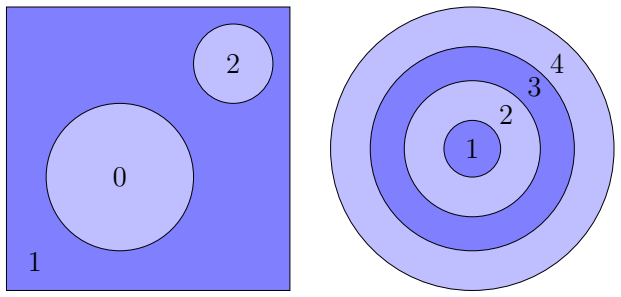
The load-bearing object is the PUFEM interface treatment: an element-wise constant phase function $\Phi_h$ taking only the values 0 and 1 distinguishes the two sides of every interface, so the permeability jump condition $\{\mathbf{D}\nabla U \cdot \mathbf{n}\} = -\kappa[U]$ can be written into the weak form as a single bilinear term. Because $\Phi_h$ is two-valued, the framework requires every multi-compartment geometry to be sorted into two groups, odd and even, with no interior interfaces inside either group. The other key device is the transformation $u = U \exp(i\gamma F(t) \mathbf{g} \cdot \mathbf{x})$, which converts the pseudo-periodic boundary conditions of a periodically repeated box into ordinary periodic conditions and makes the time-dependent phase factor part of the PDE rather than the boundary. Containers, Docker for notebooks and Singularity for HPC, carry the whole FEniCS stack, and the $\theta$-method with a fixed time step is the time discretization.
What would settle it
Take a three-compartment domain in which compartment A touches both B and C, with B and C not touching each other. Running the framework's CreatePhaseFunc on this arrangement should reveal that the two-group odd-even requirement cannot encode A-B and A-C simultaneously; if it nevertheless produces a signal, comparing that signal to the matrix-formalism reference for the same geometry would settle whether the interface treatment remains valid outside its stated assumption.
Extended reading notes
Core claim
The central claim is that a portable, containerized FEniCS-based implementation of the Bloch-Torrey equation can serve as a practical simulation tool for diffusion MRI. The method solves the complex transverse magnetization in a finite-element discretization, imposes permeable interface conditions through a partition-of-unity finite element method with a two-valued phase function, and handles periodic domains by transforming the pseudo-periodic boundary conditions into ordinary periodic ones through $u = U \exp(i\gamma F(t) \mathbf{g} \cdot \mathbf{x})$. Numerical experiments show that simulated signals match reference matrix-formalism signals for three-layered disks, spheres, tori and cylinders, that arbitrary gradient waveforms such as PGSE, double-PGSE and OGSE can be specified symbolically, and that the same code runs on a free cloud notebook, a local container, and a multi-node HPC cluster with MPI. The paper presents this as a free, reproducible, Python-based alternative to existing finite-element toolboxes.
Load-bearing premise
The framework's multi-compartment interface conditions rest on the assumption that every compartment can be split into two groups with no interfaces inside either group; a tissue with connected compartments within a group cannot be represented by the two-valued phase function.
Editorial extensions
If this is right
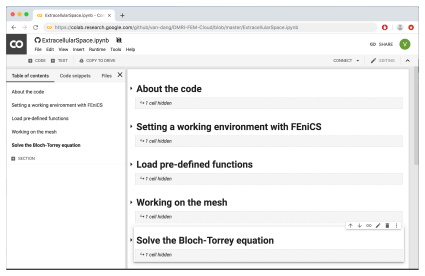
- Diffusion MRI researchers can run finite-element simulations from a web browser through Google Colaboratory, with no local FEniCS installation.
- The same Python code scales to MPI-parallel execution on cloud platforms and HPC clusters, with reported timings of a few minutes to about an hour per b-value depending on mesh size.
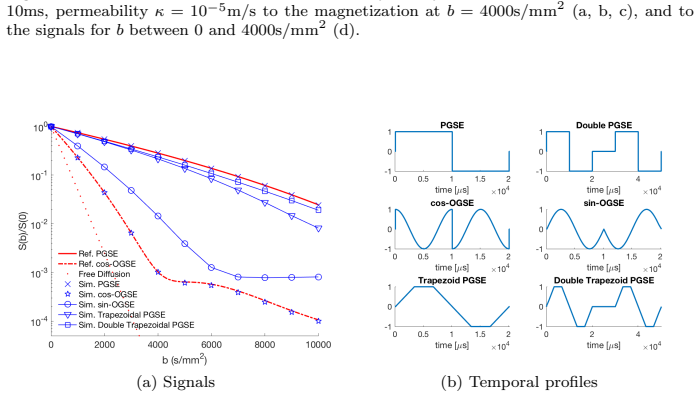
- Users can specify arbitrary gradient waveforms symbolically, including PGSE, double-PGSE, and cosine or sine OGSE, with automatic conversion between b-value and gradient strength.
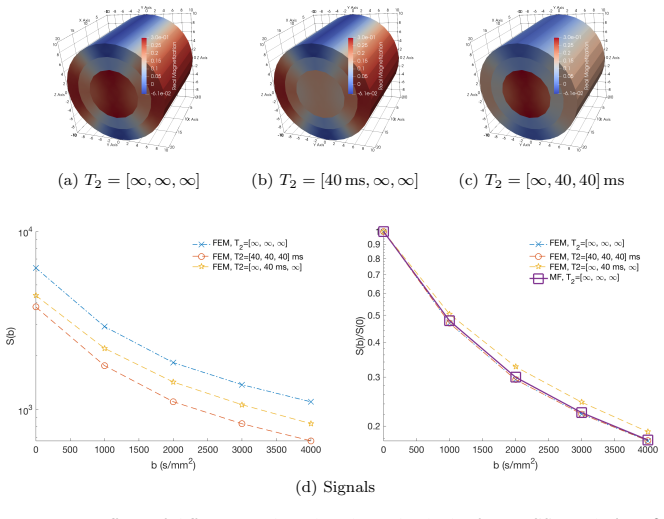
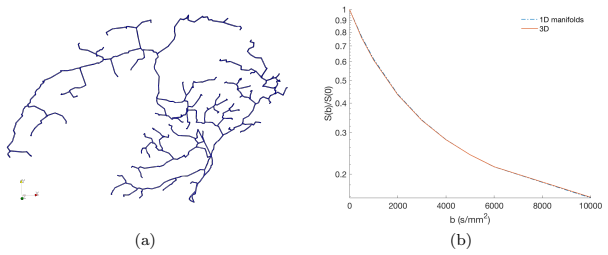
- Tissue models can include cell-wise discontinuous diffusion tensors and T2 relaxation, and thin or tubular structures can be simulated on 1D manifolds instead of full 3D meshes.
- Because the framework is open source and containerized, published notebooks can be re-run directly, which supports reproducible comparison of new diffusion MRI methods.
Reading between the lines
- The two-group restriction of the phase function means the framework, as presented, cannot handle geometries where one compartment connects to two others that are themselves in the same group; extending $\Phi_h$ to a genuinely multi-valued indicator would be the natural generalization.
- Adopting Python ODE solvers that handle mass matrices and sparse Jacobians could close the gap with SpinDoctor's adaptive time-stepping and likely reduce the fixed-step $\theta$-method cost.
- The validation set is concentric layered geometries against matrix formalism; applying the framework to non-concentric or branching connected compartments would be a testable next step before relying on it for realistic neuron networks.
- If the claimed portability holds, the framework lowers the barrier to reproducing published diffusion MRI simulations, which may shift more of the field's method-development workflow onto cloud notebooks.
Signed reviews
Editorial analysis
A structured set of objections, weighed in public.
Referee Report
Summary. The manuscript presents a portable, open-source, Python-based simulation framework for diffusion MRI built on FEniCS, containerized with Docker/Singularity, and deployable on Google Colaboratory and HPC clusters. The framework solves the Bloch-Torrey equation with PUFEM-based interface conditions, pseudo-periodic boundary conditions, arbitrary gradient waveforms, manifold discretizations, and MPI parallelism. Numerical validation compares simulated signals against matrix-formalism references for multilayered disks, spheres, tori, and cylinders, and the paper reports timings and parallel scaling. The central claim is that the framework provides a general, reproducible, multi-compartment simulation tool.
Significance. If the claims are properly qualified, this is a valuable software contribution to computational diffusion MRI: the code is open source, containerized, and accompanied by ready-to-run Colab notebooks, which directly supports reproducibility. The validation against matrix formalism uses an independent external reference with no fitted parameters, and the timing and parallel-scaling experiments are concrete. The main value is as a Python-based alternative to SpinDoctor with cloud/HPC portability. However, the demonstrated generality is narrower than advertised because of the two-valued phase-function restriction and the incomplete validation of arbitrary gradient sequences.
major comments (3)
- [Section 3.2, Eq. (A.6)] The multi-compartment interface treatment is restricted to compartment topologies whose adjacency graph is bipartite. The phase function Φh takes only two values, so all compartments must be partitioned into an even group and an odd group with no interfaces inside either group; the paper states this explicitly and Fig. 2 illustrates it. The abstract and introduction, however, promise simulation of "complex tissue micro-structures" and general "multi-compartment domains" without this qualification. All numerical examples (multilayered disk, sphere, torus, cylinder, neuron-in-box) satisfy this restriction, so the demonstrated results remain valid, but the scope of the advertised generality must be narrowed or the method must be extended to handle non-bipartite compartment adjacency graphs.
- [Section 4, Fig. 8] Validation of the "arbitrary temporal profiles" feature is incomplete. The text states that simulated signals match the matrix-formalism reference for PGSE and cos-OGSE only, but the figure also displays sin-OGSE, Trapezoidal PGSE, Double PGSE, and Double Trapezoidal PGSE without reference comparisons. Since general-sequence support is a central advertised capability, the authors should either report quantitative errors against the matrix-formalism reference for all f(t) shown, or state explicitly that those sequences are demonstrated without reference validation.
- [Section 4, Figs. 4–7] The accuracy claim "match very well" is never supported by quantitative error metrics. The paper would be strengthened by reporting a relative error norm (e.g., max or L2 relative difference between the FEM signal and the matrix-formalism signal) for each geometry and b-value range; without such numbers, the reader cannot judge the accuracy across mesh resolutions and time steps, and the stated Δt choices are not justified.
minor comments (5)
- [Abstract] "Completely portable across multiple platforms" is stronger than what is demonstrated; the workflow is tested on Ubuntu-based Docker/Singularity and Colab, not across the full range of platforms implied by "completely."
- [Introduction and Conclusion] The introduction reads "benefits from from long-established" with a duplicated word, and the conclusion spells "muti-compartment" instead of "multi-compartment."
- [Section 4] The phrase "time step size of Δt = 200µm" should use microseconds (200 µs) rather than micrometers; the same unit error appears in the MultilayeredStructures paragraph.
- [Section 4, Fig. 5] The sentence "ten times as larger" should read "ten times larger," and the comparison between the two timesteps should be rewritten to clarify which method requires the smaller step.
- [Section 5.3 vs. Section 3.3] The script-based parallel interface is stated not to support the artificial-permeability implementation; this limitation should be noted in Section 3.3, where both periodic options are described, rather than appearing only in the parallelization example.
Circularity Check
No circularity: the numerical claims are validated against an external matrix-formalism benchmark, and no fitted parameter is relabeled as a prediction.
full rationale
The paper's central numerical claim—that the simulated diffusion MRI signals match reference signals—is checked against an independent external benchmark, the matrix formalism of Grebenkov [45], not against the framework's own equations or fitted values. The simulation parameters are fixed inputs, not calibrated to the reference signals: 'Unless stated otherwise, the simulations were performed for a PGSE with Δ = 43100 µs, δ = 10600 µs, b−values between 0 and 10000 s/mm², and the diffusion coefficient of D = 3×10⁻³ mm²/s... The simulated signals are compared to the reference ones computed by the matrix formalism (MF) method [45].' The PUFEM interface treatment is inherited from the authors' prior Journal of Computational Physics paper [16], and the pseudo-periodic BCs are based on prior work [10, 12, 15, 16], but this is ordinary reuse of published methods; the load-bearing accuracy evidence in this paper is the comparison against [45], which is external to the fitted values and to the authors' own formulas. The two-valued phase function restriction stated in Section 3.2 ('the compartments need to be sorted into two groups oddgroup and evengroup... in each group, however, there is no interface between two compartments') limits the framework's multi-compartment generality to bipartite compartment topologies, but this is an explicit scope limitation, not a circular reduction. No equation in the paper defines a predicted quantity in terms of the very quantity it is supposed to predict, and no fitted parameter is renamed as a prediction. Therefore no circular step is present, and the self-citations are not load-bearing in the sense required to raise the circularity score.
Assumptions & free parameters
assumptions (6)
- domain assumption Bloch-Torrey equation with permeability interface conditions models the diffusion MRI signal (Eqs. 1-2).
- standard math Matrix formalism provides exact reference signals for multilayered structures.
- standard math The transformation u = U e^{i γ F(t) g·x} converts pseudo-periodic BCs to periodic BCs (Appendix A).
- standard math PUFEM with element-wise constant phase function Φh accurately imposes discontinuous magnetization and flux interface conditions.
- ad hoc to paper Multi-compartment domains can be partitioned into two groups with no intra-group interfaces.
- standard math Artificial permeability κe = max{D/h} with operator splitting gives stable approximation of pseudo-periodic BCs.
Cite this review
Pith. "Pith review of Portable simulation framework for diffusion MRI." pith.science (2026). https://pith.science/paper/L6U2WWYI
@misc{pith2026190801719,
  author       = {Pith},
  title        = {Pith review of: Portable simulation framework for diffusion MRI},
  year         = {2026},
  howpublished = {\url{https://pith.science/paper/L6U2WWYI}},
  note         = {Machine review of arXiv:1908.01719}
}
read the original abstract
The numerical simulation of the diffusion MRI signal arising from complex tissue micro-structures is helpful for understanding and interpreting imaging data as well as for designing and optimizing MRI sequences. The discretization of the Bloch-Torrey equation by finite elements is a more recently developed approach for this purpose, in contrast to random walk simulations, which has a longer history. While finite elements discretization is more difficult to implement than random walk simulations, the approach benefits from a long history of theoretical and numerical developments by the mathematical and engineering communities. In particular, software packages for the automated solutions of partial differential equations using finite elements discretization, such as FEniCS, are undergoing active support and development. However, because diffusion MRI simulation is a relatively new application area, there is still a gap between the simulation needs of the MRI community and the available tools provided by finite elements software packages. In this paper, we address two potential difficulties in using FEniCS for diffusion MRI simulation. First, we simplified software installation by the use of FEniCS containers that are completely portable across multiple platforms. Second, we provide a portable simulation framework based on Python and whose code is open source. This simulation framework can be seamlessly integrated with cloud computing resources such as Google Colaboratory notebooks working on a web browser or with Google Cloud Platform with MPI parallelization. We show examples illustrating the accuracy, the computational times, and parallel computing capabilities. The framework contributes to reproducible science and open-source software in computational diffusion MRI with the hope that it will help to speed up method developments and stimulate research collaborations.
Figures

Figures from the paper (8 more)




Reference graph
Works this paper leans on
-
[1]
B. D. Hughes, Random walks and random environments / Barry D. Hughes, Clarendon Press Oxford ; New York, 1995
work page 1995
-
[2]
C.-H. Yeh, B. Schmitt, D. Le Bihan, J.-R. Li-Schlittgen, C.-P. Lin, C. Poupon, Diffusion microscopist simulator: A general monte carlo simulation system for diffusion magnetic resonance imaging, PLoS One 8 (10) (2013) e76626, pONE-D-13-18755[PII]. doi:10.1371/journal. pone.0076626. URL http://www.ncbi.nlm.nih.gov/pmc/articles/PMC3794953/
doi:10.1371/journal 2013
-
[3]
M. G. Hall, D. C. Alexander, Convergence and parameter choice for monte- carlo simulations of diffusion mri, IEEE Transactions on Medical Imaging 28 (9) (2009) 1354–1364. doi:10.1109/TMI.2009.2015756
arXiv 2009
-
[4]
M. Palombo, C. Ligneul, C. Najac, J. Le Douce, J. Flament, C. Escartin, P. Hantraye, E. Brouillet, G. Bonvento, J. Valette, New paradigm to assess brain cell morphology by diffusion-weighted mr spectroscopy in vivo, Proc Natl Acad Sci U S A 113 (24) (2016) 6671–6676, 201504327[PII]. doi: 10.1073/pnas.1504327113. URL http://www.ncbi.nlm.nih.gov/pmc/articles...
-
[5]
K. V. Nguyen, E. H. Garzon, J. Valette, Efficient gpu-based monte-carlo simulation of diffusion in real astrocytes recon- structed from confocal microscopy, Journal of Magnetic Reso- nancedoi:https://doi.org/10.1016/j.jmr.2018.09.013. URL http://www.sciencedirect.com/science/article/pii/ S1090780718302386
-
[6]
P. A. Cook, Y. Bai, S. Nedjati-Gilani, K. K. Seunarine, M. G. Hall, G. J. M. Parker, D. C. Alexander, Camino: Open-source diffusion-mri reconstruc- tion and processing, 2006
work page 2006
-
[7]
S. N. Hwang, C.-L. Chin, F. W. Wehrli, D. B. Hackney, An image-based finite difference model for simulating restricted diffusion, Magnetic Reso- nance in Medicine 50 (2) (2003) 373–382. doi:10.1002/mrm.10536. URL http://dx.doi.org/10.1002/mrm.10536
- [8]
Show all 51 references
-
[9]
K. D. Harkins, J.-P. Galons, T. W. Secomb, T. P. Trouard, Assessment of the effects of cellular tissue properties on ADC measurements by numerical simulation of water diffusion, Magn. Reson. Med. 62 (6) (2009) 1414–1422. URL http://dx.doi.org/10.1002/mrm.22155 25
2009 doi
-
[10]
Russell, K
G. Russell, K. D. Harkins, T. W. Secomb, J.-P. Galons, T. P. Trouard, A finite difference method with periodic boundary conditions for simulations of diffusion-weighted magnetic resonance experiments in tissue, Physics in Medicine and Biology 57 (4) (2012) N35. URL http://stacks....
2012
-
[11]
B. F. Moroney, T. Stait-Gardner, B. Ghadirian, N. N. Yadav, W. S. Price, Numerical analysis of NMR diffusion measurements in the short gradient pulse limit, Journal of Magnetic Resonance 234 (0) (2013) 165–175. URL http://www.sciencedirect.com/science/article/pii/ S1090780713001572
2013
-
[12]
D. V. Nguyen, J.-R. Li, D. Grebenkov, D. L. Bihan, A finite elements method to solve the blochtorrey equation applied to diffusion magnetic resonance imaging, Journal of Computational Physics 263 (Supplement C) (2014) 283 – 302. doi:https://doi.org/10.1016/j.jcp.2014.01.009. URL...
2014 doi
-
[13]
Beltrachini, Z
L. Beltrachini, Z. A. Taylor, A. F. Frangi, A parametric finite element solution of the generalised blochtorrey equation for arbitrary domains, Journal of Magnetic Resonance 259 (Supplement C) (2015) 126 – 134. doi:https://doi.org/10.1016/j.jmr.2015.08.008. URL http://www.scien...
2015 doi
-
[14]
D. V. Nguyen, J. R. Li, D. S. Grebenkov, D. L. Bihan, Modeling the diffu- sion magnetic resonance imaging signal inside neurons, Journal of Physics: Conference Series 490 (1) (2014) 012013. URL http://stacks.iop.org/1742-6596/490/i=1/a=012013
2014
-
[15]
V. D. Nguyen, A FEniCS-HPC framework for multi-compartment Bloch- Torrey models, Vol. 1, 2016, pp. 105–119, QC 20170509. URL https://www.eccomas2016.org/
2016
-
[16]
Nguyen, J
V.-D. Nguyen, J. Jansson, J. Hoffman, J.-R. Li, A partition of unity finite element method for computational diffusion mri, Jour- nal of Computational Physics 375 (2018) 271 – 290. doi:https: //doi.org/10.1016/j.jcp.2018.08.039. URL http://www.sciencedirect.com/science/article/pi...
2018 doi
-
[17]
Nguyen, J
V.-D. Nguyen, J. Jansson, H. T. A. Tran, J. Hoffman, J.-R. Li, Diffusion mri simulation in thin-layer and thin-tube media using a discretization on manifolds, Journal of Magnetic Resonance 299 (2019) 176 – 187. doi:https://doi.org/10.1016/j.jmr.2019.01.002. URL http://www.scienc...
2019 doi
-
[18]
Li, V.-D
J.-R. Li, V.-D. Nguyen, T. Nguyen Tran, J. Valdman, B. Cong Trang, K. Van Nguyen, V. D. Thach Son, H. A. Tran, H. T. A. Tran, T. M. Phuong Nguyen, SpinDoctor: a Matlab toolbox for diffusion MRI simulation, arXiv e-prints (2019) arXiv:1902.01025arXiv:1902.01025
2019 arXiv
-
[19]
Logg, K.-A
A. Logg, K.-A. Mardal, G. N. Wells, Automated solution of differential equations by the finite element method : the FEniCS book, Springer Verlag, 2012, xIII, 723 s. : ill
2012
-
[20]
FEniCS, Fenics project, http://www.fenicsproject.org
-
[21]
J. S. Hale, L. Li, C. N. Richardson, G. N. Wells, Containers for portable, productive, and performant scientific computing, Computing in Science Engineering 19 (6) (2017) 40–50. doi:10.1109/MCSE.2017.2421459
2017
-
[22]
H. C. Torrey, Bloch equations with diffusion terms, Phys. Rev. 104 (1956) 563–565. doi:10.1103/PhysRev.104.563. URL https://link.aps.org/doi/10.1103/PhysRev.104.563
1956 doi
-
[23]
J. E. Tanner, Transient diffusion in a system partitioned by permeable barriers. application to nmr measurements with a pulsed field gradient, The Journal of Chemical Physics 69 (4) (1978) 1748–1754. arXiv:https: //doi.org/10.1063/1.436751, doi:10.1063/1.436751. URL https://doi....
1978 doi
-
[24]
E. O. Stejskal, J. E. Tanner, Spin diffusion measurements: Spin echoes in the presence of a time-dependent field gradient, The Journal of Chemical Physics 42 (1) (1965) 288–292. URL http://dx.doi.org/10.1063/1.1695690
1965 doi
-
[25]
M. D. Does, E. C. Parsons, J. C. Gore, Oscillating gradient measurements of water diffusion in normal and globally ischemic rat brain, Magn. Reson. Med. 49 (2) (2003) 206–215. doi:10.1002/mrm.10385
2003 doi
-
[26]
Shemesh, S
N. Shemesh, S. N. Jespersen, D. C. Alexander, Y. Cohen, I. Drobn- jak, T. B. Dyrby, J. Finsterbusch, M. A. Koch, T. Kuder, F. Laun, M. Lawrenz, H. Lundell, P. P. Mitra, M. Nilsson, E. zarslan, D. Top- gaard, C.-F. Westin, Conventions and nomenclature for double diffusion encodi...
2016
-
[27]
Dhital, M
B. Dhital, M. Reisert, E. Kellner, V. G. Kiselev, Intra-axonal dif- fusivity in brain white matter, NeuroImage 189 (2019) 543 – 550. doi:https://doi.org/10.1016/j.neuroimage.2019.01.015. URL http://www.sciencedirect.com/science/article/pii/ S1053811919300151 27
2019 doi
-
[28]
D. S. Novikov, E. Fieremans, S. N. Jespersen, V. G. Kiselev, Quantifying brain microstructure with diffusion MRI: Theory and parameter estimation, NMR in Biomedicine 32 (4) (2019) e3998. doi:10.1002/nbm.3998. URL https://onlinelibrary.wiley.com/doi/abs/10.1002/nbm.3998
2019 doi
-
[29]
R. N. Henriques, S. N. Jespersen, N. Shemesh, Microscopic anisotropy misestimation in spherical-mean single diffusion encoding mri, Mag- netic Resonance in Medicine 81 (5) (2019) 3245–3261. arXiv: https://onlinelibrary.wiley.com/doi/pdf/10.1002/mrm.27606, doi:10.1002/mrm.27606....
2019 doi
-
[30]
Topgaard, Multidimensional diffusion mri, Journal of Magnetic Reso- nance 275 (2017) 98 – 113
D. Topgaard, Multidimensional diffusion mri, Journal of Magnetic Reso- nance 275 (2017) 98 – 113. doi:https://doi.org/10.1016/j.jmr.2016. 12.007. URL http://www.sciencedirect.com/science/article/pii/ S1090780716302701
2017 doi
-
[31]
Z. Yuan, J. Fish, Toward realization of computational homogenization in practice, International Journal for Numerical Methods in Engineering 73 (2008) 361–380. doi:10.1002/nme.2074
2008 doi
-
[32]
Bashari Rad, H
B. Bashari Rad, H. Bhatti, M. Ahmadi, An introduction to docker and analysis of its performance, IJCSNS International Journal of Computer Science and Network Security 173 (2017) 8
2017
-
[33]
G. M. Kurtzer, V. Sochat, M. W. Bauer, Singularity: Scientific containers for mobility of compute, PLOS ONE 12 (5) (2017) 1–20. doi:10.1371/ journal.pone.0177459. URL https://doi.org/10.1371/journal.pone.0177459
2017 doi
-
[34]
National Academies of Sciences, Medicine, Reproducibility and Repli- cability in Science, The National Academies Press, Washington, DC, 2019
E. National Academies of Sciences, Medicine, Reproducibility and Repli- cability in Science, The National Academies Press, Washington, DC, 2019. doi:10.17226/25303. URL https://www.nap.edu/catalog/25303/ reproducibility-and-replicability-in-science
2019 doi
-
[35]
Melenk, I
J. Melenk, I. Babuka, The partition of unity finite element method: Basic theory and applications, Computer Methods in Applied Mechanics and Engineering 139 (1) (1996) 289 – 314. doi:https://doi.org/10.1016/S0045-7825(96)01087-0. URL http://www.sciencedirect.com/science/article...
1996 doi
-
[36]
J. R. G. N. W. Benjamin Kehlet, Anders Logg, Fenics project, https: //bitbucket.org/fenics-project/mshr/ (2019)
2019
-
[37]
A. Logg, G. N. Wells, Dolfin: Automated finite element computing, ACM Trans. Math. Softw. 37 (2) (2010) 20:1–20:28. doi:10.1145/1731022. 28 1731030. URL http://doi.acm.org/10.1145/1731022.1731030
2010
-
[38]
Geuzaine, J
C. Geuzaine, J. F. Remacle, Gmsh: a three-dimensional finite element mesh generator with built-in pre- and post-processing facilities, Interna- tional Journal for Numerical Methods in Engineering
-
[39]
Ribes, C
A. Ribes, C. Caremoli, Salom platform component model for numeri- cal simulation, in: 31st Annual International Computer Software and Applications Conference (COMPSAC 2007), Vol. 2, 2007, pp. 553–564. doi:10.1109/COMPSAC.2007.185
2007 doi
-
[40]
Beta cae systems, ansa pre-processor: The advanced cae pre-processing software for complete model build up., https://www.beta-cae.com
-
[41]
Schl¨ omer, meshio,https://github.com/nschloe/meshio (2019)
N. Schl¨ omer, meshio,https://github.com/nschloe/meshio (2019)
2019
-
[42]
Inc., Google colaboratory, https://github.com/jupyter/ colaboratory (2014)
G. Inc., Google colaboratory, https://github.com/jupyter/ colaboratory (2014)
2014
-
[43]
J. H. et al., Matplotlib
-
[44]
K. I. Sandia Corporation, Paraview
-
[45]
D. S. Grebenkov, Pulsed-gradient spin-echo monitoring of restricted dif- fusion in multilayered structures, Journal of Magnetic Resonance 205 (2) (2010) 181 – 195. doi:https://doi.org/10.1016/j.jmr.2010.04.017. URL http://www.sciencedirect.com/science/article/pii/ S1090780710001199
2010 doi
-
[46]
J. P. Kinney, J. Spacek, T. M. Bartol, C. L. Bajaj, K. M. Harris, T. J. Sejnowski, Extracellular sheets and tunnels modulate glutamate diffusion in hippocampal neuropil, Journal of Comparative Neurology 521 (2) (2013) 448–464. arXiv:https://onlinelibrary.wiley.com/doi/pdf/10.10...
2013 doi
-
[47]
Carim-Todd, K
L. Carim-Todd, K. G. Bath, G. Fulgenzi, S. Yanpallewar, D. Jing, C. A. Barrick, J. Becker, H. Buckley, S. G. Dorsey, F. S. Lee, L. Tessarollo, Endogenous truncated trkb.t1 receptor regulates neuronal complexity and trkb kinase receptor function in vivo, Journal of Neuroscience...
2009 doi
-
[48]
Developers, Scipy, https://www.scipy.org (2001)
S. Developers, Scipy, https://www.scipy.org (2001)
2001
-
[49]
J. Nitsche, ¨Uber ein variationsprinzip zur l¨ osung von dirichlet-problemen bei verwendung von teilr¨ aumen, die keinen randbedingungen unterwor- fen sind, Abhandlungen aus dem Mathematischen Seminar der Universit¨ at 29 Hamburg 36 (1) (1971) 9–15. doi:10.1007/BF02995904. URL...
1971 doi
-
[50]
Hansbo, Nitsche’s method for interface problems in computational me- chanics, GAMM-Mitteilungen 28 (2) (2005) 183–206
P. Hansbo, Nitsche’s method for interface problems in computational me- chanics, GAMM-Mitteilungen 28 (2) (2005) 183–206. doi:10.1002/gamm. 201490018. URL http://dx.doi.org/10.1002/gamm.201490018 30 (a) Three-layered disk (b) Three-layered sphere (c) Three-layered torus (d) Si...
2005 doi
-
[87]
25901, doi:10.1002/mrm.25901
arXiv:https://onlinelibrary.wiley.com/doi/pdf/10.1002/mrm. 25901, doi:10.1002/mrm.25901. URL https://onlinelibrary.wiley.com/doi/abs/10.1002/mrm.25901
Reviewed August 14, 2026 · model on record in the stance chip above.
Discussion (0). Continue with ORCID to comment.