REVIEW 4 major objections 4 minor 1 cited by
Influence of the external electromagnetic field on the properties of the Novikov-Thorne accretion disk in Kerr spacetime
T0 review · 4 major / 4 minor · reviewed 2026-08-06 · deepseek-v4-flash
Pith's one-line read A magnetic field aligned with a Kerr black hole's spin increases the Novikov-Thorne disk's flux and temperature, and can push luminosity above the maximum allowed for an isolated Kerr black hole.
desk verdict New numerical pipeline for non-integrable Kerr-Wald orbits, but the disk spectra rest on an unjustified extension of the Novikov-Thorne flux formula. read the letter →
The pith
A machine-rendered reading of the paper's core claim, the machinery that carries it, and where it could break.
The reading
What carries the argument
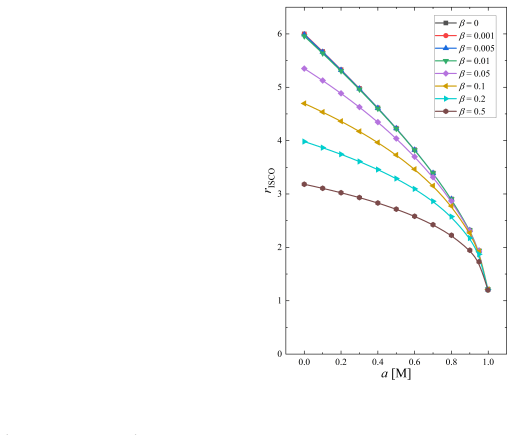
The central object is the effective potential $V_{\mathrm{eff}}$ for a charged timelike particle in Kerr spacetime with Wald's asymptotically uniform electromagnetic field, from which the circular-orbit parameters ($E$, $p_{\varphi}$, $\Omega$) are obtained numerically instead of analytically. Because the magnetized spacetime is non-integrable, the usual closed forms for $E(r)$, $p_{\varphi}(r)$, and $\Omega(r)$ do not exist; the machinery replaces them with Newton-iteration solutions of $\partial V_{\mathrm{eff}}/\partial r = 0$ and finite-difference derivatives $p'_{\varphi}$ and $\Omega'$ fed into the Novikov-Thorne flux integral. The ISCO radius, fixed by $\partial V_{\mathrm{eff}}/\partial r = \partial^{2}V_{\mathrm{eff}}/\partial r^{2}=0$, acts as the inner boundary, and the claimed luminosity enhancement is attributed to this boundary moving inward as the magnetic parameter $\beta = qB$ grows.
What would settle it
A decisive test would be to re-derive the disk flux from the full energy-momentum balance of a charged fluid in the combined gravitational and electromagnetic field and compare the resulting $F(r)$ and spectra with those obtained by inserting charged-particle orbits into the neutral-fluid Novikov-Thorne formula; a substantial difference for $\beta \gtrsim 0.5$ would undercut the reported threshold. Observationally, a system with an independently measured ambient magnetic field could be checked for the predicted excess over the Kerr-maximum luminosity.
Extended reading notes
Core claim
The central claim is that the Novikov-Thorne disk around a Kerr black hole immersed in an asymptotically uniform magnetic field radiates more intensely when the field is aligned with the black hole's angular momentum, and that the increase is large enough to push luminosity above the maximum allowed for an isolated Kerr black hole of the same mass and accretion rate. The mechanism is not a change in the disk's efficiency formula but a shift of the inner boundary: a stronger field moves the innermost stable circular orbit (ISCO) inward, so the disk extends closer to the horizon and releases more gravitational binding energy as radiation. The authors support this with numerical solutions of the effective potential for charged timelike particles, numerical derivatives of specific angular momentum and angular velocity, and blackbody integration over the disk. They further claim that spin and field strength act similarly on the spectra, so continuum data alone cannot cleanly separate the two, and that the spectral difference between $\beta=0$ and $\beta=0.5$ is large enough to detect, corresponding to the quoted threshold.
Load-bearing premise
The load-bearing assumption is that the standard Novikov-Thorne flux formula, derived for a neutral fluid on circular geodesics by conserving rest mass, energy, and angular momentum, still gives the disk's flux when the orbiting matter is charged and subject to the Lorentz force; the paper does not derive modified balance equations that include the field's exchange of energy and angular momentum with the disk.
Editorial extensions
If this is right
- Aligned magnetic fields increase the energy flux density and temperature of the Novikov-Thorne disk for fixed black hole mass and accretion rate, shifting the emission peak inward.
- Because spin also increases flux, magnetic-field and spin effects are partially degenerate; continuum spectra alone cannot cleanly separate them.
- Any observed disk luminosity above the Kerr maximum for a given mass and accretion rate would be evidence for an ambient magnetic field.
- For a $10^{6}M_{\odot}$ black hole at $10^{-12}M_{\odot}\,\mathrm{yr}^{-1}$ with proton-composition plasma, field strengths down to about $1.0638\times10^{-9}$ T should be detectable through spectral luminosity deviations.
- Magnetic effects on spectra are negligible for $\beta \leq 0.01$ and largely suppressed for rapidly spinning black holes ($a > 0.95$) or weak fields.
Reading between the lines
- Inference: the numerical orbit solver does not rely on spacetime integrability, so the same pipeline could handle non-uniform or self-consistently sourced magnetic fields, not just the asymptotically uniform Wald configuration.
- Inference: extending the pipeline to misaligned magnetic fields would break axisymmetry and likely produce non-axisymmetric or time-dependent disk signatures; the authors flag this as future work.
- Inference: pairing continuum spectra with independent spin estimates from other probes would break the spin-field degeneracy and isolate the magnetic contribution to the luminosity.
- Inference: the quoted threshold scales with the assumed charge-to-mass ratio, so a different plasma composition would shift the detectable field strength by orders of magnitude.
Editorial analysis
A structured set of objections, weighed in public.
Referee Report
Summary. The paper numerically computes the specific energy, specific angular momentum, and angular velocity of equatorial circular orbits for charged test particles in Kerr spacetime with an asymptotically uniform Wald magnetic field, using Newton iteration, finite differences, and interpolation. These orbital parameters are then inserted into the standard Novikov-Thorne flux formula to produce radial flux and temperature profiles and blackbody luminosity spectra for various black hole spins, magnetic coupling parameters, and observer inclinations. The central claims are that stronger magnetic fields increase disk luminosity and shift emission peaks to higher frequencies, and that for a 10^6 solar mass black hole with accretion rate 10^-12 solar masses per year, magnetic fields down to 1.0638 x 10^-9 T are detectable through deviations from the maximal Kerr spectrum. The paper also emphasizes that this is the first direct relationship between external magnetic fields and Novikov-Thorne disk properties.
Significance. If the central results were valid, the paper would provide a useful numerical pathway for treating accretion disk observables in non-integrable axisymmetric spacetimes, and the proposed magnetic-field threshold would be an interesting, falsifiable prediction. The paper is clear in presenting its parameter scans and identifies a degeneracy between spin and magnetic field strength that deserves attention. However, the main quantitative conclusion is not established because the standard Novikov-Thorne flux formula is applied to a charged, magnetized disk without deriving the required energy and angular momentum balance equations. The numerical orbital calculations themselves may be useful, but the spectral predictions and the threshold claim rest on an assumption that is neither derived nor tested.
major comments (4)
- [Sec. III, Eq. (15)] The paper substitutes the numerically computed orbital parameters E, p_phi, and Omega for charged particles into the standard Novikov-Thorne flux formula Eq. (15) without deriving the corresponding energy and angular-momentum balance equations for a magnetized fluid. Eq. (15) follows from conservation of rest mass, energy, and angular momentum for a neutral fluid on circular geodesics with zero torque at the ISCO; with a Lorentz force, the disk acquires an azimuthal force density f_phi = q F_{phi r} u^r, with F_{phi r} = partial_r A_phi nonzero from Eq. (5), and the external field's Maxwell stress contributes to the vertically integrated stress and may alter the ISCO boundary condition. Since none of these terms is estimated or included, the flux, temperature, and luminosity curves in Figs. 3 and 4 and the threshold B_SI = 1.0638 x 10^-9 T are not established. The authors would need to derive the modified thin-disk equations including electromagnetic stress and energy exchange, or show quantitatively that these effects are negligible.
- [Sec. III, Eq. (19)] The claimed observable threshold rests on the assumption that the accretion disk 'consists of protons' with charge-to-mass ratio 9.5788 x 10^7 C/kg. A realistic accretion disk is a quasi-neutral plasma, not a collection of free protons; a disk made solely of protons would carry an enormous net charge, and the resulting electric fields and charge-separation forces are not modeled anywhere in the paper. The single-particle charge-to-mass conversion in Eq. (19) therefore does not yield a physically meaningful magnetic-field threshold for a thin accretion disk.
- [Sec. II, Fig. 1 and Sec. III, Eq. (15)] The inner edge r_ISCO is obtained from the test-particle effective potential by requiring partial_r V_eff = partial_rr V_eff = 0, and this same radius is then used as the lower limit of the integral in Eq. (15) and, implicitly, as the zero-torque inner boundary. In a magnetized disk, magnetic stresses can be nonzero at the ISCO and can transport angular momentum across it, so the zero-torque boundary condition used in deriving Eq. (15) is not automatically valid. The paper gives no argument that the ISCO remains the stress-free inner edge once the Lorentz force and Maxwell stress act on the accreting matter.
- [Sec. IV and Fig. 4] The statement that 'any observed luminosity surpassing the Kerr maximum would provide compelling evidence for the existence of ambient magnetic fields' is an overclaim. The paper itself acknowledges a degeneracy between spin and magnetic field strength, and the Kerr maximum depends on the assumed mass, accretion rate, inclination, and blackbody character of the emission. Non-thermal emission, uncertainties in the accretion rate, or deviations from the thin-disk assumptions could produce apparent super-Kerr luminosities without magnetic fields. The observational conclusion should be presented as a model-dependent indication rather than a standalone detection criterion.
minor comments (4)
- [Fig. 3 caption] The caption reads 'From left to light' and should read 'From left to right'.
- [Sec. III, Eq. (16)] There is a missing space in 'temperature profileT [K]'; it should be 'temperature profile T [K]'.
- [Sec. III, numerical methods] The finite-difference derivatives of p_phi and Omega are computed from discrete data, but no convergence or accuracy tests are reported; a validation against the known analytical Kerr limit at beta = 0 would strengthen confidence in the numerical pipeline.
- [Sec. III, Eq. (18)] The redshift factor in Eq. (18) is the standard expression for circular equatorial emitters; its use for the quasi-Keplerian, radially drifting magnetized flow should be justified or its limitations stated.
Circularity Check
No significant circularity: orbital parameters are computed independently and fed forward into the Novikov-Thorne flux formulas; the claimed threshold is a hand-picked detection criterion, not a fitted prediction.
full rationale
The derivation chain is feed-forward rather than circular. The orbital parameters E, p_phi, and Omega are obtained numerically from the effective potential in Sec. II (Eqs. 9-14) for a specified magnetic parameter beta = qB. These are independent inputs, not quantities fitted to the disk flux, temperature, or luminosity outputs. The energy flux density is then computed from the standard Novikov-Thorne formula, Eq. (15), using finite-difference derivatives of those orbital parameters; no parameter is adjusted to reproduce F, T, or the spectra in Figs. 3-4. The threshold field B_SI = 1.0638 x 10^-9 T is obtained by choosing beta = 0.5 by hand, based on the visibly non-negligible deviations in Fig. 4, and converting via Eq. (19). That is an arbitrary detection-criterion choice, not a fitted parameter disguised as a prediction, so it does not constitute circularity. The self-citations in the reference list are contextual literature citations and are not load-bearing for the paper's central derivation. The main substantive weakness is physical rather than logical: the Novikov-Thorne flux formula, Eq. (15), is applied to charged-particle orbits without deriving the modified energy and angular-momentum balance that includes the Lorentz force and Maxwell stress. That is a modeling assumption and correctness risk, but it is not an equivalence between input and output by construction, and it does not make the derivation circular.
Assumptions & free parameters
free parameters (5)
- dimensionless magnetic coupling beta = qB =
0, 0.01, 0.1, 0.5 (scanned)
- black hole mass M =
10^6 solar masses
- accretion rate Mdot =
10^-12 solar masses per year
- proton charge-to-mass ratio rho_SI =
9.5788e7 C/kg
- disk outer radius redge =
unspecified
assumptions (5)
- domain assumption The Kerr metric is the background spacetime, and the Wald electromagnetic field is a test field that does not backreact on the geometry.
- standard math The super-Hamiltonian and effective potential of Eqs. (6)-(13) correctly describe charged test-particle motion.
- domain assumption The disk remains confined to the equatorial plane, theta = pi/2, and consists of circular quasi-Keplerian orbits.
- ad hoc to paper The Novikov-Thorne flux formula, Eq. (15), applies without modification when particle motion is governed by the Lorentz force.
- ad hoc to paper The disk fluid can be modeled as a collection of protons with charge-to-mass ratio rho_SI.
Cite this review
Pith. "Pith review of Influence of the external electromagnetic field on the properties of the Novikov-Thorne accretion disk in Kerr spacetime." pith.science (2026). https://pith.science/paper/L76YG6PN
@misc{pith2026250714599,
  author       = {Pith},
  title        = {Pith review of: Influence of the external electromagnetic field on the properties of the Novikov-Thorne accretion disk in Kerr spacetime},
  year         = {2026},
  howpublished = {\url{https://pith.science/paper/L76YG6PN}},
  note         = {Machine review of arXiv:2507.14599}
}
abstract
The Novikov-Thorne accretion disk model is widely employed in astrophysics, yet computing its blackbody spectrum theoretically requires analytical expressions for the orbital parameters -- specific energy, angular momentum, and angular velocity -- of the constituent timelike particles, a task extremely challenging in non-integrable curved spacetimes. In this work, we numerically obtain these orbital parameters for quasi-Keplerian motion in Kerr spacetime with an asymptotically uniform magnetic field using iterative, finite-difference, and interpolation methods, enabling simulations of the disk's energy flux density, temperature, and blackbody spectra across diverse spin parameters, observational inclinations, and magnetic field strengths. We demonstrate that when the magnetic field aligns with the black hole's angular momentum, the disk's radiation positively correlates with field strength, while spectral analysis for our specific black hole mass and accretion rate reveals a conservative detectable threshold of $1.0638 \times 10^{-9}$ T for ambient magnetic fields. This study not only extends the Novikov-Thorne model to non-integrable axisymmetric spacetimes but also establishes the first direct relationship between external magnetic fields and disk properties, providing critical theoretical support for future magnetic environment studies through disk radiation observations.
Figures


Figures from the paper (1 more)

Forward citations
Cited by 1 Pith paper
-
On Accretion and Neutrino Investigations of Thermodynamically Reconstructed Black Holes from Three-Parameter Generalized Entropy
A generalized-entropy black-hole model with horizon temperature fixed by entropy predicts sign-controlled ISCO, shadow, and efficiency shifts, but relies on an arbitrary exterior profile p.
Reference graph
Works this paper leans on
-
[1]
School of Mathematics and Physics, University of South China, Hengyang, 421001 People’s Republic of China
-
[2]
School of Astronomy and Space Science, Nanjing University, Nanjing, 210023 People’s Republic of China Abstract The Novikov-Thorne accretion disk model is widely employed in astrophysics, yet computing its blackbody spectrum theoretically requires analytical expressions for the orbital parameters— specific energy, angular momentum, and angular velocity—of ...
arXiv 2025
-
[3]
B. P. Abbott et al. (LIGO Scientific and Virgo Collaborations), Observation of Gravitational Waves from a Binary Black Hole Merger, Phys. Rev. Lett. 116, 061102 (2016)
2016
-
[4]
Akiyama et al
K. Akiyama et al. (Event Horizon Telescope collaboration), First M87 Event Horizon Telescope Results. I. The shadow of the supermassive black hole, Astrophys. J. Lett. 875, L1 (2019)
2019
-
[5]
Akiyama et al
K. Akiyama et al. (Event Horizon Telescope collaboration), First Sagittarius A∗ Event Horizon Telescope Results. I. The Shadow of the Supermassive Black Hole in the Center of the Milky Way, Astrophys. J. Lett. 930, L12 (2022)
2022
-
[6]
N. I. Shakura and R. A. Sunyaev, Black holes in binary systems. Observational appearance, Astron. & Astrophys. 24, 337 (1973)
1973
-
[7]
I. D. Novikov and K. S. Thorne, Astrophysics of black holes, in Black Holes, ed. C. DeWitt and B. DeWitt (New York: Gordon & Breach), 343 (1973)
1973
-
[8]
L. X. Li, E. R. Zimmerman, R. Narayan, and J. E. McClintock, Multitemperature Blackbody Spectrum of a Thin Accretion Disk around a Kerr Black Hole: Model Computations and Comparison with Observations, Astrophys. J. Suppl. S. 157, 335 (2005)
2005
Show all 90 references
-
[9]
L. J. Gou, J. E. McClintock, M. J. Reid, et al., The Extreme Spin of the Black Hole in Cygnus X-1, Astrophys. J. 742, 85 (2011)
2011
-
[10]
Bambi and E
C. Bambi and E. Barausse, Constraining the quadrupole moment of stellar-mass black-hole candidates with the continuum fitting method, Astrophys. J. 731, 121 (2011)
2011
-
[11]
L. J. Gou, J. E. McClintock, R. A. Remillard, et al., Confirmation Via the Continuum-Fitting Method that the Spin of the Black Hole in Cygnus X-1 is Extreme, Astrophys. J. 790, 29 (2014)
2014
-
[12]
Bambi, J
C. Bambi, J. C. Jiang, and J. F. Steiner, Testing the no-hair theorem with the continuum- fitting and the iron line methods: a short review, Class. Quantum Grav. 33, 064001 (2016)
2016
-
[13]
Tripathi, A
A. Tripathi, A. B. Abdikamalov, D. Ayzenberg, et al., Testing the Kerr black hole hypothesis with the continuum-fitting and the iron line methods: the case of GRS 1915+105, J. Cosmol. 15 Astropart. P. 01, 019 (2022)
2022
-
[14]
X. S. Zhao, L. J. Gou, Y. T. Dong, et al., Re-estimating the Spin Parameter of the Black Hole in Cygnus X-1, Astrophys. J. 908, 117 (2021)
2021
-
[15]
Mummery, A
A. Mummery, A. Ingram, S. Davis, et al., Continuum emission from within the plunging region of black hole discs, Mon. Not. R. Astron. Soc. 531, 366 (2024)
2024
-
[16]
K. S. Thorne, Disk-Accretion onto a Black Hole. II. Evolution of the Hole, Astrophys. J. 191, 507 (1974)
1974
-
[17]
D. F. Torres, Accretion disc onto a static non-baryonic compact object, Nucl. Phys. B 626, 377 (2002)
2002
-
[18]
Boshkayev, T
K. Boshkayev, T. Konysbayev, Y. Kurmanov, et al., Luminosity of accretion disks around rotating regular black holes, Eur. Phys. J. C 84, 230 (2024)
2024
-
[19]
Capozziello, S
S. Capozziello, S. Gambino, and O. Luongo, Comparing Bondi and Novikov-Thorne accretion disk luminosity around regular black holes, Phys. Dark Univ. 48, 101950 (2025)
2025
-
[20]
Harko, Z
T. Harko, Z. Kov´ acs, and F. S. N. Lobo, Electromagnetic signatures of thin accretion disks in wormhole geometries, Phys. Rev. D 78, 084005 (2008)
2008
-
[21]
Harko, Z
T. Harko, Z. Kov´ acs, and F. S. N. Lobo, Thin accretion disks in stationary axisymmetric wormhole spacetimes, Phys. Rev. D 79, 064001 (2009)
2009
-
[22]
R. Kh. Karimov, R. N. Izmailov, and K. K. Nandi, Accretion disk around the rotating Damour–Solodukhin wormhole, Eur. Phys. J. C 79, 952 (2019)
2019
-
[23]
R. Kh. Karimov, R. N. Izmailov, A. A. Potapov, et al., Can accretion properties distinguish between a naked singularity, wormhole and black hole? Eur. Phys. J. C 80, 1138 (2020)
2020
-
[24]
Bambhaniya, Saurabh, K
P. Bambhaniya, Saurabh, K. Jusufi, et al., Thin accretion disk in the Simpson-Visser black- bounce and wormhole spacetimes, Phys. Rev. D 105, 023021 (2022)
2022
-
[25]
Kov´ acs and T
Z. Kov´ acs and T. Harko, Can accretion disk properties observationally distinguish black holes from naked singularities? Phys. Rev. D 82, 124047 (2010)
2010
-
[26]
P. S. Joshi, D. Malafarina, and R. Narayan, Distinguishing black holes from naked singularities through their accretion disc properties, Class. Quantum Grav. 31, 015002 (2014)
2014
-
[27]
Tahelyani, A
D. Tahelyani, A. B. Joshi, D. Dey, et al., Comparing thin accretion disk properties of naked singularities and black holes, Phys. Rev. D 106, 044036 (2022)
2022
-
[28]
Harko, Z
T. Harko, Z. Kov´ acs, and F. S. N. Lobo, Can accretion disk properties distinguish gravastars from black holes? Class. Quantum Grav. 26, 215006 (2009). 16
2009
-
[29]
C. S. J. Pun, Z. Kov´ acs, and T. Harko, Thin accretion disks inf (R) modified gravity models, Phys. Rev. D 78, 024043 (2008)
2008
-
[30]
C. S. J. Pun, Z. Kov´ acs, and T. Harko, Thin accretion disks onto brane world black holes, Phys. Rev. D 78, 084015 (2008)
2008
-
[31]
Harko, Z
T. Harko, Z. Kov´ acs, and F. S. N. Lobo, Testing Hoˇ rava-Lifshitz gravity using thin accretion disk properties, Phys. Rev. D 80, 044021 (2009)
2009
-
[32]
Harko, Z
T. Harko, Z. Kov´ acs, and F. S. N. Lobo, Thin accretion disk signatures in dynamical Chern– Simons-modified gravity, Class. Quantum Grav. 27, 105010 (2010)
2010
-
[33]
S. B. Chen and J. L. Jing, Thin accretion disk around a Kaluza–Klein black hole with squashed horizons, Phys. Lett. B 704, 641 (2011)
2011
-
[34]
S. B. Chen and J. L. Jing, Properties of a thin accretion disk around a rotating non-Kerr black hole, Phys. Lett. B 711, 81 (2012)
2012
-
[35]
P´ erez, G
D. P´ erez, G. E. Romero, and S. E. Perez Bergliaffa, Accretion disks around black holes in modified strong gravity, Astron. & Astrophys. 551, A4 (2013)
2013
-
[36]
C. J. Moore and J. R. Gair, Testing the no-hair property of black holes with x-ray observations of accretion disks, Phys. Rev. D 92, 024039 (2015)
2015
-
[37]
P´ erez, F
D. P´ erez, F. G. L. Armengol, and G. E. Romero, Accretion disks around black holes in scalar- tensor-vector gravity, Phys. Rev. D 95, 104047 (2017)
2017
-
[38]
R. Kh. Karimov, R. N. Izmailov, A. Bhattacharya, et al., Accretion disks around the Gibbons– Maeda–Garfinkle–Horowitz–Strominger charged black holes, Eur. Phys. J. C 78, 788 (2018)
2018
-
[39]
Heydari-Fard, M
M. Heydari-Fard, M. Heydari-Fard, and H. R. Sepangi, Thin accretion disks and charged rotating dilaton black holes, Eur. Phys. J. C 80, 351 (2020)
2020
-
[40]
F. H. Zuluaga and L. A. S´ anchez, Accretion disk around a Schwarzschild black hole in asymp- totic safety, Eur. Phys. J. C 81, 840 (2021)
2021
-
[41]
L. G. Collodel, D. D. Doneva, and S. S. Yazadjiev, Circular Orbit Structure and Thin Accretion Disks around Kerr Black Holes with Scalar Hair, Astrophys. J. 910, 52 (2021)
2021
-
[42]
Boshkayev, T
K. Boshkayev, T. Konysbayev, E. Kurmanov, et al., Luminosity of accretion disks in compact objects with a quadrupole, Phys. Rev. D 104, 084009 (2021)
2021
-
[43]
C. Liu, T. Zhu, and Q. Wu, Thin accretion disk around a four-dimensional Einstein-Gauss- Bonnet black hole, Chin. Phys. C 45, 015105 (2021)
2021
-
[44]
Heydari-Fard and H
M. Heydari-Fard and H. R. Sepangi, Thin accretion disk signatures of scalarized black holes 17 in Einstein-scalar-Gauss-Bonnet gravity, Phys. Lett. B 816, 136276 (2021)
2021
-
[45]
Heydari-Fard, M
M. Heydari-Fard, M. Heydari-Fard, and H. R. Sepangi, Thin accretion disks around rotating black holes in 4D Einstein–Gauss–Bonnet gravity, Eur. Phys. J. C 81, 473 (2021)
2021
-
[46]
Kazempour, Y
S. Kazempour, Y. C. Zou, and A. R. Akbarieh, Analysis of accretion disk around a black hole in dRGT massive gravity, Eur. Phys. J. C 82, 190 (2022)
2022
-
[47]
T. Y. He, Z. Q. Cai, and R. J. Yang, Thin accretion disks around a black hole in Einstein- Aether-scalar theory, Eur. Phys. J. C 82, 1067 (2022)
2022
-
[48]
Fathi and N
M. Fathi and N. Cruz, Observational signatures of a static f (R) black hole with thin accretion disk, Eur. Phys. J. C 83, 1160 (2023)
2023
-
[49]
˙I. ˙I. C ¸ imdiker, A.¨Ovg¨ un, and D. Demir, Thin accretion disk images of the black hole in symmergent gravity, Class. Quantum Grav. 40, 184001 (2023)
2023
-
[50]
Alloqulov, S
M. Alloqulov, S. Shaymatov, B. Ahmedov, et al., Radiation properties of the accretion disk around a black hole in Einstein-Maxwell-scalar theory, Chin. Phys. C 48, 025101 (2024)
2024
-
[51]
Y. D. Wu, H. Y. Feng, and W. Q. Chen, Thin accretion disk around black hole in Einstein– Maxwell-scalar theory, Eur. Phys. J. C 84, 1075 (2024)
2024
-
[52]
Heydari-Fard, M
M. Heydari-Fard, M. Heydari-Fard, and N. Riazi, Thin accretion disk images of rotating hairy Horndeski black holes, Astrophys. Space Sci. 369, 96 (2024)
2024
-
[53]
Dyadina and N
P. Dyadina and N. Avdeev, Thin accretion disk signatures in hybrid metric-Palatini gravity, Eur. Phys. J. C 84, 103 (2024)
2024
-
[54]
Boshkayev, T
K. Boshkayev, T. Konysbayev, Y. Kurmanov, et al., Accretion disk in the Hartle–Thorne spacetime, Eur. Phys. J. P. 139, 273 (2024)
2024
-
[55]
A. L. Liu, T. Y. He, M. Liu, et al., Possible signatures of higher dimension in thin accretion disk around brane world black hole, J. Cosmol. Astropart. P. 07, 062 (2024)
2024
-
[56]
Y. H. Jiang and T. Wang, Accretion disks around magnetically charged black holes in string theory with an Euler-Heisenberg correction, Phys. Rev. D 110, 103009 (2024)
2024
-
[57]
Y. H. Shu and J. H. Huang, Circular orbits and thin accretion disk around a quantum corrected black hole, Phys. Lett. B 864, 139411 (2025)
2025
-
[58]
Uktamov, M
U. Uktamov, M. Alloqulov, S. Shaymatov, et al., Particle dynamics and the accretion disk around a Self-dual Black Hole immersed in a magnetic field in Loop Quantum Gravity, Phys. Dark Univ. 47, 101743 (2025)
2025
-
[59]
Faraji, The impact of compact object deformation on thin accretion disk properties, Eur
S. Faraji, The impact of compact object deformation on thin accretion disk properties, Eur. 18 Phys. J. C 85, 148 (2025)
2025
-
[60]
Nozari, S
K. Nozari, S. Saghafi, and F. Aliyan, Investigating QED Effects on the Thin Accretion Disk Properties Around Rotating Euler-Heisenberg Black Holes, Eur. Phys. J. C 85, 735 (2025)
2025
-
[61]
Nozari, S
K. Nozari, S. Saghafi, M. Hajebrahimi, et al., Circular orbits and accretion disk around a deformed-Schwarzschild black hole in loop quantum gravity, arXiv: 2504.12486
-
[62]
S. Q. Liu and J. H. Huang, Radiative properties of thin accretion disks around rotating short- hairy black holes, arXiv: 2501.10716
-
[63]
R. J. Tang, S. Faraji, and N. Afshordi, Accretion disk dynamics in Teleparallel Born-Infeld gravity, arXiv: 2502.03775
-
[64]
Kumar, Effect of Non-commutativity on Accretion Disks around RGI-Schwarzschild Black Hole, arXiv: 2507.13056
D. Kumar, Effect of Non-commutativity on Accretion Disks around RGI-Schwarzschild Black Hole, arXiv: 2507.13056
-
[65]
Boshkayev, R
K. Boshkayev, R. Giamb` o, T. Konysbayev, et al., Accretion disk luminosity for black holes surrounded by dark matter with anisotropic pressure, Astrophys. J. 925, 210 (2022)
2022
-
[66]
Boshkayev, T
K. Boshkayev, T. Konysbayev, Ye. Kurmanov, et al., Accretion Disk Luminosity for Black Holes Surrounded by Dark Matter with Tangential Pressure, Astrophys. J. 936, 96 (2022)
2022
-
[67]
Narzilloev and B
B. Narzilloev and B. Ahmedov, Radiation Properties of the Accretion Disk around a Black Hole Surrounded by PFDM, Symmetry 14, 1765 (2022)
2022
-
[68]
Heydari-Fard, M
M. Heydari-Fard, M. Heydari-Fard, and N. Riazi, Galactic black hole immersed in a dark halo with its surrounding thin accretion disk, Gen. Rel. Grav. 57, 49 (2025)
2025
-
[69]
Kobialko, D
K. Kobialko, D. Gal’tsov, and A. Molchanov, Gravitational shadow and emission spectrum of thin accretion disks in a plasma medium, arXiv: 2505. 07993
-
[70]
Capolupo, O
A. Capolupo, O. Luongo, and A. Quaranta, Impact of flavor condensate dark matter on accretion disk luminosity in spherical in spacetimes, arXiv: 2507.03758
-
[71]
J. -P. Luminet, Image of a spherical black hole with thin accretion disk, Astron. & Astrophys. 75, 228 (1979)
1979
-
[72]
Z. L. Zhang, S. B. Chen, and J. L. Jing, Polarized image of a Schwarzschild black hole with a thin accretion disk as photon couples to Weyl tensor, Eur. Phys. J. C 81, 991 (2021)
2021
-
[73]
Z. L. Zhang, S. B. Chen, and J. L. Jing, Image of Bonnor black dihole with a thin accretion disk and its polarization information, Eur. Phys. J. C 82, 885 (2022)
2022
-
[74]
S. Y. Hu, C. Deng, S. Guo, et al., Observational signatures of Schwarzschild-MOG black holes in scalar–tensor–vector gravity: images of the accretion disk, Eur. Phys. J. C 83, 264 (2023). 19
2023
-
[75]
S. Guo, Y. X. Huang, and G. P. Li, Optical appearance of the Schwarzschild black hole in the string cloud context, Chin. Phys. C 47, 065105 (2023)
2023
-
[76]
Y. X. Huang, S. Guo, Y. H. Cui, et al., Influence of accretion disk on the optical appearance of the Kazakov-Solodukhin black hole, Phys. Rev. D 107, 123009 (2023)
2023
-
[77]
Y. H. Cui, S. Guo, Y. X. Huang, et al., Optical appearance of numerical black hole solutions in higher derivative gravity, Eur. Phys. J. C 84, 772 (2024)
2024
-
[78]
Li, Observational Features of Thin Accretion Disk Around Rotating Regular Black Hole, Eur
Z. Li, Observational Features of Thin Accretion Disk Around Rotating Regular Black Hole, Eur. Phys. J. C 85, 514 (2025)
2025
-
[79]
Li and X
Z. Li and X. K. Guo, Thin Accretion Disk Around Rotating Hairy Black Hole: Radiative Property and Optical Appearance, Eur. Phys. J. C 85, 679 (2025)
2025
-
[80]
J. J. Yin, T. Y. He, M. Liu, et al., Observational properties of black hole in quantum fluctuation modified gravity, Nucl. Phys. B 1018, 117004 (2025)
2025
-
[81]
Z. Q. Cai, Z. L. Ban, H. Y. Feng, et al., Thin accretion disk around Schwarzschild-like black hole in bumblebee gravity, arXiv: 2503.08424
-
[82]
Z. Q. Cai, Z. L. Ban, H. Y. Feng, et al., Shadow and thin accretion disk around Ay´ on-Beato- Garc ´ ıa black hole coupled with cloud of strings, arXiv: 2506.22744
-
[83]
J. A. Petterson, Magnetic field of a current loop around a Schwarzschild black hole, Phys. Rev. D 10, 10 (1974)
1974
-
[84]
Stuchl ´ ık and M
Z. Stuchl ´ ık and M. Koloˇ s, Acceleration of the charged particles due to chaotic scattering in the combined black hole gravitational field and asymptotically uniform magnetic field, Eur. Phys. J. C 76, 32 (2016)
2016
-
[85]
Abbas, H
G. Abbas, H. Rehman, T. Zhu, et al., Accretion disk around Reissner-Nordstr¨ om black hole coupled with a nonlinear electrodynamics field, arXiv: 2310.04053
-
[86]
Ditta, G
A. Ditta, G. Mustafa, G. Abbas, et al., Constraining study of circular orbits and accretion disk around nonlinear electrodynamics black hole, J. Cosmol. Astropart. P. 08, 002 (2023)
2023
-
[87]
Uniyal, R
A. Uniyal, R. C. Pantig, and A. ¨Ovg¨ un, Probing a non-linear electrodynamics black hole with thin accretion disk, shadow, and deflection angle with M87 ∗ and Sgr A ∗ from EHT, Phys. Dark Univ. 40, 101178 (2023)
2023
-
[88]
Kurmanov, K
Y. Kurmanov, K. Boshkayev, T. Konysbayev, et al., Accretion disks properties around regular black hole solutions obtained from non-linear electrodynamics, Phys. Dark Univ. 46, 101566 (2024). 20
2024
-
[89]
R. M. Wald, Black hole in a uniform magnetic field, Phys. Rev. D 10, 6 (1974)
1974
-
[90]
Kop´ aˇ cek and V
O. Kop´ aˇ cek and V. Karas, Inducing chaos by breaking axial symmetry in a black hole mag- netosphere, Astrophys. J. 787, 117 (2014). 21
2014
Reviewed August 6, 2026 · model on record in the stance chip above.
Discussion (0). Continue with ORCID to comment.