REVIEW 3 major objections 5 minor 34 references
Great Power Brings Great Responsibility: Personalizing Conversational AI for Diverse Problem-Solvers
T0 review · 3 major / 5 minor · reviewed 2026-08-08 · deepseek-v4-flash
Pith's one-line read The paper argues that LLM-based OSS onboarding help can be personalized to a newcomer's problem-solving style, and demonstrates that persona-based prompts change how ChatGPT answers the same question.
desk verdict An honest, well-scoped vision paper that shows ChatGPT can vary responses by GenderMag persona but never tests whether matching style actually helps OSS newcomers, leaving the core benefit claim as an untested premise. read the letter →
The pith
A machine-rendered reading of the paper's core claim, the machinery that carries it, and where it could break.
The reading
What carries the argument
The machinery is persona-based prompt engineering: crafting a prompt that instructs the LLM to answer from the perspective of a defined user archetype. The paper anchors that archetype in the GenderMag personas Abi and Tim, opposite ends of a spectrum that covers attitude toward risk, computer self-efficacy, motivation, information processing, and technology learning style. This single mechanism does the argument's work by turning one generic query into style-specific guidance, and it is the only part of the proposal the paper actually exercises; the rest of the proposal is a research agenda.
What would settle it
Take newcomers, measure their problem-solving style, and randomly assign each one default, Abi-style, or Tim-style ChatGPT guidance for the same onboarding task; if the style-matched group does not complete the task more often or with fewer follow-up questions than the mismatched or default groups, the central claim fails.
Extended reading notes
Core claim
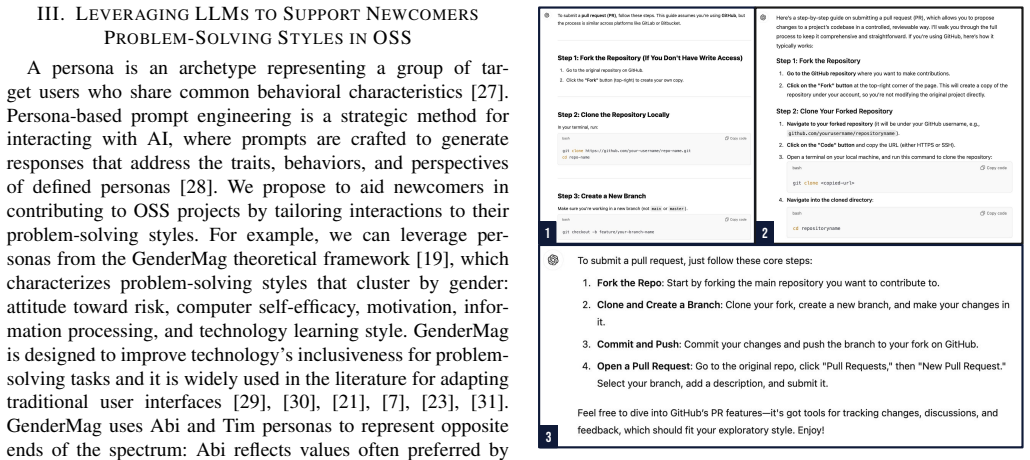
The central claim is that the information-presentation bias already documented in OSS artifacts can enter LLM-generated help, and that persona-based prompt engineering is a possible way to counter it. Concretely, the paper shows ChatGPT answering 'How can I submit a pull request?' in a neutral default, in an Abi-style response that gives structured, reversible steps for a risk-averse, process-oriented newcomer, and in a Tim-style response that gives a short list and encourages tinkering. The paper presents these transcripts from GPT-4 as evidence that response style is controllable through prompts, not as evidence that style-matched help improves outcomes; it explicitly asks for empirical studies to determine whether the tailoring benefits newcomers.
Load-bearing premise
The load-bearing premise is that matching an AI response's style to a newcomer's problem-solving style actually improves their ability to contribute; the paper shows only that prompts can change the style, not that the change helps.
Editorial extensions
If this is right
- If the claim holds, the default one-size-fits-all AI answer stops being the only answer; an OSS assistant could silently shift its explanation to match the asker's style.
- Projects could add a style-matching layer to existing onboarding bots without rewriting their documentation.
- The planned empirical studies could compare matched-style, mismatched-style, and default guidance on outcomes such as time to first contribution, task success, and follow-up questions.
- The same prompt-level technique could extend from pull-request guidance to issue triage, code review, and documentation queries, as the paper's research opportunities suggest.
Reading between the lines
- Because the style switch happens at the prompt level rather than in the model weights, the approach could transfer across LLM providers and future model versions without retraining, which the paper does not state.
- A natural next experiment, which the paper invites but does not run, would randomly assign newcomers to matched, mismatched, and default styles and measure whether matching actually lowers cognitive load or speeds first contribution.
- If the mechanism works, content designers could generate a small family of persona variants for core contribution guides, turning a single document into adaptive explanations for different learners.
Editorial analysis
A structured set of objections, weighed in public.
Referee Report
Summary. This vision paper proposes using LLM persona-based prompt engineering to tailor conversational AI assistance to newcomers' problem-solving styles in OSS onboarding. The authors use the GenderMag Abi and Tim personas to illustrate how ChatGPT can produce different stylistic responses to the same question ('How can I submit a pull request?'), and they outline future research directions including empirical studies and automatic persona inference. The paper explicitly frames itself as a vision and calls for further research.
Significance. If the proposed approach works, it could reduce style-based barriers in OSS onboarding and make AI-driven support more inclusive. The paper is honest about being a position piece, provides a publicly accessible replication package with chat transcripts, and offers concrete, testable research directions. Its main strength is the clear articulation of a plausible mechanism—persona-based personalization—grounded in an established framework (GenderMag). However, the paper does not provide empirical evidence that the mechanism yields the claimed benefits, and the single illustrative example is inherently prompt-driven.
major comments (3)
- [Section III, Figure 1] The example shown in Figure 1 is a prompt-following artifact: instructing ChatGPT to respond 'as Abi' or 'as Tim' makes different outputs highly likely, so the observed variation is constructed by the prompt rather than an independent finding. The paper should explicitly state that this demonstration only shows the model's ability to adopt personas, and not that the default response privileges Tim-like learners or that style-matched responses improve onboarding outcomes.
- [Section I, Section IV, Abstract] The central assumption—that aligning response style with a user's problem-solving style improves newcomer outcomes—is not tested anywhere in the manuscript and is deferred to future work in Section IV. Because the abstract claims the approach can 'avoid privileging a particular subgroup,' this untested hypothesis is load-bearing. The authors should mark this explicitly as an assumption and temper the abstract's wording to say that style-aligned responses are hypothesized to reduce privilege, with the example serving only as a feasibility illustration.
- [Section III, Related Work] The motivation relies on a transfer from documented biases in OSS documentation and issue descriptions (e.g., [7], [8]) to LLM-generated responses, but the paper offers no evidence that ChatGPT's default response is biased toward a particular problem-solving style. This gap should be acknowledged, and the claim that LLMs 'may carry biases' should be framed as an open question rather than a supported premise, with the research agenda being to investigate that question.
minor comments (5)
- [Abstract] The phrase 'to avoid privileging a particular subgroup' is stronger than the evidence; suggest 'has the potential to avoid privileging' to match the paper's own 'potential' framing.
- [Section II] The statement that GenderMag 'characterizes problem-solving styles that cluster by gender' oversimplifies the framework; GenderMag personas are analytic tools for surfacing inclusivity issues, not essentialist gender categories. Please add a nuance that the personas represent common patterns, not all members of a group.
- [Section III] The sentence 'It is possible to compare the ChatGPT response ... with the tailored responses' suggests a comparative analysis that the paper does not actually perform; rephrase to 'Figure 1 shows example responses from default, Abi, and Tim prompts'.
- [References] There are several typos: reference [8] has 'an multi-year' instead of 'a multi-year'; reference [20] has 'inICSE' instead of 'in ICSE'; reference [8] also appears to be missing a word ('the' before 'code review feature'). Please proofread the reference list.
- [Section III, Figure 1] The caption and text should clarify whether the transcripts are verbatim or edited for length, and what exact persona prompts were used; the replication package is a good step, but the figure itself should be self-contained.
Circularity Check
Minor self-definitional illustration: persona prompts guarantee style-matched outputs, but the paper's core benefit claim is explicitly deferred to future work, so there is no substantive circularity.
-
self definitional
[Section III, 'Leveraging LLMs to Support Newcomers Problem-Solving Styles in OSS', Figure 1 example]
"We created prompts guiding ChatGPT to answer the same query for personas representing GenderMag Abi and Tim: How can I submit a pull request? ... In Abi's response, the LLM outlines a structured, step-by-step process for submitting a pull request, aligning with Abi's process-oriented problem-solving style. ... for Tim's persona, the LLM provides a straightforward list of steps and suggests to 'tinker around' after completion, reflecting Tim's exploratory and experimental problem-solving style."
The prompts explicitly instruct ChatGPT to adopt the Abi and Tim personas, including their problem-solving traits. The observed difference in response style is therefore a direct consequence of the prompt instructions, not an independent empirical finding. The paper presents this as an illustration of LLMs' potential, not as a test of whether style-matched guidance benefits newcomers; indeed, Section IV explicitly invites future research to investigate the impact. Thus the example is definitionally consistent with the persona definitions rather than evidence for the paper's central benefit claim, which remains untested.
full rationale
This is a vision paper with no fitted parameters, equations, or predictive derivation. The only quasi-evidence is the ChatGPT transcript in Figure 1, and that evidence is self-definitional in a narrow sense: the prompts tell ChatGPT to answer as GenderMag's Abi or Tim, so the resulting step-by-step versus exploratory phrasing is generated by the prompt construction itself. The paper does not overstate this as validation; it says the example illustrates the potential of LLMs to adapt, and Section IV explicitly defers the causal question ('Future research can investigate how variations in AI-generated guidance impact newcomers with different problem-solving styles'). The paper's self-citations ([31], [33]) support background context and are not load-bearing; the GenderMag framework is external, and no central claim reduces to an author-derived uniqueness theorem or ansatz. Therefore the circularity is minor: one illustrative step is tautological, but the paper's core proposal is untested rather than circularly derived. Score 2 reflects this minor self-definitional illustration, not a reduction of the main vision to its inputs.
Assumptions & free parameters
assumptions (3)
- domain assumption GenderMag's Abi and Tim personas validly capture distinct problem-solving styles that matter for OSS contributions.
- domain assumption LLMs can consistently emulate personas via prompts, producing behavior aligned with the persona's traits.
- domain assumption Matching response style to problem-solving style improves learning, task success, or retention for OSS newcomers.
Cite this review
Pith. "Pith review of Great Power Brings Great Responsibility: Personalizing Conversational AI for Diverse Problem-Solvers." pith.science (2026). https://pith.science/paper/L7IO5PIZ
@misc{pith2026250207763,
  author       = {Pith},
  title        = {Pith review of: Great Power Brings Great Responsibility: Personalizing Conversational AI for Diverse Problem-Solvers},
  year         = {2026},
  howpublished = {\url{https://pith.science/paper/L7IO5PIZ}},
  note         = {Machine review of arXiv:2502.07763}
}
read the original abstract
Newcomers onboarding to Open Source Software (OSS) projects face many challenges. Large Language Models (LLMs), like ChatGPT, have emerged as potential resources for answering questions and providing guidance, with many developers now turning to ChatGPT over traditional Q&A sites like Stack Overflow. Nonetheless, LLMs may carry biases in presenting information, which can be especially impactful for newcomers whose problem-solving styles may not be broadly represented. This raises important questions about the accessibility of AI-driven support for newcomers to OSS projects. This vision paper outlines the potential of adapting AI responses to various problem-solving styles to avoid privileging a particular subgroup. We discuss the potential of AI persona-based prompt engineering as a strategy for interacting with AI. This study invites further research to refine AI-based tools to better support contributions to OSS projects.
Figures
Reference graph
Works this paper leans on
-
[7]
How gender-biased tools shape newcomer experiences in OSS projects,
S. H. Padala, C. J. Mendez, L. F. Dias, I. Steinmacher, Z. S. Hanson, C. Hilderbrand, A. Horvath, C. Hill, L. D. Simpson, M. Burnett et al. , “How gender-biased tools shape newcomer experiences in OSS projects,” IEEE TSE , 2020
work page 2020
-
[8]
Open source barriers to entry, revisited: a sociotechnical perspective,
C. Mendez, H. S. Padala, Z. Steine-Hanson, C. Hilderbrand, A. Horvath, C. Hill, L. Simpson, N. Patil, A. Sarma, and M. Burnett, “Open source barriers to entry, revisited: a sociotechnical perspective,” in ICSE 2018 , 2018
work page 2018
-
[1]
Social barriers faced by newcomers placing their first contribution in open source software projects,
I. Steinmacher, T. Conte, M. Gerosa, and D. Redmiles, “Social barriers faced by newcomers placing their first contribution in open source software projects,” in ACM CSCW 2015 , 2015
2015
-
[2]
Training software engineers using open-source software: the professors’ perspective,
G. H. L. Pinto, F. Figueira Filho, I. Steinmacher, and M. A. Gerosa, “Training software engineers using open-source software: the professors’ perspective,” in CSEE&T. IEEE, 2017, pp. 117–121
2017
-
[3]
Training software engineers using open-source software: the students’ perspective,
G. Pinto, C. Ferreira, C. Souza, I. Steinmacher, and P. Meirelles, “Training software engineers using open-source software: the students’ perspective,” in ICSE-SEET 2019 . IEEE, 2019
work page 2019
-
[4]
Hits and misses: newcomers’ ability to identify skills needed for OSS tasks,
I. Santos, I. Wiese, I. Steinmacher, A. Sarma, and M. A. Gerosa, “Hits and misses: newcomers’ ability to identify skills needed for OSS tasks,” in IEEE SANER . IEEE, 2022, pp. 174–183
work page 2022
-
[5]
S. Kabir, D. N. Udo-Imeh, B. Kou, and T. Zhang, “Is stack overflow obsolete? an empirical study of the characteristics of chatGPT answers to stack overflow questions,” in CHI Conference, 2024, pp. 1–17
work page 2024
-
[6]
Insights into stack overflow’s traffic,
S. Overflow, “Insights into stack overflow’s traffic,” August 2023, accessed: 2024-10-25. [Online]. Available: https://stackoverflow.blog/ 2023/08/08/insights-into-stack-overflows-traffic/
work page 2023
Show all 34 references
-
[9]
GenderMag improves discoverability in the field, especially for women: an multi-year case study of suggest edit, a code review feature,
E. Murphy-Hill, A. Elizondo, A. Murillo, M. Harbach, B. Vasilescu, D. Carlson, and F. Dessloch, “GenderMag improves discoverability in the field, especially for women: an multi-year case study of suggest edit, a code review feature,” in IEEE/ACM 46th ICSE , 2024, pp. 1–12
2024
-
[10]
Someone like me: how does peer parity influence participation of women on stack overflow?
D. Ford, A. Harkins, and C. Parnin, “Someone like me: how does peer parity influence participation of women on stack overflow?” in VL/HCC
-
[11]
Paradise unplugged: identifying barriers for female participation on stack overflow,
D. Ford, J. Smith, P. J. Guo, and C. Parnin, “Paradise unplugged: identifying barriers for female participation on stack overflow,” in 24th ESEC/FSE 2016 , 2016
2016
-
[12]
‘Patches don’t have gender’: what is not open in open source software,
D. Nafus, “‘Patches don’t have gender’: what is not open in open source software,” New Media & Society , 2012
2012
-
[13]
Gender and tenure diversity in GitHub teams,
B. Vasilescu, D. Posnett, B. Ray, M. G. van den Brand, A. Serebrenik, P. Devanbu, and V . Filkov, “Gender and tenure diversity in GitHub teams,” in ACM CHI Conference , 2015
2015
-
[14]
Empowering diversity: leveraging cognitive styles to support newcomers in open source projects,
I. Santos, “Empowering diversity: leveraging cognitive styles to support newcomers in open source projects,” in VL/HCC, 2024, pp. 380–381
2024
-
[15]
ChatGPT sets record for fastest-growing user base — analyst note,
K. Hu, “ChatGPT sets record for fastest-growing user base — analyst note,” https://www.reuters.com/technology/ chatgpt-sets-record-fastest-growing-user-base-analyst-note-2023-02-01/, 2023, accessed: 2024-10-01
2023
-
[16]
Why do people use ChatGPT? exploring user motivations for generative conversational ai,
M. Skjuve, P. B. Brandtzæg, and A. Følstad, “Why do people use ChatGPT? exploring user motivations for generative conversational ai,” First Monday, vol. 29, no. 1, 2024
2024
-
[17]
The future of employment: how susceptible are jobs to computerisation?
C. B. Frey and M. A. Osborne, “The future of employment: how susceptible are jobs to computerisation?” Technological forecasting and social change , vol. 114, pp. 254–280, 2017
2017
-
[18]
Rise of machine agency: a framework for studying the psychology of human–AI interaction (HAII),
S. S. Sundar, “Rise of machine agency: a framework for studying the psychology of human–AI interaction (HAII),” Journal of Computer- Mediated Communication , vol. 25, no. 1, pp. 74–88, 2020
2020
-
[19]
GenderMag: a method for evaluating software’s gender inclusiveness,
M. Burnett, S. Stumpf, J. Macbeth, S. Makri, L. Beckwith, I. Kwan, A. Peters, and W. Jernigan, “GenderMag: a method for evaluating software’s gender inclusiveness,” Interacting with Computers , 2016
2016
-
[20]
The shifting sands of motivation: revisiting what drives contributors in open source,
M. Gerosa, I. Wiese, B. Trinkenreich, G. Link, G. Robles, C. Treude, I. Steinmacher, and A. Sarma, “The shifting sands of motivation: revisiting what drives contributors in open source,” inICSE 2021. IEEE, 2021
2021
-
[21]
Gender in open source software: what the tools tell,
C. Mendez, A. Sarma, and M. Burnett, “Gender in open source software: what the tools tell,” in 1st Int. Workshop on Gender Equality in Software Engineering. ACM, 2018
2018
-
[22]
Women’s participation in open source software: a survey of the litera- ture,
B. Trinkenreich, I. Wiese, A. Sarma, M. Gerosa, and I. Steinmacher, “Women’s participation in open source software: a survey of the litera- ture,” ACM TOSEM, 2022
2022
-
[23]
How to debug inclusivity bugs? a debugging process with information architecture,
M. Guizani, I. Steinmacher, J. Emard, A. Fallatah, M. Burnett, and A. Sarma, “How to debug inclusivity bugs? a debugging process with information architecture,” in ICSE-SEIS 2022 , 2022
2022
-
[24]
Diversity and inclusion in open source software (OSS) projects: where do we stand?
A. Bosu and K. Z. Sultana, “Diversity and inclusion in open source software (OSS) projects: where do we stand?” in ESEM 2019 , 2019
2019
-
[25]
Gender bias in open source: pull request acceptance of women versus men
J. Terrell, A. Kofink, J. Middleton, C. Rainear, E. R. Murphy-Hill, and C. Parnin, “Gender bias in open source: pull request acceptance of women versus men.” PeerJ Prepr ., 2016
2016
-
[26]
How social and communication channels shape and challenge a participatory culture in software development,
M.-A. Storey, A. Zagalsky, F. Figueira Filho, L. Singer, and D. M. German, “How social and communication channels shape and challenge a participatory culture in software development,” IEEE TSE , 2016
2016
-
[27]
Pruitt and T
J. Pruitt and T. Adlin, The persona lifecycle: keeping people in mind throughout product design . Elsevier, 2010
2010
-
[28]
A prompt pattern cat- alog to enhance prompt engineering with ChatGPT,
J. White, Q. Fu, S. Hays, M. Sandborn, C. Olea, H. Gilbert, A. El- nashar, J. Spencer-Smith, and D. C. Schmidt, “A prompt pattern cat- alog to enhance prompt engineering with ChatGPT,” arXiv preprint arXiv:2302.11382, 2023
2023 arXiv
-
[29]
Finding gender- inclusiveness software issues with GenderMag: a field investigation,
M. Burnett, A. Peters, C. Hill, and N. Elarief, “Finding gender- inclusiveness software issues with GenderMag: a field investigation,” in ACM CHI Conference , 2016
2016
-
[30]
The GenderMag kit: how to use the GenderMag method to find inclusiveness issues through a gender lens,
M. Burnett, S. Stumpf, L. Beckwith, and A. Peters, “The GenderMag kit: how to use the GenderMag method to find inclusiveness issues through a gender lens,” 2018
2018
-
[31]
Designing for cognitive diversity: improving the GitHub experience for newcomers,
I. Santos, J. F. Pimentel, I. Wiese, I. Steinmacher, A. Sarma, and M. A. Gerosa, “Designing for cognitive diversity: improving the GitHub experience for newcomers,” in 2023 IEEE/ACM 45th ICSE-SEIS . IEEE, 2023, pp. 1–12
2023
-
[32]
RoleLLM: benchmarking, eliciting, and enhancing role-playing abilities of large language models,
Z. M. Wang, Z. Peng, H. Que, J. Liu, W. Zhou, Y . Wu, H. Guo, R. Gan, Z. Ni, J. Yang et al. , “RoleLLM: benchmarking, eliciting, and enhancing role-playing abilities of large language models,” arXiv preprint arXiv:2310.00746, 2023
-
[33]
Can AI serve as a substitute for human subjects in software engineering research?
M. Gerosa, B. Trinkenreich, I. Steinmacher, and A. Sarma, “Can AI serve as a substitute for human subjects in software engineering research?” Automated Software Engineering , vol. 31, no. 1, p. 13, 2024
2024
-
[34]
Replication package,
Figshare, “Replication package,” 2025, accessed: 2025-01-27. [Online]. Available: https://figshare.com/s/cc3c0fd01b4629a80275?file=51986177
2025
Reviewed August 8, 2026 · model on record in the stance chip above.
Discussion (0). Continue with ORCID to comment.