Learning to Emulate Chaos: Adversarial Optimal Transport Regularization
Pith reviewed 2026-05-09 22:45 UTC · model grok-4.3
The pith
Adversarial optimal transport regularization trains neural emulators to match chaotic attractor statistics.
A machine-rendered reading of the paper's core claim, the machinery that carries it, and where it could break.
Core claim
A family of adversarial optimal transport objectives, including Sinkhorn divergence for 2-Wasserstein matching and a WGAN-style dual for 1-Wasserstein matching, jointly learns summary statistics and a physically consistent emulator that reproduces the statistical properties of chaotic attractors.
What carries the argument
Adversarial optimal transport objectives that enforce distributional matching between emulator trajectories and the true chaotic attractor while learning summary statistics.
If this is right
- Emulators exhibit significantly improved long-term statistical fidelity across a variety of chaotic systems.
- The method succeeds even for systems with high-dimensional chaotic attractors.
- Joint learning of summary statistics and the emulator removes the need for handcrafted local features.
- Both the Sinkhorn divergence and WGAN-style formulations are theoretically analyzed and experimentally validated for this task.
Where Pith is reading between the lines
- The regularization may allow neural operator architectures to handle a wider range of complex dynamical systems where only statistical behavior is observable.
- Applications such as weather or power-grid modeling could use these emulators for ensemble forecasting without pointwise accuracy.
- The approach could be combined with other regularization terms that encode known physical invariants.
Load-bearing premise
The adversarial optimal transport regularization produces physically consistent emulators without introducing artifacts, instabilities, or distribution mismatches that affect downstream use.
What would settle it
Train an emulator on a chaotic system using the proposed regularization, then generate long trajectories and measure whether their statistical properties (for example, state distributions or attractor dimensions) match those of the true system or whether unphysical artifacts appear.
Figures




read the original abstract
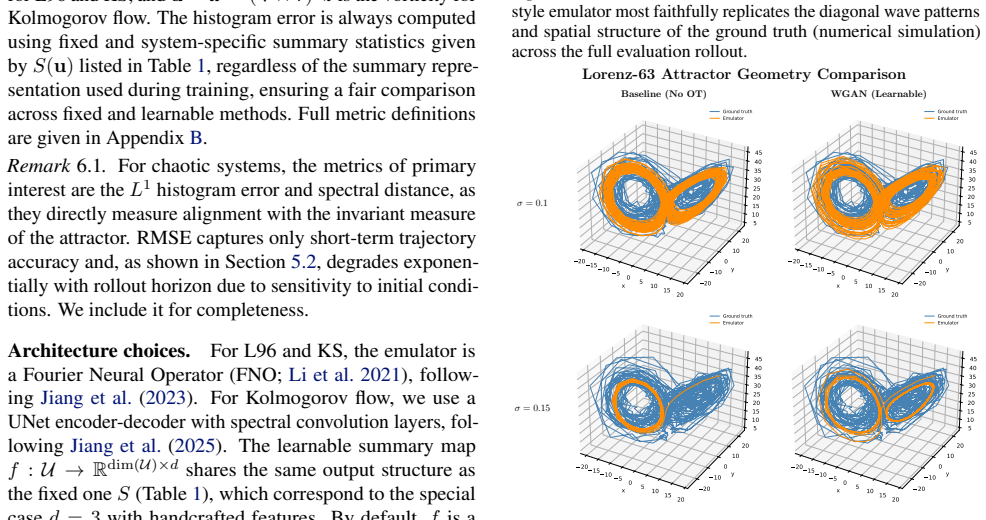
Chaos arises in many complex dynamical systems, from weather to power grids, but is difficult to accurately model with data-driven methods such as machine learning emulators. While emulators are promising tools for accelerating simulations and solving inverse problems, they still struggle to learn chaotic dynamics, where sensitivity to initial conditions renders exact long-term forecasts infeasible, especially given noisy data. Recent work instead trains emulators to match the statistical properties of chaotic attractors, but these approaches often rely on handcrafted summary statistics or large, diverse multi-environment datasets. In this work, we propose a family of adversarial optimal transport objectives that can jointly learn high-quality summary statistics and a physically consistent emulator from a single noisy trajectory. We theoretically analyze and experimentally validate a Sinkhorn divergence formulation (2-Wasserstein) and a WGAN-style dual formulation (1-Wasserstein) of our approach. Numerical experiments across a variety of chaotic systems, including ones with high-dimensional spatiotemporal chaos, show that emulators trained using our proposed objectives have significantly improved long-term statistical fidelity.
Editorial analysis
A structured set of objections, weighed in public.
Referee Report
Summary. The manuscript proposes a family of adversarial optimal transport objectives—specifically a Sinkhorn divergence formulation based on the 2-Wasserstein distance and a WGAN-style dual formulation for the 1-Wasserstein distance—to jointly learn summary statistics and train neural emulators for chaotic dynamical systems. The central claim is that this regularization yields emulators with significantly improved long-term statistical fidelity to the attractors of chaotic systems, outperforming baselines that rely on handcrafted local features or learned statistics from trajectory datasets, as supported by theoretical analysis and experiments on a variety of chaotic systems including high-dimensional attractors.
Significance. If the central claims hold, the work provides a principled, automatic alternative to handcrafted or pre-learned statistics for regularizing data-driven emulators of chaotic dynamics. This could improve the reliability of long-term statistical predictions in applications such as weather modeling and power-grid simulation, where exact trajectory matching is infeasible due to sensitivity to initial conditions. The joint learning of statistics and emulator via optimal transport is a notable strength relative to prior regularization approaches.
minor comments (3)
- The abstract and introduction would benefit from a brief, explicit statement of the precise baseline methods (handcrafted features and learned-statistic approaches) and the quantitative metrics used to assess long-term statistical fidelity, to allow readers to immediately gauge the scope of the claimed improvements.
- In the experimental section, additional detail on the number of independent runs, standard deviations or confidence intervals for the reported fidelity metrics, and the precise definition of 'long-term' (e.g., integration horizon relative to Lyapunov time) would strengthen reproducibility and interpretation of the results.
- Notation for the adversarial objectives (Sinkhorn and dual formulations) should be introduced with a short table or inline reminder of the key variables (e.g., the role of the critic network and the regularization parameter) to improve readability for readers less familiar with optimal transport.
Simulated Author's Rebuttal
We thank the referee for their positive summary of our work and for recommending minor revision. The referee's description accurately reflects the manuscript's contributions regarding adversarial optimal transport regularization for emulators of chaotic systems. No specific major comments were raised in the report.
Circularity Check
No significant circularity in derivation chain
full rationale
The paper defines its core adversarial optimal transport objectives (Sinkhorn 2-Wasserstein divergence and WGAN-style 1-Wasserstein dual) directly from standard optimal transport theory and applies them to jointly optimize summary statistics and the emulator. No load-bearing step in the abstract or described approach reduces the claimed predictions or statistical fidelity improvements to quantities fitted from the target data by construction, nor relies on self-citations for uniqueness theorems, ansatzes, or renaming of known results. The central claim rests on experimental comparison to handcrafted and learned-statistic baselines, which supplies independent validation rather than tautological equivalence to inputs.
Axiom & Free-Parameter Ledger
Forward citations
Cited by 1 Pith paper
-
Data-Adaptive Learning of Dynamical Systems by Matching Transfer Operators and Invariant Measures
A data-adaptive operator-matching approach learns vector fields by aligning induced transition matrices and invariant measures on an unstructured partition, outperforming pointwise losses under noise.
discussion (0)
Sign in with ORCID, Apple, or X to comment. Anyone can read and Pith papers without signing in.