REVIEW 3 major objections 6 minor 36 references
Estimation of Absolute Scale in Monocular SLAM Using Synthetic Data
T0 review · 3 major / 6 minor · reviewed 2026-08-14 · deepseek-v4-flash
Pith's one-line read Monocular SLAM's missing absolute scale can be estimated by a network trained on synthetic driving data alone, reaching accuracy comparable to real-data training.
desk verdict A solid, incremental improvement to monocular scale estimation, with a useful synthetic-data result for CNNs but an overstated abstract that ignores the LSTM transfer failure. read the letter →
The pith
A machine-rendered reading of the paper's core claim, the machinery that carries it, and where it could break.
The reading
What carries the argument
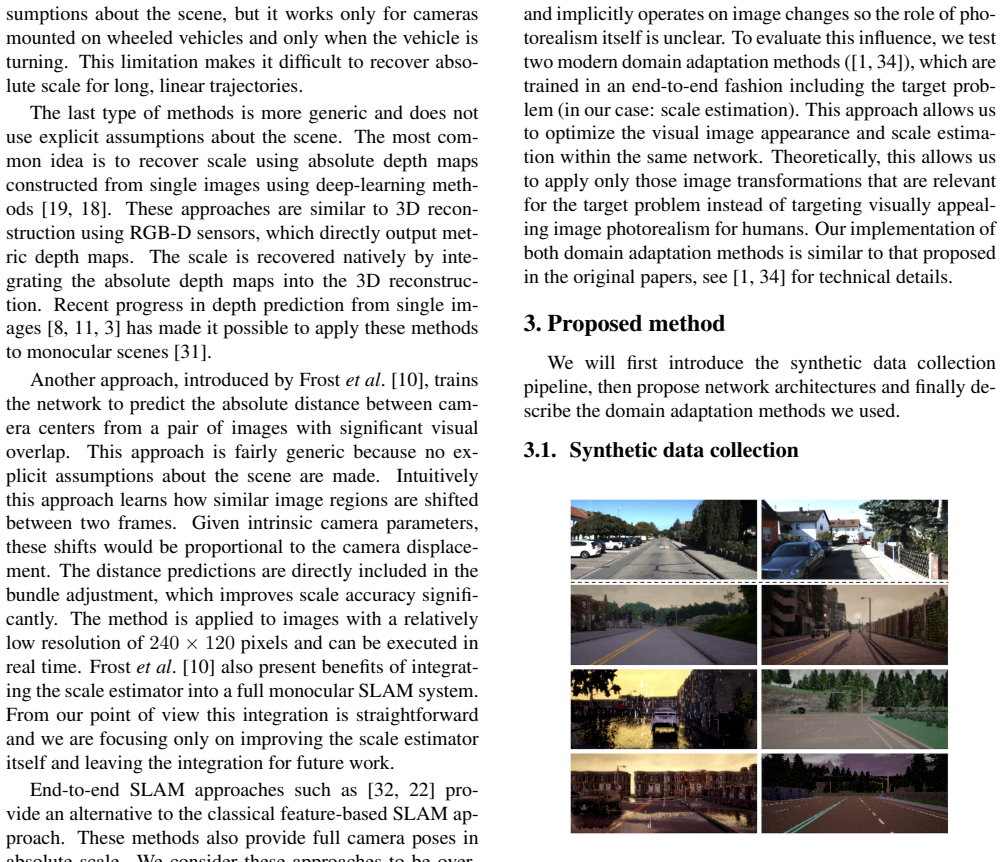
The central object is a regression network that takes a pair of consecutive 280x120 RGB images (concatenated into a 6-channel input), normalizes them to a fixed intrinsic camera model (focal length 250 px, principal point at 140,60), and outputs the absolute distance between the camera centers. The CNN has five convolutional layers with ELU activations and dropout; a variant appends a bidirectional many-to-one LSTM operating on the sequence of frame-pair embeddings, enabling the model to learn temporal priors about vehicle motion. The machinery carries the argument because the fixed normalization makes estimates invariant to different cameras, the recurrent layer exploits dynamics, and the synthetic-data pipeline supplies automatically annotated low-resolution pairs with varied weather, maps, and camera configurations.
What would settle it
Train a bidirectional LSTM on CARLA trajectories with artificially injected real-world noise matched to KITTI inter-frame distance statistics, then evaluate on the same KITTI test sequences; if the accuracy still does not reach the KITTI-trained LSTM level, the synthetic-to-real gap is not explained by trajectory smoothness alone.
Extended reading notes
Core claim
The central claim is that absolute scale in monocular SLAM can be estimated directly from low-resolution image pairs—without scene assumptions, known object sizes, or extra sensors—by training a CNN to regress the translation distance between camera centers. The paper's key discovery is that this scale estimator does not need real images with ground truth: a CNN trained only on 800K image pairs generated by the CARLA simulator generalizes to unseen real KITTI sequences almost as well as the same CNN trained on KITTI, with error standard deviations of 0.105–0.121 m versus 0.092–0.113 m. Adding a bidirectional LSTM over a window of 19 pairs further reduces the error to 0.064–0.083 m when trained on real KITTI data, because it learns smooth vehicle dynamics, but the same LSTM trained only on CARLA does not improve over the CNN, which the authors attribute to synthetic trajectories being smoother than real ones. The paper also reports that two unsupervised domain-adaptation methods produce no gain, suggesting that photorealism is not the bottleneck.
Load-bearing premise
The claim that synthetic training reaches real-data accuracy depends on simulated camera trajectories being representative of real vehicle motion; this is true for the feed-forward CNN but appears to fail for the LSTM, whose CARLA-trained version is noticeably less accurate.
Editorial extensions
If this is right
- Monocular SLAM systems can recover metric scale without IMU, stereo, or depth sensors, using a lightweight network on 0.03 MP images.
- Scale estimates improve classical bundle adjustment by constraining inter-frame distances, reducing scale drift and helping loop closure.
- Because synthetic data works, sensor reconfiguration (new camera position or intrinsics) can be handled by generating new simulator data instead of collecting and labeling new real data.
- Data diversity—more virtual maps with different road layouts—matters more than photorealism; domain adaptation did not improve accuracy.
- A bidirectional LSTM that learns vehicle dynamics lowers scale-error standard deviation from about 0.18 m baseline to 0.064–0.083 m on KITTI test sequences.
Reading between the lines
- We infer that injecting real trajectory statistics into a simulator could close the remaining LSTM gap, since the paper isolates the smoothness of synthetic trajectories as the cause of the degradation.
- We infer the method may transfer to non-driving platforms only if the training trajectories are regenerated for those dynamics, because the recurrent layer is the component most tied to vehicle motion.
- The near-zero benefit from domain adaptation suggests that scale estimation from image pairs relies on geometric displacement cues that survive domain shift, so future work could focus on trajectory diversity rather than image realism.
- We infer that evaluating the estimated inter-frame distances inside a full SLAM trajectory (for example, with absolute trajectory error) would show how much the improved scale accuracy translates to overall map quality, which the paper does not directly measure.
Signed reviews
Editorial analysis
A structured set of objections, weighed in public.
Referee Report
Summary. The manuscript proposes deep network architectures for estimating absolute inter-frame camera distance in monocular SLAM, extending the baseline of Frost et al. (2017). It introduces a deeper CNN and unidirectional/bidirectional LSTM variants, and trains them on KITTI and/or synthetic CARLA data, with evaluation on KITTI sequences 00, 02, and 08. Table 2 reports reductions in the standard deviation of distance error from roughly 0.15-0.18 m for the baseline to 0.064-0.083 m for the best bidirectional LSTM (length 19) trained on KITTI, and about 0.105-0.121 m for a CNN trained only on CARLA. The paper also evaluates LSTM sequence length, synthetic map diversity, and domain adaptation with T2Net and CyCADA. The central claim is that synthetic-only training achieves scale-estimation accuracy similar to real-data training, and that visual photorealism is not important for this task.
Significance. If the claims hold, the work provides a practical low-resolution scale estimator that can be integrated into monocular SLAM without requiring real-world data annotation. The evaluation uses external ground-truth camera poses from KITTI and CARLA, so the results are not self-referential, and the ablations cover architectures, synthetic diversity, and domain adaptation. The reported accuracy improvement over the baseline is visible and consistent across sequences. However, the central synthetic-parity claim is currently broader than the evidence: it is directly supported only for the feed-forward CNN, not for the recurrent model that gives the best absolute accuracy, and the main hyperparameter is selected on the test set. These issues are fixable with additional experiments and revised claims, but they are load-bearing for the paper's headline result.
major comments (3)
- [Abstract, Conclusion, Section 4.3, Table 2] The statement that 'using only synthetic training inputs, we can achieve similar scale estimation accuracy as that obtained from real data' is not supported for the best-performing architecture. Comparing row 5 (CNN, KITTI-only, sigma = 0.092-0.113 m) with row 6 (CNN, CARLA-only, sigma = 0.105-0.121 m) supports the claim for the CNN, but rows 8 and 9 show that the bidirectional LSTM (B,19) degrades from sigma = 0.064-0.083 m with KITTI-only training to sigma = 0.102-0.132 m with CARLA-only training. The authors acknowledge in Section 4.3 that 'our virtual vehicle dynamics do not generalize well to the real dynamics,' yet the abstract and conclusion state the claim without this qualification. The claim should be explicitly scoped to feed-forward architectures, or the authors should provide a recurrent configuration whose synthetic-only training reaches KITTI-trained accuracy.
- [Section 4.4, Table 4, Table 2 rows 8-10] The LSTM sequence length and directionality are selected by sweeping values on the same KITTI test sequences (00, 02, 08) that are used to report the final results in Table 2. In particular, length 19 is chosen because Table 4 shows the best sigma for the bidirectional LSTM on the test set, and this exact configuration is then presented as 'our best results' in Table 2 rows 8-10. This is test-set selection and can inflate the reported gains. The authors should use a validation split drawn from the training sequences for hyperparameter selection, or report the entire sweep as exploratory and avoid singling out the best test-set configuration as the headline result.
- [Section 4.3, Tables 2-6] No error bars or multiple-run statistics are provided for any experiment. Several conclusions rest on small differences: rows 5 and 6 of Table 2 differ by 0.001-0.029 m depending on the sequence, and the domain-adaptation results in Table 6 differ by only 0.002-0.005 m. Without repeated training runs or another variance estimate, the claims of 'similar accuracy' and 'almost no improvement or even minor degradation' are not statistically grounded. The authors should report mean and standard deviation over at least three runs for the key comparisons, or explicitly justify why single runs suffice for the conclusions drawn.
minor comments (6)
- [Section 3.2] There is a typo: 'vehicle dymanics' should be 'vehicle dynamics.'
- [Table 4 caption] The caption spells 'arhitectures'; this should be 'architectures.'
- [References [26] and [27]] References [26] and [27] list the same paper by Scaramuzza et al. with different page ranges; these should be consolidated into one reference.
- [Section 4.5, Table 5] Table 5 reports performance of the CNN architecture trained on synthetic data, but the text should state explicitly that all rows use CARLA-only training and the same evaluation protocol as Table 2; currently this is implied rather than stated.
- [Figure 3 caption] The caption says the CNN block corresponds to the green block of Figure 2, but Figure 2's caption does not mention a green block; please make the color coding explicit in both captions.
- [Section 4.2, Table 3] Section 4.2 reports approximately 26K testing image pairs for sequences 00, 02, and 08, while Table 3 mentions 20K image pairs for 'all available KITTI sequences'; clarify which set of sequences and how many pairs are used in Table 3.
Circularity Check
No circularity: central results are evaluated against external KITTI/CARLA ground truth.
full rationale
The paper contains no circular derivation. Scale estimates are compared against external ground-truth camera poses from KITTI and CARLA (Sections 4.2 and 4.3); no quantity used as a prediction is defined in terms of the fitted outputs. The CNN and LSTM are trained with MSE on a distance regression task and evaluated on held-out KITTI sequences (Table 2), and synthetic-data generalization is tested by training on CARLA-only data and evaluating on unseen real KITTI frames. The only internal model choice is the LSTM sequence length reported in Table 4; although that length is evaluated on the same KITTI test sequences, the reported sigma values are computed from external ground-truth distances, and no equation or fitted parameter is renamed as a prediction. The paper cites prior work [10] as a baseline and external domain-adaptation methods [1,34], but none of the load-bearing claims rests on a self-citation or on a uniqueness/ansatz assertion from the authors' own prior work. The abstract's unqualified 'similar scale accuracy' claim is broader than the evidence for the recurrent variant (rows 9 and 10 of Table 2), but that is a scope/correctness concern, not circularity.
Assumptions & free parameters
free parameters (4)
- Dmax =
1.7 m
- LSTM sequence length =
19 (selected on test set)
- Image normalization intrinsics =
focal length 250 px, principal point (140, 60)
- Training set scale =
800K synthetic pairs vs. 100K real pairs
assumptions (4)
- domain assumption Ground-truth camera trajectories for KITTI and CARLA are accurate enough to serve as supervision.
- domain assumption The visual-geometric relationship between image pairs determines camera displacement independently of scene category and visual appearance.
- domain assumption Simulated trajectory dynamics in CARLA are representative enough for the recurrent model to learn useful temporal priors.
- domain assumption The image normalization using fixed intrinsics makes predictions invariant to different cameras.
Cite this review
Pith. "Pith review of Estimation of Absolute Scale in Monocular SLAM Using Synthetic Data." pith.science (2026). https://pith.science/paper/L7OXX7ZJ
@misc{pith2026190900713,
  author       = {Pith},
  title        = {Pith review of: Estimation of Absolute Scale in Monocular SLAM Using Synthetic Data},
  year         = {2026},
  howpublished = {\url{https://pith.science/paper/L7OXX7ZJ}},
  note         = {Machine review of arXiv:1909.00713}
}
read the original abstract
This paper addresses the problem of scale estimation in monocular SLAM by estimating absolute distances between camera centers of consecutive image frames. These estimates would improve the overall performance of classical (not deep) SLAM systems and allow metric feature locations to be recovered from a single monocular camera. We propose several network architectures that lead to an improvement of scale estimation accuracy over the state of the art. In addition, we exploit a possibility to train the neural network only with synthetic data derived from a computer graphics simulator. Our key insight is that, using only synthetic training inputs, we can achieve similar scale estimation accuracy as that obtained from real data. This fact indicates that fully annotated simulated data is a viable alternative to existing deep-learning-based SLAM systems trained on real (unlabeled) data. Our experiments with unsupervised domain adaptation also show that the difference in visual appearance between simulated and real data does not affect scale estimation results. Our method operates with low-resolution images (0.03MP), which makes it practical for real-time SLAM applications with a monocular camera.
Figures


Figures from the paper (4 more)


Reference graph
Works this paper leans on
-
[1]
In International Conference on Machine Learning (ICML) , pages 1994–2003, 2018
Cycada: Cycle consistent adversarial domain adaptation. In International Conference on Machine Learning (ICML) , pages 1994–2003, 2018
work page 1994
-
[2]
Mart ´ın Abadi, Ashish Agarwal, Paul Barham, Eugene Brevdo, Zhifeng Chen, Craig Citro, Greg S. Corrado, Andy Davis, Jeffrey Dean, Matthieu Devin, Sanjay Ghemawat, Ian Goodfellow, Andrew Harp, Geoffrey Irving, Michael Isard, Yangqing Jia, Rafal Jozefowicz, Lukasz Kaiser, Manjunath Kudlur, Josh Levenberg, Dandelion Man ´e, Rajat Monga, Sherry Moore, Derek M...
work page 2015
-
[3]
A. Atapour-Abarghouei and T.P. Breckon. Real-time monoc- ular depth estimation using synthetic data with domain adap- tation. In IEEE Conference on Computer Vision and Pattern Recognition (CVPR), pages 1–8, 2018
work page 2018
-
[4]
R. O. Castle, D. J. Gawley, G. Klein, and D. W. Murray. Towards simultaneous recognition, localization and mapping for hand-held and wearable cameras. In ”International Con- ference on Robotics and Automation (ICRA)” , pages 4102– 4107, 2007
work page 2007
-
[5]
Long-term recurrent convolutional net- works for visual recognition and description
Jeff Donahue, Lisa Anne Hendricks, Sergio Guadarrama, Marcus Rohrbach, Subhashini Venugopalan, Kate Saenko, and Trevor Darrell. Long-term recurrent convolutional net- works for visual recognition and description. In Proceed- ings of the IEEE Conference on Computer Vision and Pattern Recognition (CVPR), pages 2625–2634, 2015
work page 2015
-
[6]
A. Dosovitskiy, P. Fischer, E. Ilg, P. H¨ausser, C. Hazırbas ¸, V . Golkov, P. v.d. Smagt, D. Cremers, and T. Brox. Flownet: Learning optical flow with convolutional networks. In Pro- ceedings of the IEEE International Conference on Computer Vision (ICCV), pages 2758–2766, 2015
work page 2015
-
[7]
CARLA: An open urban driving simulator
Alexey Dosovitskiy, German Ros, Felipe Codevilla, Antonio Lopez, and Vladlen Koltun. CARLA: An open urban driving simulator. In Proceedings of the 1st Annual Conference on Robot Learning, pages 1–16, 2017
2017
-
[8]
Depth map prediction from a single image using a multi-scale deep net- work
David Eigen, Christian Puhrsch, and Rob Fergus. Depth map prediction from a single image using a multi-scale deep net- work. In Advances in Neural Information Processing Sys- tems, pages 2366–2374. 2014
work page 2014
Show all 36 references
-
[9]
Frost, Olaf K ¨ahler, and David W
Duncan P. Frost, Olaf K ¨ahler, and David W. Murray. Object- aware bundle adjustment for correcting monocular scale drift. In ”International Conference on Robotics and Automa- tion (ICRA)”, pages 4770–4776, 2016
2016
-
[10]
Frost, David W
Duncan P. Frost, David W. Murray, and Victor Adrian Prisacariu. Using learning of speed to stabilize scale in monocular localization and mapping. In International Con- ference on 3D Vision (3DV), pages 527–536, 2017
2017
-
[11]
Deep ordinal regression net- work for monocular depth estimation
Huan Fu, Mingming Gong, Chaohui Wang, Kayhan Bat- manghelich, and Dacheng Tao. Deep ordinal regression net- work for monocular depth estimation. In Proceedings of the IEEE Conference on Computer Vision and Pattern Recogni- tion (CVPR), pages 2002–2011, 2018
2002
-
[12]
Are we ready for autonomous driving? the kitti vision benchmark suite
Andreas Geiger. Are we ready for autonomous driving? the kitti vision benchmark suite. In Proceedings of the IEEE Conference on Computer Vision and Pattern Recognition (CVPR), pages 3354–3361, 2012
2012
-
[13]
3d traffic scene understanding from movable platforms
Andreas Geiger, Martin Lauer, Christian Wojek, Christoph Stiller, and Raquel Urtasun. 3d traffic scene understanding from movable platforms. IEEE transactions on pattern anal- ysis and machine intelligence, 36(5):1012–1025, 2013
2013
-
[14]
Stere- oscan: Dense 3d reconstruction in real-time
Andreas Geiger, Julius Ziegler, and Christoph Stiller. Stere- oscan: Dense 3d reconstruction in real-time. In IEEE Intel- ligent V ehicles Symposium (IV), pages 963–968, 2011
2011
-
[15]
Robust scale estimation for monocular visual odometry using struc- ture from motion and vanishing points
Johannes Gr ¨ater, Tobias Schwarze, and Martin Lauer. Robust scale estimation for monocular visual odometry using struc- ture from motion and vanishing points. In IEEE Intelligent V ehicles Symposium (IV), pages 475–480, 2015
2015
-
[16]
Long short-term memory
Sepp Hochreiter and J ¨urgen Schmidhuber. Long short-term memory. Neural Computation, 9(8):1735–1780, 1997
1997
-
[17]
Multimodal unsupervised image-to-image translation
Xun Huang, Ming-Yu Liu, Serge Belongie, and Jan Kautz. Multimodal unsupervised image-to-image translation. InEu- ropean Conference on Computer Vision (ECCV), pages 172– 189, 2018
2018
-
[18]
Kinectfusion: Real-time 3d recon- struction and interaction using a moving depth camera
Shahram Izadi, David Kim, Otmar Hilliges, David Molyneaux, Richard Newcombe, Pushmeet Kohli, Jamie Shotton, Steve Hodges, Dustin Freeman, Andrew Davison, and Andrew Fitzgibbon. Kinectfusion: Real-time 3d recon- struction and interaction using a moving depth camera. In Proceedi...
2011
-
[19]
C. Kerl, J. Sturm, and D. Cremers. Robust odometry esti- mation for rgb-d cameras. In ”International Conference on Robotics and Automation (ICRA)” , pages 3748–3754, 2013
2013
-
[20]
Adam: A method for stochastic optimization
Diederik P Kingma and Jimmy Ba. Adam: A method for stochastic optimization. arXiv preprint arXiv:1412.6980 , 2014
2014 arXiv
-
[21]
Vi- sual odometry based on stereo image sequences with ransac- based outlier rejection scheme
Bernd Kitt, Andreas Geiger, and Henning Lategahn. Vi- sual odometry based on stereo image sequences with ransac- based outlier rejection scheme. In IEEE Intelligent V ehicles Symposium (IV), pages 486–492, 2010
2010
-
[22]
Rela- tive geometry-aware siamese neural network for 6dof camera relocalization
Qing Li, Jiasong Zhu, Rui Cao, Ke Sun, Jonathan M Garibaldi, Qingquan Li, Bozhi Liu, and Guoping Qiu. Rela- tive geometry-aware siamese neural network for 6dof camera relocalization. arXiv preprint arXiv:1901.01049, 2019
1901 arXiv
-
[23]
What makes good synthetic training data for learning dispar- ity and optical flow estimation? International Journal of Computer Vision, 126(9):942–960, 2018
Nikolaus Mayer, Eddy Ilg, Philipp Fischer, Caner Hazir- bas, Daniel Cremers, Alexey Dosovitskiy, and Thomas Brox. What makes good synthetic training data for learning dispar- ity and optical flow estimation? International Journal of Computer Vision, 126(9):942–960, 2018
2018
-
[24]
deepdrive/deepdrive: 2.0, 2018
Craig Quiter and Maik Ernst. deepdrive/deepdrive: 2.0, 2018
2018
-
[25]
Three-dimensional absolute orientation of stereo models using digital elevation models
Dan Rosenholm and Kenner! Torlegard. Three-dimensional absolute orientation of stereo models using digital elevation models. Photogrammetric Engineering and Remote Sensing, 54(10):4102–4107, 1988
1988
-
[26]
Absolute scale in structure from mo- tion from a single vehicle mounted camera by exploiting nonholonomic constraints
Davide Scaramuzza, Friedrich Fraundorfer, Marc Pollefeys, and Roland Siegwart. Absolute scale in structure from mo- tion from a single vehicle mounted camera by exploiting nonholonomic constraints. In Proceedings of the IEEE In- ternational Conference on Computer Vision (ICCV)...
2009
-
[27]
Absolute scale in structure from mo- tion from a single vehicle mounted camera by exploiting nonholonomic constraints
Davide Scaramuzza, Friedrich Fraundorfer, Marc Pollefeys, and Roland Siegwart. Absolute scale in structure from mo- tion from a single vehicle mounted camera by exploiting nonholonomic constraints. In Proceedings of the Interna- tional Conference on Computer Vision (ICCV), pag...
2009
-
[28]
Airsim: High-fidelity visual and physical simula- tion for autonomous vehicles
Shital Shah, Debadeepta Dey, Chris Lovett, and Ashish Kapoor. Airsim: High-fidelity visual and physical simula- tion for autonomous vehicles. In Field and Service Robotics, pages 621–635, 2017
2017
-
[29]
Robust scale esti- mation in real-time monocular SFM for autonomous driving
Shiyu Song and Manmohan Chandraker. Robust scale esti- mation in real-time monocular SFM for autonomous driving. In Proceedings of the IEEE Conference on Computer Vision and Pattern Recognition (CVPR), pages 1566–1573, 2014
2014
-
[30]
Bayesian scale estima- tion for monocular SLAM based on generic object detection for correcting scale drift
Edgar Sucar and Jean-Bernard Hayet. Bayesian scale estima- tion for monocular SLAM based on generic object detection for correcting scale drift. In ”International Conference on Robotics and Automation (ICRA)” , pages 1–7, 2018
2018
-
[31]
Tateno, F
K. Tateno, F. Tombari, I. Laina, and N. Navab. Cnn-slam: Real-time dense monocular slam with learned depth predic- tion. In Proceedings of the IEEE Conference on Computer Vision and Pattern Recognition (CVPR) , pages 6243–6252, 2017
2017
-
[32]
S. Wang, R. Clark, H. Wen, and N. Trigoni. Deepvo: To- wards end-to-end visual odometry with deep recurrent con- volutional neural networks. pages 2043–2050, 2017
2017
-
[33]
N. Yang, R. Wang, J. Stueckler, and D. Cremers. Deep vir- tual stereo odometry: Leveraging deep depth prediction for monocular direct sparse odometry. In Proceedings of the IEEE European Conference on Computer Vision (ECCV) , pages 817–833, 2018
2018
-
[34]
T2net: Synthetic-to-realistic translation for solving single-image depth estimation tasks
Chuanxia Zheng, Tat-Jen Cham, and Jianfei Cai. T2net: Synthetic-to-realistic translation for solving single-image depth estimation tasks. In Proceedings of the IEEE Euro- pean Conference on Computer Vision (ECCV) , pages 767– 783, 2018
2018
-
[35]
Ground plane based absolute scale estimation for monocular visual odom- etry
Dingfu Zhou, Yuchao Dai, and Hongdong Li. Ground plane based absolute scale estimation for monocular visual odom- etry. arXiv preprint arXiv:1903.00912, 2019
1903 arXiv
-
[36]
Unpaired image-to-image translation using cycle- consistent adversarial networks
Jun-Yan Zhu, Taesung Park, Phillip Isola, and Alexei A Efros. Unpaired image-to-image translation using cycle- consistent adversarial networks. In IEEE International Conference on Computer Vision (ICCV) , pages 2223–2232, 2017
2017
Reviewed August 14, 2026 · model on record in the stance chip above.
Discussion (0). Continue with ORCID to comment.