REVIEW 4 major objections 5 minor 1 cited by
Beyond Diagonal Covariance: Flexible Posterior VAEs via Free-Form Injective Flows
T0 review · 4 major / 5 minor · reviewed 2026-08-07 · deepseek-v4-flash
Pith's one-line read This paper claims that a regularized free-form injective flow can serve as a variational autoencoder with a full-covariance Gaussian posterior, and that this posterior costs about as much as a diagonal one while improving model likelihood.
desk verdict Neat idea, but the central derivation breaks: the claimed full-covariance posterior is not the Laplace posterior even in the linear case, and the optimized loss is a stop-gradient surrogate, not the stated ELBO. read the letter →
The pith
A machine-rendered reading of the paper's core claim, the machinery that carries it, and where it could break.
The reading
What carries the argument
The load-bearing object is the variational posterior $q(z|x) = \mathcal{N}(f(x), \sigma^2 f'(x)f'(x)^\top)$, a full-covariance Gaussian whose covariance is written as the outer product of the encoder Jacobian with itself, so it never needs to be materialized. Its justification is a Laplace approximation: with decoder $g$ and noise $\sigma$, the posterior Hessian obeys $H(x)^{-1} \approx \sigma^2 f'(x)f'(x)^\top$. The supporting machinery is the pull-back metric $G = g'(z)^\top g'(z)$ from differential geometry, used to prove the diagonal-covariance obstruction through the Frobenius involutivity condition, plus a stochastic trace estimator and a stop-gradient trace identity that compute gradients of the log-determinant term without evaluating determinants. Sampling from the posterior is just a reparameterized draw $z = f(x) + \sigma f'(x)v$ with $v \sim \mathcal{N}(0,I)$, and the KL divergence to the standard normal prior is evaluated using $\operatorname{tr}(\sigma^2 f'(x)f'(x)^\top)$ and the approximate log-determinant gradient.
What would settle it
Take a decoder whose manifold has curvature radius comparable to or smaller than the observation noise $\sigma$ (for example $z = x^2 + y^2$ with $\sigma$ not very small) and compute the exact posterior $p(z|x) \propto \exp(-u(x,z))$ by dense integration in the low-dimensional latent space; if the KL divergence between $p(z|x)$ and $\mathcal{N}(f(x), \sigma^2 f'(x)f'(x)^\top)$ is large, or if FIVE's learned decoder no longer matches the true manifold's parameterization, the local-linearity premise fails.
Extended reading notes
Core claim
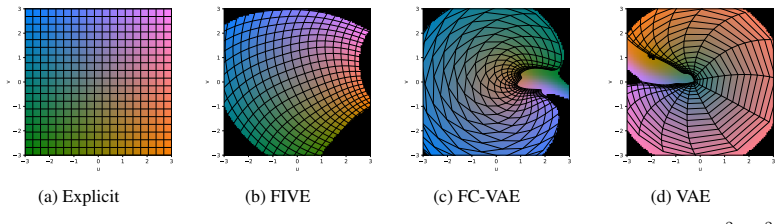
As the paper states it, a VAE that forces $q(z|x)$ to be diagonal Gaussian will at optimum force the decoder's pull-back metric $g'(z)^\top g'(z)$ to be approximately diagonal (Theorem 1), because the true posterior $p(z|x)$ approximates $\mathcal{N}(f(x), H(x)^{-1})$ with $H = I + \sigma^{-2} g'(f(x))^\top g'(f(x))$. Orthogonal coordinate systems with diagonal metric exist only when the eigen-line fields of this metric are involutive (Theorem 2), and in dimension three or higher curved manifolds can fail this test. FIVE sidesteps the constraint by defining the variational posterior directly from the encoder Jacobian, $q(z|x) = \mathcal{N}(f(x), \sigma^2 f'(x)f'(x)^\top)$, which is the Laplace-approximation form of $H(x)^{-1}$. The paper proves that in the linear case the two opposing Jacobian substitutions used in the derivation are consistent and the model recovers the data covariance exactly (Theorem 3). The empirical claim is that this full-covariance posterior, with no explicit covariance matrix ever formed, matches or exceeds the likelihoods of diagonal VAEs, learned full-covariance VAEs, and standalone free-form injective flows on MNIST and CIFAR-10.
Load-bearing premise
The argument rests on the Laplace/local-linearity assumption that the decoder $g$ is nearly linear at the scale of the noise $\sigma$, so the true posterior $p(z|x)$ is well approximated by a Gaussian whose inverse covariance is $\sigma^2 f'(x)f'(x)^\top$; the paper's own Limitations section notes this may break down when the data manifold curves sharply on that scale.
Editorial extensions
If this is right
- A VAE can carry a full-covariance Gaussian posterior with sampling cost equal to one extra Jacobian-vector product per latent draw, so the diagonal-Gaussian restriction is no longer forced by computation.
- Posterior collapse that appears in large-latent diagonal and explicitly full-covariance VAEs is reported to be much weaker for FIVE, which inherits the collapse resistance of free-form injective flows.
- The involutivity criterion gives a principled way to identify data manifolds for which diagonal posteriors are provably insufficient: check whether the eigen-line fields of the decoder metric can be integrated.
- Combining the FIF training objective with a KL-style regularizer yields a valid ELBO whose approximate KL term needs no determinant computation.
- On MNIST and CIFAR-10, with both small and larger networks, FIVE reports test log-likelihoods that match or exceed standard VAE, FC-VAE, and FIF baselines.
Reading between the lines
- If the Laplace assumption holds for real image manifolds, the same Jacobian-covariance construction could be applied to other implicit or explicit encoder-decoder architectures, not only FIF-trained ones, whenever the encoder Jacobian is available.
- The geometric obstruction suggests a testable diagnostic: for a trained decoder, compute the commutators $[e_i, e_j]$ of the metric's eigen-frame; datasets whose manifolds violate involutivity should show a systematic gap between diagonal-VAE and FIVE likelihood.
- Theorem 3's linear recovery result hints that FIVE may behave like a probabilistic autoencoder that finds a principal-subspace structure; a synthetic experiment with data drawn from a known low-rank Gaussian could directly check whether the learned encoder and decoder match the top-$d$ eigen-directions.
- At larger $\sigma$ or sharper curvature, $q(z|x)$ may remain Gaussian while $p(z|x)$ becomes non-Gaussian; a two-dimensional toy with exactly computed posteriors could measure where the approximation degrades.
Signed reviews
Editorial analysis
A structured set of objections, weighed in public.
Referee Report
Summary. FIVE is a variational autoencoder whose approximate posterior is defined implicitly by the encoder Jacobian: q(z|x)=N(f(x), σ² f'(x)f'(x)^T) (Eq. 32). The paper argues that this yields a full-covariance Gaussian posterior at computational cost near that of a diagonal VAE, provides a differential-geometric argument (Theorem 2) that diagonal-posterior VAEs cannot represent arbitrary curved data manifolds, derives a regularized FIF training objective, and reports held-out test log-likelihoods on MNIST and CIFAR-10 in which FIVE matches or exceeds VAE, full-covariance VAE, and FIF baselines. The theoretical connection to the Laplace posterior is the main basis for the claim.
Significance. The geometric obstruction result (Theorem 2) is a clean and useful observation, and the empirical comparison is careful: test likelihoods are estimated by importance sampling with 100 samples, standard errors are reported over three runs, and two architectures per dataset are considered. If the posterior interpretation were valid, FIVE would be a practically attractive way to obtain full covariance without O(d²) parameters or determinant computations. However, the central derivation equating q(z|x) with the Laplace posterior is not valid in the finite-σ regime used in the experiments, and the theorem offered in support overclaims what is proved. The empirical likelihood results can stand on their own, but the paper's theoretical significance as a principled full-covariance VAE is currently not established.
major comments (4)
- [Section 4.3 / Appendix A.3, Eq. (31) and Lemma 1] The substitution f'(x) ≈ (g'(f(x)))^+ underlying Eq. (31) is already contradicted by the paper's own linear analysis. In Lemma 1 the global optimum of the FIVE loss is w* = √λ and v* = √λ/(σ²+λ). Then v* w* = λ/(σ²+λ) ≠ 1 for finite σ, so v* is not the pseudoinverse of w*. The resulting posterior q(z|x) = N(vx, σ²v²) has variance σ²λ/(σ²+λ)², while the Laplace posterior variance from Eq. (12) or (48) is σ²/(σ²+λ). These differ by the factor λ/(σ²+λ). Thus Eq. (31) holds only in the limits σ→0 or λ→∞, and the statement that q(z|x) is the Laplace posterior is unsupported in the finite-σ regime of the experiments.
- [Section 4.3, Theorem 3] The theorem statement overclaims exact recovery of the data distribution. The proof establishes W*W*^T = Σx and hence g#p(z) = N(0, Σx), but the marginal of the generative model is p(x) = ∫ p(x|z)p(z) dz = N(0, Σx + σ²I), which equals N(0, Σx) only when σ→0. The proof itself acknowledges this ('which is also equal to p(x) in the zero σ limit'), so Theorem 3 as stated for the FIVE loss with σ>0 is false. It should be restated as a σ→0 limit or as a statement about the decoder's pushforward, not about the model marginal.
- [Appendix A.3, Eq. (68); Appendix A.4, Eq. (93)-(94)] The objective actually optimized is not the ELBO of Section 4.2. Eq. (68) replaces the log-determinant term of the KL divergence with a stop-gradient trace surrogate, and the main text does not state that the training loss is this surrogate rather than the ELBO (34). In addition, the derivation in A.4 moves from Eq. (93) to Eq. (94) as though (g'(f(x)))^+^T g'(f(x))^T = I; for an injective decoder with d < n the product equals (g'(f(x)) g'(f(x))^+)^T, the transpose of a rank-d column-space projection, not the identity. The gradient formula therefore requires an additional assumption or correction. These issues matter because the paper's central claim is that FIVE optimizes a valid variational objective with a full-covariance posterior.
- [Section 5, Table 1 and Abstract] The empirical conclusion is weaker than the abstract's claim that full covariance 'substantially improves model likelihood.' On CIFAR-10 with the larger network, FIVE (2684.44±9.33) is not statistically distinguishable from the standard VAE (2680.36±13.86), and on MNIST with the larger network, FIF (1116.31±27.29) has numerically higher mean than FIVE (1115.17±7.67). The gains are consistent on small networks but not uniformly significant. This does not undermine the empirical contribution, but the summary claims should be calibrated to the table.
minor comments (5)
- [Section 1] There is a duplicated phrase: 'enrich the latent structure enrich the latent structure'.
- [Appendix A] Theorem numbering is duplicated between the main text and appendix (Theorem 4 restates Theorem 1, Theorem 5 restates Theorem 2, Theorem 6 restates Theorem 3); renumber the appendix theorems.
- [Eq. (35) and Eq. (27)] The displayed KL expression in Eq. (35) has an unbalanced parenthesis, and the stop-gradient operator SG should be defined before its first use in Eq. (27).
- [Limitations section] The Limitations section lists dataset scope but does not mention that the training objective is a stop-gradient surrogate; this should be disclosed as a limitation.
- [Section 4 / Section 5.1] The claim that computational cost is 'comparable to diagonal VAEs' should be quantified; the Hutchinson trace estimate and Jacobian-vector products add overhead per iteration.
Circularity Check
No significant circularity: the FIVE posterior is defined rather than fitted, likelihoods are evaluated on held-out data, and the same-author FIF citation is not load-bearing.
full rationale
The paper's central derivation is self-contained in the sense that q(z|x) = N(f(x), sigma^2 f'(x)f'(x)^T) is introduced as a definition in Eq. (32), not as a quantity fitted to the quantity it claims to predict. The Laplace approximation in Section 3 is an explicit assumption, and the 'in-out' substitution in Eq. (31) is an unproven approximation whose failure at the paper's own linear optimum (Lemma 1) is a correctness or validity concern, not a circularity: the approximation is not obtained by fitting a parameter to a target and then measuring that target. The empirical claims in Table 1 are tested on held-out test sets via importance sampling with 100 samples, which is an external benchmark and does not reduce to the training objective. The only same-author citation, to Sorrenson et al. (2024) for the free-form injective flow and its Hutchinson-style trace estimator, supplies a published, independently usable component and is not used to justify the posterior's covariance form or to forbid alternatives. Theorems 1 and 2 rest on standard differential geometry arguments rather than on a self-citation chain. Overall, no load-bearing step is circular by construction, so the circularity score is low.
Assumptions & free parameters
free parameters (1)
- learnable noise level sigma^2 =
learned during training, value not reported
assumptions (4)
- domain assumption The Laplace approximation: u(x,z) is quadratic in z around f(x), so second and higher derivatives of g are negligible over the noise scale sigma
- ad hoc to paper The 'in-out' substitution f'(x) approx (g'(f(x)))^+ and its reverse in the log-det gradient are valid beyond the linear case
- standard math Frobenius integrability theorem and the equivalence of existence of orthogonal coordinates with involutive eigen-line fields
- domain assumption The variational posterior q(z|x)=N(f(x), sigma^2 f'(x)f'(x)^T) is used for importance sampling even when it may not be close to the true posterior
Cite this review
Pith. "Pith review of Beyond Diagonal Covariance: Flexible Posterior VAEs via Free-Form Injective Flows." pith.science (2026). https://pith.science/paper/L7XIVR5E
@misc{pith2026250601522,
  author       = {Pith},
  title        = {Pith review of: Beyond Diagonal Covariance: Flexible Posterior VAEs via Free-Form Injective Flows},
  year         = {2026},
  howpublished = {\url{https://pith.science/paper/L7XIVR5E}},
  note         = {Machine review of arXiv:2506.01522}
}
read the original abstract
Variational Autoencoders (VAEs) are powerful generative models widely used for learning interpretable latent spaces, quantifying uncertainty, and compressing data for downstream generative tasks. VAEs typically rely on diagonal Gaussian posteriors due to computational constraints. Using arguments grounded in differential geometry, we demonstrate inherent limitations in the representational capacity of diagonal covariance VAEs, as illustrated by explicit low-dimensional examples. In response, we show that a regularized variant of the recently introduced Free-form Injective Flow (FIF) can be interpreted as a VAE featuring a highly flexible, implicitly defined posterior. Crucially, this regularization yields a posterior equivalent to a full Gaussian covariance distribution, yet maintains computational costs comparable to standard diagonal covariance VAEs. Experiments on image datasets validate our approach, demonstrating that incorporating full covariance substantially improves model likelihood.
Figures


Figures from the paper (2 more)


Forward citations
Cited by 1 Pith paper
-
NAE: Normalizing AutoEncoder
A conditional surrogate loss that always picks the gradient estimate aligned with the reconstruction loss improves flow autoencoder training and reaches state-of-the-art generative performance on molecules, tabular da...
Reference graph
Works this paper leans on
-
[1]
Flows for simultaneous manifold learning and density estimation
Johann Brehmer and Kyle Cranmer. Flows for simultaneous manifold learning and density estimation. Advances in Neural Information Processing Systems, 33: 0 442--453, 2020
2020
-
[2]
Rectangular flows for manifold learning
Anthony L Caterini, Gabriel Loaiza-Ganem, Geoff Pleiss, and John P Cunningham. Rectangular flows for manifold learning. Advances in Neural Information Processing Systems, 34: 0 30228--30241, 2021
work page 2021
- [3]
-
[4]
Inference suboptimality in variational autoencoders
Chris Cremer, Xuechen Li, and David Duvenaud. Inference suboptimality in variational autoencoders. In International conference on machine learning, pages 1078--1086. PMLR, 2018
work page 2018
-
[5]
Free-form flows: Make any architecture a normalizing flow
Felix Draxler, Peter Sorrenson, Lea Zimmermann, Armand Rousselot, and Ullrich K \"o the. Free-form flows: Make any architecture a normalizing flow. In International Conference on Artificial Intelligence and Statistics , 2024
work page 2024
- [6]
-
[7]
J. D. Hunter. Matplotlib: A 2d graphics environment. Computing in Science & Engineering, 9 0 (3): 0 90--95, 2007. doi:10.1109/MCSE.2007.55
-
[8]
A stochastic estimator of the trace of the influence matrix for Laplacian smoothing splines
Michael F Hutchinson. A stochastic estimator of the trace of the influence matrix for Laplacian smoothing splines. Communications in Statistics-Simulation and Computation, 18 0 (3): 0 1059--1076, 1989
work page 1989
Show all 27 references
-
[9]
Auto-encoding variational Bayes
Diederik P Kingma and Max Welling. Auto-encoding variational Bayes . In International Conference on Learning Representations , 2014
2014
-
[10]
An introduction to variational autoencoders
Diederik P Kingma, Max Welling, et al. An introduction to variational autoencoders. Foundations and Trends in Machine Learning, 12 0 (4): 0 307--392, 2019
2019
-
[11]
Improved variational inference with inverse autoregressive flow
Durk P Kingma, Tim Salimans, Rafal Jozefowicz, Xi Chen, Ilya Sutskever, and Max Welling. Improved variational inference with inverse autoregressive flow. Advances in Neural Information Processing Systems, 29, 2016
2016
-
[12]
Prince, and Marcus A
Ivan Kobyzev, Simon J.D. Prince, and Marcus A. Brubaker. Normalizing flows: An introduction and review of current methods. IEEE Transactions on Pattern Analysis and Machine Intelligence, 43 0 (11): 0 3964--3979, 2021. ISSN 0162-8828, 2160-9292, 1939-3539. doi:10.1109/TPAMI.202...
2021
-
[13]
Learning multiple layers of features from tiny images
Alex Krizhevsky. Learning multiple layers of features from tiny images. Technical report, Department of Computer Science, University of Toronto, 2009
2009
-
[14]
Gradient-based learning applied to document recognition
Yann Lecun, Léon Bottou, Yoshua Bengio, and Patrick Haffner. Gradient-based learning applied to document recognition. Proceedings of the IEEE, 86 0 (11): 0 2278--2324, 1998
1998
-
[15]
John M. Lee. Introduction to Smooth Manifolds, volume 218 of Graduate Texts in Mathematics. Springer, 2nd edition, 2013
2013
-
[16]
Biva: A very deep hierarchy of latent variables for generative modeling
Lars Maal e, Marco Fraccaro, Valentin Li \'e vin, and Ole Winther. Biva: A very deep hierarchy of latent variables for generative modeling. Advances in neural information processing systems, 32, 2019
2019
-
[17]
Normalizing flows for probabilistic modeling and inference
George Papamakarios, Eric Nalisnick, Danilo Jimenez Rezende, Shakir Mohamed, and Balaji Lakshminarayanan. Normalizing flows for probabilistic modeling and inference. Journal of Machine Learning Research, 22 0 (57): 0 1--64, 2021
2021
-
[18]
Variational Laplace autoencoders
Yookoon Park, Chris Kim, and Gunhee Kim. Variational Laplace autoencoders. In International conference on machine learning, pages 5032--5041. PMLR, 2019
2019
-
[19]
Pytorch: An imperative style, high-performance deep learning library
Adam Paszke, Sam Gross, Francisco Massa, et al. Pytorch: An imperative style, high-performance deep learning library. Advances in Neural Information Processing Systems, 32, 2019
2019
-
[20]
Variational inference with normalizing flows
Danilo Rezende and Shakir Mohamed. Variational inference with normalizing flows. In International conference on machine learning, pages 1530--1538. PMLR, 2015
2015
-
[21]
Stochastic backpropagation and approximate inference in deep generative models
Danilo Jimenez Rezende, Shakir Mohamed, and Daan Wierstra. Stochastic backpropagation and approximate inference in deep generative models. In International conference on machine learning, pages 1278--1286. PMLR, 2014
2014
-
[22]
Simple and effective vae training with calibrated decoders
Oleh Rybkin, Kostas Daniilidis, and Sergey Levine. Simple and effective vae training with calibrated decoders. In International conference on machine learning, pages 9179--9189. PMLR, 2021
2021
-
[23]
Exact solutions to the nonlinear dynamics of learning in deep linear neural networks
A Saxe, J McClelland, and S Ganguli. Exact solutions to the nonlinear dynamics of learning in deep linear neural networks. In Proceedings of the International Conference on Learning Represenatations 2014. International Conference on Learning Represenatations 2014, 2014
2014
-
[24]
Ladder Variational Autoencoders
Casper Kaae S nderby, Tapani Raiko, Lars Maal e , S ren Kaae S nderby , and Ole Winther. Ladder Variational Autoencoders . In Advances in Neural Information Processing Systems , volume 29. Curran Associates, Inc., 2016
2016
-
[25]
Lifting architectural constraints of injective flows
Peter Sorrenson, Felix Draxler, Armand Rousselot, Sander Hummerich, Lea Zimmermann, and Ullrich K \"o the. Lifting architectural constraints of injective flows. In International Conference on Learning Representations , 2024
2024
-
[26]
VAE with a VampPrior
Jakub Tomczak and Max Welling. VAE with a VampPrior . In International Conference on Artificial Intelligence and Statistics , pages 1214--1223. PMLR, 2018
2018
-
[27]
Improving variational auto-encoders using Householder flow
Jakub M Tomczak and Max Welling. Improving variational auto-encoders using Householder flow. arXiv preprint arXiv:1611.09630, 2016
2016 arXiv
Reviewed August 7, 2026 · model on record in the stance chip above.
Discussion (0). Continue with ORCID to comment.