REVIEW 5 major objections 5 minor 64 references
Secure and Efficient $L^p$-Norm Computation for Two-Party Learning Applications
T0 review · 5 major / 5 minor · reviewed 2026-08-15 · deepseek-v4-flash
Pith's one-line read This paper presents Crypto-Lp, a unified two-party protocol suite for L1, L2, and L-infinity norms, reporting large gains in runtime and communication over prior secure norm computation.
desk verdict A genuinely useful building-block paper with a real correctness gap: the L1/L2 protocols sum in a ring that can overflow for the paper's own parameters, and the headline speedups rest on emulated baselines. read the letter →
The pith
A machine-rendered reading of the paper's core claim, the machinery that carries it, and where it could break.
The reading
What carries the argument
The load-bearing object is a compact set of oblivious-transfer-based primitives: an absolute-value multiplexer that selects between $x$ and $-x$ using two correlated-OT calls, a most-significant-bit protocol that detects the sign of a shared integer, a generalized multiplexer for arbitrary private selection, and a binary-tree maximum that computes the max of $n$ shared values in $O(\log n)$ rounds. These are composed into distance protocols: the $L^1$ norm sums per-coordinate absolute values, the $L^2$ norm squares differences and invokes a secure square root (or omits it for the squared variant), and the $L^\infty$ norm applies the tree maximum to per-coordinate absolute values. For machine learning, the same $L^1$ machinery realizes the Adder operation $-|x-y|$, the multiplication-free similarity function that carries the paper's inference claim.
What would settle it
Run the main baselines in the same implementation environment, on the same machine, with the same vector size and security parameter, and measure both the squared $L^2$-norm and the true Euclidean distance with secure square root; if the emulated baselines close most of the reported gap, the headline ratios are not a fair measure of improvement. Separately, measure the secure fixed-point AdderNet accuracy on CIFAR-10 and compare it with the plaintext accuracy reported in the paper.
Extended reading notes
Core claim
The paper's central claim is that a small set of optimized two-party building blocks—most-significant-bit extraction, an absolute-value multiplexer, a binary-tree maximum, and a secure square root—can be composed into norm protocols that are far cheaper than earlier constructions. The absolute-value multiplexer is the main economy: computing $|x|$ as $x - 2 \cdot \mathrm{BaseMUX}(x,s)$ halves the cost of the naive approach, and the tree-based maximum reduces the round complexity of the $L^\infty$ norm from $O(n)$ to $O(\log n)$. The paper reports that its $L^1$, $L^2$, and $L^\infty$ protocols beat the compared baselines by $82\times$, $271\times$, and $42\times$ in runtime and $36\times$, $4\times$, and $21\times$ in communication, with the stated caveat that the $L^2$ evaluation uses the squared $L^2$-norm (genuine Euclidean distance would add a secure square-root call). For inference, the framework substitutes the Adder operation $-|x-y|$ for convolution, achieving up to $3\times$ lower communication on CIFAR-10 models while keeping runtime and accuracy close to the baseline.
Load-bearing premise
The headline speedups rest on the assumption that the baselines were emulated faithfully enough for the comparisons to be fair, and that the accuracy measured in plaintext still holds when the same model runs through the secure two-party pipeline.
Editorial extensions
If this is right
- If the claimed speedups hold, secure clustering, biometric matching, and location-based services can adopt these norm protocols directly, reducing the cost of common distance-based algorithms.
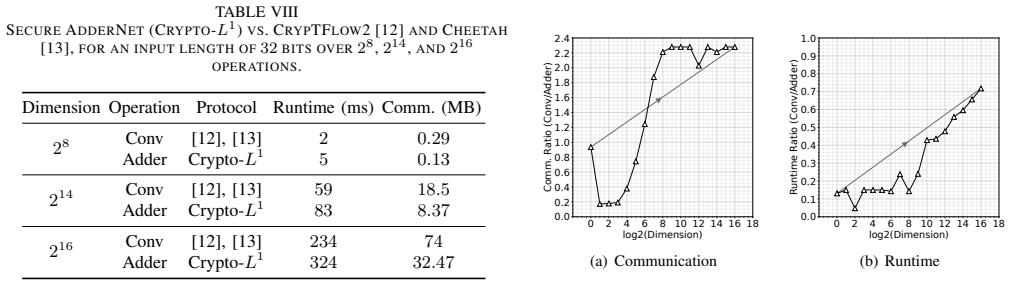
- For high-dimensional inputs, the $L^1$-based Adder layer offers a communication-favourable substitute for secure convolution, at the price of slightly slower runtime in the reported measurements.
- The absolute-value and maximum primitives are general two-party tools, so any computation needing sign, abs, or max can reuse them rather than build them from scratch.
- The framework's per-building-block cost table lets practitioners estimate end-to-end norm cost before committing to a full implementation.
Reading between the lines
- The $L^2$ headline runtime figure of $271\times$ is computed for the squared $L^2$-norm, so applications that need true Euclidean distance will pay an additional secure square-root call; treating $271\times$ as the cost of genuine $L^2$ overstates the practical gain.
- The accuracy comparison for the $L^1$-based inference is made in plaintext, not through the fixed-point secure pipeline; measuring the exact secure inference accuracy would be a direct test of the $3\times$ communication substitution.
- The emulated baselines—especially the trusted-third-party homomorphic protocol of Han et al.—are the most fragile points of the benchmark; porting that protocol into the same OT-based two-party setting would clarify whether the reported speedups are inherent or an artifact of the comparison.
Signed reviews
Editorial analysis
A structured set of objections, weighed in public.
Referee Report
Summary. Crypto-Lp is a suite of semi-honest two-party protocols for computing the L1 (Manhattan), L2 (Euclidean), and L∞ (Chebyshev) distances between n-dimensional ℓ-bit vectors held as arithmetic secret shares over Z_{2^ℓ}. The framework is assembled from a small set of building blocks — an optimized absolute-value multiplexer (F_ABS_MUX), a base multiplexer (F_Base_MUX), an MSB protocol, and a tree-based secure maximum (F_Max) — and the paper reports communication complexities for each, measured runtime and communication for n=2^16 vectors on a LAN, comparisons against seven prior systems, and a new application to secure AdderNet-style L1-based neural network inference. The abstract claims the first comprehensive secure Lp-norm framework, speedups of 82×, 271×, and 42× over prior work for p=1, 2, and ∞, respectively, and a 3× communication reduction for secure inference with comparable runtime and accuracy.
Significance. If the correctness and evaluation issues were resolved, this would be a useful contribution. The F_ABS_MUX construction is a genuine and checkable improvement: the correctness algebra in Appendix B1 verifies, and the construction halves the COT cost relative to the naive composition. The tree-based maximum reduces round complexity from O(n) to O(log n), an improvement that the authors demonstrate experimentally in Figure 3. The L1-based Adder operation for secure 2PC inference is an interesting design point backed by external plaintext results [21]–[23], and the paper is unusually concrete: a public code repository is promised, protocols are specified as numbered algorithms with explicit communication bounds, and evaluations span multiple real datasets (AT&T faces, Lsun, SIFT, Deep1B, Amazon, CIFAR-10, Twitter spatial crowdsourcing). These strengths are substantially offset by the fact that the L1 and L2 protocols, as specified in Algorithms 5 and 6, do not compute their advertised functions over the 32-bit, n=2^16 domain used in the headline benchmarks, and by the L2/squared-L2 ambiguity in the reported speedups.
major comments (5)
- [§IV-A (Alg. 5), §IV-B (Alg. 6), §II-C, Table III] The protocols F_MD and F_ED do not compute the advertised norms over the domain stated in the paper. Section II-C fixes all arithmetic in the ring Z_{2^ℓ}, and Table III evaluates on ℓ=32 with n=2^16. For F_MD (Alg. 5), the true norm Σ|x_i−y_i| can be as large as n(2^ℓ−1); for the valid inputs x_i=2^17−1 and y_i=0, the exact L1 norm is 2^33−2^16, whereas the modular sum returned by the protocol is 2^32−2^16. No input-range condition, wider accumulator, or saturation is stated in Section IV, so the protocol computes the wrong value for the paper's own benchmark parameters. F_ED (Alg. 6) has the analogous problem already at the level of a single component: (x_i−y_i)^2 needs 2ℓ bits, and the sum over n components needs 2ℓ+⌈log n⌉ bits. The authors must either state explicit range conditions under which all partial sums fit in Z_{2^ℓ}, or switch to a wider ring (e.g., 64-bit arithmetic) and re-report the runtime and communication numbers in Tables III, IV, and V accordingly. An end-to-end correctness check of the released implementation against plaintext norms should also be reported.
- [§IV-B (Alg. 6), §VI.B, Table V] The paper computes two different objects but reports them as one. Algorithm 6 defines F_ED as the square root of the sum of squared differences, while Section VI.B states that 'for the remainder of this section, L2-norm or Euclidean distance will specifically refer to the squared L2-norm,' and Table III reports both an 'L2' row that includes the SQRT cost and a 'Squared L2' row without it. The head-to-head speedup claims in Table V (e.g., 271× against Mohassel et al. [7]) are made with the squared version, so the abstract's 271× improvement for p=2 compares a squared-norm functionality against baselines that may compute the true Euclidean distance. The paper must state unambiguously which functionality each comparison uses, and any comparison of squared against unsquared distances should be removed or explicitly labeled as such.
- [§VI.C, §VI.D, Tables IV and V] The headline speedups rest on baseline comparability that is not established. Han et al. [10] is not executed in the same setting: it is a multi-party HE-based protocol relying on a trusted third party, and its performance is emulated from published complexity tables under the authors' chosen parameters. PILOT [38] is re-implemented within ABY rather than run from its original code, and Cong et al. [45] reports no communication cost at all ('-' in Table V). Comparisons across different trust models, protocol types, and implementations can be informative, but the 82×, 271×, and 42× ratios in the abstract are presented as if they were direct measurements. The paper should either run the baselines in a common setting or use the original code, or it should clearly report each baseline's provenance (original code, re-implementation, or emulated complexity) in the tables and soften the abstract claims accordingly.
- [§II-B, §III-A, §IV] The paper asserts security in the semi-honest hybrid model but provides no simulation-based proof for any of the main norm protocols. The only proof-like material is the correctness algebra for F_ABS_MUX in Appendix B1; the security statements for F_MD, F_ED, F_CD, and F_Max are one-line appeals (e.g., 'Security follows directly from that of F_Mill' in Section III-A and 'Security follows from that of F_MSB and F_Base MUX' after Algorithm 4). Since the central contribution is a secure framework, the authors should add formal theorem statements with simulation arguments, or at least a complete hybrid composition argument, for F_MD, F_ED, F_CD, and F_Max, including the handling of the tree-structured F_Max.
- [§V-C, §VII, Table VII] The secure inference claim of 'maintaining comparable runtime and accuracy' is only partially supported. Table VII reports plaintext accuracy of MiniONN and ResNet32 with CNN versus Adder layers, and Tables VIII–IX report runtime and communication for the secure Adder and Conv operations, but no end-to-end secure 2PC inference accuracy is measured. The transfer from plaintext to fixed-point 2PC is assumed rather than tested, and given the truncated modular arithmetic in F_MD (see the first major comment), the accuracy of the secure model is not automatically the plaintext accuracy. The authors should run the secure inference end-to-end on CIFAR-10 and report accuracy, or explicitly state that no secure accuracy evaluation was performed and remove the accuracy claim from the abstract.
minor comments (5)
- [Alg. 4, lines 2, 4, 9] Algorithm 4 contains several presentation errors that impede verification: line 2 reads 'while width<1 do', which is never true for n>1 and should read 'while width>1 do'; the comments on lines 4 and 11 ('if #nodes is even') contradict the condition 'width=2^0', which only isolates the single-node level; and line 9's comment 'Note that s_i = msb_i' is inconsistent with the assignments, which implement s_i = msb_i ⊕ 1 (i.e., s_i = 1{d_i ≥ 0}). These should be corrected and the pseudocode aligned with the surrounding text.
- [§VI.D and Table II] The baseline name is given inconsistently as 'SAANS' in the text of Section VI.D and as 'SANNS' in Table II and the reference list; the correct name (SANNS [46]) should be used throughout.
- [§VII] The phrase 'syntheti data' contains a typo, and the pointer 'Table VIII (Appendix VIII)' is incorrect because Table VIII appears in Section VII rather than in an appendix. In the same section, the sentence claiming AdderNet 'can serve as a practical substitute' should indicate which architecture the subsequent secure comparison (Tables VIII–IX) actually uses, since MiniONN and ResNet32 have different layer counts.
- [Abstract, §I-A, §I-B] The 'first comprehensive framework' claim should be scoped more carefully. The paper's own Table II shows that Mohassel et al. [7] and Han et al. [10] already cover all three Lp norms in specific applications; the novelty lies in the general-purpose, application-agnostic protocol design, and the claim should be phrased in those terms rather than as the first secure Lp-norm computation of any kind. Minor wording issues include 'To our best knowledge' (three occurrences) and 'ubiquituosly' in Section I.
- [Table I and §III-B] Table I's entry for the maximum functionality gives total communication as '<(n−1)(λ+16)(ℓ+1)−30(n−1)', and the accompanying text in Section III.B separately counts the cost of the F_MSB calls; the two figures are consistent, but for clarity the table should also list the round complexity, since reducing the round complexity from O(n) to O(log n) is one of the paper's stated contributions and the basis of Figure 3.
Circularity Check
No circular derivation: the Lp-norm protocols are modular compositions of external cryptographic primitives, and the self-citations are contextual rather than load-bearing.
full rationale
The paper's derivation chain for Crypto-Lp does not reduce to its inputs or to self-citations. F_ABS is defined as selecting x or -x via the MSB and an ABS multiplexer, and the optimized ABS multiplexer is derived algebraically from the base multiplexer identity x - 2*BaseMUX(x,s); this is a mathematical simplification, not a circular step. The L1, L2, and L-infinity protocols (Algorithms 5-7) are explicit compositions of external building blocks attributed to prior independent work: MSB and Millionaires' protocol from Rathee et al. [12], multiplication and square root from SIRNN [6], and OT/COT primitives from the literature. No constant is fitted to a target result, and no claimed norm or speedup is defined in terms of the benchmark outcome. The headline speedups are comparisons against external systems: Mohassel et al. [7], PILOT [38], Han et al. [10], ABY [8], and others. While the benchmark equivalence for Han et al. is emulated from reported complexity and the L2 comparisons use the paper's explicit disclosure that "L2-norm or Euclidean distance will specifically refer to the squared L2-norm," these are evaluation-comparability concerns, not self-referential derivations. The only self-citations are [62] and [63], cited in Appendix A for the standard statement that secure 2PC inference involves a party holding an input tensor and a party holding weights; this is contextual related work and is not load-bearing for any protocol or performance claim. Accordingly, the paper is substantively self-contained: the central protocols are constructed from independently established primitives, and the evaluation is benchmarked externally. The absence of any fitted-input-as-prediction, renamed known result, or author-imported uniqueness theorem keeps the circularity score at the minor/non-load-bearing self-citation level.
Assumptions & free parameters
assumptions (6)
- domain assumption Semi-honest adversary model with computationally bounded parties
- standard math 2-out-of-2 secret sharing over Z_L and Z_2 with uniform random shares
- domain assumption Correctness and security of underlying primitives from Rathee et al. and SIRNN (MSB, multiplication, SQRT)
- domain assumption Oblivious transfer extensions with 128-bit security
- ad hoc to paper Plaintext AdderNet accuracy carries over to secure fixed-point 2PC inference
- ad hoc to paper Two's-complement ring arithmetic correctly represents signed values, excluding the minimum negative edge case
Cite this review
Pith. "Pith review of Secure and Efficient $L^p$-Norm Computation for Two-Party Learning Applications." pith.science (2026). https://pith.science/paper/LA6DXOUT
@misc{pith2026250905552,
  author       = {Pith},
  title        = {Pith review of: Secure and Efficient $L^p$-Norm Computation for Two-Party Learning Applications},
  year         = {2026},
  howpublished = {\url{https://pith.science/paper/LA6DXOUT}},
  note         = {Machine review of arXiv:2509.05552}
}
abstract
Secure norm computation is becoming increasingly important in many real-world learning applications. However, existing cryptographic systems often lack a general framework for securely computing the $L^p$-norm over private inputs held by different parties. These systems often treat secure norm computation as a black-box process, neglecting to design tailored cryptographic protocols that optimize performance. Moreover, they predominantly focus on the $L^2$-norm, paying little attention to other popular $L^p$-norms, such as $L^1$ and $L^\infty$, which are commonly used in practice, such as machine learning tasks and location-based services. To our best knowledge, we propose the first comprehensive framework for secure two-party $L^p$-norm computations ($L^1$, $L^2$, and $L^\infty$), denoted as \mbox{Crypto-$L^p$}, designed to be versatile across various applications. We have designed, implemented, and thoroughly evaluated our framework across a wide range of benchmarking applications, state-of-the-art (SOTA) cryptographic protocols, and real-world datasets to validate its effectiveness and practical applicability. In summary, \mbox{Crypto-$L^p$} outperforms prior works on secure $L^p$-norm computation, achieving $82\times$, $271\times$, and $42\times$ improvements in runtime while reducing communication overhead by $36\times$, $4\times$, and $21\times$ for $p=1$, $2$, and $\infty$, respectively. Furthermore, we take the first step in adapting our Crypto-$L^p$ framework for secure machine learning inference, reducing communication costs by $3\times$ compared to SOTA systems while maintaining comparable runtime and accuracy.
Figures


Figures from the paper (1 more)
Reference graph
Works this paper leans on
-
[10]
Location privacy-preserving distance computation for spatial crowdsourcing,
S. Han, J. Lin, S. Zhao, G. Xu, S. Ren, D. He, L. Wang, and L. Shi, “Location privacy-preserving distance computation for spatial crowdsourcing,”IEEE Internet Things J., 2020
work page 2020
-
[38]
PILOT: practical privacy-preserving indoor localization using outsourcing,
K. J ¨arvinen, H. Lepp ¨akoski, E. S. Lohan, P. Richter, T. Schneider, O. Tkachenko, and Z. Yang, “PILOT: practical privacy-preserving indoor localization using outsourcing,” inEuroS&P, 2019
work page 2019
-
[21]
Addernet: Do we really need multiplications in deep learning?
H. Chen, Y . Wang, C. Xu, B. Shi, C. Xu, Q. Tian, and C. Xu, “Addernet: Do we really need multiplications in deep learning?” inCVPR, 2020
work page 2020
-
[23]
Shiftaddnet: A hardware-inspired deep network,
H. You, X. Chen, Y . Zhang, C. Li, S. Li, Z. Liu, Z. Wang, and Y . Lin, “Shiftaddnet: A hardware-inspired deep network,” inNeurIPS, 2020
work page 2020
-
[7]
Practical privacy-preserving k-means clustering,
P. Mohassel, M. Rosulek, and N. Trieu, “Practical privacy-preserving k-means clustering,”Proc. Priv. Enhancing Technol., 2020
work page 2020
-
[45]
Revisiting oblivious top- kselection with applications to securek-nn classification,
K. Cong, R. Geelen, J. Kang, and J. Park, “Revisiting oblivious top- kselection with applications to securek-nn classification,”Cryptology ePrint Archive, 2023
work page 2023
-
[1]
How to play any mental game or A completeness theorem for protocols with honest majority,
O. Goldreich, S. Micali, and A. Wigderson, “How to play any mental game or A completeness theorem for protocols with honest majority,” inSTOC, 1987
work page 1987
-
[2]
Protocols for secure computations,
A. C. Yao, “Protocols for secure computations,” inFOCS, 1982
work page 1982
Show all 64 references
-
[3]
Enhancing privacy and trust in electronic communities,
B. A. Huberman, M. K. Franklin, and T. Hogg, “Enhancing privacy and trust in electronic communities,” inEC, 1999. 12
1999
-
[4]
Private set intersection: Are garbled circuits better than custom protocols?
Y . Huang, D. Evans, and J. Katz, “Private set intersection: Are garbled circuits better than custom protocols?” inNDSS, 2012
2012
-
[5]
Efficient batched oblivious PRF with applications to private set intersection,
V . Kolesnikov, R. Kumaresan, M. Rosulek, and N. Trieu, “Efficient batched oblivious PRF with applications to private set intersection,” in CCS, 2016
2016
-
[6]
Sirnn: A math library for secure RNN inference,
D. Rathee, M. Rathee, R. K. K. Goli, D. Gupta, R. Sharma, N. Chandran, and A. Rastogi, “Sirnn: A math library for secure RNN inference,” in SP, 2021
2021
-
[8]
ABY - A framework for efficient mixed-protocol secure two-party computation,
D. Demmler, T. Schneider, and M. Zohner, “ABY - A framework for efficient mixed-protocol secure two-party computation,” inNDSS, 2015
2015
-
[9]
GSHADE: faster privacy-preserving distance computation and biometric identification,
J. Bringer, H. Chabanne, M. Favre, A. Patey, T. Schneider, and M. Zohner, “GSHADE: faster privacy-preserving distance computation and biometric identification,” inIH&MMSec, 2014
2014
-
[11]
Unsupervised machine learning on encrypted data,
A. J ¨aschke and F. Armknecht, “Unsupervised machine learning on encrypted data,” inSAC, 2018
2018
-
[12]
Cryptflow2: Practical 2-party secure inference,
D. Rathee, M. Rathee, N. Kumar, N. Chandran, D. Gupta, A. Rastogi, and R. Sharma, “Cryptflow2: Practical 2-party secure inference,” inCCS, 2020
2020
-
[13]
Cheetah: Lean and fast secure two-party deep neural network inference,
Z. Huang, W. Lu, C. Hong, and J. Ding, “Cheetah: Lean and fast secure two-party deep neural network inference,” inUSENIX Security Symposium, 2022
2022
-
[14]
GAZELLE: A low latency framework for secure neural network inference,
C. Juvekar, V . Vaikuntanathan, and A. P. Chandrakasan, “GAZELLE: A low latency framework for secure neural network inference,” inUSENIX Security Symposium, 2018
2018
-
[15]
Muse: Secure inference resilient to malicious clients,
R. Lehmkuhl, P. Mishra, A. Srinivasan, and R. A. Popa, “Muse: Secure inference resilient to malicious clients,” inUSENIX Security Symposium, 2021
2021
-
[16]
Privacy-preserving cloud-based DNN inference,
S. Xie, B. Liu, and Y . Hong, “Privacy-preserving cloud-based DNN inference,” inICASSP. IEEE, 2021
2021
-
[17]
Delphi: A cryptographic inference service for neural networks,
P. Mishra, R. Lehmkuhl, A. Srinivasan, W. Zheng, and R. A. Popa, “Delphi: A cryptographic inference service for neural networks,” in USENIX Security Symposium, 2020
2020
-
[18]
Aby 3: A mixed protocol framework for machine learning,
P. Mohassel and P. Rindal, “Aby 3: A mixed protocol framework for machine learning,” inCCS, 2018
2018
-
[19]
Secureml: A system for scalable privacy- preserving machine learning,
P. Mohassel and Y . Zhang, “Secureml: A system for scalable privacy- preserving machine learning,” inIEEE Symposium on Security and Privacy, 2017
2017
-
[20]
Secfloat: Accurate floating-point meets secure 2-party computation,
D. Rathee, A. Bhattacharya, R. Sharma, D. Gupta, N. Chandran, and A. Rastogi, “Secfloat: Accurate floating-point meets secure 2-party computation,” inSP, 2022
2022
-
[22]
Kernel based progressive distillation for adder neural networks,
Y . Xu, C. Xu, X. Chen, W. Zhang, C. Xu, and Y . Wang, “Kernel based progressive distillation for adder neural networks,” inNeurIPS, 2020
2020
-
[24]
How to share a secret,
A. Shamir, “How to share a secret,”Commun. ACM, 1979
1979
-
[25]
Safeguarding cryptographic keys,
G. R. Blakley, “Safeguarding cryptographic keys,” inMARK, 1979
1979
-
[26]
The relationship between public key encryption and oblivious transfer,
Y . Gertner, S. Kannan, T. Malkin, O. Reingold, and M. Viswanathan, “The relationship between public key encryption and oblivious transfer,” inFOCS, 2000
2000
-
[27]
Extending oblivious transfers efficiently,
Y . Ishai, J. Kilian, K. Nissim, and E. Petrank, “Extending oblivious transfers efficiently,” inCRYPTO, 2003
2003
-
[28]
More efficient oblivious transfer and extensions for faster secure computation,
G. Asharov, Y . Lindell, T. Schneider, and M. Zohner, “More efficient oblivious transfer and extensions for faster secure computation,” inCCS, 2013
2013
-
[29]
Improved OT extension for transfer- ring short secrets,
V . Kolesnikov and R. Kumaresan, “Improved OT extension for transfer- ring short secrets,” inCRYPTO (2), 2013
2013
-
[30]
Actively secure OT extension with optimal overhead,
M. Keller, E. Orsini, and P. Scholl, “Actively secure OT extension with optimal overhead,” inCRYPTO (1), 2015
2015
-
[31]
Precomputing oblivious transfer,
D. Beaver, “Precomputing oblivious transfer,” inCRYPTO, 1995
1995
-
[32]
Efficient multiparty protocols using circuit randomization,
——, “Efficient multiparty protocols using circuit randomization,” in CRYPTO, 1991
1991
-
[33]
Two party RSA key generation,
N. Gilboa, “Two party RSA key generation,” inCRYPTO, 1999
1999
-
[34]
Pushing the communication barrier in secure computation using lookup tables,
G. Dessouky, F. Koushanfar, A. Sadeghi, T. Schneider, S. Zeitouni, and M. Zohner, “Pushing the communication barrier in secure computation using lookup tables,” inNDSS, 2017
2017
-
[35]
Parameterisation of a stochastic model for human face identification,
F. Samaria and A. Harter, “Parameterisation of a stochastic model for human face identification,” inWACV, 1994
1994
-
[36]
Indoorloc platform: A public repository for comparing and evaluating indoor positioning systems,
R. Montoliu, E. Sansano-Sansano, J. Torres-Sospedra, and O. Belmonte, “Indoorloc platform: A public repository for comparing and evaluating indoor positioning systems,” inIPIN, 2017
2017
-
[37]
The death and rebirth of privacy-preserving wifi fingerprint localization with paillier encryption,
Z. Yang and K. J ¨arvinen, “The death and rebirth of privacy-preserving wifi fingerprint localization with paillier encryption,” inINFOCOM, 2018
2018
-
[39]
Priradar: A privacy- preserving framework for spatial crowdsourcing,
D. Yuan, Q. Li, G. Li, Q. Wang, and K. Ren, “Priradar: A privacy- preserving framework for spatial crowdsourcing,”TIFS, 2020
2020
-
[40]
The fundamental clustering and projection suite (FCPS): A dataset collection to test the performance of clustering and data projection algorithms,
A. Ultsch and J. L ¨otsch, “The fundamental clustering and projection suite (FCPS): A dataset collection to test the performance of clustering and data projection algorithms,”Data, 2020
2020
-
[41]
Object recognition from local scale-invariant features,
D. G. Lowe, “Object recognition from local scale-invariant features,” in ICCV, 1999
1999
-
[42]
Efficient indexing of billion-scale datasets of deep descriptors,
A. Babenko and V . S. Lempitsky, “Efficient indexing of billion-scale datasets of deep descriptors,” inCVPR, 2016
2016
-
[43]
Image-based recommendations on styles and substitutes,
J. J. McAuley, C. Targett, Q. Shi, and A. van den Hengel, “Image-based recommendations on styles and substitutes,” inSIGIR, 2015
2015
-
[44]
Learning multiple layers of features from tiny images,
A. Krizhevsky, “Learning multiple layers of features from tiny images,” University of Toronto, Tech. Rep., 2009, cIFAR-10 dataset
2009
-
[46]
SANNS: scaling up secure approximate k-nearest neighbors search,
H. Chen, I. Chillotti, Y . Dong, O. Poburinnaya, I. P. Razenshteyn, and M. S. Riazi, “SANNS: scaling up secure approximate k-nearest neighbors search,” inUSENIX Security Symposium, 2020
2020
-
[47]
EMP-toolkit: Efficient MultiParty computation toolkit
X. Wang, A. J. Malozemoff, and J. Katz, “EMP-toolkit: Efficient MultiParty computation toolkit.”
-
[48]
Efficient privacy- preserving face recognition,
A. Sadeghi, T. Schneider, and I. Wehrenberg, “Efficient privacy- preserving face recognition,” inICISC, 2009
2009
-
[49]
Secure two-party k-means clustering,
P. Bunn and R. Ostrovsky, “Secure two-party k-means clustering,” in CCS, 2007
2007
-
[50]
Privacy-preserving distributed k- means clustering over arbitrarily partitioned data,
G. Jagannathan and R. N. Wright, “Privacy-preserving distributed k- means clustering over arbitrarily partitioned data,” inKDD, 2005
2005
-
[51]
Automatic protocol selection in secure two-party computations,
F. Kerschbaum, T. Schneider, and A. Schr ¨opfer, “Automatic protocol selection in secure two-party computations,” inNDSS, 2013
2013
-
[52]
Privacy-preserving biometric identification using secure multiparty computation: An overview and recent trends,
J. Bringer, H. Chabanne, and A. Patey, “Privacy-preserving biometric identification using secure multiparty computation: An overview and recent trends,”IEEE Signal Process. Mag., 2013
2013
-
[53]
Secure and efficient protocols for iris and fingerprint identification,
M. Blanton and P. Gasti, “Secure and efficient protocols for iris and fingerprint identification,” inESORICS, 2011
2011
-
[54]
Secure two- party distance computation protocol based on privacy homomorphism and scalar product in wireless sensor networks,
H. Huang, T. Gong, P. Chen, R. Malekian, and T. Chen, “Secure two- party distance computation protocol based on privacy homomorphism and scalar product in wireless sensor networks,”Tsinghua Science and Technology, 2016
2016
-
[55]
Efficient homomorphic evaluation of k-nn classifiers,
M. Zuber and R. Sirdey, “Efficient homomorphic evaluation of k-nn classifiers,”Proc. Priv. Enhancing Technol., 2021
2021
-
[56]
Secure k-ish nearest neighbors classifier,
H. Shaul, D. Feldman, and D. Rus, “Secure k-ish nearest neighbors classifier,”Proc. Priv. Enhancing Technol., 2020
2020
-
[57]
A privacy preserving multiagent system for load balancing in the smart grid,
S. Xie, Y . Hong, and P. Wan, “A privacy preserving multiagent system for load balancing in the smart grid,” inAAMAS, 2019
2019
-
[58]
Pairing: Privately balancing multiparty real-time supply and demand on the power grid,
——, “Pairing: Privately balancing multiparty real-time supply and demand on the power grid,”TIFS, vol. 15, pp. 1114–1127, 2020
2020
-
[59]
Somewhat practical fully homomorphic encryption,
J. Fan and F. Vercauteren, “Somewhat practical fully homomorphic encryption,”IACR Cryptol. ePrint Arch., 2012
2012
-
[60]
(leveled) fully ho- momorphic encryption without bootstrapping,
Z. Brakerski, C. Gentry, and V . Vaikuntanathan, “(leveled) fully ho- momorphic encryption without bootstrapping,”ACM Trans. Comput. Theory, 2014
2014
-
[61]
Fully homomorphic encryption without modulus switch- ing from classical gapsvp,
Z. Brakerski, “Fully homomorphic encryption without modulus switch- ing from classical gapsvp,” inCRYPTO, 2012
2012
-
[62]
Secure and efficient video inferences with compressed 3-dimensional deep neural networks,
B. Liu, A. Arastehfard, R. Wang, W. Liu, Z. Ba, S. Zhou, and Y . Hong, “Secure and efficient video inferences with compressed 3-dimensional deep neural networks,” inCODASPY. ACM, 2025, pp. 185–196
2025
-
[63]
Securev2x: An efficient and privacy-preserving system for vehicle-to-everything (v2x) applications,
J. Lee, A. Arastehfard, W. Liu, X. Ban, and Y . Hong, “Securev2x: An efficient and privacy-preserving system for vehicle-to-everything (v2x) applications,” 2025
2025
-
[64]
Marbled circuits: Mixing arithmetic and boolean circuits with active security,
D. Rotaru and T. Wood, “Marbled circuits: Mixing arithmetic and boolean circuits with active security,” inINDOCRYPT, 2019. 13
2019
Reviewed August 15, 2026 · model on record in the stance chip above.
Discussion (0). Continue with ORCID to comment.