REVIEW 3 major objections 8 minor 76 references
Generative Face Parsing Map Guided 3D Face Reconstruction Under Occluded Scenes
T0 review · 3 major / 8 minor · reviewed 2026-08-11 · deepseek-v4-flash
Pith's one-line read Single-view 3D face reconstruction can survive occluders by first generating a complete landmark-guided face parsing map, then synthesizing an unoccluded face image with a GAN, and only then fitting the 3D model.
desk verdict A sensible modular pipeline for occlusion-robust 3D face reconstruction whose evidence is too thin to prove the central claim; worth one serious referee pass. read the letter →
The pith
A machine-rendered reading of the paper's core claim, the machinery that carries it, and where it could break.
The reading
What carries the argument
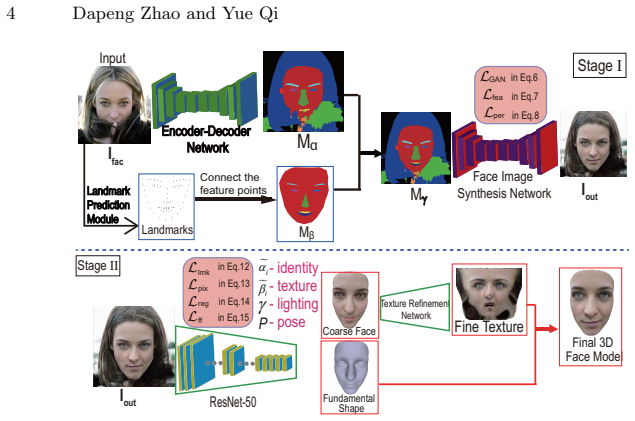
The load-bearing mechanism is the two-map merge ('Face Parsing Map Plus'): one parsing map $M_\alpha$ from a trained face parsing network and one landmark-derived map $M_\beta$ built by connecting 68 predicted landmarks into regions for skin, eyebrows, eyes, nose, and lips. Algorithm 1 fills occluded pixels of $M_\alpha$ from $M_\beta$ when the semantic label is missing, yielding the complete map $M_\gamma$ that the GAN uses as a semantic condition. The Face Image Synthesis Network, built on Pix2PixHD with SFT layers and SEAN normalization, transfers the style of visible facial features to the positions defined by $M_\gamma$, so the generated $I_{\text{out}}$ respects the subject's identity. The 3D reconstruction then uses a four-term loss (landmark, pixel-wise with occlusion attention, regularization, and face-feature cosine loss) on $I_{\text{out}}$.
What would settle it
Take a face dataset with ground-truth landmarks and ground-truth 3D scans, add artificial occluders over the eyes, nose, and mouth, and compare predicted landmarks against ground truth before reconstruction. If landmark error grows sharply whenever an occluder covers a facial feature, the merged $M_\gamma$ will be structurally wrong; one could then measure whether the 90-percent reconstruction error on MICC Florence rises towards or above the baselines when the same occluders are used. A second check: replace the predicted landmarks with ground-truth landmarks and see whether the reported 1.24 mm error drops further, which would confirm that landmark accuracy is the controlling bottleneck.
Extended reading notes
Core claim
The central claim is that occlusion handling should happen in 2D image space before 3D reconstruction, guided by facial structure rather than by direct inpainting of pixels. The paper proposes the 'Face Parsing Map Plus' algorithm: a U-Net parsing model provides a semantic map $M_\alpha$, a landmark predictor provides 68 points that are connected into a feature-region map $M_\beta$, and a rule-based merge fills occluded skin and facial features so the complete map $M_\gamma$ has the correct eye-nose-mouth topology. A Pix2PixHD-style generator conditioned on $M_\gamma$ synthesizes the unoccluded face $I_{\text{out}}$, which is then fed to a ResNet-50 regressor for 3DMM coefficients and a graph-convolution texture refinement network. The paper argues that because the occluded region is regenerated semantically before fitting, the final 3D model keeps a natural global shape while gaining refined texture.
Load-bearing premise
The whole pipeline depends on the landmark predictor producing accurate 68-point locations even when parts of the face are hidden; if an occluder drags a landmark off the true eye, nose, or mouth position, the merged parsing map and the synthesized face inherit that error, and the 3D model is fitted to a face structure that is not the subject's.
Editorial extensions
If this is right
- For inputs where the occluder does not corrupt landmark detection, the method yields complete 3D faces with correct eye-nose-mouth topology under glasses, jewelry, palms, and hair.
- On MICC Florence with artificial occluders, the reported 90-percent error of 1.24 mm is lower than the 1.75 mm of 3DDFA and 2.17 mm of Chen et al., indicating that the 2D-before-3D ordering helps accuracy, not just visual plausibility.
- LFW verification results with and without occlusion (100%-EER 85.75 vs 90.57) show that the reconstructed shapes retain recognition-level identity information under occlusion.
- The occlusion-aware pixel-wise loss, which upweights facial feature regions during 3D fitting, ties the texture optimization to the semantically regenerated areas rather than to the occluded pixels.
- The pipeline separates face-image synthesis from 3D fitting, so the cleaned image can be used as input to the 3DMM regressor independently of the synthesis backbone.
Reading between the lines
- Inference: because the landmark predictor is trained on 300-W and CelebA-HQ with pseudo-labels from Faceboxes, its accuracy on heavy occlusions is untested; a natural extension would be to train it with occluded-face landmark data or to make the parsing map guide the landmarks instead of the reverse.
- Inference: the parsing-map-plus merge is a generic semantic prior; it could be reused for other face-editing tasks such as attribute transfer or face swapping, where a complete feature layout is needed before generation.
- Inference: the two-stage design implies that any improvement in face inpainting or face parsing could be plugged in without changing the 3D fitting stage, so the method's ceiling is set by the quality of the regenerated 2D face.
- Inference: a direct test of the claim would be to compare against a pipeline that inpaints the occluded region with a state-of-the-art face inpainter and then applies the same 3DMM fitting; this would isolate whether the parsing-map guidance or the GAN synthesis is responsible for the gains.
Signed reviews
Editorial analysis
A structured set of objections, weighed in public.
Referee Report
Summary. The paper presents a pipeline for single-view 3D face reconstruction under occlusion. The method first predicts 68 facial landmarks from the occluded input, generates a face parsing map M_alpha, constructs a complete parsing map M_gamma by merging M_alpha with a landmark-derived map M_beta via Algorithm 1, synthesizes an occlusion-free face image I_out using a GAN-based Face Image Synthesis Network (FISN), and finally fits a 3DMM (ResNet-50 regressor plus a graph-convolution texture refinement network) to I_out. The authors claim state-of-the-art quality and robustness under occlusion, supported by qualitative comparisons against 3DDFA, DF2Net, and Chen et al. and by two quantitative experiments: a 90% error comparison on artificially occluded MICC Florence data (1.24 mm vs. 1.75 and 2.17 mm) and an LFW face-verification experiment with and without synthetic occlusions.
Significance. The proposed combination of landmark-guided parsing-map completion and GAN-based image synthesis is a reasonable and potentially useful direction for occlusion-robust 3D face reconstruction. The manuscript includes a concrete algorithm (Algorithm 1), qualitative results on real-world occluded images, and a quantitative comparison, which are strengths. However, the central claim of robustness is not yet adequately supported: the landmark predictor, which is load-bearing for the whole pipeline, is not evaluated on occluded faces, and the quantitative evaluations lack statistical detail and baseline comparisons under identical protocols. The text also contains an explicit self-reported degradation in the texture refinement network that conflicts with the stated high-fidelity result. These issues are addressable with additional experiments and clarifications; the core approach is not fundamentally flawed.
major comments (3)
- [§3.1–3.2, Eq. (1), Algorithm 1, Eq. (12)] The central robustness claim rests on the ability of Nlmk to produce accurate 68-point landmarks on partially occluded faces, which the paper itself describes as 'a crucial part' (Sec. 3.1). However, no quantitative evaluation of landmark accuracy under occlusion is provided; training on 300-W plus pseudo-labeled CelebA-HQ is not shown to transfer to occluders such as hair, hands, or glasses. Because M_beta is constructed by connecting the predicted landmarks (Sec. 3.2) and the final 3D fit is aligned to landmarks detected on the synthesized I_out (Eq. 12), any landmark error propagates through M_gamma and the GAN to the final shape and texture. Please report normalized mean error (NME) on an occluded landmark benchmark, or an ablation that varies landmark accuracy and measures its effect on reconstruction error.
- [§5.2, Fig. 4, Table 1] The quantitative support for the robustness claim is insufficient. On MICC Florence, only a single 90% error value per method is reported, with no error bars, no number of test subjects, no description of how the artificial occluders were generated (type, size, opacity, position), and no definition of the 90% error metric. In Table 1, the LFW experiment compares only Ours (with/without occlusion) against Tran et al.; no other method is evaluated under the same synthetic occlusions, so the claim that the accuracy drop is 'limited' has no baseline. Please report mean±std over subjects, define the metric, describe the occluder protocol, and include a comparison to at least one recent occlusion-robust reconstruction method under the same protocol.
- [§4, Implementation Details] The implementation section contains the sentence: 'We do not adopt any fully-connected layers or convolutional layers in the refinement network refer to related research [32]. This will reduce the performance of the module.' As written, this is a direct admission that the texture refinement network degrades performance, which contradicts the conclusion's claim of 'high fidelity textures.' If the sentence is a typo and should read 'will not reduce,' it must be corrected; if it is a genuine limitation, its effect on the final texture quality should be quantified and discussed. In either case, this self-reported limitation must be resolved before the central claim can be accepted.
minor comments (8)
- [Abstract] The sentence 'demonstrate the method's superior regulation ability over existing methods often break down' is ungrammatical; 'regulation' should be 'regularization' and the clause needs rewording.
- [§3.2] The text says 'we assumed that facial features only include only five parts' (duplicate 'only'), and Algorithm 1 defines the facial-feature gray range S as 'only include four parts' while the text lists five including skin; please make the number of classes consistent.
- [§3.3, Eq. (6)] The conditional adversarial loss uses the notation D1,2 without a clear definition of how the two discriminators are combined; please specify the exact form of the loss for each discriminator.
- [§3.5, Eq. (13)] The occlusion attention coefficient Pi is set to 1 for facial features in M_alpha and 0.1 otherwise, but M_alpha may contain occluder labels; the relationship between M_alpha and the occlusion mask used for attention should be clarified.
- [§5.1, Fig. 3] The caption of Fig. 3 lists methods in an order inconsistent with the text: the caption reads 'Input Ours 3DDFA'20 Chen et al.'19 DF2Net'19 Mγ Map' while the text says '3DDFA, DF2Net, Chen et al. and our method.' Ensure the figure and text correspond.
- [§5.2] The phrase 'We calculated the average 90% largest error' is ambiguous; please define the metric (e.g., the 90th percentile of per-vertex Euclidean errors) and specify whether it is averaged over all vertices or over subjects.
- [§2.2] The citation artifact '[32-35]' appears mid-sentence; use standard citation formatting such as '[32,33,34,35]'.
- [§4] Several hyperparameters (λ1–λ6, ωα, ωβ, Pi) are stated without any sensitivity analysis or ablation; a brief discussion of their stability or a table of ablations would improve reproducibility.
Circularity Check
Landmark-prediction loop: the 2D facial structure used to synthesize the target image is produced by the same fitted landmark detector that supervises the final 3D alignment.
-
fitted input called prediction
[Sections 3.2, 3.3, and 3.5, Eq. (12)]
"The architecture Nlmk aims to generate landmarks from a corrupted face photo Icor : Zlmk=Nlmk (Icor; θlmk) ... given the landmarks Zlmk ∈ R2×68, we connected the feature points to form a region. Then these regions can form a parsing map Mβ ... face features (e.g. eyes style) in Ifac are shifted to the corresponding position on Mγ so that FISN can synthesis image Iout which removed occlusion ... We ran the landmark prediction module Nlmk to detect 68 landmarks {z(n)lmk} from the training images. We obtained landmarks {l(n)y} from rendering facial images."
The same fitted landmark network N_lmk supplies both the structural input and the supervision target: its 68 outputs are connected into M_beta, merged into M_gamma, and used by FISN to synthesize I_out; then Eq. (12) minimizes the distance between projected 3D landmarks and N_lmk's detections on I_out. Thus the reconstructed eye/nose/mouth positions are aligned, by construction, to the same detector that generated the target image. Any occlusion-induced landmark bias is injected twice, and the landmark loss cannot correct or validate the occluded structure. The 'reasonable position of the occlusion area' is therefore a self-consistency loop with N_lmk, not an externally grounded estimate. The external MICC/LFW benchmarks keep the overall robustness claim partially independent.
full rationale
The paper's headline quantitative claims are supported by external benchmarks: the MICC Florence 90%-error comparison is against ground-truth 3D models (Fig. 4), and the LFW verification experiment uses an independent face-verification protocol (Table 1). Those results are not derived from the paper's own outputs, so the central robustness claim does not reduce to a tautology. However, the method does contain one component-level circular loop. The landmark predictor N_lmk is trained on 300-W plus pseudo-labeled CelebA-HQ (Sec. 4) and is used to create M_beta by connecting its 68 predicted points (Sec. 3.2). M_beta is merged into M_gamma, which conditions FISN to generate the de-occluded target I_out (Sec. 3.3). The 3DMM fit is then supervised in Eq. (12) by landmarks detected by the same N_lmk on I_out, plus pixel and identity losses against I_out. Consequently, the landmark term aligns the projected 3D landmarks to the very detector outputs that defined the target's facial topology; it cannot supply independent evidence about the occluded face's true structure. This makes the 'reasonable position of the occlusion area' a self-consistency constraint rather than an externally verified estimate. The concern is mitigated by the external MICC/LFW evaluations, which test the full pipeline against ground truth and independent recognition, but the qualitative claim of 'rationality of our estimated facial structure' rests on the unvalidated loop. No load-bearing self-citations or imported uniqueness theorems are present.
Assumptions & free parameters
free parameters (10)
- λ1 (feature matching weight) =
10
- λ2 (perceptual weight) =
10
- λ3 (landmark loss weight) =
1.6e-3
- λ4 (pixel-wise loss weight) =
1.4
- λ5 (regularization weight) =
3.7e-4
- λ6 (face feature loss weight) =
0.2
- ωα (shape regularization weight) =
1.0
- ωβ (texture regularization weight) =
1.75e-3
- Occlusion attention weight Pi for non-feature pixels =
0.1
- Grayscale ranges S and O in Algorithm 1 =
not specified
assumptions (5)
- domain assumption The pre-trained face parsing model N_alpha (trained on CelebAMask-HQ) produces reliable parsing maps on occluded images.
- domain assumption The landmark detector Nlmk is accurate under occlusion.
- domain assumption The GAN-synthesized image I_out preserves the subject's identity and facial topology.
- domain assumption The Basel Face Model (BFM) shape space is sufficient to represent faces from the evaluation datasets.
- standard math Spherical harmonics with B=3 bands model scene illumination adequately.
Cite this review
Pith. "Pith review of Generative Face Parsing Map Guided 3D Face Reconstruction Under Occluded Scenes." pith.science (2026). https://pith.science/paper/LANNOCN2
@misc{pith2026241218920,
  author       = {Pith},
  title        = {Pith review of: Generative Face Parsing Map Guided 3D Face Reconstruction Under Occluded Scenes},
  year         = {2026},
  howpublished = {\url{https://pith.science/paper/LANNOCN2}},
  note         = {Machine review of arXiv:2412.18920}
}
read the original abstract
Over the past few years, single-view 3D face reconstruction methods can produce beautiful 3D models. Nevertheless,the input of these works is unobstructed faces.We describe a system designed to reconstruct convincing face texture in the case of occlusion.Motivated by parsing facial features,we propose a complete face parsing map generation method guided by landmarks.We estimate the 2D face structure of the reasonable position of the occlusion area,which is used for the construction of 3D texture.An excellent anti-occlusion face reconstruction method should ensure the authenticity of the output,including the topological structure between the eyes,nose, and mouth. We extensively tested our method and its components, qualitatively demonstrating the rationality of our estimated facial structure. We conduct extensive experiments on general 3D face reconstruction tasks as concrete examples to demonstrate the method's superior regulation ability over existing methods often break down.We further provide numerous quantitative examples showing that our method advances both the quality and the robustness of 3D face reconstruction under occlusion scenes.
Figures


Figures from the paper (2 more)


Reference graph
Works this paper leans on
-
[32]
arXiv preprint arXiv:2003.05653 (2020)
Lin, J., Yuan, Y., Shao, T., Zhou, K.: Towards high-fidelity 3d face re- construction from in-the-wild images using graph convolutional networks. arXiv preprint arXiv:2003.05653 (2020)
arXiv 2020
-
[1]
Abdal, R., Qin, Y., Wonka, P.: Image2stylegan: How to embed images into the stylegan latent space? In: Proceedings of the IEEE/CVF International Conference on Computer Vision. pp. 4432–4441 (2019)
work page 2019
-
[2]
In: Proceedings of the 2011 joint ACM workshop on Human gesture and behavior understanding
Bagdanov, A.D., Del Bimbo, A., Masi, I.: The florence 2d/3d hybrid face dataset. In: Proceedings of the 2011 joint ACM workshop on Human gesture and behavior understanding. pp. 79–80 (2011)
2011
-
[3]
In: Proceedings of the IEEE International Conference on Computer Vision
Chen, A., Chen, Z., Zhang, G., Mitchell, K., Yu, J.: Photo-realistic facial de- tails synthesis from single image. In: Proceedings of the IEEE International Conference on Computer Vision. pp. 9429–9439 (2019)
work page 2019
-
[4]
arXiv preprint arXiv:1412.7062 (2014)
Chen, L.C., Papandreou, G., Kokkinos, I., Murphy, K., Yuille, A.L.: Seman- tic image segmentation with deep convolutional nets and fully connected crfs. arXiv preprint arXiv:1412.7062 (2014)
arXiv 2014
-
[5]
IEEE transactions on pattern analysis and machine intelligence 40(4), 834–848 (2017)
Chen, L.C., Papandreou, G., Kokkinos, I., Murphy, K., Yuille, A.L.: Deeplab: Semantic image segmentation with deep convolutional nets, atrous convolution, and fully connected crfs. IEEE transactions on pattern analysis and machine intelligence 40(4), 834–848 (2017)
2017
-
[6]
arXiv preprint arXiv:1706.05587 (2017)
Chen, L.C., Papandreou, G., Schroff, F., Adam, H.: Rethinking atrous con- volution for semantic image segmentation. arXiv preprint arXiv:1706.05587 (2017)
arXiv 2017
-
[7]
In: Proceedings of the European conference on computer vision (ECCV)
Chen, L.C., Zhu, Y., Papandreou, G., Schroff, F., Adam, H.: Encoder- decoder with atrous separable convolution for semantic image segmentation. In: Proceedings of the European conference on computer vision (ECCV). pp. 801–818 (2018)
work page 2018
Show all 76 references
-
[8]
In: Proceedings of the IEEE Conference on Computer Vision and Pat- tern Recognition
Choi, Y., Choi, M., Kim, M., Ha, J.W., Kim, S., Choo, J.: Stargan: Unified generative adversarial networks for multi-domain image-to-image transla- tion. In: Proceedings of the IEEE Conference on Computer Vision and Pat- tern Recognition. pp. 8789–8797 (2018)
2018
-
[9]
In: 2019 IEEE Interna- tional Conference on Image Processing (ICIP)
Chu, W., Hung, W.C., Tsai, Y.H., Cai, D., Yang, M.H.: Weakly-supervised caricature face parsing through domain adaptation. In: 2019 IEEE Interna- tional Conference on Image Processing (ICIP). pp. 3282–3286. IEEE (2019)
2019
-
[10]
arXiv preprint arXiv:1803.07422 (2018)
Demir, U., Unal, G.: Patch-based image inpainting with generative adver- sarial networks. arXiv preprint arXiv:1803.07422 (2018)
2018 arXiv
-
[11]
In: Proceedings of the IEEE Conference on Computer Vision and Pattern Recognition Workshops
Deng, Y., Yang, J., Xu, S., Chen, D., Jia, Y., Tong, X.: Accurate 3d face reconstruction with weakly-supervised learning: From single image to im- age set. In: Proceedings of the IEEE Conference on Computer Vision and Pattern Recognition Workshops. pp. 0–0 (2019)
2019
-
[12]
In: Proceedings of the IEEE conference on computer vision and pattern recognition
Dolhansky, B., Ferrer, C.C.: Eye in-painting with exemplar generative ad- versarial networks. In: Proceedings of the IEEE conference on computer vision and pattern recognition. pp. 7902–7911 (2018)
2018
-
[13]
arXiv preprint arXiv:1610.07629 (2016) 14 Dapeng Zhao and Yue Qi
Dumoulin, V., Shlens, J., Kudlur, M.: A learned representation for artistic style. arXiv preprint arXiv:1610.07629 (2016) 14 Dapeng Zhao and Yue Qi
2016 arXiv
-
[14]
In: Proceedings of the European Conference on Computer Vision (ECCV)
Feng, Y., Wu, F., Shao, X., Wang, Y., Zhou, X.: Joint 3d face reconstruction and dense alignment with position map regression network. In: Proceedings of the European Conference on Computer Vision (ECCV). pp. 534–551 (2018)
2018
-
[15]
ACM Transactions on Graphics (TOG) 38(4), 1–11 (2019)
Fr¨ uhst¨ uck, A., Alhashim, I., Wonka, P.: Tilegan: synthesis of large-scale non-homogeneous textures. ACM Transactions on Graphics (TOG) 38(4), 1–11 (2019)
2019
-
[16]
arXiv preprint arXiv:1406.2661 (2014)
Goodfellow, I.J., Pouget-Abadie, J., Mirza, M., Xu, B., Warde-Farley, D., Ozair, S., Courville, A., Bengio, Y.: Generative adversarial networks. arXiv preprint arXiv:1406.2661 (2014)
2014 arXiv
-
[17]
arXiv preprint arXiv:2009.09960 (2020)
Guo, J., Zhu, X., Yang, Y., Yang, F., Lei, Z., Li, S.Z.: Towards fast, accurate and stable 3d dense face alignment. arXiv preprint arXiv:2009.09960 (2020)
2020 arXiv
-
[18]
In: Proceedings of the IEEE conference on computer vision and pattern recognition
He, K., Zhang, X., Ren, S., Sun, J.: Deep residual learning for image recog- nition. In: Proceedings of the IEEE conference on computer vision and pattern recognition. pp. 770–778 (2016)
2016
-
[19]
arXiv preprint arXiv:1711.10678 (2017)
He, Z., Zuo, W., Kan, M., Shan, S., Chen, X.: Attgan: Facial attribute editing by only changing what you want. arXiv preprint arXiv:1711.10678 (2017)
2017 arXiv
-
[20]
In: Pro- ceedings of the IEEE/CVF International Conference on Computer Vision
Howard, A., Sandler, M., Chu, G., Chen, L.C., Chen, B., Tan, M., Wang, W., Zhu, Y., Pang, R., Vasudevan, V.: Searching for mobilenetv3. In: Pro- ceedings of the IEEE/CVF International Conference on Computer Vision. pp. 1314–1324 (2019)
2019
-
[21]
In: Workshop on faces in’Real-Life’Images: detection, alignment, and recognition (2008)
Huang, G.B., Mattar, M., Berg, T., Learned-Miller, E.: Labeled faces in the wild: A database forstudying face recognition in unconstrained envi- ronments. In: Workshop on faces in’Real-Life’Images: detection, alignment, and recognition (2008)
2008
-
[22]
In: Proceedings of the IEEE International Confer- ence on Computer Vision
Huang, X., Belongie, S.: Arbitrary style transfer in real-time with adaptive instance normalization. In: Proceedings of the IEEE International Confer- ence on Computer Vision. pp. 1501–1510 (2017)
2017
-
[23]
In: Proceedings of the IEEE conference on computer vision and pattern recognition
Isola, P., Zhu, J.Y., Zhou, T., Efros, A.A.: Image-to-image translation with conditional adversarial networks. In: Proceedings of the IEEE conference on computer vision and pattern recognition. pp. 1125–1134 (2017)
2017
-
[24]
arXiv preprint arXiv:1506.02025 (2015)
Jaderberg, M., Simonyan, K., Zisserman, A., Kavukcuoglu, K.: Spatial transformer networks. arXiv preprint arXiv:1506.02025 (2015)
2015 arXiv
-
[25]
In: European conference on computer vision
Johnson, J., Alahi, A., Fei-Fei, L.: Perceptual losses for real-time style trans- fer and super-resolution. In: European conference on computer vision. pp. 694–711. Springer (2016)
2016
-
[26]
In: Proceedings of the IEEE conference on computer vision and pattern recognition
Jourabloo, A., Liu, X.: Large-pose face alignment via cnn-based dense 3d model fitting. In: Proceedings of the IEEE conference on computer vision and pattern recognition. pp. 4188–4196 (2016)
2016
-
[27]
arXiv preprint arXiv:1710.10196 (2017)
Karras, T., Aila, T., Laine, S., Lehtinen, J.: Progressive growing of gans for improved quality, stability, and variation. arXiv preprint arXiv:1710.10196 (2017)
2017 arXiv
-
[28]
In: Proceedings of the IEEE/CVF Conference on Computer Vision and Pattern Recognition
Karras, T., Laine, S., Aittala, M., Hellsten, J., Lehtinen, J., Aila, T.: Ana- lyzing and improving the image quality of stylegan. In: Proceedings of the IEEE/CVF Conference on Computer Vision and Pattern Recognition. pp. 8110–8119 (2020) Title Suppressed Due to Excessive Length 15
2020
-
[29]
In: Proceedings of the IEEE/CVF Confer- ence on Computer Vision and Pattern Recognition
Lee, C.H., Liu, Z., Wu, L., Luo, P.: Maskgan: Towards diverse and interac- tive facial image manipulation. In: Proceedings of the IEEE/CVF Confer- ence on Computer Vision and Pattern Recognition. pp. 5549–5558 (2020)
2020
-
[30]
In: European conference on computer vision
Li, C., Wand, M.: Precomputed real-time texture synthesis with marko- vian generative adversarial networks. In: European conference on computer vision. pp. 702–716. Springer (2016)
2016
-
[31]
arXiv preprint arXiv:1610.05586 (2016)
Li, M., Zuo, W., Zhang, D.: Deep identity-aware transfer of facial attributes. arXiv preprint arXiv:1610.05586 (2016)
2016 arXiv
-
[33]
In: Proceedings of the IEEE Conference on Computer Vision and Pattern Recognition
Lin, J., Yang, H., Chen, D., Zeng, M., Wen, F., Yuan, L.: Face parsing with roi tanh-warping. In: Proceedings of the IEEE Conference on Computer Vision and Pattern Recognition. pp. 5654–5663 (2019)
2019
-
[34]
Image and Vision Computing p
Lin, Y., Shen, J., Wang, Y., Pantic, M.: Roi tanh-polar transformer network for face parsing in the wild. Image and Vision Computing p. 104190 (2021)
2021
-
[35]
In: European Conference on Computer Vision
Liu, F., Zeng, D., Zhao, Q., Liu, X.: Joint face alignment and 3d face re- construction. In: European Conference on Computer Vision. pp. 545–560. Springer (2016)
2016
-
[36]
arXiv preprint arXiv:1703.00848 (2017)
Liu, M.Y., Breuel, T., Kautz, J.: Unsupervised image-to-image translation networks. arXiv preprint arXiv:1703.00848 (2017)
2017 arXiv
-
[37]
In: Proceedings of the IEEE international conference on computer vision
Liu, Z., Luo, P., Wang, X., Tang, X.: Deep learning face attributes in the wild. In: Proceedings of the IEEE international conference on computer vision. pp. 3730–3738 (2015)
2015
-
[38]
In: Proceedings of the IEEE conference on computer vision and pattern recognition
Long, J., Shelhamer, E., Darrell, T.: Fully convolutional networks for se- mantic segmentation. In: Proceedings of the IEEE conference on computer vision and pattern recognition. pp. 3431–3440 (2015)
2015
-
[39]
arXiv preprint arXiv:1411.1784 (2014)
Mirza, M., Osindero, S.: Conditional generative adversarial nets. arXiv preprint arXiv:1411.1784 (2014)
2014 arXiv
-
[40]
arXiv preprint arXiv:1802.05957 (2018)
Miyato, T., Kataoka, T., Koyama, M., Yoshida, Y.: Spectral normalization for generative adversarial networks. arXiv preprint arXiv:1802.05957 (2018)
2018 arXiv
-
[41]
arXiv preprint arXiv:1901.00212 (2019)
Nazeri, K., Ng, E., Joseph, T., Qureshi, F.Z., Ebrahimi, M.: Edgeconnect: Generative image inpainting with adversarial edge learning. arXiv preprint arXiv:1901.00212 (2019)
2019 arXiv
-
[42]
In: 2018 13th IEEE International Conference on Automatic Face & Gesture Recognition (FG 2018)
Nirkin, Y., Masi, I., Tuan, A.T., Hassner, T., Medioni, G.: On face segmen- tation, face swapping, and face perception. In: 2018 13th IEEE International Conference on Automatic Face & Gesture Recognition (FG 2018). pp. 98–
2018
-
[43]
In: Proceedings of the IEEE/CVF Conference on Computer Vision and Pattern Recognition
Pan, J., Wang, C., Jia, X., Shao, J., Sheng, L., Yan, J., Wang, X.: Video gen- eration from single semantic label map. In: Proceedings of the IEEE/CVF Conference on Computer Vision and Pattern Recognition. pp. 3733–3742 (2019)
2019
-
[44]
In: Proceedings of the IEEE Conference on Computer Vision and Pattern Recognition
Park, T., Liu, M.Y., Wang, T.C., Zhu, J.Y.: Semantic image synthesis with spatially-adaptive normalization. In: Proceedings of the IEEE Conference on Computer Vision and Pattern Recognition. pp. 2337–2346 (2019)
2019
-
[45]
Parkhi, O.M., Vedaldi, A., Zisserman, A.: Deep face recognition (2015) 16 Dapeng Zhao and Yue Qi
2015
-
[46]
In: Proceedings of the IEEE con- ference on computer vision and pattern recognition
Pathak, D., Krahenbuhl, P., Donahue, J., Darrell, T., Efros, A.A.: Context encoders: Feature learning by inpainting. In: Proceedings of the IEEE con- ference on computer vision and pattern recognition. pp. 2536–2544 (2016)
2016
-
[47]
In: 2009 Sixth IEEE International Conference on Advanced Video and Signal Based Surveillance
Paysan, P., Knothe, R., Amberg, B., Romdhani, S., Vetter, T.: A 3d face model for pose and illumination invariant face recognition. In: 2009 Sixth IEEE International Conference on Advanced Video and Signal Based Surveillance. pp. 296–301. Ieee (2009)
2009
-
[48]
arXiv preprint arXiv:2103.06879 (2021)
Pizzati, F., Cerri, P., de Charette, R.: Comogan: continuous model-guided image-to-image translation. arXiv preprint arXiv:2103.06879 (2021)
2021 arXiv
-
[49]
In: 2016 Fourth International Conference on 3D Vision (3DV)
Richardson, E., Sela, M., Kimmel, R.: 3d face reconstruction by learning from synthetic data. In: 2016 Fourth International Conference on 3D Vision (3DV). pp. 460–469. IEEE (2016)
2016
-
[50]
In: Proceedings of the IEEE Conference on Computer Vision and Pattern Recognition
Richardson, E., Sela, M., Or-El, R., Kimmel, R.: Learning detailed face reconstruction from a single image. In: Proceedings of the IEEE Conference on Computer Vision and Pattern Recognition. pp. 1259–1268 (2017)
2017
-
[51]
In: International Conference on Medical image computing and computer-assisted intervention
Ronneberger, O., Fischer, P., Brox, T.: U-net: Convolutional networks for biomedical image segmentation. In: International Conference on Medical image computing and computer-assisted intervention. pp. 234–241. Springer (2015)
2015
-
[52]
In: Proceed- ings of the IEEE International Conference on Computer Vision Workshops
Sagonas, C., Tzimiropoulos, G., Zafeiriou, S., Pantic, M.: 300 faces in-the- wild challenge: The first facial landmark localization challenge. In: Proceed- ings of the IEEE International Conference on Computer Vision Workshops. pp. 397–403 (2013)
2013
-
[53]
In: Proceedings of the IEEE conference on computer vision and pattern recognition
Schroff, F., Kalenichenko, D., Philbin, J.: Facenet: A unified embedding for face recognition and clustering. In: Proceedings of the IEEE conference on computer vision and pattern recognition. pp. 815–823 (2015)
2015
-
[54]
In: Proceedings of the IEEE International Conference on Computer Vision
Sela, M., Richardson, E., Kimmel, R.: Unrestricted facial geometry recon- struction using image-to-image translation. In: Proceedings of the IEEE International Conference on Computer Vision. pp. 1576–1585 (2017)
2017
-
[55]
In: Proceedings of the IEEE conference on computer vision and pattern recognition
Shen, W., Liu, R.: Learning residual images for face attribute manipulation. In: Proceedings of the IEEE conference on computer vision and pattern recognition. pp. 4030–4038 (2017)
2017
-
[56]
arXiv preprint arXiv:1409.1556 (2014)
Simonyan, K., Zisserman, A.: Very deep convolutional networks for large- scale image recognition. arXiv preprint arXiv:1409.1556 (2014)
2014 arXiv
-
[57]
In: Proceedings of the European Conference on Computer Vision (ECCV) Workshops
Slossberg, R., Shamai, G., Kimmel, R.: High quality facial surface and tex- ture synthesis via generative adversarial networks. In: Proceedings of the European Conference on Computer Vision (ECCV) Workshops. pp. 0–0 (2018)
2018
-
[58]
In: Pro- ceedings of the European Conference on Computer Vision (ECCV)
Song, Y., Yang, C., Lin, Z., Liu, X., Huang, Q., Li, H., Kuo, C.C.J.: Contextual-based image inpainting: Infer, match, and translate. In: Pro- ceedings of the European Conference on Computer Vision (ECCV). pp. 3–19 (2018)
2018
-
[59]
arXiv preprint arXiv:2105.05633 (2021)
Strudel, R., Garcia, R., Laptev, I., Schmid, C.: Segmenter: Transformer for semantic segmentation. arXiv preprint arXiv:2105.05633 (2021)
2021 arXiv
-
[60]
Tripathi, S., Bhiwandiwalla, A., Bastidas, A., Tang, H.: Heuristics for image generation from scene graphs (2019) Title Suppressed Due to Excessive Length 17
2019
-
[61]
In: Pro- ceedings of the IEEE Conference on Computer Vision and Pattern Recog- nition
Tuan Tran, A., Hassner, T., Masi, I., Medioni, G.: Regressing robust and dis- criminative 3d morphable models with a very deep neural network. In: Pro- ceedings of the IEEE Conference on Computer Vision and Pattern Recog- nition. pp. 5163–5172 (2017)
2017
-
[62]
In: Proceedings of the IEEE Conference on Computer Vision and Pattern Recognition
Tuan Tran, A., Hassner, T., Masi, I., Paz, E., Nirkin, Y., Medioni, G.: Extreme 3d face reconstruction: Seeing through occlusions. In: Proceedings of the IEEE Conference on Computer Vision and Pattern Recognition. pp. 3935–3944 (2018)
2018
-
[63]
arXiv preprint arXiv:1607.08022 (2016)
Ulyanov, D., Vedaldi, A., Lempitsky, V.: Instance normalization: The miss- ing ingredient for fast stylization. arXiv preprint arXiv:1607.08022 (2016)
2016 arXiv
-
[64]
Wang, S., Cheng, Z., Deng, X., Chang, L., Duan, F., Lu, K.: Leveraging 3d blendshape for facial expression recognition using cnn. Sci. China Inf. Sci 63(120114), 1–120114 (2020)
2020
-
[65]
In: Proceedings of the IEEE conference on computer vision and pattern recognition
Wang, T.C., Liu, M.Y., Zhu, J.Y., Tao, A., Kautz, J., Catanzaro, B.: High-resolution image synthesis and semantic manipulation with condi- tional gans. In: Proceedings of the IEEE conference on computer vision and pattern recognition. pp. 8798–8807 (2018)
2018
-
[66]
In: Proceedings of the IEEE conference on computer vision and pattern recognition
Wei, Z., Sun, Y., Wang, J., Lai, H., Liu, S.: Learning adaptive receptive fields for deep image parsing network. In: Proceedings of the IEEE conference on computer vision and pattern recognition. pp. 2434–2442 (2017)
2017
-
[67]
In: Proceedings of the European conference on computer vision (ECCV)
Xiao, T., Hong, J., Ma, J.: Elegant: Exchanging latent encodings with gan for transferring multiple face attributes. In: Proceedings of the European conference on computer vision (ECCV). pp. 168–184 (2018)
2018
-
[68]
Cognitive Neurodynamics 15(1), 169–179 (2021)
Yin, Z., Yiu, V., Hu, X., Tang, L.: End-to-end face parsing via interlinked convolutional neural networks. Cognitive Neurodynamics 15(1), 169–179 (2021)
2021
-
[69]
In: Proceedings of the IEEE conference on computer vision and pattern recognition
Yu, J., Lin, Z., Yang, J., Shen, X., Lu, X., Huang, T.S.: Generative image in- painting with contextual attention. In: Proceedings of the IEEE conference on computer vision and pattern recognition. pp. 5505–5514 (2018)
2018
-
[70]
In: Proceedings of the IEEE International Confer- ence on Computer Vision
Zeng, X., Peng, X., Qiao, Y.: Df2net: A dense-fine-finer network for detailed 3d face reconstruction. In: Proceedings of the IEEE International Confer- ence on Computer Vision. pp. 2315–2324 (2019)
2019
-
[71]
In: 2017 IEEE International Joint Conference on Biometrics (IJCB)
Zhang, S., Zhu, X., Lei, Z., Shi, H., Wang, X., Li, S.Z.: Faceboxes: A cpu real-time face detector with high accuracy. In: 2017 IEEE International Joint Conference on Biometrics (IJCB). pp. 1–9. IEEE (2017)
2017
-
[72]
arXiv preprint arXiv:1708.03736 (2017)
Zhou, L., Liu, Z., He, X.: Face parsing via a fully-convolutional continuous crf neural network. arXiv preprint arXiv:1708.03736 (2017)
2017 arXiv
-
[73]
In: European conference on computer vision
Zhu, J.Y., Kr¨ ahenb¨ uhl, P., Shechtman, E., Efros, A.A.: Generative visual manipulation on the natural image manifold. In: European conference on computer vision. pp. 597–613. Springer (2016)
2016
-
[74]
In: Proceedings of the IEEE international conference on computer vision
Zhu, J.Y., Park, T., Isola, P., Efros, A.A.: Unpaired image-to-image trans- lation using cycle-consistent adversarial networks. In: Proceedings of the IEEE international conference on computer vision. pp. 2223–2232 (2017)
2017
-
[75]
In: Proceedings of the IEEE/CVF Conference on Computer Vision and Pattern Recognition
Zhu, P., Abdal, R., Qin, Y., Wonka, P.: Sean: Image synthesis with se- mantic region-adaptive normalization. In: Proceedings of the IEEE/CVF Conference on Computer Vision and Pattern Recognition. pp. 5104–5113 (2020) 18 Dapeng Zhao and Yue Qi
2020
-
[76]
In: Proceedings of the IEEE conference on computer vision and pattern recognition
Zhu, X., Lei, Z., Liu, X., Shi, H., Li, S.Z.: Face alignment across large poses: A 3d solution. In: Proceedings of the IEEE conference on computer vision and pattern recognition. pp. 146–155 (2016)
2016
Reviewed August 11, 2026 · model on record in the stance chip above.
Discussion (0). Continue with ORCID to comment.