REVIEW 3 major objections 4 minor 30 references
Learning Aberrance Repressed Correlation Filters for Real-Time UAV Tracking
T0 review · 3 major / 4 minor · reviewed 2026-08-14 · deepseek-v4-flash
Pith's one-line read Aberrance-repressed correlation filters keep UAV trackers from jumping to background clutter.
desk verdict The response-map regularizer is a genuine and useful idea, but the ADMM derivation has a concrete error in Eq. 12 that must be checked against the code before the optimization claims can be trusted. read the letter →
The pith
A machine-rendered reading of the paper's core claim, the machinery that carries it, and where it could break.
The reading
What carries the argument
The load-bearing device is the aberrance penalty, defined as the squared Euclidean norm of the difference between the previous frame's response map and the current one, with a peak-shift operator $[\psi_{p,q}]$ that slides the previous map so its peak coincides with the current peak. Added to the BACF objective in Eq. 3 with strength $\gamma = 0.71$, this term is transformed into the frequency domain and minimized by ADMM with closed-form updates for the two subproblems, accelerated by the Sherman-Morrison formula. The shift operator makes the penalty translation-invariant, so it punishes changes in the response map's shape and confidence rather than the target's motion.
What would settle it
Run ARCF and BACF on the full-occlusion or out-of-view subsets of UAV123 and measure center error in the first ten frames after the target reappears; if ARCF reacquires more slowly or drifts in more sequences than BACF right after occlusion, the previous-response-map assumption is the failure point.
Extended reading notes
Core claim
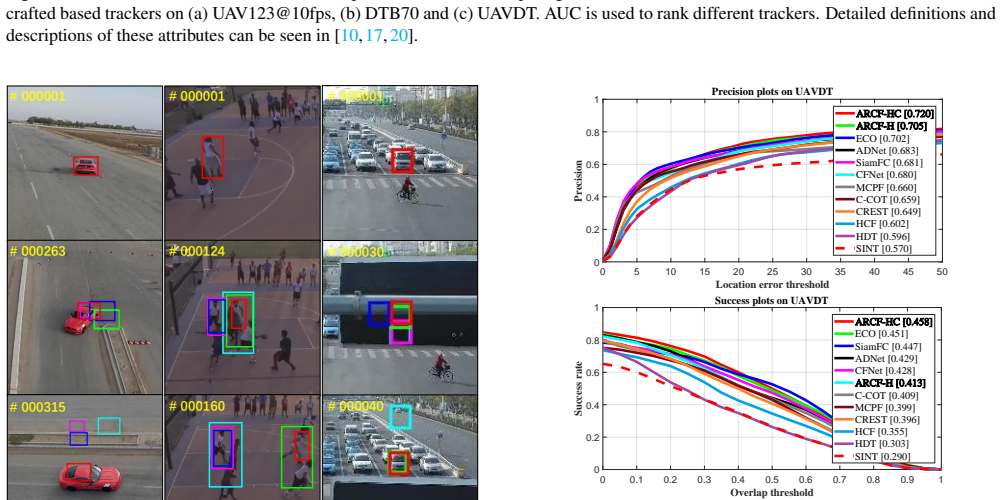
The paper's central claim is that the response map produced during detection carries information earlier DCF methods discard: when an abrupt change or wrong peak appears, the filter is about to learn from a bad location. ARCF adds to the BACF objective the penalty $\frac{\gamma}{2}\|\mathbf{M}_{k-1}[\psi_{p,q}] - \sum_d \mathbf{B}\mathbf{x}_k^d \star \mathbf{w}_k^d\|_2^2$, which forces the current response map to stay close to the previous one after the two peaks are aligned. Because this repression is part of the training objective and is solved by ADMM, it changes the filter that is learned rather than merely post-processing detections. The paper reports that this lowers the average response-map difference by about 20%, 24%, and 15% on UAV123@10fps, DTB70, and UAVDT, and that ARCF-HC ranks first among the tested trackers on those datasets.
Load-bearing premise
The penalty assumes the previous frame's response map is still a trustworthy picture of the target; if that map was corrupted by full occlusion, a wrong detection, or the target leaving the view, the penalty pulls the current filter toward the corrupted map and can slow recovery.
Editorial extensions
If this is right
- Because the aberrance penalty is a plug-in regularization term, the same idea should transfer to other DCF trackers; the paper explicitly names ECO and SRDCF as possible recipients.
- On the occlusion attribute, ARCF-HC improves AUC over BACF by 8.1% on UAV123@10fps, 9.8% on DTB70, and 5.2% on UAVDT, so the benefit is concentrated where response maps jump the most.
- The average response-map difference measured by Eq. 2 falls by roughly 20%, 24%, and 15% on the three datasets, giving a direct quantitative readout of aberrance repression independent of final tracking accuracy.
- ARCF-H runs at 51.2 FPS on CPU, so the added penalty costs little speed and the method remains deployable on UAV hardware.
Reading between the lines
- An untested extension is to make $\gamma$ adaptive: lower it when the tracker is confident so genuine fast motion is not smoothed away, and raise it when confidence drops during suspected occlusion.
- The peak-aligned shift makes the penalty invariant to translation, so the same construction could be extended to penalize response-map shape changes under scale or rotation by aligning maps more richly before comparison.
- If the regularization is as effective as reported, it should also stabilize deep-feature DCF trackers, potentially letting drone trackers use richer features without sacrificing real-time speed.
Signed reviews
Editorial analysis
A structured set of objections, weighed in public.
Referee Report
Summary. Starting from the BACF tracker, the paper augments the DCF learning objective with a temporal regularization term that penalizes differences between the previous frame's peak-aligned response map and the current response map (Eqs. 2–3). It solves the resulting convex problem with ADMM in the Fourier domain (Eqs. 5–13), updates the appearance model online (Eq. 14), and evaluates two feature configurations (HOG-only and HOG+CN+gray) on UAV123@10fps, DTB70, and UAVDT against 20 existing trackers. The reported results show consistent precision and success-rate gains over BACF at real-time CPU speeds, and the authors interpret these gains as evidence that the response-map change penalty suppresses 'aberrant' detection peaks caused by occlusion, background clutter, and appearance changes.
Significance. The proposed modification is simple and well motivated, and if the implementation is consistent with the stated objective, the consistent improvements over BACF on three UAV benchmarks, together with the CPU-only speed measurements, would be a useful contribution to real-time UAV tracking. The paper's strengths include making the code public, reporting speed, and evaluating on 243 sequences, including attribute-based analyses. However, the ADMM derivation contains a concrete algebraic error, and the response-map-difference table measures the very quantity the loss minimizes; these issues must be addressed before the central claim is fully supported.
major comments (3)
- [§4.3.2, Eq. (12)] Eq. (12) is not algebraically equivalent to Eq. (11), which is the correct solution of the per-frequency subproblem. With A = μ/(1+γ) I_D and u = v = x̂(n), the Sherman–Morrison formula yields (1/(1+γ))(A + x̂ x̂^T)^{-1} = (1/μ) I - [(1+γ)/(μ(μ+(1+γ)Sx))] x̂ x̂^T, where Sx = x̂^T x̂. The coefficients in Eq. (12) are instead γ* = μ/(1+γ)^2 for the first term and γ*/b with b = Sx + μ/(1+γ) for the second, which do not match. For example, with D=1, x=y=M=1, ζ=0, w=0, μ=1, γ=0.71, Eq. (11) gives 0.631 while Eq. (12) gives 0.216. The stated ADMM update therefore does not minimize the objective in Eq. (5); please correct Eq. (12), check the released code against the corrected formula, and state which update the experiments used.
- [§5.4, Table 2] The average map difference in Table 2 is computed with Eq. (2), the exact quantity added to the BACF objective in the third term of Eq. (3). A lower value for ARCF-H is therefore partly by construction and does not provide independent evidence that aberrance repression is what improves tracking. The precision/success gains on UAV123@10fps, DTB70, and UAVDT are independent of this term and do support the mechanism; please reframe Table 2 as a consistency check of the optimized objective rather than as a validation of the central claim.
- [Abstract and §5.3] The abstract states that ARCF 'has proven itself to have outperformed other 20 state-of-the-art trackers based on DCF and deep-based frameworks,' but the deep-tracker comparison is presented only for UAVDT (Fig. 7); on UAV123@10fps and DTB70, ARCF is compared only with hand-crafted trackers. Please either add the deep-tracker comparisons on all three datasets or qualify the claim so that it matches the reported evidence.
minor comments (4)
- [§4.1, Eq. (3)] The regularizer assumes the previous frame's response map, after peak alignment, is a reliable reference; this assumption can fail under full occlusion or out-of-view, as Fig. 8 itself shows. Please add an explicit limitation sentence in the formulation section and, ideally, a confidence-gating mechanism.
- [§5.3 and Table 1] The paper reports CPU-only speeds for hand-crafted trackers, but it is unclear whether the deep trackers in Fig. 7 were run under the same protocol; please clarify because otherwise the real-time comparison is not apples-to-apples.
- [Throughout] The manuscript contains numerous typographical issues, including 'trainig', 'aberrrance', and 'UA V' with an unintended space in the title and throughout; a careful proofreading pass is needed.
- [Section 5.1] The public code link is given without a version or commit identifier; please include a tagged release to improve reproducibility.
Circularity Check
Limited circularity: the map-difference table is the same norm the loss minimizes; benchmark gains are independent.
-
self definitional
[Section 4.1, Eqs. (2)-(3); Section 5.4, Table 2]
"Euclidean norm is introduced to define difference level of two response maps M1 and M2 as follows: ‖M1[ψp,q]− M2‖2 2, (2) ... the training objective is optimized to minimize the loss function as follows: E(wk) = ... + γ 2‖∑D d=1(Bxd k−1⋆wd k−1)[ψp,q]− ∑D d=1 Bxd k⋆wd k‖2 2, (3) ... Table 2. Average map difference comparison of BACF and ARCF-H on different datasets. Map difference is evaluated by Eq. 2."
The 'map difference' that Table 2 reports is exactly the Euclidean distance of Eq. 2, which appears, with the same [ψp,q] shift on the previous response map, as the third term of the ARCF objective, Eq. 3. ARCF-H is trained to minimize that term while BACF does not include it, so the observed 20%, 24%, and 15% reductions in Table 2 are substantially by construction rather than independent evidence that aberrance suppression causes the accuracy gains. This does not invalidate the external precision/success comparisons, which are measured on benchmarks, but it removes the status of Table 2 as an independent mechanistic test.
full rationale
The main derivation is not circular. The paper augments BACF with a new regularized objective, Eq. 3, solves it with ADMM, and evaluates on external UAV benchmarks using standard precision and success metrics that are independent of the regularizer. The accuracy and speed claims are therefore self-contained against external data. The one concrete circularity is Section 5.4: Table 2 reports the average value of the exact norm that ARCF is optimized to reduce, so lower values for ARCF than BACF are partly guaranteed by construction rather than an independent confirmation of the aberrance-repression mechanism. The central tracking results, however, do not reduce to this table. The paper also acknowledges that aberrances persist in out-of-view and full-occlusion cases, which weakens the claim but is not circularity. Separately, Eq. 12's Sherman-Morrison simplification does not appear algebraically equivalent to Eq. 11; this is a correctness and reproducibility concern and should be checked against the released code, but it is not a circularity issue. Overall score 4 reflects one definitional sub-claim while the central benchmark evaluation remains independent.
Assumptions & free parameters
free parameters (4)
- gamma (aberrance penalty) =
0.71
- eta (appearance model learning rate) =
0.0192
- ADMM iteration count =
5
- lambda (filter regularization weight) =
not reported
assumptions (4)
- domain assumption Euclidean distance between shifted response maps captures 'aberrance' severity (Eq. 2).
- domain assumption The previous frame's response map, shifted so peaks coincide, is a valid reference for the current filter (Eq. 3).
- standard math The DFT-domain reformulation and ADMM converge to a global optimum of the convex surrogate (Eqs. 5-13).
- standard math The BACF formulation with a cropping matrix is a sound base objective (Eq. 1).
Cite this review
Pith. "Pith review of Learning Aberrance Repressed Correlation Filters for Real-Time UAV Tracking." pith.science (2026). https://pith.science/paper/LBCQTBZX
@misc{pith2026190802231,
  author       = {Pith},
  title        = {Pith review of: Learning Aberrance Repressed Correlation Filters for Real-Time UAV Tracking},
  year         = {2026},
  howpublished = {\url{https://pith.science/paper/LBCQTBZX}},
  note         = {Machine review of arXiv:1908.02231}
}
read the original abstract
Traditional framework of discriminative correlation filters (DCF) is often subject to undesired boundary effects. Several approaches to enlarge search regions have been already proposed in the past years to make up for this shortcoming. However, with excessive background information, more background noises are also introduced and the discriminative filter is prone to learn from the ambiance rather than the object. This situation, along with appearance changes of objects caused by full/partial occlusion, illumination variation, and other reasons has made it more likely to have aberrances in the detection process, which could substantially degrade the credibility of its result. Therefore, in this work, a novel approach to repress the aberrances happening during the detection process is proposed, i.e., aberrance repressed correlation filter (ARCF). By enforcing restriction to the rate of alteration in response maps generated in the detection phase, the ARCF tracker can evidently suppress aberrances and is thus more robust and accurate to track objects. Considerable experiments are conducted on different UAV datasets to perform object tracking from an aerial view, i.e., UAV123, UAVDT, and DTB70, with 243 challenging image sequences containing over 90K frames to verify the performance of the ARCF tracker and it has proven itself to have outperformed other 20 state-of-the-art trackers based on DCF and deep-based frameworks with sufficient speed for real-time applications.
Figures


Figures from the paper (4 more)



Reference graph
Works this paper leans on
-
[1]
Fully-convolutional siamese networks for object tracking
Luca Bertinetto, Jack Valmadre, Joao F Henriques, Andrea Vedaldi, and Philip HS Torr. Fully-convolutional siamese networks for object tracking. In European conference on computer vision, pages 850–865. Springer, 2016
work page 2016
-
[2]
Visual object tracking using adaptive corre- lation filters
David S Bolme, J Ross Beveridge, Bruce A Draper, and Yui Man Lui. Visual object tracking using adaptive corre- lation filters. In 2010 IEEE Computer Society Conference on Computer Vision and Pattern Recognition , pages 2544–
2010
-
[3]
An autonomous vision-based target track- ing system for rotorcraft unmanned aerial vehicles
Hui Cheng, Lishan Lin, Zhuoqi Zheng, Yuwei Guan, and Zhongchang Liu. An autonomous vision-based target track- ing system for rotorcraft unmanned aerial vehicles. In 2017 IEEE/RSJ International Conference on Intelligent Robots and Systems (IROS), pages 1732–1738, Sep. 2017
work page 2017
-
[4]
Attentional cor- relation filter network for adaptive visual tracking
Jongwon Choi, Hyung Jin Chang, Sangdoo Yun, Tobias Fis- cher, Yiannis Demiris, and Jin Young Choi. Attentional cor- relation filter network for adaptive visual tracking. In Pro- ceedings of the IEEE conference on computer vision and pat- tern recognition, pages 4807–4816, 2017
work page 2017
-
[5]
Eco: Efficient convolution operators for tracking
Martin Danelljan, Goutam Bhat, Fahad Shahbaz Khan, and Michael Felsberg. Eco: Efficient convolution operators for tracking. In 2017 IEEE Conference on Computer Vision and Pattern Recognition (CVPR), pages 6931–6939, 2017
work page 2017
-
[6]
Convolutional features for correlation fil- ter based visual tracking
Martin Danelljan, Gustav Hager, Fahad Shahbaz Khan, and Michael Felsberg. Convolutional features for correlation fil- ter based visual tracking. In Proceedings of the IEEE Inter- national Conference on Computer Vision Workshops, pages 58–66, 2015
work page 2015
-
[7]
Learning spatially regularized correlation filters for visual tracking
Martin Danelljan, Gustav Hager, Fahad Shahbaz Khan, and Michael Felsberg. Learning spatially regularized correlation filters for visual tracking. In Proceedings of the IEEE inter- national conference on computer vision , pages 4310–4318, 2015
work page 2015
-
[8]
Martin Danelljan, Gustav Hger, Fahad Shahbaz Khan, and Michael Felsberg. Discriminative scale space tracking.IEEE transactions on pattern analysis and machine intelligence , 39(8):1561–1575, 2017
work page 2017
Show all 30 references
-
[9]
Beyond correlation filters: Learn- ing continuous convolution operators for visual tracking
Martin Danelljan, Andreas Robinson, Fahad Shahbaz Khan, and Michael Felsberg. Beyond correlation filters: Learn- ing continuous convolution operators for visual tracking. In European Conference on Computer Vision, pages 472–488. Springer, 2016
2016
-
[10]
The unmanned aerial vehicle benchmark: object detection and tracking
Dawei Du, Yuankai Qi, Hongyang Yu, Yifan Yang, Kaiwen Duan, Guorong Li, Weigang Zhang, Qingming Huang, and Qi Tian. The unmanned aerial vehicle benchmark: object detection and tracking. In Proceedings of the European Con- ference on Computer Vision (ECCV), pages 370–386, 2018
2018
-
[11]
Ro- bust real-time vision-based aircraft tracking from unmanned aerial vehicles
Changhong Fu, Adrian Carrio, Miguel A Olivares-Mendez, Ramon Suarez-Fernandez, and Pascual Campoy. Ro- bust real-time vision-based aircraft tracking from unmanned aerial vehicles. In 2014 ieee international conference on robotics and automation (ICRA) , pages 5441–5446. IEEE, 2014
2014
-
[12]
Boundary effect-aware visual tracking for uav with online enhanced background learning and multi-frame con- sensus verification
Changhong Fu, Ziyuan Huang, Yiming Li, Ran Duan, and Peng Lu. Boundary effect-aware visual tracking for uav with online enhanced background learning and multi-frame con- sensus verification. In 2019 IEEE/RSJ International Confer- ence on Intelligent Robots and Systems (IROS), 2019
2019
-
[13]
High-speed tracking with kernelized correlation fil- ters
Jo ˜ao F Henriques, Rui Caseiro, Pedro Martins, and Jorge Batista. High-speed tracking with kernelized correlation fil- ters. IEEE Trans Pattern Analysis and Machine Intelligence, 37(3):583–96, 2015
2015
-
[14]
Multi-store tracker (muster): A cognitive psychology inspired approach to object tracking
Zhibin Hong, Zhe Chen, Chaohui Wang, Xue Mei, Danil Prokhorov, and Dacheng Tao. Multi-store tracker (muster): A cognitive psychology inspired approach to object tracking. In Proceedings of the IEEE Conference on Computer Vision and Pattern Recognition, pages 749–758, 2015
2015
-
[15]
Learning background-aware correlation filters for visual tracking
Hamed Kiani Galoogahi, Ashton Fagg, and Simon Lucey. Learning background-aware correlation filters for visual tracking. In Proceedings of the IEEE International Confer- ence on Computer Vision, pages 1135–1143, 2017
2017
-
[16]
Learning spatial-temporal regularized correla- tion filters for visual tracking
Feng Li, Cheng Tian, Wangmeng Zuo, Lei Zhang, and Ming- Hsuan Yang. Learning spatial-temporal regularized correla- tion filters for visual tracking. In Proceedings of the IEEE Conference on Computer Vision and Pattern Recognition , pages 4904–4913, 2018
2018
-
[17]
Visual object tracking for un- manned aerial vehicles: A benchmark and new motion mod- els
Siyi Li and Dit-Yan Yeung. Visual object tracking for un- manned aerial vehicles: A benchmark and new motion mod- els. In Thirty-First AAAI Conference on Artificial Intelli- gence, 2017
2017
-
[18]
A scale adaptive kernel correlation filter tracker with feature integration
Yang Li and Jianke Zhu. A scale adaptive kernel correlation filter tracker with feature integration. In European confer- ence on computer vision, pages 254–265. Springer, 2014
2014
-
[19]
Hierarchical convolutional features for visual track- ing
Chao Ma, Jia-Bin Huang, Xiaokang Yang, and Ming-Hsuan Yang. Hierarchical convolutional features for visual track- ing. In Proceedings of the IEEE international conference on computer vision, pages 3074–3082, 2015
2015
-
[20]
A benchmark and simulator for uav tracking
Matthias Mueller, Neil Smith, and Bernard Ghanem. A benchmark and simulator for uav tracking. InEuropean con- ference on computer vision, pages 445–461. Springer, 2016
2016
-
[21]
Context-aware correlation filter tracking
Matthias Mueller, Neil Smith, and Bernard Ghanem. Context-aware correlation filter tracking. In Proceedings of the IEEE Conference on Computer Vision and Pattern Recognition, pages 1396–1404, 2017
2017
-
[22]
Hedged deep tracking
Yuankai Qi, Shengping Zhang, Lei Qin, Hongxun Yao, Qingming Huang, Jongwoo Lim, and Ming-Hsuan Yang. Hedged deep tracking. In Proceedings of the IEEE con- ference on computer vision and pattern recognition , pages 4303–4311, 2016
2016
-
[23]
Crest: Convolutional residual learning for visual tracking
Yibing Song, Chao Ma, Lijun Gong, Jiawei Zhang, Ryn- son WH Lau, and Ming-Hsuan Yang. Crest: Convolutional residual learning for visual tracking. In Proceedings of the IEEE International Conference on Computer Vision , pages 2555–2564, 2017
2017
-
[24]
Siamese instance search for tracking
Ran Tao, Efstratios Gavves, and Arnold WM Smeulders. Siamese instance search for tracking. In Proceedings of the IEEE conference on computer vision and pattern recogni- tion, pages 1420–1429, 2016
2016
-
[25]
End-to-end representation learning for correlation filter based tracking
Jack Valmadre, Luca Bertinetto, Joo Henriques, Andrea Vedaldi, and Philip HS Torr. End-to-end representation learning for correlation filter based tracking. In Proceed- ings of the IEEE Conference on Computer Vision and Pattern Recognition, pages 2805–2813, 2017
2017
-
[26]
Large mar- gin object tracking with circulant feature maps
Mengmeng Wang, Yong Liu, and Zeyi Huang. Large mar- gin object tracking with circulant feature maps. In Proceed- ings of the IEEE Conference on Computer Vision and Pattern Recognition, pages 4021–4029, 2017
2017
-
[27]
Multi-cue correlation filters for ro- bust visual tracking
Ning Wang, Wengang Zhou, Qi Tian, Richang Hong, Meng Wang, and Houqiang Li. Multi-cue correlation filters for ro- bust visual tracking. In2018 IEEE/CVF Conference on Com- puter Vision and Pattern Recognition , pages 4844–4853, 2018
2018
-
[28]
Robust Visual DetectionLearning- Tracking Framework for Autonomous Aerial Refueling of UA Vs.IEEE Transactions on Instrumentation and Measure- ment, 65(3):510–521, March 2016
Yingjie Yin, Xingang Wang, De Xu, Fangfang Liu, Yinglu Wang, and Wenqi Wu. Robust Visual DetectionLearning- Tracking Framework for Autonomous Aerial Refueling of UA Vs.IEEE Transactions on Instrumentation and Measure- ment, 65(3):510–521, March 2016
2016
-
[29]
Action-decision networks for visual tracking with deep reinforcement learning
Sangdoo Yun, Jongwon Choi, Youngjoon Yoo, Kimin Yun, and Jin Young Choi. Action-decision networks for visual tracking with deep reinforcement learning. In Proceedings of the IEEE Conference on Computer Vision and Pattern Recognition, pages 2711–2720, 2017
2017
-
[30]
Multi-task correlation particle filter for robust object track- ing
Tianzhu Zhang, Changsheng Xu, and Ming-Hsuan Yang. Multi-task correlation particle filter for robust object track- ing. In Proceedings of the IEEE Conference on Computer Vision and Pattern Recognition, pages 4335–4343, 2017
2017
Reviewed August 14, 2026 · model on record in the stance chip above.
Discussion (0). Continue with ORCID to comment.