REVIEW 3 major objections 5 minor 50 references
Know-MRI: A Knowledge Mechanisms Revealer&Interpreter for Large Language Models
T0 review · 3 major / 5 minor · reviewed 2026-08-07 · deepseek-v4-flash
Pith's one-line read Know-MRI is an open-source toolkit that automatically matches any input data format to the right LLM interpretation method and consolidates the results.
desk verdict A genuinely useful integration toolkit whose automatic matching claim is under-specified and whose validation is thin; still worth a serious referee. read the letter →
The pith
A machine-rendered reading of the paper's core claim, the machinery that carries it, and where it could break.
The reading
What carries the argument
The load-bearing mechanism is key-based input-method matching: datasets carry support_template_keys and methods carry requires_input_keys, and Know-MRI routes an input to every method whose required keys are present and then consolidates the outputs. This abstraction converts method integration into declaring field lists and wrapping a method as a diagnose function, which is what makes the toolkit extensible to new datasets, models, and interpretation techniques.
What would settle it
Run Know-MRI on a randomized version of Know-1000 in which subject-object associations are broken (shuffled ground truths). If Knowledge Neurons, FINE, and Causal Tracing still localize the same subject neurons with comparable strength as on the intact dataset, then the consolidated diagnosis cannot distinguish genuine knowledge mechanisms from artifacts, and the toolkit's central promise fails.
Extended reading notes
Core claim
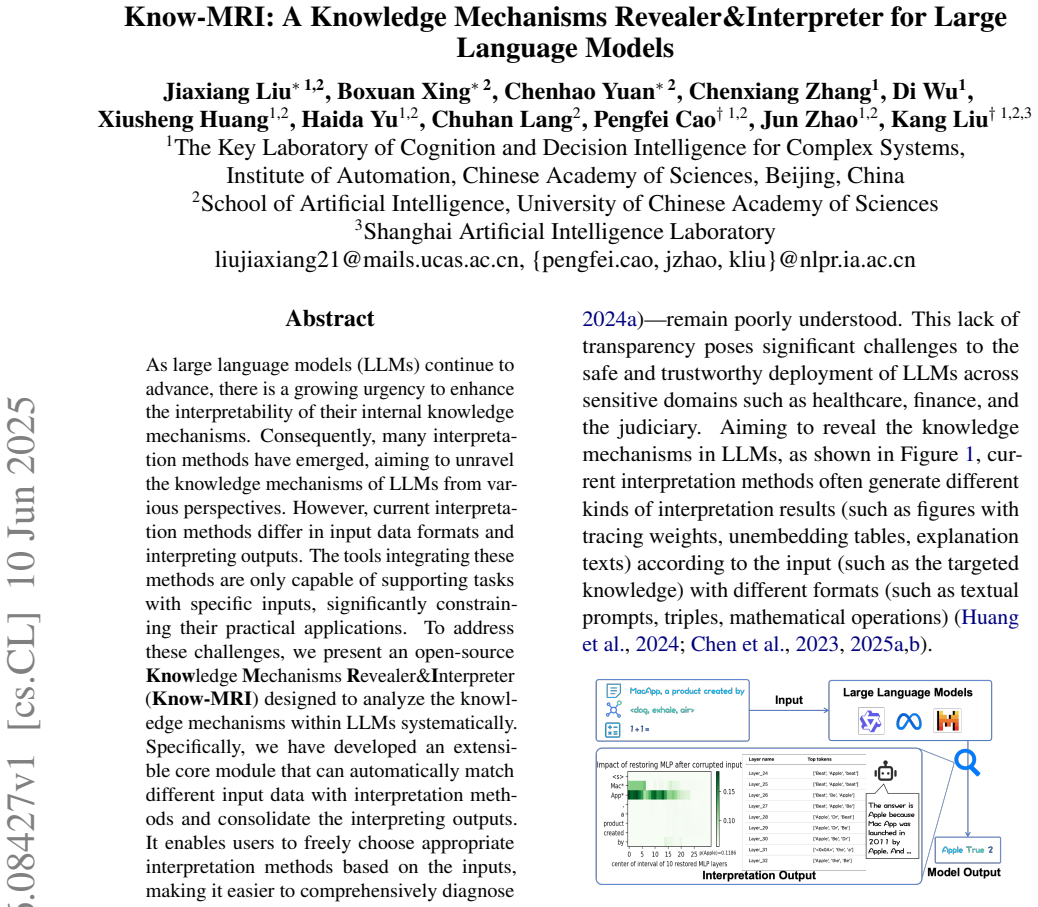
The paper introduces Know-MRI as a framework organized around three components—models, datasets, and interpretation methods—connected by a matching mechanism. Each dataset declares a support_template_keys list describing the input fields it contains (for example prompt, ground_truth, triple_subject), and each interpretation method declares a requires_input_keys list describing the fields it needs; Know-MRI then automatically selects applicable methods for a given input and consolidates their outputs. The toolkit integrates eleven interpretation techniques spanning external and internal perspectives, supports thirteen datasets with different formats on nine model architectures, and offers both a UI and an eight-line code API. Case studies on Llama2-7B show that different methods agree on the same conclusion—that the subject token dominates factual-knowledge processing—and the extended capability-localization experiments reproduce the finding that localized neurons, once enhanced, outperform random neurons.
Load-bearing premise
The toolkit's consolidated diagnosis inherits the validity of the eleven integrated interpretation methods; Know-MRI itself does not establish that those methods reveal true internal knowledge mechanisms, so if any of them is unreliable the merged output is misleading.
Editorial extensions
If this is right
- A user can run one workflow that spans factual, commonsense, counterfactual, math, sentiment, and translation datasets and get comparisons across all compatible interpretation methods.
- Adding a new interpretation method requires only a diagnose function and a requires_input_keys list; adding a dataset requires only support_template_keys.
- Cross-method comparison becomes routine: the paper shows KN and FINE agreeing on subject-relevant neurons, and Causal Tracing and Integrated Gradients both highlighting the subject token.
- The capability-localization experiment shows that neuron sets located with 100-700 samples converge to 98%/96% overlap/IoU on GSM8K and 94%/90% on Emotion, and enhancing located neurons beats random or excluded neurons.
- Know-MRI's UI-based matching also handles imprecise user input by rewriting it with GPT-4o and retrieving nearest dataset entries via BGE, making the toolkit usable by non-experts.
Reading between the lines
- The real new value is workflow integration: the paper does not introduce a new theory of knowledge mechanisms, so the toolkit's scientific output is only as trustworthy as the methods it packages.
- A natural extension is to treat the key-matching scheme as a general registry for interpretability beyond text—vision or multimodal methods that declare their input schemas could be plugged into the same router.
- The convergence of location consistency with dataset size, reproduced from prior work, would be a stronger result if paired with confidence intervals or significance tests across random data splits.
- Testable extension: hold out a set of inputs, have experts manually select the best interpretation method, and measure how often the automatic key-based match agrees with the expert choice.
Editorial analysis
A structured set of objections, weighed in public.
Referee Report
Summary. The paper presents Know-MRI, an open-source toolkit for interpreting knowledge mechanisms in large language models. The toolkit integrates eleven interpretation methods across eight method types, supports thirteen datasets with different input formats, and is designed to automatically match datasets to interpretation methods through user-supplied support_template_keys and requires_input_keys. It offers both UI-based and code-based usage, and the authors evaluate it with a single case study comparing methods on a factual-knowledge example, a capability-localization experiment reproducing prior work, and a small human evaluation. The central claim is that Know-MRI enables users to comprehensively diagnose internal knowledge mechanisms from multiple perspectives in a single system.
Significance. If the central claims hold, Know-MRI would be a useful engineering contribution: it integrates a broad set of interpretability methods and model architectures, provides a clean interface for extending methods and datasets, and ships open-source code and a demonstration video. The extensibility design, covering nine model families and eleven methods, is a genuine strength. However, the validation is thin, and the two claims that distinguish the toolkit from existing systems — automatic matching of inputs to methods and consolidation of interpreting outputs — are underspecified and not rigorously tested. The case study is qualitative, the quantitative experiment reproduces a prior result rather than validating the toolkit's novel machinery, and the human evaluation is too small and underreported to support strong usability claims.
major comments (3)
- [§3.1.2, §3.1.3, Appendix C] The automatic matching mechanism rests entirely on user-supplied support_template_keys and requires_input_keys, but the paper gives no formal specification of the key taxonomy, no validation layer for missing or incompatible keys, and no consistency check between the Appendix C taxonomy and the actual implementations. For example, the KN method is stated to require ["prompts", "ground_truth"], but the original Dai et al. (2022) pipeline commonly also needs a relation or template field to construct semantically similar paraphrase prompts; if a dataset provides ground_truth as an answer string but lacks that field, the method may run on incorrectly constructed prompts while the toolkit still reports interpretability results. This is a load-bearing gap for the paper's central claim of automatic matching.
- [Abstract, §3.1.3, §4.1] The abstract claims that Know-MRI can "consolidate the interpreting outputs," but the paper does not describe any normalization, conflict-resolution, or discrepancy-flagging rule for the consolidated outputs. Section 4.1, Table 3, shows FINE and KN reporting conflicting top neurons (L18.U327 vs. L1.U6972) for the same input example, and the text presents these results side by side without explaining how the toolkit reconciles or flags such disagreements. Without a stated consolidation mechanism, the claim of consolidation is misleading; the toolkit appears to aggregate results rather than consolidate them.
- [§4.2, §4.3, Figure 5] The quantitative validation is too thin to support the paper's effectiveness claims. In §4.2, Figure 5 reports overlap and IoU ratios without error bars, standard deviations, or multiple replications, and the claim that the ratio "will gradually converge" is not backed by any convergence criterion or statistical analysis. The text explicitly states that the result is "the same as Huang et al. (2025)", which indicates this experiment is a reproduction of prior work rather than a validation of Know-MRI's automatic matching or consolidation functionality. Similarly, §4.3 uses ten participants and reports only mean scores in Figure 6, with no variance, significance testing, or details on questionnaire construction or participant selection; this does not substantiate the statement that "Know-MRI is highly evaluated in terms of user experience."
minor comments (5)
- [§3.1.2, Figure 4] The dataset name is inconsistently written as "Known-1000" in the text and "Known 1000" in Figure 4, while the rest of the paper uses "Know-1000"; please unify the spelling.
- [Abstract, §1, §3.1.3] The paper alternates between claiming "8 classic interpretation methods" and "eleven interpretation techniques" without clearly distinguishing method types from individual techniques; please state the count consistently.
- [§4.2, Figure 5] Figure 5 lacks clear axis labels for the x-axis and does not explain what "per 100 data" means; please add a caption that defines the sampling procedure and the reported metric.
- [§3.2.2, Figure 4] The code example is described as requiring "8 lines", but the figure is too small to verify this claim; consider including the full code snippet in the appendix.
- [§4.3] The questionnaire is said to be available at a Google Forms link, but the link is not provided in the paper; please include the exact questionnaire or a link to it for reproducibility.
Circularity Check
No significant circularity: Know-MRI is an integration toolkit whose core claims are implemented, not derived, and the one self-citation is not load-bearing.
full rationale
Know-MRI does not derive a prediction from first principles; it is an engineering integration of eleven existing interpretability methods. The automatic matching mechanism is explicitly implemented as an intersection of user-declared support_template_keys and method-level requires_input_keys, so the behavior follows directly from the declared metadata rather than from a hidden fitted parameter. The case study (Section 4.1) reproduces established findings of the integrated methods (KN, FINE, Causal Tracing, Integrated Gradients, Logit Lens, PatchScopes) and compares them with their original publications, which is a sanity check of the wrapper, not a circular inference. Section 4.2 aligns all settings with Huang et al. (2025) and reports identical convergence and enhancement results; although several authors of the present paper overlap with that prior work, the underlying capability-localization method is externally published and the toolkit's central usability/extensibility claim does not rest on this citation. No equation or result reduces to its own input by construction. The unvalidated key taxonomy, the under-specified consolidation step, and inherited method limitations are correctness risks rather than circularity.
Assumptions & free parameters
assumptions (3)
- domain assumption The integrated interpretation methods produce valid signals about LLM knowledge mechanisms.
- ad hoc to paper The support_template_keys and requires_input_keys lists fully capture the input and output requirements of datasets and methods.
- standard math The neuron contribution scoring formula from Huang et al. (2025) is applicable to Llama2-7B and the tested datasets.
Cite this review
Pith. "Pith review of Know-MRI: A Knowledge Mechanisms Revealer&Interpreter for Large Language Models." pith.science (2026). https://pith.science/paper/LBKZJIJV
@misc{pith2026250608427,
  author       = {Pith},
  title        = {Pith review of: Know-MRI: A Knowledge Mechanisms Revealer&Interpreter for Large Language Models},
  year         = {2026},
  howpublished = {\url{https://pith.science/paper/LBKZJIJV}},
  note         = {Machine review of arXiv:2506.08427}
}
read the original abstract
As large language models (LLMs) continue to advance, there is a growing urgency to enhance the interpretability of their internal knowledge mechanisms. Consequently, many interpretation methods have emerged, aiming to unravel the knowledge mechanisms of LLMs from various perspectives. However, current interpretation methods differ in input data formats and interpreting outputs. The tools integrating these methods are only capable of supporting tasks with specific inputs, significantly constraining their practical applications. To address these challenges, we present an open-source Knowledge Mechanisms Revealer&Interpreter (Know-MRI) designed to analyze the knowledge mechanisms within LLMs systematically. Specifically, we have developed an extensible core module that can automatically match different input data with interpretation methods and consolidate the interpreting outputs. It enables users to freely choose appropriate interpretation methods based on the inputs, making it easier to comprehensively diagnose the model's internal knowledge mechanisms from multiple perspectives. Our code is available at https://github.com/nlpkeg/Know-MRI. We also provide a demonstration video on https://youtu.be/NVWZABJ43Bs.
Figures


Figures from the paper (7 more)


Reference graph
Works this paper leans on
-
[1]
online" 'onlinestring :=
ENTRY address archivePrefix author booktitle chapter edition editor eid eprint eprinttype howpublished institution journal key month note number organization pages publisher school series title type volume year doi pubmed url lastchecked label extra.label sort.label short.list INTEGERS output.state before.all mid.sentence after.sentence after.block STRING...
-
[2]
write newline
" write newline "" before.all 'output.state := FUNCTION n.dashify 't := "" t empty not t #1 #1 substring "-" = t #1 #2 substring "--" = not "--" * t #2 global.max substring 't := t #1 #1 substring "-" = "-" * t #2 global.max substring 't := while if t #1 #1 substring * t #2 global.max substring 't := if while FUNCTION word.in bbl.in capitalize " " * FUNCT...
-
[3]
J Alammar. 2021. https://doi.org/10.18653/v1/2021.acl-demo.30 Ecco: An open source library for the explainability of transformer language models . In Proceedings of the 59th Annual Meeting of the Association for Computational Linguistics and the 11th International Joint Conference on Natural Language Processing: System Demonstrations, pages 249--257, Onli...
-
[4]
Baichuan. 2023. https://arxiv.org/abs/2309.10305 Baichuan 2: Open large-scale language models . arXiv preprint arXiv:2309.10305
arXiv 2023
-
[5]
Ruizhe Chen, Yichen Li, Zikai Xiao, and Zuozhu Liu. 2024. https://arxiv.org/abs/2405.09341 Large language model bias mitigation from the perspective of knowledge editing . Preprint, arXiv:2405.09341
arXiv 2024
-
[6]
Yuheng Chen, Pengfei Cao, Yubo Chen, Kang Liu, and Jun Zhao. 2023. https://arxiv.org/abs/2308.13198 Journey to the center of the knowledge neurons: Discoveries of language-independent knowledge neurons and degenerate knowledge neurons . Preprint, arXiv:2308.13198
work page Pith review arXiv 2023
-
[7]
Yuheng Chen, Pengfei Cao, Yubo Chen, Kang Liu, and Jun Zhao. 2025 a . https://arxiv.org/abs/2405.14117 Knowledge localization: Mission not accomplished? enter query localization! Preprint, arXiv:2405.14117
work page Pith review arXiv 2025
-
[8]
Yuheng Chen, Pengfei Cao, Kang Liu, and Jun Zhao. 2025 b . https://arxiv.org/abs/2502.12483 The knowledge microscope: Features as better analytical lenses than neurons . Preprint, arXiv:2502.12483
work page Pith review arXiv 2025
Show all 50 references
-
[9]
Chi, Jeff Dean, Jacob Devlin, Adam Roberts, Denny Zhou, Quoc V
Hyung Won Chung, Le Hou, Shayne Longpre, Barret Zoph, Yi Tay, William Fedus, Eric Li, Xuezhi Wang, Mostafa Dehghani, Siddhartha Brahma, Albert Webson, Shixiang Shane Gu, Zhuyun Dai, Mirac Suzgun, Xinyun Chen, Aakanksha Chowdhery, Sharan Narang, Gaurav Mishra, Adams Yu, Vincent...
-
[10]
Karl Cobbe, Vineet Kosaraju, Mohammad Bavarian, Mark Chen, Heewoo Jun, Lukasz Kaiser, Matthias Plappert, Jerry Tworek, Jacob Hilton, Reiichiro Nakano, Christopher Hesse, and John Schulman. 2021. Training verifiers to solve math word problems. arXiv preprint arXiv:2110.14168
2021 arXiv
-
[11]
Damai Dai, Li Dong, Yaru Hao, Zhifang Sui, Baobao Chang, and Furu Wei. 2022. https://doi.org/10.18653/v1/2022.acl-long.581 Knowledge neurons in pretrained transformers . In Proceedings of the 60th Annual Meeting of the Association for Computational Linguistics (Volume 1: Long ...
2022 doi
-
[12]
DeepSeek-AI, Daya Guo, Dejian Yang, Haowei Zhang, Junxiao Song, Ruoyu Zhang, Runxin Xu, Qihao Zhu, Shirong Ma, Peiyi Wang, Xiao Bi, Xiaokang Zhang, Xingkai Yu, Yu Wu, Z. F. Wu, Zhibin Gou, Zhihong Shao, Zhuoshu Li, Ziyi Gao, Aixin Liu, Bing Xue, Bingxuan Wang, Bochao Wu, Bei F...
2025 arXiv
-
[13]
Jacob Devlin, Ming - Wei Chang, Kenton Lee, and Kristina Toutanova. 2018. https://arxiv.org/abs/1810.04805 BERT: pre-training of deep bidirectional transformers for language understanding . CoRR, abs/1810.04805
2018 arXiv
-
[14]
Mor Geva, Avi Caciularu, Guy Dar, Paul Roit, Shoval Sadde, Micah Shlain, Bar Tamir, and Yoav Goldberg. 2022. Lm-debugger: An interactive tool for inspection and intervention in transformer-based language models. arXiv preprint arXiv:2204.12130
2022 arXiv
-
[15]
Asma Ghandeharioun, Avi Caciularu, Adam Pearce, Lucas Dixon, and Mor Geva. 2024. https://arxiv.org/abs/2401.06102 Patchscopes: A unifying framework for inspecting hidden representations of language models . In Forty-first International Conference on Machine Learning
2024 arXiv
-
[16]
Team GLM, Aohan Zeng, Bin Xu, Bowen Wang, Chenhui Zhang, Da Yin, Diego Rojas, Guanyu Feng, Hanlin Zhao, Hanyu Lai, Hao Yu, Hongning Wang, Jiadai Sun, Jiajie Zhang, Jiale Cheng, Jiayi Gui, Jie Tang, Jing Zhang, Juanzi Li, Lei Zhao, Lindong Wu, Lucen Zhong, Mingdao Liu, Minlie H...
2024 arXiv
-
[17]
Anshita Gupta, Debanjan Mondal, Akshay Sheshadri, Wenlong Zhao, Xiang Li, Sarah Wiegreffe, and Niket Tandon. 2023. https://doi.org/10.18653/v1/2023.emnlp-main.511 Editing common sense in transformers . In Proceedings of the 2023 Conference on Empirical Methods in Natural Langu...
2023 doi
-
[18]
Shiyuan Huang, Siddarth Mamidanna, Shreedhar Jangam, Yilun Zhou, and Leilani H. Gilpin. 2023. https://arxiv.org/abs/2310.11207 Can large language models explain themselves? a study of llm-generated self-explanations . Preprint, arXiv:2310.11207
2023 arXiv
-
[19]
Xiusheng Huang, Jiaxiang Liu, Yequan Wang, and Kang Liu. 2024. https://proceedings.neurips.cc/paper_files/paper/2024/file/7f588e59e9ae6138d3ea9e4fdaa7e040-Paper-Conference.pdf Reasons and solutions for the decline in model performance after editing . In Advances in Neural Info...
2024
-
[20]
Xiusheng Huang, Jiaxiang Liu, Yequan Wang, Jun Zhao, and Kang Liu. 2025. https://openreview.net/forum?id=f6r1mYwM1g Capability localization: Capabilities can be localized rather than individual knowledge . In The Thirteenth International Conference on Learning Representations
2025
-
[21]
Albert Q. Jiang, Alexandre Sablayrolles, Arthur Mensch, Chris Bamford, Devendra Singh Chaplot, Diego de las Casas, Florian Bressand, Gianna Lengyel, Guillaume Lample, Lucile Saulnier, Lélio Renard Lavaud, Marie-Anne Lachaux, Pierre Stock, Teven Le Scao, Thibaut Lavril, Thomas ...
2023 arXiv
-
[22]
Shahar Katz and Yonatan Belinkov. 2023. https://doi.org/10.18653/v1/2023.findings-emnlp.939 VISIT : Visualizing and interpreting the semantic information flow of transformers . In Findings of the Association for Computational Linguistics: EMNLP 2023, pages 14094--14113, Singap...
2023 doi
-
[23]
Omer Levy, Minjoon Seo, Eunsol Choi, and Luke Zettlemoyer. 2017. https://doi.org/10.18653/v1/K17-1034 Zero-shot relation extraction via reading comprehension . In Proceedings of the 21st Conference on Computational Natural Language Learning ( C o NLL 2017) , pages 333--342, Va...
2017 doi
-
[24]
Maas, Raymond E
Andrew L. Maas, Raymond E. Daly, Peter T. Pham, Dan Huang, Andrew Y. Ng, and Christopher Potts. 2011. http://www.aclweb.org/anthology/P11-1015 Learning word vectors for sentiment analysis . In Proceedings of the 49th Annual Meeting of the Association for Computational Linguist...
2011
-
[25]
Kevin Meng, David Bau, Alex Andonian, and Yonatan Belinkov. 2022. Locating and editing factual associations in GPT . Advances in Neural Information Processing Systems, 36. ArXiv:2202.05262
2022 arXiv
-
[26]
nostalgebraist. 2020. https://www.lesswrong.com/posts/AcKRB8wDpdaN6v6ru/interpreting-gpt-the-logit-lens interpreting gpt: the logit lens . In LESSWRONG
2020
-
[27]
OpenAI. 2024 a . https://arxiv.org/abs/2303.08774 Gpt-4 technical report . Preprint, arXiv:2303.08774
2024 arXiv
-
[28]
OpenAI. 2024 b . https://arxiv.org/abs/2410.21276 Gpt-4o system card . Preprint, arXiv:2410.21276
2024 arXiv
-
[29]
Haowen Pan, Xiaozhi Wang, Yixin Cao, Zenglin Shi, Xun Yang, Juanzi Li, and Meng Wang. 2025. https://openreview.net/forum?id=5xP1HDvpXI Precise localization of memories: A fine-grained neuron-level knowledge editing technique for LLM s . In The Thirteenth International Conferen...
2025
-
[30]
Ian Porada, Kaheer Suleman, Adam Trischler, and Jackie Chi Kit Cheung. 2021. https://doi.org/10.18653/v1/2021.naacl-main.138 Modeling event plausibility with consistent conceptual abstraction . In Proceedings of the 2021 Conference of the North American Chapter of the Associat...
2021 doi
-
[31]
Qwen-Team. 2024. https://qwenlm.github.io/blog/qwen2.5/ Qwen2.5: A party of foundation models
2024
-
[32]
Alec Radford, Jeffrey Wu, Rewon Child, David Luan, Dario Amodei, Ilya Sutskever, et al. 2019. Language models are unsupervised multitask learners. OpenAI blog, 1(8):9
2019
-
[33]
Korbinian Randl, John Pavlopoulos, Aron Henriksson, and Tony Lindgren. 2025. https://doi.org/10.1007/978-3-031-78977-9_3 Evaluating the reliability of self-explanations in large language models . In Discovery Science: 27th International Conference, DS 2024, Pisa, Italy, Octobe...
2025 doi
-
[34]
Elvis Saravia, Hsien-Chi Toby Liu, Yen-Hao Huang, Junlin Wu, and Yi-Shin Chen. 2018. https://doi.org/10.18653/v1/D18-1404 CARER : Contextualized affect representations for emotion recognition . In Proceedings of the 2018 Conference on Empirical Methods in Natural Language Proc...
2018 doi
-
[35]
Gabriele Sarti, Nils Feldhus, Ludwig Sickert, and Oskar van der Wal. 2023. https://doi.org/10.18653/v1/2023.acl-demo.40 Inseq: An interpretability toolkit for sequence generation models . In Proceedings of the 61st Annual Meeting of the Association for Computational Linguistic...
2023 doi
-
[36]
Anant Subramanian, Danish Pruthi, Harsh Jhamtani, Taylor Berg-Kirkpatrick, and Eduard Hovy. 2018. Spine: Sparse interpretable neural embeddings. Proceedings of the Thirty Second AAAI Conference on Artificial Intelligence (AAAI)
2018
-
[37]
Mukund Sundararajan, Ankur Taly, and Qiqi Yan. 2017. https://proceedings.mlr.press/v70/sundararajan17a.html Axiomatic attribution for deep networks . In Proceedings of the 34th International Conference on Machine Learning, volume 70 of Proceedings of Machine Learning Research,...
2017
-
[38]
Ian Tenney, James Wexler, Jasmijn Bastings, Tolga Bolukbasi, Andy Coenen, Sebastian Gehrmann, Ellen Jiang, Mahima Pushkarna, Carey Radebaugh, Emily Reif, and Ann Yuan. 2020. https://doi.org/10.18653/v1/2020.emnlp-demos.15 The language interpretability tool: Extensible, interac...
2020 doi
-
[39]
J \"o rg Tiedemann. 2012. http://www.lrec-conf.org/proceedings/lrec2012/pdf/463_Paper.pdf Parallel data, tools and interfaces in OPUS . In Proceedings of the Eighth International Conference on Language Resources and Evaluation ( LREC '12) , pages 2214--2218, Istanbul, Turkey. ...
2012
-
[40]
Hugo Touvron, Louis Martin, Kevin Stone, Peter Albert, Amjad Almahairi, Yasmine Babaei, Nikolay Bashlykov, Soumya Batra, Prajjwal Bhargava, Shruti Bhosale, Dan Bikel, Lukas Blecher, Cristian Canton Ferrer, Moya Chen, Guillem Cucurull, David Esiobu, Jude Fernandes, Jeremy Fu, W...
2023 arXiv
-
[41]
Igor Tufanov, Karen Hambardzumyan, Javier Ferrando, and Elena Voita. 2024. https://doi.org/10.18653/v1/2024.acl-demos.6 LM transparency tool: Interactive tool for analyzing transformer language models . In Proceedings of the 62nd Annual Meeting of the Association for Computati...
2024 doi
-
[42]
Ashish Vaswani, Noam Shazeer, Niki Parmar, Jakob Uszkoreit, Llion Jones, Aidan N Gomez, ukasz Kaiser, and Illia Polosukhin. 2017. https://proceedings.neurips.cc/paper_files/paper/2017/file/3f5ee243547dee91fbd053c1c4a845aa-Paper.pdf Attention is all you need . In Advances in Ne...
2017
-
[43]
Ben Wang and Aran Komatsuzaki. 2021. GPT-J-6B: A 6 Billion Parameter Autoregressive Language Model . https://github.com/kingoflolz/mesh-transformer-jax
2021
-
[44]
Mengru Wang, Yunzhi Yao, Ziwen Xu, Shuofei Qiao, Shumin Deng, Peng Wang, Xiang Chen, Jia-Chen Gu, Yong Jiang, Pengjun Xie, Fei Huang, Huajun Chen, and Ningyu Zhang. 2024 a . https://doi.org/10.18653/v1/2024.findings-emnlp.416 Knowledge mechanisms in large language models: A su...
2024 doi
-
[45]
Xiaohan Wang, Shengyu Mao, Shumin Deng, Yunzhi Yao, Yue Shen, Lei Liang, Jinjie Gu, Huajun Chen, and Ningyu Zhang. 2024 b . https://doi.org/10.18653/v1/2024.findings-emnlp.40 Editing conceptual knowledge for large language models . In Findings of the Association for Computatio...
2024 doi
-
[46]
Shitao Xiao, Zheng Liu, Peitian Zhang, and Niklas Muennighoff. 2023. https://arxiv.org/abs/2309.07597 C-pack: Packaged resources to advance general chinese embedding . Preprint, arXiv:2309.07597
2023 arXiv
-
[47]
Yunzhi Yao, Ningyu Zhang, Zekun Xi, Mengru Wang, Ziwen Xu, Shumin Deng, and Huajun Chen. 2024. https://openreview.net/forum?id=YVXzZNxcag Knowledge circuits in pretrained transformers . In The Thirty-eighth Annual Conference on Neural Information Processing Systems
2024
-
[48]
Longhui Yu, Weisen Jiang, Han Shi, Jincheng Yu, Zhengying Liu, Yu Zhang, James T Kwok, Zhenguo Li, Adrian Weller, and Weiyang Liu. 2023. Metamath: Bootstrap your own mathematical questions for large language models. arXiv preprint arXiv:2309.12284
2023 arXiv
-
[49]
Biao Zhang, Philip Williams, Ivan Titov, and Rico Sennrich. 2020. https://doi.org/10.18653/v1/2020.acl-main.148 Improving massively multilingual neural machine translation and zero-shot translation . In Proceedings of the 58th Annual Meeting of the Association for Computationa...
2020 doi
-
[50]
Pan Zhang, Xiaoyi Dong, Yuhang Cao, Yuhang Zang, Rui Qian, Xilin Wei, Lin Chen, Yifei Li, Junbo Niu, Shuangrui Ding, Qipeng Guo, Haodong Duan, Xin Chen, Han Lv, Zheng Nie, Min Zhang, Bin Wang, Wenwei Zhang, Xinyue Zhang, Jiaye Ge, Wei Li, Jingwen Li, Zhongying Tu, Conghui He, ...
2024 arXiv
Reviewed August 7, 2026 · model on record in the stance chip above.
Discussion (0). Sign in to comment.