REVIEW 4 major objections 6 minor 44 references
FruitNinja: 3D Object Interior Texture Generation with Gaussian Splatting
T0 review · 4 major / 6 minor · reviewed 2026-08-12 · deepseek-v4-flash
Pith's one-line read FruitNinja trains a 3D Gaussian object once so any cut reveals plausible interior texture in real time, the authors claim.
desk verdict A plausible new task and a coherent pipeline, but the quantitative evaluation is circular and the abstract's superiority claim is contradicted by the paper's own Table 1. read the letter →
The pith
A machine-rendered reading of the paper's core claim, the machinery that carries it, and where it could break.
The reading
What carries the argument
The mechanism that carries the argument is a cross-section-conditioned training loop over an OpaqueAtom Gaussian volume. For each user-defined cutting plane $ax + by + cz + d = 0$, a 3D mask keeps only Gaussians near the plane; rendering under that mask exposes the slice, and a depth-conditioned text-to-image diffusion model combined with score distillation sampling (SDS) generates a reference image of what that slice should look like. Those reference views are then used as reconstruction targets while 10–20 random exterior views are trained alongside them to preserve the object's surface. Progressive refinement re-applies SDS to the current renderings to reconcile conflicting seeds, and voxel smoothing assigns colors to untrained Gaussians by inverse-distance weighting, $$C = \frac{\sum_i w_i C_i}{\sum_i w_i},$$ with weights based on Euclidean distance within a voxel. OpaqueAtom GS makes this stable by capping each Gaussian's scale at roughly one three-thousandth of the object's dimensions and giving every particle full opacity, avoiding the large-Gaussian drift and front-back blending that blur abrupt interior boundaries.
What would settle it
Take an object whose interior is not locally coherent and is absent from the diffusion prior — for instance, a hollow chocolate bunny with a single toy inside, or a block of Swiss cheese with random holes — train FruitNinja using canonical cross-sections, then cut it at an angle not in the training set and photograph the actual cut. If the rendered interior reproduces the hidden toy or the random holes, the claim survives; if it shows only smooth, averaged flesh-like texture, the claim that arbitrary cuts reveal plausible internal textures is settled false.
Extended reading notes
Core claim
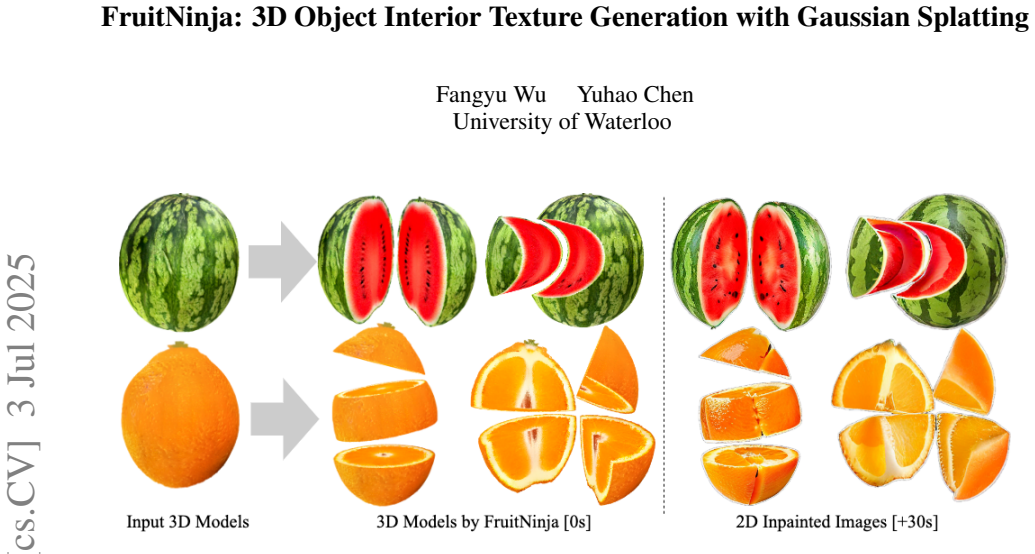
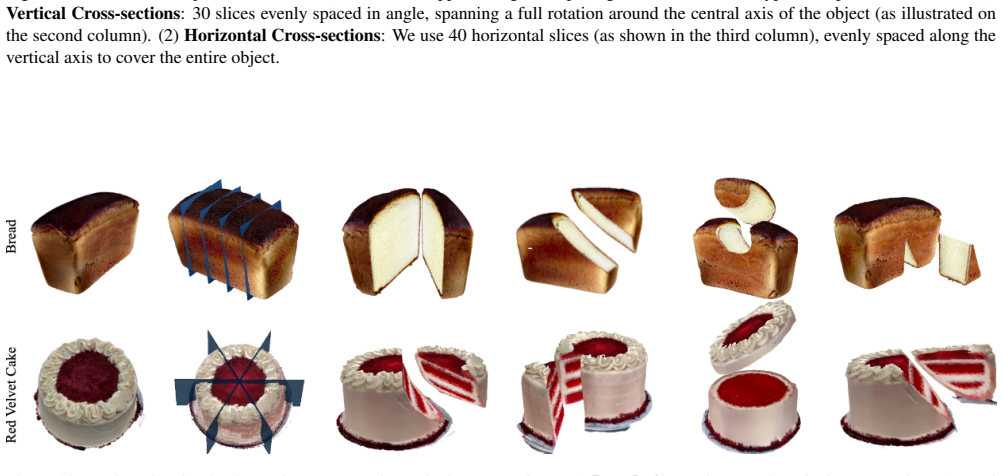
The central claim is that a single 3D Gaussian Splatting object can be trained with both its outside and inside so that arbitrary geometric and topological edits — cuts, slices, removals — reveal a convincing interior while rendering in real time. The authors state this as a first: prior work either inpaints each newly exposed region per edit (slow and inconsistent) or fills the interior by copying surface colors (unrealistic for fruit and other objects whose interiors differ from their exteriors). FruitNinja instead seeds the interior with raw Gaussian particles, renders and optimizes a small set of user-defined cutting planes using a depth-conditioned diffusion model with score distillation sampling, jointly trains those reference cross-sections with randomly selected surface views, and progressively refines them so conflicting seed textures settle into a coherent volume. Untrained interior Gaussians are then colored by inverse-distance-weighted averaging of nearby trained ones on a voxel grid. With the OpaqueAtom GS strategy — capping Gaussian scale and using uniform full opacity — the paper reports that slicing at 120 arbitrary angles yields the best CLIP scores and cross-slice consistency among the compared baselines.
Load-bearing premise
The load-bearing assumption is that a handful of user-chosen cross-section photos and a pre-trained text-to-image model can stand in for the object's entire unseen interior, and that every point not covered by those views can be plausibly colored by averaging nearby trained colors.
Editorial extensions
If this is right
- Once trained, a FruitNinja object can be sliced, torn, or partially removed interactively, and the exposed interior renders immediately with no diffusion sampling or per-edit optimization.
- Cuts at angles never seen during training still show plausible textures because the entire interior volume is populated, trained, and voxel-smoothed, not just the canonical slice planes.
- The pipeline handles objects whose interiors differ strongly from their surfaces — fruit flesh versus rind, cake crumb versus frosting — where an interior-filling baseline that inherits surface colors visibly fails.
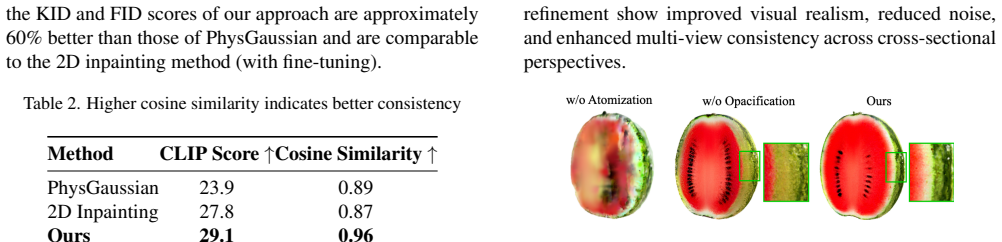
- Evaluated at 120 random cut angles on the paper's six objects, the method reports the highest CLIP score and cross-slice cosine similarity, so consecutive edits stay visually consistent.
Reading between the lines
- [Editorial inference] The same pipeline could extend to any object whose internal structure is locally predictable — layered rock, anatomical tissue, or foam — provided a diffusion model can be prompted or fine-tuned to imagine its cross-sections, which is a testable extension of the paper's symmetry assumption.
- [Editorial inference] For objects with hidden, non-local, or stochastic interiors, such as a box with random contents or a machine part with a single internal void, the smooth voxel averaging will produce a plausible-looking but fictitious interior; slicing such an object would expose that fiction, so the method is a texture generator rather than a true interior scanner.
- [Editorial inference] The voxel-smoothing prior is local and isotropic, so replacing it with a learned 3D generative prior over Gaussian colors could capture elongated or nested structures such as fibers, shells, and cavities without sacrificing real-time rendering.
Editorial analysis
A structured set of objections, weighed in public.
Referee Report
Summary. FruitNinja addresses the generation of internal textures for 3D Gaussian Splatting (3DGS) objects, enabling real-time rendering when objects are sliced or cut. The pipeline fills the object interior with Gaussian primitives, defines user-specified canonical cross-sections, optimizes reference cross-sectional images via Score Distillation Sampling (SDS) with a depth-conditioned Stable Diffusion model, optionally fine-tunes the diffusion model with DreamBooth on 1–4 real cross-section images per object, and jointly trains cross-section and surface views. It then applies progressive texture refinement and voxel-grid smoothing, and uses an 'OpaqueAtom GS' strategy (atomic clipping and uniform high opacity) to stabilize training and preserve fine details. Experiments on six objects compare against PhysGaussian and 2D inpainting, reporting CLIP, FID, and KID on canonical cross-sections and CLIP cosine similarity on 120 random slicing angles.
Significance. If the method works as demonstrated qualitatively, it fills a genuine gap: existing 3D editing and inpainting methods do not handle interior texture under topological changes, and the 'train once, slice in real time' property is practically useful. The paper's strengths include a clearly described pipeline, a sensible adoption of AtomGS-inspired training for dense small Gaussians, and qualitative results showing multiple coherent cuts on the same object. The central method is not circular: it uses a diffusion prior to synthesize references and fits 3DGS to them. However, the quantitative evidence for the abstract's claims of 'substantially outperforms existing approaches' and 'unmatched visual quality' is not reliable as presented, because the FID/KID reference images are the same images used for DreamBooth fine-tuning and SDS supervision, and the reported numbers in Table 1 actually show the fine-tuned 2D inpainting baseline with better FID and KID than Ours. The evaluation also lacks a held-out fidelity test for the arbitrary-slicing claim that is central to the paper. These issues are fixable with a cleaner evaluation protocol, but they currently block acceptance.
major comments (4)
- [§4.1, §3.2, Table 1] The FID/KID reference set is not held out: the same 1–4 real cross-section images per object used for DreamBooth fine-tuning (Section 3.2, 'Fine-tuning with DreamBooth') and for SDS and reconstruction supervision during 3DGS training are also used to compute FID and KID in Table 1. Low FID/KID can therefore reflect memorization of the training images rather than generalization to novel cuts. Please report results with a held-out set of real cross-section images (for example, leave-one-out or additional real photos per object), or, at minimum, clearly disclose that the metric is computed on training images and interpret the numbers accordingly.
- [Table 1 and Abstract] Table 1 shows Ours with FID 209.2 and KID 323.7, while '2D Inpainting (Fine-tuned)' achieves FID 176.2 and KID 224.5. The text labels Ours as 'comparable' to the 2D inpainting method, but numerically Ours is worse on both fidelity metrics, and the abstract claims FruitNinja 'substantially outperforms existing approaches, showcasing unmatched visual quality.' This is an internal inconsistency in the quantitative support. The claims should be revised to match the reported numbers, or the evaluation should be redone with a protocol that actually demonstrates a fidelity improvement over the baselines.
- [§4.3, Table 2] The core claim of the paper — real-time, arbitrary-angle slicing with plausible internal textures — is not covered by Table 1, which evaluates only canonical cross-sections, nor by Table 2, which measures only CLIP cosine self-consistency among 120 random slices and lacks any fidelity or human-preference comparison at those angles. Please add an evaluation on non-canonical cuts (for example, a user study, per-slice FID against held-out reference images at matching angles, or a comparison with 2D inpainting at random angles), or restrict the abstract's 'unmatched visual quality' claim accordingly.
- [§3.3, Eq. (6)] Voxel smoothing assigns colors to untrained Gaussians by inverse-distance-weighted averaging of nearby trained Gaussians within each voxel. This assumes locally coherent textures and is the mechanism responsible for quality on cuts that do not coincide with training views; however, its effect is demonstrated only qualitatively in Figure 10 and no quantitative ablation is provided. Please quantify the impact of Eq. (6) on the metrics in Tables 1 and 2, and state the voxel-grid resolution and smoothing interval used for each object.
minor comments (6)
- [§4.1] The text contains a typo: '1-–4 cross-sectional images' should be '1–4 cross-sectional images'.
- [Eq. (4)] The notation I^p_label is unclear, and the symbol ϵ is used both for the added noise and as a subscript in ϵ_θ; please rewrite the equation with distinct symbols for added noise and the noise-prediction network.
- [§4.1 and §3.2] Section 4.1 says 20 surface views per iteration, while Section 3.2 says 10–20 surface views; please make the numbers consistent and specify the exact value used in the experiments.
- [Table 2] Table 2 reports no error bars, standard deviations, or per-object breakdowns; please include them, since the number of random angles and objects is small.
- [Throughout] The terminology for the proposed strategy varies among 'OpaqueAtom GS', 'Opaque-Atomic Gaussians', and 'OpaqueAtomGS'; please unify the spelling in the text, figures, and captions.
- [§3.3] The convergence criterion for progressive texture refinement is stated as 'below a predefined threshold ϵ', but the threshold value is never given; please report the actual threshold or describe how it was determined.
Circularity Check
Quantitative fidelity claims are in-sample: FID/KID reference images are the same cross-section images used to fine-tune the diffusion model and train the 3DGS.
-
fitted input called prediction
[Section 4.1 (Dataset), Section 3.2 (Fine-tuning with DreamBooth), Section 4.3 (Quantitative Evaluation), Table 1]
"For each object, we captured 160–200 surface images from various angles for initial 3D reconstruction via 3DGS and 1-–4 cross-sectional images (horizontal and/or vertical) online which can be used for fine-tuning (as described in Section 3.2). ... Additionally, we use the collected real-world canonical cross-sections images mentioned in 4.1 to compute the average KID[2] and FID[12] scores for each rendered view per object."
The real cross-sectional images are first used as training inputs: Section 3.2 optionally fine-tunes Stable Diffusion with DreamBooth using 1–6 cross-sectional images, and the SDS-generated reference views used to train the 3DGS come from that (optionally fine-tuned) diffusion model. Section 4.3 then computes FID and KID 'using the collected real-world canonical cross-sections images mentioned in 4.1'. The fidelity metric is therefore evaluated on the same images that define the fine-tuning and SDS training targets; the 3DGS is optimized to reproduce renderings derived from these images.
full rationale
The core FruitNinja pipeline is not self-referential: SDS inpainting (Eq. 4), reconstruction losses (Eq. 5), voxel smoothing (Eq. 6), and the OpaqueAtom GS constraints are all applied to generate interior content, and none of these equations reduces to the paper's conclusion that arbitrary slicing works in real time. The circularity is confined to the quantitative evaluation. The FID/KID reference set in Table 1 is the same collection of 1–4 real cross-section images that Section 4.1 states 'can be used for fine-tuning' and that Section 3.2 uses for optional DreamBooth fine-tuning; the SDS-generated cross-sections used to train the 3DGS come from that (fine-tuned) diffusion model. Thus Table 1's 'texture fidelity' measures fit to training inputs, not generalization to unseen cuts. Additionally, the table itself shows Ours (FID 209.2, KID 323.7) is worse than 2D Inpainting (Fine-tuned) (FID 176.2, KID 224.5), undermining the abstract's 'substantially outperforms' claim; that inconsistency is a correctness concern rather than circularity. The CLIP and cosine-similarity results are not circular, but they are text-alignment or self-consistency measures, not independent fidelity to held-out cross-sections. No load-bearing self-citation was found. Overall, partial circularity in the evaluation protocol warrants score 6.
Assumptions & free parameters
free parameters (7)
- gaussian_scale_cap =
1/3000 of object dimension
- voxel_grid_resolution =
512^3
- smoothing_interval =
30-40 iterations
- opacity_threshold_sigma_th =
not specified
- gaussians_per_voxel =
predefined number
- recon_loss_alpha =
not specified
- cross_section_counts =
30-60 slices depending on object
assumptions (5)
- domain assumption Cross-sectional images of an object at consistent angles are similar, so a few canonical views suffice to infer the whole interior.
- domain assumption A pre-trained depth-conditioned Stable Diffusion model, optionally fine-tuned with 1-4 DreamBooth images, can generate faithful cross-section images for the target object.
- domain assumption The opacity field d(x) built from surface Gaussians reliably locates object interiors for void filling.
- domain assumption Uniform full opacity and atomized small Gaussians represent opaque materials with sharp color transitions without transparency artifacts.
- domain assumption SDS gradients from a 2D diffusion model can be backpropagated to 3DGS parameters to optimize cross-section appearance.
Cite this review
Pith. "Pith review of FruitNinja: 3D Object Interior Texture Generation with Gaussian Splatting." pith.science (2026). https://pith.science/paper/LBMR6VK4
@misc{pith2026241112089,
  author       = {Pith},
  title        = {Pith review of: FruitNinja: 3D Object Interior Texture Generation with Gaussian Splatting},
  year         = {2026},
  howpublished = {\url{https://pith.science/paper/LBMR6VK4}},
  note         = {Machine review of arXiv:2411.12089}
}
read the original abstract
In the real world, objects reveal internal textures when sliced or cut, yet this behavior is not well-studied in 3D generation tasks today. For example, slicing a virtual 3D watermelon should reveal flesh and seeds. Given that no available dataset captures an object's full internal structure and collecting data from all slices is impractical, generative methods become the obvious approach. However, current 3D generation and inpainting methods often focus on visible appearance and overlook internal textures. To bridge this gap, we introduce FruitNinja, the first method to generate internal textures for 3D objects undergoing geometric and topological changes. Our approach produces objects via 3D Gaussian Splatting (3DGS) with both surface and interior textures synthesized, enabling real-time slicing and rendering without additional optimization. FruitNinja leverages a pre-trained diffusion model to progressively inpaint cross-sectional views and applies voxel-grid-based smoothing to achieve cohesive textures throughout the object. Our OpaqueAtom GS strategy overcomes 3DGS limitations by employing densely distributed opaque Gaussians, avoiding biases toward larger particles that destabilize training and sharp color transitions for fine-grained textures. Experimental results show that FruitNinja substantially outperforms existing approaches, showcasing unmatched visual quality in real-time rendered internal views across arbitrary geometry manipulations.
Figures


Figures from the paper (8 more)




Reference graph
Works this paper leans on
-
[1]
Midas v3.1 – a model zoo for robust monocular relative depth estimation
Reiner Birkl, Diana Wofk, and Matthias M ¨uller. Midas v3.1 – a model zoo for robust monocular relative depth estimation. arXiv preprint arXiv:2307.14460, 2023. 4
arXiv 2023
-
[2]
Sutherland, Michael Arbel, and Arthur Gretton
Mikołaj Bi ´nkowski, Dougal J. Sutherland, Michael Arbel, and Arthur Gretton. Demystifying MMD GANs. In Inter- national Conference on Learning Representations (ICLR) ,
-
[3]
Gasp: Gaussian splatting for physic-based simulations
Piotr Borycki, Weronika Smolak, Joanna Waczy ´nska, Marcin Mazur, Sławomir Tadeja, and Przemysław Spurek. Gasp: Gaussian splatting for physic-based simulations. arXiv preprint arXiv:2409.05819, 2024. 1
arXiv 2024
-
[4]
Mario Botsch, Leif Kobbelt, Mark Pauly, Pierre Alliez, and Bruno L ´evy. Polygon Mesh Processing . AK Peters/CRC Press, 2010. 2
work page 2010
-
[5]
Texfusion: Synthesizing 3d textures with text-guided image diffusion models
Tianshi Cao, Karsten Kreis, Sanja Fidler, Nicholas Sharp, and Kangxue Yin. Texfusion: Synthesizing 3d textures with text-guided image diffusion models. In Proceedings of the IEEE/CVF International Conference on Computer Vision (ICCV), pages 4169–4181. IEEE/CVF, 2023. 2, 3
work page 2023
-
[6]
Angel X. Chang, Thomas Funkhouser, Leonidas Guibas, Pat Hanrahan, Qixing Huang, Zimo Li, Silvio Savarese, Mano- lis Savva, Shuran Song, Hao Su, Jianxiong Xiao, Li Yi, and Fisher Yu. Shapenet: An information-rich 3d model reposi- tory. arXiv preprint arXiv:1512.03012, 2015. 2
arXiv 2015
-
[7]
Text2tex: Text-driven tex- ture synthesis via diffusion models
Dave Zhenyu Chen, Yawar Siddiqui, Hsin-Ying Lee, Sergey Tulyakov, and Matthias Nießner. Text2tex: Text-driven tex- ture synthesis via diffusion models. In Proceedings of the IEEE/CVF International Conference on Computer Vision (ICCV), pages 18558–18568, 2023. 2, 3
work page 2023
-
[8]
Gaussianeditor: Swift and control- lable 3d editing with gaussian splatting
Yiwen Chen, Zilong Chen, Chi Zhang, Feng Wang, Xiaofeng Yang, Yizhou Wang, Zhaowen Cai, Liang Yang, Hong Liu, and Guosheng Lin. Gaussianeditor: Swift and control- lable 3d editing with gaussian splatting. In Proceedings of the IEEE/CVF Conference on Computer Vision and Pattern Recognition (CVPR), 2024. 1, 2, 3
work page 2024
Show all 44 references
-
[9]
Objaverse: A universe of annotated 3d objects
Matt Deitke, Dustin Schwenk, Jordi Salvador, Luca Weihs, Oscar Michel, Eli VanderBilt, Ludwig Schmidt, Kiana Ehsani, Aniruddha Kembhavi, and Ali Farhadi. Objaverse: A universe of annotated 3d objects. In Proceedings of the IEEE/CVF Conference on Computer Vision and Pattern Rec...
2023
-
[10]
Mani-gs: Gaussian splatting manipulation with triangular mesh
Xiangjun Gao, Xiaoyu Li, Yiyu Zhuang, Qi Zhang, Wenbo Hu, Chaopeng Zhang, Yao Yao, Ying Shan, and Long Quan. Mani-gs: Gaussian splatting manipulation with triangular mesh. arXiv preprint arXiv:2405.17811, 2024. 2
2024 arXiv
-
[11]
CLIPScore: A reference-free evaluation metric for image captioning
Jack Hessel, Ari Holtzman, Maxwell Forbes, Ronan Le Bras, and Yejin Choi. CLIPScore: A reference-free evaluation metric for image captioning. In Proceedings of the 2021 Conference on Empirical Methods in Natural Language Pro- cessing (EMNLP), pages 7514–7528, 2021. 7
2021
-
[12]
Gans trained by a two time-scale update rule converge to a local nash equilib- rium
Martin Heusel, Hubert Ramsauer, Thomas Unterthiner, Bernhard Nessler, and Sepp Hochreiter. Gans trained by a two time-scale update rule converge to a local nash equilib- rium. In Advances in Neural Information Processing Systems (NeurIPS), 2017. 7
2017
-
[13]
Point’n move: Interac- tive scene object manipulation on gaussian splatting radiance fields
Jiajun Huang and Hongchuan Yu. Point’n move: Interac- tive scene object manipulation on gaussian splatting radiance fields. arXiv preprint arXiv:2311.16737, 2023. 1, 2, 3
2023 arXiv
-
[14]
Gsdeformer: Direct cage- based deformation for 3d gaussian splatting
Jiajun Huang and Hongchuan Yu. Gsdeformer: Direct cage- based deformation for 3d gaussian splatting. arXiv preprint arXiv:2405.15491, 2024. 2
2024 arXiv
-
[15]
Deep learning-based inverse scat- tering with structural similarity loss functions
Youyou Huang, Rencheng Song, Kuiwen Xu, Xiuzhu Ye, Chang Li, and Xun Chen. Deep learning-based inverse scat- tering with structural similarity loss functions. IEEE Sensors Journal, 21(4):4900–4907, 2020. 5
2020
-
[16]
Nerf-texture: Texture synthesis with neural radi- ance fields
Yi-Hua Huang, Yan-Pei Cao, Yu-Kun Lai, Ying Shan, and Lin Gao. Nerf-texture: Texture synthesis with neural radi- ance fields. In ACM SIGGRAPH 2023 Conference Proceed- ings, pages 1–10, 2023. 3
2023
-
[17]
Vr-gs: A physical dynamics- aware interactive gaussian splatting system in virtual reality
Ying Jiang, Chang Yu, Tianyi Xie, Xuan Li, Yutao Feng, Huamin Wang, Minchen Li, Henry Lau, Feng Gao, Yin Yang, and Chenfanfu Jiang. Vr-gs: A physical dynamics- aware interactive gaussian splatting system in virtual reality. In ACM SIGGRAPH 2024 Conference Papers, 2024. 1, 2, 3, 7
2024
-
[18]
3d gaussian splatting for real-time radiance field rendering
Bernhard Kerbl, Georgios Kopanas, Thomas Leimkuhler, and George Drettakis. 3d gaussian splatting for real-time radiance field rendering. ACM Transactions on Graphics (ToG), 42(4):1–14, 2023. 1, 2
2023
-
[19]
Abc: A big cad model dataset for geometric deep learning
Sebastian Koch, Albert Matveev, Zhongshi Jiang, Francis Williams, Alexey Artemov, Evgeny Burnaev, Marc Alexa, Denis Zorin, and Daniele Panozzo. Abc: A big cad model dataset for geometric deep learning. In 2019 IEEE/CVF Conference on Computer Vision and Pattern Recognition (CVP...
2019
-
[20]
Stylegaussian: Instant 3d style transfer with gaussian splatting
Kunhao Liu, Fangneng Zhan, Muyu Xu, Christian Theobalt, Ling Shao, and Shijian Lu. Stylegaussian: Instant 3d style transfer with gaussian splatting. arXiv preprint arXiv:2403.07807, 2024. 1
2024 arXiv
-
[21]
Neural impostor: Editing neural radiance fields with explicit shape manipulation
Ruiyang Liu, Jinxu Xiang, Bowen Zhao, Ran Zhang, Jingyi Yu, and Changxi Zheng. Neural impostor: Editing neural radiance fields with explicit shape manipulation. Computer Graphics Forum, 42(7), 2023. 2
2023
-
[22]
Atomgs: Atomizing gaussian splatting for high-fidelity ra- diance field
Rong Liu, Rui Xu, Yue Hu, Meida Chen, and Andrew Feng. Atomgs: Atomizing gaussian splatting for high-fidelity ra- diance field. arXiv preprint arXiv:2405.12369, 2024. 2, 3, 6
2024 arXiv
-
[23]
Infusion: Inpainting 3d gaussians via learn- ing depth completion from diffusion prior
Zhiheng Liu, Hao Ouyang, Qiuyu Wang, Ka Leong Cheng, Jie Xiao, Kai Zhu, Nan Xue, Yu Liu, Yujun Shen, and Yang Cao. Infusion: Inpainting 3d gaussians via learn- ing depth completion from diffusion prior. arXiv preprint arXiv:2404.11613, 2024. 1, 3, 7
2024 arXiv
-
[24]
Real-time 3d reconstruction at scale using voxel hashing
Matthias Niessner, Michael Zollh ¨ofer, Shahram Izadi, and Marc Stamminger. Real-time 3d reconstruction at scale using voxel hashing. In ACM Transactions on Graphics (TOG) , page 169, 2013. 2
2013
-
[25]
Gsedit: Efficient text-guided edit- ing of 3d objects via gaussian splatting
Francesco Palandra, Andrea Sanchietti, Daniele Baieri, and Emanuele Rodol `a. Gsedit: Efficient text-guided edit- ing of 3d objects via gaussian splatting. arXiv preprint arXiv:2403.05154, 2024. 1
2024 arXiv
-
[26]
Deepsdf: Learning con- tinuous signed distance functions for shape representation
Jeong Joon Park, Peter Florence, Julian Straub, Richard Newcombe, and Steven Lovegrove. Deepsdf: Learning con- tinuous signed distance functions for shape representation. In 9 Proceedings of the IEEE/CVF Conference on Computer Vi- sion and Pattern Recognition (CVPR), pages 165...
2019
-
[27]
Barron, and Ben Milden- hall
Ben Poole, Ajay Jain, Jonathan T. Barron, and Ben Milden- hall. Dreamfusion: Text-to-3d using 2d diffusion. In In- ternational Conference on Learning Representations (ICLR),
-
[28]
Yi-Ling Qiao, Alexander Gao, and Ming C. Lin. Neu- physics: Editable neural geometry and physics from monoc- ular videos. In Conference on Neural Information Process- ing Systems (NeurIPS), 2022. 2
2022
-
[29]
Learning transferable visual models from natural language supervision
Alec Radford, Jong Wook Kim, Chris Hallacy, Aditya Ramesh, Gabriel Goh, Sandhini Agarwal, Girish Sastry, Amanda Askell, Pamela Mishkin, Jack Clark, Gretchen Krueger, and Ilya Sutskever. Learning transferable visual models from natural language supervision. In Proceedings of In...
2021
-
[30]
Texture: Text-guided texturing of 3d shapes
Elad Richardson, Gal Metzer, Yuval Alaluf, Raja Giryes, and Daniel Cohen-Or. Texture: Text-guided texturing of 3d shapes. arXiv preprint arXiv:2302.01721, 2023. 2, 3
2023 arXiv
-
[31]
High-resolution image synthesis with latent diffusion models
Robin Rombach, Andreas Blattmann, Dominik Lorenz, Patrick Esser, and Bj ¨orn Ommer. High-resolution image synthesis with latent diffusion models. In Proceedings of the IEEE/CVF Conference on Computer Vision and Pattern Recognition (CVPR), pages 10684–10695, 2022. 5, 6, 7
2022
-
[32]
Dreambooth: Fine tuning text-to-image diffusion models for subject-driven generation
Nataniel Ruiz, Yuanzhen Li, Varun Jampani, Yael Pritch, Michael Rubinstein, and Kfir Aberman. Dreambooth: Fine tuning text-to-image diffusion models for subject-driven generation. In Proceedings of the IEEE/CVF Conference on Computer Vision and Pattern Recognition (CVPR), 2023. 5, 7
2023
-
[33]
3d is here: Point cloud library (pcl)
Radu Bogdan Rusu and Steve Cousins. 3d is here: Point cloud library (pcl). In Proceedings of the IEEE International Conference on Robotics and Automation (ICRA), pages 1–4,
-
[34]
Texturify: Generating textures on 3d shape surfaces
Yawar Siddiqui, Justus Thies, Fangchang Ma, Qi Shan, Matthias Nießner, and Angela Dai. Texturify: Generating textures on 3d shape surfaces. In European Conference on Computer Vision (ECCV), 2022. 3
2022
-
[35]
Dreamgaussian: Generative gaussian splatting for ef- ficient 3d content creation
Jiaxiang Tang, Jiawei Ren, Hang Zhou, Ziwei Liu, and Gang Zeng. Dreamgaussian: Generative gaussian splatting for ef- ficient 3d content creation. In International Conference on Learning Representations (ICLR), 2024. 5
2024
-
[36]
Revisiting point cloud classification: A new benchmark dataset and classifi- cation model on real-world data
Mikaela Angelina Uy, Quang-Hieu Pham, Binh-Son Hua, Duc Thanh Nguyen, and Sai-Kit Yeung. Revisiting point cloud classification: A new benchmark dataset and classifi- cation model on real-world data. InInternational Conference on Computer Vision (ICCV), 2019. 2
2019
-
[37]
Clip-nerf: Text-and-image driven manip- ulation of neural radiance fields
Can Wang, Menglei Chai, Mingming He, Dongdong Chen, and Jing Liao. Clip-nerf: Text-and-image driven manip- ulation of neural radiance fields. In Proceedings of the IEEE/CVF Conference on Computer Vision and Pattern Recognition (CVPR), pages 3835–3844, 2022. 3
2022
-
[38]
Shape inpainting using 3d generative adversarial network and recurrent convolutional networks
Weiyue Wang, Qiangui Huang, Suya You, Chao Yang, and Ulrich Neumann. Shape inpainting using 3d generative adversarial network and recurrent convolutional networks. 2017 IEEE International Conference on Computer Vision (ICCV), pages 2317–2325, 2017. 3
2017
-
[39]
Physgaussian: Physics- integrated 3d gaussians for generative dynamics
Tianyi Xie, Zeshun Zong, Yuxing Qiu, Xuan Li, Yutao Feng, Yin Yang, and Chenfanfu Jiang. Physgaussian: Physics- integrated 3d gaussians for generative dynamics. 2024 IEEE/CVF Conference on Computer Vision and Pattern Recognition (CVPR), pages 4389–4398, 2023. 1, 2
2024
-
[40]
Texture-gs: Disentangling the geometry and texture for 3d gaussian splatting editing
Tian-Xing Xu, Wenbo Hu, Yu-Kun Lai, Ying Shan, and Song-Hai Zhang. Texture-gs: Disentangling the geometry and texture for 3d gaussian splatting editing. In European Conference on Computer Vision (ECCV), 2024. 1
2024
-
[41]
Gaussian grouping: Segment and edit anything in 3d scenes
Mingqiao Ye, Martin Danelljan, Fisher Yu, and Lei Ke. Gaussian grouping: Segment and edit anything in 3d scenes. In European Conference on Computer Vision (ECCV), 2024. 1
2024
-
[42]
Nerf-editing: Geometry editing of neural radiance fields
Wentao Yuan, Lingjie Gao, Chen Zheng, and Yebin Liu. Nerf-editing: Geometry editing of neural radiance fields. In Proceedings of the IEEE/CVF Conference on Computer Vi- sion and Pattern Recognition (CVPR), 2022. 2
2022
-
[43]
Styl- izedgs: Controllable stylization for 3d gaussian splatting
Dingxi Zhang, Yu-Jie Yuan, Zhuoxun Chen, Fang-Lue Zhang, Zhenliang He, Shiguang Shan, and Lin Gao. Styl- izedgs: Controllable stylization for 3d gaussian splatting. arXiv preprint arXiv:2404.05220, 2024. 1
2024 arXiv
-
[44]
Unsupervised 3d shape completion through GAN in- version
Junzhe Zhang, Xinyi Chen, Zhongang Cai, Liang Pan, Haiyu Zhao, Shuai Yi, Chai Kiat Yeo, Bo Dai, and Chen Change Loy. Unsupervised 3d shape completion through GAN in- version. In Proceedings of the IEEE/CVF Conference on Computer Vision and Pattern Recognition (CVPR), 2021. 3 A...
2021
Reviewed August 12, 2026 · model on record in the stance chip above.
Discussion (0). Continue with ORCID to comment.