REVIEW 3 major objections 4 minor 24 references
SAKI: Score-Aware Low-Rank Key Indexing with Random-Matrix Noise Correction for KV Retrieval
T0 review · 3 major / 4 minor · reviewed 2026-08-08 · deepseek-v4-flash
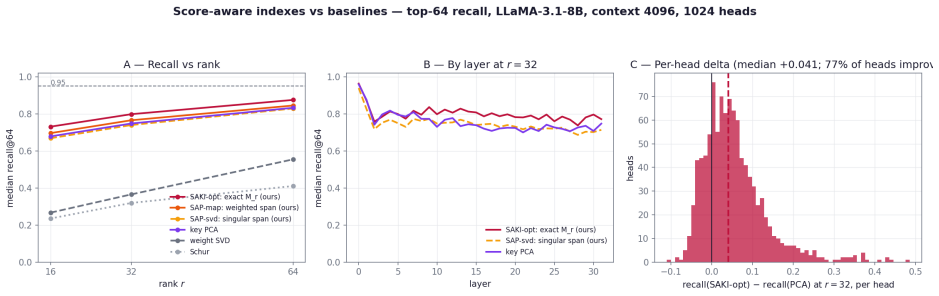
Pith's one-line read Key compression should preserve attention scores, not key variance; the exact low-rank solution is an asymmetric closed form that beats key-PCA on all four LLMs tested, cutting 13–30% of its remaining recall error at rank 32.
desk verdict SAKI is a genuinely new, well-verified training-free KV index that beats key-PCA by optimizing score distortion instead of reconstruction; its soft spots are mostly self-declared. read the letter →
The pith
A machine-rendered reading of the paper's core claim, the machinery that carries it, and where it could break.
The reading
What carries the argument
The load-bearing object is the covariance-weighted query–key operator $C = \Sigma_q^{1/2} \Sigma_k^{1/2}$, formed from per-head second moments of queries and keys, together with its truncated SVD $C_r = U_r \Lambda_r V_r^\top$. Substituting $M_r = \Sigma_q^{-1/2} C_r \Sigma_k^{-1/2}$ into the score-error objective turns the problem into approximating $C$ by a rank-$r$ matrix, so the classical Eckart–Young theorem (the best rank-$r$ approximation is the truncated SVD) selects $C_r$; this is the closed-form asymmetric optimum the paper calls an optimal rank-$r$ linear score map. The same factorization yields stored index codes via $B_k = \Sigma_k^{-1/2} V_r \Lambda_r^{1/2}$ and a query map $B_q = \Sigma_q^{-1/2} U_r \Lambda_r^{1/2}$, so the $r$-dimensional codes reproduce the optimal bilinear score exactly. A Marchenko–Pastur threshold on the key correlation matrix (the eigenvalue band of pure sampling noise) separates genuine covariance signal from autocorrelated sampling noise, identifying the heads where a variance-based index has no reliable signal to use.
What would settle it
Evaluate SAKI's own protocol with calibration and evaluation on different domains, or on sequences engineered to carry strong query–key correlation, and check two outputs: the per-head predicted-versus-actual score-MSE correlation (claimed at 0.997) and the SAKI-versus-PCA recall comparison (claimed never worse in any cell). A correlation far below 0.997, or a single PCA-winning (model, rank) cell, would falsify the claim that the closed form is the deployment-time optimum for the deployed recall objective.
Extended reading notes
Core claim
The central discovery is that the right objective for a low-rank KV-cache index is neither weight fidelity nor key reconstruction: it is the expected distortion of the attention scores themselves. Compressing cached keys through a rank-$r$ linear map $P$ perturbs scores by $q^\top (I-P) k$, and its expected square under an independent query/key model with second moments $\Sigma_q$ and $\Sigma_k$ equals $L(P) = \|\Sigma_q^{1/2} (I-P) \Sigma_k^{1/2}\|_F^2$. The exact rank-$r$ minimizer is $M_r = \Sigma_q^{-1/2} C_r \Sigma_k^{-1/2}$ with $C_r$ the truncated SVD of $C = \Sigma_q^{1/2} \Sigma_k^{1/2}$: an asymmetric linear map, generally not a projector, that no span-restricted method, PCA included, can express. A margin condition converts control of $L$ into top-$k$ recall, and the resulting training-free index SAKI beats key-PCA on every model and rank tested, with per-head predicted score-MSE reductions matching measurement at Pearson $r = 0.997$; the independence approximation is near-exact for score-MSE on natural text, and a random-matrix analysis shows the gains concentrate on heads whose key spectra hug the Marchenko–Pastur bulk, where key variance offers PCA no reliable signal.
Load-bearing premise
The load-bearing assumption is that queries and keys behave like independent random draws with fixed per-head second moments, ignoring the query–key correlations, positional structure, and rotary positional-encoding rotation that real self-attention has; the paper itself flags the RoPE handling as 'the approximation to refine.'
Editorial extensions
If this is right
- At rank 32, SAKI removes 13–30% of key-PCA's remaining top-64 recall error across four model families, and it never loses to PCA in any tested (model, rank) cell.
- Calibration is roughly 8× more efficient: SAKI calibrated on 512 tokens matches PCA calibrated on 4,096, and beats same-length PCA at every calibration size.
- Per-head predicted score-MSE reduction matches measurement at Pearson $r = 0.997$ (median gap 0.0009), so on in-domain natural text the closed form is the deployment-time optimum for its stated objective.
- The variant ordering — exact asymmetric optimum above weighted span above raw span ≈ PCA — shows the gain comes from solving the score-distortion objective over all rank-$r$ maps, not from inserting covariances into a projector.
- Score-operator geometry (extreme non-normality, heavy-tailed weight spectra, hub-shaped cross-subspace couplings) explains why weight-only, invariant-subspace, and key-reconstruction indexes are suboptimal for retrieval.
Reading between the lines
- Domain shift and end-to-end generation quality are the open threats the paper itself lists as remaining work; if calibration-domain transfer degrades SAKI's edge, online updates of $\Sigma_q$ and $\Sigma_k$ would turn the closed form into an adaptive index.
- The measured Marchenko–Pastur spike counts (median 15 of 128 per head) imply most heads could run well below the uniform rank 32, giving a principled per-head rank budget that the paper notes but does not develop.
- Because both factors fold into the attention weight matrices, SAKI's subspace could become a drop-in sketching primitive for retrieval systems, composing with learned selectors, page indexes, and quantization rather than replacing them; the paper's own framing already suggests this composition.
- A decisive head-to-head that follows from the paper's framing is SAKI against the covariance-aware conversion methods it cites: the paper argues those optimize representation fidelity while SAKI optimizes pairwise score fidelity, a difference that should be visible on heads where query statistics carry the most information.
Editorial analysis
A structured set of objections, weighed in public.
Referee Report
Summary. SAKI is a training-free low-rank KV-cache index. The paper derives the expected attention-score distortion under key-side rank-r compression as L(P) = ||Σq^{1/2}(I-P)Σk^{1/2}||_F^2, proves that the minimizer over all rank-r linear maps P is M_r = Σq^{-1/2} C_r Σk^{-1/2}, where C_r is the truncated SVD of C = Σq^{1/2}Σk^{1/2}, and evaluates the resulting index against key PCA on four LLMs using top-64 recall at context 4,096. The paper also reports an operator-geometry diagnosis of attention score operators and a random-matrix analysis of calibration-length sensitivity.
Significance. The closed-form solution is elegant, the ablation isolating the score objective from mere covariance weighting is convincing, and the internal validation (predicted versus actual score-MSE reduction at Pearson r = 0.997) is a genuine strength. The empirical recall gains are consistent and replicated across four models, and the paper is unusually explicit about its limitations. However, the headline claim that optimizing L(P) improves top-k recall beyond chance relies on a margin condition that is not verified, and the RoPE handling is an acknowledged approximation that is not validated for the deployed rotated scores. Read as an improved score-MSE surrogate for low-rank KV indexing, the contribution is solid; read as a proven recall-optimal index, the theoretical bridge is incomplete.
major comments (3)
- [§5, Eqs. (1)–(2)] There is an inconsistency in the definition of the compression map P. If P acts on the d-dimensional cached keys k = W_K x, as stated in §5 and used in the algorithm, then the score error is e = q^T(I-P)k and the correct expression is Eq. (2), namely E[e²] = ||Σq^{1/2}(I-P)Σk^{1/2}||_F². The x-space form e = x_q^T A(I-P)x_k in Eq. (1) would require P to act on the input vectors x, and the two descriptions are not equivalent for non-invertible or non-orthogonal W_Q, W_K. This does not invalidate the final theorem, since Prop. 1 is proved from Eq. (2), but the derivation as written is mathematically misleading and needs to be rewritten or explicitly reconciled.
- [§5, Prop. 2 and §7] The theoretical bridge from L(P) to top-k recall is not established. Prop. 2 requires a uniform error bound |s_ij - s_hat_ij| ≤ ε for all j, while L(P) controls the mean-squared error E[e²]. The condition 2ε < γ_k is never estimated or verified on the evaluation data, and no argument shows that minimizing L drives the maximum per-key error below the margin. The sentence following Prop. 2 ('Control of L therefore transfers to recall') is therefore a non sequitur as written. The empirical recall gains remain valid, but the abstract and §5 overstate the theoretical support; either estimate the margin on the tested heads and report how often the condition is satisfied, or explicitly present Prop. 2 as motivation rather than a guarantee.
- [§6, Remark 2, Appendix C] The validation of the independence model applies only to pre-RoPE score-MSE, whereas the deployed retrieval uses RoPE-rotated scores after reconstruction. Appendix C reports Pearson r = 0.997 for predicted versus actual score-MSE reduction on pre-RoPE, causal query-key pairs at r = 32, but this does not validate the approximation for the actual attention score computation, which applies rotation after the low-rank reconstruction. Since the paper's central claim is that SAKI 'directly preserves attention scores,' the score-MSE agreement should be re-measured on the RoPE-rotated scores actually used in the recall experiments, or the claim should be qualified to pre-RoPE score fidelity.
minor comments (4)
- [Title and §7] The phrase 'random-matrix noise correction' is stronger than what the paper implements: the Marchenko–Pastur analysis is used diagnostically to explain where SAKI gains over PCA, and the only correction step is Ledoit–Wolf shrinkage, which is reported to help only marginally. Consider retitling or clarifying that the RMT analysis is a diagnostic rather than a noise-correction mechanism in the algorithm.
- [Appendix A] The eigenvalue floor of 10^-6 λmax for the pseudoinverse is described as having no observed sensitivity, but the tested range of the floor is not given. Reporting the range and the resulting recall variation would make the claim more precise.
- [References] References [21]–[24] are 2026 arXiv preprints without arXiv identifiers or version dates. Please provide complete bibliographic information, since the comparison with the '2026 data-aware family' is a central part of the positioning.
- [§7, Table 1] The statement that 'SAKI never loses to PCA in any (model, rank) cell' is based on median recall; the per-head distributions still show a minority of heads with negative deltas (11–32% depending on model). Reporting the spread or confidence intervals for the medians would help calibrate the strength of the claim.
Circularity Check
No significant circularity: the closed-form minimizer follows from an explicit objective via a classical reduction, no parameters are fitted to the target metric, and the central recall claims are measured against external baselines.
full rationale
The derivation is self-contained. The objective L(P)=||Σq^{1/2}(I-P)Σk^{1/2}||_F^2 is defined from an explicit independence model for attention scores, and Proposition 1 obtains its minimizer M_r by the substitution P~=Σq^{1/2}PΣk^{1/2} followed by Eckart–Young, a classical reduction that the paper explicitly attributes to refs. [12,14,15]. No parameter is fitted to recall data; the only implementation knob is the 1e-6 eigenvalue floor, whose sensitivity the paper reports as null (Appendix A). The predicted-vs-actual score-MSE agreement (Pearson r=0.997) is a self-consistency check of the independence approximation rather than an independent external prediction, but it is not used to define M_r and does not feed back into the derivation; it could have failed, and the paper reports it as validation. The central empirical claims are comparisons against key-PCA, weight-SVD, and Schur invariant subspaces on four models (Tables 1-2), which are external benchmarks and do not reduce to the objective being optimized. Prop. 2's gap — mean-square L does not imply the uniform bound 2ε<γ_k, and γ_k is not estimated — is a correctness risk for the recall-transfer claim, not a circularity. No load-bearing self-citation or author-imported uniqueness theorem is used; the paper's own limitations sections explicitly acknowledge what is not yet shown, further indicating that the derivation is not being presented as stronger than it is.
Assumptions & free parameters
free parameters (4)
- rank r =
16, 32, 64
- eigenvalue floor for pseudoinverse =
10^-6 × λmax
- Ledoit-Wolf shrinkage intensity =
data-derived (LW 2004)
- autocorrelation time τint (and qeff = d/Teff) =
median τint = 3.2
assumptions (6)
- domain assumption Queries and keys are independent random vectors with second moments Σq and Σk, allowing E[e^2] to drop cross terms (Eq. 1).
- domain assumption The index is restricted to rank-r linear maps P; nonlinear sketches are out of scope.
- standard math Eckart-Young theorem gives the best rank-r approximation of C after substitution.
- domain assumption Σq and Σk are treated as positive definite (or replaced by regularized pseudoinverses with eigenvalue floor 10^-6 λmax).
- domain assumption For recall transfer, score errors are bounded by ε and the top-k margin γ is positive (Prop. 2).
- ad hoc to paper RoPE relative position can be handled by pre-rotation codes without modeling rotation in the covariance objective.
Cite this review
Pith. "Pith review of SAKI: Score-Aware Low-Rank Key Indexing with Random-Matrix Noise Correction for KV Retrieval." pith.science (2026). https://pith.science/paper/LBPCW45T
@misc{pith2026260803228,
  author       = {Pith},
  title        = {Pith review of: SAKI: Score-Aware Low-Rank Key Indexing with Random-Matrix Noise Correction for KV Retrieval},
  year         = {2026},
  howpublished = {\url{https://pith.science/paper/LBPCW45T}},
  note         = {Machine review of arXiv:2608.03228}
}
read the original abstract
Existing low rank KV cache methods preserve either model weights or key variance, neither of which directly reflects the attention scores used during inference. We derive the expected attention score distortion caused by rank r key compression and show that it yields a covariance weighted low rank objective. Under a margin condition, controlling this distortion also improves top k recall. The optimal rank r solution has a closed form asymmetric factorization obtained from the SVD of the covariance weighted query key operator. This motivates SAKI, a training free KV cache index that directly preserves attention scores rather than key reconstruction quality. Across LLaMA 3.1 8B, Qwen 2.5 7B, Mistral 7B v0.1, and Llama 3.2 3B, SAKI outperforms key PCA at every tested rank. At rank 32, it removes 13 to 30 percent of PCA's remaining top 64 recall error, including improvements from 0.748 to 0.799 on LLaMA 3.1 8B and from 0.786 to 0.850 on Qwen 2.5 7B. It improves 68 to 89 percent of attention heads per model, with the largest gains in deeper layers. Predicted score MSE reductions closely match empirical measurements, with a Pearson correlation of 0.997, while ablation studies confirm that the gains arise from optimizing the attention score objective rather than covariance weighting alone. Analysis of the scoring operator further explains why weight only, invariant subspace, and key reconstruction methods can be suboptimal. SAKI uses random-matrix theory to separate genuine covariance signal from autocorrelated sampling noise, matching PCA with only 512 calibration tokens and adding value exactly where PCA sees no reliable signal.
Figures


Figures from the paper (3 more)


Reference graph
Works this paper leans on
-
[1]
Native Sparse Attention: Hardware-Aligned and Natively Trainable Sparse Attention
Yuan et al. Native Sparse Attention: Hardware-Aligned and Natively Trainable Sparse Attention. arXiv:2502.11089, 2025
arXiv 2025
-
[2]
DeepSeek-V2: A Strong, Economical, and Efficient Mixture-of-Experts Language Model
DeepSeek-AI. DeepSeek-V2: A Strong, Economical, and Efficient Mixture-of-Experts Language Model. arXiv:2405.04434, 2024
arXiv 2024
-
[3]
Palu: Compressing KV-Cache with Low-Rank Projection
Chang et al. Palu: Compressing KV-Cache with Low-Rank Projection. arXiv:2407.21118, 2024
arXiv 2024
-
[4]
Eigen Attention: Attention in Low-Rank Space for KV Cache Compression
Saxena et al. Eigen Attention: Attention in Low-Rank Space for KV Cache Compression. arXiv:2408.05646, 2024
arXiv 2024
-
[5]
ShadowKV: KV Cache in Shadows for High-Throughput Long-Context LLM Inference
Sun et al. ShadowKV: KV Cache in Shadows for High-Throughput Long-Context LLM Inference. arXiv:2410.21465, 2024
arXiv 2024
-
[6]
LoRC: Low-Rank Compression for LLMs’ KV Cache
Zhang et al. LoRC: Low-Rank Compression for LLMs’ KV Cache. arXiv:2410.03111, 2024
arXiv 2024
-
[7]
KIVI: A Tuning-Free Asymmetric 2bit Quantization for KV Cache
Liu et al. KIVI: A Tuning-Free Asymmetric 2bit Quantization for KV Cache. arXiv:2402.02750, 2024
arXiv 2024
-
[8]
KVQuant: Towards 10 Million Context Length LLM Inference
Hooper et al. KVQuant: Towards 10 Million Context Length LLM Inference. arXiv:2401.18079, 2024
arXiv 2024
Show all 24 references
-
[9]
H2O: Heavy-Hitter Oracle for Efficient Generative Inference
Zhang et al. H2O: Heavy-Hitter Oracle for Efficient Generative Inference. arXiv:2306.14048, 2023
2023 arXiv
-
[10]
SnapKV: LLM Knows What You are Looking for Before Generation
Li et al. SnapKV: LLM Knows What You are Looking for Before Generation. arXiv:2404.14469, 2024
2024 arXiv
-
[11]
Quest: Query-Aware Sparsity for Efficient Long-Context LLM Inference
Tang et al. Quest: Query-Aware Sparsity for Efficient Long-Context LLM Inference. arXiv:2406.10774, 2024
2024 arXiv
-
[12]
The approximation of one matrix by another of lower rank
Eckart and Young. The approximation of one matrix by another of lower rank. Psychometrika, 1936. 8
1936
-
[13]
Relations between two sets of variates
Hotelling. Relations between two sets of variates. Biometrika, 1936
1936
-
[14]
Reduced-rank regression for the multivariate linear model
Izenman. Reduced-rank regression for the multivariate linear model. Journal of Multivariate Analysis, 1975
1975
-
[15]
Weighted low-rank approximations
Srebro and Jaakkola. Weighted low-rank approximations. ICML, 2003
2003
-
[16]
Asymmetric LSH (ALSH) for sublinear time maximum inner product search
Shrivastava and Li. Asymmetric LSH (ALSH) for sublinear time maximum inner product search. NeurIPS, 2014
2014
-
[17]
Accelerating large-scale inference with anisotropic vector quantization
Guo et al. Accelerating large-scale inference with anisotropic vector quantization. ICML, 2020
2020
-
[18]
Distribution of eigenvalues for some sets of random matrices
Marchenko and Pastur. Distribution of eigenvalues for some sets of random matrices. Mat. Sb., 1967
1967
-
[19]
Noise dressing of financial correlation matrices
Laloux, Cizeau, Bouchaud, and Potters. Noise dressing of financial correlation matrices. Physical Review Letters, 1999
1999
-
[20]
A well-conditioned estimator for large-dimensional covariance matrices
Ledoit and Wolf. A well-conditioned estimator for large-dimensional covariance matrices. Journal of Multivariate Analysis, 2004
2004
-
[21]
arXiv, 2026
KV-CoRE: data-dependent low-rank compressibility of KV caches. arXiv, 2026
2026
-
[22]
arXiv, 2026
CARE: covariance-aware low-rank attention conversion. arXiv, 2026
2026
-
[23]
arXiv, 2026
OjaKV: online adaptive PCA for KV-cache compression. arXiv, 2026
2026
-
[24]
arXiv, 2026
STAR-KV: adaptive rank selection and hybrid low-rank KV decomposition. arXiv, 2026. A Full derivation of Proposition 1 Conventions.Column vectors q, k∈R d; P : Rd →R d linear, rank(P ) ≤r ; scores s = q⊤k, compressed ˆs=q ⊤P k(centering handled below). Reduction.With Σ q ≻ 0, ...
2026
Reviewed August 8, 2026 · model on record in the stance chip above.
Discussion (0). Continue with ORCID to comment.