Endowing variational phase-field fracture models with custom strength criteria
Pith reviewed 2026-06-28 00:39 UTC · model grok-4.3
The pith
Letting the dissipation potential depend on material state incorporates arbitrary elastic domains into phase-field fracture models while preserving variational structure.
A machine-rendered reading of the paper's core claim, the machinery that carries it, and where it could break.
Core claim
By letting the dissipation potential depend on the current state of the material, arbitrary elastic domains can be incorporated into phase-field fracture models while preserving the variational structure, with elastic degradation and the strength criterion remaining two distinct and independently controllable aspects of the material response.
What carries the argument
A state-dependent dissipation potential that encodes an arbitrary elastic domain.
If this is right
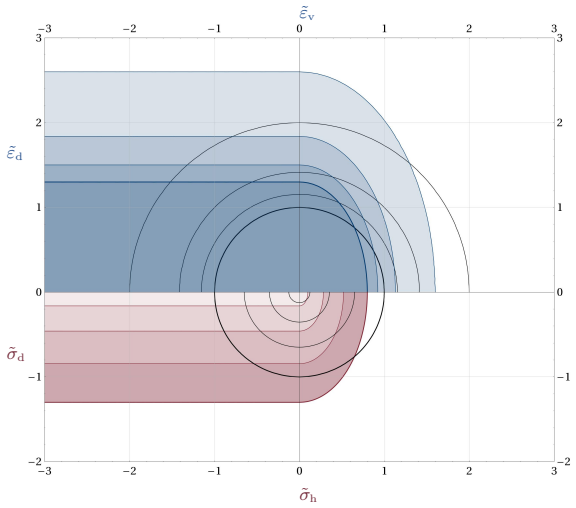
- The evolution of the elastic domain can be investigated in both strain and stress spaces.
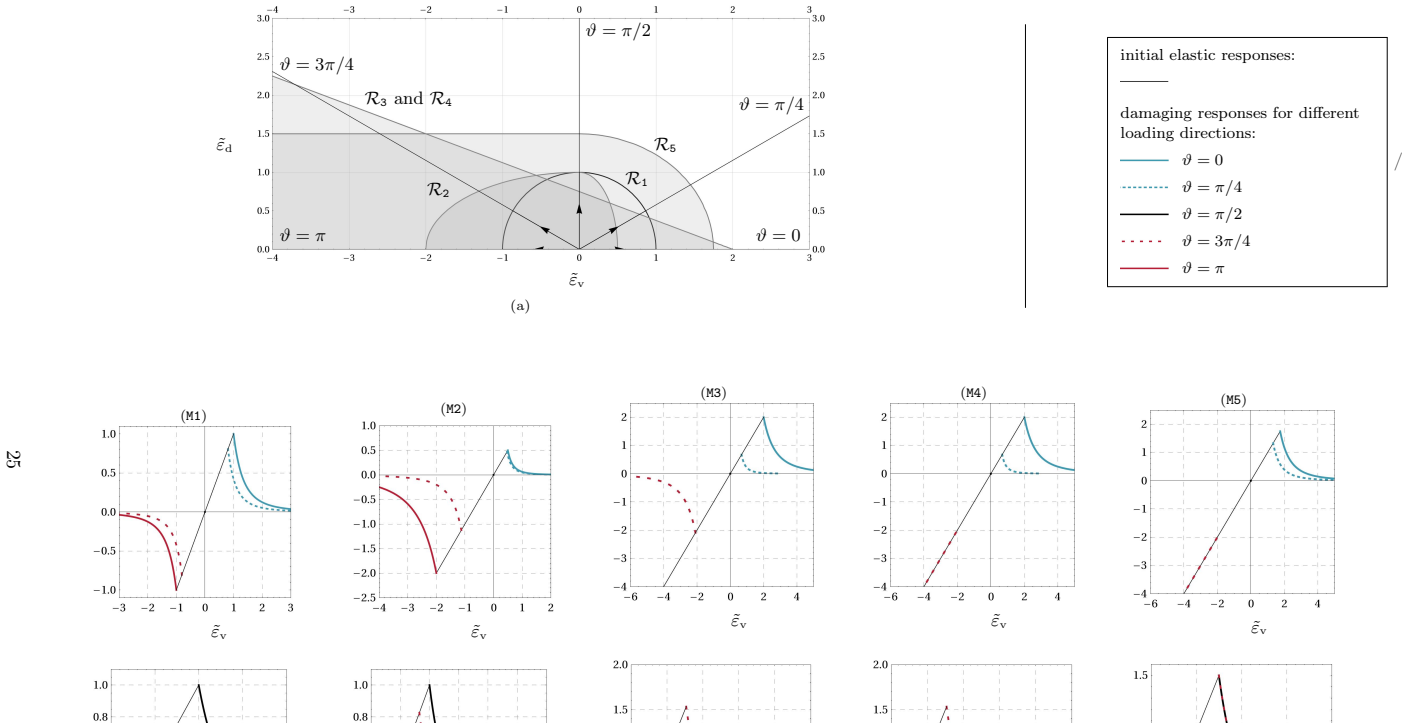
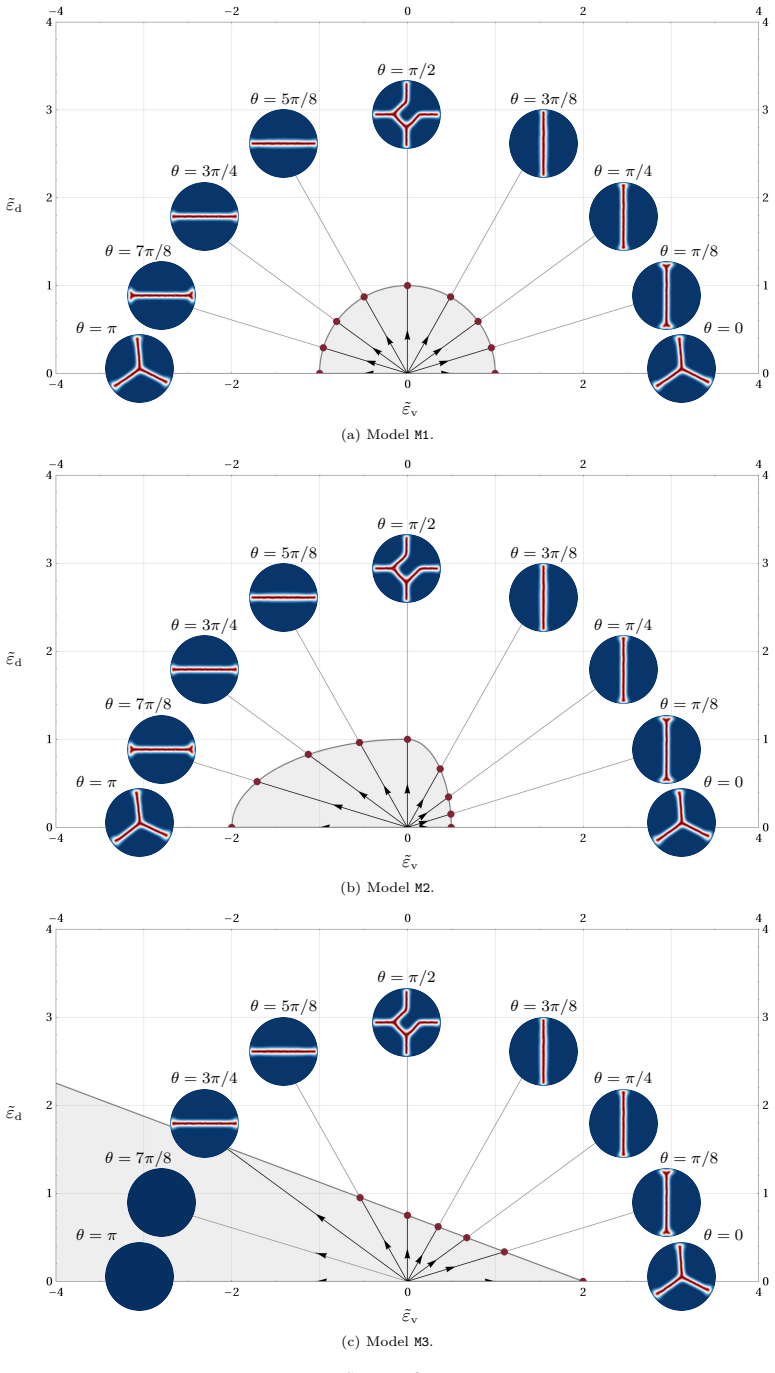
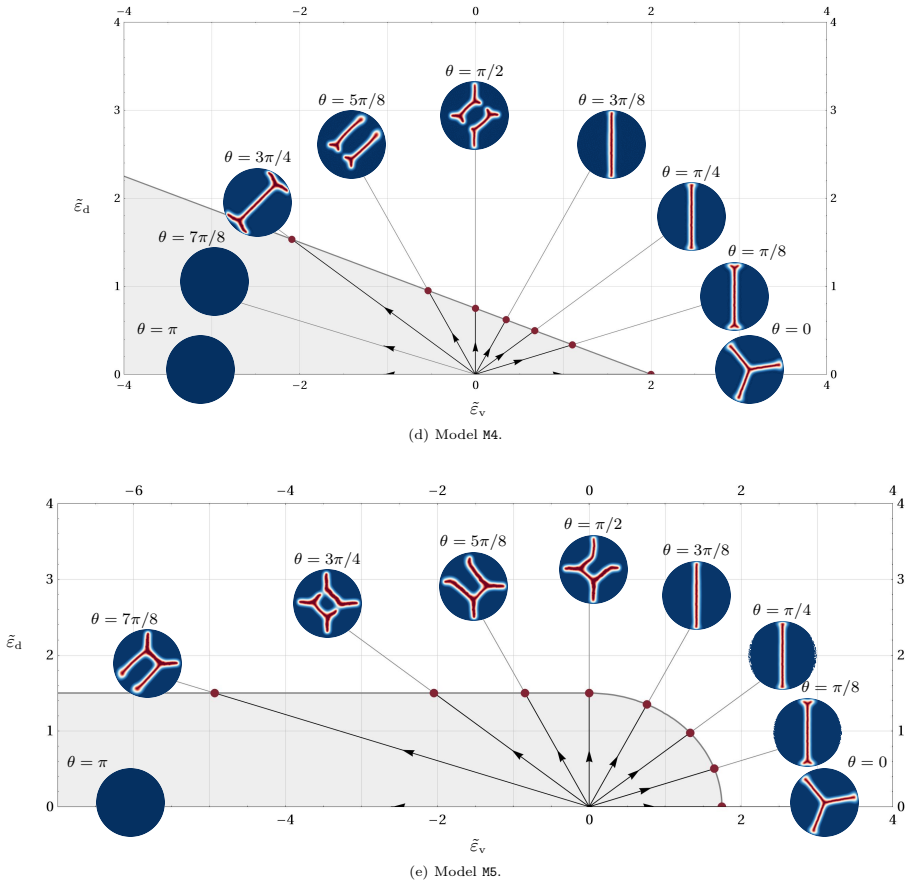
- Numerical simulations demonstrate crack nucleation processes under multiaxial loading for various analytical strength surfaces.
- Elastic degradation and the strength criterion are independently controllable.
- Simple representative models preserve the variational structure of generalized standard materials.
Where Pith is reading between the lines
- This method could be extended to incorporate other nonlinear material behaviors while maintaining variational consistency.
- Comparisons with experimental data on crack initiation under complex loading would validate the approach.
- Future models might combine this with plasticity without sacrificing the generalized standard material framework.
Load-bearing premise
A state-dependent dissipation potential can be formulated to encode an arbitrary elastic domain without inconsistencies in the evolution equations or violating the variational structure.
What would settle it
A simulation or analytical check showing that for a chosen strength criterion the resulting evolution equations lead to non-dissipative behavior or non-uniqueness would falsify the claim.
Figures
read the original abstract
By now, several approaches have been proposed to endow phase-field fracture models with the ability to describe crack nucleation under multiaxial stress states. These include techniques for splitting the free energy, direct modifications of the phase-field driving or resisting forces that sacrifice the variational structure of the problem, and the introduction of additional internal variables, such as plastic strains or other nonlinear strains. In this paper, we propose a fundamentally different strategy for incorporating arbitrary elastic domains into phase-field fracture models, formulated within the variational framework of generalized standard materials. The proposed approach relies on letting the dissipation potential depend on the current state of the material. In this way, the variational structure of the problem is preserved, while elastic degradation and the strength criterion remain two distinct and independently controllable aspects of the material response. Simple yet representative models are presented and thoroughly discussed to demonstrate the effectiveness of the proposed methodology. The resulting evolution of the elastic domain is investigated in both strain and stress spaces. Moreover, numerical simulations demonstrate a range of crack nucleation processes under multiaxial loading conditions for various analytical strength surfaces. This work paves the way for future developments and applications in several directions.
Editorial analysis
A structured set of objections, weighed in public.
Referee Report
Summary. The paper proposes a new strategy within the generalized standard materials (GSM) framework to incorporate arbitrary elastic domains (strength criteria) into variational phase-field fracture models. By making the dissipation potential state-dependent on the current material state, the approach preserves the variational structure while keeping elastic degradation (via the free-energy function) and the strength criterion as independent, separately tunable aspects. Representative analytical models are derived and analyzed for the evolution of the elastic domain in strain and stress space; numerical simulations then demonstrate crack nucleation under multiaxial loading for several custom strength surfaces.
Significance. If the construction holds, the work provides a clean variational route to custom multiaxial strength criteria without energy splitting, auxiliary internal variables, or loss of the variational structure. This is a meaningful advance for phase-field modeling of fracture in materials where nucleation is sensitive to stress triaxiality or other non-standard surfaces. The explicit separation of degradation and nucleation threshold, together with the reported recovery of the initial strength surface and independent tunability, are concrete strengths. The numerical examples across multiple analytical surfaces further support practical utility.
minor comments (3)
- [§2.3] §2.3: the notation for the state-dependent dissipation potential Φ(·,·) should explicitly distinguish the dependence on the current elastic strain versus the phase-field variable to avoid ambiguity when taking the subdifferential.
- [Figure 7] Figure 7 and accompanying text: the evolution plots in stress space would benefit from an overlay of the initial elastic domain for direct visual comparison of how the surface translates or distorts.
- [§5] The discussion of numerical implementation (likely §5) should state the solver tolerances and mesh-size convergence checks used to confirm that the reported nucleation loads are insensitive to discretization.
Simulated Author's Rebuttal
We thank the referee for the positive assessment of our manuscript, the recognition of its significance, and the recommendation for minor revision. No major comments were provided in the report.
Circularity Check
No significant circularity; new construction within GSM framework
full rationale
The paper advances a modeling construction: a state-dependent dissipation potential is introduced inside the standard generalized standard materials (GSM) variational setting so that an arbitrary elastic domain can be encoded while the free-energy degradation function stays independent. No derivation chain reduces a claimed result to its own inputs by construction; there are no fitted parameters renamed as predictions, no self-definitional loops, and no load-bearing uniqueness theorems imported from the authors' prior work. The abstract and described strategy treat the state dependence as an explicit modeling choice whose consistency with convexity and subdifferentiation is asserted directly from GSM axioms rather than derived from the target strength surfaces. The resulting models are therefore self-contained proposals, not re-derivations.
Axiom & Free-Parameter Ledger
axioms (1)
- domain assumption Formulation within the variational framework of generalized standard materials
Reference graph
Works this paper leans on
-
[1]
B. Bourdin, G. A. Francfort, J.-J. Marigo, Numerical experiments in revisited brittle fracture, Journal of the Mechanics and Physics of Solids 48 (2000) 797–826. URL:http://linkinghub. elsevier.com/retrieve/pii/S0022509699000289. doi:10.1016/S0022-5096(99)00028-9
-
[2]
R. Alessi, J.-J. Marigo, S. Vidoli, Gradient Damage Models Coupled with Plasticity and Nucleation of Cohesive Cracks, Archive for Rational Mechanics and Analysis 214 (2014) 575–615. URL:http: //link.springer.com/10.1007/s00205-014-0763-8. doi:10.1007/s00205-014-0763-8
-
[3]
M. Ambati, T. Gerasimov, L. De Lorenzis, Phase-field modeling of ductile fracture, Computational Mechanics55(2015)1017–1040.URL:http://link.springer.com/10.1007/s00466-015-1151-4. doi:10.1007/s00466-015-1151-4
-
[4]
C. Miehe, S. Teichtmeister, F. Aldakheel, Phase-field modelling of ductile fracture: a variational gradient-extended plasticity-damage theory and its micromorphic regulariza- tion., Philosophical transactions. Series A, Mathematical, physical, and engineering sciences 374 (2016). URL:http://rsta.royalsocietypublishing.org/content/374/2066/20150170. abstra...
-
[5]
F.Dammaß, M.Ambati, M.Kästner, Aunifiedphase-fieldmodeloffractureinviscoelasticmaterials, Continuum Mechanics and Thermodynamics 33 (2021) 1907–1929. URL:https://doi.org/10. 1007/s00161-021-01013-3. doi:10.1007/s00161-021-01013-3
-
[6]
F. Kamarei, E. Breedlove, O. Lopez-Pamies, Nucleation and propagation of fracture in viscoelas- tic elastomers: A complete phase-field theory, Computer Methods in Applied Mechanics and Engineering 446 (2025) 118337. URL:https://www.sciencedirect.com/science/article/pii/ S0045782525006097. doi:https://doi.org/10.1016/j.cma.2025.118337. 29
-
[7]
J. Ciambella, G. Lancioni, N. Stortini, Viscous Effects on the Crack Propagation in Elas- tomers, Springer Nature Switzerland, Cham, 2025, pp. 217–228. URL:https://doi.org/10.1007/ 978-3-031-84379-2_17. doi:10.1007/978-3-031-84379-2_17
-
[8]
Alessi, S
R. Alessi, S. Vidoli, L. De Lorenzis, Variational approach to fatigue phenomena with a phase-field model: the one-dimensional case, Engineering Fracture Mechanics 190 (2018) 53–73
2018
-
[9]
Alessi, V
R. Alessi, V. Crismale, G. Orlando, Fatigue Effects in Elastic Materials with Variational Damage Models: A Vanishing Viscosity Approach, Journal of Nonlinear Science 29 (2019). doi:10.1007/ s00332-018-9511-9
2019
-
[10]
A. Mesgarnejad, A. Imanian, A. Karma, Phase-field models for fatigue crack growth, Theoretical and Applied Fracture Mechanics 103 (2019) 102282. URL:https://doi.org/10.1016/j.tafmec. 2019.102282. doi:10.1016/j.tafmec.2019.102282
-
[11]
M. Seiler, T. Linse, P. Hantschke, M. Kästner, An efficient phase-field model for fatigue frac- ture in ductile materials, Engineering Fracture Mechanics 224 (2020) 106807. URL:https://www. sciencedirect.com/science/article/pii/S0013794419303200. doi:10.1016/j.engfracmech. 2019.106807.arXiv:1903.06465
-
[13]
M. J. Borden, C. V. Verhoosel, M. A. Scott, T. J. R. Hughes, C. M. Landis, A phase-field description of dynamic brittle fracture, Computer Methods in Applied Mechanics and Engineering 217 (2012) 77–95. doi:10.1016/j.cma.2012.01.008
-
[14]
T. Li, J.-J. Marigo, D. Guilbaud, S. Potapov, Gradient damage modeling of brittle fracture in an explicit dynamics context, International Journal for Numerical Methods in Engineering 108 (2016) 1381–1405. URL:https://onlinelibrary.wiley.com/doi/abs/10.1002/nme.5262http: //dx.doi.org/10.1002/nme.5262https://hal-mines-paristech.archives-ouvertes.fr/ hal-012...
-
[15]
A. Mikelić, M. F. Wheeler, T. Wick, Phase-field modeling of a fluid-driven fracture in a poroelas- tic medium, Computational Geosciences 19 (2015) 1171–1195. URL:https://doi.org/10.1007/ s10596-015-9532-5. doi:10.1007/s10596-015-9532-5
-
[16]
E. Martínez-Pañeda, A. Golahmar, C. F. Niordson, A phase field formulation for hydrogen assisted cracking, Computer Methods in Applied Mechanics and Engineering 342 (2018) 742–761. doi:10. 1016/j.cma.2018.07.021.arXiv:1808.03264
Pith/arXiv arXiv 2018
-
[17]
M. Dittmann, F. Aldakheel, J. Schulte, F. Schmidt, M. Krüger, P. Wriggers, C. Hesch, Phase-field modeling of porous-ductile fracture in non-linear thermo-elasto-plastic solids, Com- puter Methods in Applied Mechanics and Engineering 361 (2020) 112730. URL:https:// www.sciencedirect.com/science/article/pii/S0045782519306206. doi:https://doi.org/10. 1016/j....
arXiv 2020
-
[18]
H. Amor, J.-J. Marigo, C. Maurini, Regularized formulation of the variational brittle fracture with unilateral contact: Numerical experiments, Journal of the Mechanics and Physics of Solids 57 (2009) 1209–1229. URL:http://dx.doi.org/10.1016/j.jmps.2009.04.011. doi:10.1016/j. jmps.2009.04.011
-
[19]
C. Miehe, F. R. Welschinger, M. Hofacker, Thermodynamically consistent phase-field models of frac- ture: Variational principles and multi-field FE implementations, International Journal for Numerical Methods in Engineering 83 (2010) 1273–1311. URL:http://doi.wiley.com/10.1002/nme.2861. doi:10.1002/nme.2861
-
[20]
F. Freddi, G. F. Royer-Carfagni, Regularized variational theories of fracture: A uni- fied approach, Journal of the Mechanics and Physics of Solids 58 (2010) 1154–1174. URL:http://www.sciencedirect.com/science/article/pii/S0022509610000475http: //linkinghub.elsevier.com/retrieve/pii/S0022509610000475http://dx.doi.org/10. 1016/j.jmps.2010.02.010. doi:10.10...
-
[21]
F. Freddi, G. Royer-Carfagni, Variational fracture mechanics to model compressive splitting of masonry-like materials, Annals of Solid and Structural Mechanics 2 (2011) 57–67. URL:http: //link.springer.com/10.1007/s12356-011-0018-4. doi:10.1007/s12356-011-0018-4
-
[22]
L. De Lorenzis, C. Maurini, Nucleation under multi-axial loading in variational phase-field models of brittle fracture, International Journal of Fracture (2021). URL:https://link.springer.com/ 10.1007/s10704-021-00555-6. doi:10.1007/s10704-021-00555-6
-
[23]
Y. Navidtehrani, C. Betegón, E. Martínez-Pañeda, A general framework for decomposing the phase field fracture driving force, particularised to a Drucker–Prager failure surface, Theoretical and Applied Fracture Mechanics 121 (2022) 103555. URL:https://doi.org/10.1016/j.tafmec.2022. 103555. doi:10.1016/j.tafmec.2022.103555
-
[24]
F. Vicentini, C. Zolesi, P. Carrara, C. Maurini, L. De Lorenzis, On the energy decomposition in variational phase-field models for brittle fracture under multi-axial stress states, International Jour- nalofFracture247(2024)291–317.URL:https://doi.org/10.1007/s10704-024-00763-whttps: //hal.sorbonne-universite.fr/hal-04231075. doi:10.1007/s10704-024-00763-w
-
[25]
P.-L. Bian, H. Qing, T. Yu, S. Schmauder, A novel and simple variationally-consistent phase-field cohesive zone model for mixed-mode fracture, Theoretical and Applied Fracture Mechanics 130 (2024)104324.URL:https://doi.org/10.1016/j.tafmec.2024.104324.doi:10.1016/j.tafmec. 2024.104324
work page doi:10.1016/j.tafmec.2024.104324.doi:10.1016/j.tafmec 2024
-
[26]
C. Miehe, L.-M. Schänzel, H. Ulmer, Phase field modeling of fracture in multi-physics problems. Part I. Balance of crack surface and failure criteria for brittle crack propagation in thermo-elastic solids, Computer Methods in Applied Mechanics and Engineering 294 (2015) 449–485. URL:https: //linkinghub.elsevier.com/retrieve/pii/S0045782514004423. doi:10.1...
-
[27]
X. Zhang, S. W. Sloan, C. Vignes, D. Sheng, A modification of the phase-field model for mixed mode crack propagation in rock-like materials, Computer Methods in Applied Mechan- ics and Engineering 322 (2017) 123–136. URL:http://dx.doi.org/10.1016/j.cma.2017.04.028. doi:10.1016/j.cma.2017.04.028. 31
-
[28]
T. Wang, X. Ye, Z. Liu, D. Chu, Z. Zhuang, Modeling the dynamic and quasi-static compression- shear failure of brittle materials by explicit phase field method, Computational Mechanics 64 (2019) 1537–1556. URL:http://link.springer.com/10.1007/s00466-019-01733-z. doi:10. 1007/s00466-019-01733-z
-
[29]
A. Kumar, B. Bourdin, G. A. Francfort, O. Lopez-Pamies, Revisiting nucleation in the phase-Field approach to brittle fracture, Journal of the Mechanics and Physics of Solids 142 (2020) 104027. URL:https://doi.org/10.1016/j.jmps.2020.104027. doi:10.1016/j.jmps.2020.104027
-
[30]
Y. Feng, J. Li, Phase-field method with additional dissipation force for mixed-mode cohesive frac- ture, JournaloftheMechanicsandPhysicsofSolids159(2022)104693.URL:https://linkinghub. elsevier.com/retrieve/pii/S0022509621003148. doi:10.1016/j.jmps.2021.104693
-
[31]
S. Abrari Vajari, M. Neuner, P. K. Arunachala, C. Linder, Investigation of driving forces in a phase field approach to mixed mode fracture of concrete, Computer Methods in Applied Mechanics and Engineering 417 (2023) 116404. URL:https://linkinghub.elsevier.com/retrieve/pii/ S0045782523005285. doi:10.1016/j.cma.2023.116404
-
[32]
F. Kamarei, B. Zeng, J. E. Dolbow, O. Lopez-pamies, Nine circles of elastic brittle fracture : A series of challenge problems to assess fracture models, Computer Methods in Applied Mechan- ics and Engineering 448 (2026) 118449. URL:https://doi.org/10.1016/j.cma.2025.118449. doi:10.1016/j.cma.2025.118449
-
[34]
F. Vicentini, J. Heinzmann, P. Carrara, L. D. Lorenzis, Variational phase-field modeling of cohesive fracture with flexibly tunable strength surface, 2025. URL:https://arxiv.org/abs/2506.12188. arXiv:2506.12188
arXiv 2025
-
[35]
B. Bourdin, J.-J. Marigo, C. Maurini, C. Zolesi, A variational approach to fracture incorporating any convex strength criterion, 2025. URL:https://arxiv.org/abs/2506.22558.arXiv:2506.22558
arXiv 2025
-
[36]
Dal Maso, G
G. Dal Maso, G. Orlando, R. Toader, Fracture models for elasto-plastic materials as limits of gradient damage models coupled with plasticity: the antiplane case, Calc. Var. Partial Differential Equations 55 (2016) 45. URL:http://cvgmt.sns.it/paper/2677/
2016
-
[37]
E. Maggiorelli, M. Negri, F. Vicentini, L. De Lorenzis,Γ-convergence for a phase-field cohesive en- ergy, MechanicsofMaterials215(2026)105606.URL:https://www.sciencedirect.com/science/ article/pii/S0167663626000104. doi:https://doi.org/10.1016/j.mechmat.2026.105606
-
[38]
P. Carrara, M. Ambati, R. Alessi, L. De Lorenzis, A framework to model the fatigue behavior of brittle materials based on a variational phase-field approach, Computer Methods in Applied Mechanics and Engineering 361 (2020) 112731. URL:http://www.sciencedirect.com/science/ article/pii/S0045782519306218. doi:10.1016/j.cma.2019.112731. 32
-
[39]
R. Alessi, J. Ulloa, Endowing Griffith’s fracture theory with the ability to describe fatigue cracks, Engineering Fracture Mechanics 281 (2023) 109048. URL:https://linkinghub.elsevier.com/ retrieve/pii/S0013794423000061. doi:10.1016/j.engfracmech.2023.109048
-
[40]
G. A. Francfort, Recovering convexity in non-associated plasticity, Comptes Rendus - Mecanique 346 (2018) 198–205. doi:10.1016/j.crme.2017.12.005
-
[41]
J. Ulloa, R. Alessi, J. Wambacq, G. Degrande, S. François, On the variational modeling of non-associative plasticity, International Journal of Solids and Structures 217-218 (2021) 272–296. URL:https://www.sciencedirect.com/science/article/pii/S0020768320304212. doi:10.1016/j.ijsolstr.2020.10.027
-
[42]
A. Mielke, A Mathematical Framework for Generalized Standard Materials in the Rate-Independent Case, in: R. Helmig, A. Mielke, B. Wohlmuth (Eds.), Multifield Problems in Solid and Fluid Mechanics, volume 28 ofLecture Notes in Applied and Computational Mechanics, Springer Berlin / Heidelberg, 2006, pp. 399–428. URL:http://dx.doi.org/10.1007/978-3-540-34961-7_12
-
[43]
K. Pham, J.-J. Marigo, The variational approach to damage: I. The foundations, Comptes Rendus Mecanique 338 (2010) 191–198. doi:10.1016/j.crme.2010.03.009
-
[44]
J.-J. Marigo, Constitutive relations in plasticity, damage and fracture mechanics based on a work property, Nuclear Engineering and Design 114 (1989) 249–272. URL:http://dx.doi.org/10. 1016/0029-5493(89)90105-2. doi:10.1016/0029-5493(89)90105-2
-
[45]
Halphen, Q
B. Halphen, Q. S. Nguyen, Generalized Standard Materials, Journal de Mécanique 14 (1975) 39–63
1975
-
[46]
Q. S. Nguyen, Stability and Nonlinear Solid Mechanics, Wiley, 2000. URL:https://hal. archives-ouvertes.fr/hal-00105248/
2000
-
[47]
Q. S. Nguyen, On standard dissipative gradient models, Annals of Solid and Structural Mechanics 1 (2010) 79–86. URL:http://www.scopus.com/inward/record.url?eid=2-s2.0-77952287745& partnerID=40&md5=8bcaf218bf850f40deaf0839e572cf58. doi:10.1007/s12356-010-0006-0
-
[48]
URL:http://link.springer.com/ article/10.1007/s00707-016-1636-z
R.Alessi, Energeticformulationforrate-independentprocesses: remarksondiscontinuousevolutions with a simple example, Acta Mechanica 227 (2016) 2805–2829. URL:http://link.springer.com/ article/10.1007/s00707-016-1636-z. doi:10.1007/s00707-016-1636-z
-
[49]
K. Pham, H. Amor, J.-J. Marigo, C. Maurini, Gradient Damage Models and Their Use to Approximate Brittle Fracture, International Journal of Damage Mechanics 20 (2011) 618–652. doi:10.1177/1056789510386852
-
[50]
C. Zolesi, C. Maurini, Stability and crack nucleation in variational phase-field models of fracture: Effects of length-scales and stress multi-axiality, Journal of the Mechan- ics and Physics of Solids 192 (2024) 105802. URL:https://hal.sorbonne-universite.fr/ hal-04552309https://linkinghub.elsevier.com/retrieve/pii/S0022509624002680. doi:10. 1016/j.jmps....
arXiv 2024
-
[51]
Marigo, C
J.-J. Marigo, C. Maurini, K. Pham, An overview of the modelling of fracture by gradient damage models, Meccanica 51 (2016) 3107–3128. URL:http://link.springer.com/10.1007/ s11012-016-0538-4https://hal-ensmp.archives-ouvertes.fr/hal-01321465/. doi:10.1177/ 1056789510386852. 33
2016
-
[52]
Tanné, T
E. Tanné, T. Li, B. Bourdin, J.-J. Marigo, C. Maurini, Crack nucleation in variational phase-field models of brittle fracture, Journal of the Mechanics and Physics of Solids 110 (2018) 80–99
2018
-
[53]
R. Alessi, D. Bernardini, Analysis of localization phenomena in Shape Memory Alloys bars by a variational approach, International Journal of Solids and Structures 73-74 (2015) 113–133. URL:http://www.sciencedirect.com/science/article/pii/S0020768315002851. doi:http:// dx.doi.org/10.1016/j.ijsolstr.2015.06.021
-
[54]
Mielke, T
A. Mielke, T. Roubíček, Rate-Independent Systems: Theory and Application, Springer, 2015. URL: https://books.google.com/books?id=RN3HCgAAQBAJ&pgis=1
2015
-
[55]
Pham, J.-J
K. Pham, J.-J. Marigo, C. Maurini, The issues of the uniqueness and the stability of the homogeneous response in uniaxial tests with gradient damage models, Journal of the Me- chanics and Physics of Solids 59 (2011) 1163–1190. URL:http://www.sciencedirect.com/ science/article/B6TXB-52GXVJG-2/2/76efa9d53fe4f29eff9170a066d1302e. doi:DOI:10.1016/ j.jmps.2011.03.010
2011
-
[56]
A. A. León Baldelli, C. Maurini, Numerical bifurcation and stability analysis of variational gradient- damage models for phase-field fracture, Journal of the Mechanics and Physics of Solids 152 (2021) 104424. URL:https://linkinghub.elsevier.com/retrieve/pii/S0022509621001010. doi:10. 1016/j.jmps.2021.104424
arXiv 2021
-
[57]
G. Hansen, I. Herburt, H. Martini, M. Moszyńska, Starshaped sets, Aequationes mathematicae 94 (2020) 1001–1092. URL:https://link.springer.com/10.1007/s00010-020-00720-7. doi:10. 1007/s00010-020-00720-7
-
[58]
C. Miehe, A multi-field incremental variational framework for gradient-extended standard dissipative solids, Journal of the Mechanics and Physics of Solids 59 (2011) 898–923. URL:https://linkinghub.elsevier.com/retrieve/pii/S0022509610002358. doi:10.1016/j. jmps.2010.11.001
work page doi:10.1016/j 2011
-
[59]
A. Mielke, R. Rossi, Existence and uniqueness results for general rate-independent hysteresis prob- lems, Mathematical Models and Methods in Applied Sciences 17 (2007) 81–123. URL:https://www. worldscientific.com/doi/10.1142/S021820250700184X. doi:10.1142/S021820250700184X
-
[60]
M. Luege, A. Orlando, M. E. Almenar, E. A. Pilotta, An energetic formulation of a gradient damage model for concrete and its numerical implementation, International Journal of Solids and Structures 155 (2018) 160–184. URL:https://doi.org/10.1016/j.ijsolstr.2018.07.017. doi:10.1016/j. ijsolstr.2018.07.017
-
[61]
L. Stainier, Consistent incremental approximation of dissipation pseudo-potentials in the variational formulation of thermo-mechanical constitutive updates, Mechanics Research Communications 38 (2011) 315–319. doi:10.1016/j.mechrescom.2011.03.011
-
[62]
A. C. Correas, J. Reinoso, P. Cornetti, M. Corrado, On the (lack of) representativeness of quasi- static variational fracture models for unstable crack propagation, Journal of the Mechanics and Physics of Solids (2024) 105573. URL:https://doi.org/10.1016/j.jmps.2024.105573. doi:10. 1016/j.jmps.2024.105573. 34
-
[63]
R. Alessi, F. Freddi, L. Mingazzi, Phase-field numerical strategies for deviatoric driven frac- tures, Computer Methods in Applied Mechanics and Engineering 359 (2020) 112651. URL: http://www.sciencedirect.com/science/article/pii/S0045782519305365. doi:https://doi. org/10.1016/j.cma.2019.112651
-
[64]
Chambolle, S
A. Chambolle, S. Conti, G. A. Francfort, Approximation of a Brittle Fracture Energy with a Constraint of Non-interpenetration, Archive for Rational Mechanics and Analysis 2 (2017) 1–
2017
-
[65]
Approximation of a Brittle Fracture Energy with a Constraint of Non-Interpenetration
URL:http://arxiv.org/abs/1709.04208https://doi.org/10.1007/s00205-017-1207-z. doi:10.1007/s00205-017-1207-z.arXiv:1709.04208
work page internal anchor Pith review Pith/arXiv arXiv doi:10.1007/s00205-017-1207-z
-
[66]
P. Li, W. Li, B. Li, S. Yang, Y. Shen, Q. Wang, K. Zhou, A review on phase field models for fracture and fatigue, Engineering Fracture Mechanics 289 (2023) 109419. URL:https://doi.org/ 10.1016/j.engfracmech.2023.109419. doi:10.1016/j.engfracmech.2023.109419
-
[67]
J. Carlsson, P. Isaksson, Crack dynamics and crack tip shielding in a material containing pores analysedbyaphasefieldmethod, EngineeringFractureMechanics206(2019)526–540.URL:https: //doi.org/10.1016/j.engfracmech.2018.11.013. doi:10.1016/j.engfracmech.2018.11.013
-
[68]
C. Miehe, M. Hofacker, F. R. Welschinger, A phase field model for rate-independent crack prop- agation: Robust algorithmic implementation based on operator splits, Computer Methods in Ap- plied Mechanics and Engineering 199 (2010) 2765–2778. URL:http://linkinghub.elsevier.com/ retrieve/pii/S0045782510001283. doi:10.1016/j.cma.2010.04.011
-
[69]
On the crack-driving force of phase-field models in linearized and finite elasticity
C. Bilgen, K. Weinberg, On the crack-driving force of phase-field models in linearized and finite elas- ticity, Computer Methods in Applied Mechanics and Engineering 353 (2019) 348–372. URL:https: //doi.org/10.1016/j.cma.2019.05.009. doi:10.1016/j.cma.2019.05.009.arXiv:1808.00542
work page internal anchor Pith review Pith/arXiv arXiv doi:10.1016/j.cma.2019.05.009 2019
-
[70]
Negri, A unilateral L2-gradient flow and its quasi-static limit in phase-field fracture by an alternate minimizing movement, Advances in Calculus of Variations 12 (2019) 1–29
M. Negri, A unilateral L2-gradient flow and its quasi-static limit in phase-field fracture by an alternate minimizing movement, Advances in Calculus of Variations 12 (2019) 1–29. doi:10.1515/ acv-2016-0028. 35
2019
discussion (0)
Sign in with ORCID, Apple, or X to comment. Anyone can read and Pith papers without signing in.