OpenAgenet / OAN Yellow Paper: Technical Architecture for Trust-Governed Resource Identity and Discovery
Pith reviewed 2026-06-28 08:03 UTC · model grok-4.3
The pith
OAN defines a protocol-neutral trust layer using did:oan identities and governance-backed Roots to make AI agent resources admissible, discoverable, and safe across frameworks.
A machine-rendered reading of the paper's core claim, the machinery that carries it, and where it could break.
Core claim
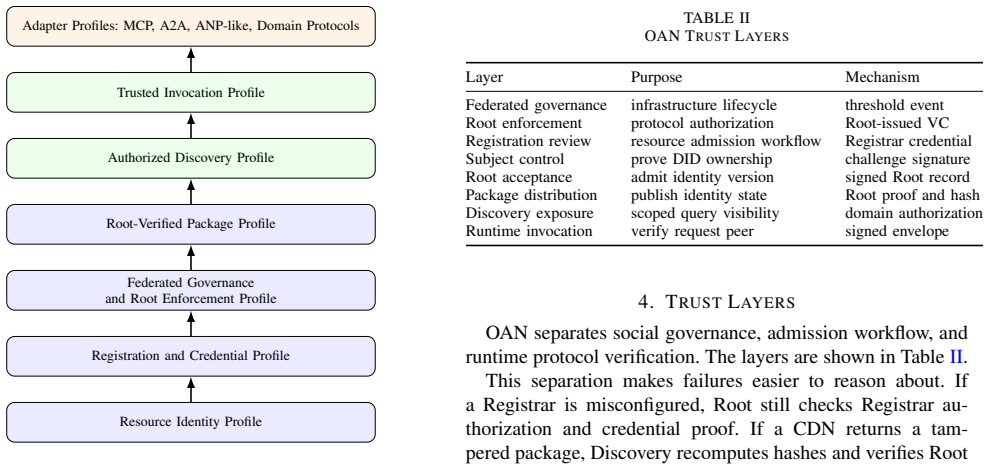
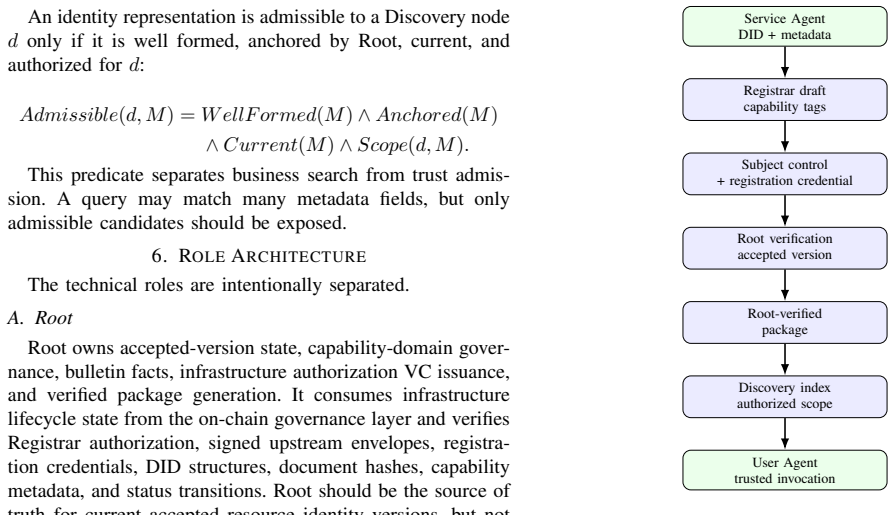
The paper claims that by specifying the role architecture, did:oan identity objects, registration workflow, governance-backed Root lifecycle enforcement, Root-verified package model, authorization-aware Discovery, Root-issued infrastructure authorization VCs, signed trusted invocation, verification requirements, state transitions, security properties, implementation boundaries, and deployment considerations, OAN supports heterogeneous Agent frameworks and interaction protocols while leaving the native protocols and full business conversations to those systems.
What carries the argument
did:oan identity objects together with governance-backed Root lifecycle enforcement that verify packages, issue authorization VCs, and control discovery and invocation.
If this is right
- Resource identities become admissible, discoverable, verifiable, and safe to approach before protocol-specific interaction starts.
- The same Root-verified package model and authorization VCs apply uniformly to Skills, MCP Servers, Tool/API resources, and domain-specific protocols.
- Signed trusted invocation and defined state transitions enforce security properties at the trust layer.
- Implementation boundaries and deployment considerations remain separate from the native protocols of each supported framework.
Where Pith is reading between the lines
- Successful deployment would still require an independent solution for securing the Root governance process itself.
- The did:oan objects could be tested for interoperability by registering the same resource under both an MCP-based and an A2A-based agent and confirming mutual discovery.
- If the Root-issued VCs are made portable, the layer could extend to additional decentralized identity methods without changing the core discovery flow.
Load-bearing premise
Governance-backed Root lifecycle enforcement and Root-issued authorization VCs will reliably create trust and safety without the need to first secure the governance mechanism or guarantee adoption across frameworks.
What would settle it
A working counter-example in which a resource carrying a valid did:oan identity and Root verification is nevertheless unsafe to invoke or fails to appear in discovery across two different agent frameworks.
Figures
read the original abstract
This yellow paper describes the technical architecture of OpenAgenet / OAN. OAN is a protocol-neutral trust layer for open Agent interconnection and discoverable AI resource products. It specifies the role architecture, \texttt{did:oan} identity objects, registration workflow, governance-backed Root lifecycle enforcement, Root-verified package model, authorization-aware Discovery, Root-issued infrastructure authorization VCs, signed trusted invocation, verification requirements, state transitions, security properties, implementation boundaries, and deployment considerations. The design is intended to support heterogeneous Agent frameworks and interaction protocols, including MCP, A2A, ANP-like systems, domain-specific Agent protocols, Skills, MCP Servers, and Tool/API resources. OAN does not define the entire business conversation among Agents or the native protocol of every resource; it defines how resource identities become admissible, discoverable, verifiable, and safe to approach before protocol-specific interaction begins.
Editorial analysis
A structured set of objections, weighed in public.
Referee Report
Summary. The paper presents the technical architecture of OpenAgenet / OAN as a protocol-neutral trust layer for open Agent interconnection and discoverable AI resource products. It details the role architecture, did:oan identity objects, registration workflow, governance-backed Root lifecycle enforcement, Root-verified package model, authorization-aware Discovery, Root-issued infrastructure authorization VCs, signed trusted invocation, verification requirements, state transitions, security properties, implementation boundaries, and deployment considerations to support heterogeneous frameworks including MCP, A2A, ANP-like systems, Skills, and Tool/API resources.
Significance. If the mechanisms can be shown to deliver the claimed trust and safety properties, the architecture could offer a useful standardized approach for admissible, discoverable, and verifiable resource identities across diverse Agent protocols without dictating native interaction details. The manuscript provides a comprehensive design specification covering multiple components, which is a strength for a yellow paper, but the absence of any empirical data, formal proofs, or implementation details means the significance remains prospective rather than demonstrated.
major comments (2)
- [governance-backed Root lifecycle enforcement] Abstract and governance-backed Root lifecycle enforcement section: the central claim that OAN supplies a trust layer via governance-backed Root lifecycle enforcement and Root-issued infrastructure authorization VCs presupposes that these mechanisms reliably produce admissible and safe resources, yet no concrete security model (consensus rules, threat model, key-management assumptions, or failure modes) is supplied for the governance layer itself; without this the trust and safety properties cannot be evaluated.
- [deployment considerations] Abstract and deployment considerations section: the architecture is presented as supporting heterogeneous frameworks (MCP, A2A, ANP-like, domain-specific), but no mechanism or incentive structure is described that would drive adoption across these frameworks, which is load-bearing for the protocol-neutral claim.
minor comments (1)
- The manuscript would benefit from explicit section numbering or headings to allow precise citation of components such as the registration workflow and signed trusted invocation.
Simulated Author's Rebuttal
We thank the referee for the constructive review and for recognizing the comprehensive scope of this yellow paper as a design specification. We address each major comment below and will make targeted revisions to strengthen the manuscript.
read point-by-point responses
-
Referee: [governance-backed Root lifecycle enforcement] Abstract and governance-backed Root lifecycle enforcement section: the central claim that OAN supplies a trust layer via governance-backed Root lifecycle enforcement and Root-issued infrastructure authorization VCs presupposes that these mechanisms reliably produce admissible and safe resources, yet no concrete security model (consensus rules, threat model, key-management assumptions, or failure modes) is supplied for the governance layer itself; without this the trust and safety properties cannot be evaluated.
Authors: We agree that the current description of the governance layer lacks the concrete security model details needed for rigorous evaluation of the trust and safety claims. While the manuscript specifies high-level security properties and verification requirements, it does not enumerate consensus rules, threat model, key-management assumptions, or failure modes for Root governance. We will add a dedicated subsection to the governance-backed Root lifecycle enforcement section that explicitly defines these elements, drawing on the existing state transition and verification requirements already present in the paper. This revision will directly address the gap without changing the yellow-paper focus on architecture. revision: yes
-
Referee: [deployment considerations] Abstract and deployment considerations section: the architecture is presented as supporting heterogeneous frameworks (MCP, A2A, ANP-like, domain-specific), but no mechanism or incentive structure is described that would drive adoption across these frameworks, which is load-bearing for the protocol-neutral claim.
Authors: The protocol-neutral claim in the manuscript is narrowly scoped to OAN not defining or dictating native interaction protocols and business conversations among agents; it does not assert that the architecture will automatically drive adoption. We acknowledge, however, that the deployment considerations section would benefit from additional discussion of how the design lowers integration barriers (e.g., via standardized discoverability, verifiable identities, and authorization VCs) across the listed frameworks. We will expand that section with a brief analysis of these facilitation mechanisms while clarifying that concrete incentive structures lie outside the technical specification and would be deployment-specific. This constitutes a partial revision focused on clarification rather than addition of new claims. revision: partial
Circularity Check
No circularity: purely descriptive architecture specification
full rationale
The document is an architecture yellow paper that defines roles, did:oan objects, workflows, governance-backed enforcement, package models, discovery, VCs, and invocation without any equations, derivations, fitted parameters, or self-referential reductions. No load-bearing claims reduce to inputs by construction, self-citation chains, or ansatzes. The reader's assessment of 0.0 is confirmed; this is the normal non-finding for a non-mathematical specification paper.
Axiom & Free-Parameter Ledger
Reference graph
Works this paper leans on
-
[1]
Decentralized identifiers (dids) v1.0,
W3C Credentials Community Group, “Decentralized identifiers (dids) v1.0,” https://www.w3.org/TR/did-core/, 2022
2022
-
[2]
Verifiable credentials data model v2.0,
W3C Verifiable Credentials Working Group, “Verifiable credentials data model v2.0,” https://www.w3.org/TR/vc-data-model-2.0/, 2025
2025
-
[3]
Verifiable credential data integrity 1.0,
——, “Verifiable credential data integrity 1.0,” https://www.w3.org/TR/ vc-data-integrity/, 2024
2024
-
[4]
Did resolution,
W3C Credentials Community Group, “Did resolution,” https://w3c-ccg. github.io/did-resolution/, 2024
2024
-
[5]
Model context protocol specifi- cation,
Model Context Protocol Contributors, “Model context protocol specifi- cation,” https://modelcontextprotocol.io/specification/, 2025
2025
-
[6]
Agent2agent protocol specification,
A2A Protocol Contributors, “Agent2agent protocol specification,” https: //a2a-protocol.org/latest/specification/, 2025
2025
-
[7]
Zero trust archi- tecture,
S. Rose, O. Borchert, S. Mitchell, and S. Connelly, “Zero trust archi- tecture,” NIST Special Publication 800-207, 2020
2020
-
[8]
The spiffe and spire project for workload identity,
Cloud Native Computing Foundation, “The spiffe and spire project for workload identity,” https://spiffe.io/, 2022
2022
-
[9]
Analyzing and comparing the security of self-sovereign identity management systems through threat modeling,
A. Gr ¨uner, A. M ¨uhle, and C. Meinel, “Analyzing and comparing the security of self-sovereign identity management systems through threat modeling,” inProceedings of the 38th ACM/SIGAPP Symposium on Applied Computing, 2023, pp. 389–396
2023
-
[10]
A systematic review of identity and access management requirements in enterprises and potential contributions of self-sovereign identity,
M. Gl ¨ockler, J. Sedlmeir, V . Schlatt, and N. Urbach, “A systematic review of identity and access management requirements in enterprises and potential contributions of self-sovereign identity,”Business & Infor- mation Systems Engineering, vol. 65, no. 4, pp. 421–440, 2023
2023
-
[11]
Chaindis- cipline: A blockchain-based self-sovereign identity framework for iot,
M. Popa, X. Yue, A. Boudguiga, A. Chibani, and H. B ´echa, “Chaindis- cipline: A blockchain-based self-sovereign identity framework for iot,” IEEE Transactions on Services Computing, vol. 16, no. 4, pp. 2571– 2584, 2023
2023
-
[12]
J. Xu, “Grail: A deep-granularity hybrid resonance framework for real-time agent discovery via slm-enhanced indexing,”arXiv preprint arXiv:2605.02489, 2026
work page internal anchor Pith review Pith/arXiv arXiv 2026
-
[13]
Did:wba method specification: Web-based agent decentralized identifier,
Agent Network Protocol Contributors, “Did:wba method specification: Web-based agent decentralized identifier,” https://agentnetworkprotocol. com/en/specs/03-did-wba-method-specification/, 2025
2025
-
[14]
Model Context Protocol Reg- istry,
Model Context Protocol Contributors, “Model Context Protocol Reg- istry,” https://github.com/modelcontextprotocol/registry, 2026, accessed: 2026-06-05
2026
-
[15]
Open Agentic Schema Framework,
AGNTCY Contributors, “Open Agentic Schema Framework,” https:// github.com/agntcy/oasf, 2026, accessed: 2026-06-05
2026
-
[16]
Agent Directory Service Overview,
——, “Agent Directory Service Overview,” https://docs.agntcy.org/dir/ overview/, 2026, accessed: 2026-06-05
2026
-
[17]
Agent name service (ans): A universal directory for secure ai agent discovery and interoperability,
K. Huang, V . S. Narajala, I. Habler, and A. Sheriff, “Agent name service (ans): A universal directory for secure ai agent discovery and interoperability,”arXiv preprint arXiv:2505.10609, 2025
-
[18]
DarwinNet: An Evolutionary Network Architecture for Agent-Driven Protocol Synthesis
J. Xu and B. Li, “Darwinnet: An evolutionary network architecture for agent-driven protocol synthesis,”arXiv preprint arXiv:2604.01236, 2026
work page internal anchor Pith review Pith/arXiv arXiv 2026
-
[19]
AutoGen: Enabling Next-Gen LLM Applications via Multi-Agent Conversation
Q. Wu, G. Bansal, J. Zhang, Y . Wu, B. Li, E. Zhu, L. Jiang, X. Zhang, S. Zhang, J. Liu, A. H. Awadallah, R. W. White, D. Burger, and C. Wang, “Autogen: Enabling next-gen llm applications via multi-agent conversation,”arXiv preprint arXiv:2308.08155, 2023
work page internal anchor Pith review Pith/arXiv arXiv 2023
-
[20]
A survey on large language model based autonomous agents,
L. Wang, C. Ma, X. Feng, Z. Zhang, H. Yang, J. Zhang, Z. Chen, J. Tang, X. Chen, Y . Lin, W. X. Zhao, Z. Wei, and J.-R. Wen, “A survey on large language model based autonomous agents,”Frontiers of Computer Science, vol. 18, no. 6, p. 186345, 2024
2024
-
[21]
Managing update conflicts in bayou, a weakly connected replicated storage system,
D. B. Terry, M. M. Theimer, K. Petersen, A. J. Demers, M. J. Spreitzer, and C. H. Hauser, “Managing update conflicts in bayou, a weakly connected replicated storage system,”Proceedings of SOSP, pp. 172– 183, 1995
1995
-
[22]
Internet x.509 public key infrastructure certificate and certificate revo- cation list (crl) profile,
D. Cooper, S. Santesson, S. Farrell, S. Boeyen, R. Housley, and T. Polk, “Internet x.509 public key infrastructure certificate and certificate revo- cation list (crl) profile,” RFC 5280, 2008
2008
-
[23]
X.509 internet public key infrastructure online certificate status protocol - ocsp,
M. Myers, R. Ankney, A. Malpani, S. Galperin, and C. Adams, “X.509 internet public key infrastructure online certificate status protocol - ocsp,” RFC 2560, 1999
1999
-
[24]
ToolEmu: Identifying the risks of lm agents with an lm-emulated sandbox,
Y . Ruan, H. Dong, A. Wang, S. Pitis, Y . Zhou, J. Ba, Y . Dubois, C. J. Maddison, and T. Hashimoto, “ToolEmu: Identifying the risks of lm agents with an lm-emulated sandbox,” inThe Twelfth International Conference on Learning Representations, 2024. [Online]. Available: https://openreview.net/forum?id=NB5FP1A2yC
2024
discussion (0)
Sign in with ORCID, Apple, or X to comment. Anyone can read and Pith papers without signing in.