REVIEW 3 major objections 5 minor 44 references
SM2ITH: Safe Mobile Manipulation with Interactive Human Prediction via Task-Hierarchical Bilevel Model Predictive Control
T0 review · 3 major / 5 minor · reviewed 2026-08-03 · deepseek-v4-flash
Pith's one-line read A mobile manipulator can keep strict task priorities while treating nearby humans as reactive planners, and the coupled optimization beats weighted-sum and open-loop baselines in tests.
desk verdict A clean, useful integration of HTMPC and SICNav for mobile manipulators, with real hardware experiments and sound math; the empirical safety claim is softer than advertised because the CBF guarantee runs on predicted, not real, human states. read the letter →
The pith
A machine-rendered reading of the paper's core claim, the machinery that carries it, and where it could break.
The reading
What carries the argument
The load-bearing object is the bilevel optimization: an upper level that solves the robot's task hierarchy one task at a time, with constraints guaranteeing higher-priority tracking errors do not increase, and a lower level in which each human's velocity is the solution of an ORCA (optimal reciprocal collision avoidance) problem—each agent picks a velocity by minimizing deviation from a desired velocity subject to collision-avoidance half-planes. The lower-level problems are replaced by their KKT conditions (stationarity, complementarity, and dual feasibility), which turns the bilevel problem into a single-level nonlinear program. Discrete-time control barrier functions, one per human and ob
What would settle it
Record a participant's actual velocity choices while the robot approaches and test whether they solve the embedded ORCA optimization (e.g., by checking KKT residual or comparing to the predicted action). A run where a participant deliberately walks straight into the robot without yielding, while the controller still claims a collision-free guarantee, would break the central assumption; equally, showing that a constant-velocity predictor matches real human behavior as well as the interactive model would undercut the claimed benefit.
Extended reading notes
Core claim
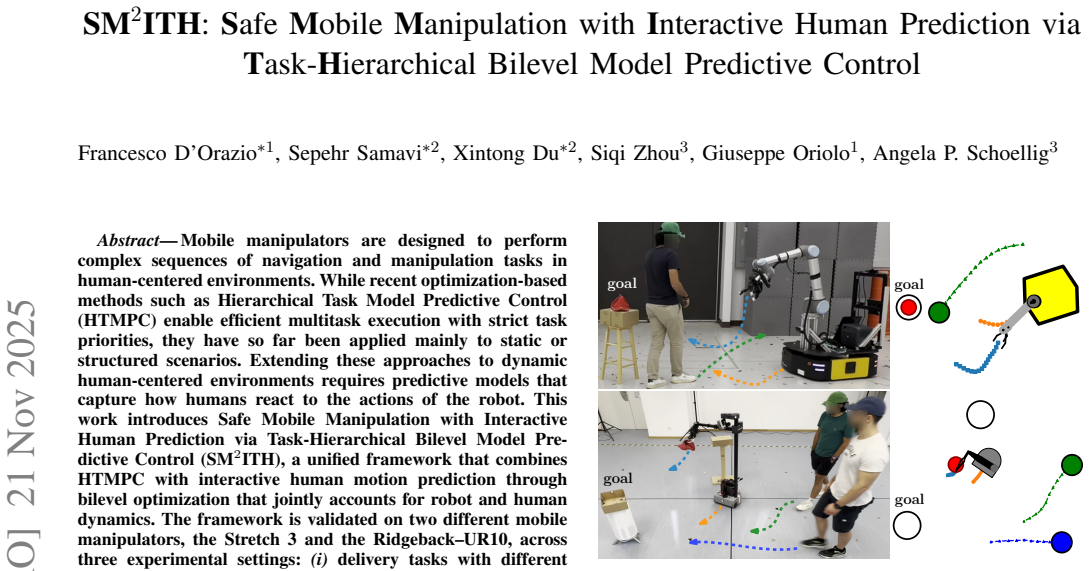
SM^2ITH's central claim is that a single bilevel MPC can simultaneously enforce strict task priorities and closed-loop human motion prediction. The robot optimizes a lexicographic sequence of task costs (navigation and end-effector) while, at the same time, co-solving the velocity-optimization problems that nearby humans are assumed to be solving—humans are modeled as optimal reciprocal collision avoidance agents—by replacing those lower-level problems with their KKT conditions. Discrete-time control barrier functions on robot-human and robot-obstacle distances provide the safety layer. In delivery, pick-and-place, and adversarial experiments on two mobile manipulators, this combined formula
Load-bearing premise
Humans walking in the experiments are assumed to actually solve the same ORCA optimization the robot embeds, so their real velocity choices satisfy the KKT conditions; if a person walks non-reciprocally or ignores the robot, the coupled prediction is misspecified and the CBF's collision-free guarantee only holds for the predicted states, not the real ones.
Editorial extensions
If this is right
- Strict lexicographic priorities let the same controller produce two qualitatively different avoidance behaviors—move the base to protect a banner, retract the arm to protect a cup—without re-tuning weights.
- Closed-loop human prediction yields shorter detours and lower runtime than constant-velocity prediction, and less time inside a human's intimate space than reactive-only control.
- In adversarial situations, interactive prediction lets the robot continue toward its target instead of retreating indefinitely, because it anticipates the human will adapt.
- Higher human densities (three humans) reveal the largest gap over weighted-sum MPC on the high-priority task, suggesting the hierarchy matters most when conflicts are frequent.
- The same formulation transfers to platforms with different kinematics (nonholonomic 7-DOF and holonomic 9-DOF), indicating the approach is platform-agnostic.
Reading between the lines
- The safety guarantee is model-in-the-loop: the control barrier function is checked against predicted human positions, so the advertised collision-free behavior is only as strong as the ORCA assumption; an explicit bound or estimator for non-reciprocal human behavior would be needed for a formal guarantee against real pedestrians.
- The KKT reformulation is what makes the bilevel problem tractable; replacing ORCA with a richer but non-convex human model (social forces, learned predictors) would break this direct embedding and require a different solution scheme.
- The task hierarchy itself can act as a communication channel: by choosing whether the arm or the base yields, the robot reveals its intent to humans, which the ORCA model can exploit implicitly through the predicted human velocities.
- The cautiousness parameter gamma could be made adaptive—increasing when the human's measured velocity deviates from ORCA-optimality—as a testable extension that might reduce freezing in dense crowds.
Signed reviews
Editorial analysis
A structured set of objections, weighed in public.
Referee Report
Summary. The paper introduces SM2ITH, a bilevel model predictive control framework for mobile manipulators that couples hierarchical task execution (HTMPC) with interactive human motion prediction based on the ORCA model. The robot's lexicographic task optimization is augmented by KKT conditions of the human's ORCA problem, and discrete-time control barrier functions are added to enforce safety with respect to predicted human and obstacle states. The framework is evaluated on two mobile manipulators (Stretch 3 and Ridgeback-UR10) in task-prioritization, pick-and-place, and adversarial human-interaction experiments, totaling 140 runs, with comparisons against weighted-sum MPC, constant-velocity prediction, and reactive-only baselines.
Significance. If the ORCA assumption on human behavior holds, SM2ITH is a plausible and timely integration of hierarchical task MPC and interactive human prediction, extending prior work from mobile navigation to mobile manipulation. The mathematical formulation is clean and built on standard components: the lower-level ORCA problem is convex, so KKT replacement is justified, and the DT-CBF constraint is textbook. The experimental comparison against constant-velocity and reactive baselines is thoughtful, and the two-platform validation adds credibility. However, the paper's central safety claim is not yet substantiated for real human behavior, and the comparative empirical claims rest on small samples without statistical testing. The contribution is incremental relative to the authors' prior works [3] and [11], but the integration itself is non-trivial and of interest to the mobile-manipulation community.
major comments (3)
- [IV-C, Eq. (5f)-(5k); V-C] The DT-CBF constraint (5f) is evaluated on x_{k+1}, which includes human states propagated by the ORCA lower-level model (5g)-(5k). The forward-invariance guarantee therefore applies to the model's predicted human states, not to a real human who does not solve ORCA. The abstract's 'safe and collision-free' claim and the adversarial experiment in V-C depend on this assumption: in Fig. 7b, SM2ITH plans to continue toward the target because it predicts the human will yield. The paper does not document how participants were instructed to behave, and no experiment is reported in which the human ignores the robot or blocks non-reciprocally. As written, safety is a model-in-the-loop claim. Please add stress tests with non-ORCA humans (e.g., a scripted straight-line walker, or an active blocker) and/or rephrase all safety claims as conditional on the ORCA assumption, and state participant instru
- [V-A/V-B, Figs. 3 and 6] The empirical claims 'SM2ITH performs significantly better' (V-A) and 'balances safety and efficiency' (V-B) are based on n=5 per condition in V-A and n=5-10 per platform/condition in V-B, with heavily overlapping box plots. No significance tests, effect sizes, or confidence intervals are reported. Add appropriate paired statistics (e.g., Wilcoxon signed-rank or permutation tests with multiple-comparison correction) and report the underlying per-run data; otherwise the comparative conclusions are not supported.
- [V-A, weighted-sum baseline] The weighted-sum baseline uses weights W_ee and W_base described only as 'chosen to approximate hierarchical preferences.' The actual values and any tuning procedure are not given, and no sensitivity analysis is provided. Since a headline result is that strict lexicographic prioritization outperforms weighted-sum MPC, the comparison is interpretable only if the baseline weights are systematically optimized or at least varied over a range. Please report the weights used and show how the conclusions depend on them.
minor comments (5)
- [V-A] There are broken figure references in the text ('Fig.??' appears three times in Section V-A). Please fix the cross-references.
- [Eq. (4c)] The notation dot q_t in the acceleration constraint is not defined. Clarify whether it is the human's current velocity, the robot's velocity, or a relative quantity.
- [IV-C] The function h is described as a concatenation of constraints but is used in (5f) as if it were scalar. Clarify that (5f) is enforced elementwise, and state the relative degree of h required for the DT-CBF guarantee to apply to this system.
- [V] No real-time computation times or solver iteration counts are reported. For an MPC framework advertised for real-time control, please report per-step solve times for both platforms.
- [Abstract / V-C] The abstract mentions 'adversarial human behavior,' but Section V-C is explicitly qualitative and does not report quantitative metrics. Consider softening the abstract or adding quantitative adversarial metrics.
Circularity Check
No significant circularity: the ORCA human model is a stated assumption, not a fitted input; self-citations are to prior peer-reviewed formulations being combined.
full rationale
The derivation chain in Eq. (5) is a lexicographic MPC (HTMPC, [3]) augmented with the KKT conditions of the ORCA optimization (Eq. (4)) and DT-CBF constraints. The human motion 'prediction' is not obtained by fitting a parameter to the reported experimental outcomes; it is an explicit modeling assumption: 'SM2ITH models humans to be solving the Optimal Reciprocal Collision Avoidance (ORCA) [12] optimization problem, and embeds this model as constraints within the HTMPC optimization problem.' Because the DT-CBF safe set is built around 'their respective predicted state x^(j)_k', the forward-invariance guarantee is model-relative: it holds for trajectories generated by the co-solved ORCA model. If a real human does not solve ORCA, the predicted states differ from the true states and the same inequality does not directly constrain the true human position. That is a serious robustness/assumption-mismatch concern, not a circularity: no equation in the paper reduces the claimed prediction or safety result to a fitted value or defines the output in terms of the input. The self-citations to HTMPC [3] and SICNav [11] are to prior peer-reviewed formulations being combined; they are load-bearing but not unverified self-referential uniqueness claims, and the human model itself is attributed to the independent ORCA work [12]. The experimental comparisons (weighted-sum baseline, CVMM, reactive) are external benchmarks, so the central empirical claims do not reduce by construction. The underexplained human instructions in the experiments are an experimental reporting/validity gap, not a derivation step. Hence no significant circularity.
Assumptions & free parameters
free parameters (3)
- gamma (CBF safe-set approach rate) =
not reported (stated to lie in [0,1))
- Weighted-sum baseline weights W_ee, W_base =
not reported
- ORCA slack penalty matrix M =
not reported (inherited from [11])
assumptions (4)
- domain assumption Humans solve the ORCA optimization, so their velocity choices satisfy the KKT conditions (5h)-(5k).
- standard math KKT conditions are necessary and sufficient for the ORCA lower-level problem.
- domain assumption DT-CBF forward invariance (5f) holds with the predicted human states.
- domain assumption Human states are accurately estimated by Kalman-filtered external motion capture.
Cite this review
Pith. "Pith review of SM2ITH: Safe Mobile Manipulation with Interactive Human Prediction via Task-Hierarchical Bilevel Model Predictive Control." pith.science (2026). https://pith.science/paper/LBXCGYG3
@misc{pith2026251117798,
  author       = {Pith},
  title        = {Pith review of: SM2ITH: Safe Mobile Manipulation with Interactive Human Prediction via Task-Hierarchical Bilevel Model Predictive Control},
  year         = {2026},
  howpublished = {\url{https://pith.science/paper/LBXCGYG3}},
  note         = {Machine review of arXiv:2511.17798}
}
abstract
Mobile manipulators are designed to perform complex sequences of navigation and manipulation tasks in human-centered environments. While recent optimization-based methods such as Hierarchical Task Model Predictive Control (HTMPC) enable efficient multitask execution with strict task priorities, they have so far been applied mainly to static or structured scenarios. Extending these approaches to dynamic human-centered environments requires predictive models that capture how humans react to the actions of the robot. This work introduces Safe Mobile Manipulation with Interactive Human Prediction via Task-Hierarchical Bilevel Model Predictive Control (SM$^2$ITH), a unified framework that combines HTMPC with interactive human motion prediction through bilevel optimization that jointly accounts for robot and human dynamics. The framework is validated on two different mobile manipulators, the Stretch 3 and the Ridgeback-UR10, across three experimental settings: (i) delivery tasks with different navigation and manipulation priorities, (ii) sequential pick-and-place tasks with different human motion prediction models, and (iii) interactions involving adversarial human behavior. Our results highlight how interactive prediction enables safe and efficient coordination, outperforming baselines that rely on weighted objectives or open-loop human models.
Figures


Figures from the paper (3 more)


Reference graph
Works this paper leans on
-
[3]
Hierarchical task model predictive control for sequential mobile manipulation tasks,
X. Du, S. Zhou, and A. P. Schoellig, “Hierarchical task model predictive control for sequential mobile manipulation tasks,”Robotics and Automation Letters (RA-L), vol. 9, no. 2, pp. 1270–1277, 2023
2023
-
[11]
SICNav: Safe and interactive crowd navigation using model predictive control and bilevel optimization,
S. Samavi, J. R. Han, F. Shkurti, and A. P. Schoellig, “SICNav: Safe and interactive crowd navigation using model predictive control and bilevel optimization,”IEEE Trans. on Robotics, 2024
2024
-
[1]
Deployment of an autonomous mobile manipulator at MBZIRC,
J. Carius, M. Wermelinger, B. Rajasekaran, K. Holtmann, and M. Hut- ter, “Deployment of an autonomous mobile manipulator at MBZIRC,” J. of Field Robotics, vol. 35, no. 8, pp. 1342–1357, 2018
2018
-
[2]
A weighted method for fast resolution of strictly hierarchical robot task specifica- tions using exact penalty functions,
A. S. Sathya, G. Pipeleers, W. Decr ´e, and J. Swevers, “A weighted method for fast resolution of strictly hierarchical robot task specifica- tions using exact penalty functions,”Robotics and Automation Letters (RA-L), vol. 6, no. 2, pp. 3057–3064, 2021
2021
-
[4]
Ehrgott,Multicriteria optimization
M. Ehrgott,Multicriteria optimization. Springer, 2005
2005
-
[5]
Reactive base control for on-the-move mobile manipulation in dynamic envi- ronments,
B. Burgess-Limerick, J. Haviland, C. Lehnert, and P. Corke, “Reactive base control for on-the-move mobile manipulation in dynamic envi- ronments,”Robotics and Automation Letters (RA-L), vol. 9, no. 3, pp. 2048–2055, 2024
-
[6]
Globally-guided geometric fabrics for reactive mobile manip- ulation in dynamic environments,
T. Merva, S. Bakker, M. Spahn, D. Zhao, I. Virgala, and J. Alonso- Mora, “Globally-guided geometric fabrics for reactive mobile manip- ulation in dynamic environments,”Robotics and Automation Letters (RA-L), 2025
2025
-
[7]
Stochastic trajectory prediction via motion indeterminacy diffusion,
T. Gu, G. Chen, J. Li, C. Lin, Y . Rao, J. Zhou, and J. Lu, “Stochastic trajectory prediction via motion indeterminacy diffusion,” inIEEE/CVF Conference on Computer Vision and Pattern Recogni- tion, 2022, pp. 17 092–17 101
2022
Show all 44 references
-
[8]
From Crowd Motion Prediction to Robot Navigation in Crowds,
S. Poddar, C. Mavrogiannis, and S. S. Srinivasa, “From Crowd Motion Prediction to Robot Navigation in Crowds,” inIEEE/RSJ International Conference on Intelligent Robots and System, 2023
2023
-
[9]
Unfreezing the robot: Navigation in dense, interacting crowds,
P. Trautman and A. Krause, “Unfreezing the robot: Navigation in dense, interacting crowds,” inIEEE/RSJ Int. Conf. on Intelligent Robots and Systems (IROS), 2010, pp. 797–803
2010
-
[10]
Leveraging neural network gradients within trajectory optimization for proactive human- robot interactions,
S. Schaefer, K. Leung, B. Ivanovic, and M. Pavone, “Leveraging neural network gradients within trajectory optimization for proactive human- robot interactions,” inIEEE Int. Conf. on Robotics and Automation (ICRA), 2021, pp. 9673–9679
2021
-
[12]
Reciprocal n-body collision avoidance,
J. Van Den Berg, S. J. Guy, M. Lin, and D. Manocha, “Reciprocal n-body collision avoidance,” inRobotics Research: The 14th Interna- tional Symposium ISRR. Springer, 2011, pp. 3–19
2011
-
[13]
Control barrier functions: Theory and applications,
A. D. Ames, S. Coogan, M. Egerstedt, G. Notomista, K. Sreenath, and P. Tabuada, “Control barrier functions: Theory and applications,” in18th European Control Conf. (ECC). IEEE, 2019, pp. 3420–3431
2019
-
[14]
An architecture for reactive mobile manipulation on-the-move,
B. Burgess-Limerick, , C. Lehnert, J. Leitner, and P. Corke, “An architecture for reactive mobile manipulation on-the-move,”IEEE Int. Conf. on Robotics and Automation (ICRA), pp. 1623–1629, 2023
2023
-
[15]
Go fetch! - dynamic grasps using boston dynamics spot with external robotic arm,
S. Zimmermann, R. Poranne, and S. Coros, “Go fetch! - dynamic grasps using boston dynamics spot with external robotic arm,” inIEEE Int. Conf. on Robotics and Automation (ICRA), 2021, pp. 4488–4494
2021
-
[16]
Manipulator motion planning for part pickup and transport operations from a moving base,
S. Thakar, P. Rajendran, A. M. Kabir, and S. K. Gupta, “Manipulator motion planning for part pickup and transport operations from a moving base,”Trans. on Automation Science and Engineering, vol. 19, no. 1, pp. 191–206, 2020
2020
-
[17]
Analysis and control of articulated robot arms with redundancy,
H. Hanafusa, T. Yoshikawa, and Y . Nakamura, “Analysis and control of articulated robot arms with redundancy,”Int. Federation of Automatic Control (IFAC), vol. 14, no. 2, pp. 1927–1932, 1981
1927
-
[18]
Hierarchical quadratic programming: fast online humanoid-robot motion generation,
A. Escande, N. Mansard, and P.-B. Wieber, “Hierarchical quadratic programming: fast online humanoid-robot motion generation,”The Int. J. of Robotics Research, vol. 33, no. 7, pp. 1006–1028, 2014
2014
-
[19]
A hierarchical MPC for end-effector tracking control of legged mobile manipulators,
D. Wang, J. Yu, S. Wu, Z. Li, C. Li, R. Xiong, S. Qu, and Y . Wang, “A hierarchical MPC for end-effector tracking control of legged mobile manipulators,”Trans. on Automation Science and Engineering, vol. 22, pp. 4855–4866, 2024
2024
-
[20]
An HQP-based obstacle avoidance control scheme for redundant mobile manipulators under multiple constraints,
J. Nie, Y . Wang, Y . Mo, Z. Miao, Y . Jiang, H. Zhong, and J. Lin, “An HQP-based obstacle avoidance control scheme for redundant mobile manipulators under multiple constraints,”Trans. on Industrial Electronics, vol. 70, no. 6, pp. 6004–6016, 2022
2022
-
[21]
Hierarchical incremental MPC for redundant robots: A robust and singularity-free approach,
Y . Wang, Y . Liu, M. Leibold, M. Buss, and J. Lee, “Hierarchical incremental MPC for redundant robots: A robust and singularity-free approach,”Trans. on Robotics, vol. 40, pp. 2128–2148, 2024
2024
-
[22]
Keep it upright: Model predictive control for nonprehensile object transportation with obstacle avoidance on a mobile manipulator,
A. Heins and A. P. Schoellig, “Keep it upright: Model predictive control for nonprehensile object transportation with obstacle avoidance on a mobile manipulator,”Robotics and Automation Letters (RA-L), vol. 8, no. 12, pp. 7986–7993, 2023
2023
-
[23]
Dynamics-aware navi- gation among moving obstacles with application to ground and flying robots,
S. G. Tarantos, T. Belvedere, and G. Oriolo, “Dynamics-aware navi- gation among moving obstacles with application to ground and flying robots,”Robotics and Autonomous Systems, vol. 172, p. 104582, 2024
2024
-
[24]
A collision-free MPC for whole-body dynamic locomotion and manipu- lation,
J.-R. Chiu, J.-P. Sleiman, M. Mittal, F. Farshidian, and M. Hutter, “A collision-free MPC for whole-body dynamic locomotion and manipu- lation,” inIEEE Int. Conf. on Robotics and Automation (ICRA), 2022, pp. 4686–4693
2022
-
[25]
Collision- free MPC for legged robots in static and dynamic scenes,
M. Gaertner, M. Bjelonic, F. Farshidian, and M. Hutter, “Collision- free MPC for legged robots in static and dynamic scenes,” inIEEE Int. Conf. on Robotics and Automation (ICRA), 2021, pp. 8266–8272
2021
-
[26]
Perceptive model predictive control for continuous mobile manipulation,
J. Pankert and M. Hutter, “Perceptive model predictive control for continuous mobile manipulation,”Robotics and Automation Letters (RA-L), vol. 5, no. 4, pp. 6177–6184, 2020
2020
-
[27]
Geometry-aware predictive safety filters on humanoids: From Poisson safety functions to CBF constrained MPC,
R. M. Bena, G. Bahati, B. Werner, R. K. Cosner, L. Yang, and A. D. Ames, “Geometry-aware predictive safety filters on humanoids: From Poisson safety functions to CBF constrained MPC,”arXiv:2508.11129, 2025
2025 arXiv
-
[28]
Dynamic control barrier function based trajectory planning for mobile manipulator,
L. Xu, X. Xiong, and Y . Bai, “Dynamic control barrier function based trajectory planning for mobile manipulator,” inChinese Control Conference (CCC). IEEE, 2024, pp. 3815–3820
2024
-
[29]
Dynamic control barrier function-based model predictive control to safety-critical obstacle-avoidance of mobile robot,
Z. Jian, Z. Yan, X. Lei, Z. Lu, B. Lan, X. Wang, and B. Liang, “Dynamic control barrier function-based model predictive control to safety-critical obstacle-avoidance of mobile robot,”Int. Conf. on Robotics and Automation (ICRA), 2023
2023
-
[30]
Scenario-based motion planning with bounded probability of colli- sion,
O. de Groot, L. Ferranti, D. M. Gavrila, and J. Alonso-Mora, “Scenario-based motion planning with bounded probability of colli- sion,”The Int. J. of Robotics Research, 2023
2023
-
[31]
OA-MPC: Occlusion-aware MPC for guaranteed safe robot navigation with unseen dynamic obstacles,
R. Firoozi, A. Mir, G. S. Camps, and M. Schwager, “OA-MPC: Occlusion-aware MPC for guaranteed safe robot navigation with unseen dynamic obstacles,”Trans. on Control Systems Technology, vol. 33, no. 3, pp. 940–951, 2025
2025
-
[32]
Safe robot navigation in a crowd combining NMPC and control barrier functions,
V . Vulcano, S. G. Tarantos, P. Ferrari, and G. Oriolo, “Safe robot navigation in a crowd combining NMPC and control barrier functions,” inConf. on Decision and Control (CDC), 2022, pp. 3321–3328
2022
-
[33]
Time-to-collision based social force model for intelligent agents on shared public spaces,
A. Jafari and Y .-C. Liu, “Time-to-collision based social force model for intelligent agents on shared public spaces,”Int. J. of Social Robotics, vol. 16, no. 9, pp. 1953–1968, 2024
1953
-
[34]
Reciprocal velocity obstacles for real-time multi-agent navigation,
J. Van den Berg, M. Lin, and D. Manocha, “Reciprocal velocity obstacles for real-time multi-agent navigation,” inIEEE Int. Conf. on Robotics and Automation (ICRA), 2008, pp. 1928–1935
2008
-
[35]
Siciliano, L
B. Siciliano, L. Sciavicco, L. Villani, and G. Oriolo,Robotics: Mod- elling, Planning and Control. Springer, 2008
2008
-
[36]
SICNav-diffusion: Safe and interactive crowd navigation with diffusion trajectory predictions,
S. Samavi, A. Lem, F. Sato, S. Chen, Q. Gu, K. Yano, A. P. Schoellig, and F. Shkurti, “SICNav-diffusion: Safe and interactive crowd navigation with diffusion trajectory predictions,”Robotics and Automation Letters (RA-L), 2025
2025
-
[37]
Discrete control barrier functions for safety-critical control of discrete systems with application to bipedal robot navigation,
A. Agrawal and K. Sreenath, “Discrete control barrier functions for safety-critical control of discrete systems with application to bipedal robot navigation,” inRobotics: Science and Systems, vol. 13, 2017, pp. 1–10
2017
-
[38]
Safety-critical model predictive control with discrete-time control barrier function,
J. Zeng, B. Zhang, and K. Sreenath, “Safety-critical model predictive control with discrete-time control barrier function,” inAmerican Control Conf.IEEE, 2021, pp. 3882–3889
2021
-
[39]
Maintaining balance of mobile manipulators for safe pick-up tasks,
F. D’Orazio, T. Belvedere, S. G. Tarantos, and G. Oriolo, “Maintaining balance of mobile manipulators for safe pick-up tasks,” inInt. Conf. on Control, Automation, Robotics and Vision (ICARCV), 2024, pp. 1207–1212
2024
-
[40]
acados – a modular open-source framework for fast embedded optimal control,
R. Verschueren, G. Frison, D. Kouzoupis, J. Frey, N. v. Duijkeren, A. Zanelli, B. Novoselnik, T. Albin, R. Quirynen, and M. Diehl, “acados – a modular open-source framework for fast embedded optimal control,”Mathematical Programming Computation, vol. 14, no. 1, pp. 147–183, 2022
2022
-
[41]
The hidden dimension anchor books editions,
E. T. Hall, “The hidden dimension anchor books editions,”New York, 1990
1990
-
[42]
BodyS- LAM++: Fast and tightly-coupled visual-inertial camera and human motion tracking,
D. F. Henning, C. Choi, S. Schaefer, and S. Leutenegger, “BodyS- LAM++: Fast and tightly-coupled visual-inertial camera and human motion tracking,” inIEEE/RSJ International Conference on Intelligent Robots and Systems (IROS), 2023, pp. 3781–3788
2023
-
[43]
The walking behaviour of pedestrian social groups and its impact on crowd dynamics,
M. Moussa ¨ıd, N. Perozo, S. Garnier, D. Helbing, and G. Theraulaz, “The walking behaviour of pedestrian social groups and its impact on crowd dynamics,”PloS one, vol. 5, no. 4, p. e10047, 2010
2010
-
[44]
Self-supervised prediction of the intention to interact with a service robot,
G. Abbate, A. Giusti, V . Schmuck, O. Celiktutan, and A. Paolillo, “Self-supervised prediction of the intention to interact with a service robot,”Robotics and Autonomous Systems (RAS), vol. 171, p. 104568, 2024
2024
Reviewed August 3, 2026 · model on record in the stance chip above.
Discussion (0). Continue with ORCID to comment.