REVIEW 4 major objections 6 minor 32 references
Convolutional Recurrent Reconstructive Network for Spatiotemporal Anomaly Detection in Solder Paste Inspection
T0 review · 4 major / 6 minor · reviewed 2026-08-14 · deepseek-v4-flash
Pith's one-line read A convolutional recurrent network trained only on normal solder paste inspection data decomposes defect-induced anomalies as reconstruction error, and the anomaly maps support printer defect classification.
desk verdict A plausible, incremental application of recurrent reconstruction to solder paste inspection, but the reported numbers don't support the 'outperforms' claim. read the letter →
The pith
A machine-rendered reading of the paper's core claim, the machinery that carries it, and where it could break.
The reading
What carries the argument
The central object is the CSTM cell, an LSTM-style cell whose cell-state update combines the temporal cell state $C^l_{t-1}$ with the spatial cell state $C^{l-1}_t$ from the layer below through a channel-wise concatenation followed by a $1\times1$ convolution, so spatial information crosses layers without doubling parameter count. Around it, the ST-Attention mechanism computes a per-timestep map $A_t = \tanh(W_A * E_t)$ from the encoder hidden state, adds it into the encoder and subtracts it in the decoder, acting as a shortcut path that relieves long-term dependency. The anomaly map is the reconstruction error between input and output, and it is what carries detection and classification.
What would settle it
Hand-label every anomalous pad for the five real defect types and measure per-pad reconstruction error from a normal-only CRRN: if for any defect type the anomalous pads' errors are not systematically larger than normal pads' errors at moderate severity, for instance if the per-pad area under the ROC curve stays below 0.8, then the reconstruction residual is not a reliable anomaly map and the central claim fails.
Extended reading notes
Core claim
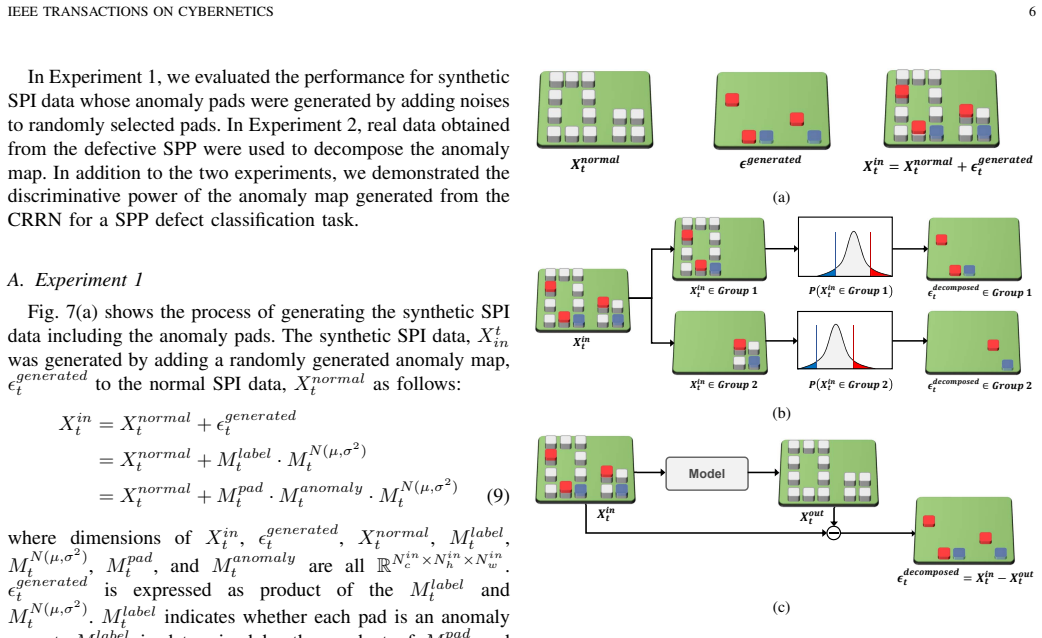
CRRN is a convolutional recurrent autoencoder made of a spatial encoder/decoder pair and a spatiotemporal encoder-decoder built from convolutional spatiotemporal memory (CSTM) cells linked by a spatiotemporal attention (ST-Attention) mechanism. Trained only on normal data, the network is expected to reconstruct normal patterns and fail on defect-induced patterns, so the per-pad reconstruction error between the input and the reconstructed output is the decomposed anomaly map. The paper reports that this anomaly map detects excessive and insufficient solder paste pads with F1 scores that rise as the anomaly ratio increases, while the statistical method's scores fall, and that the same maps, split into excessive and insufficient channels, classify five real printer defects with 93.8% mAP and 74.8% exact-match ratio using a fine-tuned convolutional classifier.
Load-bearing premise
The whole method rests on the premise that a network trained only on normal solder-paste images will reconstruct normal-looking patterns well but will fail to reproduce defect-induced deviations, so that the residual between input and reconstruction really is the anomaly map.
Editorial extensions
If this is right
- Anomaly detection in solder paste inspection becomes robust at high anomaly ratios, where the conventional Gaussian-threshold method fails because the defective pads shift the group mean.
- A single normal-only reconstruction model can feed a downstream defect-classification stage, since the decomposed anomaly map is discriminative across five printer fault types.
- Long inspection sequences can be reconstructed without storing all local context in a fixed hidden state, thanks to the ST-Attention shortcut, supporting detection that improves as defect severity grows over production time.
- The method outputs per-pad anomaly localization, not just a board-level score, giving an operator a direct map of where and how much the printer drifted from normal behavior.
Reading between the lines
- An extension the paper leaves untested is non-sigmoid defect onset: the experiments model anomaly severity as a sigmoid of production time, so sudden or intermittent printer faults remain an open test of the temporal memory.
- The classification stage borrows the binarization threshold from the detection experiment; a learned or per-defect threshold would likely improve exact-match accuracy beyond the reported 74.8%, but that comparison is not in the paper.
- Because CSTM couples spatial and temporal cell states in a data-agnostic way, the same normal-only reconstruction logic should transfer to other spatiotemporal inspection streams, such as chip mounting or reflow output, though the paper does not claim this.
Signed reviews
Editorial analysis
A structured set of objections, weighed in public.
Referee Report
Summary. The paper proposes a Convolutional Recurrent Reconstructive Network (CRRN) for detecting solder paste printing anomalies in spatiotemporal SPI data. CRRN is a convolutional recurrent autoencoder composed of a spatial encoder/decoder and a spatiotemporal encoder/decoder built from convolutional spatiotemporal memory (CSTM) cells with a spatiotemporal attention (ST-Attention) mechanism. Trained only on normal SPI data, the model reconstructs the input and the residual is used as the anomaly map. The paper claims that CRRN outperforms conventional models in anomaly detection and that the decomposed anomaly maps are discriminative for printer defect classification. Three experiments are reported: synthetic anomaly detection with additive Gaussian perturbations at various anomaly ratios, evaluation on real data from five printer defects with recall curves, and a defect classification task using the anomaly maps as inputs to fine-tuned CNN classifiers.
Significance. If fully validated, the work would offer a practical one-class anomaly localization method for solder paste inspection and an interesting use of reconstruction residuals as features for diagnosing printer faults. The paper is clearly written and the architectural components (CSTM, ST-Attention) are specified in sufficient detail. The use of a real industrial SPI dataset with five actual printer defects is a notable strength, as is the attempt to connect reconstruction-based anomaly maps to a downstream classification task. However, the experimental evidence for the central claim of outperforming conventional models is currently weak: the reported differences over the main deep baseline are tiny and unquantified, the real-data evaluation lacks deep baselines, and the classification experiment has no baseline comparison. With more rigorous comparative experiments and uncertainty quantification, the contribution would be of interest to the anomaly detection and manufacturing communities.
major comments (4)
- [Section V-A, Table I] The abstract claim that CRRN 'outperforms the other conventional models' is not supported by Table I. Across both excessive and insufficient anomaly panels, CRRN differs from CRAE by at most 0.01 in F1 score at every anomaly ratio, and several entries are identical (e.g., excess Pa=10%, 20%, 30%, and 50% are 0.77, 0.80, 0.83, and 0.86 for both models). No error bars, confidence intervals, or significance tests are reported, so the observed differences are within likely run-to-run variability. Please provide repeated-run statistics and a statistical test of the difference, or soften the superiority claim.
- [Section V-B, Fig. 12] On the real-defect data, CRRN is compared only with the statistical method; the deep baselines used in Experiment 1 (CRAE, CRRN\a, CRAE\a) are absent. Consequently, the recall improvements seen in Fig. 12 cannot be attributed to the proposed CSTM or ST-Attention mechanisms, as any reconstruction-based model might produce similar results. Please evaluate the deep baselines on the same real data and report quantitative summaries (e.g., AUPRC per defect) rather than only qualitative recall curves.
- [Section IV-B-2 and Section V-A, Eq. (9)] The synthetic anomalies in Experiment 1 are generated by adding Gaussian noise with mean ±5 to randomly selected pads, while CRRN is trained with a denoising autoencoder objective that explicitly teaches the model to suppress additive input perturbations. This creates a confound: the test anomaly distribution closely matches the training perturbation, potentially inflating CRRN's advantage over the statistical method and any baselines not trained with denoising. Please test on structured anomalies or real defect patterns, or ablate the denoising objective for all compared models.
- [Section V-B, Eq. (10)-(11), and Section V-C] The ground-truth labeling and the hand-set anomaly score introduce a confound in the real-data experiments. For the real data, Eq. (10) requires Mlabel_t, but the manuscript does not state how the spatial anomaly area is obtained; the anomaly score f(t) is hand-approximated by sigmoid functions in Eq. (11). The recall curves may therefore reflect the assumed form of f(t) rather than an independently measured ground truth. Additionally, Experiment 3 reports mAP/EMR for ResNet-18 and Inception-v4 on the decomposed anomaly maps without comparing against classifiers trained directly on raw SPI data or on anomaly maps from CRAE, so the claim that CRRN's anomaly maps are discriminative is not established. Please specify the labeling procedure and add appropriate baselines.
minor comments (6)
- [Section IV, second paragraph] The phrase 'CRRN can reconstructs normal data' should be 'CRRN can reconstruct normal data'.
- [Section V, first paragraph] The word 'S-Decoder' is misspelled as 'S-Deocder' in the paragraph describing the experimental settings.
- [Equation (1d)] In the output gate definition, the first and third terms both use W_o; please check whether the second term should be U_o*H^l_{t-1} and whether the third term is intended to use a separate weight.
- [Equation (11e)] There is an extra parenthesis in the expression '−σ((10t/T−5)'; it should read '−σ(10t/T−5)'.
- [Section V-B, paragraph before Eq. (11)] The list of defects preceding Eq. (11) mentions 'support defect' twice; one occurrence should be another defect name.
- [Section V-B, Fig. 12] The recall curves are presented without any uncertainty quantification; at minimum, indicate the number of boards evaluated at each timestep or show standard deviations across repeated runs.
Circularity Check
No significant circularity: the anomaly map is an operational reconstruction-error definition, but it is validated against independent ground-truth masks, real defect labels, and an external classification task.
full rationale
The paper walks a standard reconstruction-based anomaly-detection chain: train on normal data, define the anomaly map as the reconstruction error, then test that map against external ground truth. The sentence “the anomaly map can be decomposed from the reconstruction error between the reconstructed data and the input data” (Section IV, introductory paragraph) is an operational definition rather than a derived prediction, and the paper does not stop there. In Experiment 1, the anomaly map is compared with the independently generated mask Mlabel_t from Eq. (9) via PR curves and F1 scores; in Experiment 2, the map is compared with real SPP defect types and a hand-specified anomaly-score profile f(t) from Eq. (11); in Experiment 3, the map is fed into separately fine-tuned ResNet-18/Inception-v4 classifiers and evaluated on multi-label defect classification. These are external validations, not inputs of the derivation. The architectural claims for CSTM and ST-Attention are evaluated by ablations against CRAE baselines, not by citing the authors' own prior results. There are no self-citations, no fitted parameter renamed as a prediction, and no uniqueness theorem imported from the authors' own work. The threshold transfer from Experiment 1 to Experiments 2 and 3 is an evaluation choice that could be questioned on robustness grounds, but it is not circular because the real-defect labels are not used to select that threshold. Overall, the derivation chain is self-contained and empirically grounded rather than circular.
Assumptions & free parameters
free parameters (2)
- Anomaly score functions f(t) for five defects =
sig(10t/T-5) or variants, Eq. (11a-e)
- Decision threshold =
Not reported numerically; selected as the threshold of highest F1 from Experiment 1
assumptions (2)
- domain assumption SPI data has periodic temporal patterns with period equal to the stencil cleaning interval and alternating squeegee blade directions
- domain assumption A model trained only on normal data will reconstruct normal patterns well and anomalous patterns poorly, so reconstruction error equals the anomaly map
Cite this review
Pith. "Pith review of Convolutional Recurrent Reconstructive Network for Spatiotemporal Anomaly Detection in Solder Paste Inspection." pith.science (2026). https://pith.science/paper/LCGEVFAE
@misc{pith2026190808204,
  author       = {Pith},
  title        = {Pith review of: Convolutional Recurrent Reconstructive Network for Spatiotemporal Anomaly Detection in Solder Paste Inspection},
  year         = {2026},
  howpublished = {\url{https://pith.science/paper/LCGEVFAE}},
  note         = {Machine review of arXiv:1908.08204}
}
read the original abstract
Surface mount technology (SMT) is a process for producing printed circuit boards. Solder paste printer (SPP), package mounter, and solder reflow oven are used for SMT. The board on which the solder paste is deposited from the SPP is monitored by solder paste inspector (SPI). If SPP malfunctions due to the printer defects, the SPP produces defective products, and then abnormal patterns are detected by SPI. In this paper, we propose a convolutional recurrent reconstructive network (CRRN), which decomposes the anomaly patterns generated by the printer defects, from SPI data. CRRN learns only normal data and detects anomaly pattern through reconstruction error. CRRN consists of a spatial encoder (S-Encoder), a spatiotemporal encoder and decoder (ST-Encoder-Decoder), and a spatial decoder (S-Decoder). The ST-Encoder-Decoder consists of multiple convolutional spatiotemporal memories (CSTMs) with ST-Attention mechanism. CSTM is developed to extract spatiotemporal patterns efficiently. Additionally, a spatiotemporal attention (ST-Attention) mechanism is designed to facilitate transmitting information from the ST-Encoder to the ST-Decoder, which can solve the long-term dependency problem. We demonstrate the proposed CRRN outperforms the other conventional models in anomaly detection. Moreover, we show the discriminative power of the anomaly map decomposed by the proposed CRRN through the printer defect classification.
Figures


Figures from the paper (9 more)




Reference graph
Works this paper leans on
-
[1]
C.-Y . Huang, Y .-H. Lin, K.-C. Ying, and C.-L. Ku, “The solder paste printing process: critical parameters, defect scenarios, specifications, and cost reduction,” Soldering & Surface Mount Technology , vol. 23, no. 4, pp. 211–223, 2011
work page 2011
-
[2]
Unsupervised anomaly detection with generative adversarial networks to guide marker discovery,
T. Schlegl, P. Seeb ¨ock, S. M. Waldstein, U. Schmidt-Erfurth, and G. Langs, “Unsupervised anomaly detection with generative adversarial networks to guide marker discovery,” in International Conference on Information Processing in Medical Imaging . Springer, 2017, pp. 146– 157
work page 2017
-
[3]
Deep autoencoding models for unsupervised anomaly segmentation in brain MR images,
C. Baur, B. Wiestler, S. Albarqouni, and N. Navab, “Deep autoencoding models for unsupervised anomaly segmentation in brain MR images,” in International MICCAI Brainlesion Workshop . Springer, 2018, pp. 161–169
work page 2018
-
[4]
Automatic fabric defect detection with a multi-scale convolutional denoising autoencoder network model,
S. Mei, Y . Wang, and G. Wen, “Automatic fabric defect detection with a multi-scale convolutional denoising autoencoder network model,” Sensors, vol. 18, no. 4, p. 1064, 2018
2018
-
[5]
Anomaly detection using deep learning based image completion,
M. Haselmann, D. P. Gruber, and P. Tabatabai, “Anomaly detection using deep learning based image completion,” in2018 17th IEEE International Conference on Machine Learning and Applications (ICMLA) . IEEE, 2018, pp. 1237–1242
work page 2018
-
[6]
Convolutional neural networks for steel surface defect detection from photometric stereo images,
D. Soukup and R. Huber-M ¨ork, “Convolutional neural networks for steel surface defect detection from photometric stereo images,” in International Symposium on Visual Computing . Springer, 2014, pp. 668–677
work page 2014
-
[7]
Steel defect classification with max-pooling convolutional neural networks,
J. Masci, U. Meier, D. Ciresan, J. Schmidhuber, and G. Fricout, “Steel defect classification with max-pooling convolutional neural networks,” in The 2012 International Joint Conference on Neural Networks (IJCNN) . IEEE, 2012, pp. 1–6
work page 2012
-
[8]
An anomaly detection system based on variable n-gram features and one- class svm,
W. Khreich, B. Khosravifar, A. Hamou-Lhadj, and C. Talhi, “An anomaly detection system based on variable n-gram features and one- class svm,” Information and Software Technology, vol. 91, pp. 186–197, 2017
work page 2017
Show all 32 references
-
[9]
Long short term memory networks for anomaly detection in time series,
P. Malhotra, L. Vig, G. Shroff, and P. Agarwal, “Long short term memory networks for anomaly detection in time series,” in Proceedings. Presses universitaires de Louvain, 2015, p. 89
2015
-
[10]
Sequence classification for credit-card fraud detection,
J. Jurgovsky, M. Granitzer, K. Ziegler, S. Calabretto, P.-E. Portier, L. He- Guelton, and O. Caelen, “Sequence classification for credit-card fraud detection,” Expert Systems with Applications , vol. 100, pp. 234–245, 2018
2018
-
[11]
An intrusion detection system using network traffic profiling and online sequential extreme learning machine,
R. Singh, H. Kumar, and R. Singla, “An intrusion detection system using network traffic profiling and online sequential extreme learning machine,” Expert Systems with Applications , vol. 42, no. 22, pp. 8609– 8624, 2015
2015
-
[12]
Computer network intrusion detection using sequential LSTM Neural Networks autoencoders,
A. H. Mirza and S. Cosan, “Computer network intrusion detection using sequential LSTM Neural Networks autoencoders,” in 2018 26th Signal Processing and Communications Applications Conference (SIU) . IEEE, 2018, pp. 1–4
2018
-
[13]
Anomaly detection in ecg time signals via deep long short-term memory networks,
S. Chauhan and L. Vig, “Anomaly detection in ecg time signals via deep long short-term memory networks,” in 2015 IEEE International Conference on Data Science and Advanced Analytics (DSAA) . IEEE, 2015, pp. 1–7
2015
-
[14]
Convolutional LSTM network: A machine learning approach for precipitation nowcasting,
S. Xingjian, Z. Chen, H. Wang, D.-Y . Yeung, W.-K. Wong, and W.-C. Woo, “Convolutional LSTM network: A machine learning approach for precipitation nowcasting,” in Advances in neural information processing systems, 2015, pp. 802–810. IEEE TRANSACTIONS ON CYBERNETICS 11
2015
-
[15]
Anomaly detection in video using pre- dictive convolutional long short-term memory networks,
J. R. Medel and A. Savakis, “Anomaly detection in video using pre- dictive convolutional long short-term memory networks,” arXiv preprint arXiv:1612.00390, 2016
2016 arXiv
-
[16]
PredRNN: Recurrent neural networks for predictive learning using spatiotemporal LSTMs,
Y . Wang, M. Long, J. Wang, Z. Gao, and S. Y . Philip, “PredRNN: Recurrent neural networks for predictive learning using spatiotemporal LSTMs,” in Advances in Neural Information Processing Systems , 2017, pp. 879–888
2017
-
[17]
Traffic system anomaly detection using spatiotemporal pattern networks,
T. Huang, C. Liu, A. Sharma, and S. Sarkar, “Traffic system anomaly detection using spatiotemporal pattern networks,” International Journal of Prognostics and Health Management , vol. 9, no. 1, p. 1, 2018
2018
-
[18]
Spatio- temporal autoencoder for video anomaly detection,
Y . Zhao, B. Deng, C. Shen, Y . Liu, H. Lu, and X.-S. Hua, “Spatio- temporal autoencoder for video anomaly detection,” in Proceedings of the 25th ACM international conference on Multimedia . ACM, 2017, pp. 1933–1941
2017
-
[19]
Remembering history with convolutional LSTM for anomaly detection,
W. Luo, W. Liu, and S. Gao, “Remembering history with convolutional LSTM for anomaly detection,” in 2017 IEEE International Conference on Multimedia and Expo (ICME) . IEEE, 2017, pp. 439–444
2017
-
[20]
Learning deep represen- tations of appearance and motion for anomalous event detection,
D. Xu, E. Ricci, Y . Yan, J. Song, and N. Sebe, “Learning deep represen- tations of appearance and motion for anomalous event detection,” arXiv preprint arXiv:1510.01553, 2015
2015 arXiv
-
[21]
Stencil printing process optimization to control solder paste volume transfer efficiency,
N. Khader and S. W. Yoon, “Stencil printing process optimization to control solder paste volume transfer efficiency,” IEEE Transactions on Components, Packaging and Manufacturing Technology , vol. 8, no. 9, pp. 1686–1694, 2018
2018
-
[22]
Stencil printing optimization using a hybrid of support vector regression and mixed-integer linear programming,
N. Khader, S. W. Yoon, and D. Li, “Stencil printing optimization using a hybrid of support vector regression and mixed-integer linear programming,” Procedia Manufacturing, vol. 11, pp. 1809–1817, 2017
2017
-
[23]
An Implementation of Health Prediction in SMT Solder Joint via Machine Learning,
Y .-M. Chang, C.-C. Wei, J. Chen, and P. Hsieh, “An Implementation of Health Prediction in SMT Solder Joint via Machine Learning,” in 2019 IEEE International Conference on Big Data and Smart Computing (BigComp). IEEE, 2019, pp. 1–4
2019
-
[24]
Recurrent neural network-based stencil cleaning cycle predictive modeling,
H. Wang, T. He, and S. W. Yoon, “Recurrent neural network-based stencil cleaning cycle predictive modeling,” Procedia Manufacturing , vol. 17, pp. 86–93, 2018
2018
-
[25]
Optimization of solder paste printing parameters using design of experiments (DOE),
S. Gopal, J. M. Rohani, S. M. Yusof, and Z. A. Bakar, “Optimization of solder paste printing parameters using design of experiments (DOE),” Jurnal Teknologi, vol. 43, no. 1, pp. 11–20, 2006
2006
-
[26]
Solder paste inspection using region- based defect detection,
T.-W. Hui and G. K.-H. Pang, “Solder paste inspection using region- based defect detection,” The International journal of advanced manu- facturing technology, vol. 42, no. 7-8, p. 725, 2009
2009
-
[27]
Solder joint defect classification based on ensemble learning,
H. Wu, “Solder joint defect classification based on ensemble learning,” Soldering & Surface Mount Technology , vol. 29, no. 3, pp. 164–170, 2017
2017
-
[28]
Detection of soldering defects in printed circuit boards with hierarchical marked point processes,
C. Benedek, “Detection of soldering defects in printed circuit boards with hierarchical marked point processes,” Pattern Recognition Letters , vol. 32, no. 13, pp. 1535–1543, 2011
2011
-
[29]
Batch normalization: Accelerating deep network training by reducing internal covariate shift,
S. Ioffe and C. Szegedy, “Batch normalization: Accelerating deep network training by reducing internal covariate shift,” arXiv preprint arXiv:1502.03167, 2015
2015 arXiv
-
[30]
Scheduled sampling for sequence prediction with recurrent neural networks,
S. Bengio, O. Vinyals, N. Jaitly, and N. Shazeer, “Scheduled sampling for sequence prediction with recurrent neural networks,” in Advances in Neural Information Processing Systems , 2015, pp. 1171–1179
2015
-
[31]
Extract- ing and composing robust features with denoising autoencoders,
P. Vincent, H. Larochelle, Y . Bengio, and P.-A. Manzagol, “Extract- ing and composing robust features with denoising autoencoders,” in Proceedings of the 25th international conference on Machine learning . ACM, 2008, pp. 1096–1103
2008
-
[32]
Network in network,
M. Lin, Q. Chen, and S. Yan, “Network in network,” arXiv preprint arXiv:1312.4400, 2013
2013 arXiv
Reviewed August 14, 2026 · model on record in the stance chip above.
Discussion (0). Continue with ORCID to comment.