REVIEW 3 major objections 3 minor
Comprehensive analyses of rare $ \Lambda_b \rightarrow \Lambda \ell^+ \ell^-$, $\Sigma_b \rightarrow \Sigma \ell^+ \ell^-$ and $\Xi_b \rightarrow \Xi \ell^+ \ell^-$ decays in the 2HDM
T0 review · 3 major / 3 minor · reviewed 2026-07-14 · grok-4.5
Pith's one-line read Type-III two-Higgs-doublet model can shift measurable rates and asymmetries in rare Λb, Σb and Ξb dileptonic decays relative to the Standard Model.
desk verdict Abstract-only Type-III 2HDM scan of three rare b-baryon dileptonic channels; standard method, experimentally motivated, but form-factor systematics cannot be checked. read the letter →
The pith
A machine-rendered reading of the paper's core claim, the machinery that carries it, and where it could break.
The reading
What carries the argument
Transition form factors of the baryon-to-baryon currents, evaluated with light-cone QCD sum rules in the full theory; they convert the effective Hamiltonian (including Type-III charged-Higgs contributions) into the differential observables and forward-backward asymmetries.
What would settle it
A precision measurement at LHCb or Belle II of any of the branching ratios or lepton forward-backward asymmetries that lies outside the Type-III band (while remaining consistent with the Standard-Model prediction) would falsify the claim that Type III produces observable shifts in these channels.
Extended reading notes
Core claim
In the Type-III two-Higgs-doublet model the differential and total decay widths, branching ratios and lepton forward-backward asymmetries of Λb → Λ ℓ⁺ℓ⁻, Σb → Σ ℓ⁺ℓ⁻ and Ξb → Ξ ℓ⁺ℓ⁻ (ℓ = μ, τ) can deviate measurably from their Standard-Model values, with branching ratios accessible to near-future LHCb and Belle II measurements.
Load-bearing premise
The light-cone QCD sum-rule form factors remain accurate enough across the whole physical q² range that the predicted SM–Type-III differences can be trusted when compared with lattice QCD and experiment.
Signed reviews
Editorial analysis
A structured set of objections, weighed in public.
Referee Report
Summary. The manuscript studies rare dileptonic baryon decays Λ_b → Λ ℓ⁺ℓ⁻, Σ_b → Σ ℓ⁺ℓ⁻ and Ξ_b → Ξ ℓ⁺ℓ⁻ (ℓ = μ, τ) in the Standard Model and in Type-III 2HDM. Observables considered are differential and total decay widths, differential and total branching ratios, and lepton forward-backward asymmetries. Transition matrix elements are expressed through form factors obtained from light-cone QCD sum rules in the full theory; results are compared to SM predictions, existing lattice QCD, and experimental data, with the claim that Type-III 2HDM can produce measurable shifts accessible to LHCb and Belle II.
Significance. If the reported SM–Type-III differences survive a controlled form-factor uncertainty budget and are realized in a parameter region still allowed by existing FCNC and collider constraints, the work would supply concrete, experimentally relevant targets for baryonic b → sℓℓ modes at LHCb and Belle II and would help bound flavor-violating Yukawa couplings of Type-III 2HDM. The calculational framework (effective amplitude + LCSR form factors) is standard in the field; the abstract does not claim machine-checked proofs, public code, or parameter-free predictions, so significance rests entirely on the numerical robustness of the shifts.
major comments (3)
- [Abstract (form-factor claim)] The central claim that Type-III 2HDM produces measurable, trustworthy shifts relative to the SM rests on the LCSR form factors being accurate across the full physical q² range. The abstract states only that form factors are “calculated via light cone QCD in full theory”; without Borel windows, continuum thresholds, higher-twist truncation, q²-extrapolation procedure, or a quantified error budget, it is impossible to decide whether the reported differences exceed residual theoretical systematics or are artefacts of the LCSR modelling. This is load-bearing for every comparison to lattice QCD and experiment.
- [Abstract (2HDM framework)] Type-III 2HDM introduces free Yukawa/flavor-violating couplings, charged and neutral Higgs masses, and mixing parameters. The abstract does not indicate how these are constrained by existing FCNC, rare-decay, or collider bounds, nor whether the chosen points remain viable after those constraints. Without a documented, allowed parameter scan, the “measurable shifts” cannot be assessed as physically relevant rather than artefacts of unconstrained inputs.
- [Abstract (comparison claim)] The abstract asserts comparison with lattice QCD predictions and experimental data to “assess the agreement and viability” of Type-III 2HDM, yet supplies no numerical results, tables, or figures. In the absence of the full text it is impossible to verify that the SM–2HDM differences survive the combined LCSR and lattice uncertainties or that the branching ratios truly lie within LHCb/Belle II reach.
minor comments (3)
- [Abstract] Notation for the model is inconsistent in the abstract (“Two-Higgs-Doublet Model with Type III” vs “Type III” vs “2HDM”); a single conventional label (e.g. Type-III 2HDM) should be fixed throughout.
- [Abstract] The phrase “rare special dileptonic decays” is non-standard; “rare dileptonic decays” is clearer.
- [Abstract] The abstract lists many observables (differential/total widths, BRs, FBAs) without indicating which are the primary discovery channels versus secondary diagnostics; a brief prioritization would improve readability.
Circularity Check
Abstract-only review: no derivation chain or equations available to exhibit circular reduction; no significant circularity can be demonstrated.
full rationale
Only the abstract is available. It states that form factors are 'calculated via light cone QCD in full theory' and that observables (differential/total widths, branching ratios, lepton FBAs) are compared to SM, lattice QCD, and experiment. No equations, no explicit fit of a parameter that is then re-presented as a prediction, no uniqueness theorem, and no self-citation chain appear in the provided text. Under the hard rules, circularity may be claimed only when a specific reduction can be quoted and exhibited (Eq. X = Eq. Y by construction, or fitted input renamed as prediction). That evidence is absent. Self-sourced LCSR form factors from overlapping authors would be a potential concern if the full text showed them load-bearing without independent checks, but the abstract itself claims comparison to lattice QCD and experiment, which would constitute external benchmarks if present. With no full text, the honest finding is score 0 and empty steps: the derivation cannot be shown to be circular from the material given.
Assumptions & free parameters
free parameters (3)
- Type-III 2HDM Yukawa couplings / flavor-violating parameters
- Charged and neutral Higgs masses (and tanβ or equivalent mixing)
- LCSR form-factor normalizations and shape parameters
assumptions (3)
- domain assumption Effective weak Hamiltonian for b → sℓℓ (SM operators plus 2HDM-induced modifications) correctly describes the short-distance physics.
- domain assumption Light-cone QCD sum rules in the full theory yield reliable transition form factors over the physical q² range.
- domain assumption Type-III 2HDM is a viable UV completion whose extra scalars can be integrated into the low-energy amplitude without additional light states.
Cite this review
Pith. "Pith review of Comprehensive analyses of rare $ \Lambda_b \rightarrow \Lambda \ell^+ \ell^-$, $\Sigma_b \rightarrow \Sigma \ell^+ \ell^-$ and $\Xi_b \rightarrow \Xi \ell^+ \ell^-$ decays in the 2HDM." pith.science (2026). https://pith.science/paper/LD2ND7YS
@misc{pith2026260415834,
  author       = {Pith},
  title        = {Pith review of: Comprehensive analyses of rare $ \Lambda_b \rightarrow \Lambda \ell^+ \ell^-$, $\Sigma_b \rightarrow \Sigma \ell^+ \ell^-$ and $\Xi_b \rightarrow \Xi \ell^+ \ell^-$ decays in the 2HDM},
  year         = {2026},
  howpublished = {\url{https://pith.science/paper/LD2ND7YS}},
  note         = {Machine review of arXiv:2604.15834}
}
abstract
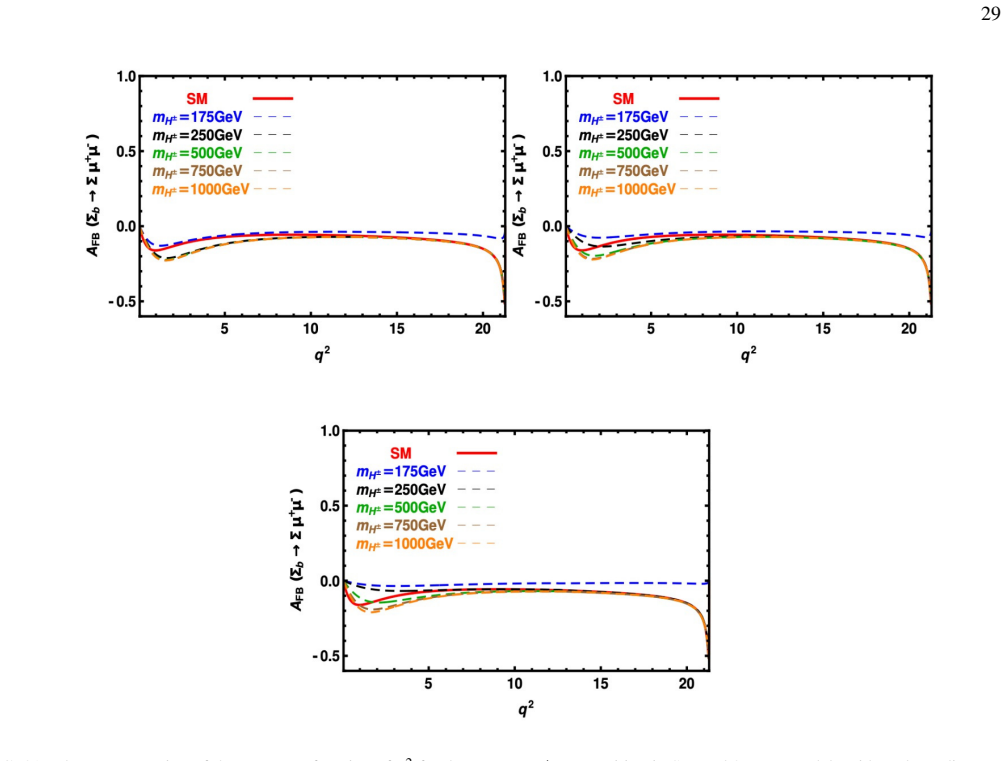
We investigate rare special dileptonic decays of $ \Lambda_b$, $\Sigma_b$ and $\Xi_b $ baryons in the Standard Model and context of the general Two-Higgs-Doublet Model with Type III. Specifically, we consider the decays $ \Lambda_b \rightarrow \Lambda \ell^+ \ell^-$, $\Sigma_b \rightarrow \Sigma \ell^+ \ell^-$ and $\Xi_b \rightarrow \Xi \ell^+ \ell^-$, where $\ell$ represents $\mu$ or $\tau$ lepton. By studying these rare decays, we aim to assess the impact of the Two-Higgs-Doublet Model with Type III on various observables, such as the differential decay width, the total decay width, the differential branching ratio, total branching ratio, and lepton forward-backward asymmetries using the decay amplitude and the transition matrix elements in terms of form factors calculated via light cone QCD in full theory. We compare our results to those of the Standard Model, as well as existing lattice QCD predictions and experimental data, to assess the agreement and viability of the Two-Higgs-Doublet Model with Type III. Furthermore, we highlight the potential for experimental investigations of these decay channels in the near future. The soon-to-be updated LHCb and/or Belle II detectors, renowned for their capabilities in studying rare decays, present excellent opportunities for probing the predicted branching ratios.
Figures


Figures from the paper (24 more)




Reviewed July 14, 2026 · model on record in the stance chip above.
Discussion (0). Continue with ORCID to comment.