REVIEW 3 major objections 4 minor 72 references
Holographic complexity of charged Taub-NUT-AdS black holes
T0 review · 3 major / 4 minor · reviewed 2026-08-14 · deepseek-v4-flash
Pith's one-line read For charged Taub-NUT-AdS black holes, the late-time complexity-equals-action growth rate receives a contribution from the Misner-string singularities, and the electric charge that enters is the total charge of the black hole.
desk verdict A careful CA calculation for charged Taub-NUT-AdS whose headline result depends on an unproven tube regularization of the Misner strings. read the letter →
The pith
A machine-rendered reading of the paper's core claim, the machinery that carries it, and where it could break.
The reading
What carries the argument
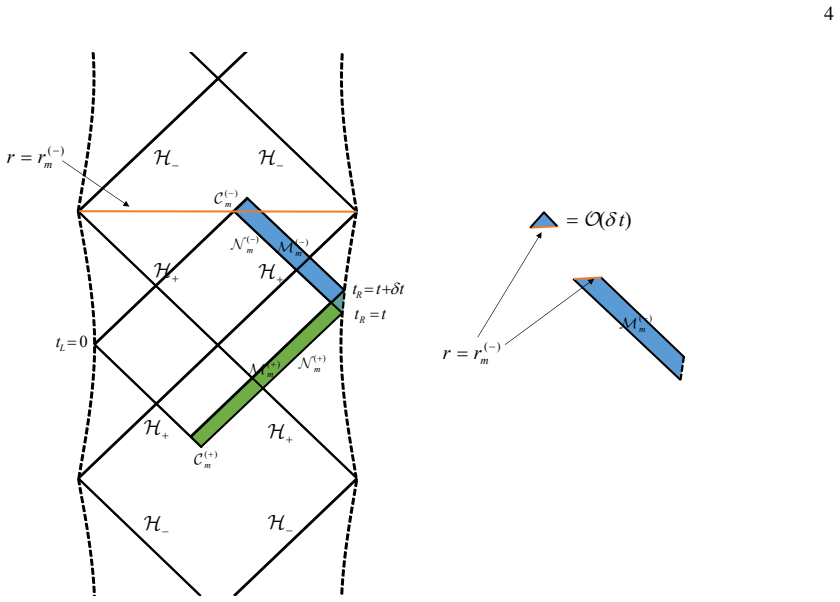
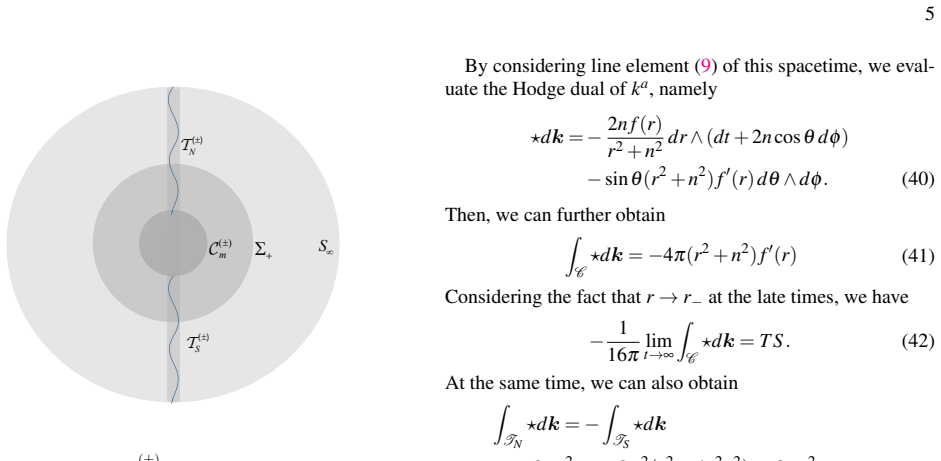
The load-bearing device is the treatment of the Misner string singularities as boundaries of the Wheeler-DeWitt patch. Because the strings lie on the polar axes at $\theta=0$ and $\theta=\pi$, the authors surround each string by an infinitesimally thin tube of radius $\varepsilon$ and compute the action variation on null segments whose boundary is the union of the usual meeting-point spheres, the asymptotic sphere at infinity, and the two Misner tubes, taking $\varepsilon\to 0$ at the end. The tube integrals assemble into the compact identity $K^{(-)}(r_-)-K^{(+)}(r_+)=\psi(N^{(-)}-N^{(+)})$, which turns the complicated string contribution into the product of Misner potential and Misner charge. The calculation also uses a Noether-charge/Stokes decomposition of the bulk action, rewriting the gravitational and Maxwell bulk contributions as boundary integrals, and the Maxwell boundary term $I_{\mu Q}$ with free coefficient $\gamma$, which is fixed to $\gamma=1/2$ by the requirement of electromagnetic duality.
What would settle it
Compute the WDW action for the same charged Taub-NUT-AdS spacetime with a different regularization of the Misner strings—for instance, replacing each string by a conical defect or a codimension-2 brane with its own action—and compare the coefficient of $\psi(N^{(-)}-N^{(+)})$ in the late-time rate; if it changes sign or disappears, the tube-boundary prescription is not scheme-independent. Alternatively, compute the complexity-equals-volume rate for this spacetime: a genuinely topological Misner-string contribution should appear there too, while an action-boundary artifact would not.
Extended reading notes
Core claim
On the paper's own terms, the central result is the late-time limit of the CA complexity growth rate for a charged Taub-NUT-AdS black hole with two RN-type horizons, $\lim_{t\to\infty} \frac{dC_A}{dt} = \frac{1}{\pi\hbar}[(\varphi_e^{(-)} - \varphi_e^{(+)}) Q_e + \psi(N^{(-)} - N^{(+)})]$, where $\varphi_e^{(\pm)}$ are the electric potentials at the outer and inner horizons, $Q_e$ is the total electric charge, and $\psi$ and $N^{(\pm)}$ are the Misner potential and Misner charge associated with the string singularities. Unlike ordinary black holes, the rate is not fixed by horizon quantities alone; the Misner-string data contribute directly. A corollary the authors stress is that the electric charge entering the formula is the total charge, not a charge evaluated on a horizon. A further corollary is that the original CA rate is independent of the magnetic charge and violates electromagnetic duality; adding the Maxwell boundary term $I_{\mu Q}=\frac{\gamma}{4\pi}\int_{\partial M} G\wedge A$ changes only the proportion between electric and magnetic terms and, at $\gamma=1/2$, restores the duality and makes the rate sensitive to the magnetic charge, while the Misner term $\psi(N^{(-)}-N^{(+)})$ is unchanged.
Load-bearing premise
The calculation assumes that a Misner string singularity can be regularized by an infinitesimally thin tube whose boundary belongs to the WDW action with a chosen orientation; if that tube prescription is not the right way to handle the singular spacetime, the central formula would change.
Editorial extensions
If this is right
- The late-time CA complexity growth rate for charged Taub-NUT-AdS black holes is determined by outer/inner horizon data together with Misner-string data through the term $\psi(N^{(-)}-N^{(+)})$.
- The electric charge entering the late-time rate is the total charge of the solution, so horizon-local charge measurements alone do not determine the complexity growth.
- The original CA conjecture violates electromagnetic duality for these dyonic solutions; the duality-sensitive version requires the Maxwell boundary term, and $\gamma=1/2$ is the special value that restores the duality.
- With $\gamma=1/2$, the late-time rate is bounded by half the Lloyd bound, and the full-time rate can be kept below the bound by choosing the counterterm scale $\ell_{ct}$ appropriately.
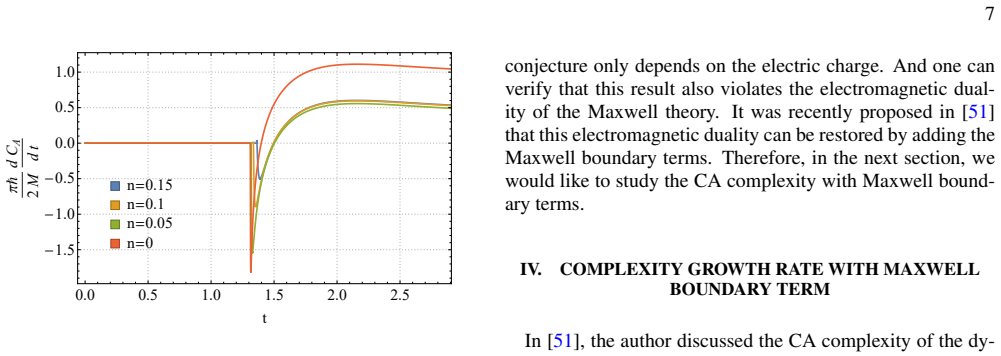
- The time dependence of the rate follows the known RN-AdS pattern, including approach from above and Lloyd-bound violation for small charges, so the qualitative behavior familiar from ordinary charged black holes survives in the Taub-NUT-AdS family.
Reading between the lines
- If the tube prescription is the correct way to regularize the WDW action on a singular spacetime, the same Misner-string term should show up in other holographic complexity proposals; for example, a complexity-equals-volume computation for this spacetime would provide a cross-check, and its absence there would suggest the tube term is an artifact of the action boundary treatment.
- The invariance of the Misner term under changes of $\gamma$ hints that this contribution is purely gravitational or topological, independent of the electromagnetic field; one could test this by taking the neutral limit and checking whether $\psi(N^{(-)}-N^{(+)})$ survives.
- The appearance of the total electric charge rather than horizon charges may mean the boundary dual sees the Misner strings as global charge sources; the paper does not develop this dual interpretation, but it is a natural next step.
- The special value $\gamma=1/2$ could be probed in other dyonic or NUT-charged solutions to see whether it is a universal requirement for duality-invariant complexity rather than a coincidence of this family.
Signed reviews
Editorial analysis
A structured set of objections, weighed in public.
Referee Report
Summary. The paper studies the 'complexity equals action' (CA) conjecture for charged Taub-NUT-AdS black holes in four-dimensional Einstein-Maxwell theory. Using the Wheeler-DeWitt patch method, the authors compute the time-dependent complexity growth rate and its late-time limit. Their central result, Eq. (67), states that the late-time growth rate contains, in addition to the usual horizon terms, a contribution ψ(N(−)−N(+)) proportional to the Misner potential and Misner charge, and that the electric term involves the total asymptotic charge Qe rather than horizon charges. They then add a Maxwell boundary term (68) and claim that for γ=1/2 the late-time rate satisfies electromagnetic duality, becoming sensitive to magnetic charges, and that this modification leaves the Misner term unchanged. The paper also presents numerical plots of the time dependence and discusses the Lloyd bound.
Significance. If the central formula is reliable, the paper is a meaningful step: it shows that non-trivial spacetime topology (Misner strings) can enter holographic complexity, going beyond the usual statement that late-time CA growth is fixed by outer and inner horizon data. The n→0 limit reproduces the RN-AdS result, which is a useful consistency check. The γ=1/2 Maxwell boundary-term discussion connects to the recent 'which action?' literature and is of topical interest. The paper is clearly written and the main algebra is substantially explicit. These strengths are, however, conditional on the tube regularization used to define the action in the presence of Misner string singularities.
major comments (3)
- [§III, Eqs. (38), (43)–(45), and (50)] The Misner-string contribution to the central late-time formula (67) rests on a regularization prescription that is not justified. Replacing the string singularities by infinitesimal tubes at θ=ε and θ=π−ε and using ∂N = TN + S∞ − TS − C treats the tubes as boundaries, but the paper does not include the corresponding GHY surface terms or corner terms at the tube endpoints, and the tube integrals (43) and (45) are quoted without derivation. Since the tubes are timelike, the affine-null-boundary argument used in (25) does not apply to them. The identity (50) is then only asserted. This is load-bearing: if a different tube shape or an alternative regulator (for example, a Noether-charge computation) changes the K(±) terms, the claimed dependence of the late-time rate on ψ(N(−)−N(+)) is an artifact. The n→0 limit in Sec. III only tests the vanishing of the tube terms, not their finite value for n≠0.
- [§IV, around Eq. (77)] The claim that γ=1/2 restores electromagnetic duality is not demonstrated. The sentence 'It is not difficult to verify' is insufficient. One needs an explicit transformation of Eq. (77) under the stated duality e↔−2ng, 2ng↔e, showing how the electric term (1/2)(φ_e^− − φ_e^+)Qe and the magnetic term (1/2)(φ_m^− Q_m^− − φ_m^+ Q_m^+) map into each other, including the r-dependent charges Q_m^± and the Misner term. Without this check, the duality-restoration result in the abstract and conclusion is unsupported.
- [§III, Eqs. (46)–(50)] The derivation of the key K(±) functions in Eq. (47) and of the identity (50) is not shown. In particular, the step from the tube integrals (43) and (45) to the compact form (47), and then the comparison with the Misner charge N(±) in Eq. (20) leading to (50), are essential for the final result. These steps should be presented, or at least collected in an appendix, so that a reader can check that no factor of 2 or sign error enters the Misner term.
minor comments (4)
- [§IV, Eq. (77)] The displayed formula for the late-time rate is missing a '+' between the electric and magnetic terms; as printed, the expression '(1−γ)(φ_e^− − φ_e^+)Qe γ(φ_m^−Q_m^− − φ_m^+Q_m^+)' is ambiguous and should read '(1−γ)(φ_e^− − φ_e^+)Qe + γ(φ_m^−Q_m^− − φ_m^+Q_m^+)'.
- [§III, after Eq. (60)] The word 'ralation' should be 'relation'.
- [§IV and §V] The name 'Lloyd' is misspelled as 'Llyod' in the sentence before Eq. (79) and in the concluding paragraph.
- [§II, Eq. (20)] The notation N(±) for the Misner charge is introduced in Eq. (20) without explaining its physical normalization; a brief comment connecting N(±) to the string contribution to the Komar integral would help the reader.
Circularity Check
No significant circularity: the Misner term is obtained from an explicit action calculation, not fitted or defined into existence.
full rationale
The paper performs a direct computation of the Wheeler-DeWitt action for the charged Taub-NUT-AdS solution under the CA conjecture. The parameters appearing in the final late-time rate (67), such as e, g, n, m, and the horizon radii, are solution parameters fixed by the metric; none are fitted to the complexity result. The Misner potential ψ and Misner charge N are taken from prior thermodynamic literature, but they enter only after the tube integrals are computed, through the algebraic identity (50), which the paper verifies by comparing its independently derived expression (47) with the definitions (20). This is a check of a derived equality, not an input used to construct the result. The choice γ=1/2 for the Maxwell boundary term is a free parameter of that added term, selected to restore electromagnetic duality, and the paper explicitly shows how the final formula depends on γ; this is a parameter choice, not a fitted prediction. Self-citations, such as Ref. [6] for the general action-growth formalism and Ref. [13] for the null-boundary action, provide standard ingredients, but the horizon and Misner-string contributions are calculated in this paper rather than imported as the conclusion. The tube regularization around the Misner strings is a prescription and a possible correctness risk, but it is not circular: no target result is used to define the regulator, the tube orientation, or the value of K(±). A regulator-dependent prescription can be wrong without being circular. Accordingly, no load-bearing step reduces to its own inputs or to a self-citation chain.
Assumptions & free parameters
free parameters (1)
- gamma =
1/2
assumptions (5)
- domain assumption The CA conjecture: boundary complexity equals WDW patch action divided by pi hbar.
- domain assumption The WDW patch action is well-defined in a spacetime with Misner string singularities using the tube regularization described in Sec. III.
- domain assumption The first law of thermodynamics (21) including Misner potential psi and Misner charge N(+/-) from Ref. [69] is the correct thermodynamic description.
- standard math The line element (9) is the correct charged Taub-NUT-AdS solution of Einstein-Maxwell theory.
- domain assumption The mass M=m from the conformal method [72].
Cite this review
Pith. "Pith review of Holographic complexity of charged Taub-NUT-AdS black holes." pith.science (2026). https://pith.science/paper/LD3TLKBD
@misc{pith2026190806565,
  author       = {Pith},
  title        = {Pith review of: Holographic complexity of charged Taub-NUT-AdS black holes},
  year         = {2026},
  howpublished = {\url{https://pith.science/paper/LD3TLKBD}},
  note         = {Machine review of arXiv:1908.06565}
}
abstract
In this paper, we investigate the holographic complexity in the charged Taub-NUT-AdS black holes with Misner strings present in the Einstein-Maxwell gravity. We show that differing from the normal black holes, where the late-time complexity growth rate is only determined by the quantities at outer and inner ``Reissner-Nordstrom''-type (RN-type) horizons, here the quantities (the Misner potential and Misner charge) related to the Misner strings also play an important role in CA complexity. Similar to the case of the normal electromagnetic black hole, the late-time rate for the original CA conjecture is independent on the magnetic charges. However, disparate with common results of the dyonic solutions, the electric charge appeared here is the total charge of this black hole. Besides, we found that the result in this original CA conjecture also violates the electromagnetic duality. And this duality can be restored by adding the Maxwell boundary term with the proportional constant $\g=1/2$. In this case, the late-time rate is sensitive to the magnetic charge. Moreover, we also found that the additional term only changes the proportion between the electric and magnetic charges, and it does not affect the Misner term appeared in the late-time rate. Finally, we studied the time-dependence of the complexity growth rate and found that they share similar behaviors with that in RN-AdS black holes.
Figures
Figures from the paper (1 more)

Reference graph
Works this paper leans on
-
[1]
The Complexity of Quantum States and Transformations: From Quantum Money to Black Holes,
S. Aaronson, “The Complexity of Quantum States and Transformations: From Quantum Money to Black Holes,” arXiv:1607.05256
-
[2]
Computational complexity and black hole hori- zons,
L. Susskind,“Computational complexity and black hole hori- zons,” Fortsch. Phys. 64 24 (2016)
work page 2016
-
[3]
Complexity and shock wave ge- ometries,
D. Stanford and L. Susskind, “Complexity and shock wave ge- ometries,” Phys. Rev. D90, 126007 (2014)
work page 2014
-
[4]
Holographic complexity equals bulk action?
A. R. Brown, D. A. Roberts, L. Susskind, B. Swingle and Y . Zhao,“Holographic complexity equals bulk action?” Phys. Rev. Lett. 116 191301 (2016)
work page 2016
-
[5]
Complexity, action, and black holes,
A. R. Brown, D. A. Roberts, L. Susskind, B. Swingle and Y . Zhao,“Complexity, action, and black holes,” Phys. Rev. D 93 086006 (2016)
work page 2016
-
[6]
Action growth rate for a higher curvature gravitational theory,
J. Jiang, “Action growth rate for a higher curvature gravitational theory,” Phys. Rev. D98, 086018 (2018)
work page 2018
-
[7]
Action growth for AdS black holes,
R. G. Cai, S. M. Ruan, S. J. Wang, R. Q. Yang and R. H. Peng, “Action growth for AdS black holes,” JHEP1809 161 (2016)
work page 2016
-
[8]
Complexity growth rates for AdS black holes in massive gravity and f (R) gravity,
W. D. Guo, S. W. Wei, Y . Y . Li and Y . X. Liu, “Complexity growth rates for AdS black holes in massive gravity and f (R) gravity,” Eur. Phys. J. C77, 904 (2017)
work page 2017
Show all 72 references
-
[9]
Action growth inf (R) gravity,
P. Wang, H. Yang and S. Ying, “Action growth inf (R) gravity,” Phys. Rev. D 96, no. 4, 046007 (2017)
2017
-
[10]
Holographic complexity and action growth in massive gravities,
W. J. Pan and Y . C. Huang, “Holographic complexity and action growth in massive gravities,” Phys. Rev. D 95, no. 12, 126013 (2017)
2017
-
[11]
On the time dependence of holographic complexity,
D. Carmi, S. Chapman, H. Marrochio, R. C. Myers and S. Sug- ishita, “On the time dependence of holographic complexity,” JHEP 1711 188 (2017)
2017
-
[12]
Holographic complexity and thermo- dynamics of AdS black holes,
Z. Y . Fan and M. Guo, “Holographic complexity and thermo- dynamics of AdS black holes,” arXiv:1903.04127
1903 arXiv
-
[13]
Gravi- tational action with null boundaries
L. Lehner, R. C. Myers, E. Poisson and R. D. Sorkin, “Gravi- tational action with null boundaries” Phys. Rev. D 94, 084046 (2016)
2016
-
[14]
On the Noether charge and the gravity duals of quantum complexity,
Z. Y . Fan and M. Guo, “On the Noether charge and the gravity duals of quantum complexity,” JHEP1808, 031 (2018)
2018
-
[15]
Time Dependence of Holo- graphic Complexity in Gauss-Bonnet Gravity,
Y . S. An, R. G. Cai and Y . Peng, “Time Dependence of Holo- graphic Complexity in Gauss-Bonnet Gravity,” Phys. Rev. D 98, 106013 (2018)
2018
-
[16]
Effect of the dilaton on holographic complexity growth,
Y . S. An and R. H. Peng, “Effect of the dilaton on holographic complexity growth,” Phys. Rev. D97 066022 (2018)
2018
-
[17]
Complexity in de Sitter Space,
A. Reynolds and S. F. Ross, Class. “Complexity in de Sitter Space,” Quant. Grav.34 175013 (2017)
2017
-
[18]
Complexity of Formation in Holography,
S. Chapman, H. Marrochio and R. C. Myers, “Complexity of Formation in Holography,” JHEP1701 062 (2017)
2017
-
[19]
Holographic Complexity Growth Rate in Horndeski Theory,
X. H. Feng and H. S. Liu, “Holographic Complexity Growth Rate in Horndeski Theory,” arXiv:1811.03303
-
[20]
Comments on Holographic Complexity,
D. Carmi, R. C. Myers and P. Rath,“Comments on Holographic Complexity,” JHEP1703 118 (2017)
2017
-
[21]
Holographic Complexity,
M. Alishahiha, “Holographic Complexity,” Phys. Rev. D 92 126009 (2015)
2015
-
[22]
Subsystem Com- plexity and Holography,
C. A. Agon, M. Headrick and B. Swingle,“Subsystem Com- plexity and Holography,” arXiv:1804.01561
-
[23]
On V olumes of Subregions in Holography and Complexity,
O. Ben-Ami and D. Carmi, “On V olumes of Subregions in Holography and Complexity,” JHEP1611, 129 (2016)
2016
-
[24]
Holographic complexity of the electro- magnetic black hole,
J. Jiang and M. Zhang, “Holographic complexity of the electro- magnetic black hole,” arXiv:1905.07576
1905 arXiv
-
[25]
Uncomplexity and Black Hole Geometry,
Y . Zhao, “Uncomplexity and Black Hole Geometry,” Phys. Rev. D 97, 126007 (2018)
2018
-
[26]
Holographic complexity is nonlocal,
Z. Fu, A. Maloney, D. Marolf, H. Maxfield and Z. Wang, “Holographic complexity is nonlocal,” JHEP1802 072 (2018)
2018
-
[27]
Complexity Growth with Lifshitz Scaling and Hyperscaling Violation,
M. Alishahiha, A. Faraji Astaneh, M. R. Mohammadi Mozaffar and A. Mollabashi, “Complexity Growth with Lifshitz Scaling and Hyperscaling Violation,” JHEP1807 042 (2018)
2018
-
[28]
Holographic complexity and noncommutative gauge theory,
J. Couch, S. Eccles, W. Fischler and M. L. Xiao,“Holographic complexity and noncommutative gauge theory,” JHEP 1803 108 (2018)
2018
-
[29]
Holographic Complexity of Einstein- Maxwell-Dilaton Gravity,
B. Swingle and Y . Wang, “Holographic Complexity of Einstein- Maxwell-Dilaton Gravity,” JHEP1809 106 (2018)
2018
-
[30]
Evolution of Complexity Following a Global Quench,
M. Moosa, “Evolution of Complexity Following a Global Quench,” JHEP 1803 031 (2018)
2018
-
[31]
Holographic subregion complexity under a thermal quench,
B. Chen, W. M. Li, R. Q. Yang, C. Y . Zhang and S. J. Zhang, “Holographic subregion complexity under a thermal quench,” JHEP 1807 034 (2018)
2018
-
[32]
Action Growth of Dyonic Black Holes and Electromagnetic Duality,
H. S. Liu and H. Lu, “Action Growth of Dyonic Black Holes and Electromagnetic Duality,” arXiv:1905.06409
1905 arXiv
-
[33]
Circuit complexity in interacting QFTs and RG flows,
A. Bhattacharyya, A. Shekar and A. Sinha, “Circuit complexity in interacting QFTs and RG flows,” JHEP 1810, 140 (2018)
2018
-
[34]
Time Evolution of Complexity: A Critique of Three Methods,
T. Ali, A. Bhattacharyya, S. Shajidul Haque, E. H. Kim and N. Moynihan, “Time Evolution of Complexity: A Critique of Three Methods,” JHEP 1904, 087 (2019)
2019
-
[35]
Post-Quench Evolution of Distance and Uncer- tainty in a Topological System: Complexity, Entanglement and Revivals,
T. Ali, A. Bhattacharyya, S. Shajidul Haque, E. H. Kim and N. Moynihan, “Post-Quench Evolution of Distance and Uncer- tainty in a Topological System: Complexity, Entanglement and Revivals,” arXiv:1811.05985. 10
-
[36]
Holographic complexity of anisotropic black branes,
S. A. Hosseini Mansoori, V . Jahnke, M. M. Qaemmaqami and Y . D. Olivas, “Holographic complexity of anisotropic black branes,” arXiv:1808.00067
-
[37]
Time Evolution of Complexity in Abelian Gauge Theories - And Playing Quantum Othello Game -
K. Hashimoto, N. Iizuka, and S. Sugishita, “Time Evolution of Complexity in Abelian Gauge Theories - And Playing Quantum Othello Game -”, arXiv:1707.03840
-
[38]
Circuit complexity in quan- tum field theory,
R. A. Jefferson and R. C. Myers, “Circuit complexity in quan- tum field theory,” JHEP 1710 107 (2017)
2017
-
[39]
Towards Complexity for Quantum Field Theory States
S. Chapman, M. P. Heller, H. Marrochio and F. Pastawski,“ Towards Complexity for Quantum Field Theory States” Phys. Rev. Lett. 120, 121602 (2018)
2018
-
[40]
A Complexity for Quantum Field Theory States and Application in Thermofield Double States,
R.-Q. Yang, “A Complexity for Quantum Field Theory States and Application in Thermofield Double States,” Phys. Rev. D 97, 066004 (2018)
2018
-
[41]
Comparison of holographic and field theoretic complexities for time depen- dent thermofield double states,
R. Q. Yang, C. Niu, C. Y . Zhang, and K.-Y . Kim, “Comparison of holographic and field theoretic complexities for time depen- dent thermofield double states,” JHEP 1802 082 (2018)
2018
-
[42]
More on complexity of operators in quantum field theory,
R. Q. Yang, Y . S. An, C. Niu, C. Y . Zhang and K. Y . Kim,“More on complexity of operators in quantum field theory,” JHEP1903 161 (2019)
2019
-
[43]
Second law of quantum com- plexity
A. R. Brown and L. Susskind, “Second law of quantum com- plexity” Phys. Rev. D97 086015 (2018)
2018
-
[44]
Complexity of the AdS Soliton,
A. P. Reynolds and S. F. Ross, “Complexity of the AdS Soliton,” Class. Quant. Grav. 35 095006 (2018)
2018
-
[45]
Liouville Action as Path-Integral Complexity: From Con- tinuous Tensor Networks to AdS/CFT,
P. Caputa, N. Kundu, M. Miyaji, T. Takayanagi and K. Watan- abe,“Liouville Action as Path-Integral Complexity: From Con- tinuous Tensor Networks to AdS/CFT,” JHEP1711 097 (2017)
2017
-
[46]
Circuit Complexity in Fermionic Field Theory,
R. Khan, C. Krishnan, and S. Sharma, “Circuit Complexity in Fermionic Field Theory,” Phys. Rev. D98, 126001 (2018)
2018
-
[47]
Modified “complexity equals action
J. Jiang and X. W. Li, “Modified “complexity equals action” conjecture,” arXiv:1903.05476
1903 arXiv
-
[48]
Circuit Complexity for Coherent States,
M. Guo, J. Hernandez, R. C. Myers and S. M. Ruan, “Circuit Complexity for Coherent States,” JHEP 1810 011 (2018)
2018
-
[49]
Circuit complexity for free Fermion with a mass quench,
J. Jiang, J. Shan and J. Yang, “Circuit complexity for free Fermion with a mass quench,” arXiv:1810.00537
-
[50]
Prin- ciples and symmetries of complexity in quantum field theory,
R. Q. Yang, Y . S. An, C. Niu, C. Y . Zhang and K. Y . Kim, “Prin- ciples and symmetries of complexity in quantum field theory,” Eur. Phys. J. C 79, 109 (2019)
2019
-
[51]
Holographic Complexity Equals Which Action?,
K. Goto, H. Marrochio, R. C. Myers, L. Queimada and B. Yoshida,“Holographic Complexity Equals Which Action?,” JHEP 1902, 160 (2019)
2019
-
[52]
Complexity and entanglement for thermofield double states,
S. Chapman, J. Eisert, L. Hackl, M. P. Heller, R. Jefferson, H. Marrochio and R. C. Myers, “Complexity and entanglement for thermofield double states,” SciPost Phys. 6, 034 (2019)
2019
-
[53]
Circuit Complexity for Fermionic Ther- mofield Double states,
J. Jiang and X. Liu, “Circuit Complexity for Fermionic Ther- mofield Double states,” Phys. Rev. D99, 026011 (2019)
2019
-
[54]
Circuit complexity for free fermions,
L. Hackl and R. C. Myers, “Circuit complexity for free fermions,” JHEP 1807 139 (2018)
2018
-
[55]
Stringy Effects and the Role of the Singularity in Holographic Complexity,
R. Nally,“Stringy Effects and the Role of the Singularity in Holographic Complexity,” arXiv:1902.09545
1902 arXiv
-
[56]
Surface term, corner term, and action growth in F(Riemann) gravity theory,
J. Jiang and H. Zhang, “Surface term, corner term, and action growth in F(Riemann) gravity theory,” Phys. Rev. D99, 086005 (2019)
2019
-
[57]
Investigating two counting methods of the holographic complexity,
J. Jiang and B. X. Ge, “Investigating two counting methods of the holographic complexity,” Phys. Rev. D99, 126006 (2019)
2019
-
[58]
Holo- graphic complexity in Vaidya spacetimes. Part I,
S. Chapman, H. Marrochio and R. C. Myers, JHEP “Holo- graphic complexity in Vaidya spacetimes. Part I,” 1806 046 (2018)
2018
-
[59]
Localized shocks,
D. A. Roberts, D. Stanford and L. Susskind,“Localized shocks,” JHEP 1503, 051 (2015)
2015
-
[60]
Holographic complexity in Vaidya spacetimes. Part II,
S. Chapman, H. Marrochio and R. C. Myers, “Holographic complexity in Vaidya spacetimes. Part II,” JHEP 1806 114 (2018)
2018
-
[61]
Holographic complexity in charged Vaidya black hole,
J. Jiang, “Holographic complexity in charged Vaidya black hole,” Eur. Phys. J. C79 130 (2019)
2019
-
[62]
Switchbacks and the Bridge to Nowhere,
L. Susskind and Y . Zhao, “Switchbacks and the Bridge to Nowhere,” arXiv:1408.2823
-
[63]
Holographic complexity under a global quantum quench,
Z. Y . Fan and M. Guo, “Holographic complexity under a global quantum quench,” arXiv:1811.01473
-
[64]
Lloyd, Nature 406 1047 (2000)
S. Lloyd, Nature 406 1047 (2000)
2000
-
[65]
Empty space-times admitting a three parameter group of motions,
A. H. Taub, “Empty space-times admitting a three parameter group of motions,” Annals Math. 53, 472 (1951)
1951
-
[66]
Empty-space gener- alization of the Schwarzschild metric,
E. Newman, L. Tamburino, and T. Unti, “Empty-space gener- alization of the Schwarzschild metric,” J. Math. Phys. 4, 915 (1963)
1963
-
[67]
The Flatter regions of Newman, Unti and Tam- burino’s generalized Schwarzschild space,
C. W. Misner, “The Flatter regions of Newman, Unti and Tam- burino’s generalized Schwarzschild space,” J. Math. Phys. 4, 924 (1963)
1963
-
[68]
Thermodynam- ics of Lorentzian Taub-NUT spacetimes,
R. A. Hennigar, D. Kubiznak, and R. B. Mann, “Thermodynam- ics of Lorentzian Taub-NUT spacetimes,” arXiv:1903. 08668
1903
-
[69]
Thermodynamics and Phase Transitions of NUTty Dyons,
A. B. Bordo, F. Gray, and D. Kubiznak, “Thermodynamics and Phase Transitions of NUTty Dyons,” arXiv:1904.00030
1904 arXiv
-
[70]
The Extended Thermodynamic Phase Structure of Taub-NUT and Taub-Bolt,
C. V . Johnson, “The Extended Thermodynamic Phase Structure of Taub-NUT and Taub-Bolt,” Class. Quant. Grav. 31 225005 (2014)
2014
-
[71]
Supersymme- try of topological Kerr-Newman-Taub-NUT-AdS space-times,
N. Alonso-Alberca, P. Meessen and T. Ortin, “Supersymme- try of topological Kerr-Newman-Taub-NUT-AdS space-times,” Class. Quant. Grav. 17, 2783 (2000)
2000
-
[72]
Asymptotically Anti-de Sitter space- times: Conserved quantities,
A. Ashtekar and S. Das, “Asymptotically Anti-de Sitter space- times: Conserved quantities,” Class. Quant. Grav. 17 L17 (2000)
2000
Reviewed August 14, 2026 · model on record in the stance chip above.
Discussion (0). Continue with ORCID to comment.