REVIEW 5 major objections 5 minor 50 references
Giant thermal magnetoconductivity in CrCl$_3$ and a general model for spin-phonon scattering
T0 review · 5 major / 5 minor · reviewed 2026-08-14 · deepseek-v4-flash
Pith's one-line read CrCl3's thermal conductivity rises sharply in a magnetic field because the field suppresses incoherent spin fluctuations that scatter phonons; the entire effect is captured by a single field-independent scattering efficiency multiplied by…
desk verdict A striking and likely real field-induced enhancement of thermal conductivity in CrCl3, wrapped in a useful but overreaching phenomenological model; the core observation deserves a serious referee, the strong claims need trimming. read the letter →
The pith
A machine-rendered reading of the paper's core claim, the machinery that carries it, and where it could break.
The reading
What carries the argument
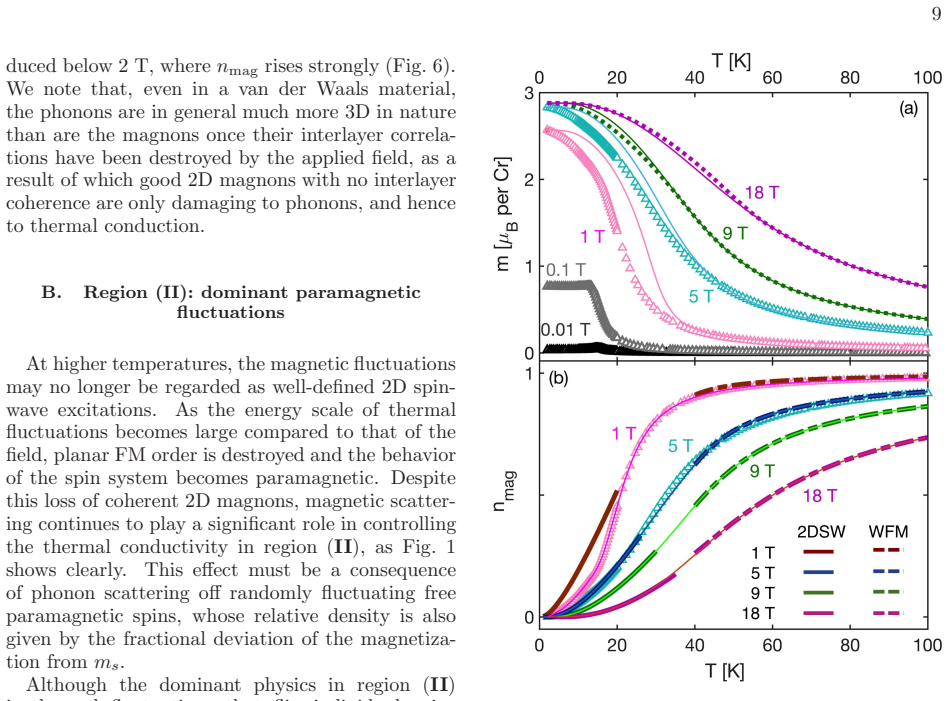
The machinery is a factorization of the phonon thermal resistivity into a field-independent lattice part and a spin-fluctuation scattering term. Equation (4) states $\kappa^{-1}(H,T)=\kappa_{\mathrm{ph}}^{-1}(T)[1+\lambda(T)\,n_{\mathrm{mag}}(H,T)]$, where $n_{\mathrm{mag}}$ is the fractional density of magnetic fluctuations, set equal to $1-m(H,T)/m_s$ from measured magnetization, and $\lambda(T)$ is a dimensionless, field-independent scattering efficiency. In the low-temperature, high-field regime $n_{\mathrm{mag}}$ is computed from the population of two-dimensional spin waves with a field gap; in the high-temperature, low-field regime it is computed from a molecular-field magnetization. The high-temperature tail of $\lambda(T)$ is represented by a Lorentzian continuation, which the authors state is a practical choice rather than a physically proven form.
What would settle it
Measure $\kappa(H,T)$ on CrCl3 at fields well above the 2 T saturation field: the model predicts that once $n_{\mathrm{mag}}=0$, $\kappa$ becomes independent of $H$ at every temperature, so any continued field dependence above saturation would falsify the factorization. Alternatively, for another layered magnet, test whether the ratio $[\kappa^{-1}(H,T)-\kappa_{\mathrm{ph}}^{-1}(T)]/[1-m(H,T)/m_s]$ is field-independent at fixed $T$.
Extended reading notes
Core claim
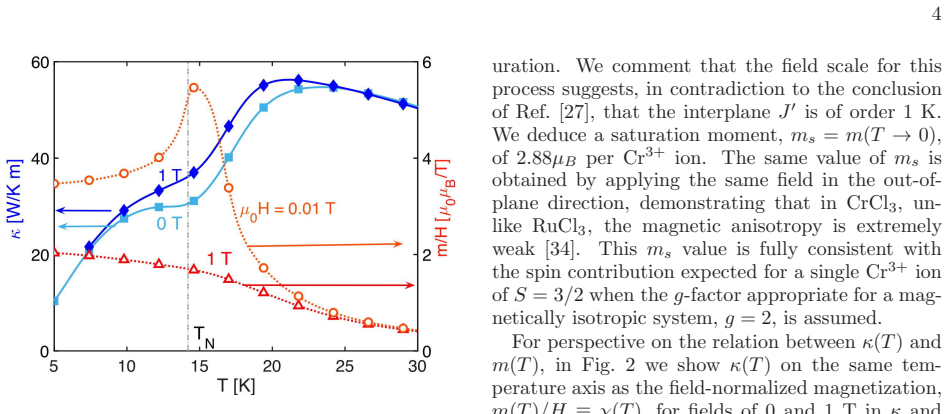
The discovery is that in CrCl3, away from a narrow low-field ordered region, heat is carried entirely by phonons, and the magnetic field acts only by thinning the population of spin fluctuations that scatter them. The authors show that the measured thermal resistivity obeys $\kappa^{-1}(H,T) = \kappa_{\mathrm{ph}}^{-1}(T)[1+\lambda(T)\,n_{\mathrm{mag}}(H,T)]$ with $n_{\mathrm{mag}}(H,T) = 1-m(H,T)/m_s$ taken directly from magnetization, and with $\lambda(T)$ independent of field at every temperature. Around the magnetic ordering transition this scattering removes up to two-thirds of the phonon heat current at zero field, and even at 18 T the spin-fluctuation suppression is not quite fully removed. From the factorization the authors extract the intrinsic phonon conductivity $\kappa_{\mathrm{ph}}(T)$, reconstruct $\kappa(H,T)$ at all measured fields and temperatures, and argue the same two-parameter description should apply to other magnetic insulators, including systems whose spin excitations are not conventional magnons.
Load-bearing premise
The load-bearing assumption is that the number of phonon-scattering spin fluctuations is exactly the magnetization deficit $1-m/m_s$, so that correlated or wavevector-dependent fluctuations scatter phonons with the same efficiency per spin as independent ones.
Editorial extensions
If this is right
- High-field thermal conductivity data should not be assumed to be the pure phonon baseline: even 18 T leaves a roughly 20% spin-fluctuation suppression around the peak in CrCl3.
- The same factorization should describe other insulating magnets with strong spin-phonon scattering, including candidate quantum spin liquids whose excitations are not conventional magnons, because the model needs no microscopic spin or phonon dispersion.
- Thermal conductivity measurements can separate coherent magnetic heat carriers from incoherent spin scatters: in CrCl3 the coherent magnon contribution appears only below about 4 K, while fluctuation scattering operates up to roughly 70 K.
- The extracted $\kappa_{\mathrm{ph}}(T)$ provides a field-independent phonon baseline that can be compared with heat-capacity data and phonon models.
Reading between the lines
- If the magnetization-deficit counting is generic, field-dependent thermal conductivity becomes a cheap, bulk probe of fluctuating spin density in materials where direct magnetization is inaccessible, such as exfoliated few-layer samples or pulsed-field regimes.
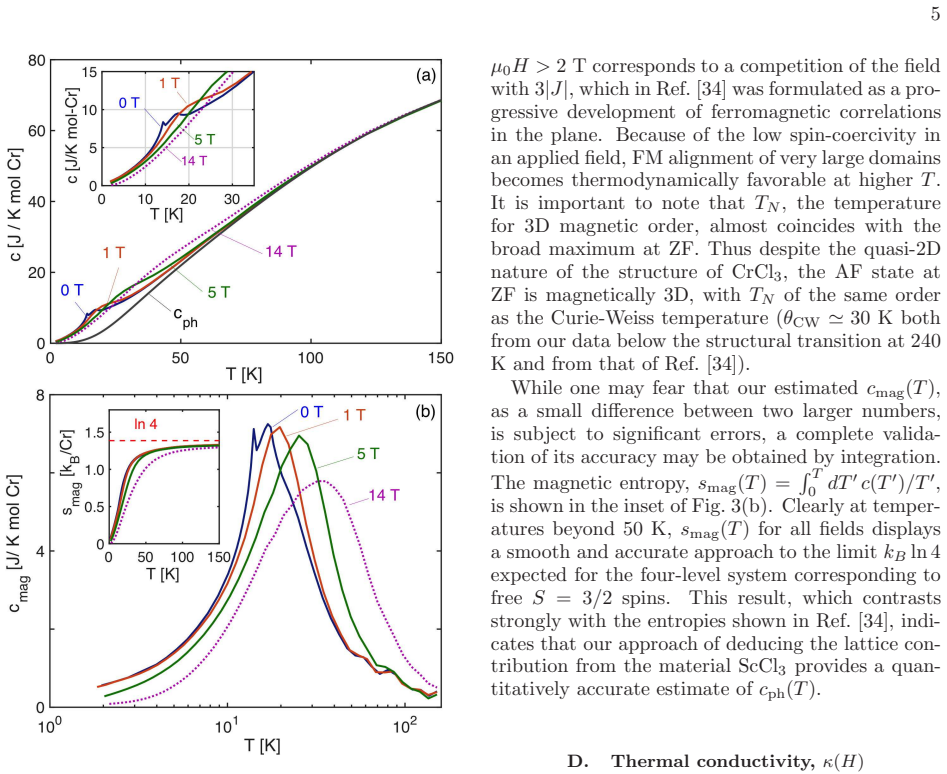
- The authors' choice of a Lorentzian tail for $\lambda(T)$ is openly a convenience; comparing $\lambda(T)$ with the magnetic specific heat $c_{\mathrm{mag}}(T)$ would test whether the scattering efficiency simply tracks the density of spin-flip excitations, a connection the paper does not make.
- The unresolved roughly 40 K bulge in $\kappa(T)$ could be an intrinsic phonon feature or a second magnetic scattering channel; a measurement of $\kappa$ on the nonmagnetic analog ScCl3 would help decide which, and would sharpen the extracted $\lambda(T)$.
Signed reviews
Editorial analysis
A structured set of objections, weighed in public.
Referee Report
Summary. The paper reports a large field-induced enhancement of the in-plane thermal conductivity of the layered honeycomb magnet CrCl3, measured with the field parallel to the thermal gradient. The authors argue that the enhancement is caused by the field suppression of incoherent spin fluctuations that scatter phonons. They propose an empirical factorization, Eq. (4), in which the thermal resistivity is written as κ^{-1}(H,T) = κ_ph^{-1}(T)[1 + λ(H,T) n_mag(H,T)], with n_mag the density of spin fluctuations and λ a dimensionless scattering efficiency. They determine n_mag from magnetization measurements, using two separate models: a 2D spin-wave model in the high-H/T regime (Sec. IVA) and a Weiss-field model in the paramagnetic regime (Sec. IVB). The key qualitative conclusion is that λ can be taken as field-independent, λ(H,T) ≡ λ(T), so that the entire field dependence of κ is carried by n_mag. The authors extract the pure phonon conductivity κ_ph(T) by inverting the measured κ(H,T) with their fitted λ and n_mag, and they reconstruct the measured κ(H,T) over a wide field and temperature range. The paper closes with claims of general applicability to magnetic insulators with strong spin-phonon scattering.
Significance. If the central claim holds, the paper offers a useful and unusually simple phenomenological framework for spin-phonon scattering in magnetic insulators: the field dependence of the phonon thermal conductivity is controlled by the density of magnetic fluctuations, while the scattering efficiency is a temperature-only property. The use of independently measured magnetization data to fix n_mag is a genuine strength and gives the model predictive content. The extraction of a field-independent λ(T) at four temperatures is a nontrivial empirical result. However, the significance is tempered by the fact that the identification of n_mag with the static magnetization deviation is an assumption rather than a derived consequence, the λ(T) tail is chosen rather than measured, and the strongest low-field regime near T_N is explicitly outside the model. These gaps mean that the universal claim, while plausible, is not yet established at the level claimed in the abstract.
major comments (5)
- [Eq. (4), Secs. IVA and IVB] The central identification n_mag(H,T) = 1 - m(H,T)/m_s is not justified microscopically. Phonon scattering is controlled by the wavevector- and frequency-resolved spin correlation function weighted by spin-phonon coupling matrix elements, not simply by the uniform static magnetization deficit. If correlated spin fluctuations scatter phonons differently from independent unaligned spins, the field independence of λ in Eq. (4) could be an artifact of the chosen n_mag rather than a physical property. A concrete test would be to compare the field dependence of the phonon scattering rate with the field dependence of the dynamical spin correlations measured, for example, by neutron scattering linewidths or the magnetic correlation length; if the scattering rate does not track 1 - m/m_s, the factorization in Eq. (4) loses its stated physical meaning.
- [Sec. IVC, Figs. 9 and 10(c)] The extraction of κ_ph(T) is not independent of the model being tested. The paper inverts the measured κ(H,T) using Eq. (4) with the fitted λ(T) and n_mag(H,T), and then shows that the same κ_ph(T), λ(T), and n_mag reproduce the measured data in Fig. 10(c). This is a self-consistency check, not an independent validation. The claim that the reconstruction is 'quantitatively excellent' (Sec. IVC) would be considerably strengthened by an independent estimate of κ_ph(T), for example a Debye-Callaway fit constrained by the measured specific heat, or by demonstrating that the extracted κ_ph(T) is insensitive to reasonable alternative forms of λ(T).
- [Fig. 7 and Abstract] The statement that the scattering efficiency is 'entirely independent of the field' is tested only at four temperatures (8.5, 13, 21, and 32 K) and only for μ0H > 2 T. The largest field-induced enhancement of κ occurs in the low-field region around T_N, which the model explicitly excludes (Sec. IVC and Fig. 10(c)). The abstract's claim of a quantitative description 'at all fields and temperatures' is therefore broader than the data support; the paper should either extend the analysis to lower fields or qualify the claim to the range where the model is actually applied.
- [Sec. IVB and Sec. IVC, Lorentzian continuation of λ(T)] The high-temperature tail of λ(T) is not measured but is assumed to have a Lorentzian form because of an unexplained bulge near 40 K in the measured κ(T). The authors explicitly state that they make no claim of a physical underpinning for this form. Since this choice affects the extracted κ_ph(T) and hence the high-temperature reconstruction, the quantitative agreement at T > 40 K is partly built into the analysis. A sensitivity analysis using the Gaussian and exponential forms mentioned in Sec. IVB, showing the resulting spread in κ_ph(T), would help establish how much of the high-T agreement depends on this arbitrary choice.
- [Figs. 7, 9, and 10] No uncertainty estimates are provided for λ(T), κ_ph(T), or the reconstructed curves. The paper reports deviations of 1–15% between model and data, but without error bars it is impossible to assess whether these deviations are statistically significant. Since the central quantitative claims rest on 'excellent agreement' and on a 20% separation between κ_ph(T) and the 18 T data, the experimental and propagation uncertainties should be stated explicitly.
minor comments (5)
- [Sec. IVC] The phrase 'values with do track the edge of region (I)' contains a typo; 'with' should be removed.
- [Sec. IVA, Eq. (5)] The notation e^{-gµH/k_B T} omits the vacuum permeability μ0 that appears elsewhere in the paper; for consistency, use the same symbol for the applied field throughout.
- [Sec. IVC, Fig. 8(b)] It is unclear what 'a fit to the data' means for the 1 T solid curve in Fig. 8(b); the text says the 2D spin-wave approach is not effective at 1 T, so the functional form of this fit and its parameters should be specified.
- [Abstract and Sec. V] The abstract says the effect occurs 'at all relevant temperatures' and that the model describes data 'at all fields and temperatures', but Sec. V acknowledges that the model fails in the low-field critical regime around T_N; the wording should be adjusted to match this stated limitation.
- [Fig. 4] The fractional change Δκ/κ0 is shown without error bars; if the point-to-point scatter is small this should be stated, and representative error bars should be shown in at least one panel.
Circularity Check
The Fig. 10(c) 'prediction' is a self-consistency check because κph is inverted from the same κ(H,T) data using the fitted λ; the independent magnetization input prevents full circularity.
-
fitted input called prediction
[Sec. IVC, Eq. (4), Fig. 10(c)]
"Inverting our κ(H,T) data using these estimates of nmag(H,T) and λ(T) provides four different curves for κest_ph(T) ... In Fig. 10(c) we use our deduced values of κph(T), nmag(H,T), and λ(T) to reconstruct our measured κ(H,T) data for all fields and temperatures. ... We stress that this is not a circular exercise, because all of the field-dependence of κ(H,T) is reproduced using only nmag(H,T)."
κph and λ are not independent of the κ data being 'predicted': λ(T) is fit to the isothermal κ^{-1}(H) curves in Fig. 7 using Eq. (4), and κph(T) is then obtained by inverting the same κ(H,T) data via κest_ph = κ[1 + λ n_mag]. The Fig. 10(c) reconstruction is therefore κ_recon = κph / [1 + λ n_mag], which reduces algebraically to the measured κ used to determine κph and λ; it is a self-consistency check, not an out-of-sample prediction. The independent magnetization input grounds n_mag, so the central field-independence claim of λ still has external content; hence partial circularity only.
full rationale
The load-bearing identification n_mag = 1 - m/m_s (or the spin-wave and Weiss-field estimates fitted to m) is externally grounded: m(H,T) is measured independently of κ. The field-independent λ is a fitted property at four temperatures, not imported from a self-citation, and no uniqueness theorem or ansatz is smuggled via citation. The paper's honest admission that the high-temperature Lorentzian tail is a convenience without proven physical underpinning weakens predictive power but is not circular. The main circular element is the validation loop in Sec. IVC and Fig. 10(c): κph is extracted by inverting the same measured κ(H,T) with the fitted λ, so reconstructing κ from those values is a consistency check, not independent confirmation. This does not make the core result tautological because n_mag is independent and the linear scaling in Eq. (4) could have failed; the central claim of a field-independent scattering efficiency therefore retains independent content. Score 4 reflects one partial fitted-input-called-prediction step with independent central content.
Assumptions & free parameters
free parameters (5)
- J_tilde (effective in-plane FM interaction in 2D spin-wave model) =
13.1 K
- B_mol (Weiss molecular field) =
22.4 T (~15 K)
- lambda(T) values and Lorentzian tail parameters =
Four values at 8.5, 13, 21, 32 K; tail parameters not given numerically
- saturation moment ms =
2.88 μB per Cr3+
- Regime crossover temperatures T_l(H) and T_u(H) =
T_u = 40 K for all fields; T_l about 25, 30, 35 K at 5, 9, 18 T
assumptions (6)
- domain assumption Phonon scattering rates add independently (Matthiessen's rule), and the magnetic contribution can be separated as τ^{-1} = τ_0^{-1} + τ_mag^{-1}.
- domain assumption The phonon thermal conductivity κ_ph(T) is independent of magnetic field.
- ad hoc to paper The density of spin fluctuations scattering phonons is n_mag = 1 - m/m_s.
- ad hoc to paper The scattering efficiency λ is independent of magnetic field.
- domain assumption 2D spin waves with quadratic dispersion and a field gap describe the fluctuation population for T < 2TN and H ≥ 2 T.
- ad hoc to paper The 40 K bump in κ(T) is not intrinsic to the phonon conductivity and can be bypassed by choosing a Lorentzian continuation of λ(T).
Cite this review
Pith. "Pith review of Giant thermal magnetoconductivity in CrCl$_3$ and a general model for spin-phonon scattering." pith.science (2026). https://pith.science/paper/LDPMQZT6
@misc{pith2026190807004,
  author       = {Pith},
  title        = {Pith review of: Giant thermal magnetoconductivity in CrCl$_3$ and a general model for spin-phonon scattering},
  year         = {2026},
  howpublished = {\url{https://pith.science/paper/LDPMQZT6}},
  note         = {Machine review of arXiv:1908.07004}
}
abstract
Insulating quantum magnets lie at the forefront both of fundamental research into quantum matter and of technological exploitation in the increasingly applied field of spintronics. In this context, the magnetic thermal transport is a particularly sensitive probe of the elementary spin and exotic topological excitations in unconventional magnetic insulators. However, magnetic contributions to heat conduction are invariably intertwined with lattice contributions, and thus the issue of spin-phonon coupling in determining the spin and thermal transport properties becomes more important with emergent topological magnetic system. Here we report the observation of an anomalously strong enhancement of the thermal conductivity, occurring at all relevant temperatures, in the layered honeycomb material CrCl$_3$ in the presence of an applied magnetic field. Away from the magnetically ordered phase at low temperatures and small fields, there is no coherent spin contribution to the heat conduction, and hence the effect must be caused by a strong suppression of the phonon thermal conductivity due to magnetic fluctuations, which are in turn suppressed by the field. We build an empirical model for the thermal conductivity of CrCl$_3$ within a formalism assuming an independently determined number of spin-flip processes and an efficiency of the phonon scattering events they mediate. By extracting the intrinsic phonon thermal conductivity we obtain a quantitative description at all fields and temperatures and demonstrate that the scattering efficiency is entirely independent of the field. In this way we use CrCl$_3$ as a model system to understand the interactions between spin and phonon excitations in the context of thermal transport. We anticipate that the completely general framework we introduce will have broad implications for the interpretation of transport phenomena in magnetic quantum materials.
Figures

Figures from the paper (7 more)




Reference graph
Works this paper leans on
-
[1]
J. M. Ziman, Electrons and Phonons (Oxford Uni- versity Press, Oxford, 1960)
work page 1960
-
[2]
Y. Ando, J. Takeya, D. L. Sisson, S. G. Doettinger, I. Tanaka, R. S. Feigelson, and A. Kapitulnik, Phys. Rev. B 58, 2913 (1998)
work page 1998
-
[3]
A. V. Sologubenko, K. Giann´ o, H. R. Ott, U. Am- merahl, and A. Revcolevschi, Phys. Rev. Lett. 84, 2714 (2000)
work page 2000
-
[4]
M. Hofmann, T. Lorenz, G. S. Uhrig, H. Kier- spel, O. Zabara, A. Freimuth, H. Kageyama, and Y. Ueda, Phys. Rev. Lett. 87, 047202 (2001)
work page 2001
-
[5]
B. C. Sales, M. D. Lumsden, S. E. Nagler, D. Man- drus, and R. Jin, Phys. Rev. Lett. 88, 095901 (2002)
work page 2002
-
[6]
R. Jin, Y. Onose, Y. Tokura, D. Mandrus, P. Dai, and B. C. Sales, Phys. Rev. Lett. 91, 146601 (2003)
work page 2003
-
[7]
S. Y. Li, L. Taillefer, C. H. Wang, and X. H. Chen, Phys. Rev. Lett. 95, 156603 (2005)
work page 2005
-
[8]
J. C. Wu, J. D. Song, Z. Y. Zhao, J. Shi, H. S. Xu, J. Y. Zhao, X. G. Liu, X. Zhao, and X. F. Sun, J. 15 Phys.: Condens. Matter 28, 056002 (2016)
work page 2016
Show all 50 references
-
[9]
I. A. Leahy, C. A. Pocs, P. E. Siegfried, D. Graf, S.-H. Do, K.-Y. Choi, B. Normand, and M. Lee, Phys. Rev. Lett. 118, 187203 (2017)
2017
-
[10]
J. M. Fletcher, W. E. Gardner, A. C. Fox, and G. Topping, J. Chem. Soc. A , 1038 (1967)
1967
-
[11]
K. W. Plumb, J. P. Clancy, L. J. Sandilands, V. V. Shankar, Y. F. Hu, K. S. Burch, H.-Y. Kee, and Y.-J. Kim, Phys. Rev. B 90, 041112(R) (2014)
2014
-
[12]
J. A. Sears, M. Songvilay, K. W. Plumb, J. P. Clancy, Y. Qiu, Y. Zhao, D. Parshall, and Y.-J. Kim, Phys. Rev. B 91, 144420 (2015)
2015
-
[13]
R. D. Johnson, S. C. Williams, A. A. Haghighirad, J. Singleton, V. Zapf, P. Manuel, I. I. Mazin, Y. Li, H. O. Jeschke, R. Valent ´ ı, and R. Coldea, Phys. Rev. B 92, 235119 (2015)
2015
-
[14]
H. B. Cao, A. Banerjee, J.-Q. Yan, C. A. Bridges, M. D. Lumsden, D. G. Mandrus, D. A. Tennant, B. C. Chakoumakos, and S. E. Nagler, Phys. Rev. B 93, 134423 (2016)
2016
-
[15]
Banerjee, C
A. Banerjee, C. A. Bridges, J. Q. Yan, A. A. Aczel, L. Li, M. B. Stone, G. E. Granroth, M. D. Lumsden, Y. Yiu, J. Knolle, S. Bhattacharjee, D. L. Kovrizhin, R. Moessner, D. A. Tennant, D. G. Mandrus, and S. E. Nagler, Nature Mater. 15, 733 (2016)
2016
-
[16]
Zheng, K
J. Zheng, K. Ran, T. Li, J. Wang, P.-S. Wang, B. Liu, Z.-X. Liu, B. Normand, J. Wen, and W. Yu, Phys. Rev. Lett. 119, 227208 (2017)
2017
-
[17]
A. N. Ponomaryov, E. Schulze, J. Wosnitza, P. Lampen-Kelley, A. Banerjee, J. Q. Yan, C. A. Bridges, D. G. Mandrus, S. E. Nagler, A. K. Kolezhuk, and S. A. Zvyagin, Phys. Rev. B 96, 241107 (2017)
2017
-
[18]
Banerjee, J
A. Banerjee, J. Q. Yan, J. Knolle, C. A. Bridges, M. B. Stone, M. D. Lumsden, D. G. Mandrus, D. A. Tennant, R. Moessner, and S. E. Nagler, Science 356, 1055 (2017)
2017
-
[19]
Banerjee, P
A. Banerjee, P. Lampen-Kelley, J. Knolle, C. Balz, A. A. Aczel, B. Winn, Y. Liu, D. Pajerowski, J.- Q. Yan, C. A. Bridges, A. T. Savici, B. C. Chak- oumakos, M. D. Lumsden, D. A. Tennant, R. Moess- ner, D. G. Mandrus, and S. E. Nagler, npj Quantum Materials 3, 8 (2018)
2018
-
[20]
and a theoretical analysis of phonon scattering by fractionalized spins is still awaited. We comment in passing that phonon coupling to chiral Majorana edge states has recently been invoked [45, 46] as an ingredient essential for the interpretation of contro- versial thermal H...
-
[21]
Hentrich, A
R. Hentrich, A. U. B. Wolter, X. Zotos, W. Brenig, D. Nowak, A. Isaeva, T. Doert, A. Banerjee, P. Lampen-Kelley, D. G. Mandrus, S. E. Nagler, J. Sears, Y.-J. Kim, B. B¨ uchner, and C. Hess, Phys. Rev. Lett. 120, 117204 (2018)
2018
-
[22]
S. S. Pershoguba, S. Banerjee, J. C. Lashley, J. Park, H. ˚ Agren, G. Aeppli, and A. V. Balatsky, Phys. Rev. X 8, 011010 (2018)
2018
-
[23]
M. A. McGuire, H. Dixit, V. R. Cooper, and B. C. Sales, Chem. Mater. 27, 612 (2015)
2015
-
[24]
Huang, G
B. Huang, G. Clark, E. Navarro-Moratalla, D. R. Klein, R. Cheng, K. L. Seyler, Z. Ding, E. Schmidgall, M. A. McGuire, D. H. Cobden, Y. Wang, X. Di, P. Jarillo-Herrero, and X. Xu, Nature 546, 270 (2017)
2017
-
[25]
W. N. Hansen and M. Griffel, J. Chem. Phys. 28, 902 (1958)
1958
-
[26]
J. W. Cable, M. K. Wilkinson, and E. O. Wollan, J. Phys. Chem. Solids 19, 29 (1961)
1961
-
[27]
Bizette, C
H. Bizette, C. Terrier, and A. Adam, C. R. Acad. Sci. 252, 1571 (1961)
1961
-
[28]
Narath and H
A. Narath and H. L. Davis, Phys. Rev. 137, A163 (1965)
1965
-
[29]
Kuhlow, Phys
B. Kuhlow, Phys. Stat. Sol. 72, 161 (1982)
1982
-
[30]
M. N. Baibich, J. M. Broto, A. Fert, F. N. V. Dau, F. Petroff, P. Etienne, G. Creuzet, A. Friederich, and J. Chazelas, Phys. Rev. Lett. 61, 2472 (1988)
1988
-
[31]
Callaway, Phys
J. Callaway, Phys. Rev. 113, 1046 (1959)
1959
-
[32]
Bergman, Thermal conduction in solids (Oxford University Press, Oxford, 1979)
R. Bergman, Thermal conduction in solids (Oxford University Press, Oxford, 1979)
1979
-
[33]
A. V. Sologubenko, K. Giann` o, H. R. Ott, A. Vi- etkine, and A. Revcolevschi, Phys. Rev. B 64, 054412 (2001)
2001
-
[34]
Glamazda, P
A. Glamazda, P. Lemmens, S.-H. Do, Y. S. Kwon, and K.-Y. Choi, Phys. Rev. B 95, 174429 (2017)
2017
-
[35]
M. A. McGuire, G. Clark, S. KC, W. M. Chance, G. E. Jellison, V. R. Cooper, X. Xu, and B. C. Sales, Phys. Rev. Mater. 1, 014001 (2017)
2017
-
[36]
Morosin and A
B. Morosin and A. Narath, J. Chem. Phys. 40, 1958 (1964)
1964
-
[37]
R. O. Pohl and B. Stritzker, Phys. Rev. B 25, 3068 (1982)
1982
-
[38]
Do, S.-Y
S.-H. Do, S.-Y. Park, J. Yoshitake, J. Nasu, Y. Mo- tome, Y. S. Kwon, D. T. Adroja, D. J. Voneshen, K. Kim, T.-H. Jang, J.-H. Park, K.-Y. Choi, and S. Ji, Nature Phys. 13, 1079 (2017)
2017
-
[39]
Hirschberger, R
M. Hirschberger, R. Chisnell, Y. S. Lee, and N. P. Ong, Phys. Rev. Lett. 115, 106603 (2015)
2015
-
[40]
B. Y. Pan, T. Y. Guan, X. C. Hong, S. Y. Zhou, X. Qiu, H. Zhang, and S. Y. Li, Europhys. Lett. 103, 37005 (2013)
2013
-
[41]
Blundell, Magnetism in Condensed Matter (Ox- ford University Press, Oxford, 2001)
S. Blundell, Magnetism in Condensed Matter (Ox- ford University Press, Oxford, 2001)
2001
-
[42]
D. R. Klein, D. MacNeill, Q. Song, D. T. Larson, S. Fang, M. Xu, R. A. Ribeiro, P. C. Canfield, E. Kaxiras, R. Comin, and P. Jarillo-Herrero, Na- ture Phys. 15, in press; arXiv:1903.00002 (2019)
2019 arXiv
-
[43]
Kitaev, Ann
A. Kitaev, Ann. Phys. 321, 2 (2006)
2006
-
[44]
J. Wang, B. Normand, and Z.-X. Liu, to appear in Phys. Rev. Lett. (arXiv:1903.10026)
1903 arXiv
-
[45]
Liu and B
Z.-X. Liu and B. Normand, Phys. Rev. Lett. 120, 187201 (2018)
2018
-
[46]
M. Ye, G. B. Halasz, L. Savary, and L. Balents, Phys. Rev. Lett. 121, 147201 (2018)
2018
-
[47]
Vinkler-Aviv and A
Y. Vinkler-Aviv and A. Rosch, Phys. Rev. X 8, 031032 (2018)
2018
-
[48]
Kasahara, T
Y. Kasahara, T. Ohnishi, Y. Mizukami, O. Tanaka, S. Ma, K. Sugii, N. Kurita, H. Tanaka, J. Nasu, Y. Motome, T. Shibauchi, and Y. Matsuda, Nature 559, 227 (2018)
2018
-
[49]
X. Cai, T. Song, N. P. Wilson, G. Clark, M. He, X. Zhang, T. Taniguchi, K. Watanabe, W. Yao, D. Xiao, M. A. McGuire, D. H. Cobden, and X. Xu, Nano Lett. 19, 3993 (2019)
2019
-
[50]
H. H. Kim, B. Yang, S. Li, S. Jiang, C. Jin, Z. Tao, G. Nichols, F. Sfigakis, S. Zhong, C. Li, S. Tian, D. G. Cory, G.-X. Miao, J. Shan, K. F. Mak, H. Lei, K. Sun, L. Zhao, and A. W. Tsen, Proc. Natl. Acad. Sci. U.S.A. 116, 11131 (2019)
2019
Reviewed August 14, 2026 · model on record in the stance chip above.
Discussion (0). Continue with ORCID to comment.