REVIEW 4 major objections 4 minor 46 references
Exploring Efficient Quantification of Modeling Uncertainties with Differentiable Physics-Informed Machine Learning Architectures
T0 review · 4 major / 4 minor · reviewed 2026-08-06 · deepseek-v4-flash
Pith's one-line read Bayesian nets add error bars to physics-informed ML
desk verdict Honest small negative result: BNNs in hybrid PIML give at-par accuracy, but the paper's cheap Taylor uncertainty propagation fails on its own benchmark and the efficiency claim is unmeasured. read the letter →
The pith
A machine-rendered reading of the paper's core claim, the machinery that carries it, and where it could break.
The reading
What carries the argument
The central object is the BNN-integrated hybrid PIML architecture: a Bayesian neural network (with only its final layer probabilistic) replaces the deterministic ANN in a serial PIML configuration, producing transfer parameters (and their uncertainties) that feed into an auto-differentiable partial physics model. Uncertainty is then carried to the outputs either by a first-order Taylor expansion using the physics model's Jacobian (Eq. 3, the efficient option) or by Monte Carlo sampling of the BNN weights end-to-end through the physics model. The two-stage training scheme — deterministic pretraining with MSE loss followed by Bayesian fine-tuning with MSE + ELBO loss, using the deterministic weights as priors — is the mechanism that makes the architecture trainable.
What would settle it
On a nonlinear physics model with a known transfer-parameter distribution, compute 68% confidence bounds once from Eq. (3) and once from end-to-end Monte Carlo using the same trained BNN; if the Taylor bounds' coverage falls substantially below 68% while the Monte Carlo bounds are well calibrated, the efficiency claim fails.
Extended reading notes
Core claim
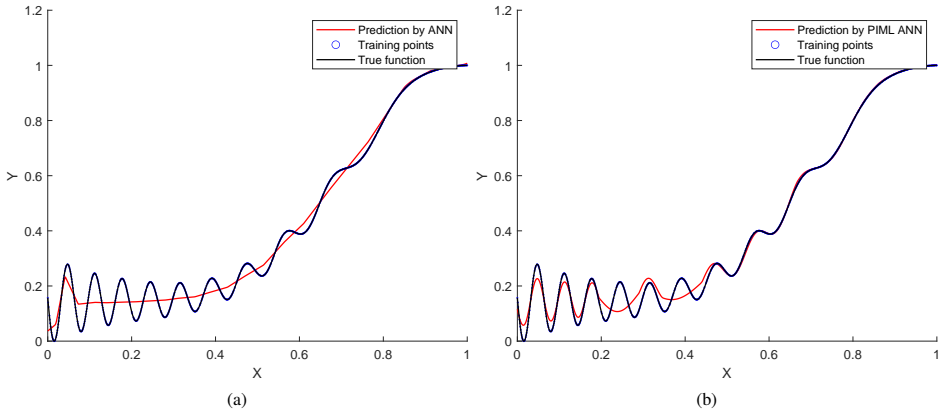
The paper's central claim is that a BNN-integrated PIML architecture — in which a Bayesian neural network outputs transfer parameters that enter a differentiable partial physics model — can predict both mean outputs and their uncertainties, with prediction performance slightly worse or at par with deterministic ANN, PIML-ANN, and BNN baselines. The mechanism is a two-stage training procedure that initializes the Bayesian layer with the weights of a previously trained deterministic PIML model, then refines with a combined MSE and ELBO loss, making the probabilistic training tractable. On the Gramacy & Lee benchmark the first-order Taylor propagation of Eq. (3) produced confidence bounds that deviated strongly from the true function, while end-to-end Monte Carlo sampling over the BNN weights recovered a meaningful uncertainty band; the same comparison on real flight data confirmed that PIML-BNN uncertainty plots track the data when Monte Carlo is used. The paper therefore establishes the BNN-as-transfer-net design as a viable route to model uncertainty in PIML, and identifies the propagation method—not the architecture—as the critical choice.
Load-bearing premise
The framework's efficiency claim rests on the assumption that a first-order Taylor expansion can adequately carry transfer-parameter uncertainties through the partial physics model, which the paper's own nonlinear benchmark contradicts.
Editorial extensions
If this is right
- Uncertainty-aware surrogates for engineering design can be obtained by swapping the ANN in an existing hybrid PIML for a BNN, without redesigning the partial physics model.
- The two-stage training recipe (deterministic pretrain, then Bayesian fine-tune with weight priors) is a practical route to training probabilistic networks inside hybrid architectures.
- End-to-end Monte Carlo sampling should be the default propagation method when the partial physics is nonlinear, because the Taylor expansion did not track the true function on the benchmark.
- The BNN-PIML model stays more accurate than the low-fidelity physics alone while providing confidence bounds, at a training-time premium of about a factor of seven to ten in the reported cases.
- In the aircraft case, the remaining accuracy shortfall on two force components points to the low-fidelity propeller model, not the Bayesian layer, as the main error source.
Reading between the lines
- The paper does not test how the Taylor-propagated bounds degrade as the partial physics becomes more nonlinear; a testable extension is to measure their coverage against end-to-end Monte Carlo across a family of physics models with increasing curvature.
- The result that 10 hidden units beat 200 on the simple benchmark suggests the transfer network's capacity affects uncertainty calibration, a relationship the paper leaves unexamined.
- If the drop-in idea generalizes, other probabilistic surrogates (for instance, Gaussian processes) could occupy the transfer-parameter role, and the two-stage pretraining idea would carry over to them.
Editorial analysis
A structured set of objections, weighed in public.
Referee Report
Summary. The paper proposes integrating Bayesian neural networks (BNNs) into differentiable hybrid physics-informed machine learning (PIML) architectures by replacing the ANN component with a BNN whose final layer is Bayesian, trained via a two-stage procedure (deterministic pretraining followed by an MSE plus ELBO objective). Uncertainty in the BNN transfer parameters is propagated through the partial physics model by either a first-order Taylor expansion (Eq. 3) or by end-to-end Monte Carlo sampling. The approach is evaluated on a multimodal Gramacy & Lee benchmark and on flight-test data from a fixed-wing RC aircraft, with prediction accuracy compared against ANN, BNN, PIML-ANN, and partial-physics baselines.
Significance. If the central efficiency claim were substantiated, the work would offer a practical recipe for adding uncertainty quantification to hybrid PIML surrogates without a large accuracy penalty. The two-stage training and last-layer Bayesian treatment are pragmatic and address known BNN training difficulties. However, the paper's own results show the proposed Taylor propagation producing poor confidence bounds on the analytical benchmark, and no quantitative reliability or runtime comparison is provided; the central contribution is therefore not yet demonstrated. The configuration tables and convergence plots are useful for reproducibility, but the evidence currently supports only a qualitative exploration, not a validated efficient-UQ method.
major comments (4)
- [II.C, Eq. (3), Figs. 7–8] The central efficiency claim rests on the first-order Taylor expansion in Eq. (3), but Fig. 7(b) shows that on the Gramacy & Lee benchmark the resulting 68% confidence bounds deviate dramatically from the true function, and the text then replaces this approach with end-to-end Monte Carlo simulations (Fig. 8). No coverage statistic, interval score, or wall-clock comparison is reported for the two propagation strategies. As a result, the paper does not establish that the Taylor approach is an efficient or adequate way to propagate uncertainty in hybrid PIML models; please add a quantitative accuracy-versus-cost comparison for both propagation methods on both case studies.
- [Table I vs. Fig. 8] The accuracy comparison in Fig. 6 and Table I uses PIML-BNN and BNN architectures with 200 nodes per layer, whereas the uncertainty results in Fig. 8 are obtained with 10 hidden units and 20 Monte Carlo runs. The final RMSE comparison is therefore not on the same architecture as the uncertainty evaluation, and the baselines (ANN/PIML-ANN) remain at 200 nodes. Please report results for matched architectures or explicitly present the hyperparameter search as a separate exploratory result.
- [IV, Figs. 7–11] The uncertainty estimates are only visualized as confidence bands; no quantitative calibration metric (e.g., empirical coverage, negative log-likelihood, interval score) is computed for any model. Without such a metric the claim that BNN-integrated PIML architectures successfully provision uncertainty propagation is not supported.
- [IV.B, Figs. 10–11] For the aircraft case study only Monte Carlo based uncertainty plots are shown; no Taylor-propagation results or runtime figures are presented for this more realistic problem. This leaves open whether the efficiency advantage claimed for Eq. (3) holds for the nonlinear VLM/propeller model. Please include Taylor-based results for this case or clearly state that the efficiency claim is restricted to the analytical benchmark.
minor comments (4)
- [Eq. (4)] The denominator in the printed expression for f_FP(x) appears to be 2(π(x−0.5)/4), which is inconsistent with the substitution f_FP(x)=f_PP(0.5+2 sin(π(x−0.5)/4)); it should likely be 2(0.5+2 sin(π(x−0.5)/4)).
- [Eq. (1) and surrounding text] Equation (1) uses p(ŷ(x)|D), but the surrounding text refers to p(y|x,θ) and θ inconsistently; please unify the notation for inputs, weights, and predictive distributions.
- [Appendix B] The phrase 'Monty Flight' in the convergence-history discussion is a typo; it should refer to the fixed-wing aircraft case study.
- [Abstract and Section V] The abstract's statement that Monte Carlo sampling was 'found to be most effective' is not supported by any quantitative uncertainty-quality comparison; please either add supporting metrics or soften the claim.
Circularity Check
No significant circularity: the BNN-PIML uncertainty comparison is anchored to external baselines and independent benchmarks; the failed Taylor approximation is a validation gap, not a circular derivation.
full rationale
The paper's central comparison is not circular. Eq. (3) is a standard first-order Taylor propagation rule, and the paper's own results (Section IV.A, Figs. 7 and 8) reject it in favor of end-to-end Monte Carlo sampling; no output quantity is defined as the fitted input, and no fitted parameter is relabeled as a prediction. The Gramacy and Lee analytic case uses a known transfer map only to construct the benchmark; the BNN must learn the transfer from (x, f_FP) training data, so the prediction is not equivalent to the input by construction. The two-stage training initializes BNN weights from the deterministic PIML-ANN, but the evaluation still compares PIML-BNN against PIML-ANN on held-out data and explicitly reports equal-or-worse accuracy, so the result is not forced. Self-citations to [1]-[3] supply the prior hybrid-PIML architecture and the BLOFI low-fidelity tool, but the uncertainty-propagation finding does not reduce to those citations; the flight case even points out propeller-solver limitations. The genuine weaknesses are empirical: no wall-clock cost comparison between Taylor and MC, no coverage or calibration metrics, and a hidden-unit count (10) selected after observing MC performance, which confounds the propagation-method comparison with model capacity. These are correctness and validation gaps, not circularity under the definitions used here.
Assumptions & free parameters
free parameters (5)
- lambda_ELBO
- num_mc_samples =
20
- transfer_net_hidden_units_analytical =
10
- learning_rate =
1e-4 (ANN/PIML-ANN), 1e-3 (BNN/PIML-BNN)
- transfer_parameter_choice_aircraft =
six inputs directly used as transfer parameters
assumptions (4)
- domain assumption First-order Taylor expansion (Eq. 3) adequately propagates uncertainty through the partial physics model
- domain assumption BLOFI VLM plus propeller solver is a valid low-fidelity partial physics model for the fixed-wing aircraft
- domain assumption Two-stage training with pretrained ANN weights as priors yields a valid posterior for the BNN
- standard math KL divergence and ELBO derivation in Appendix A
Cite this review
Pith. "Pith review of Exploring Efficient Quantification of Modeling Uncertainties with Differentiable Physics-Informed Machine Learning Architectures." pith.science (2026). https://pith.science/paper/LDT6F3LJ
@misc{pith2026250618247,
  author       = {Pith},
  title        = {Pith review of: Exploring Efficient Quantification of Modeling Uncertainties with Differentiable Physics-Informed Machine Learning Architectures},
  year         = {2026},
  howpublished = {\url{https://pith.science/paper/LDT6F3LJ}},
  note         = {Machine review of arXiv:2506.18247}
}
read the original abstract
Quantifying and propagating modeling uncertainties is crucial for reliability analysis, robust optimization, and other model-based algorithmic processes in engineering design and control. Now, physics-informed machine learning (PIML) methods have emerged in recent years as a new alternative to traditional computational modeling and surrogate modeling methods, offering a balance between computing efficiency, modeling accuracy, and interpretability. However, their ability to predict and propagate modeling uncertainties remains mostly unexplored. In this paper, a promising class of auto-differentiable hybrid PIML architectures that combine partial physics and neural networks or ANNs (for input transformation or adaptive parameter estimation) is integrated with Bayesian Neural networks (replacing the ANNs); this is done with the goal to explore whether BNNs can successfully provision uncertainty propagation capabilities in the PIML architectures as well, further supported by the auto-differentiability of these architectures. A two-stage training process is used to alleviate the challenges traditionally encountered in training probabilistic ML models. The resulting BNN-integrated PIML architecture is evaluated on an analytical benchmark problem and flight experiments data for a fixed-wing RC aircraft, with prediction performance observed to be slightly worse or at par with purely data-driven ML and original PIML models. Moreover, Monte Carlo sampling of probabilistic BNN weights was found to be most effective in propagating uncertainty in the BNN-integrated PIML architectures.
Figures


Figures from the paper (9 more)



Reference graph
Works this paper leans on
-
[1]
Physics infused machine learning based predic- tion of vtol aerodynamics with sparse datasets,
M. Oddiraju, D. Amin, M. Piedmonte, and S. Chowd- hury, “Physics infused machine learning based predic- tion of vtol aerodynamics with sparse datasets,” in AIAA AVIATION 2023 Forum, 2023, p. 4376
work page 2023
-
[2]
M. Oddiraju, J. Cleeman, R. Malhotra, and S. Chowd- hury, “A differentiable physics-informed machine learn- ing approach to model laser-based micro-manufacturing process,” Journal of Manufacturing Science and Engi- neering, pp. 1–13, Dec. 2024, ISSN : 1087-1357. DOI: 10.1115/1.4067355. [Online]. Available: https://doi.org/ 10.1115/1.4067355
-
[3]
Physics-informed machine learning towards a real-time spacecraft thermal simulator,
M. Oddiraju, Z. Hasnain, S. Bandyopadhyay, E. Sunada, and S. Chowdhury, “Physics-informed machine learning towards a real-time spacecraft thermal simulator,” in AIAA AVIATION FORUM AND ASCEND 2024 , 2024, p. 4204
work page 2024
-
[4]
Physics-informed machine learning,
G. E. Karniadakis, I. G. Kevrekidis, L. Lu, P. Perdikaris, S. Wang, and L. Yang, “Physics-informed machine learning,” Nature Reviews Physics , vol. 3, no. 6, pp. 422–440, 2021
2021
-
[5]
R. Rai and C. K. Sahu, “Driven by data or derived through physics? a review of hybrid physics guided machine learning techniques with cyber-physical system (cps) focus,” IEEE Access , vol. 8, pp. 71 050–71 073, 2020
work page 2020
-
[6]
Physics- informed neural networks for high-speed flows,
Z. Mao, A. D. Jagtap, and G. E. Karniadakis, “Physics- informed neural networks for high-speed flows,” Com- puter Methods in Applied Mechanics and Engineering , vol. 360, p. 112 789, 2020
work page 2020
-
[7]
M. Raissi, P. Perdikaris, and G. E. Karniadakis, “Physics-informed neural networks: A deep learning framework for solving forward and inverse problems involving nonlinear partial differential equations,” Jour- 0 0.2 0.4 0.6 0.8 1X-0.200.20.40.60.811.21.41.6Y 68% confidence bound of BNNMean Prediction of BNNTraining pointsTrue function (a) 0 0.2 0.4 0.6 0....
-
[8]
Analyses of internal structures and defects in mate- rials using physics-informed neural networks,
E. Zhang, M. Dao, G. E. Karniadakis, and S. Suresh, “Analyses of internal structures and defects in mate- rials using physics-informed neural networks,” Science advances, vol. 8, no. 7, eabk0644, 2022
work page 2022
Show all 46 references
-
[9]
Physics-informed neural networks (pinns) for fluid mechanics: A review,
S. Cai, Z. Mao, Z. Wang, M. Yin, and G. E. Karniadakis, “Physics-informed neural networks (pinns) for fluid mechanics: A review,” Acta Mechanica Sinica , vol. 37, no. 12, pp. 1727–1738, 2021
2021
-
[10]
A. D. Jagtap, K. Kawaguchi, and G. E. Karniadakis, “Adaptive activation functions accelerate convergence 0 20 40 60 80 100Data points-0.4-0.200.20.40.60.811.21.41.6Fx(N) 95% confidence bound of BNNMean Prediction of BNNTraining points (a) 0 20 40 60 80 100Data points-0.4 -0.2 ...
2020
-
[11]
Physics-informed neural networks with periodic activation functions for solute transport in heterogeneous porous media,
S. A. Faroughi, R. Soltanmohammadi, P. Datta, S. K. Mahjour, and S. Faroughi, “Physics-informed neural networks with periodic activation functions for solute transport in heterogeneous porous media,” Mathematics, vol. 12, no. 1, p. 63, 2023
2023
-
[12]
Fourier neural operator for parametric partial differential equa- tions,
Z. Li, N. Kovachki, K. Azizzadenesheli, et al., “Fourier neural operator for parametric partial differential equa- tions,” arXiv preprint arXiv:2010.08895 , 2020
2010 arXiv
-
[13]
Learning nonlinear operators via deeponet based on the universal approximation theorem of operators,
L. Lu, P. Jin, G. Pang, Z. Zhang, and G. E. Karniadakis, “Learning nonlinear operators via deeponet based on the universal approximation theorem of operators,” Nature Machine Intelligence, vol. 3, no. 3, pp. 218–229, 2021
2021
-
[14]
Scientific machine learning through physics–informed neural networks: Where we are and what’s next,
S. Cuomo, V . S. Di Cola, F. Giampaolo, G. Rozza, M. Raissi, and F. Piccialli, “Scientific machine learning through physics–informed neural networks: Where we are and what’s next,” Journal of Scientific Computing , vol. 92, no. 3, p. 88, 2022
2022
-
[15]
Investigating grey-box modeling for predictive analytics in smart manufacturing,
Z. Yang, D. Eddy, S. Krishnamurty, et al., “Investigating grey-box modeling for predictive analytics in smart manufacturing,” in International design engineering technical conferences and computers and information in engineering conference , American Society of Me- chanical En...
2017
-
[16]
A grey box soft- ware framework for sustainability assessment of com- posed manufacturing processes: A hybrid manufactur- ing case,
S. Manoharan and K. R. Haapala, “A grey box soft- ware framework for sustainability assessment of com- posed manufacturing processes: A hybrid manufactur- ing case,” Procedia CIRP, vol. 80, pp. 440–445, 2019
2019
-
[17]
A physically based and machine learning hybrid approach for accu- rate rainfall-runoff modeling during extreme typhoon events,
C.-C. Young, W.-C. Liu, and M.-C. Wu, “A physically based and machine learning hybrid approach for accu- rate rainfall-runoff modeling during extreme typhoon events,” Applied Soft Computing , vol. 53, pp. 205–216, 2017
2017
-
[18]
A com- bined neural-wavelet model for prediction of ligvanchai watershed precipitation,
V . Nourani, M. T. Alami, and M. H. Aminfar, “A com- bined neural-wavelet model for prediction of ligvanchai watershed precipitation,” Engineering Applications of Artificial Intelligence, vol. 22, no. 3, pp. 466–472, 2009
2009
-
[19]
Pi-lstm: Physics-infused long short-term memory network,
S. K. Singh, R. Yang, A. Behjat, R. Rai, S. Chowdhury, and I. Matei, “Pi-lstm: Physics-infused long short-term memory network,” in 2019 18th IEEE International Conference On Machine Learning And Applications (ICMLA), IEEE, 2019, pp. 34–41
2019
-
[20]
A robust & reliable data-driven prognostics approach based on extreme learning machine and fuzzy clustering.,
K. Javed, “A robust & reliable data-driven prognostics approach based on extreme learning machine and fuzzy clustering.,” Ph.D. dissertation, Universit ´e de Franche- Comt´e, 2014
2014
-
[21]
A fusion prognostics method for remaining useful life prediction of electronic prod- ucts,
S. Cheng and M. Pecht, “A fusion prognostics method for remaining useful life prediction of electronic prod- ucts,” in Automation Science and Engineering, 2009. CASE 2009. IEEE International Conference on , IEEE, 2009, pp. 102–107
2009
-
[22]
Physics-guided neural networks (pgnn): An applica- tion in lake temperature modeling,
A. Karpatne, W. Watkins, J. Read, and V . Kumar, “Physics-guided neural networks (pgnn): An applica- tion in lake temperature modeling,” arXiv preprint arXiv:1710.11431, 2017
2017 arXiv
-
[23]
Interval static displace- ment analysis for structures with interval parameters,
S. Chen, H. Lian, and X. Yang, “Interval static displace- ment analysis for structures with interval parameters,” International Journal for Numerical Methods in Engi- neering, vol. 53, no. 2, pp. 393–407, 2002
2002
-
[24]
Im- proving interval analysis in finite element calculations by means of affine arithmetic,
D. Degrauwe, G. Lombaert, and G. De Roeck, “Im- proving interval analysis in finite element calculations by means of affine arithmetic,” Computers & structures, vol. 88, no. 3-4, pp. 247–254, 2010
2010
-
[25]
Uncertainty quantification in dynamic system risk assessment: A new approach with randomness and fuzzy theory,
H. Abdo and J.-M. Flaus, “Uncertainty quantification in dynamic system risk assessment: A new approach with randomness and fuzzy theory,” International Journal of Production Research, vol. 54, no. 19, pp. 5862–5885, 2016
2016
-
[26]
Modern monte carlo methods for efficient uncertainty quantification and propagation: A survey,
J. Zhang, “Modern monte carlo methods for efficient uncertainty quantification and propagation: A survey,” Wiley Interdisciplinary Reviews: Computational Statis- tics, vol. 13, no. 5, e1539, 2021
2021
-
[27]
Bayesian neural networks for uncertainty quan- tification in data-driven materials modeling,
A. Olivier, M. D. Shields, and L. Graham-Brady, “Bayesian neural networks for uncertainty quan- tification in data-driven materials modeling,” Com- puter methods in applied mechanics and engineering , vol. 386, p. 114 079, 2021
2021
-
[28]
M. Farid, “Data-driven method for real-time prediction and uncertainty quantification of fatigue failure under stochastic loading using artificial neural networks and gaussian process regression,” International Journal of Fatigue, vol. 155, p. 106 415, 2022
2022
-
[29]
Physics-informed gaussian process regression generalizes linear pde solvers,
M. Pf ¨ortner, I. Steinwart, P. Hennig, and J. Wenger, “Physics-informed gaussian process regression generalizes linear pde solvers,” arXiv preprint arXiv:2212.12474, 2022
2022 arXiv
-
[30]
Flow field tomogra- phy with uncertainty quantification using a bayesian physics-informed neural network,
J. P. Molnar and S. J. Grauer, “Flow field tomogra- phy with uncertainty quantification using a bayesian physics-informed neural network,” Measurement Sci- ence and Technology, vol. 33, no. 6, p. 065 305, 2022
2022
-
[31]
Bayesian physics-informed neural net- works for inverse uncertainty quantification problems in cardiac electrophysiology,
D. Ceccarelli, “Bayesian physics-informed neural net- works for inverse uncertainty quantification problems in cardiac electrophysiology,” 2021
2021
-
[32]
Physically interpretable machine learning for nu- clear masses,
M. Mumpower, T. Sprouse, A. Lovell, and A. Mo- han, “Physically interpretable machine learning for nu- clear masses,” Physical Review C , vol. 106, no. 2, p. L021301, 2022
2022
-
[33]
Uncertainty quan- tification for additive manufacturing process improve- ment: Recent advances,
S. Mahadevan, P. Nath, and Z. Hu, “Uncertainty quan- tification for additive manufacturing process improve- ment: Recent advances,” ASCE-ASME Journal of Risk and Uncertainty in Engineering Systems, Part B: Me- chanical Engineering, vol. 8, no. 1, p. 010 801, 2022
2022
-
[34]
Information fusion and machine learning for sensitivity analysis using physics knowledge and experimental data,
B. Kapusuzoglu and S. Mahadevan, “Information fusion and machine learning for sensitivity analysis using physics knowledge and experimental data,” Reliability Engineering & System Safety , vol. 214, p. 107 712, 2021
2021
-
[35]
A physics-informed machine learning approach for notch fatigue evaluation of alloys used in aerospace,
W. Hao, L. Tan, X. Yang, et al. , “A physics-informed machine learning approach for notch fatigue evaluation of alloys used in aerospace,” International Journal of Fatigue, vol. 170, p. 107 536, 2023
2023
-
[36]
Physics-informed machine learning for reliabil- ity and systems safety applications: State of the art and challenges,
Y . Xu, S. Kohtz, J. Boakye, P. Gardoni, and P. Wang, “Physics-informed machine learning for reliabil- ity and systems safety applications: State of the art and challenges,” Reliability Engineering & System Safety , vol. 230, p. 108 900, 2023
2023
-
[37]
Fuks, Physics Informed Machine Learning and Uncertainty Propagation for Multiphase Transport in Porous Media
O. Fuks, Physics Informed Machine Learning and Uncertainty Propagation for Multiphase Transport in Porous Media. Stanford University, 2020
2020
-
[38]
Mul- tiaxial fatigue prediction and uncertainty quantification based on back propagation neural network and gaussian process regression,
J. Gao, J. Wang, Z. Xu, C. Wang, and S. Yan, “Mul- tiaxial fatigue prediction and uncertainty quantification based on back propagation neural network and gaussian process regression,” International Journal of Fatigue , vol. 168, p. 107 361, 2023, ISSN : 0142-1123. DOI: https: ...
2023
-
[39]
Bayesian neural networks: An introduction and survey,
E. Goan and C. Fookes, “Bayesian neural networks: An introduction and survey,” Case Studies in Applied Bayesian Data Science: CIRM Jean-Morlet Chair, Fall 2018, pp. 45–87, 2020
2018
-
[40]
What uncertainties do we need in bayesian deep learning for computer vision?
A. Kendall and Y . Gal, “What uncertainties do we need in bayesian deep learning for computer vision?” Advances in neural information processing systems , vol. 30, 2017
2017
-
[41]
Taking the human out of the loop: A review of bayesian optimization,
B. Shahriari, K. Swersky, Z. Wang, R. P. Adams, and N. De Freitas, “Taking the human out of the loop: A review of bayesian optimization,” Proceedings of the IEEE, vol. 104, no. 1, pp. 148–175, 2015
2015
-
[42]
Uncertainty decomposition in bayesian neural networks with latent variables,
S. Depeweg, J. M. Hern ´andez-Lobato, F. Doshi-Velez, and S. Udluft, “Uncertainty decomposition in bayesian neural networks with latent variables,” arXiv preprint arXiv:1706.08495, 2017
2017 arXiv
-
[43]
Bayesian and markov chain monte carlo methods for identifying nonlinear systems in the presence of uncertainty,
P. L. Green and K. Worden, “Bayesian and markov chain monte carlo methods for identifying nonlinear systems in the presence of uncertainty,” Philosophical Transactions of the Royal Society A: Mathematical, Physical and Engineering Sciences , vol. 373, no. 2051, p. 20 140 405, 2015
2015
-
[44]
Stochastic variational inference,
M. D. Hoffman, D. M. Blei, C. Wang, and J. Paisley, “Stochastic variational inference,” the Journal of ma- chine Learning research, vol. 14, no. 1, pp. 1303–1347, 2013. APPENDIX APPENDIX A: KL- DIVERGENCE AND ELBO To get the intractable posterior distribution in variational in...
2013
-
[45]
Formalizing a notion of similarity between two probability distributions
-
[46]
Writing down a tractable optimization problem that corre- sponds to maximizing this notion of similarity We use the Kullback-Liebler divergence (or KL-divergence) to convey dissimilarity between two distributions. Expression for KL-divergence between approximate posterior (qϕ(...
Reviewed August 6, 2026 · model on record in the stance chip above.
Discussion (0). Continue with ORCID to comment.