REVIEW 3 major objections 6 minor 94 references
The paper argues that the 45-year quiescent X-ray glow of the accreting millisecond pulsar SRGA J144459.2-604207 can be explained by deep crustal heating, not by the companion star's corona.
Reviewed by Pith at T0; open to challenge. T0 means a machine referee read the full paper against a public rubric. the ladder, T0–T4 →
T0 review · deepseek-v4-flash
2026-08-01 23:56 UTC pith:LDTZQOZB
load-bearing objection Solid spectral decay study with a useful archival upper-limit compilation, but the deep-crustal-heating claim is a consistency check with large uncertainties, not a quantitative match. the 3 major comments →
Spectral study of the outburst decay of the accreting millisecond X-ray pulsar SRGA J144459.2-604207
The pith
A machine-rendered reading of the paper's core claim, the machinery that carries it, and where it could break.
Core claim
On the paper's own terms, the central discovery is that the quiescent X-ray emission of SRGA J144459.2-604207, traced through upper limits across five decades, is consistent with the deep crustal heating model: with an estimated time-averaged accretion rate of about 8.4×10^15 g/s, the predicted bolometric thermal luminosity is about 1.6×10^34 erg/s, which falls inside the archival upper-limit range of 0.4–2.2×10^34 erg/s, while the donor star's corona (about 10^32 erg/s) cannot account for it. The paper also reports the 2024 outburst decay: the X-ray spectrum softens as the source fades, the flux drops by roughly a factor of 40 into quiescence, several reflares occur, and one reflare is near
What carries the argument
The deep crustal heating model, in which nuclear reactions in the neutron star's crust store energy during outbursts and release it as thermal X-rays in quiescence, with the identity L_th,bol = ⟨Ṁ⟩ Q_nuc / m_u ≈ 1.9×10^18 ⟨Ṁ⟩ for Q_nuc ≈ 2 MeV per accreted nucleon. The paper feeds this identity with a time-averaged accretion rate ⟨Ṁ⟩ ≈ ⟨Ṁ_obs⟩ × t_out / t_recur, using the 2024 outburst's roughly 30-day duration and a roughly 1.04-year recurrence time inferred from sparse detections in 2022, 2023, and 2024. This energy-budget relation is the mechanism that connects the observed 2024 outburst to the archival 45-year quiescent upper limits.
Load-bearing premise
The match hinges on assuming that the 2024 outburst — about 30 days long with a recurrence time of about 1.04 years — represents the neutron star's average accretion history; the paper's own lifetime-average feeding-rate estimate is eight times lower, which would shrink the predicted glow below the archival limits.
What would settle it
Monitor the source with an all-sky X-ray instrument for the next several years. If no new outburst occurs within roughly two years, or if the next outbursts are shorter or fainter than the 2024 one, the time-averaged accretion rate drops below about 4×10^15 g/s and the predicted crustal luminosity falls below about 8×10^33 erg/s, underneath the lowest archival upper limits; the claimed fit would then fail.
If this is right
- The source becomes another accreting millisecond pulsar whose long-term quiescent emission is consistent with deep crustal heating rather than with the companion star's corona.
- The companion star's corona alone cannot power the quiescent X-ray luminosity, so future quiescent variability is better attributed to neutron-star cooling or residual accretion.
- During reflares and the 2024 quiescent state the source luminosity exceeded the estimated propeller luminosity, meaning the magnetosphere did not prevent material from reaching the neutron star.
- The near-simultaneous reflare, ultrafast outflow, and radio emission in February 2024 are consistent with a jet launched during an accretion reflare, similar to behavior seen in another accreting millisecond pulsar.
- Continuous all-sky monitoring of future outbursts can test the assumed recurrence time and tighten or overturn the predicted quiescent luminosity.
Where Pith is reading between the lines
- The paper leaves unresolved that the 2024 quiescent luminosity measured directly (roughly 3–8×10^35 erg/s) is an order of magnitude above the archival upper limits; a natural reading is that the 2024 emission included residual accretion or a slow decay component, not pure crustal cooling — a distinction that can be tested by tracking the decay over the next months to see whether it settles near 10
- Because the crustal-heating prediction scales linearly with recurrence time, a future monitoring campaign that finds the true recurrence time is, e.g., twice as long would cut the predicted luminosity to about 8×10^33 erg/s, below the archival range; the agreement presented here would then be a coincidence rather than a confirmation.
- The single-epoch placement on the radio–X-ray plane is only weakly constraining, since accreting millisecond pulsars scatter by orders of magnitude in radio luminosity at fixed X-ray luminosity; a dense radio-X-ray campaign across the next outburst decay could reveal whether this source follows the usual correlation or is an outlier.
- The ~0.9 keV blackbody component found in the 2024 quiescent spectra is hotter than the ~0.1–0.3 keV usually associated with crustal cooling; if it persists, it points to ongoing shallow heating or residual accretion on top of the crustal heat.
Editorial analysis
A structured set of objections, weighed in public.
Referee Report
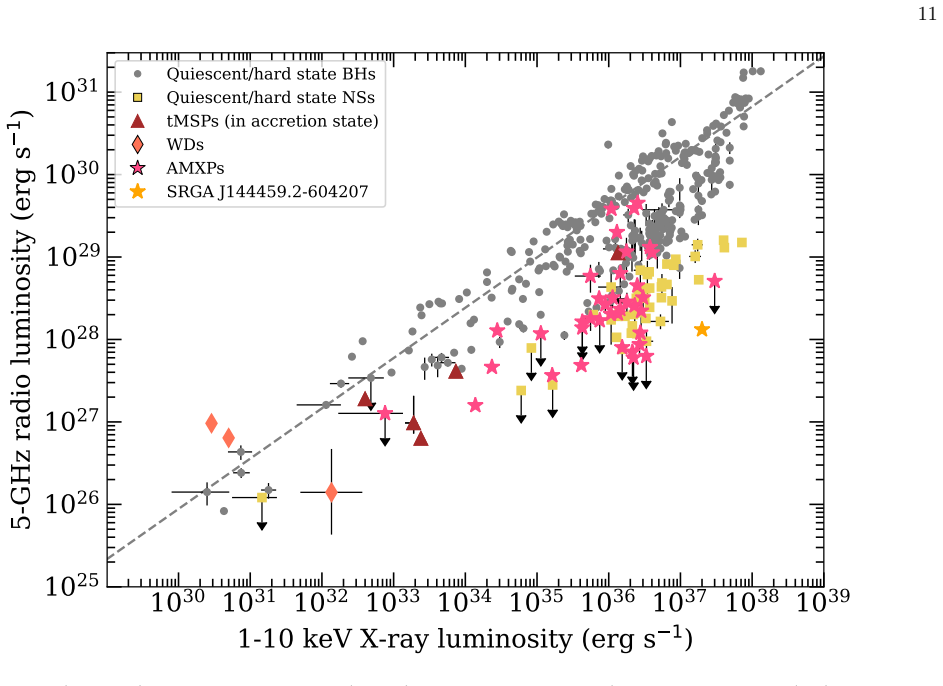
Summary. The paper presents a spectral study of the accreting millisecond X-ray pulsar SRGA J144459.2-604207 during the decay of its 2024 outburst, using NICER and Swift observations. The outburst-decay and reflare spectra are fitted with an absorbed Comptonized model, and the quiescent spectra are also described with absorbed power-law and blackbody models. The paper then compiles archival X-ray upper limits covering roughly 45 years and argues that the long-term quiescent luminosity can be explained by deep crustal heating, with a predicted bolometric thermal luminosity L_th,bol ~1.6e34 erg/s based on an estimated average mass accretion rate. Additional sections place the source on the radio-X-ray luminosity plane, estimate the propeller luminosity, and discuss the possible association of a reflare with an ultrafast outflow and radio emission.
Significance. If the crustal-heating interpretation is correct, the paper adds a new AMXP data point to the sparse set of sources with long quiescent histories and measured outburst properties. The compilation of archival upper limits from Einstein, ROSAT, INTEGRAL, Swift, XMM-Newton, and eROSITA is useful, and the spectral fitting is standard and generally careful. The analysis of the reflare/outflow/radio connection is also of interest. However, the central crustal-heating claim rests on a duty-cycle estimate (t_recur ~1.04 yr) derived from only three sparse archival detections, with no quoted uncertainty and with the paper itself noting that the estimate is likely overestimated. The quantitative match with the upper limits is therefore not yet robust; the paper is honest about the caveats, but the caveats undercut rather than support the specific adopted value. With better propagation of uncertainties and a clearer treatment of the 2024 'quiescent' level versus the long-term limits, the claim could become a credible confirmation.
major comments (3)
- [§3.4, Eq. (1)] The central crustal-heating prediction is L_th,bol = 1.6e34 erg/s, obtained from <Mdot> = <Mdot_obs> × t_out/t_recur. The estimate t_recur ≈ 1.04 yr is derived from three archival detections (2022 Jan, 2023 Dec, 2024 Feb) with intervals of ~23 and ~2 months, and no uncertainty is given. Two of the detections are described as 'faint state' rather than confirmed outbursts. If the 2022/2023 detections are part of one prolonged low-level episode, t_recur is ≥2 yr and L_th drops by at least a factor ~2; if one uses the lifetime-averaged mass-transfer rate quoted later in the same section (1.6e-11 M_sun/yr, a factor 8 lower), L_th ≈ 2e33 erg/s, below the tightest archival upper limits. The paper itself notes that the adopted values are likely overestimated, so the 'match' is not a robust central prediction. In addition, the conversion from the mean outburst flux (1.6e-9 erg/cm2/s) to <Mdot_obs
- [§3.4 and Table 4] The paper states L_th ≈ 1.6e34 erg/s is 'comparable' to the 0.4–2.2e34 erg/s range of archival upper limits. But the two most sensitive limits (Einstein 1979 and ROSAT 1992) correspond to ~0.26–0.35e34 erg/s for the same distance and assumptions, i.e., a factor ~5 below the predicted value. Since these are upper limits, the model prediction as computed is formally inconsistent with those observations. The comparison should be re-framed: state the factor by which the adopted rates would need to be lowered, propagate the uncertainty in t_recur, and apply a consistent bolometric correction. As written, the agreement is largely an artifact of comparing with the upper end of the upper-limit range.
- [§3.2.3 vs §3.4] The NICER 'quiescent' luminosities in 2024 April (3.3–7.5e35 erg/s, Table 3) are one to two orders of magnitude above the archival long-term upper limits (0.4–2.2e34 erg/s) used for the crustal-heating comparison. The paper does not reconcile this discrepancy. Either the 2024 state is still dominated by residual accretion/reflaring and is not representative of true quiescence, or the source's quiescent level has changed; both possibilities have implications for the crustal-heating interpretation. Please add a quantitative discussion and, if the 2024 state is not used in the crustal-heating comparison, state this explicitly and justify the choice.
minor comments (6)
- [Throughout] The source name is inconsistent: 'SRGA J144459.2-60420' appears in the Section 3.4 title and elsewhere; it should be 'SRGA J144459.2-604207'.
- [§3.2.3] The first quiescent epoch is listed as 2024 March 14 (MJD 60383.1), but Obs. ID 6639080116 starts at MJD 60392.05 (2024 March 23). The text and Table 1 appear mismatched. Also, the second Swift observation (MJD 60378.3) is used in Section 3.3 but is not reported in Table 2.
- [§3.4] The text says the upper limits span '1979-2023', but Table 4 ends at eROSITA 2020; the 2022/2023 detections are outburst/faint detections, not upper limits. Please clarify the time span.
- [Figures 1 and 2] The shading is described in the captions, but Figure 2's yellow regions are single reflare epochs rather than a continuous 'outburst/reflare' interval; consider making the caption consistent with the plotted epochs.
- [Table 1] Several NICER exposures are very short (133-578 s). The text mentions that some epochs were background-dominated and excluded, but the quantitative exclusion criterion is not stated. Please specify how many and which epochs were excluded.
- [Acknowledgments] The acknowledgments include 'We are thankful to the reviewer for carefully going through the manuscript...' which is unusual in a submitted draft and should be removed or revised.
Circularity Check
No significant circularity: the deep-crustal-heating estimate is a forward calculation with external model constants; the weak t_recur constraint is a data-limitation, not a circular step.
full rationale
The central claim (Sec. 3.4) computes L_th,bol from Eq. 1 using Q_nuc and ⟨Mdot⟩ = ⟨Mdot_obs⟩ x t_out/t_recur. L_th is not fitted to the archival upper limits; it is compared with them, and the comparison is explicitly framed as 'may be explained'/'comparable.' The inputs (peak flux, MAXI average count rate, t_out = 30 d, t_recur ≈ 1.04 yr from archival detections, distance ≈ 10 kpc) come from independent observations, and the crustal-heating constants are cited to external literature (Brown et al. 1998; Degenaar et al. 2012; Gupta et al. 2007; Haensel & Zdunik 2008). The paper itself discloses that t_out and t_recur 'are not very well constrained in this source' and that both mass-transfer estimates 'are likely to be overestimated.' That is a robustness caveat, not a definitional reduction. No fitted parameter is relabeled as a prediction, and no uniqueness claim is imported from the author's own prior work. Self-citations to A. D. Chandra (2020, 2021, 2023, 2024, 2025, 2026) occur for contextual comparisons and for standard Alfvén/co-rotation radius formulas (Eqs. 3-4), none of which is load-bearing for the crustal-heating claim; those formulas are also standard textbook results. The main weakness (recurrence time inferred from sparse 'faint state' detections) is a data-constraint issue and a correctness-risk concern, not circularity.
Axiom & Free-Parameter Ledger
free parameters (5)
- t_recur (outburst recurrence time) =
~1.04 yr
- t_out (outburst duration) =
~30 d
- average outburst flux scale =
⟨Ṁ_obs⟩ ~1.6e-9 erg s^-1 cm^-2 implied
- kTe (Swift outburst-decay) =
5 keV (fixed)
- kTbb (quiescent NICER) =
0.1 keV (fixed)
axioms (5)
- domain assumption L_th = 1.9e18 ⟨Ṁ⟩ with Q_nuc ≈ 2 MeV/nucleon (deep crustal heating)
- ad hoc to paper t_recur ≈ 1.04 yr and t_out ≈ 30 d are representative of the long-term accretion duty cycle
- domain assumption Distance = 10 kpc
- ad hoc to paper Spectral shape is constant for MAXI count-rate-to-flux and NICER count-rate-to-luminosity conversions
- domain assumption Propeller/jet formulas with standard coefficients (k=0.5, ξ=0.5, η=0.1, f_ang=1, k_A=1)
read the original abstract
We study the spectra of the accreting X-ray millisecond pulsar SRGA J144459.2-604207 during the 2024 outburst using the Neutron star Interior Composition Explorer (NICER) and Swift observations. The spectra during the outburst decay, reflares, and quiescent state are explored using the absorbed Comptonized model. We find that the spectra during the quiescent state can also be explained using the absorbed power-law and absorbed blackbody model. The spectral evolution of the source is explored as the outburst decays into quiescence. We study the long-term quiescent X-ray activity of the source spanning roughly 45 years and find that the long-term quiescent luminosity may be explained using the deep crustal heating model. We also find that the coronal activity of the companion star alone cannot power the quiescent X-ray luminosity of the source. We place the source on the radio-X-ray luminosity plane and compare its position with other sources. We estimate the propeller luminosity of the source and find that it is smaller than the estimated luminosity during reflares and the quiescent state during the 2024 outburst. Several reflares are detected during the outburst decay, one of which is near-simultaneous with the detection of an ultrafast outflow and radio emission. We explore plausible mechanisms that may power outflow, radio emission and associated jet formation in this accreting binary.
Figures



Reference graph
Works this paper leans on
-
[1]
1996, in ASP Conf
Arnaud, K. 1996, in ASP Conf. Ser. 101, Astronomical Data Analysis Software and Systems V, ed. G. H. Jacoby & J. Barnes (San Francisco, CA: ASP), Vol. 17
1996
-
[2]
1995, in Astronomical Data Analysis Software and Systems IV, Vol
Blackburn, J. 1995, in Astronomical Data Analysis Software and Systems IV, Vol. 77, 367
1995
-
[3]
T., Miller-Jones, J
Bogdanov, S., Deller, A. T., Miller-Jones, J. C., et al. 2018, The Astrophysical Journal, 856, 54
2018
-
[4]
F., Bildsten, L., & Rutledge, R
Brown, E. F., Bildsten, L., & Rutledge, R. E. 1998, The Astrophysical Journal, 504, L95
1998
-
[5]
2021, Monthly Notices of the Royal Astronomical Society, 503, 5600
Buisson, D., Altamirano, D., Armas Padilla, M., et al. 2021, Monthly Notices of the Royal Astronomical Society, 503, 5600
2021
-
[6]
2009, The Astrophysical Journal, 694, L21
Cackett, E., Altamirano, D., Patruno, A., et al. 2009, The Astrophysical Journal, 694, L21
2009
-
[7]
2022, Monthly Notices of the Royal Astronomical Society: Letters, 517, L21
Carotenuto, F., Corbel, S., & Tzioumis, A. 2022, Monthly Notices of the Royal Astronomical Society: Letters, 517, L21
2022
-
[8]
2021, Monthly Notices of the Royal Astronomical Society: Letters, 505, L58
Carotenuto, F., Corbel, S., Tremou, E., et al. 2021, Monthly Notices of the Royal Astronomical Society: Letters, 505, L58
2021
-
[9]
Chandra, A. D. 2024, The Astronomer’s Telegram, 16471, 1
2024
-
[10]
Chandra, A. D. 2025, Publications of the Astronomical Society of Australia, 42, e037
2025
-
[11]
Chandra, A. D. 2026, Journal of High Energy Astrophysics, 49, 100429
2026
-
[12]
D., Roy, J., & Agrawal, P
Chandra, A. D., Roy, J., & Agrawal, P. C. 2023, Research in Astronomy and Astrophysics, 23, 045003
2023
-
[13]
D., Roy, J., Agrawal, P
Chandra, A. D., Roy, J., Agrawal, P. C., & Choudhury, M. 2020, Monthly Notices of the Royal Astronomical Society, 495, 2664
2020
-
[14]
D., Roy, J., Agrawal, P
Chandra, A. D., Roy, J., Agrawal, P. C., & Choudhury, M. 2021, Monthly Notices of the Royal Astronomical Society, 508, 4429
2021
-
[15]
J., et al
Chomiuk, L., Strader, J., Maccarone, T. J., et al. 2013, The Astrophysical Journal, 777, 69
2013
-
[16]
2002, The Astrophysical Journal, 580, 394
Coburn, W., Heindl, W., Rothschild, R., et al. 2002, The Astrophysical Journal, 580, 394
2002
-
[17]
2013, Monthly Notices of the Royal Astronomical Society, 428, 2500
Corbel, S., Coriat, M., Brocksopp, C., et al. 2013, Monthly Notices of the Royal Astronomical Society, 428, 2500
2013
-
[18]
2003, Astronomy & Astrophysics, 400, 1007
Markoff, S. 2003, Astronomy & Astrophysics, 400, 1007
2003
-
[19]
2006, The Astrophysical Journal, 636, 971
Corbel, S., Tomsick, J., & Kaaret, P. 2006, The Astrophysical Journal, 636, 971
2006
-
[20]
2024, The Astronomer’s Telegram, 16477, 1
Cowie, F., Gillanders, J., Rhodes, L., et al. 2024, The Astronomer’s Telegram, 16477, 1
2024
-
[21]
2012, The Astrophysical Journal, 756, 148
Degenaar, N., Patruno, A., & Wijnands, R. 2012, The Astrophysical Journal, 756, 148
2012
-
[22]
2015, The Astrophysical Journal, 809, 13
Deller, A., Moldon, J., Miller-Jones, J., et al. 2015, The Astrophysical Journal, 809, 13
2015
-
[23]
C., Linsky, J
Dempsey, R. C., Linsky, J. L., Fleming, T. A., & Schmitt, J. 1993, Astrophysical Journal Supplement Series (ISSN 0067-0049), vol. 86, no. 2, p. 599-609., 86, 599 Din¸ cer, T., Bailyn, C. D., Miller-Jones, J. C., Buxton, M., & MacDonald, R. K. 2017, The Astrophysical Journal, 852, 4
1993
-
[24]
2025, Publications of the Astronomical Society of Japan, 77, L17
Dohi, A., Nishimura, N., Hirai, R., et al. 2025, Publications of the Astronomical Society of Japan, 77, L17
2025
-
[25]
2010, Monthly Notices of the Royal Astronomical Society, 403, 61
Dunn, R., Fender, R., K¨ ording, E., Belloni, T., & Cabanac, C. 2010, Monthly Notices of the Royal Astronomical Society, 403, 61
2010
-
[26]
2009, Monthly Notices of the Royal Astronomical Society, 397, 1177
Evans, P., Beardmore, A., Page, K., et al. 2009, Monthly Notices of the Royal Astronomical Society, 397, 1177
2009
-
[27]
R., & Raine, D
Frank, J., King, A. R., & Raine, D. 2002, Accretion power in astrophysics (Cambridge university press)
2002
-
[28]
2025, The Astrophysical Journal, 980, 161
Fu, T., Li, Z., Pan, Y., et al. 2025, The Astrophysical Journal, 980, 161
2025
-
[29]
P., Miller-Jones, J., et al
Gallo, E., Fender, R. P., Miller-Jones, J., et al. 2006, Monthly Notices of the Royal Astronomical Society, 370, 1351
2006
-
[30]
P., & Pooley, G
Gallo, E., Fender, R. P., & Pooley, G. G. 2003, Monthly Notices of the Royal Astronomical Society, 344, 60
2003
-
[31]
P., & Fender, R
Gallo, E., Miller, B. P., & Fender, R. 2012, Monthly Notices of the Royal Astronomical Society, 423, 590
2012
-
[32]
2014, Monthly Notices of the Royal Astronomical Society, 445, 290
Gallo, E., Miller-Jones, J., Russell, D., et al. 2014, Monthly Notices of the Royal Astronomical Society, 445, 290
2014
-
[33]
2023, Monthly Notices of the Royal Astronomical Society, 521, 2806
Gasealahwe, K., Monageng, I., Fender, R., et al. 2023, Monthly Notices of the Royal Astronomical Society, 521, 2806
2023
-
[34]
2004, The Astrophysical Journal, 611, 1005
Gehrels, N., Chincarini, G., Giommi, P., et al. 2004, The Astrophysical Journal, 611, 1005
2004
-
[35]
C., Arzoumanian, Z., Adkins, P
Gendreau, K. C., Arzoumanian, Z., Adkins, P. W., et al. 2016, in Space telescopes and instrumentation 2016: Ultraviolet to gamma ray, Vol. 9905, SPIE, 420–435
2016
-
[36]
1978, Astrophysical Journal, Part 2-Letters to the Editor, vol
Ghosh, P., & Lamb, F. 1978, Astrophysical Journal, Part 2-Letters to the Editor, vol. 223, July 15, 1978, p. L83-L87., 223, L83
1978
-
[37]
F., Schatz, H., M¨ oller, P., & Kratz, K.-L
Gupta, S., Brown, E. F., Schatz, H., M¨ oller, P., & Kratz, K.-L. 2007, The Astrophysical Journal, 662, 1188
2007
-
[38]
2017, Monthly Notices of the Royal Astronomical Society, 470, 1871
Gusinskaia, N., Deller, A., Hessels, J., et al. 2017, Monthly Notices of the Royal Astronomical Society, 470, 1871
2017
-
[39]
2020, Monthly Notices of the Royal Astronomical Society, 492, 1091
Gusinskaia, N., Russell, T., Hessels, J., et al. 2020, Monthly Notices of the Royal Astronomical Society, 492, 1091
2020
-
[40]
2008, Astronomy & Astrophysics, 480, 459 15
Haensel, P., & Zdunik, J. 2008, Astronomy & Astrophysics, 480, 459 15
2008
-
[41]
R., Millman, K
Harris, C. R., Millman, K. J., Van Der Walt, S. J., et al. 2020, Nature, 585, 357 HI4PI Collaboration, Bekhti, N. B., Fl¨ oer, L., et al. 2016, Astronomy & Astrophysics, 594, A116
2020
-
[42]
2011, Monthly Notices of the Royal Astronomical Society, 415, 235
Hill, A., Szostek, A., Corbel, S., et al. 2011, Monthly Notices of the Royal Astronomical Society, 415, 235
2011
-
[43]
Hunter, J. D. 2007, Computing in science & engineering, 9, 90
2007
-
[44]
2009, Monthly Notices of the Royal Astronomical Society, 400, 492
Ibragimov, A., & Poutanen, J. 2009, Monthly Notices of the Royal Astronomical Society, 400, 492
2009
-
[45]
2024, The Astronomer’s Telegram, 16510, 1 Jim´ enez-Ibarra, F., Mu˜ noz-Darias, T., Armas Padilla, M., et al
Illiano, G., Coti Zelati, F., Marino, A., et al. 2024, The Astronomer’s Telegram, 16510, 1 Jim´ enez-Ibarra, F., Mu˜ noz-Darias, T., Armas Padilla, M., et al. 2019, Monthly Notices of the Royal Astronomical Society, 484, 2078
2024
-
[46]
2016, Astronomy & Astrophysics, 587, A151
Kaastra, J., & Bleeker, J. 2016, Astronomy & Astrophysics, 587, A151
2016
-
[47]
A., Buxton, M., et al
Kalemci, E., Tomsick, J. A., Buxton, M., et al. 2005, The Astrophysical Journal, 622, 508 K¨ onig, O., Saxton, R. D., Kretschmar, P., et al. 2022, Astronomy and Computing, 38, 100529
2005
-
[48]
2025, arXiv preprint arXiv:2507.00793
Li, Z., Kuiper, L., Pan, Y., et al. 2025, arXiv preprint arXiv:2507.00793
Pith/arXiv arXiv 2025
-
[49]
2025, arXiv preprint arXiv:2502.08239
Malacaria, C., Papitto, A., Campana, S., et al. 2025, arXiv preprint arXiv:2502.08239
Pith/arXiv arXiv 2025
-
[50]
2016, Nature, 537, 374
Marsh, T., G¨ ansicke, B., H¨ ummerich, S., et al. 2016, Nature, 537, 374
2016
-
[51]
Massi, M., & Bernad´ o, M. K. 2008, Astronomy & Astrophysics, 477, 1
2008
-
[52]
2009, Publications of the Astronomical Society of Japan, 61, 999
Matsuoka, M., Kawasaki, K., Ueno, S., et al. 2009, Publications of the Astronomical Society of Japan, 61, 999
2009
-
[53]
2024, The Astronomer’s Telegram, 16464, 1
Mereminskiy, I., Semena, A., Molkov, S., et al. 2024, The Astronomer’s Telegram, 16464, 1
2024
-
[54]
2003, Monthly Notices of the Royal Astronomical Society, 345, 1057
Merloni, A., Heinz, S., & Di Matteo, T. 2003, Monthly Notices of the Royal Astronomical Society, 345, 1057
2003
-
[55]
2011, Monthly Notices of the Royal Astronomical Society, 415, 2407
Migliari, S., Miller-Jones, J., & Russell, D. 2011, Monthly Notices of the Royal Astronomical Society, 415, 2407
2011
-
[56]
2024, The Astronomer’s Telegram, 16469, 1
Mihara, T., Negoro, H., Nakajima, M., et al. 2024, The Astronomer’s Telegram, 16469, 1
2024
-
[57]
2010, The astronomer’s telegram, 2377, 1
Miller-Jones, J., Heinke, C., Sivakoff, G., et al. 2010, The astronomer’s telegram, 2377, 1
2010
-
[58]
2011, The Astrophysical Journal Letters, 739, L18
Miller-Jones, J., Jonker, P., Maccarone, T., Nelemans, G., & Calvelo, D. 2011, The Astrophysical Journal Letters, 739, L18
2011
-
[59]
C., Strader, J., Heinke, C
Miller-Jones, J. C., Strader, J., Heinke, C. O., et al. 2015, Monthly Notices of the Royal Astronomical Society, 453, 3918
2015
-
[60]
V., Lutovinov, A
Molkov, S. V., Lutovinov, A. A., Tsygankov, S. S., et al. 2024, Astronomy & Astrophysics, 690, A353
2024
-
[61]
E., Casella, P., & Fender, R
Motta, S. E., Casella, P., & Fender, R. 2018, Monthly Notices of the Royal Astronomical Society, 478, 5159
2018
-
[62]
2015, Monthly Notices of the Royal Astronomical Society, 452, 3994 Nasa High Energy Astrophysics Science Archive Research Center (Heasarc)
Mukherjee, D., Bult, P., van der Klis, M., & Bhattacharya, D. 2015, Monthly Notices of the Royal Astronomical Society, 452, 3994 Nasa High Energy Astrophysics Science Archive Research Center (Heasarc). 2014, Astrophysics Source Code Library, ascl, 1408
2015
-
[63]
2024, The Astronomer’s Telegram, 16483, 1
Negoro, H., Mihara, T., Serino, M., et al. 2024, The Astronomer’s Telegram, 16483, 1
2024
-
[64]
2013, Nature, 501, 517
Papitto, A., Ferrigno, C., Bozzo, E., et al. 2013, Nature, 501, 517
2013
-
[65]
2025, Astronomy & Astrophysics, 694, A37
Papitto, A., Di Marco, A., Poutanen, J., et al. 2025, Astronomy & Astrophysics, 694, A37
2025
-
[66]
2016, The Astrophysical Journal, 817, 100
Patruno, A., Maitra, D., Curran, P., et al. 2016, The Astrophysical Journal, 817, 100
2016
-
[67]
Patruno, A., & Watts, A. L. 2020, in Timing Neutron Stars: Pulsations, Oscillations and Explosions (Springer), 143–208
2020
-
[68]
2017, The Astrophysical Journal, 848, 92
Plotkin, R., Bright, J., Miller-Jones, J., et al. 2017, The Astrophysical Journal, 848, 92
2017
-
[69]
M., Gallo, E., & Jonker, P
Plotkin, R. M., Gallo, E., & Jonker, P. G. 2013, The Astrophysical Journal, 773, 59
2013
-
[70]
G., Miller-Jones, J
Ratti, E., Jonker, P. G., Miller-Jones, J. C., et al. 2012, Monthly Notices of the Royal Astronomical Society, 423, 2656 Rib´ o, M., Munar-Adrover, P., Paredes, J., et al. 2017, The Astrophysical Journal Letters, 835, L33
2012
-
[71]
K., Baglio, M
Rout, S. K., Baglio, M. C., Hughes, A. K., et al. 2025, The Astrophysical Journal, 988, 153
2025
-
[72]
2016, Monthly Notices of the Royal Astronomical Society, 463, 628
Rushton, A., Shaw, A., Fender, R., et al. 2016, Monthly Notices of the Royal Astronomical Society, 463, 628
2016
-
[73]
2018, The Astrophysical Journal Letters, 869, L16
Russell, T., Degenaar, N., Wijnands, R., et al. 2018, The Astrophysical Journal Letters, 869, L16
2018
-
[74]
2024, The Astronomer’s Telegram, 16511, 1
Russell, T., Carotenuto, F., Eijnden, J., et al. 2024, The Astronomer’s Telegram, 16511, 1
2024
-
[75]
D., & Sanna, A
Salvo, T. D., & Sanna, A. 2021, in Millisecond Pulsars (Springer), 87–124
2021
-
[76]
2024, The Astronomer’s Telegram, 16493, 1
Sguera, V., & Sidoli, L. 2024, The Astronomer’s Telegram, 16493, 1
2024
-
[77]
2024, The Astronomer’s Telegram, 16476, 1
Sokolovsky, K., Korotkiy, S., & Zalles, R. 2024, The Astronomer’s Telegram, 16476, 1
2024
-
[78]
J., Miller-Jones, J
Strader, J., Chomiuk, L., Maccarone, T. J., Miller-Jones, J. C., & Seth, A. C. 2012, Nature, 490, 71
2012
-
[79]
2025, Publications of the Astronomical Society of Japan, 77, L24
Takeda, T., Tamagawa, T., Enoto, T., et al. 2025, Publications of the Astronomical Society of Japan, 77, L24
2025
-
[80]
M., & van den Heuvel, E
Tauris, T. M., & van den Heuvel, E. P. 2006, Compact stellar X-ray sources, 39, 623
2006
discussion (0)
Sign in with ORCID, Apple, or X to comment. Anyone can read and Pith papers without signing in.