REVIEW 4 major objections 4 minor 37 references
Key Fact as Pivot: A Two-Stage Model for Low Resource Table-to-Text Generation
T0 review · 4 major / 4 minor · reviewed 2026-08-14 · deepseek-v4-flash
Pith's one-line read Splitting table-to-text into two stages beats end-to-end by 17 BLEU
desk verdict Promising two-stage recipe with a large claimed gain, but the pseudo-parallel pivot has a train/test distribution mismatch and the headline numbers need verification before they can be trusted. read the letter →
The pith
A machine-rendered reading of the paper's core claim, the machinery that carries it, and where it could break.
The reading
What carries the argument
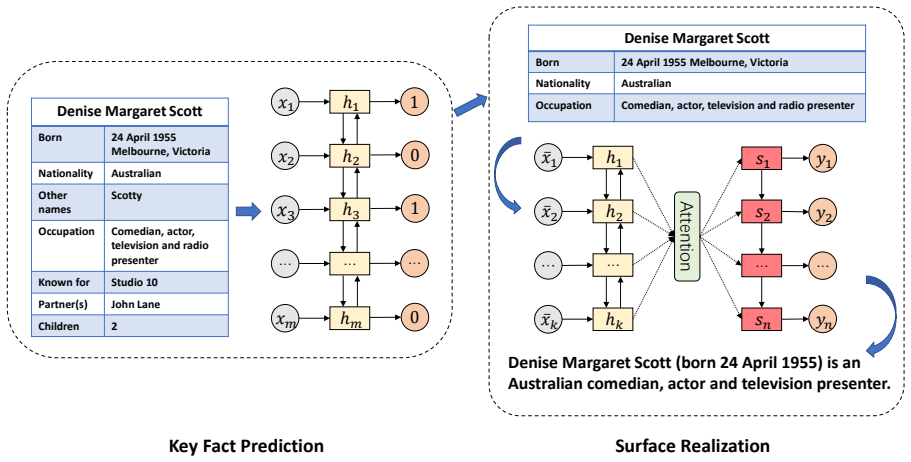
The key fact pivot: a binary sequence over the words of the table, marking which attribute values appear in the reference text. Stage one is a Bi-LSTM with a per-token MLP classifier, trained with automatically derived labels based on word overlap between table values and text. Stage two is a sequence-to-sequence model (vanilla Seq2Seq with attention or Transformer) that takes the predicted key facts as input and generates the sentence. The pseudo parallel corpus is built by POS filtering unlabeled text to retain content words, and denoising augmentation (random dropping/inserting) makes stage two robust to stage-one mistakes; the pipeline is what carries the argument.
What would settle it
Train the same two-stage pipeline on a table-to-text dataset whose references paraphrase rather than reuse table values, so word overlap marking fails; if the BLEU advantage over end-to-end baselines disappears, the gain depends on lexical overlap rather than the two-stage structure. Alternatively, feed stage one's output at test time to a stage two trained only on gold POS-stripped text and measure whether the drop in BLEU exceeds the drop when stage-one predictions are replaced by gold key facts; a large gap would show the pseudo data is not a faithful proxy.
Extended reading notes
Core claim
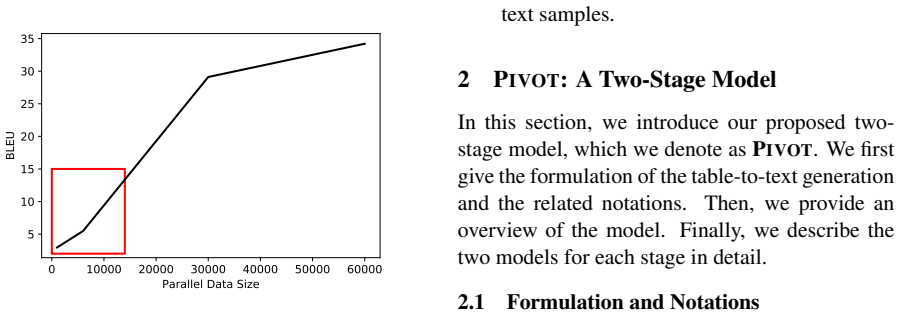
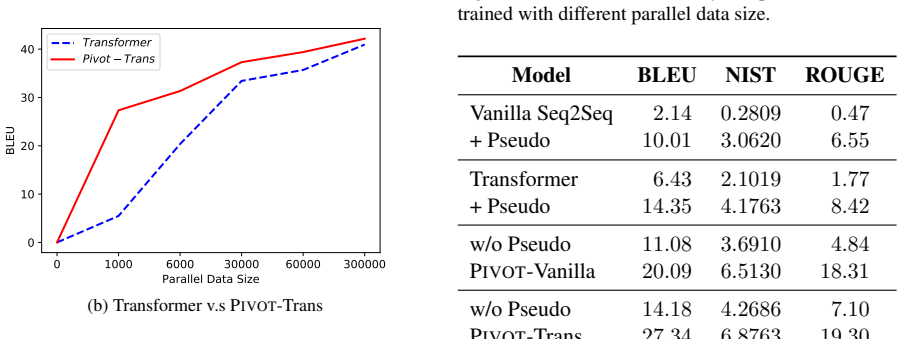
The central discovery is that the bottleneck in low-resource table-to-text is not surface realization but the difficulty of jointly learning content selection and sentence generation from tiny parallel data. By using key facts as an explicit pivot, the paper turns content selection into a sequence labeling problem over table words, and trains realization on pseudo parallel examples obtained by keeping only content words (NN, NNS, NNP, NNPS, JJ, JJR, JJS, CD, FW) of unlabeled text. The two stages are trained separately, and denoising data augmentation simulates stage-one errors by randomly dropping and inserting words. The reported result is 27.34 BLEU, 6.8763 NIST, and 19.30 ROUGE-4 on WIKIBIO with 1,000 parallel samples, roughly triple the strongest end-to-end baseline.
Load-bearing premise
The method assumes that the table values that literally co-occur with the reference text are the key facts, and that text stripped of function words by POS tags faithfully mimics the key-fact input that stage one will produce.
Editorial extensions
If this is right
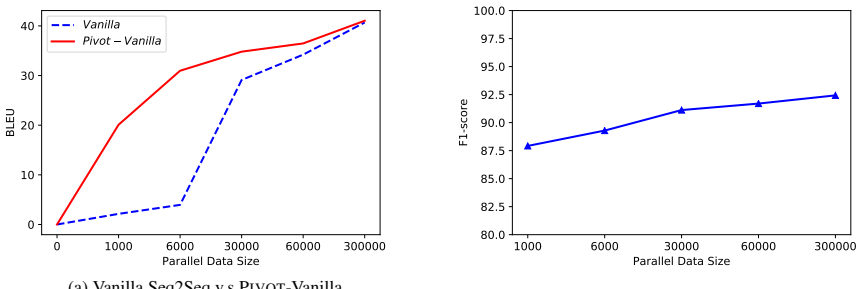
- With tiny parallel data, a model can still produce fluent text by learning content selection separately, since sequence labeling saturates at about 88% F1 even with 1,000 examples.
- Unlabeled text alone can train a surface realization model when the task is narrowed to expanding content-word skeletons.
- The margin over baselines shrinks as parallel data grows, suggesting the decomposition matters most under extreme data scarcity.
- Denoising augmentation brings a consistent gain (for example, PIVOT-Trans from 25.72 to 27.34 BLEU), indicating error propagation between the two stages is a real and addressable cost.
Reading between the lines
- The method's reliance on lexical overlap suggests it would transfer best to domains where descriptions quote field values verbatim (for example, infobox-style biographies); on datasets with heavy paraphrase, the automatic labels and pseudo data would need a learned aligner.
- The same pivot idea could apply to other structured-to-text tasks like data-to-report or knowledge-graph-to-text, where content selection is the data-hungry part.
- The POS-filtering definition of key facts is a strong inductive bias; a testable extension is to replace it with a trained extractor or a neural aligner and measure whether the 1,000-sample BLEU gain survives.
- The phrase 'pseudo parallel' hints that the pipeline might be iterable: generate text, re-extract typical facts, and self-train, but the paper does not explore that loop.
Signed reviews
Editorial analysis
A structured set of objections, weighed in public.
Referee Report
Summary. The paper proposes PIVOT, a two-stage model for low-resource table-to-text generation. Stage 1 is a Bi-LSTM sequence labeling model that predicts which words of a concatenated table should be retained as key facts, with training labels obtained automatically from word overlap between table values and the reference text. Stage 2 is a surface realization model, implemented as either vanilla Seq2Seq or Transformer, trained on the limited parallel data together with a large pseudo-parallel corpus constructed by POS-filtering unlabeled text into content-word skeletons. A denoising data augmentation procedure is added to reduce error propagation between stages. On WIKIBIO with only 1,000 parallel training samples, the paper reports 27.34 BLEU for PIVOT-Trans, compared with 9.71 for the best semi-supervised baseline (SemiMT) and 5.48 for the Transformer baseline, and ablation studies attribute substantial gains to the pseudo-parallel data and the denoising augmentation.
Significance. If the central empirical claim holds, the two-stage decomposition is a clean and practical way to reduce parallel-data requirements in table-to-text generation, and the pseudo-parallel construction is a useful semi-supervised idea that could transfer to other low-resource NLG settings. The paper releases code, evaluates on a standard benchmark, compares against several supervised and semi-supervised baselines, and includes ablations that isolate the contributions of pseudo data and denoising. These are real strengths. However, the headline numbers rest on a single unseeded random subset, no significance tests or error bars are reported, and the training-time pivots used by the surface realization model are not verified to resemble the test-time pivots emitted by Stage 1. The reported margins are therefore not yet established to the standard the paper claims.
major comments (4)
- [Section 2.3, Algorithm 1] The key-fact annotation rule is internally inconsistent. The prose states that all values with at least one overlapping word are collected as key facts, but Algorithm 1, lines 8-13, first adds attribute ai to set A if value vi overlaps, and then appends every value whose attribute is in A. Thus, once any value of an attribute overlaps with the text, all other values of that attribute are labeled as key facts even if they have no overlap. This changes the gold labels used to train Stage 1, the reported F1 of 87.92, and the pivot distribution seen by Stage 2. The paper must state which rule was actually implemented; if Algorithm 1 was used, the pipeline should be rerun under the value-level rule described in Section 2.3 and both sets of numbers should be reported.
- [Section 2.6, Section 2.3, Section 2.7] Pseudo-parallel inputs and test-time pivots appear to come from two different distributions. In Section 2.6, pseudo inputs are the POS-filtered content words of the reference sentence in the original sentence order, and they may contain words that do not appear in the table at all. At test time, Stage 1 emits a subsequence of concatenated table values in table order, as described in Sections 2.3 and 2.4, so the realizer sees table-order tokens drawn only from the table vocabulary. Section 2.7's denoising augmentation drops or inserts words but never reorders pseudo inputs into table order or replaces non-table words with table values, so it does not close the gap. The ablation in Table 2 credits pseudo data with a substantial part of the gain (e.g., Vanilla Seq2Seq 2.14 vs 10.01 with pseudo, and PIVOT-Vanilla 20.09 vs 14.18 without pseudo), but this gain is only interpretable if the pseudo inputs actually resemble Stage-1 outputs. The paper should report a distribution-similarity analysis between pseudo inputs and Stage-1 outputs, and should include an ablation in which pseudo inputs are reordered into table order or grounded to table values before training.
- [Section 3.1, Table 1, Figure 4] The evaluation lacks statistical reliability. The 1,000-sample parallel subset is obtained by random sampling without reporting a seed, and the numbers in Tables 1-3 appear to be single runs without variance or significance tests. Section 3.5 says the models 'significantly outperform all the baseline models,' but no significance test is performed. Because BLEU under a 1,000-sample training set is sensitive to the composition of the subset, the paper should report means and standard deviations over multiple random seeds or subset draws, and should include a paired bootstrap or similar test for the main comparisons.
- [Table 2] The row organization of Table 2 is ambiguous and contains an inconsistency with Table 1. The 'w/o Pseudo' rows are not explicitly attached to a base model, making it difficult to read off the exact effect of pseudo data on each model. Additionally, the baseline 'Transformer' row in Table 2 lists BLEU 6.43, while Table 1 lists 5.48 for the same Transformer setting. This undermines the clarity of the ablation argument. The table should be reformatted so each row clearly identifies the base model and the corresponding ablation, and the inconsistent Transformer numbers should be corrected.
minor comments (4)
- [Section 2.2, Section 2.5, Section 3.3] There are several typos: 'adpots' in Sections 2.2 and 2.5 should be 'adopts', and 'Transfomer' in Section 3.3 should be 'Transformer'.
- [Table 1] The F1, precision, and recall for the key fact prediction model are reported in Table 1, but the paper does not state whether these scores are computed on the validation set or the test set. Please specify the split.
- [Section 2.8] Equation (9) trains the surface realization model on selected key facts, but the paper does not specify how batches mix the real parallel data and the pseudo-parallel data, or whether the real data are also used without pseudo augmentation. A sentence clarifying the mixing ratio and training schedule would improve reproducibility.
- [Figure 4] The horizontal axis in Figure 4(a) appears to include a spurious '0' label before the 1000, 6000, 30000, 60000, and 300000 data points. Please correct the axis labels so the parallel data sizes are unambiguous.
Circularity Check
No significant circularity: the key-fact heuristic and pseudo-parallel surrogate are training signals, not derived predictions, and the headline BLEU is measured against held-out references with external baselines.
full rationale
The paper's derivation chain does not reduce to its own inputs. Section 2.3 defines key facts as co-occurrence between table values and reference text and uses those automatic labels to train the Stage 1 sequence labeler; Section 2.6 constructs pseudo-parallel pairs by deleting function words from unlabeled text and uses them as an auxiliary training signal for Stage 2. Both are training-construction choices, not predicted outputs that are then claimed as derivations. The central claim, 27.34 BLEU on WIKIBIO with 1,000 parallel samples, is evaluated against held-out reference sentences (Section 3.5), and the ablation studies (Tables 2 and 3) compare the same test metric with and without the pseudo corpus and denoising augmentation. The semi-supervised baselines use the same unlabeled text, so the comparison is not a self-fulfilling fit. Overlapping-author citations, such as Liu et al. (2018) for table encoding and position embeddings, are technical or contextual and are not load-bearing for the reported gains. The skeptical concern that pseudo inputs are in sentence order while test-time Stage 1 outputs are in table order is a distribution-mismatch or fidelity risk, not circularity: nothing defines the test-time key facts as pseudo inputs or optimizes the evaluation references during training. No step is equivalent to its inputs by construction.
Assumptions & free parameters
free parameters (3)
- key fact overlap threshold =
>= 1 word overlap
- pseudo-parallel POS tag set =
{NN, NNS, NNP, NNPS, JJ, JJR, JJS, CD, FW}
- denoising augmentation rate =
not specified
assumptions (5)
- domain assumption Key facts can be represented as a binary sequence over the flattened table tokens.
- domain assumption Co-occurrence between table values and reference text identifies the key facts.
- domain assumption POS-filtered unlabeled text is a valid proxy for a key fact sequence.
- domain assumption Sequence labeling for key fact prediction requires substantially fewer annotated examples than end-to-end generation.
- domain assumption The unlabeled text corpus is drawn from the same distribution as the labeled data.
Cite this review
Pith. "Pith review of Key Fact as Pivot: A Two-Stage Model for Low Resource Table-to-Text Generation." pith.science (2026). https://pith.science/paper/LE5VXDBB
@misc{pith2026190803067,
  author       = {Pith},
  title        = {Pith review of: Key Fact as Pivot: A Two-Stage Model for Low Resource Table-to-Text Generation},
  year         = {2026},
  howpublished = {\url{https://pith.science/paper/LE5VXDBB}},
  note         = {Machine review of arXiv:1908.03067}
}
abstract
Table-to-text generation aims to translate the structured data into the unstructured text. Most existing methods adopt the encoder-decoder framework to learn the transformation, which requires large-scale training samples. However, the lack of large parallel data is a major practical problem for many domains. In this work, we consider the scenario of low resource table-to-text generation, where only limited parallel data is available. We propose a novel model to separate the generation into two stages: key fact prediction and surface realization. It first predicts the key facts from the tables, and then generates the text with the key facts. The training of key fact prediction needs much fewer annotated data, while surface realization can be trained with pseudo parallel corpus. We evaluate our model on a biography generation dataset. Our model can achieve $27.34$ BLEU score with only $1,000$ parallel data, while the baseline model only obtain the performance of $9.71$ BLEU score.
Figures

Figures from the paper (2 more)
Reference graph
Works this paper leans on
-
[1]
Mikel Artetxe, Gorka Labaka, Eneko Agirre, and Kyunghyun Cho. 2017. Unsupervised neural machine translation. CoRR, abs/1710.11041
arXiv 2017
-
[2]
Dzmitry Bahdanau, Kyunghyun Cho, and Yoshua Bengio. 2014. Neural machine translation by jointly learning to align and translate. CoRR, abs/1409.0473
arXiv 2014
-
[3]
Jun - Wei Bao, Duyu Tang, Nan Duan, Zhao Yan, Yuanhua Lv, Ming Zhou, and Tiejun Zhao. 2018. Table-to-text: Describing table region with natural language. In Proceedings of the Thirty-Second AAAI Conference on Artificial Intelligence, (AAAI-18), the 30th innovative Applications of Artificial Intelligence (IAAI-18), and the 8th AAAI Symposium on Educational...
work page 2018
-
[4]
Regina Barzilay and Mirella Lapata. 2005. Collective content selection for concept-to-text generation. In HLT/EMNLP 2005, Human Language Technology Conference and Conference on Empirical Methods in Natural Language Processing, Proceedings of the Conference, 6-8 October 2005, Vancouver, British Columbia, Canada , pages 331--338
work page 2005
-
[5]
Anja Belz and Ehud Reiter. 2006. Comparing automatic and human evaluation of NLG systems. In EACL 2006, 11st Conference of the European Chapter of the Association for Computational Linguistics, Proceedings of the Conference, April 3-7, 2006, Trento, Italy
work page 2006
-
[6]
Yong Cheng, Wei Xu, Zhongjun He, Wei He, Hua Wu, Maosong Sun, and Yang Liu. 2016. Semi-supervised learning for neural machine translation. In Proceedings of the 54th Annual Meeting of the Association for Computational Linguistics, ACL 2016, August 7-12, 2016, Berlin, Germany, Volume 1: Long Papers
work page 2016
-
[7]
Sumit Chopra, Michael Auli, and Alexander M. Rush. 2016. Abstractive sentence summarization with attentive recurrent neural networks. In NAACL HLT 2016, The 2016 Conference of the North American Chapter of the Association for Computational Linguistics: Human Language Technologies , pages 93--98
work page 2016
-
[8]
Pablo Ariel Dubou \' e and Kathleen R. McKeown. 2002. Content planner construction via evolutionary algorithms and a corpus-based fitness function. In Proceedings of the International Natural Language Generation Conference, Harriman, New York, USA, July 2002, pages 89--96
work page 2002
Show all 37 references
-
[9]
Dai, Henry Elder, and Alexander M
Sebastian Gehrmann, Falcon Z. Dai, Henry Elder, and Alexander M. Rush. 2018. End-to-end content and plan selection for data-to-text generation. In Proceedings of the 11th International Conference on Natural Language Generation, Tilburg University, The Netherlands, November 5-8...
2018
-
[10]
Jiatao Gu, Hany Hassan, Jacob Devlin, and Victor O. K. Li. 2018. Universal neural machine translation for extremely low resource languages. In Proceedings of the 2018 Conference of the North American Chapter of the Association for Computational Linguistics: Human Language Tech...
2018
-
[11]
Diederik P Kingma and Jimmy Ba. 2014. Adam: A method for stochastic optimization. CoRR, abs/1412.6980
2014 arXiv
-
[12]
Guillaume Lample, Alexis Conneau, Ludovic Denoyer, and Marc'Aurelio Ranzato. 2018 a . Unsupervised machine translation using monolingual corpora only. In International Conference on Learning Representations (ICLR)
2018
-
[13]
Guillaume Lample, Myle Ott, Alexis Conneau, Ludovic Denoyer, and Marc'Aurelio Ranzato. 2018 b . Phrase-based & neural unsupervised machine translation. In Proceedings of the 2018 Conference on Empirical Methods in Natural Language Processing (EMNLP)
2018
-
[14]
R \' e mi Lebret, David Grangier, and Michael Auli. 2016. Neural text generation from structured data with application to the biography domain. In Proceedings of the 2016 Conference on Empirical Methods in Natural Language Processing, EMNLP 2016, Austin, Texas, USA, November 1...
2016
-
[15]
Jordan, and Dan Klein
Percy Liang, Michael I. Jordan, and Dan Klein. 2009. Learning semantic correspondences with less supervision. In ACL 2009, Proceedings of the 47th Annual Meeting of the Association for Computational Linguistics and the 4th International Joint Conference on Natural Language Pro...
2009
-
[16]
Chin - Yew Lin and Eduard H. Hovy. 2003. Automatic evaluation of summaries using n-gram co-occurrence statistics. In Human Language Technology Conference of the North American Chapter of the Association for Computational Linguistics, HLT-NAACL 2003
2003
-
[17]
Tianyu Liu, Kexiang Wang, Lei Sha, Baobao Chang, and Zhifang Sui. 2018. Table-to-text generation by structure-aware seq2seq learning. In Proceedings of the Thirty-Second AAAI Conference on Artificial Intelligence, (AAAI-18), the 30th innovative Applications of Artificial Intel...
2018
-
[18]
Jiasen Lu, Caiming Xiong, Devi Parikh, and Richard Socher. 2017. Knowing when to look: Adaptive attention via a visual sentinel for image captioning. In 2017 IEEE Conference on Computer Vision and Pattern Recognition, CVPR 2017, Honolulu, HI, USA, July 21-26, 2017 , pages 3242--3250
2017
-
[19]
Thang Luong, Hieu Pham, and Christopher D. Manning. 2015. Effective approaches to attention-based neural machine translation. In Proceedings of the 2015 Conference on Empirical Methods in Natural Language Processing, EMNLP 2015 , pages 1412--1421
2015
-
[20]
Feng Nie, Jinpeng Wang, Jin - Ge Yao, Rong Pan, and Chin - Yew Lin. 2018. Operation-guided neural networks for high fidelity data-to-text generation. In Proceedings of the 2018 Conference on Empirical Methods in Natural Language Processing, Brussels, Belgium, October 31 - Nove...
2018
-
[21]
Kishore Papineni, Salim Roukos, Todd Ward, and Wei - Jing Zhu. 2002. BLEU : a method for automatic evaluation of machine translation. In Proceedings of the 40th Annual Meeting of the Association for Computational Linguistics, pages 311--318
2002
-
[22]
Razvan Pascanu, Tomas Mikolov, and Yoshua Bengio. 2013. On the difficulty of training recurrent neural networks. In Proceedings of the 30th International Conference on Machine Learning, ICML 2013, Atlanta, GA, USA, 16-21 June 2013 , pages 1310--1318
2013
-
[23]
Ratish Puduppully, Li Dong, and Mirella Lapata. 2018. Data-to-text generation with content selection and planning. CoRR, abs/1809.00582
2018 arXiv
-
[24]
Guanghui Qin, Jin - Ge Yao, Xuening Wang, Jinpeng Wang, and Chin - Yew Lin. 2018. Learning latent semantic annotations for grounding natural language to structured data. In Proceedings of the 2018 Conference on Empirical Methods in Natural Language Processing, Brussels, Belgiu...
2018
-
[25]
Lei Sha, Lili Mou, Tianyu Liu, Pascal Poupart, Sujian Li, Baobao Chang, and Zhifang Sui. 2018. Order-planning neural text generation from structured data. In Proceedings of the Thirty-Second AAAI Conference on Artificial Intelligence, (AAAI-18), the 30th innovative Application...
2018
-
[26]
Ivan Skorokhodov, Anton Rykachevskiy, Dmitry Emelyanenko, Sergey Slotin, and Anton Ponkratov. 2018. Semi-supervised neural machine translation with language models. In Proceedings of the Workshop on Technologies for MT of Low Resource Languages, LoResMT@AMTA 2018, Boston, MA, ...
2018
-
[27]
Hinton, Alex Krizhevsky, Ilya Sutskever, and Ruslan Salakhutdinov
Nitish Srivastava, Geoffrey E. Hinton, Alex Krizhevsky, Ilya Sutskever, and Ruslan Salakhutdinov. 2014. Dropout: a simple way to prevent neural networks from overfitting. Journal of Machine Learning Research, 15(1):1929--1958
2014
-
[28]
Ilya Sutskever, Oriol Vinyals, and Quoc V. Le. 2014. Sequence to sequence learning with neural networks. In Advances in Neural Information Processing Systems 27: Annual Conference on Neural Information Processing Systems 2014, pages 3104--3112
2014
-
[29]
Ottokar Tilk and Tanel Alum \" a e. 2017. Low-resource neural headline generation. In Proceedings of the Workshop on New Frontiers in Summarization, NFiS@EMNLP 2017, Copenhagen, Denmark, September 7, 2017, pages 20--26
2017
-
[30]
Van - Khanh Tran and Le - Minh Nguyen. 2018. Dual latent variable model for low-resource natural language generation in dialogue systems. In Proceedings of the 22nd Conference on Computational Natural Language Learning, CoNLL 2018, Brussels, Belgium, October 31 - November 1, 2...
2018
-
[31]
Gomez, Lukasz Kaiser, and Illia Polosukhin
Ashish Vaswani, Noam Shazeer, Niki Parmar, Jakob Uszkoreit, Llion Jones, Aidan N. Gomez, Lukasz Kaiser, and Illia Polosukhin. 2017. Attention is all you need. In Advances in Neural Information Processing Systems 30: Annual Conference on Neural Information Processing Systems 20...
2017
-
[32]
Shieber, and Alexander M
Sam Wiseman, Stuart M. Shieber, and Alexander M. Rush. 2017. Challenges in data-to-document generation. In Proceedings of the 2017 Conference on Empirical Methods in Natural Language Processing, EMNLP 2017, Copenhagen, Denmark, September 9-11, 2017 , pages 2253--2263
2017
-
[33]
Shieber, and Alexander M
Sam Wiseman, Stuart M. Shieber, and Alexander M. Rush. 2018. Learning neural templates for text generation. In Proceedings of the 2018 Conference on Empirical Methods in Natural Language Processing, Brussels, Belgium, October 31 - November 4, 2018, pages 3174--3187
2018
-
[34]
Pengcheng Yang, Xu Sun, Wei Li, Shuming Ma, Wei Wu, and Houfeng Wang. 2018. SGM: sequence generation model for multi-label classification. In Proceedings of the 27th International Conference on Computational Linguistics, COLING 2018, Santa Fe, New Mexico, USA, August 20-26, 20...
2018
-
[35]
Yi Zhang, Jingjing Xu, Pengcheng Yang, and Xu Sun. 2018. Learning sentiment memories for sentiment modification without parallel data. In Proceedings of the 2018 Conference on Empirical Methods in Natural Language Processing, Brussels, Belgium, October 31 - November 4, 2018, p...
2018
-
[36]
URL: " 'urlintro :=
ENTRY address author booktitle chapter edition editor howpublished institution journal key month note number organization pages publisher school series title type volume year eprint doi pubmed url lastchecked label extra.label sort.label short.list INTEGERS output.state before...
-
[37]
write newline
" write newline "" before.all 'output.state := FUNCTION n.dashify 't := "" t empty not t #1 #1 substring "-" = t #1 #2 substring "--" = not "--" * t #2 global.max substring 't := t #1 #1 substring "-" = "-" * t #2 global.max substring 't := while if t #1 #1 substring * t #2 gl...
Reviewed August 14, 2026 · model on record in the stance chip above.
Discussion (0). Continue with ORCID to comment.