Spatially resolved star formation history of Sextans dSph
Pith reviewed 2026-06-26 08:16 UTC · model grok-4.3
The pith
Sextans dwarf spheroidal galaxy assembled through a minor merger 13 Gyr ago that left an inverse metallicity gradient.
A machine-rendered reading of the paper's core claim, the machinery that carries it, and where it could break.
Core claim
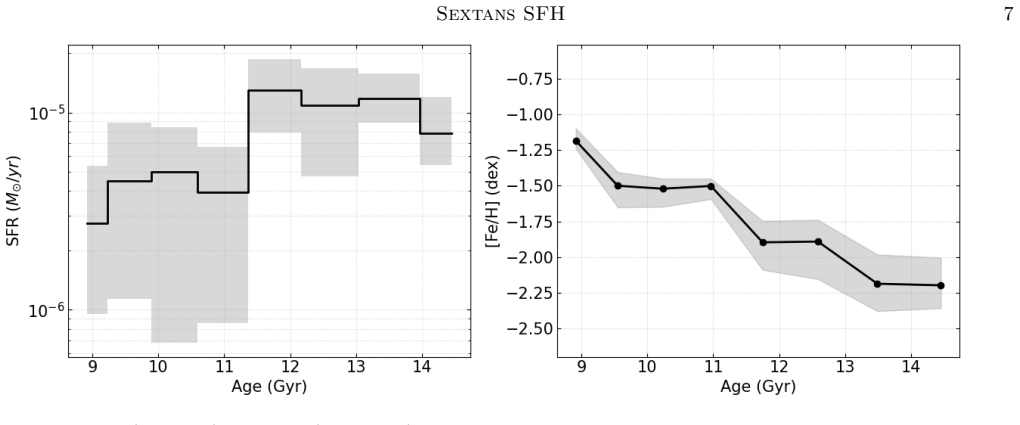
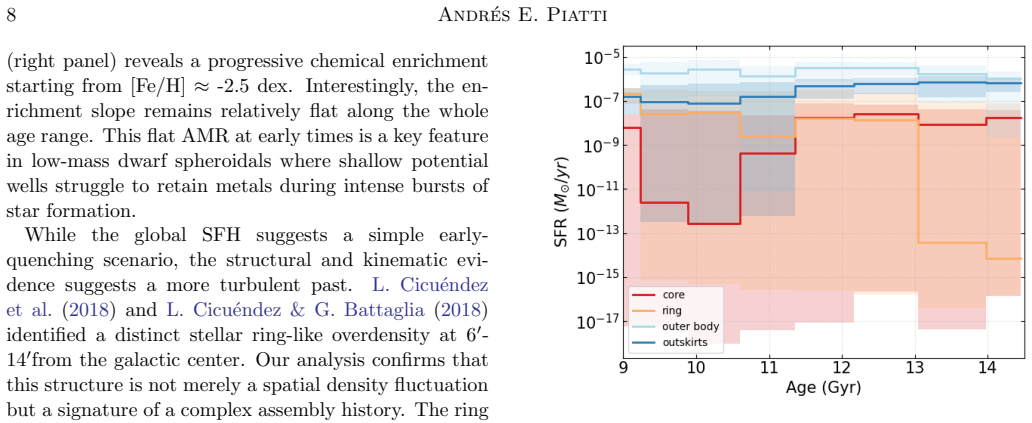
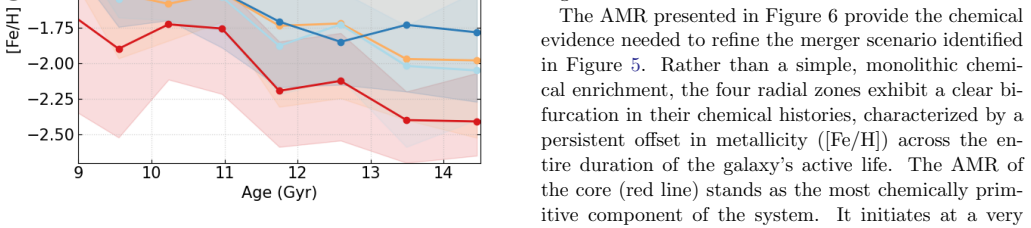
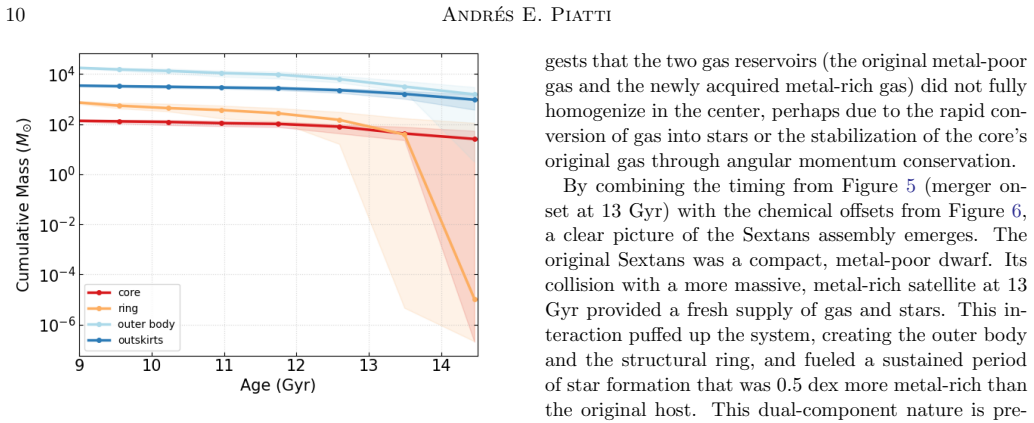
Sextans is a composite system formed through a minor merger approximately 13 Gyr ago. The results reveal an inverse metallicity gradient: a primitive, metal-poor host (the current core) surrounded by a more massive, chemically evolved envelope (Δ[Fe/H] ≈ -0.5 dex) introduced by the accreted satellite. A distinct delayed onset of star formation in the ring at ∼13 Gyr marks the merger event. While the core quenched early, star formation in the outer body and ring persisted until ∼9 Gyr, suggesting that the final cessation of activity was driven by environmental stripping during infall into the Milky Way halo. The red HB dominance in the core reflects its ancient, α-rich nature, while the blue
What carries the argument
Spatially resolved star formation histories and age-metallicity relations extracted in four radial zones (core, ring, outer body, outskirts) via PANCAKE CMD fitting to DECam photometry
If this is right
- The core region formed and quenched earliest while the accreted envelope continued forming stars until about 9 Gyr ago.
- The final shutdown of star formation was caused by environmental effects during infall into the Milky Way rather than internal exhaustion.
- The horizontal-branch morphology difference between core and outskirts arises from the distinct α-element abundances of the two progenitor populations.
- Sextans experienced non-monolithic assembly, leaving a testable radial gradient in [α/Fe] that future observations can measure.
Where Pith is reading between the lines
- Other Local Group dwarf spheroidals with mixed horizontal-branch populations may also be products of early minor mergers rather than single-collapse events.
- The timing of the Sextans merger supplies a concrete lower limit on when some dwarfs were accreted by the Milky Way halo.
- If similar inverse gradients appear in additional dwarfs, the fraction of stellar mass assembled by accretion at high redshift would increase.
Load-bearing premise
The CMD-fitting procedure recovers distinct star formation histories and metallicities in separate radial zones without significant bias from photometric scatter, total-metallicity model assumptions, or later stellar mixing.
What would settle it
A spectroscopic survey showing no radial gradient in [α/Fe] across the galaxy would falsify the claim that the core and envelope populations originated in separate systems with different chemical-evolution paths.
Figures

read the original abstract
We present a spatially resolved archaeological reconstruction of the Sextans dwarf spheroidal (dSph) galaxy using deep DECam wide-field photometry and the PANCAKE CMD-fitting code. By analyzing the star formation history (SFH) and age-metallicity relationship (AMR) across four radial zones, namely: core, ring, outer body, and outskirts, we find that Sextans is a composite system formed through a minor merger approximately 13 Gyr ago. Our results reveal an inverse metallicity gradient: a primitive, metal-poor host (the current core) surrounded by a more massive, chemically evolved envelope ($\Delta$[Fe/H] $\approx$ -0.5 dex) introduced by the accreted satellite. We identify a distinct delayed onset of star formation in the ring at $\sim$ 13 Gyr, marking the merger event. While the core quenched early, star formation in the outer body and ring persisted until $\sim$9 Gyr, suggesting that the final cessation of activity was driven by environmental stripping during infall into the Milky Way halo. We propose a plausible scenario to reconcile the derived inverse metallicity gradient with the observed horizontal-branch (HB) morphology and reported Mg deficits. We suggest that the red HB dominance in the core reflects its ancient, $\alpha$-rich nature, while the blue HB in the outskirts represents an $\alpha$-poor, accreted component. However, we note that our CMD-derived [Fe/H] values are model-dependent inferences based on the total metal content $Z$. These findings suggest a non-monolithic assembly for Sextans, posing a testable prediction of a strong radial gradient in [$\alpha$/Fe].
Editorial analysis
A structured set of objections, weighed in public.
Referee Report
Summary. The manuscript presents a spatially resolved star formation history (SFH) and age-metallicity relation (AMR) for the Sextans dwarf spheroidal galaxy using deep DECam photometry and the PANCAKE CMD-fitting code. Analyzing four radial zones (core, ring, outer body, outskirts), it concludes that Sextans is a composite system formed via a minor merger ~13 Gyr ago, exhibiting an inverse metallicity gradient with a primitive metal-poor core and a chemically evolved envelope from the accreted satellite. The core quenched early, while outer regions continued star formation until ~9 Gyr, attributed to environmental stripping. A scenario is proposed to reconcile the gradient with horizontal branch morphology and Mg deficits, noting the model-dependence of [Fe/H] from total Z, and predicting a radial [α/Fe] gradient.
Significance. If substantiated, this work offers significant insights into the assembly history of dwarf spheroidal galaxies, supporting non-monolithic formation through mergers even for small systems. The identification of a delayed star formation onset in the ring as a merger signature and the testable prediction of an [α/Fe] gradient are notable strengths. The use of wide-field photometry for radial SFH is a valuable approach in the field.
major comments (2)
- [Abstract] Abstract: The central claim of an inverse metallicity gradient (Δ[Fe/H] ≈ -0.5 dex) supporting the minor merger scenario depends on the recovery of distinct AMRs in the radial zones. However, the abstract explicitly states that CMD-derived [Fe/H] values are model-dependent inferences based on total metal content Z. Variations in [α/Fe] (invoked to explain HB morphology and Mg deficits) can change the inferred [Fe/H] without altering Z, potentially affecting or reversing the claimed gradient. This requires explicit sensitivity tests or spectroscopic anchoring to validate the gradient.
- [Abstract] Abstract: The manuscript does not describe details of the PANCAKE code application, such as how photometric errors, completeness, or model dependencies in isochrones are handled across radial zones, or any validation against synthetic CMDs or known systems. These are load-bearing for the distinct SFH and AMR claims in each zone.
minor comments (2)
- [Abstract] Abstract: The abstract mentions 'four radial zones, namely: core, ring, outer body, and outskirts' but does not specify the exact radial boundaries or how they were chosen.
- [Abstract] Abstract: The proposed reconciliation with HB morphology is presented as a plausible scenario but lacks quantitative support in the abstract.
Simulated Author's Rebuttal
We thank the referee for their thoughtful review and positive assessment of the significance of our results on the assembly history of Sextans. We address the two major comments point by point below.
read point-by-point responses
-
Referee: [Abstract] Abstract: The central claim of an inverse metallicity gradient (Δ[Fe/H] ≈ -0.5 dex) supporting the minor merger scenario depends on the recovery of distinct AMRs in the radial zones. However, the abstract explicitly states that CMD-derived [Fe/H] values are model-dependent inferences based on total metal content Z. Variations in [α/Fe] (invoked to explain HB morphology and Mg deficits) can change the inferred [Fe/H] without altering Z, potentially affecting or reversing the claimed gradient. This requires explicit sensitivity tests or spectroscopic anchoring to validate the gradient.
Authors: We agree that the translation from total metallicity Z to [Fe/H] is model-dependent and that [α/Fe] variations can affect the absolute scale, as already stated in the abstract. The reported inverse gradient reflects the relative differences in the recovered AMRs across zones under a consistent set of isochrones. The scenario we propose explicitly attributes part of the HB morphology and Mg deficit differences to an [α/Fe] contrast between the ancient core and the accreted envelope. In the revised manuscript we will add explicit sensitivity tests that vary the assumed [α/Fe] mixture while refitting the CMDs, demonstrating that the relative AMR offsets and the sign of the gradient remain stable. revision: yes
-
Referee: [Abstract] Abstract: The manuscript does not describe details of the PANCAKE code application, such as how photometric errors, completeness, or model dependencies in isochrones are handled across radial zones, or any validation against synthetic CMDs or known systems. These are load-bearing for the distinct SFH and AMR claims in each zone.
Authors: We accept that the current description of the PANCAKE implementation is insufficiently detailed for the claims made. The methods section of the manuscript outlines the overall fitting approach, but we will expand it substantially in revision to document the treatment of photometric uncertainties, radial completeness maps, isochrone grid choices, and any internal validation (including synthetic CMD recovery tests) performed to confirm that the distinct SFHs and AMRs are not artifacts of the fitting procedure. revision: yes
Circularity Check
No circularity: derivation is standard CMD fitting applied to photometry
full rationale
The paper applies the PANCAKE code to DECam photometry across four radial zones to extract SFH and AMR, then interprets the resulting inverse gradient and timing as evidence for a minor merger. No equations, self-citations, or fitted inputs are shown that reduce any load-bearing claim (gradient, merger epoch, or alpha scenario) to the input data by construction. The explicit note that [Fe/H] values are model-dependent inferences from total Z is an acknowledged limitation rather than a definitional loop. The central results remain independent outputs of the fitting procedure.
Axiom & Free-Parameter Ledger
Reference graph
Works this paper leans on
-
[1]
Amorisco, N. C. 2017a, MNRAS, 469, L48, doi: 10.1093/mnrasl/slx044
-
[2]
Amorisco, N. C. 2017b, MNRAS, 464, 2882, doi: 10.1093/mnras/stw2229
-
[3]
2001, AJ, 122, 2524, doi: 10.1086/323535
Aparicio, A., Carrera, R., & Mart´ ınez-Delgado, D. 2001, AJ, 122, 2524, doi: 10.1086/323535
-
[4]
Robust constraints on neutrino properties
Battaglia, G., Tolstoy, E., Helmi, A., et al. 2011, MNRAS, 411, 1013, doi: 10.1111/j.1365-2966.2010.17745.x Ben´ ıtez-Llambay, A., Navarro, J. F., Abadi, M. G., et al. 2016, MNRAS, 456, 1185, doi: 10.1093/mnras/stv2722
-
[5]
Piotto, G. 2018, MNRAS, 476, 71, doi: 10.1093/mnras/sty226
-
[6]
Bressan, A., Marigo, P., Girardi, L., et al. 2012, MNRAS, 427, 127, doi: 10.1111/j.1365-2966.2012.21948.x
-
[7]
2002, AJ, 123, 3199, doi: 10.1086/340702 Cicu´ endez, L., & Battaglia, G
Carrera, R., Aparicio, A., Mart´ ınez-Delgado, D., & Alonso-Garc´ ıa, J. 2002, AJ, 123, 3199, doi: 10.1086/340702 Cicu´ endez, L., & Battaglia, G. 2018, MNRAS, 480, 251, doi: 10.1093/mnras/sty1748 Cicu´ endez, L., Battaglia, G., Irwin, M., et al. 2018, A&A, 609, A53, doi: 10.1051/0004-6361/201731450
-
[8]
Dolphin, A. E. 2002, MNRAS, 332, 91, doi: 10.1046/j.1365-8711.2002.05271.x
-
[9]
Flaugher, B., Diehl, H. T., Honscheid, K., et al. 2015, AJ, 150, 150, doi: 10.1088/0004-6256/150/5/150
-
[10]
Harbeck, D., Grebel, E. K., Holtzman, J., et al. 2001, AJ, 122, 3092, doi: 10.1086/324232
-
[11]
Hernquist, L., & Weil, M. L. 1993, MNRAS, 261, 804, doi: 10.1093/mnras/261.4.804
-
[12]
1995, MNRAS, 277, 1354, doi: 10.1093/mnras/277.4.1354
Irwin, M., & Hatzidimitriou, D. 1995, MNRAS, 277, 1354, doi: 10.1093/mnras/277.4.1354
-
[13]
McMahon, R. G. 1990, MNRAS, 244, 16P
1990
-
[14]
Johnston, K. V., Bullock, J. S., Sharma, S., et al. 2008, ApJ, 689, 936, doi: 10.1086/592228 14Andr ´es E. Piatti
-
[15]
Karachentsev, I. D., Karachentseva, V. E., Huchtmeier, W. K., & Makarov, D. I. 2004, AJ, 127, 2031, doi: 10.1086/382905
-
[16]
1962, AJ, 67, 471, doi: 10.1086/108756
King, I. 1962, AJ, 67, 471, doi: 10.1086/108756
-
[17]
Kirby, E. N., Lanfranchi, G. A., Simon, J. D., Cohen, J. G., & Guhathakurta, P. 2011, ApJ, 727, 78, doi: 10.1088/0004-637X/727/2/78
-
[18]
2002, Science, 295, 82, doi: 10.1126/science.1067524
Kroupa, P. 2002, Science, 295, 82, doi: 10.1126/science.1067524
-
[19]
Mapelli, M., Moore, B., Ripamonti, E., et al. 2008, MNRAS, 383, 1223, doi: 10.1111/j.1365-2966.2007.12650.x
-
[20]
1991, AJ, 101, 892, doi: 10.1086/115734
Mateo, M., Nemec, J., Irwin, M., & McMahon, R. 1991, AJ, 101, 892, doi: 10.1086/115734
-
[21]
Mateo, M. L. 1998, ARA&A, 36, 435, doi: 10.1146/annurev.astro.36.1.435
-
[22]
Quinn, P. J. 1984, ApJ, 279, 596, doi: 10.1086/161924
-
[23]
Roederer, I. U., Pace, A. B., Placco, V. M., et al. 2023, ApJ, 954, 55, doi: 10.3847/1538-4357/ace3c1
-
[24]
1993, ApJ, 414, 580, doi: 10.1086/173105
Salaris, M., Chieffi, A., & Straniero, O. 1993, ApJ, 414, 580, doi: 10.1086/173105
-
[25]
, archivePrefix = "arXiv", eprint =
Schlafly, E. F., & Finkbeiner, D. P. 2011, ApJ, 737, 103, doi: 10.1088/0004-637X/737/2/103
work page internal anchor Pith review doi:10.1088/0004-637x/737/2/103 2011
-
[26]
Sersic, J. L. 1968, Atlas de Galaxias Australes
1968
-
[27]
Taylor, M. B. 2005, in Astronomical Society of the Pacific Conference Series, Vol. 347, Astronomical Data Analysis Software and Systems XIV, ed. P. Shopbell, M. Britton, & R. Ebert, 29
2005
-
[28]
2020, A&A, 642, A176, doi: 10.1051/0004-6361/201937146
Theler, R., Jablonka, P., Lucchesi, R., et al. 2020, A&A, 642, A176, doi: 10.1051/0004-6361/201937146
-
[29]
Tolstoy, E., Battaglia, G., Arroyo-Polonio, J. M., et al. 2025, A&A, 698, A53, doi: 10.1051/0004-6361/202554176
-
[30]
Walker, M. G., Mateo, M., Olszewski, E. W., et al. 2009, ApJ, 704, 1274, doi: 10.1088/0004-637X/704/2/1274
-
[31]
2025, ApJ, 993, 249, doi: 10.3847/1538-4357/ae07ce
Yang, H., Wang, W., Zhu, L., et al. 2025, ApJ, 993, 249, doi: 10.3847/1538-4357/ae07ce
-
[32]
2025, ApJ, 981, 155, doi: 10.3847/1538-4357/adb57c
Yang, S., Zhang, S., Zhang, L., & Li, H. 2025, ApJ, 981, 155, doi: 10.3847/1538-4357/adb57c
-
[33]
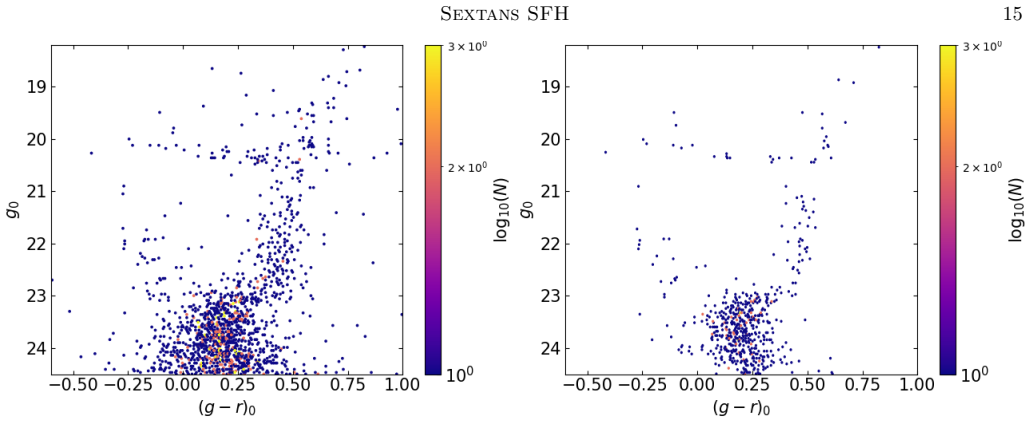
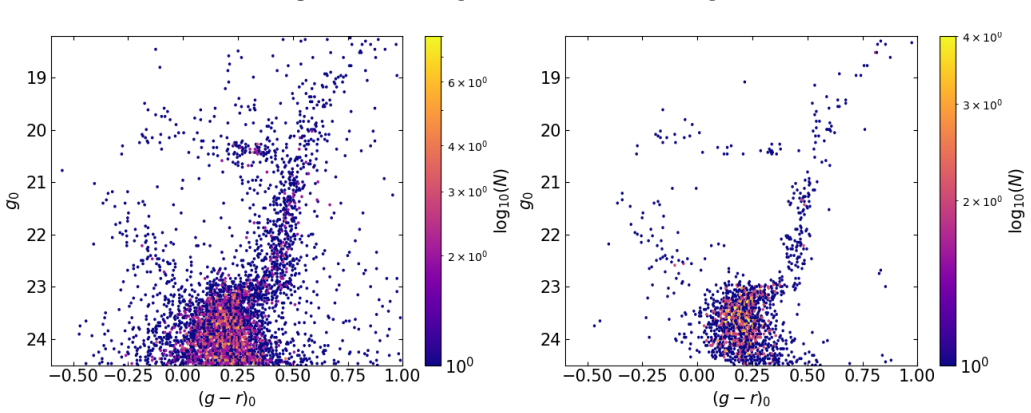
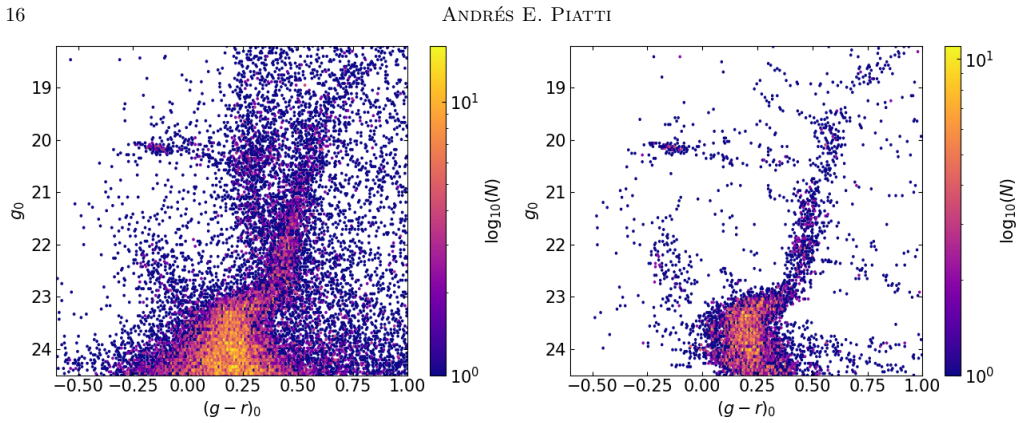
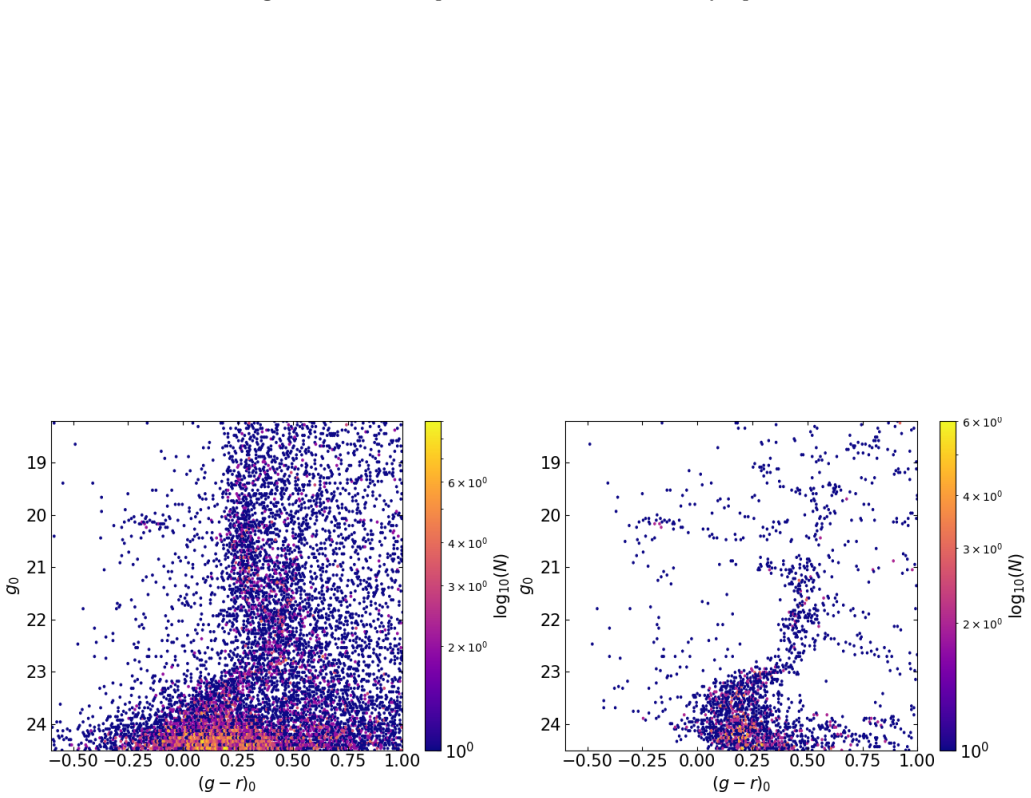
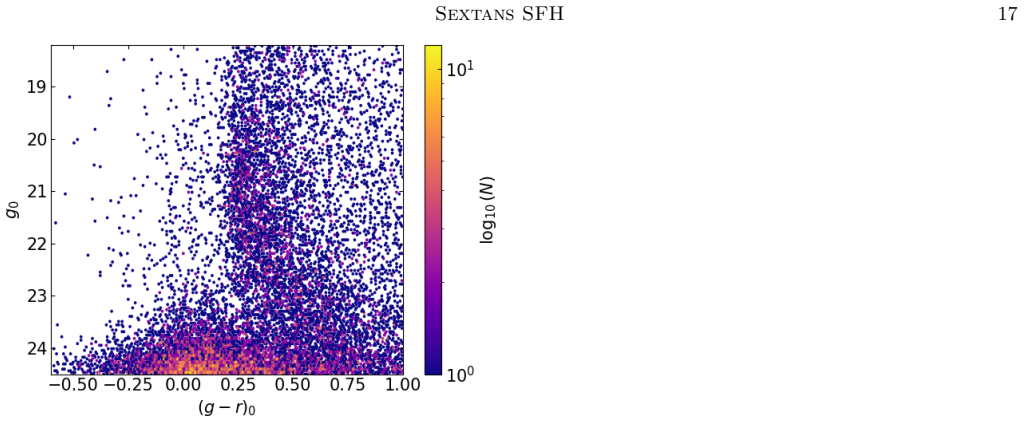
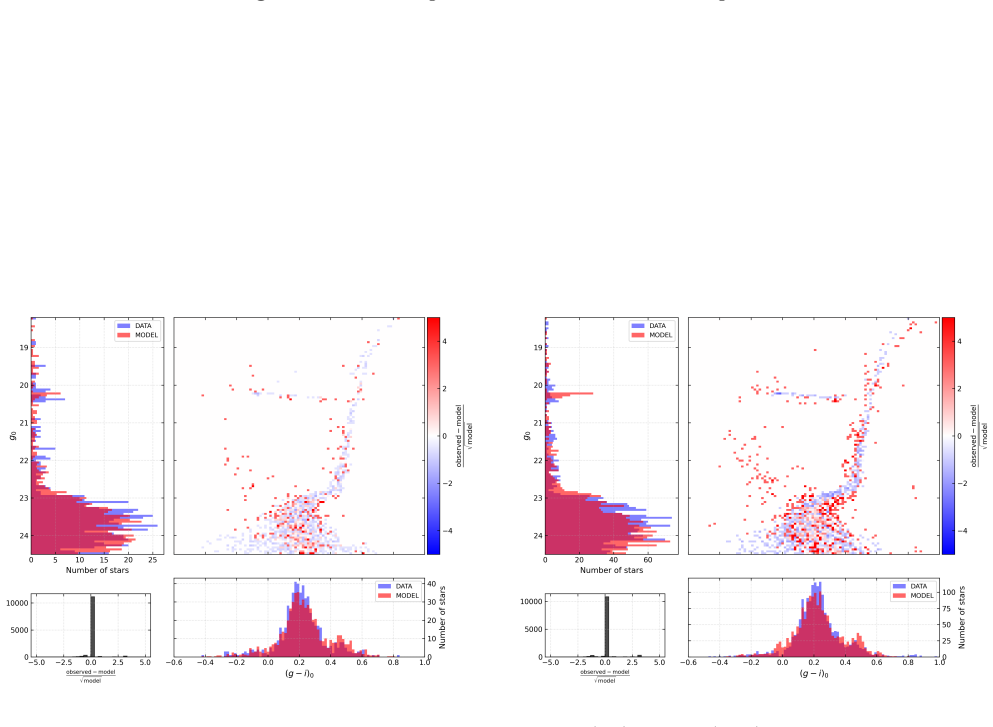
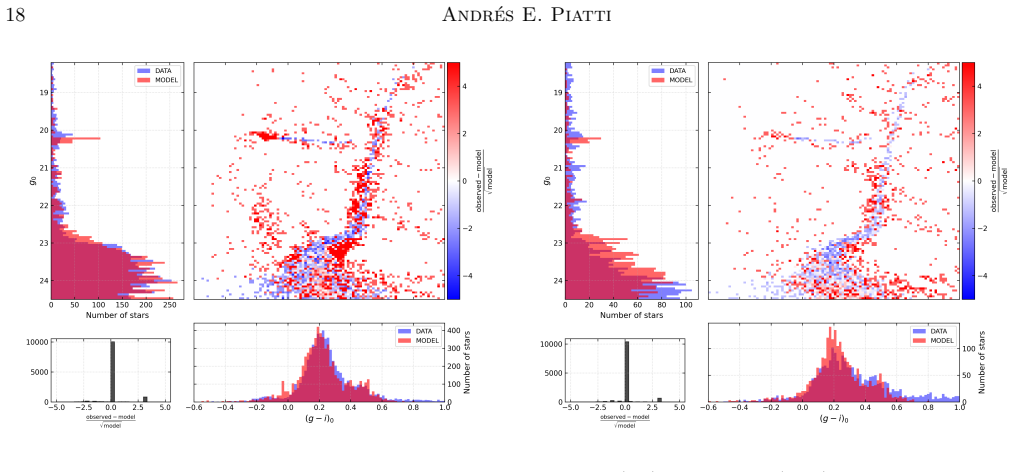
Zheng, Y., Yang, Y., Zhang, Y.-K., et al. 2025, ApJS, 279, 12, doi: 10.3847/1538-4365/add88c Sextans SFH15 Figure 8.Same as Figure 2 for the Sextans’s core region. Figure 9.Same as Figure 2 for the Sextans’s ring region. APPENDIX A.CMDS OF SEXTANS SUB-FIELDS 16Andr ´es E. Piatti Figure 10.Same as Figure 2 for the Sextans’s outer body region. Figure 11.Sam...
discussion (0)
Sign in with ORCID, Apple, or X to comment. Anyone can read and Pith papers without signing in.