REVIEW 4 major objections 4 minor 95 references
Topological Foundations of Multi-Field Instabilities in Continua: Part 1: Foundations Part 2:Analytical Formulation for 1-D Spin Chains Part 3: Numerical Upscaling
T0 review · 4 major / 4 minor · reviewed 2026-08-01 · deepseek-v4-flash
Pith's one-line read The paper claims that the parity of the number of coupled thermodynamic channels decides whether a granular material drifts or oscillates: odd counts force a structural zero mode that drives frictionless configurational drift, even counts c
desk verdict Correct algebra, honest caveats, but the granular claim hangs on two unproven identifications—worth a serious referee, not a desk reject. read the letter →
The pith
A machine-rendered reading of the paper's core claim, the machinery that carries it, and where it could break.
The reading
What carries the argument
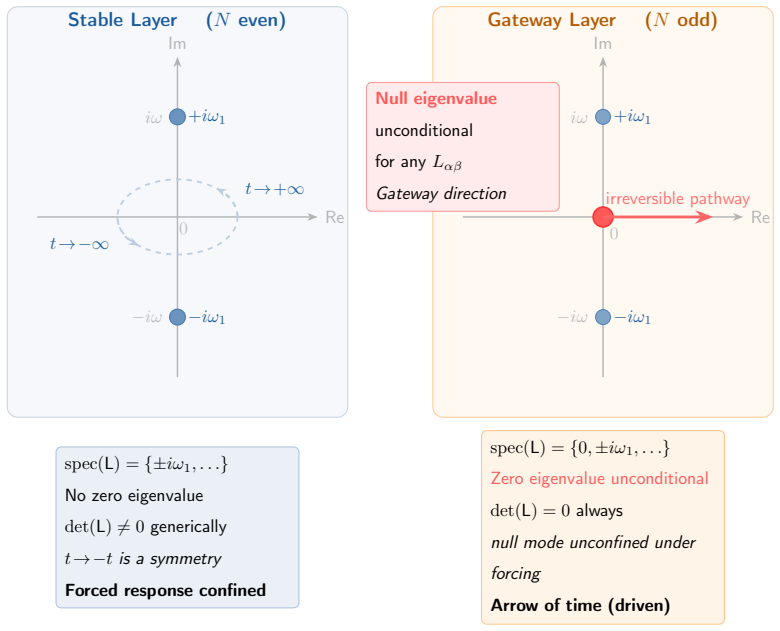
The load-bearing object is the Parity Theorem identity det(L)=(-1)^N det(L) for real skew-symmetric matrices: it guarantees a zero eigenvalue and hence a structural null mode for every odd channel count N, independent of coupling strengths. Around it sits the augmented coupling operator A=D+L, split into a symmetric dissipative block D and a skew-symmetric conservative block L; the basis-invariant Gateway number G_inv=||D^{-1/2}LD^{-1/2}||_2^2 quantifies whether conservative circulation outweighs dissipation. In the minimal N=3 VMC contact the reversible coupling graph is a chain V–M–C (the particle–contact–void topology forbidding a direct V–C edge, L_VC=0), so L acts as a three-dimensional
What would settle it
In a frictionless 1-D DEM oedometer column under sustained axial stress, measure the deviatoric fabric response together with volumetric strain: if the fabric rate is instantaneously slaved to the volumetric and mechanical variables (no independent relaxation lag) and the null-mode projection v0·q fails to grow linearly in time, the independence premise and the parity-driven drift are falsified; the companion prediction of spontaneous drift arrest as L_MC→0 provides the sharp sub-case.
Extended reading notes
Core claim
The paper's central assertion is the Parity Theorem: for any real skew-symmetric coupling matrix L, det(L)=det(L^T)=det(-L)=(-1)^N det(L); for odd N this forces det(L)=0 irrespective of the coupling coefficients, so a null mode v0 exists in thermodynamic force-flux space. In the augmented operator A=D+L, the symmetric part D produces entropy and the skew part L redistributes energy work-free; the null mode evades the restoring forces of L, and when the basis-invariant Gateway number G_inv=||D^{-1/2} L D^{-1/2}||_2^2 >=1, non-normal transient amplification routes energy along v0 through the cross-dissipative projection, producing a precursor to localisation before any loss of ellipticity. Par
Load-bearing premise
The load-bearing premise is that the configurational channel C is a genuinely independent thermodynamic degree of freedom, not slaved to the volumetric and mechanical channels, and that reversible V–C exchange is strictly force-mediated through M — the paper itself notes this identification needs an extra constitutive premise; if either condition fails, the channel count collapses from N=3 to N=2 and the Gateway null mode disappears.
Editorial extensions
If this is right
- Any physical system with an odd number of coupled thermodynamic channels carries a structural null direction that no choice of coupling coefficients can remove.
- Granular dilatancy in a 1-D column is predicted to be a topological cocycle (gradient) instability, algebraically isolated by the acyclic chain graph, and it operates in the complete absence of friction.
- Boundary work projected along the null direction accumulates linearly in time in the frictionless idealisation; with dissipation present, G_inv>=1 marks a soft crossover where transient null-mode amplification dominates, a precursor distinct from the classical acoustic-tensor threshold.
- Adding or removing a single reversible channel flips parity: an even-N extension of the triad confines all forced response to a bounded invariant torus, so any fourth coupled channel (thermal, chemical, electrical) acts as a stabiliser in this framework.
- The Gateway number G is computable from DEM contact statistics without free parameters, and four oedometer protocols — including spontaneous arrest when the mechanical–configurational coupling vanishes — can falsify the mechanism.
Reading between the lines
- If the parity logic is generic, the same Gateway drift should appear in any odd-cardinality subset of thermo-hydro-mechano-chemical-electrical couplings, not just granular contacts; this implies sub-threshold transient growth in multi-physics systems well before classical instability criteria are met — a measurable precursor.
- A design rule the authors leave implicit: parity of the channel count can be engineered. Coupling an odd system to one additional reversible channel should convert secular drift into bounded oscillation, which could provide a generic stabilisation strategy for localisation-prone media.
- The saturation of the linear drift is delegated to future nonlinear analysis; a concrete follow-up is whether the growing null-mode amplitude nucleates a compaction band or a shear band depending on boundary aspect ratio and L_VC perturbation, which a finite-aspect-ratio DEM experiment could test.
- The planetary conjecture (even Earth, odd Venus) is explicitly speculative, but it suggests a testable program: identify the genuinely independent reversible channels in a planetary energy budget and check whether secular, non-cyclic evolution correlates with an odd count.
Editorial analysis
A structured set of objections, weighed in public.
Referee Report
Summary. The three-part manuscript proposes a topological classification of multi-field instabilities centered on the Parity Theorem: any odd-dimensional real skew-symmetric coupling matrix L necessarily has a zero eigenvalue. Part 1 develops the augmented Onsager D+L framework, introduces the Volumetric–Mechanical–Configurational (VMC) triad, derives the structural zero L_VC=0 from Satake's discrete Poincaré lemma under an entity–channel identification, and defines the basis-invariant Gateway number G_inv as an activation criterion for non-normal transient amplification. Part 2 specializes to a 1-D granular spin chain, showing that N=3 displays secular configurational drift while N=4 displays harmonic confinement, and reinterprets L as an so(3) rotation generator whose null mode is the rotation axis. Part 3 reports quad-precision integrations of tridiagonal skew-symmetric chains (N=3 to 50), derives the even-N spectral scaling |λ_min^{even}|~γπ/N, and proposes DEM oedometer protocols. The algebraic core—det(L)=(-1)^N det(L), the closed-form N=3/N=4 solutions, and the 2x2 transient-peak formula—is correct and internally consistent. However, the paper's central physical claim, that odd parity makes configurational failure a structural necessity in granular continua, rests on two explicitly admitted assumptions: the VMC–Satake entity–channel identification and the constitutive premise that give L_VC=0, and the independence of the configurational channel C. The numerical 'validation' in
Significance. If the physical transfer were established, the framework would offer a genuinely new precursor mechanism for localization: a parity-mandated null direction that operates before classical ellipticity thresholds, with explicit closed-form predictions and a parameter-free existence statement. The manuscript has real strengths: the Parity Theorem is proved cleanly; the tridiagonal Pfaffian result (Part 1, Eq. (5)) is exact; the N=3 and N=4 closed-form solutions are derived and match direct integration; and the 2x2 transient amplification formula is rigorously proved with monotonicity. The paper is also unusually honest in its tri-level validation scheme (Theorems / Model interpretations / Conjectures) and in stating several limitations. These strengths are, however, confined to the algebraic and reduced dynamical core. The load-bearing step from that core to granular dilatancy is conditional on identifications and constitutive choices that are plausible but not derived, and the abstract and conclusions present the conditional statement as an unconditional structural necessity. The significance of the paper for granular mechanics therefore depends on work that is partly deferred and par
major comments (4)
- [Part 1, §3.1 and Supp. S3; Part 2, §4.2] The physical transfer rests on two assumptions the paper itself concedes. Prop. 1 derives L_VC=0 only under the entity–channel identification p↔V, c↔M, v↔C and the constitutive premise that reversible V–C exchange is force-mediated; Supp. S3 states these are 'required in addition.' Part 2, §4.2 then concedes that if C were slaved to V and M, the count would collapse to N=2 and the Gateway would disappear. The supporting evidence for C-independence is three qualitative observations (path-dependent fabric, non-coaxiality, delayed fabric response), not a derivation or a direct measurement. Since the abstract claims 'configurational failure is an inherent structural necessity,' this is load-bearing: the granular conclusion is conditional on assumptions that are plausible but not established. A concrete test would be a DEM study that measures whether the fabric rate ξ̇_conf is statistically i
- [Abstract; Part 1, Def. 2, Eq. (8); Part 3, Eq. (3)] The paper repeatedly describes the framework as 'parameter-free,' but the activation criterion is not parameter-free in any operational sense. G_inv = ||D^{-1/2} L D^{-1/2}||_2^2 requires the full dissipative tensor D and the coupling matrix L; Part 2's minimal model has free coefficients L_VM, L_MC (and L_CE in N=4), while the channel count N itself is an input. The zero-eigenvalue existence is parameter-free, but the prediction of onset (G_inv ≥ 1) and the magnitude of drift depend on material coefficients that are not derived from topology. The phrase 'parameter-free topological classification' in the abstract overstates the scope of what is actually parameter-free and should be qualified.
- [Part 3, §§4–7; Abstract] The numerical 'validation' and 'upscaling' do not test the physical hypotheses. Section 4 integrates the model equation dq/dt = Lq + f0 with the same a priori VMC channel assignment and the same L_VC=0 structure; the observed odd/even contrast is an exact algebraic consequence of that model, not a test of the Satake–VMC identification or of C-independence. Section 6 maps VMC channels to DEM observables and Section 7 lists four falsifiable protocols, but no DEM simulation, oedometer experiment, or other independent data are presented. As it stands, the paper validates a mathematical model against itself. The physical claim requires either a DEM test with measured L_VM, L_MC and fabric dynamics, or an explicit statement that this manuscript contains no empirical validation.
- [Part 1, §5.2–5.3, Heuristic Criterion 4] The transfer of the 2x2 transient-peak formula to the full N-dimensional system is admitted to be a conjecture. The paper states that the extremal 2D subspace realizes the 2-norm exactly, but then says 'What remains a conjecture is whether this extremal plane also dominates the routing under generic loading, and whether the closed-form peak M(G_inv) transfers globally.' The abstract, however, presents G_inv ≥ 1 as an established activation criterion: 'once the basis-invariant Gateway number G_inv ≥1, gyroscopic pumping drives deterministic non-modal transient amplification along this null direction.' This is a mismatch between the level of proof and the level of claim. The criterion should be flagged as a heuristic/conjecture in the abstract and conclusions unless the global transfer is proved.
minor comments (4)
- [Part 1, §3.1; Part 2, §2.3] The notation conflict between Satake's integer arrays L_vc, D_cp and the Onsager operators D, L is acknowledged, but the subsequent text often refers to 'the discrete Poincaré lemma forces L_VC=0' without repeating the two extra assumptions. Part 2, §2.3 even cites the proof as 'a structural theorem rather than a kinematic idealisation,' which is inconsistent with Part 1 Supp. S3's explicit admission that the constitutive premise is additional. Please harmonize the wording.
- [Part 2, §5.6, three regimes] The frictionless limit (D=0) gives unconditional unbounded drift with no G ≥ 1 condition, while the damped regime uses G for a bounded overshoot. This is clarified in the text, but the abstract of Part 2 and the conclusions emphasize the frictionless drift without noting that the activation criterion is vacuous there; a sentence connecting the regimes would prevent misreading.
- [Part 1, Supp. S6] Typos in the proof labels: 'label=(i)', 'lbbel=(ii)', 'lcbel=(iii)', 'ldbel=(iv)' should be corrected.
- [Part 3, §1 and §2] The theoretical recap refers to 'Ref. [2]' for Part 1, but the reference list uses [2] for a different item; please verify all cross-references among the three parts and with the companion Royal Society paper.
Circularity Check
Algebraic Parity Theorem is self-contained, but the granular Gateway rests on self-cited channel-independence and on assumptions presented as structural results; Part 3 validates by integrating the same equations.
-
self citation load bearing
[Part 1 §3.1 (VMC configurational contact framework); Part 2 §4.2 (independence of the configurational channel)]
"The property that Nicot et al. establish, and on which the present classification turns, is that this configurational channel is a genuinely independent kinematic degree of freedom."
The granular Gateway claim requires N=3, and N=3 requires C to be an independent degree of freedom. This independence is not derived in the series: Part 2 calls it 'the sole load-bearing assumption' and concedes that if C were slaved, 'C would merge with M, the count would fall to N=2 ... the Gateway, would disappear.' The premise is imported from Ref. [3] (Nicot et al. 2024), co-authored by the present second author, so the central physical prediction depends on a self-citation rather than on an internal proof or an external benchmark within the series.
-
self definitional
[Part 1 Proposition 1 (§3.1) and Supplementary Material S3]
"the step from this to the vanishing of the thermodynamic coupling coefficient LVC requires, in addition, the entity–channel identification and the constitutive premise that the sole route for reversible V–C exchange is the force-carrying channel M."
Proposition 1 is presented as a 'Structural vanishing' of L_VC=0 and the abstract calls it a 'topological necessity', yet the proof's conclusion is effectively the identification-plus-premise input: once V and C are identified with the Satake entities p and v that have no direct edge, and V–C exchange is declared to be M-mediated, L_VC=0 holds by construction. The main text states that 'the topological absence of a particle–void contact enforces the invariant structural null coupling L_VC=0'; that absence is part of the identification, so the 'derivation' restates its own assumptions.
1 more flagged steps
-
other
[Part 3 Abstract and §1; Part 2 Supplementary S5/S8]
"quad-precision integration of tridiagonal skew-symmetric Onsager chains (N=3 to 50), we confirm an absolute topological contrast ... By comparing numerical simulations against our analytical derivations, we ... validate the predictive capacity of the topological approach."
The numerical experiments integrate the same ODE (dq/dt = Lq + f0, Part 2 Supp. S5) that was solved in closed form to produce the analytical predictions. With L taken as the VMC chain and f0 as the axial forcing defined in Part 2, the odd-N drift versus even-N confinement contrast is a property of the equations being integrated, not a test of the physical VMC–Satake identification or of C-independence. The validation loop therefore closes on the mathematical model itself and cannot independently confirm the granular-dilatancy interpretation.
full rationale
The core algebraic result—det(L)=(-1)^N det(L) forces a null mode for odd N—is correct, self-contained, and not circular; the paper itself disclaims novelty in the raw algebraic fact. The circularity is confined to the physical bridge. The granular content requires the VMC channel count N=3, the structural zero L_VC=0, and the independence of C. Each is either asserted via an identification plus constitutive premise (L_VC=0) or imported from the authors' own prior work (C-independence, from Nicot et al. 2024, co-authored by the present second author), and Part 3's numerical 'validation' solves the same equations it set up, so it provides no external support for those premises. These are openly labelled 'model interpretations' in §7.5, and the slaving caveat is conceded explicitly, so this is not a hidden circularity of the algebraic theorem; hence score 4 rather than 6+.
Assumptions & free parameters
free parameters (3)
- L_VM, L_MC, L_CE (coupling coefficients) =
2.0, 1.5, 2.5 in the baseline numerical study
- Channel count N =
3 (VMC), 4 (VMC+E), 5 (THMCE), 3–50 in numerics
- d_min, d_max (dissipation projections onto the 2×2 subspace) =
unspecified / case-dependent
assumptions (7)
- standard math Real skew-symmetric matrices of odd dimension are singular (det(L) = det(−L) = (−1)^N det(L) implies det(L) = 0).
- domain assumption Every constitutive coupling operator decomposes uniquely as A = D + L with D symmetric positive semi-definite and L skew-symmetric (Onsager–Casimir).
- standard math Satake's discrete Poincaré lemma L_vc D_cp = 0 holds for the oriented planar granular contact graph.
- ad hoc to paper Entity–channel identification p↔V, c↔M, v↔C plus the constitutive premise that reversible V–C exchange is force-mediated transfers Satake's static lemma into the dynamic structural zero L_VC = 0.
- domain assumption The configurational channel C (fabric rotation / deviatoric fabric ξ_conf) is a genuinely independent thermodynamic degree of freedom, not slaved to V and M.
- domain assumption Local quasi-static equilibrium at each contact neighborhood, with D and L held as static, state-independent tensors and S⊥ treated as an unbounded energy reservoir.
- ad hoc to paper The extremal 2-D subspace span{v0, v1} captures the maximal instantaneous null-mode growth of the full N-dimensional operator, and this plane dominates routing under generic loading.
invented entities (3)
-
Gateway number G_inv (and the non-invariant bound G)
-
Gateway Layer and structural null direction v0
-
Cocycle filter (β1 = 0 chain topology isolates the dilatancy pathway)
Cite this review
Pith. "Pith review of Topological Foundations of Multi-Field Instabilities in Continua: Part 1: Foundations Part 2:Analytical Formulation for 1-D Spin Chains Part 3: Numerical Upscaling." pith.science (2026). https://pith.science/paper/LEM4HFPK
@misc{pith2026260718995,
  author       = {Pith},
  title        = {Pith review of: Topological Foundations of Multi-Field Instabilities in Continua: Part 1: Foundations Part 2:Analytical Formulation for 1-D Spin Chains Part 3: Numerical Upscaling},
  year         = {2026},
  howpublished = {\url{https://pith.science/paper/LEM4HFPK}},
  note         = {Machine review of arXiv:2607.18995}
}
abstract
This three-part series establishes a parameter-free, topological classification of multi-field instability in granular continua, extending Maxwell's rigidity count to dynamic, non-equilibrium processes. Part 1 (Foundations): a discrete Volumetric-Mechanical-Configurational (VMC) contact formulation maps contact-scale topology to macroscopic multiphysics coupling. A Parity Theorem, $\det(\mathsf{L})=(-1)^N\det(\mathsf{L})$, forces a structural null-mode for every odd channel count $N$, creating "Gateway" layers of broken time-reversal symmetry; once the basis-invariant Gateway number $\mathcal{G}_{\rm inv}\geq 1$, gyroscopic pumping drives non-modal transient amplification along the null direction. Part 2 (analytical, 1-D spin chains): the minimal Gateway is the $N=3$ VMC contact, whose skew block $\mathsf{L}\in\mathfrak{so}(3)$ carries a persistent zero eigenvalue and an unresisted configurational drift that operates even without friction. In an acyclic chain (first Betti number $\beta_1=0$) this isolates dilatancy; closed-form solutions give secular drift for $N=3$ and harmonic confinement for $N=4$. Part 3 (numerical upscaling): quad-precision integration of tridiagonal skew-symmetric Onsager chains ($N=3$ to $50$) confirms the contrast between odd-$N$ secular drift and even-$N$ confinement on invariant tori, with even-chain frequencies scaling as $|\lambda_{\min}^{\rm even}|\sim\gamma\pi/N$. VMC channels map to measurable DEM observables, enabling parameter-free evaluation of $\mathcal{G}$ and four falsifiable oedometer protocols.
Figures


Figures from the paper (16 more)


Reference graph
Works this paper leans on
-
[1]
Leslie Lamport, : a document preparation system, Addison Wesley, Massachusetts, 2nd edition, 1994
1994
-
[2]
and Luding, S
Kumar, N. and Luding, S. , title =. Granular Matter , volume =
-
[3]
Goldhirsch, Isaac , title =. Granular Matter , volume =. doi:10.1007/s10035-010-0181-z , year =
-
[4]
and Luding, Stefan and Bokhove, Onno , title =
Weinhart, Thomas and Thornton, Anthony R. and Luding, Stefan and Bokhove, Onno , title =. Granular Matter , volume =. doi:10.1007/s10035-012-0317-4 , year =
-
[5]
Behringer, R. P. and Chakraborty, B. , title =. Rep Prog Phys , volume =. doi:10.1088/1361-6633/aadc3c , year =
-
[6]
and Roux, J.-N
Peyneau, P.-E. and Roux, J.-N. , title =. Physical Review E , volume =. 2008 , doi =
2008
-
[7]
Internal friction and absence of dilatancy of packings of frictionless polygons , journal =
Az. Internal friction and absence of dilatancy of packings of frictionless polygons , journal =. 2015 , doi =
2015
-
[8]
and Chakraborty, B
Henkes, S. and Chakraborty, B. , title =. Physical Review E , volume =. 2009 , doi =
2009
Show all 95 references
-
[9]
and Bi, D
Sarkar, S. and Bi, D. and Zhang, J. and Behringer, R. P. and Chakraborty, B. , title =. Physical Review Letters , volume =. 2013 , doi =
2013
-
[10]
Eshelby, J. D. , title =. Journal of Elasticity , volume =. doi:10.1007/BF00126994 , year =
-
[11]
Kontinuumstheorie der Versetzungen und Eigenspannungen , publisher =
Kr. Kontinuumstheorie der Versetzungen und Eigenspannungen , publisher =. 1958 , ISBN =
1958
-
[12]
Journal of the Mechanics and Physics of Solids , volume =
Acharya, Amit , title =. Journal of the Mechanics and Physics of Solids , volume =. doi:https://doi.org/10.1016/S0022-5096(00)00060-0 , year =
-
[13]
Solomon, S. C. and Bullock, M. A. and Grinspoon, D. H. , title =. Science , volume =. 1999 , type =
1999
-
[14]
, title =
Heggie, M. , title =. Nature , volume =. 1992 , type =
1992
-
[15]
and Karrech, A
Regenauer-Lieb, K. and Karrech, A. and Chua, H. T. and Horowitz, F. G. and Yuen, D. , title =. Philosophical Transactions of the Royal Society A: Mathematical, Physical and Engineering Sciences , volume =. doi:10.1098/rsta.2009.0204 , year =
2009
-
[16]
and Yuen, D
Regenauer-Lieb, K. and Yuen, D. A. and Branlund, J. , title =. Science , volume =. doi:10.1126/science.1063891 , year =
-
[17]
Turcotte, D. L. and Morein, G. and Roberts, D. and Malamud, B. D. , title =. Icarus , volume =. 1999 , type =
1999
-
[18]
and Solomatov, V
Moresi, L. and Solomatov, V. , title =. Geophysical Journal International , volume =. 1998 , type =
1998
-
[19]
M\"uhlhaus, H. B. and Regenauer-Lieb, K. , title =. Geophysical Journal International , volume =. doi:10.1111/j.1365-246X.2005.02742.x , year =
2005 arXiv
-
[20]
Philosophical Magazine Series 4 , volume =
On the Calculation of the Equilibrium and Stiffness of Frames , author =. Philosophical Magazine Series 4 , volume =. 1864 , publisher =. doi:10.1080/14786446408643668 , url =
-
[21]
, title =
Hill, R. , title =. Journal of the Mechanics and Physics of Solids , volume =. 1962 , type =. doi:https://doi.org/10.1016/0022-5096(62)90024-8 , url =
1962 doi
-
[22]
and Noll, W
Truesdell, C. and Noll, W. ,title=
-
[23]
International Journal of Engineering Science , volume =
Ken-Ichi, Kanatani , title =. International Journal of Engineering Science , volume =. 1984 , type =. doi:https://doi.org/10.1016/0020-7225(84)90090-9 , url =
1984 doi
-
[24]
Soils and Foundations , volume =
Oda, Masanobu , title =. Soils and Foundations , volume =. 1972 , type =. doi:https://doi.org/10.3208/sandf1960.12.17 , url =
1972 doi
-
[25]
and Bathurst, R
Rothenburg, L. and Bathurst, R. J. , title =. Mechanics of Materials , volume =. 1993 , type =. doi:https://doi.org/10.1016/0167-6636(93)90037-R , url =
1993 doi
-
[26]
and Rothenburg, Leo , title =
Bathurst, Richard J. and Rothenburg, Leo , title =. Mechanics of Materials , volume =. 1990 , type =. doi:https://doi.org/10.1016/0167-6636(90)90030-J , url =
1990 doi
-
[27]
G\'eotechnique , year = 1989, month = dec, volume =
Analytical study of induced anisotropy in idealized granular materials. G\'eotechnique , year = 1989, month = dec, volume =. doi:10.1680/geot.1989.39.4.601 , adsurl =
1989 doi
-
[28]
Kruyt, N. P. and Rothenburg, L. , title =. Mechanics of Materials , volume =. doi:10.1016/j.mechmat.2002.12.001 , year =
2002 doi
-
[29]
Biot, M. A. , title =. Journal of Applied Physics , volume =
-
[30]
Rudnicki, J. W. and Rice, J. R. , title =. Journal of the Mechanics and Physics of Solids , volume =. 1975 , type =
1975
-
[31]
Rice, J. R. , title =. Theoretical and Applied Mechanics , editor =. 1976 , type =
1976
-
[32]
Barato, A. C. and Seifert, U. , title =. Phys Rev Lett , volume =. 2015 , type =. doi:10.1103/PhysRevLett.114.158101 , url =
2015 doi
-
[33]
Journal of Coupled Systems and Multiscale Dynamics , volume =
Regenauer-Lieb, Klaus and Veveakis, Manolis and Poulet, Thomas and Wellmann, Florian and Karrech, Ali and Liu, Jie and Hauser, Juerg and Schrank, Christoph and Gaede, Oliver and Fusseis, Florian , title =. Journal of Coupled Systems and Multiscale Dynamics , volume =. doi:10.1...
2013
-
[34]
and Regenauer-Lieb, K
Veveakis, E. and Regenauer-Lieb, K. , title =. Journal of the Mechanics and Physics of Solids , volume =. 2015 , type =. doi:10.1016/j.jmps.2015.02.010 , url =
2015 doi
-
[35]
, title =
Regenauer-Lieb, Klaus and Hu, Manman and Chua, Hui Tong and Calo, Victor and Yakobson, Boris and Zemskov, Evgeny P. , title =. Physical Sciences Forum , volume =. 2025 , type =
2025
-
[36]
, title =
Hill, R. , title =. Journal of the Mechanics and Physics of Solids , volume =. 1958 , type =. doi:https://doi.org/10.1016/0022-5096(58)90029-2 , url =
1958 doi
-
[37]
2012 , type =
Stanley, Richard , title =. 2012 , type =
2012
-
[38]
Discrete and Continuous Dynamical Systems - S , volume =
Mielke, Alexander , title =. Discrete and Continuous Dynamical Systems - S , volume =. 2013 , type =. doi:10.3934/dcdss.2013.6.479 , url =
2013 doi
-
[39]
and Oda, M
Iwashita, K. and Oda, M. , title =. Powder Technology , volume =
-
[40]
and Lim, Keng-Wit and Avila, Carlos F
Andrade, José E. and Lim, Keng-Wit and Avila, Carlos F. and Vlahinić, Ivan , title =. Computer Methods in Applied Mechanics and Engineering , volume =. 2012 , type =. doi:https://doi.org/10.1016/j.cma.2012.06.012 , url =
2012 doi
-
[41]
Mechanics of Materials , volume =
Radjai, Farhang and Richefeu, Vincent , title =. Mechanics of Materials , volume =. 2009 , type =. doi:https://doi.org/10.1016/j.mechmat.2009.01.028 , url =
2009 doi
-
[42]
Geotechnique , volume =
Cundall, PA and Strack, ODL , title =. Geotechnique , volume =. 1979 , type =
1979
-
[43]
Satake , title =
M. Satake , title =. Mechanics of Materials , volume =
-
[44]
Satake , title =
M. Satake , title =. Continuum Models of Discrete Systems , editor =
-
[45]
Satake , title =
M. Satake , title =. Proc. US--Japan Seminar on Continuum-Mechanical and Statistical Approaches in the Mechanics of Granular Materials , editor =
-
[46]
1982 , url=
Fabric tensor in granular materials , author=. 1982 , url=
1982
-
[47]
Philosophical Magazine , volume =
Reynolds, Osborne , title =. Philosophical Magazine , volume =. 1885 , type =
-
[48]
Journal of Engineering Mechanics , volume =
Iwashita, Kazuyoshi and Oda, Masanobu , title =. Journal of Engineering Mechanics , volume =. 1998 , type =. doi:doi:10.1061/(ASCE)0733-9399(1998)124:3(285) , url =
1998 doi
-
[49]
Quarterly of Applied Mathematics , volume =
Drucker, DC and Prager, W , title =. Quarterly of Applied Mathematics , volume =. 1952 , type =
1952
-
[50]
Roscoe, K. H. and Schofield, A. N. and Thurairajah, A. , title =. Géotechnique , volume =. 1963 , type =. doi:10.1680/geot.1963.13.3.211 , url =
1963 doi
-
[51]
International Journal of Mechanical Sciences , volume =
de Borst, René and Sabet, Sepideh Alizadeh and Hageman, Tim , title =. International Journal of Mechanical Sciences , volume =. doi:10.1016/j.ijmecsci.2022.107535 , year =
2022
-
[52]
and Cosserat, F
Cosserat, E. and Cosserat, F. , title =. 1909 , type =
1909
-
[53]
and Ratiu, Tudor S
Marsden, Jerrold E. and Ratiu, Tudor S. , title =. doi:10.1007/978-0-387-21792-5 , year =
-
[54]
Zeitschrift f
Heisenberg, W , title =. Zeitschrift f. Physik , volume =. 1926 , type =
1926
-
[55]
, title =
Regenauer-Lieb, K and Nicot, F. , title =. Journal of Mechanics and Physics of Solids , note =. 2026 , type =
2026
-
[56]
and Nicot, F
Regenauer-Lieb, K. and Nicot, F. , title =
-
[57]
and Regenauer-Lieb, K
Nicot, F. and Regenauer-Lieb, K. , title =
-
[58]
, title =
Schnakenberg, J. , title =. Reviews of Modern Physics , volume =. doi:10.1103/RevModPhys.48.571 , year =
-
[59]
2005 , type =
Oettinger, Hans Christian , title =. 2005 , type =
2005
-
[60]
and Saffer, Demian M
Ikari, Matt J. and Saffer, Demian M. and Marone, Chris , title =. Journal of Geophysical Research: Solid Earth , volume =. doi:10.1029/2008jb006089 , year =
-
[61]
Reviews of Modern Physics , volume =
Jaeger, H M and Nagel, S R and Behringer, R P , title =. Reviews of Modern Physics , volume =. 1996 , type =. doi:10.1103/RevModPhys.68.1259 , url =
1996 doi
-
[62]
and Guazzelli, E
Boyer, F. and Guazzelli, E. and Pouliquen, O. , title =. Phys Rev Lett , volume =. 2011 , type =. doi:10.1103/PhysRevLett.107.188301 , url =
2011 doi
-
[63]
Nedderman, R. M. , title =. 1992 , type =
1992
-
[64]
Granular Matter , volume =
Nicot, Francois and Lin, Mingchun and Wautier, Antoine and Wan, Richard and Darve, Félix , title =. Granular Matter , volume =. doi:10.1007/s10035-024-01443-1 , year =
-
[65]
, title =
Aharonov, Einat and Scholz, Christopher H. , title =. Journal of Geophysical Research: Solid Earth , volume =. 2019 , type =. doi:https://doi.org/10.1029/2018JB016878 , url =
2019 doi
-
[66]
Schofield, A. N. , title =. 1968 , type =
1968
-
[67]
International Journal of Solids and Structures , volume =
Luding, Stefan , title =. International Journal of Solids and Structures , volume =. doi:10.1016/j.ijsolstr.2004.05.048 , year =
2004 doi
-
[68]
and Gendelman, O
Chattoraj, J. and Gendelman, O. and Pica Ciamarra, M. and Procaccia, I. , title =. Phys Rev Lett , volume =. 2019 , type =. doi:10.1103/PhysRevLett.123.098003 , url =
2019 doi
-
[69]
Scheibner, Colin and Souslov, Anton and Banerjee, Debarghya and Surówka, Piotr and Irvine, William T. M. and Vitelli, Vincenzo , title =. Nature Physics , volume =. 2020 , type =. doi:10.1038/s41567-020-0795-y , url =
2020 doi
-
[70]
and Hanai, R
Fruchart, M. and Hanai, R. and Littlewood, P. B. and Vitelli, V. , title =. Nature , volume =. 2021 , type =. doi:10.1038/s41586-021-03375-9 , url =
2021 doi
-
[71]
Physical Review E , volume =
Grmela, Miroslav and \"Ottinger, Hans Christian , title =. Physical Review E , volume =. 1997 , type =. doi:10.1103/PhysRevE.56.6620 , url =
1997 doi
-
[72]
1997 , month =
\"Ottinger, Hans Christian and Grmela, Miroslav , journal =. 1997 , month =. doi:10.1103/PhysRevE.56.6633 , url =
1997 doi
-
[73]
and Roux, S
Radjai, F. and Roux, S. , title =. Phys Rev Lett , volume =. 2002 , type =. doi:10.1103/PhysRevLett.89.064302 , url =
2002 doi
-
[74]
and Jean, Michel and Moreau, Jean-Jacques , journal =
Radjai, Farhang and Wolf, Dietrich E. and Jean, Michel and Moreau, Jean-Jacques , journal =. 1998 , month =. doi:10.1103/PhysRevLett.80.61 , url =
1998 doi
-
[75]
Journal of the Mechanics and Physics of Solids , volume =
Einav, Itai , title =. Journal of the Mechanics and Physics of Solids , volume =. doi:10.1016/j.jmps.2006.11.003 , year =
2006 doi
-
[76]
Soft Matter , volume =
Chakraborty, Bulbul , title =. Soft Matter , volume =. doi:10.1039/b927435a , year =
-
[77]
and Wang, P
Song, C. and Wang, P. and Makse, H. A. , title =. Nature , volume =. 2008 , type =. doi:10.1038/nature06981 , url =
2008 doi
-
[78]
Scientific Reports , volume =
Kronborg, Joel and Hoffman, Johan , title =. Scientific Reports , volume =. doi:10.1038/s41598-026-41372-y , year =
-
[79]
Geochemistry, Geophysics, Geosystems , volume =
Regenauer‐Lieb, Klaus and Hu, Manman and Sun, Qingpei and Liu, Chong and Zhu, Zhennan and Calo, Victor , title =. Geochemistry, Geophysics, Geosystems , volume =. doi:10.1029/2025gc012710 , year =
-
[80]
Physica Scripta , volume =
Regenauer-Lieb, Klaus and Hu, Manman , title =. Physica Scripta , volume =. doi:10.1088/1402-4896/ad36f2 , year =
-
[81]
Riemannian geometry in thermodynamic fluctuation theory , author =. Rev. Mod. Phys. , volume =. 1995 , month =. doi:10.1103/RevModPhys.67.605 , url =
1995 doi
-
[82]
, title =
Casimir, H.B.C. , title =. Reviews of Modern Physics , volume =. 1945 , type =
1945
-
[83]
Heliyon , volume =
Regenauer-Lieb, Klaus and Hu, Manman , title =. Heliyon , volume =. doi:10.1016/j.heliyon.2023.e22701 , year =
2023 doi
-
[84]
de Groot, S. R. and Mazur, P. , title =. 1984 , note =
1984
-
[85]
, title =
Tolman, Richard C. , title =. Physical Review , volume =. 1930 , doi =
1930
-
[86]
and Kurchan, Jorge , title =
Cugliandolo, Leticia F. and Kurchan, Jorge , title =. Physical Review Letters , volume =. 1993 , doi =
1993
-
[87]
Advances in neural information processing systems , pages=
Using manifold stucture for partially labeled classification , author=. Advances in neural information processing systems , pages=
-
[88]
Embedding
B. Embedding. Geometric & Functional Analysis GAFA , volume=. 1994 , publisher=
1994
-
[89]
Edwards, S. F. and Oakeshott, R. B. S. , title =. Physica A: Statistical Mechanics and its Applications , volume =. 1989 , type =. doi:https://doi.org/10.1016/0378-4371(89)90034-4 , url =
1989 doi
-
[90]
Proceedings of the National Academy of Sciences of the United States of America , volume=
Geometric diffusions as a tool for harmonic analysis and structure definition of data: Diffusion maps , author=. Proceedings of the National Academy of Sciences of the United States of America , volume=. 2005 , publisher=
2005
-
[91]
R. J. Ferrell Thomas , title=
-
[92]
Toolan , title =
Timothy M. Toolan , title =
-
[93]
The journal of physical chemistry
Blumenfeld, Raphael and Edwards, Sam , year =. The journal of physical chemistry. B , doi =
-
[94]
Jensen, J. L. W. V. , title =. doi:10.1007/bf02418571 , url =
-
[95]
Kullback and R
S. Kullback and R. A. Leibler , title =. The Annals of Mathematical Statistics , number =. 1951 , doi =
1951
Reviewed August 1, 2026 · model on record in the stance chip above.
Discussion (0). Continue with ORCID to comment.