REVIEW 3 major objections 4 minor 43 references
Fortuity and fragility in supersymmetric SYK
T0 review · 3 major / 4 minor · reviewed 2026-08-16 · deepseek-v4-flash
Pith's one-line read In generic SYK, BPS classes climb forever but exact metric lift fails.
desk verdict Useful decoder diagnostics and clean solvable uplifts, but the 'eventual failure' claim is a conjecture-conditioned expectation, not a proven result. read the letter →
The pith
A machine-rendered reading of the paper's core claim, the machinery that carries it, and where it could break.
The reading
What carries the argument
The load-bearing object is the uplift decoder $D_T$, the restriction of an occupation-pattern projection: for a fixed set of added modes and pattern $T\subseteq M$, it maps a BPS state of the enlarged theory to its $T$-component in the smaller Hilbert space. Its singular values define a state-dependent spectral measure whose mass at zero, first moment, and inverse moment are the uplift fidelity $F_T$, the bare fraction $f_{0,T}$, and the dressing cost $\kappa_T$; $F_T=1$ is exactly the condition that $\alpha$ lies in the image of $D_T$. Around this sits the cohomological-walk machinery: binary strings record whether each added fermion is placed in the unoccupied or occupied channel of a long exact sequence, and the fortuity window guarantees that at every step one channel is unobstructed. The asymptotic obstruction argument uses a generic-position formula for the intersection dimension of the BPS space and the decoder image inside the constrained ambient rooms $\ker Q$ and $\ker Q^\dagger$, fed by Conjecture A.1's rank formula for the supercharge blocks.
What would settle it
Exact-diagonalize the supercharge blocks of the generic one-flavor N=2 SYK model at odd $N=15,17,19$ with several fresh coupling realizations, compute the decoder image inside the middle sector, and check whether $\dim(B^m_N \cap \operatorname{im} D_{\uparrow})$ is positive for $N\ge 19$ or whether the rank of the supercharge block matches Conjecture A.1; either failure would overturn the predicted vanishing.
Extended reading notes
Core claim
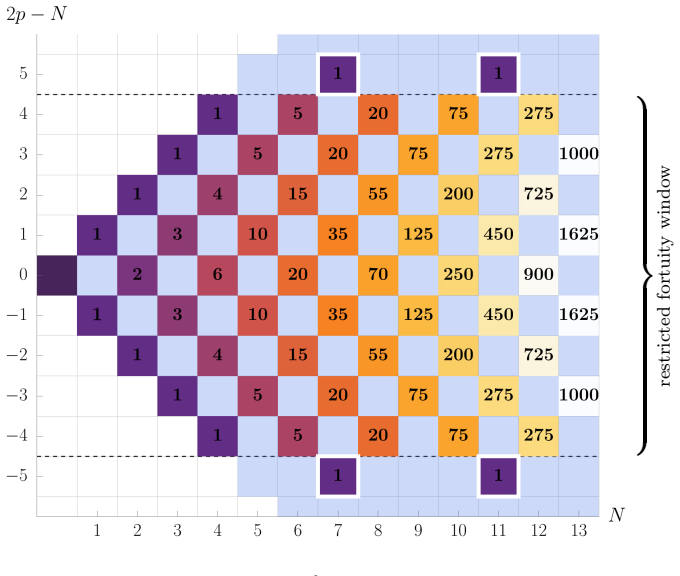
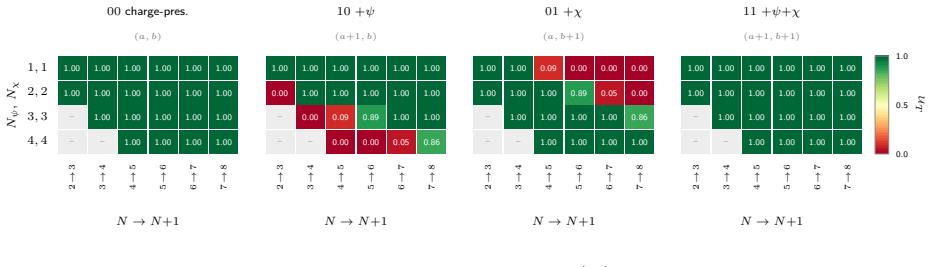
The central discovery is that algebraic and metric continuability of BPS states decouple. Inside the fortuity window $|2p-N|\le q$, the two connecting homomorphisms in the long exact sequence between sizes $N$ and $N+1$ can never obstruct both uplift channels at once, so every nonzero BPS class admits a walk to arbitrarily large $N$. But harmonic representatives are not functorial: the paper defines the decoder $D_T$ as the projection of the enlarged BPS space $B^P_{N'}$ onto the designated occupation-pattern component in $H^p_N$, and shows that exact uplift of a state $\alpha$ is equivalent to $\alpha\in \operatorname{im} D_T$. In the generic one-flavor model, generic-position counting inside the constrained rooms $\ker Q$ and $\ker Q^\dagger$, conditional on Conjecture A.1, predicts $\operatorname{codim}_{B^m_N} A^m_{N;\uparrow} > 0$ for odd $N\ge 15$ and $A^m_{N;\uparrow} = \{0\}$ for odd $N\ge 19$, so the exact-lift locus eventually vanishes even though the cohomology classes remain continuable. The two solvable models sit at the opposite extreme: the single-matrix model has rigid bare embeddings with $F_T=1$ and $\kappa_T=0$, and the two-flavor tower has $F_T=1$ with dressing cost bounded by $n/(N-n+1)$. The operator $D_T^\dagger D_T$, a compressed occupation projector, has adjacent-gap ratio $0.599\pm 0.001$ in the central sector $N'=12$, consistent with the Gaussian unitary ensemble.
Load-bearing premise
The asymptotic vanishing of exact uplift rests on Conjecture A.1 (an unproved formula for the rank of the supercharge blocks) together with the vanishing of connecting maps and the assumption that the BPS space and decoder image are in generic position inside their constrained ambient rooms; if any of these fails, the N≥15 and N≥19 thresholds would move.
Editorial extensions
If this is right
- In the generic N=2 SYK model, fixed-charge fortuity does not mean a BPS class disappears: every nonzero class has at least one one-step cohomological lift, and iterating gives walks to arbitrarily large N.
- Exact metric uplift of harmonic representatives eventually fails in the generic model; subject to Conjecture A.1 and generic position, the middle-directed up channel loses its last direction at odd N≥19.
- Protected models behave oppositely: the single-matrix model uplifts every BPS state with unit fidelity and zero dressing cost, and the two-flavor tower uplifts with unit fidelity and a dressing cost that decreases at fixed rung.
- The decoder operator $D_T^\dagger D_T$ is simultaneously a fragility meter and a chaos probe: its eigenvalues set the visibility scales of uplift, and their correlations match the Gaussian unitary ensemble in the central sector tested.
- State-resolved greedy dressing costs distinguish the families: along surviving fortuitous walks the cost rises with N, while along protected tower rungs it falls.
Reading between the lines
- If metric fragility is generic in chaotic BPS sectors, then microstate identity across system sizes is at best approximate: the paper's framework predicts that the approximate uplift of the vanishing directions becomes increasingly expensive, a claim that longer numerical walks could test.
- The same decoder construction applies to any family of theories with added fermionic modes and a conserved charge, so quiver quantum mechanics' middle-cohomology pure-Higgs classes should realize the same width-one fortuity window and a diagonal walk uplift; writing down that decoder would test the universality of the mechanism.
- Read as quantum error correction, the decoder measures how well BPS information survives erasing fermionic modes; if any BPS subspace has nearly uniform singular values, arbitrary superpositions would uplift with approximately state-independent cost, forming a BPS-protected code.
- The paper's contrast suggests a general criterion: integrable BPS towers should admit isometric or symmetry-dressed exact uplifts, while chaotic sectors should not; checking other supersymmetric models would separate the fragility effect from model-specific arithmetic accidents.
Signed reviews
Editorial analysis
A structured set of objections, weighed in public.
Referee Report
Summary. This paper studies whether BPS states of the N=2 supersymmetric SYK model persist when the number of fermions N is increased. Using the long exact sequence in cohomology, the authors show that every nonzero BPS class can be lifted to arbitrarily large N if the fermion number is allowed to drift along a lattice walk inside the fortuity window, while no canonical lift exists at the level of harmonic representatives. They introduce an 'uplift decoder' D_T and associated diagnostics—fidelity, bare fraction, and dressing cost—to measure whether a harmonic state is exactly present as a designated component of a larger BPS state. In the single-matrix model and in the protected tower of the two-flavor model, exact uplift is realized explicitly, with zero or controlled dressing cost. In the generic one-flavor model, the paper argues that the exact-lift locus for the middle-directed up channel eventually vanishes, with partial failure at odd N >= 15 and complete failure at odd N >= 19 (Eq. (100)). The decoder spectrum is shown to have adjacent-gap statistics consistent with the Gaussian unitary ensemble. The main quantitative claim is conditional on Conjecture A.1, on vanishing connecting maps, and on a generic-position assumption.
Significance. If the central claim were established, the paper would provide a clean separation between algebraic cohomological continuation and metric continuation of BPS states, and would introduce a new observable, D^† D, that connects fortuity, metric fragility, and BPS chaos. There are real strengths: the cohomological walk argument in Section 4 follows from exactness of the long exact sequence and is elegant; the decoder diagnostics are well defined and partly basis independent; the two solvable models give explicit realizations of lossless and dressed uplift; and the paper ships numerical data with a data-access statement. However, the headline result about the generic one-flavor model is not a theorem: it depends on an unproved rank conjecture and on generic-position checks that stop below the claimed thresholds. The framework is valuable even if the threshold values change, but the significance of the paper as submitted is conditional on Conjecture A.1 being resolved or directly verified.
major comments (3)
- [7.2, Eq. (100); Conjecture A.1, Eq. (120)] The central quantitative claim that exact uplift eventually fails is conditional on three ingredients: Conjecture A.1 for the rank of the supercharge blocks, the vanishing of the relevant connecting maps in the dimension formula, and generic position of B^p_N and im D_T inside R^p_{N;up}. Conjecture A.1 is explicitly unproved and is verified numerically only for q=3,...,9 and N=q,...,14; Table 1 checks the generic-position prediction only through N=13. Both threshold values in Eq. (100), N=15 and N=19, lie outside the verified ranges, and the (9,3) row of Table 1 already exhibits an intersection exceeding the generic-position prediction. As written, Eq. (100) is therefore not established, and the abstract's statement that 'exact uplift eventually fails' in the generic model is stronger than the evidence presented. I ask the authors either to prove the relevant instance of Conjecture A.1 for q=3, or to verify the exact-lift-locus dimensions directly at N=15, 17, and 19, and in any case to present the claim as a conditional prediction in the abstract and introduction.
- [Abstract; 7.2; 8] Even assuming Conjecture A.1, Eq. (100) concerns only the up channel in the odd-N middle sector. The authors themselves note that failure in this channel 'does not exclude exact uplift through another channel or at specially tuned couplings.' The abstract and Section 8 nevertheless summarize the result as 'exact uplift eventually fails' in the generic one-flavor model. This is an overstatement: the conditional content is that the middle-directed up channel loses its exact-lift locus, not that no exact uplift exists at all. Please qualify the claim accordingly.
- [7.1, Table 1] The generic-position hypothesis is load-bearing for the threshold computation, but the evidence for it is limited to N <= 13 and already shows an exception at the boundary case (N,p) = (9,3) and its mirror (9,6). Since the claimed thresholds N=15 and N=19 lie beyond the table, the disappearance of A^m_{N;up} at N >= 19 is an extrapolation from the generic-position pattern. A direct numerical computation of dim A^m_{N;up} for the up channel at N=15, 17, and 19 would be a decisive and inexpensive test: if it confirms Eq. (100), the conditional claim becomes a well-supported prediction, and if not, the threshold values and possibly the conjectured mechanism would need revision.
minor comments (4)
- [Abstract; Section 7.2] The symbol eD_m is used in Section 7.2 without definition in the main text; it is introduced only in Appendix A.1. Please define or explicitly refer to Eq. (114) at first use.
- [Appendix A.3] The sentence 'This completes the proof that B_p = dim V^-_p, conditional on Conjecture A.1' is internally contradictory: a derivation that assumes an unproved conjecture is a conditional derivation, not a proof. Please rephrase it as a conditional derivation.
- [6.2, after Eq. (89)] The sentence 'No sampling of states within S is involved' is confusing because U_T(S) is defined as a minimum over normalized states alpha in S. Please clarify that the minimization is over a finite-dimensional subspace and is computed as a singular-value problem, not by Monte Carlo sampling.
- [Section 7.4] The GUE comparison in Eq. (105) and Figure 13 is based on a single sector, N'=12, P=6, pooled over 500 realizations. The authors acknowledge the finite-size limitation, but the wording 'the non-trivial decoder spectrum ... exhibits level statistics consistent with the GUE' could be read as a general claim. Please state explicitly that this is a single-sector test.
Circularity Check
No significant circularity: the central claims follow from exact sequences and explicit definitions; the asymptotic thresholds are honestly conditional on a stated conjecture, not derived from it.
full rationale
The derivation chain is self-contained rather than circular. The cohomological walk statement in Section 4.2 follows from exactness of the long exact sequence (24) together with the fortuity-window input taken from the external reference [3]; no element of the argument is defined in terms of its own conclusion. The decoder diagnostics in Section 5 — fidelity F_T, bare fraction f_0,T, and dressing cost κ_T — are definitions as moments of a state-dependent spectral measure (63), not fitted parameters that are later renamed as predictions. The solvable-model results in Section 6 are established by explicit algebraic identities, such as the staircase embedding (78) and the two-flavor tower expansion (85), with input from the independent works [3], [4], and [21]. The only load-bearing assumption for the generic-model claim (100) is Conjecture A.1, the rank formula, which the paper explicitly labels as a conjecture, verifies numerically for q=3,...,9 and N=q,...,14, and uses to compute the thresholds N≥15 and N≥19; the claim is moreover stated as conditional on the vanishing of connecting maps and generic position. This is an acknowledged unproven input and therefore a correctness risk for the precise thresholds, but it is not a circular reduction: the conjecture is not the target result in disguise, it is not fitted from the data whose dimensions it predicts, and it does not depend on the paper's own conclusions. Finally, there are no self-citations supporting the central claims, and no known empirical pattern is merely renamed. Thus no circular step is identifiable, and the paper receives a score of 0.
Assumptions & free parameters
assumptions (5)
- domain assumption For generic couplings, the cohomology H^p(Q_N) is supported in the fortuity window |2p-N| <= q, with at most O(1) exceptional states on the boundaries.
- ad hoc to paper Conjecture A.1 (rank formula 2): dim V^-_p = eD_p for level below 1-q, and = eD_{N-p-q} for level above or equal to 1-q, up to exceptional boundary corrections.
- domain assumption The relevant connecting maps in the dimension recursion vanish, so dim B^{p+1}_{N+1} = dim B^{p+1}_N + dim B^p_N.
- domain assumption Generic position of B^p_N and im D_T inside the constrained ambient room R^p_{N;T}, so the predicted intersection dimension a_gen = max(0, dim B^p_N + rk D_T - dim R^p_{N;T}) holds.
- standard math The long exact sequence in cohomology induced by the short exact sequence (23) is the standard one.
Cite this review
Pith. "Pith review of Fortuity and fragility in supersymmetric SYK." pith.science (2026). https://pith.science/paper/LEPFXWBD
@misc{pith2026260812160,
  author       = {Pith},
  title        = {Pith review of: Fortuity and fragility in supersymmetric SYK},
  year         = {2026},
  howpublished = {\url{https://pith.science/paper/LEPFXWBD}},
  note         = {Machine review of arXiv:2608.12160}
}
abstract
In the $\mathcal N=2$ supersymmetric SYK model with $N$ fermions, every BPS state is fortuitous: at fixed charge, it exists only over a finite range of $N$. Allowing the charge to increase, we show that BPS classes may instead be uplifted along lattice walks inside the fortuity window, potentially to arbitrarily large $N$. However, there is no canonical uplift. We therefore introduce a decoder $D$ whose spectrum quantifies exact uplift and its metric cost. We call the failure or increasing cost of uplifting harmonic representatives metric fragility. Chen's single-matrix model and the protected tower of the two-flavor SYK model realize bare and genuinely dressed mechanisms of perfect uplift, respectively. In the generic one-flavor model, exact uplift eventually fails. The Lin-Maldacena-Rozenberg-Shan-type operator $D^\dagger D$ exhibits level statistics consistent with the Gaussian unitary ensemble. Its eigenvalues quantify the metric continuity of BPS states across system size, while their correlations probe chaos within the BPS sector. Metric fragility and BPS chaos are thus encoded in complementary observables of the same operator, distinguishing chaotic BPS sectors from exactly solvable towers.
Figures


Figures from the paper (12 more)




Reference graph
Works this paper leans on
-
[1]
C.-M. Chang and Y.-H. Lin,Holographic covering and the fortuity of black holes, 2402.10129
-
[2]
C.-M. Chang and X. Yin,1/16 BPS states inN=4 super-Yang-Mills theory,Phys. Rev. D88(2013), no. 10 106005 [1305.6314]
arXiv 2013
- [3]
-
[4]
Chen,Fortuity with a single matrix,2511.00790
Y. Chen,Fortuity with a single matrix,2511.00790
- [5]
-
[6]
M. R. R. Hughes and M. Shigemori,Fortuity and supergravity,JHEP03(2026) 130 [2505.14888]
arXiv 2026
-
[7]
M. R. R. Hughes and M. Shigemori,The resolved elliptic genus and the D1-D5 CFT, JHEP07(2026) 224 [2603.18138]
arXiv 2026
-
[8]
M. R. R. Hughes, K. Jin, D. Matsumoto, L. Miyahara and M. Shigemori,Towering Gravitons in AdS 3/CFT2,2604.20663
Show all 43 references
-
[9]
S. Kim, J. Lee, S. Lee and H. Oh,BPS phases and fortuity in higher spin holography, JHEP07(2026) 218 [2511.03105]
2026
-
[10]
de Mello Koch, A
R. de Mello Koch, A. Ghosh and H. J. R. Van Zyl,Bosonic fortuity in vector models, JHEP06(2025) 246 [2504.14181]
2025 arXiv
-
[11]
J. R. Fliss, V. Jejjala and O. Parrikar,Fortuity and Complexity in a Simple Quark Model,2605.16254
-
[12]
Belin, P
A. Belin, P. Singh, R. Vadala and A. Zaffaroni,Fortuity in ABJM,2512.04146
- [13]
-
[14]
W. Fu, D. Gaiotto, J. Maldacena and S. Sachdev,Supersymmetric Sachdev-Ye-Kitaev models,Phys. Rev. D95(2017), no. 2 026009 [1610.08917]. [Addendum: Phys.Rev.D 95, 069904 (2017)]
2017 arXiv
-
[15]
Sachdev and J
S. Sachdev and J. Ye,Gapless spin-fluid ground state in a random quantum heisenberg magnet,Phys. Rev. Lett.70(May, 1993) 3339–3342 [cond-mat/9212030]
1993 arXiv
-
[16]
Kitaev,A Simple Model of Quantum Holography, Talks at KITP, April 7, 2015 and May 27, 2015, http://online.kitp.ucsb.edu/online/entangled15/kitaev,
A. Kitaev,A Simple Model of Quantum Holography, Talks at KITP, April 7, 2015 and May 27, 2015, http://online.kitp.ucsb.edu/online/entangled15/kitaev,
2015
-
[17]
Maldacena and D
J. Maldacena and D. Stanford,Remarks on the Sachdev-Ye-Kitaev model,Phys. Rev. D94(2016), no. 10 106002 [1604.07818]. 42
2016 arXiv
-
[18]
Stanford and E
D. Stanford and E. Witten,Fermionic Localization of the Schwarzian Theory,JHEP 10(2017) 008 [1703.04612]
2017 arXiv
-
[19]
Chandrasekaran and A
V. Chandrasekaran and A. Levine,Quantum error correction in SYK and bulk emergence,JHEP06(2022) 039 [2203.05058]
2022 arXiv
-
[20]
Bentsen, P
G. Bentsen, P. Nguyen and B. Swingle,Approximate Quantum Codes From Long Wormholes,Quantum8(2024) 1439 [2310.07770]
2024 arXiv
-
[21]
Heydeman, G
M. Heydeman, G. J. Turiaci and W. Zhao,Phases ofN= 2 Sachdev-Ye-Kitaev models,JHEP01(2023) 098 [2206.14900]
2023 arXiv
-
[22]
H. W. Lin, J. Maldacena, L. Rozenberg and J. Shan,Looking at supersymmetric black holes for a very long time,SciPost Phys.14(2023), no. 5 128 [2207.00408]
2023 arXiv
-
[23]
Y. Chen, H. W. Lin and S. H. Shenker,BPS chaos,SciPost Phys.18(2025), no. 2 072 [2407.19387]
2025 arXiv
-
[24]
Miyahara and S
L. Miyahara and S. Shibuya,Chaos-Integrability Transition in the BPS Subspace of theN= 2SYK Model,2605.20913
-
[25]
Kanazawa and T
T. Kanazawa and T. Wettig,Complete random matrix classification of SYK models withN= 0,1and2supersymmetry,JHEP09(2017) 050 [1706.03044]
2017 arXiv
-
[26]
H. W. Lin, J. Maldacena, L. Rozenberg and J. Shan,Holography for people with no time,SciPost Phys.14(2023), no. 6 150 [2207.00407]
2023 arXiv
-
[27]
Y. Chen, S. Colin-Ellerin, O. Mamroud and K. Papadodimas,Chaos of Berry curvature for BPS microstates,2604.23287
-
[28]
C. V. Johnson,Fortuitous Chaos, BPS Black Holes, and Random Matrices, 2601.17122
-
[29]
Denef,Quantum quivers and Hall / hole halos,JHEP10(2002) 023 [hep-th/0206072]
F. Denef,Quantum quivers and Hall / hole halos,JHEP10(2002) 023 [hep-th/0206072]
2002 arXiv
-
[30]
I. Bena, M. Berkooz, J. de Boer, S. El-Showk and D. Van den Bleeken,Scaling BPS Solutions and pure-Higgs States,JHEP11(2012) 171 [1205.5023]
2012 arXiv
-
[31]
Manschot, B
J. Manschot, B. Pioline and A. Sen,From Black Holes to Quivers,JHEP11(2012) 023 [1207.2230]
2012 arXiv
-
[32]
Anninos, T
D. Anninos, T. Anous and F. Denef,Disordered Quivers and Cold Horizons,JHEP12 (2016) 071 [1603.00453]
2016 arXiv
-
[33]
H. S. Wilf,generatingfunctionology. A K Peters, 3rd ed., 2005
2005
-
[34]
Moreno-Soc´ ıas and J
G. Moreno-Soc´ ıas and J. E. Snellman,Some conjectures about the hilbert series of generic ideals in the exterior algebra,Homology, Homotopy and Applications4(2002) 409–426. 43
2002
-
[35]
Lundqvist and L
S. Lundqvist and L. Nicklasson,On generic principal ideals in the exterior algebra, Journal of Pure and Applied Algebra223(2019), no. 6 2615–2634
2019
-
[36]
Feller,An Introduction to Probability Theory and Its Applications, Vol
W. Feller,An Introduction to Probability Theory and Its Applications, Vol. I. Wiley, New York, 3rd ed., 1968
1968
-
[37]
Krattenthaler,Lattice path enumeration, inHandbook of Enumerative Combinatorics(M
C. Krattenthaler,Lattice path enumeration, inHandbook of Enumerative Combinatorics(M. Bona, ed.), Discrete Mathematics and Its Applications, pp. 589–678. CRC Press, 2015.1503.05930
2015
-
[38]
Banderier and P
C. Banderier and P. Flajolet,Basic analytic combinatorics of directed lattice paths, Theoret. Comput. Sci.281(2002), no. 1–2 37–80
2002
-
[39]
Banderier and M
C. Banderier and M. Wallner,Lattice paths with catastrophes,arXiv e-prints(July,
-
[40]
Ouvry and A
S. Ouvry and A. P. Polychronakos,Hamiltonian and exclusion statistics approach to discrete forward-moving paths,Phys. Rev. E104(2021), no. 1 014143 [2103.15827]
2021 arXiv
-
[41]
Felsner and D
S. Felsner and D. Heldt,Lattice path enumeration and Toeplitz matrices,J. Integer Seq.18(2015). Article 15.1.3
2015
-
[42]
Biggs,Algebraic Graph Theory
N. Biggs,Algebraic Graph Theory. Cambridge University Press, 2 ed., 1994
1994
-
[43]
R. A. Usmani,Inversion of a tridiagonal Jacobi matrix,Linear Algebra and its Applications212–213(1994) 413–414. 44
1994
Reviewed August 16, 2026 · model on record in the stance chip above.
Discussion (0). Continue with ORCID to comment.