REVIEW 3 major objections 4 minor 37 references
q-Cosymplectic Geometry, Integrability and Reduction
T0 review · 3 major / 4 minor · reviewed 2026-08-05 · deepseek-v4-flash
Pith's one-line read q-cosymplectic manifolds give multitime Hamiltonian systems Poisson brackets, tori, and reduction.
desk verdict The paper has a real, correct core in the reduction and symplectization results, but its advertised Liouville–Arnold theorems do not go through, and the q-cosymplectic name hides a known concept. read the letter →
The pith
A machine-rendered reading of the paper's core claim, the machinery that carries it, and where it could break.
The reading
What carries the argument
The object doing the work is the q-cosymplectic structure itself: q closed, everywhere-independent 1-forms λ_1,...,λ_q select q Reeb vector fields R_i, while the closed 2-form Ω is symplectic on the horizontal distribution ξ=∩ker λ_i and has kernel exactly span{R_i}. The bundle isomorphism b(v)=i_vΩ+Σλ_i(v)λ_i converts functions into Hamiltonian and gradient vector fields, and the q-evolution field E_f=ΣR_i+X_f is the object whose first integrals and commuting flows drive the integrability theorems. Reduction is carried by the same data: the Reeb fields are tangent to momentum level sets and push forward to q commuting Reeb fields on the quotient.
What would settle it
Directly check the count in Theorem 3.4: take n=2, q=2, r=1; the condition forces m=4, so the level sets of (f_2,f_3,f_4) are 3-dimensional and the theorem asserts T^3, but only two commuting fields E_H and X_{f_1} are tangent to the fibers. Constructing such a system on the explicit R^{2n+q} q-cosymplectic manifold of Example 2.3 and asking whether its compact connected level set is a 3-torus would decide the claim.
Extended reading notes
Core claim
The central claim is that the structure (M,Ω,λ_1,...,λ_q), with closed Ω and closed independent λ_i such that ker Ω is spanned by Reeb vector fields R_i and Ω is symplectic on ∩ker λ_i, supports a Hamiltonian formalism parallel to symplectic geometry. The map b(v)=i_vΩ+Σλ_i(v)λ_i is an isomorphism; Hamiltonian vector fields X_f=b^{-1}(df−ΣR_i(f)λ_i) are horizontal, the gradient field is ∇f=X_f+ΣR_i(f)R_i, and the q-evolution field E_f=ΣR_i+X_f encodes all q time directions. The bracket {f,g}=Ω(X_f,X_g) is a Poisson bracket, and a q-cosymplectic manifold symplectizes into (R^q×M, pr*ω+Σ ds_i∧pr*λ_i) with a Poisson morphism. Under involutivity and the dimension condition 2n+q−1=m+r, Theorems 3
Load-bearing premise
The integrability theorems hinge on a counting assumption: the number of commuting vector fields must equal the dimension of the level sets. Under the paper's condition, the level-set dimension becomes 2r+1 while the available commuting fields number r+1, so the matching holds only when r=0; if that count misfires, the torus conclusion does not follow.
Editorial extensions
If this is right
- Any q-cosymplectic manifold carries a Poisson bracket, so multitime Hamiltonian systems form a corank-q Poisson system rather than a mere collection of one-time equations.
- Under the paper's dimension condition, a q-evolution field with enough commuting first integrals has compact level sets diffeomorphic to tori and is conjugate to a constant field, extending action-angle coordinates to multitime dynamics.
- In Liouville coordinates the forms λ_i are torus-invariant, so the clock directions remain aligned with the integrable fibration.
- A Hamiltonian group action with a q-cosymplectic momentum map admits a reduced q-cosymplectic space at every weakly regular value, with reduced Reeb fields and forms pushed forward from the original ones.
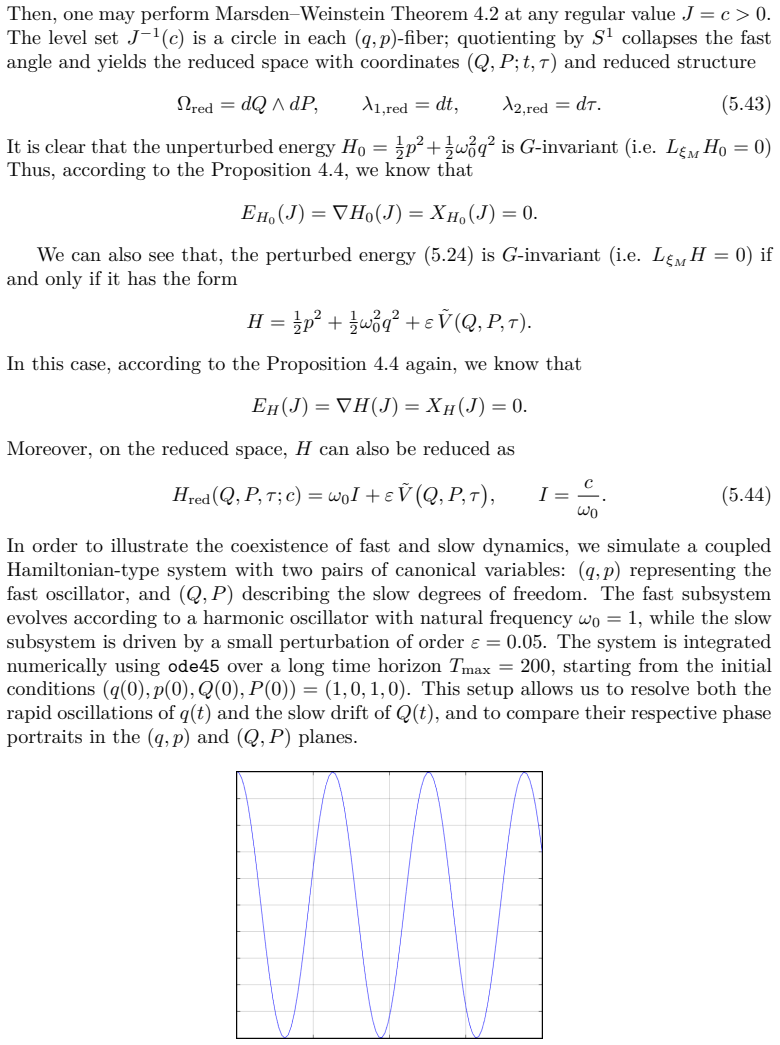
- The fast-slow oscillator example shows that action-angle averaging and symmetry reduction in the q-cosymplectic setting reproduce the standard slow drift equations.
Reading between the lines
- The symplectization theorem suggests a route to multitime Hamilton–Jacobi theory: solve a Hamilton–Jacobi equation on R^q×M and pull back solutions to M, which the paper does not explicitly do.
- Reduction at the fast action J=c in the example could be viewed as a geometric counterpart of averaging; making that identification explicit might turn the ε→0 limit into an exact quotient.
- The framework is plausibly compatible with singular reduction or non-Abelian cocycle twists, but neither is explored in this paper.
Editorial analysis
A structured set of objections, weighed in public.
Referee Report
Summary. The paper introduces q-cosymplectic manifolds, defined by a closed 2-form and q closed, pointwise independent 1-forms, and studies Hamiltonian, gradient, local-gradient, and q-evolution vector fields. It proves a Poisson-bracket structure (Theorem 3.2), a symplectization statement (Theorem 3.8), two Liouville–Arnold-type integrability theorems (Theorems 3.4 and 3.7), and a Marsden–Weinstein-type reduction theorem (Theorem 4.2). Section 5 applies the formalism to a fast–slow harmonic-oscillator system, including the averaged slow dynamics. The claimed central contributions are the integrability theorems and the reduction theorem for the new geometric structure.
Significance. If the main results were valid, the paper would provide a useful framework for multi-time Hamiltonian dynamics, connecting q-cosymplectic geometry with noncommutative integrability and reduction. The construction of the Poisson bracket in Theorem 3.2 and the symplectization in Theorem 3.8 are natural and appear to be correct; the Marsden–Weinstein reduction in Theorem 4.2 is also plausibly correct and is proved in detail. However, the two Liouville–Arnold-type theorems are dimensionally inconsistent and do not follow from the quoted Bogoyavlenskij theorem. Since integrability is advertised in the abstract and the title, this is a load-bearing defect. The fast–slow application is heuristic and does not repair the gap.
major comments (3)
- [Theorem 3.4, Section 3] The hypotheses do not meet those of Bogoyavlenskij's Theorem 2.2. In Theorem 3.4 the level map is F=(f_{r+1},...,f_m), so k=m-r and the fibers have dimension dim M - k = 2n+q-(m-r). Using the stated condition 2n+q-1=m+r, this equals 2r+1. Theorem 2.2 requires n=2r+1 commuting, independent vector fields tangent to the fibers. The proof supplies only E_H and X_{f_1},...,X_{f_r}, which is r+1 fields. For every r>0, r+1<2r+1, so the hypotheses are not satisfied. Moreover the asserted torus T^{m-r} has dimension m-r=2n+q-1-2r, which is not forced to equal 2r+1. Thus the theorem's conclusion does not follow from the assumptions.
- [Theorem 3.7, Section 3] The same dimensional defect appears. Here F=(H,f_{r+1},...,f_m) has k=m-r+1 components, so its fibers have dimension dim M - k = 2n+q-(m-r+1). With 2n+q-1=m+r this is 2r. The proof supplies E'_H and X'_{f_1},...,X'_{f_r}, i.e. r+1 vector fields. For r>=2, r+1<2r, and for r=0 the nonzero field E'_H cannot be tangent to a zero-dimensional fiber. The claimed torus T^{m-r+1}=T^{2n+q-2r} also does not match the fiber dimension 2r except in special cases. Hence Theorem 3.7 is not a consequence of the stated hypotheses and cannot be rescued by the invocation of Theorem 2.2.
- [Abstract and title] Because Theorems 3.4 and 3.7 are the basis for the advertised 'Liouville–Arnold-type theorems' and for the word 'Integrability' in the title, the central claim of the manuscript is unsupported. Restricting r=0 in Theorem 3.4 would recover a one-field Liouville statement, but then the noncommutative integrability content disappears; Theorem 3.7 does not reduce cleanly even to r=0. This is not a local typo but a structural mismatch in the main new theorems.
minor comments (4)
- [Example 2.3] The form Omega = sum_{j=1}^n x_j dy_j is not closed; d(Omega)=sum_j dx_j wedge dy_j. This contradicts the q-cosymplectic requirement dOmega=0. The example should use Omega = sum_j dx_j wedge dy_j.
- [Theorem 3.7, condition (3.15)] The condition '{H',f_k}=0, k=1,...,q' appears to have the wrong index range: f_k is only defined for k<=m and q is unrelated to m. It should likely be k=1,...,m or k=r+1,...,m.
- [Proof of Theorem 3.4] The proof refers to 'relations (3.11) and (3.15)', but (3.15) belongs to Theorem 3.7 and is not available in Theorem 3.4. The relevant bracket identities are (3.9)-(3.10) and (3.8).
- [Section 5.1.1] The assertion that the averaging theorem applies 'because (i)-(iii)' is informal; in particular, the projection commutation in (iii) is not demonstrated. The application section is presented as an illustration, but its claims about the geometric validity of averaging would need more proof if they are meant as theorems.
Circularity Check
No circularity: the paper's constructions and theorems are derived from the stated q-cosymplectic definitions and from external cited theorems (Bogoyavlenskij, Liouville, Zung, Albert); self-citations are contextual and not load-bearing.
full rationale
Walked the derivation chain. The q-cosymplectic structure is defined explicitly (Definition 2.1), and the Poisson bracket (Theorem 3.2), the Hamiltonian/gradient/evolution vector-field identities (Section 3), the symplectization equivalence (Theorem 3.8), and the Marsden--Weinstein reduction (Theorem 4.2) are all proved from the structure equations and standard external results. The integrability and action-angle statements (Theorems 2.2--2.5, 3.4, 3.7) invoke Bogoyavlenskij's Theorem 2.2, Liouville's theorem, and Zung's conservation theorem as external mathematical inputs, with their assumptions stated in the paper. The paper's self-citations [33]--[35] appear only in the introductory literature survey and are not used as the justification for any central theorem. The fast-slow application is an illustrative example, not a fitted parameter called a prediction. The only substantial concern is a possible hypothesis-count mismatch in the application of Theorem 2.2 inside Theorems 3.4 and 3.7 (the proofs supply r+1 commuting tangent vector fields while dim M - k evaluates to 2r+1 under the paper's condition), but that is a correctness gap, not circularity: the cited theorem is external and the asserted torus conclusion does not reduce to an input by construction. No circular step is present.
Assumptions & free parameters
assumptions (4)
- standard math Theorem 2.2 (Bogoyavlenskij): compact connected fibers of a submersion with n commuting vector fields tangent to the fibers are T^n.
- standard math Theorem 2.3 (Liouville's theorem) and Theorem 2.4 (Zung's conservation property): existence of Liouville torus actions and preservation of tensor fields.
- domain assumption Albert's cosymplectic reduction theorem and proof strategy [2].
- standard math Smooth manifold machinery, Cartan's magic formula, and standard de Rham cohomology identities.
invented entities (2)
-
q-cosymplectic manifold (M, Omega, lambda_1,...,lambda_q)
-
q-evolution vector field E_f = sum_i R_i + X_f
Cite this review
Pith. "Pith review of q-Cosymplectic Geometry, Integrability and Reduction." pith.science (2026). https://pith.science/paper/LER3TXUP
@misc{pith2026250905998,
  author       = {Pith},
  title        = {Pith review of: q-Cosymplectic Geometry, Integrability and Reduction},
  year         = {2026},
  howpublished = {\url{https://pith.science/paper/LER3TXUP}},
  note         = {Machine review of arXiv:2509.05998}
}
abstract
In the present paper, we define the concept of a \( q \)-cosymplectic manifold, on which we study the Hamiltonian, gradient, local gradient, and \( q \)-evolution vector fields. Several Liouville--Arnold-type theorems and a \( q \)-cosymplectic Marsden--Weinstein reduction theorem are established. We also provide physical examples illustrating the application of the structure to multitime dynamics (Fast-slow dynamical system). To make our work more self-contained, we include detailed proofs for some results that may resemble those known for cosymplectic manifolds.
Figures


Figures from the paper (5 more)


Reference graph
Works this paper leans on
-
[1]
R.AbrahamandJ.E.Marsden, Foundationsofmechanics, AMSChelseapublishing, Vol. 364, Benja min/Cummings Pub. Co., 1978
work page 1978
-
[2]
Albert, Le théorème de réduction de Marsden-Weinstein en géométrie cosymplec- tique et de contact, J
C. Albert, Le théorème de réduction de Marsden-Weinstein en géométrie cosymplec- tique et de contact, J. Geom. Phys. 6, 627–649, (1989)
work page 1989
-
[3]
V. I. Arnold, Mathematical Methods of Classical Mechanics. Graduate Texts in Mathematics, Springer, New York, (1989)
work page 1989
-
[4]
V. Arnold, and A. B. Givental, Symplectic Geometry.Dynamical Systems IV, Eneyclopeadia of Mathematical Sciences, VoL 4, Springer-Verlag, Berli, (2001)
work page 2001
-
[5]
V.I. Arnold, V.V. Kozlov, and A.I. Neishtadt,Mathematical Aspects of Classical and Celestial Mechanics, 3rd ed., Encyclopaedia of Mathematical Sciences, vol. 3, Springer-Verlag, Berlin, 2006
work page 2006
- [6]
-
[7]
O. I. Bogoyavlenskij, Extended integrability and bi-Hamiltonian systems. Commun. Math. Phys. 196, 19-51, (1998)
work page 1998
-
[8]
O. I. Bogoyavlenkij, Theory of tensor invariants of integrable Hamiltonian systems. II. Theorem on symmetries and its applications, Comm. Math. Phys. 184, 301-365, (1997)
work page 1997
Show all 37 references
-
[9]
Cappelletti-Montano, A
B. Cappelletti-Montano, A. de Nicola and I. Yudin, A survey on cosymplectic ge- ometry, Rev. Math. Phys. 25, 1343002, (2013)
2013
-
[10]
Cardin and C
F. Cardin and C. Viterbo, Commuting Hamiltonians and Hamilton–Jacobi multi- time equations, Duke Math. J. 144, 235–84, (2008)
2008
-
[11]
Davini and M
A. Davini and M. Zavidovique, On the (non) existence of viscosity solutions of multi-time Hamilton-Jacobi equations, J. Differ. Equ. 258, 362–378, (2015)
2015
-
[12]
de Lucas and B
J. de Lucas and B. M. Zawora, A time-dependent energy-momentum method, J. Geom. Phys. 170, 104364 (2021)
2021
-
[13]
de León and M
M. de León and M. Saralegi, Cosymplectic reduction for singular momentum maps, J. Phys. A. 26, 5033–5043, (1993). 41
1993
-
[14]
de León, J
M. de León, J. C. Marrero, D. M. de Diego, Linear almost Poisson structures and Hamilton–Jacobi equation. Applications to nonholonomic mechanics, J. Geom. Mech. 2, 159–198, (2010)
2010
-
[15]
L. C. Evans, Partial Differential Equations, American Mathematical Society, Prov- idence, Rhode Island. 1998
1998
-
[16]
Guillemin, and S
V. Guillemin, and S. Sternberg, Symplectic techniques in physics. Cambridge Uni- versity Press, Cam bridge, (1990)
1990
-
[17]
G. Q. Gu, K. H. Chung and P. M. Hui, Two-dimensional traffic flow problems in inhomogeneous lattices, Physica A. 217, 339–347, (1995)
1995
-
[18]
J. L. Lagrange, Mécanique analytique, vol. 2. Cambridge University Press, Cam- bridge, (2009)
2009
-
[19]
Liouville, Note sur l’integration des equations differentielles de la dynamique
J. Liouville, Note sur l’integration des equations differentielles de la dynamique. J. Math. Pures Appl. 20, 137-138, (1855)
-
[20]
Libermann and Ch.-M
P. Libermann and Ch.-M. Marle, Symplectic Geometry and Analytical Mechanics, (D. Reidel Publishing Company, Dordrecht), 1987
1987
-
[21]
Libermann, Sur les automorphismes infinitésimaux des structures symplectiques et des structures de contact, in Colloque Géom
P. Libermann, Sur les automorphismes infinitésimaux des structures symplectiques et des structures de contact, in Colloque Géom. Diff. Globale (Bruxelles,: Centre Belge Rech. Math. Louvain 1959), 37–59, (1958)
1959
-
[22]
Libermann, Sur quelques exemples de structures pfaffiennes et presque cosym- plectiques, Ann
P. Libermann, Sur quelques exemples de structures pfaffiennes et presque cosym- plectiques, Ann. Mat. Pura Appl. 4, 153–172, (1962)
1962
-
[23]
C. M. Marle, The inception of symplectic geometry: the works of Lagrange and Poisson during the years 1808–1810, Lett. Math. Phys. 90, 3–21, (2009)
2009
-
[24]
J. E. Marsden and A. Weinstein, Reduction of symplectic manifolds with symmetry. Rep. Math. Phys. 5, 121-130, (1974)
1974
-
[25]
N. N. Nekhoroshev, Action-angle variables and their generalization, Trans. Mosc. Math. Soc. 26, 180-198, (1972)
1972
-
[26]
Neagu and C
M. Neagu and C. A. Udriste, Riemann-Lagrange geometrization for metrical multi- time Lagrange spaces, Balkan J. Geom. Appl. 11, 87–98, (2006)
2006
-
[27]
P. J. Olver, Applications of Lie Groups to Differential Equations (New York: Springer), 1993
1993
-
[28]
J. P. Ortega and T. S. Ratiu, Momentum Maps and Hamiltonian Reduction, Progress in Mathematics, Vol. 222, (Birkha¨user, Boston), 2004
2004
-
[29]
J. A. Sanders, F. Verhulst, and J. Murdock, Averaging Methods in Nonlinear Dy- namical Systems, 2nd ed., Applied Mathematical Sciences, vol. 59, Springer, New York, 2007
2007
-
[30]
Stickforth, The Kepler problem in relativistic multi-time formalism
J. Stickforth, The Kepler problem in relativistic multi-time formalism. Part I, Acta Mechanica, 123, 195–201, (1997). 42
1997
-
[31]
Wechselberger, Existence and bifurcation of canards inR3 in the case of a folded node,SIAM J
M. Wechselberger, Existence and bifurcation of canards inR3 in the case of a folded node,SIAM J. Appl. Dyn. Syst., 4(1):101–139, 2005
2005
-
[32]
Zawora, A time-dependent energy-momentum method, Master’s thesis, Univer- sity of Warsaw, Faculty of Physics, 2021
B. Zawora, A time-dependent energy-momentum method, Master’s thesis, Univer- sity of Warsaw, Faculty of Physics, 2021
2021
-
[33]
X. F. Zhao and Y. Li, Conserved Quantities, Symmetries of (Almost-)Hamiltonian and Lagrangian Systems, J. Geom. Anal. 35, no. 9, Paper No. 268, (2025)
2025
-
[34]
X. F. Zhao, Completely integrable system with Jacobi multipliers and its KAM stability, Discrete Contin. Dyn. Syst., 45, 1870-1890, (2025)
2025
-
[35]
X. F. Zhao and Y. Li, Geometric properties of vector fields on manifold, Acta Math. Sin. (Engl. Ser.), (To appear)
-
[36]
N. T. Zung, A conceptual approach to the problem of action-angle variables. Arch. Ration. Mech. Anal. 229, 789–833, (2018)
2018
-
[37]
Zwiebach, A first course in String Theory, Cambridge University Press, 2009
B. Zwiebach, A first course in String Theory, Cambridge University Press, 2009. 43
2009
Reviewed August 5, 2026 · model on record in the stance chip above.
Discussion (0). Continue with ORCID to comment.