REVIEW 2 major objections 41 references
Reviewed by Pith at T0; open to challenge.
T0 means a machine referee read the full paper against a public rubric. The mark states how deep the mechanical check went, never who wrote it. the ladder, T0–T4 →
T0 review · grok-4.3
Proton bunches from RHIC can drive a plasma wake to accelerate polarized electrons for the Electron-Ion Collider at required performance levels.
2026-06-30 23:24 UTC pith:LEUICOSD
load-bearing objection This is a high-level conceptual sketch for an EIC injector that reuses RHIC protons in a PWFA scheme, but it gives only stated estimates with no calculations or simulations to support them. the 2 major comments →
An electron injector for the Electron-Ion Collider based on proton-driven plasma wakefield acceleration
The pith
A machine-rendered reading of the paper's core claim, the machinery that carries it, and where it could break.
Core claim
Our initial study indicates that the design parameters of the EIC are within reach when accelerating the electron bunches in the proton-driven plasma wake, with average polarization of ~70% and a luminosity of 1e34 cm^{-2}s^{-1}.
What carries the argument
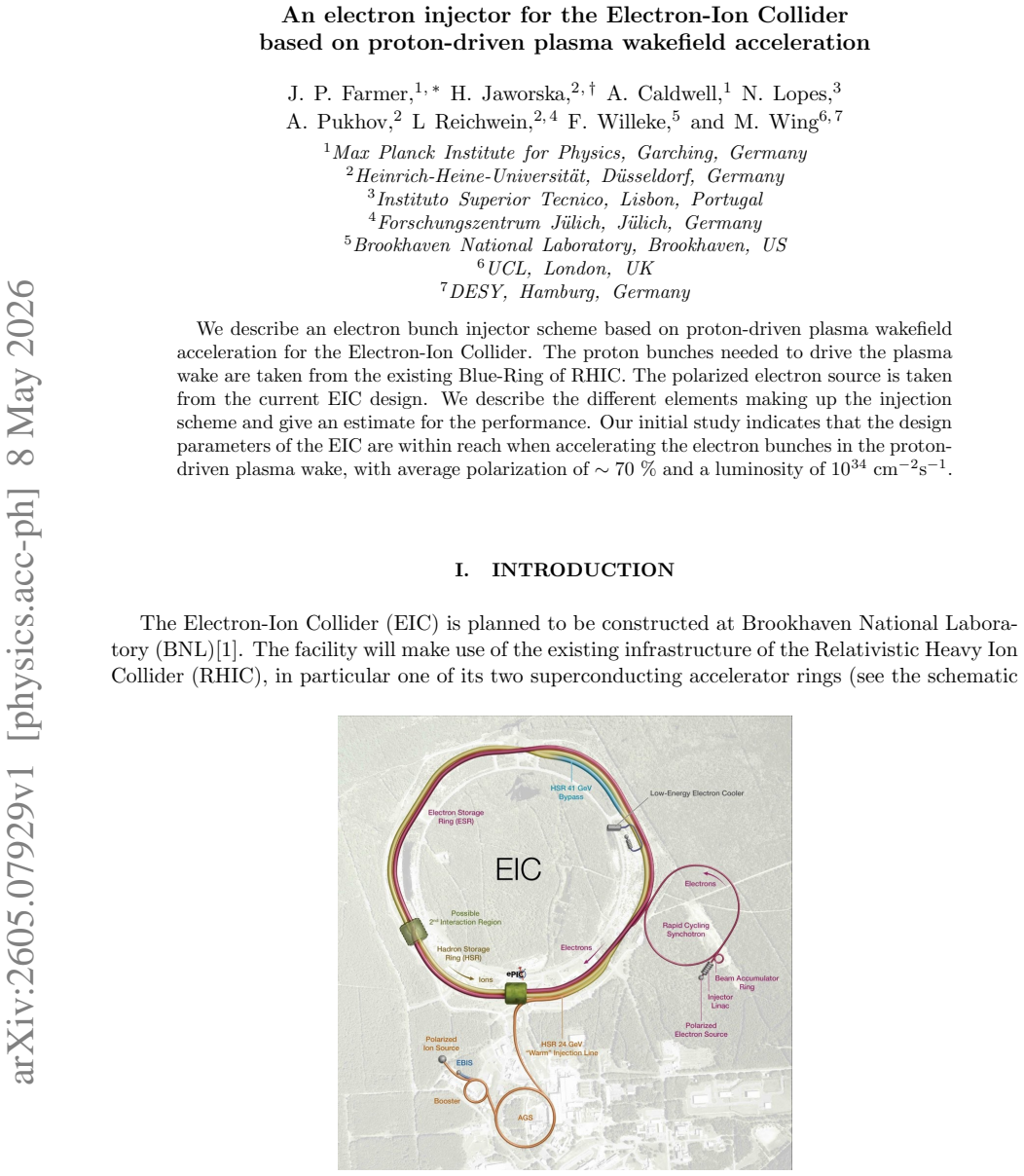
Proton-driven plasma wakefield acceleration in which RHIC Blue-Ring proton bunches drive the wake to accelerate the electron bunches.
Load-bearing premise
The proton bunches delivered by the RHIC Blue-Ring can drive a sufficiently stable and uniform plasma wake that preserves the polarization and emittance of the injected electron bunches at the levels required for EIC operation.
What would settle it
A simulation or experiment that measures whether electron emittance growth and polarization loss after passage through the proton-driven wake remain below the thresholds needed for EIC operation.
If this is right
- Existing RHIC proton bunches become usable for EIC electron injection.
- Electron polarization near 70 percent survives the acceleration process.
- Luminosity of 10^34 cm^{-2}s^{-1} becomes attainable with the described scheme.
- The injection scheme integrates with the planned EIC polarized electron source.
Where Pith is reading between the lines
- The scheme could reduce the need to construct a separate high-energy electron accelerator for the EIC.
- Analogous proton-driven injection methods might be examined for other proposed polarized-electron colliders.
- Further modeling of wake uniformity would test whether emittance can be held to collider specifications.
Editorial analysis
A structured set of objections, weighed in public.
Referee Report
Summary. The manuscript proposes an electron injector scheme for the Electron-Ion Collider (EIC) based on proton-driven plasma wakefield acceleration. Proton bunches delivered by the existing RHIC Blue-Ring drive the plasma wake, while the polarized electron source follows the current EIC design. The paper outlines the elements of the injection scheme and supplies a high-level performance estimate, concluding that EIC design parameters are within reach with an average polarization of ~70% and a luminosity of 10^{34} cm^{-2}s^{-1}.
Significance. If the estimates hold after detailed validation, the scheme would demonstrate a novel use of existing RHIC proton infrastructure to meet EIC injector requirements via proton-driven PWFA, potentially reducing the need for new electron acceleration hardware while preserving polarization and emittance at collider-relevant levels.
major comments (2)
- Abstract: the central claim that EIC design parameters (average polarization ~70%, luminosity 10^{34} cm^{-2}s^{-1}) are within reach is presented solely as an 'initial study' estimate with no derivation, simulation details, error analysis, or supporting data, leaving the claim unsubstantiated.
- The manuscript supplies no PIC simulations, analytic wake calculations, or tracking studies that quantify wake uniformity, hose instability growth, or spin precession/depolarization for the stated RHIC proton bunch and plasma parameters, which are load-bearing for the polarization and emittance preservation required by the central claim.
Simulated Author's Rebuttal
We thank the referee for the constructive comments. We address each major point below and indicate planned revisions to the manuscript.
read point-by-point responses
-
Referee: Abstract: the central claim that EIC design parameters (average polarization ~70%, luminosity 10^{34} cm^{-2}s^{-1}) are within reach is presented solely as an 'initial study' estimate with no derivation, simulation details, error analysis, or supporting data, leaving the claim unsubstantiated.
Authors: We agree the abstract presents the performance claim without explicit derivation. The estimates scale from published proton-driven PWFA results (e.g., AWAKE) using the known RHIC proton parameters and EIC beam requirements; no new simulations were performed for this conceptual proposal. We will revise the abstract to qualify the estimates as order-of-magnitude scalings and add a short section or appendix summarizing the scaling relations and assumptions. revision: yes
-
Referee: The manuscript supplies no PIC simulations, analytic wake calculations, or tracking studies that quantify wake uniformity, hose instability growth, or spin precession/depolarization for the stated RHIC proton bunch and plasma parameters, which are load-bearing for the polarization and emittance preservation required by the central claim.
Authors: The manuscript is framed as an initial conceptual study rather than a detailed simulation paper. No PIC or tracking studies are included because they lie outside the present scope. We will revise the text to state the key assumptions on wake quality and polarization preservation explicitly, cite relevant literature on hose mitigation and spin precession in plasma wakes, and note that full validation would require dedicated follow-on simulations. revision: partial
Circularity Check
No circularity: performance figures presented as estimates without any derivation chain or self-referential reduction
full rationale
The manuscript contains no equations, analytic derivations, fitted parameters, or simulation outputs that are then repurposed as predictions. The abstract and description explicitly frame the polarization (~70%) and luminosity (1e34 cm^{-2}s^{-1}) values as order-of-magnitude estimates from an initial study rather than results obtained by solving or fitting within the paper itself. No self-citations are invoked to justify uniqueness or load-bearing premises, and no ansatz or renaming of known results occurs. The central claim therefore rests on external assumptions about RHIC beam quality rather than any internal loop that reduces to the paper's own inputs.
Axiom & Free-Parameter Ledger
read the original abstract
We describe an electron bunch injector scheme based on proton-driven plasma wakefield acceleration for the Electron-Ion Collider. The proton bunches needed to drive the plasma wake are delivered by the existing Blue-Ring of RHIC. The polarized electron source is that in the current EIC design. We describe the different elements making up the injection scheme and give an estimate for the performance. Our initial study indicates that the design parameters of the EIC are within reach when accelerating the electron bunches in the proton-driven plasma wake, with average polarization of ~70% and a luminosity of 1e34 cm$^{-2}$s$^{-1}$.
Figures


Reference graph
Works this paper leans on
-
[1]
F. Willeke and J. Beebe-Wang,Electron Ion Collider Conceptual Design Report 2021, Tech. Rep. (Brookhaven National Laboratory (BNL), Upton, NY, United States; Thomas Jefferson National Ac- celerator Facility (TJNAF), Newport News, VA, United States, United States, 2021)
work page 2021
-
[2]
E. Gschwendtner, K. Lotov, P. Muggli, M. Wing,et al.(AWAKE Collaboration), The AWAKE Run 2 programme and beyond, Symmetry14, 1680 (2022)
work page 2022
-
[3]
V. N. Litvinenko, N. Bachhawat, J. C. Brutus, L. Cultrera, K. Decker, M. Gaowei, P. Inacker, Y. Jing, J. Ma, K. P. Mondal, G. Narayan, I. Pinayev, F. Severino, K. Shih, J. Skaritka, L. Smart, Y. Than, J. Walsh, E. Wang, G. Wang, and D. Weiss, Towards advanced polarized electron sources, Nature Physics22, 325–330 (2026)
work page 2026
-
[4]
T. Tajima and J. M. Dawson, Laser electron accelerator, Phys. Rev. Lett.43, 267 (1979)
work page 1979
-
[5]
P. Chen, J. M. Dawson, R. W. Huff, and T. Katsouleas, Acceleration of electrons by the interaction of a bunched electron beam with a plasma, Phys. Rev. Lett.54, 693 (1985)
work page 1985
-
[6]
I. Blumenfeldet al., Energy doubling of 42 GeV electrons in a metre-scale plasma wakefield accelerator, Nature445, 741 (2007)
work page 2007
-
[7]
A. J. Gonsalveset al., Petawatt Laser Guiding and Electron Beam Acceleration to 8 GeV in a Laser- Heated Capillary Discharge Waveguide, Phys. Rev. Lett.122, 084801 (2019)
work page 2019
-
[8]
F. Albert, M. E. Couprie, A. Debus, M. C. Downer, J. Faure, A. Flacco, L. A. Gizzi, T. Grismayer, A. Huebl, C. Joshi, M. Labat, W. P. Leemans, A. R. Maier, S. P. D. Mangles, P. Mason, F. Mathieu, P. Muggli, M. Nishiuchi, J. Osterhoff, P. P. Rajeev, U. Schramm, J. Schreiber, A. G. R. Thomas, J.-L. Vay, M. Vranic, and K. Zeil, 2020 roadmap on plasma acceler...
work page 2020
-
[9]
Proton Driven Plasma Wakefield Acceleration
A. Caldwell, K. Lotov, A. Pukhov, and F. Simon, Proton Driven Plasma Wakefield Acceleration, Nature Phys.5, 363 (2009), arXiv:0807.4599 [physics.acc-ph]
work page internal anchor Pith review Pith/arXiv arXiv 2009
- [10]
-
[11]
F. Willeke,Study of a Fixed Field Accelerator as a Driver for Proton Driven Plasma Wakefield Accel- eration, Tech. Rep. (Brookhaven National Lab, 2026)
work page 2026
-
[12]
Self-modulation instability of a long proton bunch in plasmas
N. Kumar, A. Pukhov, and K. Lotov, Self-modulation instability of a long proton bunch in plasmas, Phys. Rev. Lett.104, 255003 (2010), arXiv:1003.5816 [physics.plasm-ph]
work page internal anchor Pith review Pith/arXiv arXiv 2010
-
[13]
Proton-driven plasma wakefield acceleration: a path to the future of high-energy particle physics
R. Assmannet al.(AWAKE Collaboration), Proton-driven plasma wakefield acceleration: a path to the future of high-energy particle physics, Plasma Phys. Control. Fusion56, 084013 (2014), arXiv:1401.4823 [physics.acc-ph]
work page internal anchor Pith review Pith/arXiv arXiv 2014
-
[14]
Path to AWAKE: Evolution of the concept
A. Caldwellet al., Path to AWAKE: Evolution of the concept, Nucl. Instrum. Meth. A829, 3 (2016), arXiv:1511.09032 [physics.plasm-ph]
work page internal anchor Pith review Pith/arXiv arXiv 2016
-
[15]
P. Muggliet al.(AWAKE Collaboration), AWAKE readiness for the study of the seeded self-modulation of a 400 GeV proton bunch, Plasma Phys. Control. Fusion60, 014046 (2017), arXiv:1708.01087 [physics.plasm-ph]
-
[16]
L. Verraet al.(AWAKE Collaboration), Controlled Growth of the Self-Modulation of a Relativistic Proton Bunch in Plasma, Phys. Rev. Lett.129, 024802 (2022), arXiv:2203.13752 [physics.plasm-ph]
-
[17]
Acceleration of electrons in the plasma wakefield of a proton bunch
E. Adliet al.(AWAKE Collaboration), Acceleration of electrons in the plasma wakefield of a proton bunch, Nature561, 363 (2018), arXiv:1808.09759
work page internal anchor Pith review Pith/arXiv arXiv 2018
-
[18]
F. Batschet al.(AWAKE Collaboration), Transition between Instability and Seeded Self-Modulation of a Relativistic Particle Bunch in Plasma, Phys. Rev. Lett.126, 164802 (2021), arXiv:2012.09676 [physics.plasm-ph]
-
[19]
K. V. Lotov, Controlled self-modulation of high energy beams in a plasma, Phys. Plasmas18, 024501 (2011)
work page 2011
-
[20]
K. V. Lotov, Physics of beam self-modulation in plasma wakefield accelerators, Phys. Plasmas22, 103110 (2015), arXiv:1503.05104 [physics.plasm-ph]
work page internal anchor Pith review Pith/arXiv arXiv 2015
-
[21]
T. Katsouleas, S. Wilks, P. Chen, J. M. Dawson, and J. J. Su, Beam Loading in Plasma Accelerators, Part. Accel.22, 81 (1987)
work page 1987
-
[22]
R. Keinigs and M. E. Jones, Two-dimensional dynamics of the plasma wakefield accelerator, Phys. Fluids30, 252 (1987)
work page 1987
-
[23]
K. V. Lotov, Fine wakefield structure in the blowout regime of plasma wakefield accelerators, Phys. 22 Rev. ST Accel. Beams6, 061301 (2003). [24]Seehttps: // lcode. infofor code description and manual
work page 2003
-
[24]
K. V. Lotov and P. V. Tuev, Plasma wakefield acceleration beyond the dephasing limit with 400 GeV proton driver, Plasma Phys. Controlled Fusion63, 125027 (2021)
work page 2021
-
[25]
H. Jaworskaet al., A full-energy electron injector for the EIC based on proton-driven plasma-wakefield acceleration, inProceedings of the 17th International Particle Accelerator Conf. (IPAC’26), TUP3043, in preparation
-
[26]
J. B. Rosenzweig, G. Andonian, M. Ferrario, P. Muggli, O. Williams, V. Yakimenko, and K. Xuan, Plasma wakefields in the quasi-nonlinear regime, AIP Conference Proceedings1299, 500 (2010), https://aip.scitation.org/doi/pdf/10.1063/1.3520373
-
[27]
van der Meer,Improving the power efficiency of the plasma wakefield accelerator, Tech
S. van der Meer,Improving the power efficiency of the plasma wakefield accelerator, Tech. Rep. (CERN, Geneva, 1985)
work page 1985
-
[28]
C. A. Lindstrømet al., Energy-Spread Preservation and High Efficiency in a Plasma-Wakefield Accel- erator, Phys. Rev. Lett.126, 014801 (2021)
work page 2021
-
[29]
L. Reichwein, Z. Gong, C. Zheng, L. L. Ji, A. Pukhov, and M. B¨ uscher, Plasma acceleration of polarized particle beams, Reports on Progress in Physics88, 117001 (2025)
work page 2025
-
[30]
Y. Wu, L. Ji, X. Geng, Q. Yu, N. Wang, B. Feng, Z. Guo, W. Wang, C. Qin, X. Yan, L. Zhang, J. Thomas, A. H¨ utzen, M. B¨ uscher, T. P. Rakitzis, A. Pukhov, B. Shen, and R. Li, Polarized electron- beam acceleration driven by vortex laser pulses, New Journal of Physics21, 073052 (2019)
work page 2019
-
[31]
Y. Wu, L. Ji, X. Geng, Q. Yu, N. Wang, B. Feng, Z. Guo, W. Wang, C. Qin, X. Yan, L. Zhang, J. Thomas, A. H¨ utzen, A. Pukhov, M. B¨ uscher, B. Shen, and R. Li, Polarized electron acceleration in beam-driven plasma wakefield based on density down-ramp injection, Phys. Rev. E100, 043202 (2019)
work page 2019
-
[32]
J. Vieira, C.-K. Huang, W. B. Mori, and L. O. Silva, Polarized beam conditioning in plasma based acceleration, Phys. Rev. ST Accel. Beams14, 071303 (2011)
work page 2011
-
[33]
Plyushchevet al., A rubidium vapor source for a plasma source for AWAKE, J
G. Plyushchevet al., A rubidium vapor source for a plasma source for AWAKE, J. Phys. D: Appl. Phys.51, 025203 (2018)
work page 2018
-
[34]
B. Buttensch¨ onet al., A high power, high density helicon discharge for the plasma wakefield accelerator experiment AWAKE, Plasma Phys. Control. Fusion60, 075005 (2018)
work page 2018
-
[35]
M. Granetznyet al., Exploration of helicon plasmas for wakefield accelerators at the Madison AWAKE Prototype, Physics of Plasmas32, 093507 (2025)
work page 2025
-
[36]
N. C. Lopes, C. Cobo, J. B. Ben Chen, P. B. Jury, L. C. Kennedy, A. Vanstone, and Z. Najmudin, A metre-scale plasma discharge for plasma wakefield acceleration, Plasma Phys. Control. Fusion68, 045046 (2026)
work page 2026
-
[37]
N. E. Torrado, N. C. Lopes, J. F. A. Silva, C. Amoedo, and A. Sublet, Double pulse generator for unipolar discharges in long plasma tubes for the awake experiment, IEEE Trans. Plasma Sci.51, 3619 (2023)
work page 2023
-
[38]
N. E. Torrado, C. Amoedo, A. Sublet, M. Taborelli, S. F. Pinto, J. F. Silva, and N. Lopes, Double pulse generator for awake scalable discharge plasma source, J. Phys.: Conf. Ser.3124, 012021 (2025)
work page 2025
- [39]
- [40]
-
[41]
Nosochkovet al., Dynamic aperture of the EIC electron storage ring, JACoWIPAC2024, MOPC82 (2024)
Y. Nosochkovet al., Dynamic aperture of the EIC electron storage ring, JACoWIPAC2024, MOPC82 (2024)
work page 2024
discussion (0)
Sign in with ORCID, Apple, or X to comment. Anyone can read and Pith papers without signing in.