AGN Feeding & Feedback Over the Galactic Scales
Pith reviewed 2026-07-01 04:07 UTC · model grok-4.3
The pith
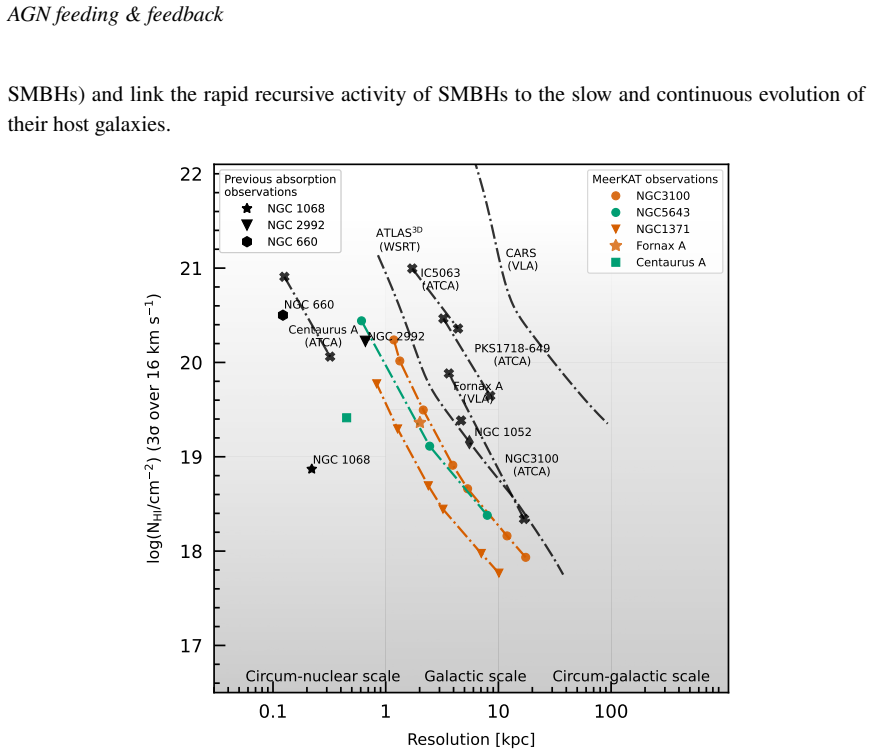
SKAO will map AGN feeding and feedback by observing hundreds of nearby galaxies down to low radio powers and HI column densities of 10^19 cm^-2 at arcsecond resolution.
A machine-rendered reading of the paper's core claim, the machinery that carries it, and where it could break.
Core claim
The manuscript illustrates how the Square Kilometre Array Observatory will solve observational limitations in AGN feeding and feedback studies. It will observe hundreds of nearby AGN to radio powers of 10^21 W Hz^-1, with simultaneous low and mid frequency data tracing star formation and jets, and HI mapping reaching column densities of about 10^19 cm^-2 at arcsecond resolution to follow inflows, outflows, and multi-phase processes linked to star formation.
What carries the argument
Simultaneous SKA-Low and Mid observations plus arcsecond-resolution HI mapping to trace thermal and synchrotron emission and low-column-density gas in AGN inflows and outflows.
If this is right
- Characterization of the AGN duty-cycle and timescales of nuclear activities from broad-band radio observations.
- Tracing the impact of AGN feedback over the full galaxy through low column density HI gas.
- Understanding fuelling processes from the environment onto the supermassive black hole.
- Linking multi-phase AGN feeding and feedback to star formation via combined radio, mm, sub-mm and optical observations.
Where Pith is reading between the lines
- Such observations could provide benchmarks for simulations of how AGN regulate galaxy growth over cosmic time.
- Statistical samples might reveal whether feedback effects are dominated by rare powerful events or common weak ones.
- Connecting radio jet properties directly to HI structures could test models of how energy is transferred to the interstellar medium.
Load-bearing premise
The low column density HI gas detected at arcsecond resolution will directly represent the inflows and outflows that regulate AGN activity and its connection to star formation.
What would settle it
A survey with SKAO that finds no association between the detected low-density HI structures and either AGN radio activity or star formation rates in the observed galaxies would challenge the central claim.
Figures
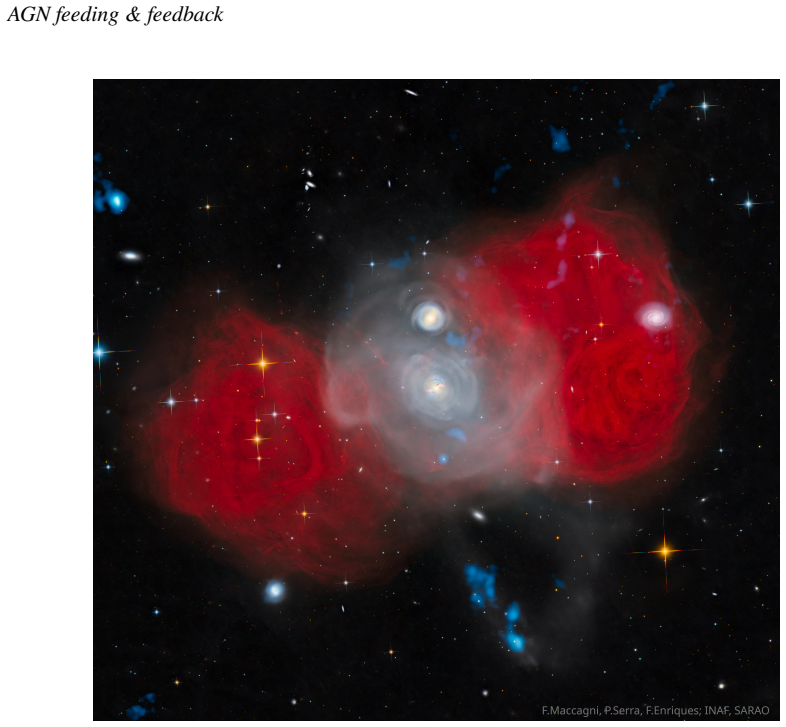
read the original abstract
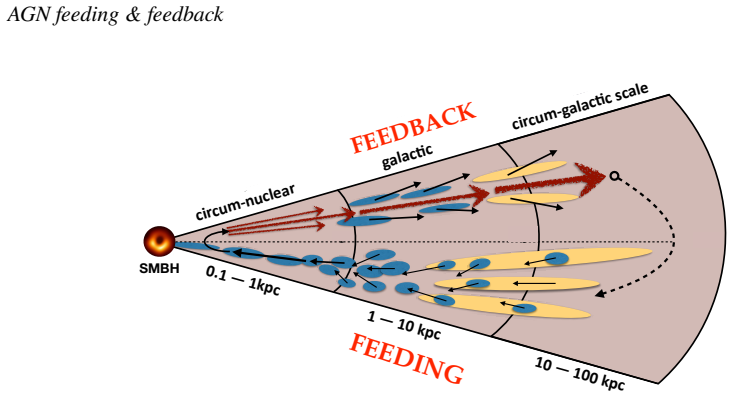
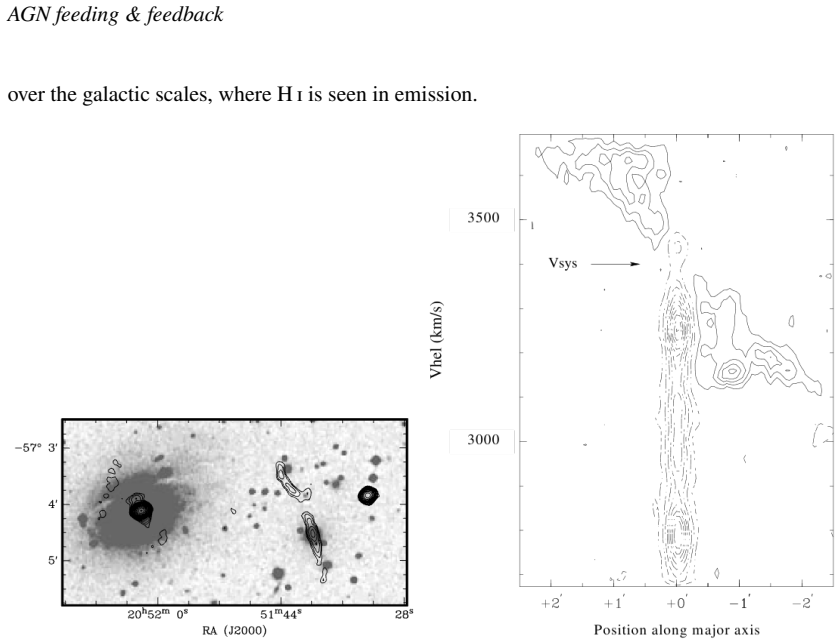
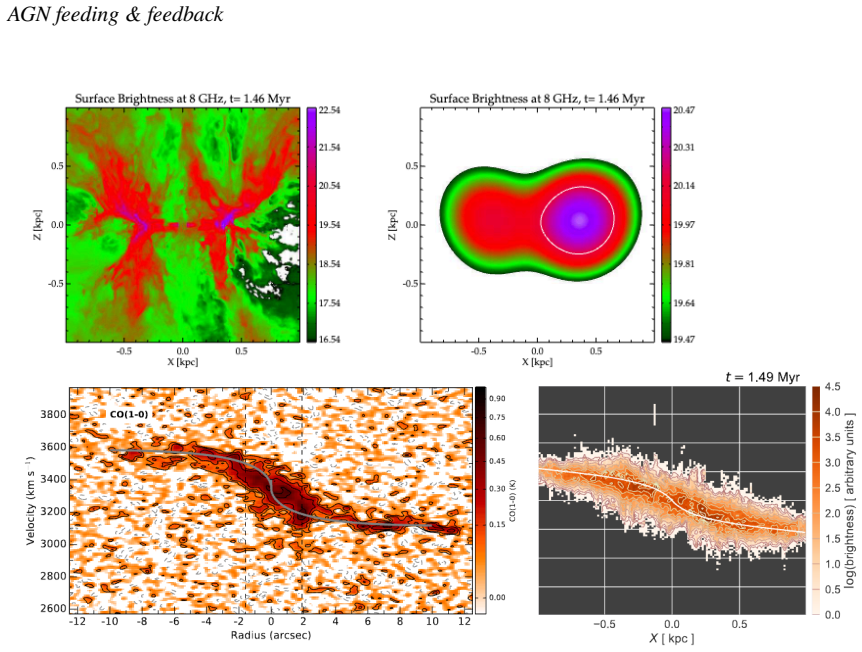
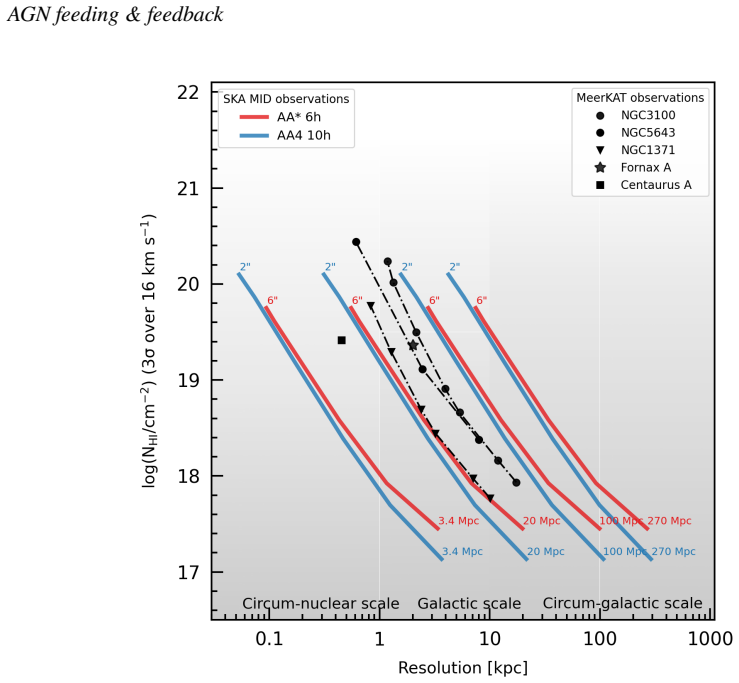
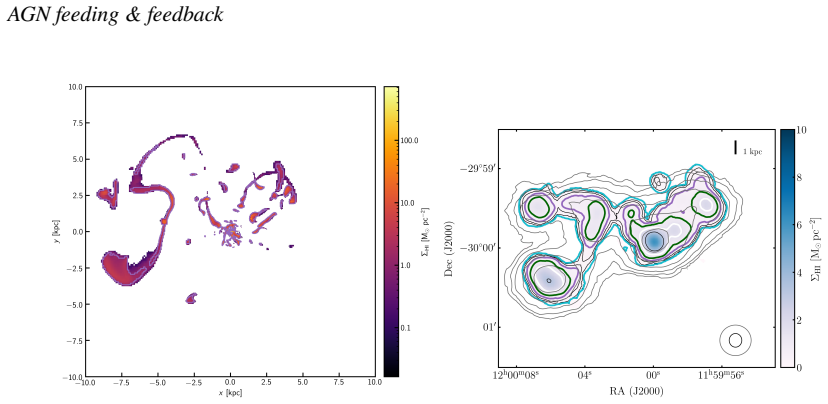
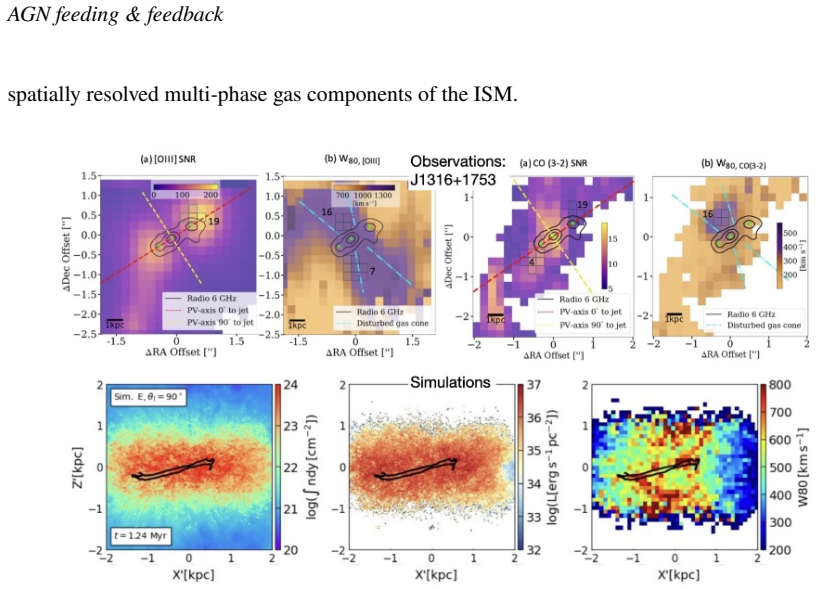
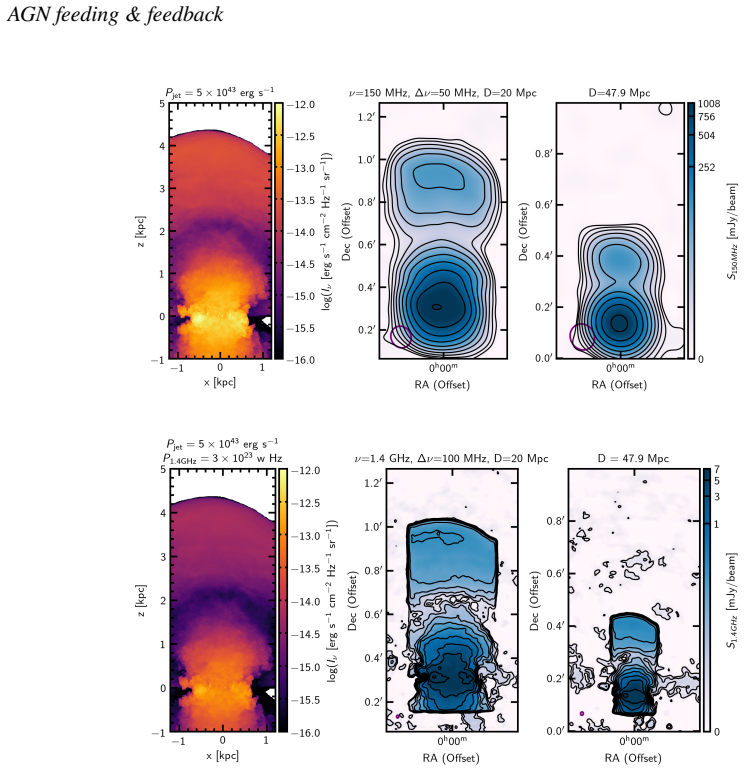
Active Galactic Nuclei (AGN) are key drivers of galaxy evolution, triggered by cold gas accreting onto a super-massive black hole. However, the processes regulating this gas accretion (feeding) and how AGN alter the interstellar medium to affect star formation (feedback) remain poorly understood. A major observational challenge is the vast range of spatial scales involved: AGN fuelling and jet-ejection occur over the sub-pc scales, while AGN feedback shocks and heats the ISM preventing star formation over the galactic and circum-galactic scales. Moreover, it is unclear how short stochastic AGN episodes are connected with the long timescales of gas accretion and star formation. In this manuscript, we illustrate how SKAO will provide the unprecedented opportunity to solve the observational limitations of AGN feeding and feedback studies by observing hundreds of nearby AGN down to low radio powers ($10^{21}$ W Hz$^{-1}$). Simultaneous SKA-Low and Mid observations of nearby galaxies will trace the thermal emission associated with star formation and AGN feedback and the synchrotron emission of their jets of relativistic plasma. These broad-band radio observations enable the detailed characterisation of the AGN duty-cycle, unravelling the time-scales of the nuclear activities. Reaching in 10 hours neutral atomic hydrogen (HI) column density sensitivities $\sim 10^{19}$ cm$^{-2}$ at arcsecond resolution, SKA AA4 observations will trace the typical low column density of HI gas in AGN inflows and outflows, to understand the impact AGN feedback over the full galaxy and trace fuelling processes from the environment onto the SMBH. Combining SKA with mm, sub-mm and optical Integral Field Spectrographic observations at comparable arcsecond resolution will provide an exhaustive understanding of the link between multi-phase AGN feeding and feedback processes and star formation.
Editorial analysis
A structured set of objections, weighed in public.
Referee Report
Summary. The manuscript presents a science case for the Square Kilometre Array Observatory (SKAO) in studying AGN feeding and feedback across galactic scales. It argues that SKAO will overcome current observational limits by enabling observations of hundreds of nearby AGN down to radio powers of 10^{21} W Hz^{-1}, simultaneous SKA-Low and Mid broadband observations to trace star formation, AGN feedback, and jets, and HI column density sensitivities of ~10^{19} cm^{-2} at arcsecond resolution in 10 hours. These capabilities, combined with multi-wavelength data, are claimed to connect short AGN episodes to longer gas accretion and star formation timescales.
Significance. If the projected SKAO performance metrics are realized, the paper outlines a pathway to address the multi-scale disconnect in AGN studies, potentially allowing direct tracing of low-column-density HI in inflows/outflows and characterization of AGN duty cycles. This is a useful forward-looking contribution for facility planning in galaxy evolution research, though the manuscript itself contains no new derivations or data.
major comments (2)
- [Abstract] Abstract: The specific performance claims (HI sensitivity ~10^{19} cm^{-2} at arcsecond resolution in 10 hours; hundreds of AGN observable to 10^{21} W Hz^{-1}) are stated without any supporting calculations, error budgets, integration-time derivations, or citations to SKAO design documents. These numbers are load-bearing for the central thesis that SKAO solves the observational limitations.
- [SKA capabilities and multi-phase combination paragraphs] Paragraphs on SKA capabilities and multi-phase combination: The assertion that simultaneous Low/Mid observations plus arcsecond HI mapping will 'directly trace the typical low column density of HI gas in AGN inflows and outflows' and connect stochastic episodes to star-formation timescales is presented without quantitative discussion of kinematic discrimination, confusion limits, or how the data will distinguish feeding from feedback processes.
minor comments (2)
- The abstract contains several long, compound sentences that reduce readability; splitting them would improve clarity.
- A short table summarizing the key SKAO specifications cited (sensitivities, resolutions, frequencies) with references would help readers quickly assess the claims.
Simulated Author's Rebuttal
We thank the referee for the constructive review. The comments correctly identify that the performance metrics and observational assertions require better anchoring in the literature. We have revised the manuscript to address both points while preserving its character as a forward-looking science case.
read point-by-point responses
-
Referee: [Abstract] Abstract: The specific performance claims (HI sensitivity ~10^{19} cm^{-2} at arcsecond resolution in 10 hours; hundreds of AGN observable to 10^{21} W Hz^{-1}) are stated without any supporting calculations, error budgets, integration-time derivations, or citations to SKAO design documents. These numbers are load-bearing for the central thesis that SKAO solves the observational limitations.
Authors: We agree that the quoted figures require explicit support. In the revised version we add citations to the SKAO1 System Baseline Design (SKA-TEL-SKO-0000002) and the SKA1 Science Performance documents, together with a short paragraph deriving the 10-hour HI column-density sensitivity from the standard radiometer equation using the AA4 array parameters and a 1-arcsec beam. The estimate of hundreds of AGN is now referenced to the expected SKA-Mid continuum survey depth and the local radio luminosity function from Best & Heckman (2012). These additions are confined to one new paragraph and two references so that the high-level nature of the paper is retained. revision: yes
-
Referee: [SKA capabilities and multi-phase combination paragraphs] Paragraphs on SKA capabilities and multi-phase combination: The assertion that simultaneous Low/Mid observations plus arcsecond HI mapping will 'directly trace the typical low column density of HI gas in AGN inflows and outflows' and connect stochastic episodes to star-formation timescales is presented without quantitative discussion of kinematic discrimination, confusion limits, or how the data will distinguish feeding from feedback processes.
Authors: The manuscript is a science-case overview rather than a technical simulation study; therefore a full quantitative treatment of confusion limits and kinematic separation lies outside its scope. Nevertheless, we accept that a brief discussion of the practical steps is warranted. The revised text now includes a short paragraph noting that (i) spectral-index separation between synchrotron jets and thermal star-formation emission is enabled by the simultaneous Low/Mid bands, (ii) kinematic discrimination of inflows versus outflows will rely on the combination with optical IFU data at matched resolution (as already demonstrated in existing PHANGS and ALMA studies), and (iii) the arcsecond HI sensitivity is sufficient to reach the column densities reported in the literature for AGN-driven outflows. We do not claim that SKAO data alone will fully separate feeding from feedback; the multi-wavelength synergy is emphasised. revision: partial
Circularity Check
No significant circularity; purely descriptive science-case paper
full rationale
The manuscript enumerates expected SKAO performance metrics and sketches their application to AGN feeding/feedback studies. No derivations, equations, parameter fits, or predictions that reduce to prior fitted quantities are present. Central statements are conditional on instrument capabilities lying outside the paper. No self-citation chains or ansatzes are invoked as load-bearing steps. The text is self-contained against external benchmarks of future telescope performance.
Axiom & Free-Parameter Ledger
Reference graph
Works this paper leans on
-
[1]
The tiered radio extragalactic continuum (T-RECS) simulation II: H I emission and continuum-H I cross-correlation. , keywords =. doi:10.1093/mnras/stad1913 , archivePrefix =. 2305.10175 , primaryClass =
-
[2]
2019 , eprint=
Anticipated Performance of the Square Kilometre Array -- Phase 1 (SKA1) , author=. 2019 , eprint=
2019
-
[3]
2015 , publisher=
Advancing Astrophysics with the Square Kilometre Array (AASKA14) , author=. 2015 , publisher=
2015
-
[4]
Coevolution (Or Not) of Supermassive Black Holes and Host Galaxies
Coevolution (Or Not) of Supermassive Black Holes and Host Galaxies. , keywords =. doi:10.1146/annurev-astro-082708-101811 , archivePrefix =. 1304.7762 , primaryClass =
work page internal anchor Pith review Pith/arXiv arXiv doi:10.1146/annurev-astro-082708-101811
-
[5]
Kiloparsec-scale outflows are prevalent among luminous AGN: outflows and feedback in the context of the overall AGN population. , keywords =. doi:10.1093/mnras/stu515 , archivePrefix =. 1403.3086 , primaryClass =
work page internal anchor Pith review Pith/arXiv arXiv doi:10.1093/mnras/stu515
-
[6]
Unleashing Positive Feedback: Linking the Rates of Star Formation, Supermassive Black Hole Accretion, and Outflows in Distant Galaxies. , keywords =. doi:10.1088/0004-637X/772/2/112 , archivePrefix =. 1305.5840 , primaryClass =
work page internal anchor Pith review Pith/arXiv arXiv doi:10.1088/0004-637x/772/2/112
-
[7]
On the fundamental dichotomy in the local radio-AGN population: accretion, evolution and host galaxy properties. , keywords =. doi:10.1111/j.1365-2966.2012.20414.x , archivePrefix =. 1201.2397 , primaryClass =
-
[8]
Kinetic and radiative power from optically thin accretion flows
Kinetic and radiative power from optically thin accretion flows. , keywords =. doi:10.1093/mnras/stx543 , archivePrefix =. 1701.07033 , primaryClass =
work page internal anchor Pith review Pith/arXiv arXiv doi:10.1093/mnras/stx543
-
[9]
Chaotic cold accretion onto black holes
Chaotic cold accretion on to black holes. , keywords =. doi:10.1093/mnras/stt692 , archivePrefix =. 1301.3130 , primaryClass =
work page internal anchor Pith review Pith/arXiv arXiv doi:10.1093/mnras/stt692
-
[10]
Effect of the interactions and environment on nuclear activity
Effect of the interactions and environment on nuclear activity. , keywords =. doi:10.1093/mnras/sts675 , archivePrefix =. 1212.4836 , primaryClass =
work page internal anchor Pith review Pith/arXiv arXiv doi:10.1093/mnras/sts675
-
[11]
Active galactic nuclei flicker: an observational estimate of the duration of black hole growth phases of 10 ^ 5 yr. , keywords =. doi:10.1093/mnras/stv1136 , archivePrefix =. 1505.06733 , primaryClass =
work page internal anchor Pith review Pith/arXiv arXiv doi:10.1093/mnras/stv1136
-
[12]
Linking macro-, meso- and microscales in multiphase AGN feeding and feedback. Nature Astronomy , keywords =. doi:10.1038/s41550-019-0970-1 , archivePrefix =. 2001.04985 , primaryClass =
-
[13]
Black-hole activity feedback across vast scales. Nature Astronomy , keywords =. doi:10.1038/s41550-022-01785-x , archivePrefix =. 2209.05675 , primaryClass =
-
[14]
Properties of the molecular gas in the fast outflow in the Seyfert galaxy IC 5063
Properties of the molecular gas in the fast outflow in the Seyfert galaxy IC 5063. , keywords =. doi:10.1051/0004-6361/201731781 , archivePrefix =. 1710.01570 , primaryClass =
work page internal anchor Pith review Pith/arXiv arXiv doi:10.1051/0004-6361/201731781
-
[15]
ALMA observations of feeding and feedback in nearby Seyfert galaxies: an AGN-driven outflow in NGC 1433. , keywords =. doi:10.1051/0004-6361/201322288 , archivePrefix =. 1309.7486 , primaryClass =
work page internal anchor Pith review Pith/arXiv arXiv doi:10.1051/0004-6361/201322288
-
[16]
ALMA reveals the feeding of the Seyfert 1 nucleus in NGC 1566
ALMA reveals the feeding of the Seyfert 1 nucleus in NGC 1566. , keywords =. doi:10.1051/0004-6361/201423433 , archivePrefix =. 1401.4120 , primaryClass =
work page internal anchor Pith review Pith/arXiv arXiv doi:10.1051/0004-6361/201423433
-
[17]
Observational Evidence of AGN Feedback
Observational Evidence of Active Galactic Nuclei Feedback. , keywords =. doi:10.1146/annurev-astro-081811-125521 , archivePrefix =. 1204.4114 , primaryClass =
work page internal anchor Pith review Pith/arXiv arXiv doi:10.1146/annurev-astro-081811-125521
-
[18]
Observational Constraints on the Feeding of Supermassive Black Holes
Observational constraints on the feeding of supermassive black holes. Nature Astronomy , keywords =. doi:10.1038/s41550-018-0611-0 , archivePrefix =. 1904.03338 , primaryClass =
work page internal anchor Pith review Pith/arXiv arXiv doi:10.1038/s41550-018-0611-0 1904
-
[19]
Comparisons of the Emission-Line and Continuum Properties of Broad Absorption Line and Normal Quasi-stellar Objects. , keywords =. doi:10.1086/170020 , adsurl =
-
[20]
Outflows in AGN/Starburst-Composite Ultraluminous Infrared Galaxies
Outflows in Active Galactic Nucleus/Starburst-Composite Ultraluminous Infrared Galaxies1,. , keywords =. doi:10.1086/444451 , archivePrefix =. astro-ph/0507037 , primaryClass =
work page internal anchor Pith review Pith/arXiv arXiv doi:10.1086/444451
-
[21]
On the presence of ultra-fast outflows in the WAX sample of Seyfert galaxies
On the presence of ultrafast outflows in the WAX sample of Seyfert galaxies. , keywords =. doi:10.1093/mnrasl/slu091 , archivePrefix =. 1406.2645 , primaryClass =
work page internal anchor Pith review Pith/arXiv arXiv doi:10.1093/mnrasl/slu091
-
[22]
Suppression of Star Formation in NGC 1266
Suppression of Star Formation in NGC 1266. , keywords =. doi:10.1088/0004-637X/798/1/31 , archivePrefix =. 1410.4556 , primaryClass =
work page internal anchor Pith review Pith/arXiv arXiv doi:10.1088/0004-637x/798/1/31
-
[23]
Physical cool-core condensation radius in massive galaxy clusters. , keywords =. doi:10.1051/0004-6361/202244138 , archivePrefix =. 2304.08810 , primaryClass =
-
[24]
Shaken Snow Globes: Kinematic Tracers of the Multiphase Condensation Cascade in Massive Galaxies, Groups, and Clusters. , keywords =. doi:10.3847/1538-4357/aaaa1b , archivePrefix =. 1709.06564 , primaryClass =
work page internal anchor Pith review Pith/arXiv arXiv doi:10.3847/1538-4357/aaaa1b
-
[25]
Closing the feedback-feeding loop of the radio galaxy 3C 84. Nature Astronomy , keywords =. doi:10.1038/s41550-023-02138-y , archivePrefix =. 2312.00917 , primaryClass =
-
[26]
Discovery of an AGN-Driven Molecular Outflow in the Local Early-Type Galaxy NGC 1266
Discovery of an Active Galactic Nucleus Driven Molecular Outflow in the Local Early-type Galaxy NGC 1266. , keywords =. doi:10.1088/0004-637X/735/2/88 , archivePrefix =. 1104.2326 , primaryClass =
work page internal anchor Pith review Pith/arXiv arXiv doi:10.1088/0004-637x/735/2/88
-
[27]
Intrinsic Absorption Lines in the Seyfert 1 Galaxy NGC 5548: Ultraviolet Echelle Spectra from the Space Telescope Imaging Spectrograph. , keywords =. doi:10.1086/307586 , archivePrefix =. astro-ph/9903439 , primaryClass =
work page internal anchor Pith review Pith/arXiv arXiv doi:10.1086/307586
-
[28]
Quasar feedback revealed by giant molecular outflows
Quasar feedback revealed by giant molecular outflows. , keywords =. doi:10.1051/0004-6361/201015164 , archivePrefix =. 1006.1655 , primaryClass =
work page internal anchor Pith review Pith/arXiv arXiv doi:10.1051/0004-6361/201015164
-
[29]
On the discovery of fast molecular gas in the UFO/BAL quasar APM 08279+5255 at z=3.912
On the discovery of fast molecular gas in the UFO/BAL quasar APM 08279+5255 at z = 3.912. , keywords =. doi:10.1051/0004-6361/201731387 , archivePrefix =. 1706.05527 , primaryClass =
work page internal anchor Pith review Pith/arXiv arXiv doi:10.1051/0004-6361/201731387
-
[30]
Radiative cooling of swept-up gas in AGN-driven galactic winds and its implications for molecular outflows. , keywords =. doi:10.1093/mnras/sty1285 , archivePrefix =. 1710.09433 , primaryClass =
work page internal anchor Pith review Pith/arXiv arXiv doi:10.1093/mnras/sty1285
-
[31]
Enhanced line widths perpendicular to radio jets as tracers of jet-ISM interaction
MAGNUM survey: Compact jets causing large turmoil in galaxies. Enhanced line widths perpendicular to radio jets as tracers of jet-ISM interaction. , keywords =. doi:10.1051/0004-6361/202039869 , archivePrefix =. 2011.04677 , primaryClass =
-
[32]
Driving Outflows with Relativistic Jets and the Dependence of Active Galactic Nucleus Feedback Efficiency on Interstellar Medium Inhomogeneity. , keywords =. doi:10.1088/0004-637X/757/2/136 , archivePrefix =. 1205.0542 , primaryClass =
work page internal anchor Pith review Pith/arXiv arXiv doi:10.1088/0004-637x/757/2/136
-
[33]
Cold gas removal from the centre of a galaxy by a low-luminosity jet. Nature Astronomy , keywords =. doi:10.1038/s41550-021-01596-6 , archivePrefix =. 2202.05222 , primaryClass =
-
[34]
Cold gas bubble inflated by a low-luminosity radio jet. , keywords =. doi:10.1051/0004-6361/202453139 , archivePrefix =. 2501.12230 , primaryClass =
-
[35]
Cold Molecular Outflows in the Local Universe
Cold molecular outflows in the local Universe and their feedback effect on galaxies. , keywords =. doi:10.1093/mnras/sty3449 , archivePrefix =. 1805.05352 , primaryClass =
work page internal anchor Pith review Pith/arXiv arXiv doi:10.1093/mnras/sty3449
-
[36]
Revealing the Physics and Evolution of Galaxies and Galaxy Clusters with SKA Continuum Surveys
Revealing the Physics and Evolution of Galaxies and Galaxy Clusters with SKA Continuum Surveys. Advancing Astrophysics with the Square Kilometre Array (AASKA14) , year = 2015, month = apr, eid =. doi:10.22323/1.215.0067 , archivePrefix =. 1412.6512 , primaryClass =
work page internal anchor Pith review Pith/arXiv arXiv doi:10.22323/1.215.0067 2015
-
[37]
The inside-out quenching of the MHONGOOSE galaxy NGC 1371. , keywords =. doi:10.1051/0004-6361/202555735 , archivePrefix =. 2509.18728 , primaryClass =
-
[38]
Raining on black holes and massive galaxies: the top-down multiphase condensation model
Raining on black holes and massive galaxies: the top-down multiphase condensation model. , keywords =. doi:10.1093/mnras/stw3108 , archivePrefix =. 1608.08216 , primaryClass =
work page internal anchor Pith review Pith/arXiv arXiv doi:10.1093/mnras/stw3108
-
[39]
An Unusual Radio Galaxy in Abell 428: A Large, Powerful FR I Source in a Disk-Dominated Host
An Unusual Radio Galaxy in Abell 428: A Large, Powerful FR I Source in a Disk-dominated Host. , keywords =. doi:10.1086/305251 , archivePrefix =. astro-ph/9709213 , primaryClass =
work page internal anchor Pith review Pith/arXiv arXiv doi:10.1086/305251
-
[40]
PKS 1814-637: a powerful radio-loud AGN in a disk galaxy
PKS 1814-637: a powerful radio-loud AGN in a disk galaxy. , keywords =. doi:10.1051/0004-6361/201117686 , archivePrefix =. 1109.0630 , primaryClass =
work page internal anchor Pith review Pith/arXiv arXiv doi:10.1051/0004-6361/201117686
-
[41]
Kiloparsec-scale Radio Structures in Narrow-line Seyfert 1 Galaxies
Kiloparsec-scale Radio Structures in Narrow-line Seyfert 1 Galaxies. , keywords =. doi:10.1088/0004-637X/760/1/41 , archivePrefix =. 1210.1303 , primaryClass =
work page internal anchor Pith review Pith/arXiv arXiv doi:10.1088/0004-637x/760/1/41
-
[42]
WISDOM Project - I: Black Hole Mass Measurement Using Molecular Gas Kinematics in NGC 3665
WISDOM project - I. Black hole mass measurement using molecular gas kinematics in NGC 3665. , keywords =. doi:10.1093/mnras/stx631 , archivePrefix =. 1703.05247 , primaryClass =
work page internal anchor Pith review Pith/arXiv arXiv doi:10.1093/mnras/stx631
-
[43]
Probing Multiphase Gas in Local Massive Elliptical Galaxies via Multiwavelength Observations. , keywords =. doi:10.3847/1538-4357/ac5036 , archivePrefix =. 2201.09330 , primaryClass =
-
[44]
Molecular Gas Kinematics in Local Early-Type Galaxies with ALMA. Galaxies , keywords =. doi:10.3390/galaxies12040036 , archivePrefix =. 2405.10683 , primaryClass =
-
[45]
Driving massive molecular gas flows in central cluster galaxies with AGN feedback. , keywords =. doi:10.1093/mnras/stz2719 , archivePrefix =. 1902.09227 , primaryClass =
-
[46]
A Galaxy-Scale Fountain of Cold Molecular Gas Pumped by a Black Hole
A Galaxy-scale Fountain of Cold Molecular Gas Pumped by a Black Hole. , keywords =. doi:10.3847/1538-4357/aad6dd , archivePrefix =. 1808.00473 , primaryClass =
work page internal anchor Pith review Pith/arXiv arXiv doi:10.3847/1538-4357/aad6dd
-
[47]
Jets blowing bubbles in the young radio galaxy 4C 31.04
Jets blowing bubbles in the young radio galaxy 4C 31.04. , keywords =. doi:10.1093/mnras/stz233 , archivePrefix =. 1811.08971 , primaryClass =
work page internal anchor Pith review Pith/arXiv arXiv doi:10.1093/mnras/stz233
-
[48]
Anatomy of a Cooling Flow: The Feedback Response to Pure Cooling in the Core of the Phoenix Cluster. , keywords =. doi:10.3847/1538-4357/ab464c , archivePrefix =. 1904.08942 , primaryClass =
-
[49]
Spectral signatures of young radio galaxies. , keywords =. doi:10.1017/pasa.2025.10068 , archivePrefix =. 2412.14433 , primaryClass =
-
[50]
The life cycle of radio galaxies in the LOFAR Lockman Hole field. , keywords =. doi:10.1051/0004-6361/201936955 , archivePrefix =. 2004.09118 , primaryClass =
-
[51]
The Energetics and Lifetimes of Local Radio Active Galactic Nuclei
Energetics and Lifetimes of Local Radio Active Galactic Nuclei. , keywords =. doi:10.1088/0004-637X/806/1/59 , archivePrefix =. 1504.05204 , primaryClass =
work page internal anchor Pith review Pith/arXiv arXiv doi:10.1088/0004-637x/806/1/59
-
[52]
The duty cycle of radio galaxies revealed by LOFAR: remnant and restarted radio source populations in the Lockman Hole. , keywords =. doi:10.1093/mnras/staa1172 , archivePrefix =. 2004.08979 , primaryClass =
-
[53]
Does the HCO ^ + emission highlight the presence of shocks?
Physical conditions in Centaurus A's northern filaments: II. Does the HCO ^ + emission highlight the presence of shocks?. , keywords =. doi:10.1051/0004-6361/202450952 , archivePrefix =. 2409.11031 , primaryClass =
-
[54]
Triggered star formation in the inner filament of Centaurus A. , keywords =. doi:10.1111/j.1365-2966.2012.20418.x , archivePrefix =. 1201.3369 , primaryClass =
-
[55]
Galaxy Zoo: dust lane early-type galaxies are tracers of recent, gas-rich minor mergers. , keywords =. doi:10.1111/j.1365-2966.2012.20598.x , archivePrefix =. 1107.5310 , primaryClass =
-
[56]
Relativistic jet feedback - II. Relationship to gigahertz peak spectrum and compact steep spectrum radio galaxies. , keywords =. doi:10.1093/mnras/sty070 , archivePrefix =. 1801.06518 , primaryClass =
work page internal anchor Pith review Pith/arXiv arXiv doi:10.1093/mnras/sty070
-
[57]
Numerical modelling of the lobes of radio galaxies in cluster environments - III. Powerful relativistic and non-relativistic jets. , keywords =. doi:10.1093/mnras/stw1407 , archivePrefix =. 1606.03374 , primaryClass =
work page internal anchor Pith review Pith/arXiv arXiv doi:10.1093/mnras/stw1407
-
[58]
Dynamics and observable signatures of radio jets in cosmological environments
CosmoDRAGoN simulations I. Dynamics and observable signatures of radio jets in cosmological environments. , keywords =. doi:10.1017/pasa.2023.10 , archivePrefix =. 2212.10059 , primaryClass =
-
[59]
BRAiSE: Synthetic polarisation in RMHD AGN jet simulations. , keywords =. doi:10.1017/pasa.2025.10101 , archivePrefix =. 2506.19541 , primaryClass =
-
[60]
Radio AGN in spiral galaxies. , keywords =. doi:10.1093/mnras/stv1957 , archivePrefix =. 1412.5602 , primaryClass =
work page internal anchor Pith review Pith/arXiv arXiv doi:10.1093/mnras/stv1957
-
[61]
Delayed triggering of radio Active Galactic Nuclei in gas-rich minor mergers in the local Universe
Delayed triggering of radio active galactic nuclei in gas-rich minor mergers in the local Universe. , keywords =. doi:10.1093/mnras/stw2536 , archivePrefix =. 1608.04178 , primaryClass =
work page internal anchor Pith review Pith/arXiv arXiv doi:10.1093/mnras/stw2536
-
[62]
Interaction between the intergalactic medium and central radio source in the NGC 4261 group of galaxies. , keywords =. doi:10.1111/j.1365-2966.2011.19239.x , archivePrefix =. 1106.2449 , primaryClass =
-
[63]
Mechanical Feedback from Active Galactic Nuclei in Galaxies, Groups, and Clusters
Mechanical feedback from active galactic nuclei in galaxies, groups and clusters. New Journal of Physics , keywords =. doi:10.1088/1367-2630/14/5/055023 , archivePrefix =. 1204.0006 , primaryClass =
work page internal anchor Pith review Pith/arXiv arXiv doi:10.1088/1367-2630/14/5/055023
-
[64]
Feedback from Central Black Holes in Elliptical Galaxies. III. Models with Both Radiative and Mechanical Feedback. , keywords =. doi:10.1088/0004-637X/717/2/708 , archivePrefix =. 1003.0578 , primaryClass =
work page internal anchor Pith review Pith/arXiv arXiv doi:10.1088/0004-637x/717/2/708
-
[65]
Molecular line emission in NGC 1068 imaged with ALMA. I. An AGN-driven outflow in the dense molecular gas. , keywords =. doi:10.1051/0004-6361/201423843 , archivePrefix =. 1405.7706 , primaryClass =
work page internal anchor Pith review Pith/arXiv arXiv doi:10.1051/0004-6361/201423843
-
[66]
Shocks, clouds, and atomic outflows in active galactic nuclei hosting relativistic jets. , keywords =. doi:10.1051/0004-6361/202348624 , archivePrefix =. 2401.14218 , primaryClass =
-
[67]
Measuring turbulence and gas motions in galaxy clusters via synthetic Athena X-IFU observations
Measuring turbulence and gas motions in galaxy clusters via synthetic Athena X-IFU observations. , keywords =. doi:10.1051/0004-6361/201833371 , archivePrefix =. 1805.02577 , primaryClass =
work page internal anchor Pith review Pith/arXiv arXiv doi:10.1051/0004-6361/201833371
-
[68]
Feedback from reorienting AGN jets. I. Jet-ICM coupling, cavity properties and global energetics. , keywords =. doi:10.1051/0004-6361/201832582 , adsurl =
-
[69]
The fast molecular outflow in the Seyfert galaxy IC5063 as seen by ALMA
The fast molecular outflow in the Seyfert galaxy IC 5063 as seen by ALMA. , keywords =. doi:10.1051/0004-6361/201525860 , archivePrefix =. 1505.07190 , primaryClass =
work page internal anchor Pith review Pith/arXiv arXiv doi:10.1051/0004-6361/201525860
-
[70]
ALMA observations of AGN fuelling: the case of PKS B1718-649
ALMA observations of AGN fuelling. The case of PKS B1718-649. , keywords =. doi:10.1051/0004-6361/201732269 , archivePrefix =. 1801.03514 , primaryClass =
work page internal anchor Pith review Pith/arXiv arXiv doi:10.1051/0004-6361/201732269
-
[71]
Nonthermal processes in galactic and extragalactic sources
Radio astrophysics. Nonthermal processes in galactic and extragalactic sources
-
[72]
Dissecting the turbulent weather driven by mechanical AGN feedback. , keywords =. doi:10.1093/mnras/staa2747 , archivePrefix =. 2009.03344 , primaryClass =
-
[73]
Morphology and kinematics of the ionized gas
Gas condensation in brightest group galaxies unveiled with MUSE. Morphology and kinematics of the ionized gas. , keywords =. doi:10.1051/0004-6361/202142475 , archivePrefix =. 2201.07838 , primaryClass =
-
[74]
Close entrainment of massive molecular gas flows by radio bubbles in the central galaxy of Abell 1795. , keywords =. doi:10.1093/mnras/stx2255 , archivePrefix =. 1708.08935 , primaryClass =
work page internal anchor Pith review Pith/arXiv arXiv doi:10.1093/mnras/stx2255
-
[75]
Complex AGN feedback in the Teacup galaxy. A powerful ionised galactic outflow, jet-ISM interaction, and evidence for AGN-triggered star formation in a giant bubble. , keywords =. doi:10.1051/0004-6361/202347375 , archivePrefix =. 2309.02498 , primaryClass =
-
[76]
Radio Jets Clearing the Way Through a Galaxy: Watching Feedback in Action in the Seyfert Galaxy IC 5063. Revolution in Astronomy with ALMA: The Third Year , year = 2015, editor =. doi:10.48550/arXiv.1504.04694 , archivePrefix =. 1504.04694 , primaryClass =
work page internal anchor Pith review Pith/arXiv arXiv doi:10.48550/arxiv.1504.04694 2015
-
[77]
ALMA reveals optically thin, highly excited CO gas in the jet-driven winds of the galaxy IC5063
ALMA reveals optically thin, highly excited CO gas in the jet-driven winds of the galaxy IC 5063. , keywords =. doi:10.1051/0004-6361/201629689 , archivePrefix =. 1609.03421 , primaryClass =
work page internal anchor Pith review Pith/arXiv arXiv doi:10.1051/0004-6361/201629689
-
[78]
The link between galaxy merger, radio jet expansion, and molecular outflow in the ULIRG IRAS 00183 - 7111. , keywords =. doi:10.1093/mnras/staf2269 , archivePrefix =. 2506.07852 , primaryClass =
-
[79]
Megaparsec Relativistic Jets Launched from an Accreting Supermassive Black Hole in an Extreme Spiral Galaxy. , keywords =. doi:10.1088/0004-637X/788/2/174 , archivePrefix =. 1404.6889 , primaryClass =
work page internal anchor Pith review Pith/arXiv arXiv doi:10.1088/0004-637x/788/2/174
-
[80]
HI Absorption Toward the Nucleus of the Radio Galaxy PKS 2322-123 in A 2597
H I Absorption toward the Nucleus of the Radio Galaxy PKS 2322-123 in A2597. , keywords =. doi:10.1086/311873 , archivePrefix =. astro-ph/9811343 , primaryClass =
work page internal anchor Pith review Pith/arXiv arXiv doi:10.1086/311873
discussion (0)
Sign in with ORCID, Apple, or X to comment. Anyone can read and Pith papers without signing in.