Graph Structures for Local Distinguishability of Quantum Product States
Pith reviewed 2026-06-26 05:08 UTC · model grok-4.3
The pith
Sets of bipartite product states are distinguishable by two-way LOCC after finite steps precisely when their graphs satisfy derived closure properties.
A machine-rendered reading of the paper's core claim, the machinery that carries it, and where it could break.
Core claim
We extend prior graph-based identification of one-way LOCC distinguishable product states to the setting of two-way LOCC. The work supplies the first significant analysis of the graphs that correspond to bipartite product states distinguishable by two-way protocols after finitely many steps. Basic closure properties of the distinguishable graph set are obtained, together with concrete classes of graphs that guarantee local distinguishability and classes that do not.
What carries the argument
The mapping that sends sets of bipartite product states to graphs while preserving the distinction between one-way and two-way LOCC distinguishability.
If this is right
- If two graphs belong to the distinguishable set, certain combinations or modifications of them remain in the set.
- Some explicit graph families, such as particular trees or complete graphs, always correspond to distinguishable states under two-way LOCC.
- Other graph families lie outside the distinguishable set and therefore block finite two-way distinction.
- The closure properties allow systematic generation of new distinguishable graphs from known ones without returning to the quantum states.
Where Pith is reading between the lines
- The same graph lens might be used to bound the number of communication rounds needed for distinction.
- It could connect local distinguishability questions to existing algorithms for testing graph properties such as planarity or bipartiteness.
- The approach may generalize to settings with more than two parties once the corresponding hypergraph structures are defined.
Load-bearing premise
The graph representation of product-state sets keeps enough structure that two-way LOCC distinguishability after finite rounds can be read off from graph-theoretic properties alone.
What would settle it
Exhibit a concrete collection of bipartite product states whose associated graph lies inside the claimed distinguishable class yet cannot be perfectly distinguished by any finite two-way LOCC protocol.
Figures


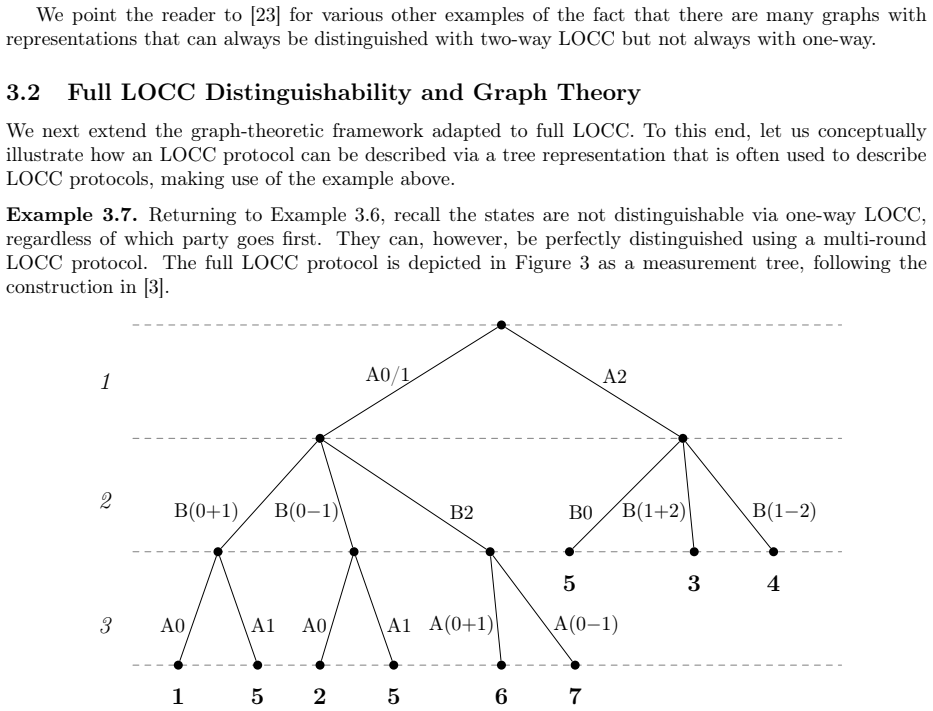


read the original abstract
We consider the problem of distinguishing sets of quantum product states with local operations and classical communication (LOCC). Recent work has used graph theory to identify sets of product states distinguishable with one-way LOCC. We extend these efforts to full two-way LOCC, with the first significant analysis of the set of graphs corresponding to bipartite product states that can be distinguished with two-way protocols after finitely many steps. We derive basic closure properties of the set of distinguishable graphs and identify some classes of graphs that guarantee local distinguishability and some graphs that do not. We also include several examples and forward-looking comments.
Editorial analysis
A structured set of objections, weighed in public.
Referee Report
Summary. The paper extends graph-theoretic methods previously used for one-way LOCC distinguishability of bipartite quantum product states to the two-way LOCC setting. It analyzes the graphs corresponding to sets of product states that are distinguishable via finite-round two-way protocols, derives basic closure properties of the distinguishable graph set, identifies certain graph classes that are (or are not) locally distinguishable, and provides examples along with forward-looking comments.
Significance. If the mapping from product-state sets to graphs and the derived closure properties are valid, the work supplies a concrete combinatorial handle on two-way LOCC distinguishability, a regime that is strictly more powerful than one-way LOCC yet still lacks a complete characterization. Explicit identification of distinguishable and non-distinguishable graph families, together with the closure results, offers a reusable toolkit that could be applied to concrete state-discrimination tasks and to the design of finite-round LOCC protocols.
minor comments (3)
- [Abstract] The abstract states that the work supplies 'the first significant analysis'; this phrasing is subjective and could be replaced by a more neutral claim such as 'the first systematic analysis of closure properties' to avoid inviting reviewer push-back on the word 'significant'.
- Notation for the graph-to-state mapping (presumably introduced in §2 or §3) should be stated once in a dedicated paragraph or table so that later closure proofs can refer to it without re-deriving the correspondence each time.
- The forward-looking comments at the end would benefit from explicit pointers to open graph-theoretic questions (e.g., decidability of membership in the distinguishable set) rather than remaining at the level of general remarks.
Simulated Author's Rebuttal
We thank the referee for the positive assessment of our work on extending graph-theoretic methods to two-way LOCC distinguishability of product states, including the derived closure properties and identification of distinguishable graph classes. The recommendation for minor revision is noted, and we will address any editorial or minor issues accordingly. No specific major comments were provided in the report.
Circularity Check
No significant circularity detected
full rationale
The paper extends prior graph-theoretic analysis of one-way LOCC distinguishability to two-way protocols by defining a mapping from product states to graphs and deriving closure properties. No step reduces by construction to its own inputs, no fitted parameters are relabeled as predictions, and no load-bearing premise rests solely on self-citation chains. The derivation remains self-contained against the stated definitions of the graph mapping and LOCC semantics, consistent with external prior work rather than internal redefinition.
Axiom & Free-Parameter Ledger
Reference graph
Works this paper leans on
-
[1]
Unextendible product bases.Journal of combinatorial theory
Noga Alon and László Lovász. Unextendible product bases.Journal of combinatorial theory. Series A, 95(1):169–179, 2001
2001
-
[2]
Teleporting an unknown quantum state via dual classical and Einstein-Podolsky-Rosen channels.Physical Review Letters, 70(13):1895, 1993
Charles H Bennett, Gilles Brassard, Claude Crépeau, Richard Jozsa, Asher Peres, and William K Wootters. Teleporting an unknown quantum state via dual classical and Einstein-Podolsky-Rosen channels.Physical Review Letters, 70(13):1895, 1993
1993
-
[3]
Quantum nonlocality without entanglement.Physical Review A, 59(2):1070, 1999
Charles H Bennett, David P DiVincenzo, Christopher A Fuchs, Tal Mor, Eric Rains, Peter W Shor, John A Smolin, and William K Wootters. Quantum nonlocality without entanglement.Physical Review A, 59(2):1070, 1999
1999
-
[4]
Unextendible product bases and bound entanglement.Physical Review Letters, 82(26):5385, 1999
Charles H Bennett, David P DiVincenzo, Tal Mor, Peter W Shor, John A Smolin, and Barbara M Terhal. Unextendible product bases and bound entanglement.Physical Review Letters, 82(26):5385, 1999
1999
-
[5]
Condition for unambiguous state discrimination using local operations and classical communication.Physical Review A—Atomic, Molecular, and Optical Physics, 69(5):050307, 2004
Anthony Chefles. Condition for unambiguous state discrimination using local operations and classical communication.Physical Review A—Atomic, Molecular, and Optical Physics, 69(5):050307, 2004
2004
-
[6]
Everything you always wanted to know about LOCC (but were afraid to ask).Communications in Mathematical Physics, 328:303–326, 2014
Eric Chitambar, Debbie Leung, Laura Mančinska, Maris Ozols, and Andreas Winter. Everything you always wanted to know about LOCC (but were afraid to ask).Communications in Mathematical Physics, 328:303–326, 2014
2014
-
[7]
Complement reducible graphs.Discrete Applied Mathematics, 3(3):163–174, 1981
Derek G Corneil, Helmut Lerchs, and L Stewart Burlingham. Complement reducible graphs.Discrete Applied Mathematics, 3(3):163–174, 1981
1981
-
[8]
Small sets of locally indistinguishable orthogonal maximally entangled states
Alessandro Cosentino and Vincent Russo. Small sets of locally indistinguishable orthogonal maximally entangled states.arXiv preprint arXiv:1307.3232, 2013
work page internal anchor Pith review Pith/arXiv arXiv 2013
-
[9]
Perfect state transfer in products and covers of graphs.Linear and Multilinear Algebra, 64(2):235–246, 2016
Gabriel Coutinho and Chris Godsil. Perfect state transfer in products and covers of graphs.Linear and Multilinear Algebra, 64(2):235–246, 2016
2016
-
[10]
Unextendible product bases, uncompletable product bases and bound entanglement.Communications in Mathe- matical Physics, 238(3):379–410, 2003
David P DiVincenzo, Tal Mor, Peter W Shor, John A Smolin, and Barbara M Terhal. Unextendible product bases, uncompletable product bases and bound entanglement.Communications in Mathe- matical Physics, 238(3):379–410, 2003
2003
-
[11]
Hiding classical data in multipartite quantum states.Physical Review Letters, 89(9):097905, 2002
Tilo Eggeling and Reinhard F Werner. Hiding classical data in multipartite quantum states.Physical Review Letters, 89(9):097905, 2002
2002
-
[12]
Distinguishability and indistinguishability by local operations and classical communication
Heng Fan. Distinguishability and indistinguishability by local operations and classical communication. Physical Review Letters, 92(17):177905, 2004
2004
-
[13]
Carl Friedrich Gauss.Disquisitiones arithmeticae, volume 1. K. Gesellschaft der Wissenschaften zu Göttingen, 1870
-
[14]
Distinguishability of maximally entangled states.Physical Review A—Atomic, Molecular, and Optical Physics, 70(2):022304, 2004
Sibasish Ghosh, Guruprasad Kar, Anirban Roy, and Debasis Sarkar. Distinguishability of maximally entangled states.Physical Review A—Atomic, Molecular, and Optical Physics, 70(2):022304, 2004
2004
-
[15]
Distinguishability classes, resource sharing, and bound entanglement distribution.Physical Review A, 101(1):012311, 2020
Saronath Halder and Ritabrata Sengupta. Distinguishability classes, resource sharing, and bound entanglement distribution.Physical Review A, 101(1):012311, 2020
2020
-
[16]
Weakly triangulated graphs.Journal of Combinatorial Theory, Series B, 39(3):200– 208, 1985
Ryan B Hayward. Weakly triangulated graphs.Journal of Combinatorial Theory, Series B, 39(3):200– 208, 1985
1985
-
[17]
Local information as a resource in distributed quantum systems.Physical Review Letters, 90(10):100402, 2003
Michał Horodecki, Karol Horodecki, Paweł Horodecki, Ryszard Horodecki, Jonathan Oppenheim, Aditi Sen, and Ujjwal Sen. Local information as a resource in distributed quantum systems.Physical Review Letters, 90(10):100402, 2003. 15
2003
-
[18]
Operator structures and quantum one-way LOCC conditions.Journal of Mathematical Physics, 58(9), 2017
David W Kribs, Comfort Mintah, Michael Nathanson, and Rajesh Pereira. Operator structures and quantum one-way LOCC conditions.Journal of Mathematical Physics, 58(9), 2017
2017
-
[19]
Quantum error correction and one-way LOCC state distinguishability.Journal of Mathematical Physics, 60(3), 2019
David W Kribs, Comfort Mintah, Michael Nathanson, and Rajesh Pereira. Quantum error correction and one-way LOCC state distinguishability.Journal of Mathematical Physics, 60(3), 2019
2019
-
[20]
One-way LOCC indistin- guishable lattice states via operator structures.Quantum Information Processing, 19(7):194, 2020
David W Kribs, Comfort Mintah, Michael Nathanson, and Rajesh Pereira. One-way LOCC indistin- guishable lattice states via operator structures.Quantum Information Processing, 19(7):194, 2020
2020
-
[21]
Vector representations of graphs and distinguishing quantum product states with one-way LOCC.Linear Algebra and its Applications, 602:223–239, 2020
David W Kribs, Comfort Mintah, Michael Nathanson, and Rajesh Pereira. Vector representations of graphs and distinguishing quantum product states with one-way LOCC.Linear Algebra and its Applications, 602:223–239, 2020
2020
-
[22]
Operator and graph theo- retic techniques for distinguishing quantum states via one-way LOCC.Applied Sciences, 11(20):9542, 2021
David W Kribs, Comfort Mintah, Michael Nathanson, and Rajesh Pereira. Operator and graph theo- retic techniques for distinguishing quantum states via one-way LOCC.Applied Sciences, 11(20):9542, 2021
2021
-
[23]
Chordal graphs and distinguishability of quantum product states.Linear Algebra and its Applications, 694:478–498, 2024
David W Kribs, Comfort Mintah, Michael Nathanson, and Rajesh Pereira. Chordal graphs and distinguishability of quantum product states.Linear Algebra and its Applications, 694:478–498, 2024
2024
-
[24]
Elsevier, 1995
Nadimpalli VR Mahadev and Uri N Peled.Threshold graphs and related topics, volume 56. Elsevier, 1995
1995
-
[25]
Distinguishing bipartitite orthogonal states using LOCC: Best and worst cases
Michael Nathanson. Distinguishing bipartitite orthogonal states using LOCC: Best and worst cases. Journal of Mathematical Physics, 46(6), 2005
2005
-
[26]
Three maximally entangled states can require two-way local operations and classical communication for local discrimination.Physical Review A, 88:062316, Dec 2013
Michael Nathanson. Three maximally entangled states can require two-way local operations and classical communication for local discrimination.Physical Review A, 88:062316, Dec 2013
2013
-
[27]
Hiding bits in bell states.Physical Review Letters, 86(25):5807, 2001
Barbara M Terhal, David P DiVincenzo, and Debbie W Leung. Hiding bits in bell states.Physical Review Letters, 86(25):5807, 2001
2001
-
[28]
Über eine eigenschaft der ebenen komplexe.Mathematische Annalen, 114(1):570–590, 1937
Klaus Wagner. Über eine eigenschaft der ebenen komplexe.Mathematische Annalen, 114(1):570–590, 1937
1937
-
[29]
Nonlocality, asymmetry, and distinguishing bipartite states
Jonathan Walgate and Lucien Hardy. Nonlocality, asymmetry, and distinguishing bipartite states. Physical Review Letters, 89(14):147901, 2002
2002
-
[30]
Local distinguishability of multipartite orthogonal quantum states.Physical Review Letters, 85(23):4972, 2000
Jonathan Walgate, Anthony J Short, Lucien Hardy, and Vlatko Vedral. Local distinguishability of multipartite orthogonal quantum states.Physical Review Letters, 85(23):4972, 2000
2000
-
[31]
Four locally indistinguishable ququad-ququad orthogonal maximally entangled states.Physical Review Letters, 109(2):020506, 2012
Nengkun Yu, Runyao Duan, and Mingsheng Ying. Four locally indistinguishable ququad-ququad orthogonal maximally entangled states.Physical Review Letters, 109(2):020506, 2012. 16
2012
discussion (0)
Sign in with ORCID, Apple, or X to comment. Anyone can read and Pith papers without signing in.