REVIEW 3 major objections 3 minor 1 cited by
Constraining initial orbital eccentricity of inspiral-dominated gravitational-wave events with an analytic approximant
T0 review · 3 major / 3 minor · reviewed 2026-08-15 · deepseek-v4-flash
Pith's one-line read Two neutron-star mergers show no detectable orbital eccentricity at 20 Hz.
desk verdict A careful but unsurprising null result: TaylorF2Ecck, a restricted version of the authors' own 2019 model, confirms Lenon et al.'s eccentricity bounds for two BNS events, with a caveat about model validation in exactly the constrained regime. read the letter →
The pith
A machine-rendered reading of the paper's core claim, the machinery that carries it, and where it could break.
The reading
What carries the argument
TaylorF2ecck is a fully analytic frequency-domain waveform for inspiraling non-spinning binaries in eccentric orbits, built from the stationary-phase approximation and a 3PN-accurate eccentric Keplerian description. It sums four harmonics $(1,0)$, $(1,-2)$, $(2,-2)$, $(3,-2)$, keeps eccentric corrections to $O(e_0^2)$ in the Fourier phase and $O(e_0)$ in the amplitude, and includes periastron advance consistently. This machinery lets the paper isolate eccentricity and periastron-advance effects in parameter estimation.
What would settle it
Re-analyze GW170817 and GW190425 with an independent eccentric inspiral model that includes $O(e_0^4)$ phase terms and more harmonics; if the 90% upper limits on $e_0$ move above 0.011 and 0.028, or if the Bayes factor starts favoring the eccentric model, the zero-eccentricity conclusion is a modeling artifact rather than a property of the data.
Extended reading notes
Core claim
Using a frequency-domain approximant that combines 3PN-accurate orbital phase with leading-order $O(e_0^2)$ eccentric corrections, periastron advance, and quadrupolar amplitudes with $O(e_0)$ harmonic terms, the authors find initial eccentricity at 20 Hz is negligible for both events: $e_0 < 0.011$ for GW170817 and $e_0 < 0.028$ for GW190425 at 90% confidence. Bayes factors do not favor the eccentric template over the quasi-circular template, and at these eccentricities the inclusion of periastron advance does not change the posteriors. A comparison of 3PN and 3.5PN quasi-circular phasing shows the mass-ratio posterior shifts substantially with the PN order of circular phase contributions, indicating that 3.5PN eccentric corrections are needed for reliable parameter estimation.
Load-bearing premise
The central claim depends on the waveform model representing the eccentric signal faithfully at the very small eccentricities it is constraining; if the leading-order eccentric phase truncation or the limited harmonic set distorts the templates even at $e_0$ below 0.01, the reported upper limits could be biased toward zero.
Editorial extensions
If this is right
- The 90% upper limits $e_0 < 0.011$ for GW170817 and $e_0 < 0.028$ for GW190425 at 20 Hz mean both events are consistent with field-formed, circularized binaries; no dynamical-formation eccentricity signature is required by the data.
- Periastron advance does not leave a measurable imprint in these two events, so for low-eccentricity BNS analyses simpler eccentric or circular templates remain adequate.
- The mass-ratio posterior shifts between 3PN and 3.5PN circular phasing, so eccentric inspiral templates need 3.5PN eccentric phase terms before claimed mass-ratio constraints are trustworthy.
- For GW170817-like signals with $e_0$ below about 0.01, circular templates are sufficient in parameter estimation, while eccentricity must be included above that threshold to avoid biased masses.
Reading between the lines
- Applied to the same data with the same settings, the model gives an eccentricity estimate for GW200105 that is consistent with an independent fully precessing eccentric analysis but without strong Bayes evidence; higher-signal-to-noise neutron-star-black-hole inspirals may be the cleanest place to test periastron advance, since its effect grows with total mass.
- The PN-order dependence of the mass-ratio posterior implies that published mass-ratio constraints derived from 3PN eccentric templates may carry a systematic bias comparable to the statistical error; re-analysis with 3.5PN eccentric phasing would settle this.
- Lowering the analysis start frequency below 20 Hz would add many eccentricity-sensitive cycles; relative-binning techniques could make such a re-analysis computationally feasible and likely tighten the limits.
- The mismatch between the TaylorF2 family and a fully precessing eccentric model begins to exceed 3% only above $e_0 \approx 0.08$, suggesting the leading-order $O(e_0^2)$ phasing is adequate for weak-eccentricity events but not for moderate-eccentricity candidates.
Signed reviews
Editorial analysis
A structured set of objections, weighed in public.
Referee Report
Summary. The manuscript introduces TaylorF2Ecck, a frequency-domain inspiral waveform approximant for non-spinning eccentric binaries, implemented in LALSuite as a restricted version of the model in Ref. [72] with O(e0^2) corrections in the 3PN Fourier phase, O(e0) quadrupolar amplitudes, and harmonics (1,0), (1,-2), (2,-2), (3,-2). After sanity checks consisting of match calculations and zero-noise injection-recovery studies against TaylorF2Ecc, TaylorF2Ecch, and TaylorF2, the authors perform Bayesian parameter estimation on GW170817 and GW190425 using Bilby and report 90% credible upper limits of e0 < 0.011 and e0 < 0.028 at 20 Hz, respectively, with median values consistent with zero under both uniform and log-uniform priors. They also compare posteriors with and without periastron advance and, using circular TaylorF2 at 3PN-4.5PN order, argue that eccentric inspiral templates should include 3.5PN phasing contributions for reliable mass-ratio estimates.
Significance. If the upper limits are robust, the paper strengthens the case that GW170817 and GW190425 are consistent with field-formed, circularized binaries and that periastron-advance effects are not resolvable for these events. The work provides an openly available LALSuite implementation, a data/code release, and reproduces and extends earlier constraints from Lenon et al. (2020). The main caveats are that the abstract's Bayes-factor claim is not directly presented, the 3.5PN recommendation is inferred from circular-phasing runs rather than an eccentric 3.5PN model, and the waveform model lacks independent validation inside the constrained e0 range.
major comments (3)
- [Abstract; Sec. III B; Table II] The statement in the abstract that 'Bayes factors show no strong evidence favoring the eccentric waveform over the quasi-circular waveform' is not supported by the results as reported. Table II lists Delta(log10 BF) values around 368 for both TaylorF2Ecck and TaylorF2Ecc, which appear to be log-evidences relative to Gaussian noise rather than pairwise model-comparison Bayes factors; the text's 'Delta(log10 BF) < 1' refers to a comparison between two eccentric models, TaylorF2Ecck and TaylorF2Ecc, not to a direct comparison with quasi-circular TaylorF2. To justify the abstract, the authors should report a direct Bayes factor between TaylorF2Ecck and the quasi-circular TaylorF2 model and correct the Table II column label.
- [Sec. III C; Sec. IV] The conclusion that eccentric models should incorporate initial-eccentricity contributions at least up to 3.5PN order is inferred from parameter-estimation runs of the quasi-circular TaylorF2 with 3PN, 3.5PN, 4PN, and 4.5PN phasing, not from an eccentric 3.5PN waveform. The observed shift in the mass-ratio posterior when 3.5PN circular phasing is added to TaylorF2Ecc demonstrates a circular-phasing sensitivity, but it does not by itself establish the size or importance of the missing O(e0^2) 3.5PN eccentric terms in TaylorF2Ecck. The claim should be reworded as a recommendation based on a circular-phasing proxy, or the missing eccentric 3.5PN model should be constructed and tested.
- [Sec. II B; Appendix F] The validation of TaylorF2Ecck in the eccentricity range relevant to the reported upper limits is incomplete. The injection-recovery tests use TaylorF2Ecck as both the injection generator and the recovery model, so they cannot falsify missing higher-order eccentric phasing or harmonic-content errors. Appendix F shows that pyEFPE, an independent eccentric model, has mismatch exceeding 3% for e0 > 0.08 and does not approach zero mismatch as e0 approaches 0, a difference attributed to response conventions. Because the 90% credible upper limits are 0.011 and 0.028, they lie in a region where agreement with an independent model is not demonstrated; a low-e0 cross-check, for example recovering pyEFPE injections with TaylorF2Ecck, or an explicit statement of this limitation is needed before the upper limits can be taken as robust against model systematics.
minor comments (3)
- [Table II] The Table II header contains typos: 'TaylorEcck (Ecck)' should be 'TaylorF2Ecck (Ecck)' and the second model should be 'TaylorF2Ecc (Ecc)'.
- [General] The paper uses the same equation numbering in different sections, for example Eq. (1) appears in both Sec. II A and Sec. III A, which makes cross-referencing confusing; renumber equations sequentially or use section-prefixed labels.
- [Sec. IV] The astrophysical conclusion that both events are consistent with field formation should be stated together with the caveat that the eccentricity limits are derived from a leading-order-truncated eccentric waveform model, as discussed in the major comments.
Circularity Check
No circularity: the e0 constraints are an independent Bayesian fit to public LVK strain data using a waveform model whose analytic inputs predate and do not contain the target result.
full rationale
I walked the claimed derivation chain: TaylorF2Ecck is built from PN-accurate analytic eccentric-inspiral expressions adapted from the authors' own Ref. [72]; it is implemented in LALSuite and sanity-checked against TaylorF2Ecc, TaylorF2Ecch, circular TaylorF2, and, in Appendix F, the independent pyEFPE model. The e0 posteriors for GW170817 and GW190425 come from Bayesian parameter estimation with Bilby on public LVK strain data; e0 is a free parameter in the likelihood, not a value fitted elsewhere and then renamed a prediction. The reported upper limits e0 < 0.011 and e0 < 0.028 at 90% credibility are outputs of those runs. The paper's 'essentially zero' wording is an explicitly defined interpretative label (90% CI below the injection-recovery distinguishability threshold), but the threshold does not enter the likelihood and does not force the posterior bounds. Self-citations to Ref. [72] supply the waveform family, but that reference is a parameter-free PN construction that does not contain the target result, and the paper checks the model's behavior rather than merely asserting it. Appendix F's residual mismatch between TaylorF2Ecck and pyEFPE at e0 tending to zero is a model-uncertainty/correctness concern, not a circular reduction: it does not show that any output was used as an input. No step in the paper reduces a prediction to a fitted value or to a self-citation whose content is the claimed conclusion.
Assumptions & free parameters
free parameters (1)
- Reference frequency for initial eccentricity (f0/fmin) =
20 Hz
assumptions (5)
- domain assumption Post-Newtonian expansion to 3PN order is adequate for BNS inspiral at f >= 20 Hz
- standard math Stationary phase approximation is valid for these signals
- domain assumption Binaries are non-spinning and amplitudes are quadrupolar (0PN) with O(e0) corrections
- ad hoc to paper Leading-order eccentricity truncation O(e0^2) in phase is sufficient at the low eccentricities considered
- domain assumption Detector noise is Gaussian and PSD estimation from pre-event data is accurate
Cite this review
Pith. "Pith review of Constraining initial orbital eccentricity of inspiral-dominated gravitational-wave events with an analytic approximant." pith.science (2026). https://pith.science/paper/LFEHWVPP
@misc{pith2026250812697,
  author       = {Pith},
  title        = {Pith review of: Constraining initial orbital eccentricity of inspiral-dominated gravitational-wave events with an analytic approximant},
  year         = {2026},
  howpublished = {\url{https://pith.science/paper/LFEHWVPP}},
  note         = {Machine review of arXiv:2508.12697}
}
read the original abstract
The LIGO-Virgo-KAGRA consortium has sporadically detected inspiral-dominated gravitational-wave events such as GW170817 and GW190425. These events offer an opportunity to constrain possible initial (residual) orbital eccentricities using purely inspiral template families. We detail the implementation of an LALSuite approximant, TaylorF2Ecck, which analytically models inspiral gravitational waves from non-spinning compact binaries in Post-Newtonian-accurate eccentric orbits and restricts the initial-eccentricity contributions to leading order. Specifically, our frequency-domain approximant consistently incorporates orbital, advance of periastron, and gravitational-wave emission effects fully up to 3PN order. We conduct detailed parameter-estimation studies of GW170817 and GW190425 using TaylorF2Ecck, following comprehensive sanity checks to validate model performance and investigate the influence of eccentricity and periastron advance in the relevant parameter space. The results indicate that the initial eccentricity at 20 Hz is negligible within the 90 percent credible intervals, and Bayes factors show no strong evidence favoring the eccentric waveform over the quasi-circular waveform. At such negligible initial eccentricities, comparisons between eccentric models with and without periastron advance show no clear signature of this effect, with no significant model-dependent shifts in the posterior distributions and no strong Bayes-factor evidence favoring one model over the other. Additionally, these detailed studies reveal the importance of incorporating initial-eccentricity contributions at least up to 3.5PN order and discuss its implications. We substantiate this inference by employing versions of the quasi-circular TaylorF2 approximant that incorporate Fourier phase contributions beyond the conventional 3.5PN order.
Figures


Figures from the paper (10 more)




Forward citations
Cited by 1 Pith paper
-
Tests of general relativity using analytic derivatives of parametrized post-Einsteinian gravitational waveforms within the Fisher-matrix framework
Analytic derivatives of ppE TaylorF2 waveforms enable efficient Fisher-matrix forecasts that map how PN order, detector band, and BBH population jointly set bounds on non-GR and environmental effects.
Reference graph
Works this paper leans on
-
[72]
V. Gayathri, J. Healy, J. Lange, B. O’Brien, M. Szczep- anczyk, I. Bartos, M. Campanelli, S. Klimenko, C. Lousto, and R. O’Shaughnessy, Eccentricity estimate for black hole mergers with numerical relativity simula- tions (2022), arXiv:2009.05461 [astro-ph.HE]
arXiv 2022
-
[1]
phasing corrections, whereas pyEFPE incorporates up-to O(e4
-
[2]
[72] for a comparison ofO(e2
terms, which are important for long inspirals and moderatee0 (also see Ref. [72] for a comparison ofO(e2
-
[3]
Future updates to TaylorF2Ecck will enable direct tests of these higher-order corrections
corrections in eccentric inspirals). Future updates to TaylorF2Ecck will enable direct tests of these higher-order corrections. For the GW200105 event, using the same parameter estimation settings as in Ref. [67], our TaylorF2Ecck analysis yielded e0 = 0.122+0.027 −0.098 at 20 Hz, and an anal- ysis with TaylorF2Ecc resulted in e0 = 0 .122+0.028 −0.096. Th...
-
[4]
The 3PN Accurate Analytical Expression for the F requency-Domain W aveform˜h(f) Below, we present the explicit of ˜h(f) with it’s 3PN accurateψj,n with eccentricity correction ofO(e2
-
[5]
order, and quadrupolar amplitude with eccentricity correction ofO(e0) order. The expression reads ˜h(f) = 5πη 384 1/2 (Gm)2 c5D Gmπf c3 −7/6 × X j,n ξj,n j 2 2/3 e−i(Ψj,n−π/4)Θj,n, (A1a) with Θj,n = Heaviside j− (j +n) k 1 +k fISCO− 2f , = 1 if j− (j +n) k 1+k fLSO > 2f, 0 if j− (j +n) k 1+k fLSO≤ 2f, (A1b) where fLSO is the last stable circular orb...
-
[6]
This phase is ac- curate to the 3PN order and includes terms that account 16 for orbital eccentricity up to the order ofO(e2
Explicit 3PN Order Expression for the F ourier Phase ψj,n The analytical form of 3PN-order Fourier phase of each (j,n) harmonic, ψj,n, is presented here. This phase is ac- curate to the 3PN order and includes terms that account 16 for orbital eccentricity up to the order ofO(e2
-
[7]
3j 256ηx5/2 j,n P6 u=0Duxu/2 j,n
contribu- tions. The expression for ψj,n reads ψj,n =− 2πftc +ϕc j− (j +n) k 1 +k − 3j 256ηx5/2 j,n 6X u=0 Duxu/2 j,n , (A3a) with xj,n = 2πGmfn j− (j+n)k 1+k o c3 2/3 , (A3b) where the PN coefficientsDu in the above expression read D0 = 1−e2 0 2355 1462χ−19/9 , (A4a) D1 = 0, (A4b) D2 = 55η 9 − 25n 3j − 2585 756 +e2 0 −128365η 12432 + 1805n 172j +...
Show all 121 references
-
[8]
k expres- sion reads kj = 6X u=0 kuxu/2 j , (A6a) with xj = 2πGmf jc3 2/3
Explicit 3PN Order Expression for the Periastron Advance Parameter k Complete expression of advancement of periastron pa- rameter k is shown below and encompasses up-to 3PN terms and leading order in eccentricity O(e2 0). k expres- sion reads kj = 6X u=0 kuxu/2 j , (A6a) with ...
-
[9]
Explicit expression for eccentricity evolution et Following Appendix C of [72], our 3PN accurate et ex- pression that accounts for the leading order O(e0) con- tributions reads et = 6X m=0 Emxm/2 j,n , (A8) 18 with E0 =e0χ−19/18, (A9a) E1 = 0, (A9b) E2 =e0 −2833 2016 + 197η 72...
2016
-
[10]
The 3PN Accurate Analytical Expression for the F requency-Domain W aveform˜h(f) Below, we present the explicit of ˜h(f) with it’s 3PN accurate ψj with eccentricity correction of O(e2
-
[11]
The expression reads ˜h(f) = 5πη 384 1/2 (Gm)2 c5D Gmπf c3 −7/6 × X j ξj j 2 2/3 e−i(Ψj −π/4)Θj, (B1) where Θj = Heaviside [jfLSO− 2f]
order, and quadrupolar amplitude with eccentricity correction ofO(e0) order. The expression reads ˜h(f) = 5πη 384 1/2 (Gm)2 c5D Gmπf c3 −7/6 × X j ξj j 2 2/3 e−i(Ψj −π/4)Θj, (B1) where Θj = Heaviside [jfLSO− 2f]
-
[12]
Explicit 3PN Order Expression for the F ourier Phase ψj The analytical form of 3PN-order Fourier phaseψj, for eachj-th harmonic, that includes O(e2
-
[13]
contributions is given by ψj =− 2πftc +ϕcj− 3j 256ηx5/2 j 6X u=0 Duxu/2 j , (B2) where xj = 2πGmf jc3 2/3 . The PN coefficients Du in the above expression read 19 D0 = 1−e2 0 2355 1462χ−19/9 , (B3a) D1 = 0, (B3b) D2 = 3715 756 + 55η 9 +e2 0 −2223905 491232 + 154645η 17544 χ−25...
-
[14]
8 shows two injection-recovery tests comparing TaylorF2Ecck, TaylorF2Ecc, and TaylorF2
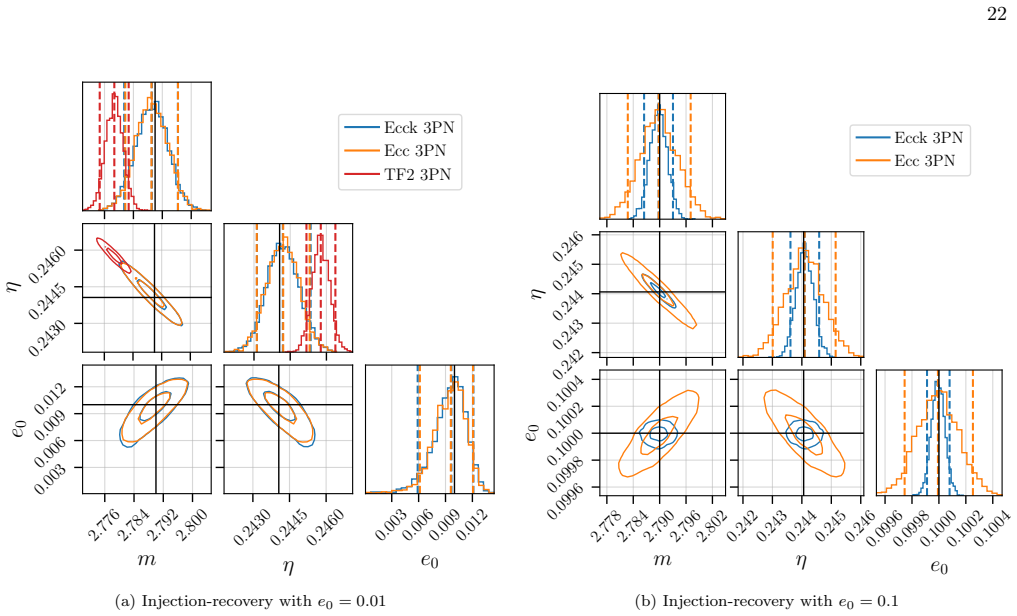
GW170817-like Injections Fig. 8 shows two injection-recovery tests comparing TaylorF2Ecck, TaylorF2Ecc, and TaylorF2. It shows that TaylorF2 fails to recover the injected mass param- eters at e0 = 0.01. Additionally, the plot illustrates how the constraints on the mass paramet...
-
[15]
9 shows results from injection-recovery tests with a GW190425-like event and varying e0 values
GW190425-like Injections Fig. 9 shows results from injection-recovery tests with a GW190425-like event and varying e0 values. It com- pares TaylorF2Ecck with TaylorF2 and illustrates the e0 parameter region where TaylorF2Ecck becomes dis- tinguishable from TaylorF2, and a valu...
-
[16]
Parameter estimation result for GW170817 Fig. 4 (right-panel) contextualizes TaylorF2ecck’s pa- rameter estimation behavior against full- TaylorF2ecc (which includes leading-order spin and 3.5PN phase circular contributions) and LVK’s IMRPhenomPv2NRT (low-spin). We include two...
-
[17]
12 shows extended posterior distributions for GW190425 using the same waveform models and param- eter set as in the GW170817 analysis
Parameter estimation result for GW190425 Fig. 12 shows extended posterior distributions for GW190425 using the same waveform models and param- eter set as in the GW170817 analysis. This analysis re- inforces the conclusions drawn from GW170817, albeit with greater uncertainty ...
-
[18]
B. P. Abbott et al. , Living Reviews in Relativity 23, 10.1007/s41114-020-00026-9 (2020)
2020 doi
-
[19]
Aasi et al
J. Aasi et al. , Classical and Quantum Gravity 32, 074001 (2015)
2015
-
[20]
Acernese et al
F. Acernese et al. , Classical and Quantum Gravity 32, 024001 (2014)
2014
-
[21]
Akutsu et al
T. Akutsu et al. , Progress of Theoreti- cal and Experimental Physics 2021, 05A101 (2020), https://academic.oup.com/ptep/article- pdf/2021/5/05A101/37974994/ptaa125.pdf
2020
-
[22]
Y. Aso, Y. Michimura, K. Somiya, M. Ando, O. Miyakawa, T. Sekiguchi, D. Tatsumi, and H. Ya- mamoto (The KAGRA Collaboration), Phys. Rev. D 88, 043007 (2013)
2013
-
[23]
Gravitational-wave candidate event database (GraceDB) public superevents for observing run O4, https://gracedb.ligo.org/superevents/public/O4/ (2024), accessed: [insert date]
2024
-
[24]
B. P. Abbott et al. (LIGO Scientific, Virgo), Phys. Rev. X 9, 031040 (2019), arXiv:1811.12907 [astro-ph.HE]
2019 arXiv
-
[25]
Abbott et al
R. Abbott et al. (LIGO Scientific, Virgo), Phys. Rev. X 11, 021053 (2021), arXiv:2010.14527 [gr-qc]
2021 arXiv
-
[26]
Abbott et al
R. Abbott et al. (LIGO Scientific, VIRGO), Phys. Rev. D 109, 022001 (2024), arXiv:2108.01045 [gr-qc]
2024 arXiv
-
[27]
Abbott et al
R. Abbott et al. (LIGO Scientific Collaboration, Virgo Collaboration, and KAGRA Collaboration), Phys. Rev. X 13, 041039 (2023)
2023
-
[28]
B. P. Abbott, R. Abbott, T. D. Abbott, et al. (LIGO Scientific Collaboration and Virgo Collaboration), Phys. Rev. Lett. 119, 161101 (2017)
2017
-
[29]
Abbott, T
R. Abbott, T. D. Abbott, S. Abraham, et al. (LIGO Scientific Collaboration, Virgo Collaboration, and KA- GRA Collaboration), The Astrophysical Journal Letters 915, L5 (2021). 23 0.02 0.04 0.06 e0 10□2 10□1 100 101 102 ∆log 10BF ∆log 10BF=2 ∆log 10BF=1 ∆log 10BF=8 e0 = 0.018 e0...
2021
-
[30]
B. P. Abbott et al. (LIGO Scientific Collaboration, Virgo Collaboration, and KAGRA Collaboration), The Astrophysical Journal Letters 848, L12 (2017)
2017
-
[31]
Buonanno, B
A. Buonanno, B. R. Iyer, E. Ochsner, Y. Pan, and B. S. Sathyaprakash, Phys. Rev. D 80, 084043 (2009)
2009
-
[32]
Blanchet, Living Reviews in Relativity 17, 2 (2014)
L. Blanchet, Living Reviews in Relativity 17, 2 (2014)
2014
-
[33]
Damour, B
T. Damour, B. R. Iyer, and B. S. Sathyaprakash, Phys. Rev. D 62, 084036 (2000)
2000
-
[34]
Poisson and C
E. Poisson and C. M. Will, Physical Review D 52, 848–855 (1995)
1995
-
[35]
Tanay, M
S. Tanay, M. Haney, and A. Gopakumar, Physical Re- view D 93, 10.1103/physrevd.93.064031 (2016)
2016 doi
-
[36]
Moore and N
B. Moore and N. Yunes, Classical and Quantum Gravity 36, 185003 (2019)
2019
-
[38]
G. Cho, S. Tanay, A. Gopakumar, and H. M. Lee, Physi- cal Review D 105, 10.1103/physrevd.105.064010 (2022)
2022 doi
-
[39]
Paul and C
K. Paul and C. K. Mishra, Physical Review D 108, 10.1103/physrevd.108.024023 (2023)
2023 doi
-
[40]
Henry and M
Q. Henry and M. Khalil, Physical Review D 108, 10.1103/physrevd.108.104016 (2023)
2023 doi
-
[41]
Sridhar, S
O. Sridhar, S. Bhattacharyya, K. Paul, and C. K. Mishra, Spin effects in the phasing formula of eccentric compact binary inspirals till the third post-newtonian order (2024), arXiv:2412.10909 [gr-qc]
2024 arXiv
-
[42]
Ashton et al
G. Ashton et al. , Astrophys. J. Suppl. 241, 27 (2019), arXiv:1811.02042 [astro-ph.IM]
2019 arXiv
-
[43]
Favata, C
M. Favata, C. Kim, K. Arun, J. Kim, and H. W. Lee, Physical Review D 105, 10.1103/physrevd.105.023003 (2022)
2022 doi
-
[44]
Kowalska, T
I. Kowalska, T. Bulik, K. Belczynski, M. Dominik, and D. Gondek-Rosinska, Astronomy and Astrophysics527, A70 (2011)
2011
-
[45]
P. C. Peters, Physical Review 136, 1224 (1964)
1964
-
[46]
Zevin, I
M. Zevin, I. M. Romero-Shaw, K. Kremer, E. Thrane, and P. D. Lasky, The Astrophysical Journal Letters921, L43 (2021)
2021
-
[47]
F. S. Broekgaarden, E. Berger, C. J. Neijssel, A. Vigna- G´ omez, D. Chattopadhyay, S. Stevenson, M. Chruslin- ska, S. Justham, S. E. de Mink, and I. Mandel, Monthly Notices of the Royal Astronomical Society508, 5028–5063 (2021)
2021
-
[48]
Belczynski, D
K. Belczynski, D. E. Holz, T. Bulik, and R. O’Shaughnessy, Nature 534, 512 (2016)
2016
-
[49]
Sigurdsson and L
S. Sigurdsson and L. Hernquist, Nature 364, 423 (1993)
1993
-
[50]
M. C. Miller and D. P. Hamilton, ApJ 576, 894 (2002). 24 0.60 0.80 1.00 q 1.19700 1.19750 M 0.005 0.010 0.015 e0 0.75 1.00 q 0.005 0.010 0.015 e0 Ecck 3PN Ecc 3.5PN+Spin Ecc 3.5PN+Spin LNB Pv2NRT FIG. 10. Corner plots showing the posterior distributions for M, q, and e0 from p...
2002
-
[51]
C. L. Rodriguez, S. Chatterjee, and F. A. Rasio, Phys. Rev. D 93, 084029 (2016)
2016
-
[52]
Antonini and F
F. Antonini and F. A. Rasio, ApJ 831, 187 (2016)
2016
-
[53]
Antonini, S
F. Antonini, S. Chatterjee, C. L. Rodriguez, M. Morscher, B. Pattabiraman, V. Kalogera, and F. A. Rasio, The Astrophysical Journal 816, 65 (2016)
2016
-
[54]
Askar, M
A. Askar, M. Arca Sedda, M. Giersz, and A. Gualandris, MNRAS 464, L36 (2017)
2017
-
[55]
Haiman, B
Z. Haiman, B. Kocsis, and E. M. Rossi, ApJ 700, 1952 (2009)
2009
-
[56]
Bartos, B
I. Bartos, B. Kocsis, Z. Haiman, and S. M´ arka, ApJ 835, 165 (2017)
2017
-
[57]
Antonini, N
F. Antonini, N. Murray, and S. Mikkola, The Astro- physical Journal 781, 45 (2014)
2014
-
[58]
C. L. Rodriguez, S. Chatterjee, and F. A. Rasio, Phys- ical Review D 93, 10.1103/physrevd.93.084029 (2016)
2016 doi
-
[59]
Wen, The Astrophysical Journal 598, 419–430 (2003)
L. Wen, The Astrophysical Journal 598, 419–430 (2003)
2003
-
[60]
J. M. Antognini, B. J. Shappee, T. A. Thompson, and P. Amaro-Seoane, Monthly Notices of the Royal Astro- nomical Society 439, 1079–1091 (2014)
2014
-
[61]
Gultekin, M
K. Gultekin, M. C. Miller, and D. P. Hamilton, The Astrophysical Journal 616, 221–230 (2004)
2004
-
[62]
R. M. O’Leary, F. A. Rasio, J. M. Fregeau, N. Ivanova, and R. O’Shaughnessy, The Astrophysical Journal 637, 937–951 (2006)
2006
-
[63]
Haster, F
C.-J. Haster, F. Antonini, V. Kalogera, and I. Mandel, The Astrophysical Journal 832, 192 (2016)
2016
-
[64]
D. J. D’Orazio and J. Samsing, Monthly Notices of the Royal Astronomical Society 481, 4775–4785 (2018)
2018
-
[65]
Fragione and A
G. Fragione and A. Loeb, Monthly Notices of the Royal Astronomical Society 486, 4443–4450 (2019)
2019
-
[66]
Breivik, C
K. Breivik, C. L. Rodriguez, S. L. Larson, V. Kalogera, and F. A. Rasio, The Astrophysical Journal Letters830, L18 (2016)
2016
-
[68]
Morras, G
G. Morras, G. Pratten, and P. Schmidt, Physical Review D 111, 10.1103/physrevd.111.084052 (2025)
2025 doi
-
[69]
de Lluc Planas, A
M. de Lluc Planas, A. Ramos-Buades, C. Garc´ ıa-Quir´ os, H. Estell´ es, S. Husa, and M. Haney, Time-domain phenomenological multipolar waveforms for aligned- spin binary black holes in elliptical orbits (2025), arXiv:2503.13062 [gr-qc]
2025
-
[70]
I. M. Romero-Shaw, P. D. Lasky, and E. Thrane, Monthly Notices of the Royal Astronomical Society490, 5210–5216 (2019)
2019
-
[71]
A. H. Nitz, A. Lenon, and D. A. Brown, The Astrophys- 25 1.1975+0.0001 □0.0001 0.720 0.800 0.880 0.960 q 0.7365+0.0590 □0.0428 2.760 2.775 2.790 2.805 2.820 m 2.7897+0.0165 □0.0169 0.242 0.244 0.246 0.248 η 0.2442+0.0025 □0.0024 0.002 0.004 0.006 0.008 0.010 e0 0.0027+0.0056 □...
2020
-
[73]
S. Wu, Z. Cao, and Z.-H. Zhu, Monthly Notices of the Royal Astronomical Society 495, 466–478 (2020)
2020
-
[74]
O’Shea and P
E. O’Shea and P. Kumar, Physical Review D 108, 10.1103/physrevd.108.104018 (2023)
2023 doi
-
[75]
Romero-Shaw, P
I. Romero-Shaw, P. D. Lasky, and E. Thrane, The As- trophysical Journal Letters 921, L31 (2021)
2021
-
[76]
Gamba, M
R. Gamba, M. Breschi, G. Carullo, S. Albanesi, P. Ret- tegno, S. Bernuzzi, and A. Nagar, Nature Astronomy 7, 11–17 (2022)
2022
-
[77]
Bonino, R
A. Bonino, R. Gamba, P. Schmidt, A. Nagar, G. Prat- ten, M. Breschi, P. Rettegno, and S. Bernuzzi, Physical Review D 107, 10.1103/physrevd.107.064024 (2023)
2023 doi
-
[78]
H. L. Iglesias, J. Lange, I. Bartos, S. Bhau- mik, R. Gamba, V. Gayathri, A. Jan, R. Nowicki, R. O’Shaughnessy, D. Shoemaker, R. Venkataramanan, and K. Wagner, Eccentricity estimation for five binary black hole mergers with higher-order gravitational wave modes (2023), arXiv:2...
2023 arXiv
-
[79]
Klein and P
A. Klein and P. Jetzer, Physical Review D 81, 10.1103/physrevd.81.124001 (2010)
2010 doi
-
[80]
Klein, Y
A. Klein, Y. Boetzel, A. Gopakumar, P. Jetzer, and L. de Vittori, Phys. Rev. D 98, 104043 (2018)
2018
-
[81]
Klein, Efpe: Efficient fully precessing eccentric grav- itational waveforms for binaries with long inspirals (2021), arXiv:2106.10291 [gr-qc]
A. Klein, Efpe: Efficient fully precessing eccentric grav- itational waveforms for binaries with long inspirals (2021), arXiv:2106.10291 [gr-qc]
2021 arXiv
-
[82]
Ramos-Buades, A
A. Ramos-Buades, A. Buonanno, and J. Gair, Bayesian inference of binary black holes with inspiral-merger- ringdown waveforms using two eccentric parameters (2023), arXiv:2309.15528 [gr-qc]
2023 arXiv
-
[83]
Morras, G
G. Morras, G. Pratten, and P. Schmidt, Orbital ec- centricity in a neutron star - black hole binary (2025), arXiv:2503.15393 [astro-ph.HE]
2025
-
[84]
de Lluc Planas, A
M. de Lluc Planas, A. Ramos-Buades, C. Garc´ ıa-Quir´ os, H. Estell´ es, S. Husa, and M. Haney, Eccentric or cir- cular? a reanalysis of binary black hole gravitational wave events for orbital eccentricity signatures (2025), arXiv:2504.15833 [gr-qc]
2025
-
[85]
A. K. Lenon, A. H. Nitz, and D. A. Brown, Monthly No- tices of the Royal Astronomical Society 497, 1966–1971 (2020)
2020
-
[86]
Moore, M
B. Moore, M. Favata, K. Arun, and C. K. Mishra, Phys- ical Review D 93, 10.1103/physrevd.93.124061 (2016)
2016 doi
-
[87]
Damour and N
T. Damour and N. Deruelle, Annales de l’I.H.P. Physique th´ eorique43, 107 (1985)
1985
-
[89]
Skilling, in AIP Conference Proceedings , American Institute of Physics Conference Series, Vol
J. Skilling, in AIP Conference Proceedings , American Institute of Physics Conference Series, Vol. 735 (2004) p. 395
2004
-
[90]
Yunes, K
N. Yunes, K. G. Arun, E. Berti, and C. M. Will, Physical Review D 80, 10.1103/physrevd.80.084001 (2009)
2009 doi
-
[91]
Allen, W
B. Allen, W. G. Anderson, P. R. Brady, D. A. Brown, and J. D. E. Creighton, Physical Review D 85, 10.1103/physrevd.85.122006 (2012)
2012 doi
-
[93]
R. E. Kass and A. E. R. and, Journal of the American Statistical Association 90, 773 (1995)
1995
-
[94]
Damour, B
T. Damour, B. R. Iyer, and B. S. Sathyaprakash, Phys- 28 ical Review D 57, 885–907 (1998)
1998
-
[95]
L. S. Collaboration and V. Collaboration, Sen- sitivity Achieved by the LIGO and Virgo Grav- itational Wave Detectors during the Fourth Ob- serving Run , Tech. Rep. LIGO-T2000012 (LIGO Project, 2023) data file: aligo O4high.txt. Available at https://dcc.ligo.org/LIGO-T2000012/...
2023
-
[96]
S. Khan, K. Chatziioannou, M. Hannam, and F. Ohme, Physical Review D 100, 10.1103/physrevd.100.024059 (2019)
2019 doi
-
[97]
Wang and A
Y.-F. Wang and A. H. Nitz, The Astrophysical Journal 912, 53 (2021)
2021
-
[98]
Jeffreys, Theory of Probability , 3rd ed
H. Jeffreys, Theory of Probability , 3rd ed. (Clarendon Press, Oxford, 1961)
1961
-
[99]
J. D. E. Creighton and W. G. Anderson, Gravitational- Wave Physics and Astronomy: An Introduction to The- ory, Experiment and Data Analysis (Wiley-VCH, 2011)
2011
-
[100]
D. S. Sivia and J. Skilling, Data Analysis - A Bayesian Tutorial, 2nd ed., Oxford Science Publications (Oxford University Press, 2006)
2006
-
[101]
I. M. Romero-Shaw et al. , Mon. Not. Roy. Astron. Soc. 499, 3295 (2020), arXiv:2006.00714 [astro-ph.IM]
2020 arXiv
-
[102]
Gelman, J
A. Gelman, J. B. Carlin, H. S. Stern, and D. B. Ru- bin, Bayesian Data Analysis , 2nd ed. (Chapman and Hall/CRC, 2003)
2003
-
[103]
Hemantakumar, Github repository for the paper ‘on constraining initial orbital eccentricity of purely inspiral events’ (2024)
P. Hemantakumar, Github repository for the paper ‘on constraining initial orbital eccentricity of purely inspiral events’ (2024)
2024
-
[104]
LIGO Scientific Collaboration, Virgo Collaboration, and KAGRA Collaboration, LVK Algorithm Library - LALSuite, Free software (GPL) (2018)
2018
-
[105]
B. P. Abbott et al., Physical Review X 9, 10.1103/phys- revx.9.011001 (2019)
2019 doi
-
[106]
Gupte, A
N. Gupte, A. Ramos-Buades, A. Buonanno, J. Gair, M. C. Miller, M. Dax, S. R. Green, M. P¨ urrer, J. Wildberger, J. Macke, I. M. Romero-Shaw, and B. Sch¨ olkopf, Evidence for eccentricity in the popula- tion of binary black holes observed by ligo-virgo-kagra (2024), arXiv:2404....
2024 arXiv
-
[107]
L. Sun, E. Goetz, J. S. Kissel, J. Betzwieser, S. Karki, A. Viets, M. Wade, D. Bhattacharjee, V. Bossilkov, P. B. Covas, L. E. H. Datrier, R. Gray, S. Kandhasamy, Y. K. Lecoeuche, G. Mendell, T. Mistry, E. Payne, R. L. Savage, A. J. Weinstein, S. Aston, A. Buikema, C. Cahillan...
2020
-
[108]
L. Sun, E. Goetz, J. S. Kissel, J. Betzwieser, S. Karki, D. Bhattacharjee, P. B. Covas, L. E. H. Datrier, S. Kandhasamy, Y. K. Lecoeuche, G. Mendell, T. Mis- try, E. Payne, R. L. Savage, A. Viets, M. Wade, A. J. Weinstein, S. Aston, C. Cahillane, J. C. Driggers, S. E. Dwyer, a...
2021 arXiv
-
[109]
M. Emma, T. F. de Nobrega, and G. Ashton, Com- paring advanced-era interferometric gravitational-wave detector network configurations: sky localization and source properties (2024), arXiv:2404.16949 [gr-qc]
2024 arXiv
-
[110]
Blanchet, Post-newtonian theory for gravitational waves (2024), arXiv:1310.1528 [gr-qc]
L. Blanchet, Post-newtonian theory for gravitational waves (2024), arXiv:1310.1528 [gr-qc]
2024 arXiv
-
[111]
K. Arun, L. Blanchet, B. Iyer, and S. Sinha, Physical Review D 80, 10.1103/physrevd.80.124018 (2009)
2009 doi
-
[112]
Huerta, C
E. Huerta, C. Moore, P. Kumar, D. George, A. J. Chua, R. Haas, E. Wessel, D. Johnson, D. Glennon, A. Rebei, A. M. Holgado, J. R. Gair, and H. P. Pfeiffer, Physical Review D 97, 10.1103/physrevd.97.024031 (2018)
2018 doi
-
[113]
C. S. Ye, W.-f. Fong, K. Kremer, C. L. Rodriguez, S. Chatterjee, G. Fragione, and F. A. Rasio, The As- trophysical Journal Letters 888, L10 (2019)
2019
-
[114]
Zackay, L
B. Zackay, L. Dai, and T. Venumadhav, Relative binning and fast likelihood evaluation for gravitational wave parameter estimation (2018), arXiv:1806.08792 [astro- ph.IM]
2018 arXiv
-
[115]
K. S. Phukon, P. Schmidt, and G. Pratten, Physical Review D 111, 10.1103/physrevd.111.043040 (2025)
2025 doi
-
[116]
Ficarra and C
G. Ficarra and C. O. Lousto, Eccentric binary black hole simulations with numerical relativity (2025), arXiv:2409.18728 [gr-qc]
2025 arXiv
-
[117]
Hemantakumar, Gitlab repository for the lalsuite forked from the original lalsuite repo (https://git.ligo.org/lscsoft/lalsuite) (2024)
P. Hemantakumar, Gitlab repository for the lalsuite forked from the original lalsuite repo (https://git.ligo.org/lscsoft/lalsuite) (2024)
2024
-
[118]
Vallisneri, J
M. Vallisneri, J. Kanner, R. Williams, A. Weinstein, and B. Stephens, Journal of Physics: Conference Series 610, 012021 (2015)
2015
-
[119]
Blackburn, A
K. Blackburn, A. Weinstein, J. Kanner, and E. Chassande-Mottin, LOSC CLN Data Products for GW170817, https://dcc.ligo.org/LIGO-P1700349/ public (2017), lIGO Document Control Center, LIGO-P1700349
2017
-
[120]
J. C. Driggers et al. (The LIGO Scientific Collaboration Instrument Science Authors), Phys. Rev. D 99, 042001 (2019)
2019
-
[121]
LIGO Scientific Collaboration and Virgo Collaboration, Strain data release for GW170817,https://gwosc.org/ events/GW170817/ (2017), gravitational-Wave Open Science Center; cleaned and raw strain data, including glitch-subtracted LIGO-Livingston channel
2017
-
[122]
LIGO Scientific Collaboration and Virgo Collaboration, Data release for GW190425: compact binary coales- cence observed April 25, 2019, https://dcc.ligo.org/ LIGO-P190425/public (2019), lIGO Document Con- trol Center, LIGO-P190425-v10; includes strain data (L1/V1), PSDs, calib...
2019
-
[123]
B. P. Abbott et al. , The Astrophysical Journal Letters 892, L3 (2020)
2020
-
[124]
A. Nitz, I. Harry, D. Brown, C. M. Biwer, J. Willis, T. D. Canton, C. Capano, T. Dent, L. Pekowsky, G. S. C. Davies, S. De, M. Cabero, S. Wu, A. R. Williamson, B. Machenschalk, D. Macleod, F. Pan- narale, P. Kumar, S. Reyes, dfinstad, S. Kumar, M. T´ apai, L. Singer, P. Kumar,...
2024
-
[125]
A. K. Lenon, A. H. Nitz, and D. A. Brown, Data release: Measuring the eccentricity of gw170817 and gw190425 (2020)
2020
Reviewed August 15, 2026 · model on record in the stance chip above.
Discussion (0). Continue with ORCID to comment.