REVIEW 2 major objections 5 minor 36 references
Optical cycling of MgF molecules within the hyperfine states in X(N=1) state
T0 review · 2 major / 5 minor · reviewed 2026-08-06 · deepseek-v4-flash
Pith's one-line read Three independently tuned laser frequencies plus a 45-degree magnetic field raise the photon scattering rate of MgF molecules by roughly a factor of six compared with single-frequency excitation.
desk verdict Solid MgF optical cycling optimization study; the headline factor-of-six is a product of two separately measured enhancements and should be treated as an upper estimate until a combined measurement is reported. read the letter →
The pith
A machine-rendered reading of the paper's core claim, the machinery that carries it, and where it could break.
The reading
What carries the argument
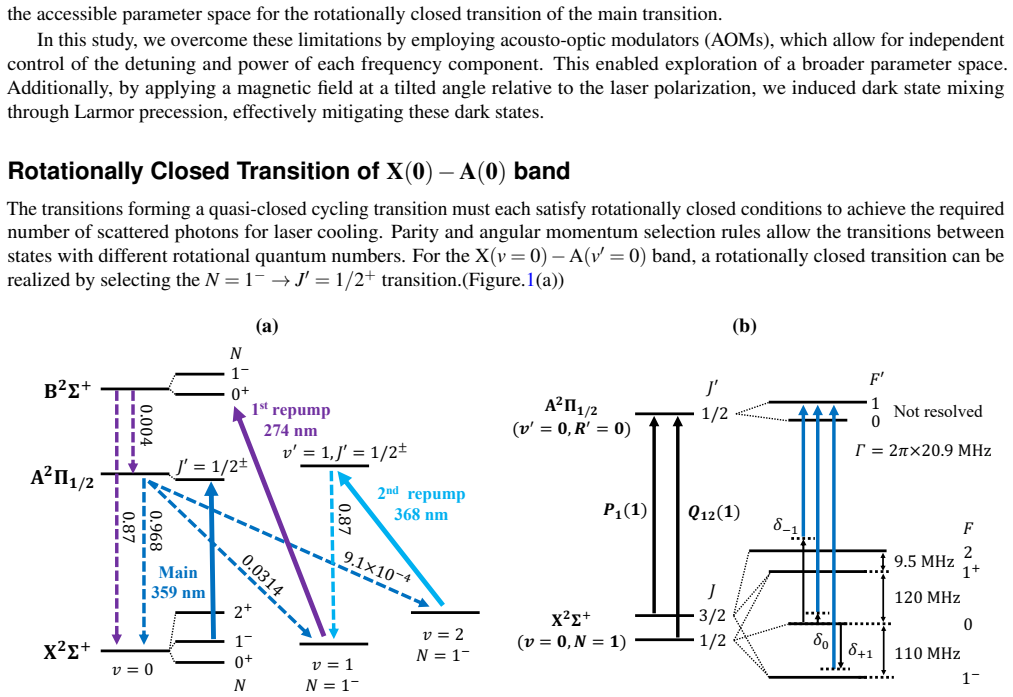
The load-bearing object is the $\mathrm{P_1/Q_{12}(1)}$ transition set: the ground hyperfine states $F=2,1^+,0,1^-$ are addressed by three laser frequencies with detunings $(-125,0,+110)$ MHz, taking advantage of the unresolved hyperfine splitting of the excited state ($\Gamma=2\pi\times20.9$ MHz) so that three components, not six, close the cycle. The experimental freedom comes from acousto-optic modulators, which let the experiment set each frequency's detuning and power independently, unlike electro-optic modulators with their fixed, symmetric sidebands. The supporting mechanism for dark states is Larmor precession: a DC magnetic field applied at $45^\circ$ to the linear laser polarization mixes magnetic sublevels, including the $|F=2,m_F=\pm2\rangle$ states that cannot be reached by $\pi$ transitions, converting dark population back into the cycling manifold. Rate-equation simulations with Gaussian transit-time intensity profiles tie the observations together and identify dark-state and vibrational leakage as the saturation channels.
What would settle it
Measure the OC-beam fluorescence versus magnetic field strength and angle while also recording the spectral line shape: if a field applied parallel to the laser polarization (where no Larmor precession between $m_F$ sublevels occurs) gives the same enhancement, or if the enhancement follows the Zeeman shift of a single hyperfine line rather than a broad plateau, then the dark-state-mixing explanation is wrong and the claimed factor of six must be reinterpreted.
Extended reading notes
Core claim
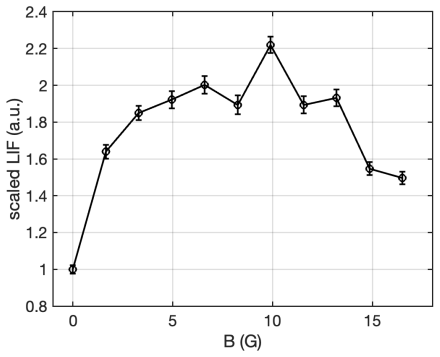
The central claim is that optimized optical cycling of the $\mathrm{X}^2\Sigma(v=0,N=1^-)$--$\mathrm{A}^2\Pi_{1/2}(v'=0,J'=1/2^+)$ band, with all three hyperfine transitions of the $\mathrm{P_1/Q_{12}(1)}$ manifold driven simultaneously, produces up to three times the fluorescence of the summed single-frequency signals; when a magnetic field of about 5--10 G is applied at $45^\circ$ to the laser polarization, the scattering rate rises by a further factor of up to 2.2, giving an overall enhancement of approximately six. The optimization is achieved by scanning the detunings $\delta_{-1}$, $\delta_0$, $\delta_{+1}$ and the power ratios $P_{-1}:P_0:P_{+1}$, with the best detuning for the $F=2$/$F=1^+$ pair near $-125$ MHz and the best distribution allocating the most power to the component that drives the $F=2$ and $F=1^+$ states. Rate-equation simulations that include the Gaussian beam profile reproduce the dependence on detuning, power ratio, and total power, and attribute the saturation of the cycling beam to population accumulating in dark magnetic sublevels and vibrationally excited states. The magnetic-field enhancement is interpreted as Larmor-precession mixing of those dark sublevels, with the decrease at higher fields attributed to increased off-resonant scattering and rapid precession returning population to dark states.
Load-bearing premise
The paper's sixfold claim depends on the assumption that the magnetic-field enhancement comes from Larmor precession repumping dark magnetic sublevels, rather than from Zeeman shifts or other field-dependent systematic effects; this mechanism is asserted qualitatively and not quantitatively modeled.
Editorial extensions
If this is right
- For MgF laser slowing and magneto-optical trapping, the cycling beam should be built from three AOM-generated components with independently chosen detunings and powers rather than from EOM sidebands.
- The measured optimum places $\delta_{-1}$ near $-125$ MHz, midway between the $F=2$ and $F=1^+$ transitions, and gives the largest power share to that component.
- A small magnetic field of about 5--10 G at $45^\circ$ to the polarization can recover much of the population lost to dark magnetic sublevels, adding up to a factor of 2.2 on top of the three-frequency gain.
- The observed saturation with total power is a real limit: at high power the cycling beam pumps population into dark magnetic sublevels and vibrational dark states, so repumping and dark-state mixing must be included in any trap design.
- The rate-equation simulation reproduces the measured detuning, power-ratio, and saturation behaviour, giving a practical tool for designing MgF cooling-laser configurations.
Reading between the lines
- Because the AOM approach removes the fixed power-ratio constraint of EOM sidebands, a direct AOM-versus-EOM comparison at equal total power should show whether the extra parameter freedom alone explains the factor-of-three gain; this comparison is not reported in the paper.
- The dark-state-mixing mechanism should generalize to other Type-II molecular cycling schemes with more ground than excited magnetic sublevels; an angled magnetic field could serve as a simple repumper for CaF, SrF, or BaF without additional laser frequencies.
- A quantitative Zeeman-plus-Larmor model, including the velocity dependence and the Gaussian beam profile, could turn the observed field optimum near 5--10 G into a predictive design rule and test whether the decline above 10 G is really due to rapid precession.
- For a MOT, the local laser polarization varies across the trap, so a single 45-degree field direction may not optimally mix dark states everywhere; polarization modulation or a rotating field might be needed to reproduce the sixfold enhancement in a trapping geometry.
Editorial analysis
A structured set of objections, weighed in public.
Referee Report
Summary. The paper reports optical cycling of MgF molecules on the rotationally closed P1/Q12(1) transition in the X(v=0) - A(v'=0) band. Three frequency components generated by acousto-optic modulators (AOMs) are used to address the hyperfine transitions, with independent control of detuning and power. The authors optimize these parameters and report that the laser-induced fluorescence (LIF) from the optical cycling (OC) beam is up to three times the sum of single-frequency LIF at zero magnetic field. Applying a DC magnetic field at a 45-degree angle to the laser polarization yields an additional up-to-2.2x increase in LIF. The abstract and conclusion combine these factors to claim an overall scattering-rate enhancement of approximately a factor of six. The experimental results are compared with rate equation simulations.
Significance. If substantiated, the reported factor-of-six enhancement would be a practically useful benchmark for MgF laser cooling and trapping, and the AOM-based scheme with independent frequency and power control is a genuine improvement over fixed-ratio EOM approaches. The qualitative demonstration that a tilted magnetic field can partially recover population from dark magnetic sublevels is also of interest. However, the central quantitative claim is not directly measured, and the magnetic-field mechanism is not modeled quantitatively. The paper's value lies in the detailed optimization data and the OC-beam approach, but the headline claim needs stronger support.
major comments (2)
- [Abstract and Conclusion, with Fig. 2b/3c and Fig. 6] The claimed 'approximately a factor of six' enhancement (Abstract and Conclusion) is obtained by multiplying the up-to-3x enhancement of the OC beam over the sum of single-frequency LIF at B=0 (Fig. 2b, Fig. 3c) with the up-to-2.2x enhancement of the OC beam with a magnetic field over the OC beam without a field (Fig. 6). No direct measurement is reported in which the optimized OC beam with the magnetic field applied is compared to the sum of single-frequency LIF under the same magnetic field. The single-frequency baseline's response to B is not characterized, and the statement that the optimal detunings and power ratios 'remained unchanged with varying magnetic field strengths' is an unsupported assertion. If the B-field also repumps dark states in the single-frequency reference, or if the optimal detunings shift with B, the combined enhancement over the proper baseline could be well below six. A direct combined measurement, or at least a measurement of the single-frequency LIF vs. B, is required to support the central claim.
- [Dark state mixing and Figure 6] The attribution of the LIF increase in Fig. 6 to Larmor precession mixing dark magnetic sublevels is not quantitatively supported. At B=5-10 G, the Zeeman shifts of the relevant ground-state sublevels are of order 7-14 MHz for an electron-spin g-factor near 2, which is comparable to the natural linewidth Gamma = 2*pi*20.9 MHz. The observed rise to ~5 G and subsequent decrease at higher fields could also be explained by Zeeman shifts altering the effective detunings of the three frequency components. The rate-equation simulations described in the Methods do not include a magnetic field, so they cannot validate the proposed dark-state-mixing mechanism. A quantitative model of the B-field dependence, or at least a measurement of the single-frequency LIF under the same B-field conditions, is needed to distinguish repumping from Zeeman-shift effects.
minor comments (5)
- [Experimental Setup and Figures 2-6] The LIF signals are presented without error bars, repetition statistics, or a clear statement of the number of independent measurements; this limits the confidence in the 'up to' enhancement ratios, which appear to be single-shot or averaged values without quantified uncertainty.
- [Methods, Rate Equation Simulation] The text states that the simulations 'agree well' with the experimental data, but does not describe how the absolute LIF scale is matched between the arbitrary-unit experimental signal and the simulated populations. A vertical scaling factor appears to be used, and its selection procedure should be stated explicitly.
- [Dark state mixing] The sentence 'The optimal detuning and power ratio remained unchanged with varying magnetic field strengths' should be supported by a figure or table showing the LIF as a function of detuning or power ratio at different B values, since this claim is important for the interpretation of Fig. 6.
- [Methods, Experiment Setup] There is a typographical error: 'Nd:Y AG laser' should be 'Nd:YAG laser'.
- [References] Reference 21 is a preprint (arXiv:2506.02266); the authors should update it to the published version if one becomes available, and similarly for other preprints cited.
Circularity Check
No circularity: the optical-cycling and magnetic-field enhancements are directly measured LIF signals, and the factor-of-six claim is an arithmetic summary rather than a model output fitted to the data.
full rationale
The paper's central claims are experimental observations. The factor-of-three enhancement (Fig. 2(b)/3(c)) compares the OC-beam LIF with the sum of the single-frequency LIF signals, and the factor-of-2.2 enhancement (Fig. 6) compares the OC-beam LIF with and without a magnetic field. Neither quantity is generated by fitting a model parameter to the value being reported. The rate-equation simulation (Eqs. 1-5) uses independently published molecular constants, stated detunings, powers, and beam geometry; no adjustable parameter is introduced to force agreement with the claimed enhancement. The conclusion's 'approximately a factor of six' is obtained by multiplying the threefold and twofold gains, which may be an experimental-support gap if no combined measurement was made, but it is not circular: the six is not an input to any model that then 'predicts' it. There is no load-bearing self-citation, no imported uniqueness theorem, and no known result renamed as new. The paper is self-contained as an empirical study, so the circularity score is 0.
Assumptions & free parameters
free parameters (1)
- Simulation-to-experiment vertical scale factor =
not stated
assumptions (4)
- domain assumption The rate equation treatment with a single stimulated rate Reg,i per laser component adequately describes the multilevel MgF A-X interaction (Methods, Eqs. 1-5).
- domain assumption The hyperfine splittings of X(v=0,N=1) and A(v'=0,J'=1/2) are as reported in ref 30, and the F=2/1+ and F'=1/0 pairs are unresolved at Γ=2π*20.9 MHz.
- ad hoc to paper A DC magnetic field at 45° mixes the dark magnetic sublevels via Larmor precession, with negligible change to the detunings.
- domain assumption Power broadening dominates over Doppler broadening from the molecular beam's transverse velocity spread.
Cite this review
Pith. "Pith review of Optical cycling of MgF molecules within the hyperfine states in X(N=1) state." pith.science (2026). https://pith.science/paper/LFRDL4PD
@misc{pith2026250623507,
  author       = {Pith},
  title        = {Pith review of: Optical cycling of MgF molecules within the hyperfine states in X(N=1) state},
  year         = {2026},
  howpublished = {\url{https://pith.science/paper/LFRDL4PD}},
  note         = {Machine review of arXiv:2506.23507}
}
abstract
We investigated the optical cycling effect of the $\mathrm{X}^2\Sigma(v=0,\ N=1^-) - \mathrm{A}^2\Pi_{1/2}(v'=0,\ J'=1/2^+)$ band of MgF molecules, specifically the $\mathrm{P_1/Q_{12}(1)}$ transition, which serves as the main transition in the quasi-closed cycling scheme for the laser cooling. A higher number of scattered photons was observed when all three frequency components of the $\mathrm{P_1/Q_{12}(1)}$ transition were simultaneously applied using acousto-optic modulators (AOMs). Optimal conditions were identified by scanning the detuning of frequency components, the laser beam power ratio, and the total laser beam power, and the results were confirmed through rate equation simulations. Under these optimized conditions, and with an applied magnetic field, the scattering rate was enhanced by approximately a factor of six. These results refine the implementation of optical cycling in MgF and lay the groundwork for laser slowing and magneto-optical trapping (MOT) experiments.
Figures


Figures from the paper (6 more)




Reference graph
Works this paper leans on
-
[1]
Hudson, J. J. et al. Improved measurement of the shape of the electron. Nature 473, 493–496, DOI: 10.1038/nature10104 (2011)
-
[2]
Baron, J. et al. Order of magnitude smaller limit on the electric dipole moment of the electron. Science 343, 269–272, DOI: 10.1126/science.1248213 (2014)
-
[3]
Cairncross, W. B. et al. Precision measurement of the electron’s electric dipole moment using trapped molecular ions. Phys. Rev. Lett. 119, 153001, DOI: 10.1103/PhysRevLett.119.153001 (2017)
-
[4]
Improved limit on the electric dipole moment of the electron
Andreev, V .et al. Improved limit on the electric dipole moment of the electron. Nature 562, 355–360, DOI: 10.1038/ s41586-018-0599-8 (2018)
work page 2018
-
[5]
Kozyryev, I., Lasner, Z. D. & Doyle, J. M. Enhanced sensitivity to ultralight bosonic dark matter in the spectra of the linear radical sroh. Phys. Rev. A 103, 043313, DOI: 10.1103/PhysRevA.103.043313 (2021)
-
[6]
Ospelkaus, S. et al. Controlling the hyperfine state of rovibronic ground-state polar molecules. Phys. Rev. Lett. 104, 030402, DOI: 10.1103/PhysRevLett.104.030402 (2010)
-
[7]
Gregory, P. D., Frye, M. D. & Cornish, S. L. Sticky collisions of ultracold rbcs molecules. Nat. Commun. 10, 3104, DOI: 10.1038/s41467-019-11057-8 (2019)
-
[8]
Chae, E., Choi, J. & Kim, J. An elementary review on basic principles and developments of qubits for quantum computing. Nano Convergence 11, 11, DOI: 10.1186/s40580-024-00418-5 (2024)
Show all 36 references
-
[9]
L., Tarbutt, M
Cornish, S. L., Tarbutt, M. R. & Hazzard, K. R. A. Quantum computation and quantum simulation with ultracold molecules. Nat. Phys. 20, 730–743, DOI: 10.1038/s41567-024-02453-9 (2024)
2024 doi
-
[10]
Bigagli, N. et al. Observation of bose–einstein condensation of dipolar molecules. Nature 631, 289–293, DOI: 10.1038/ s41586-024-07492-z (2024)
2024
-
[11]
Dipolar spin-exchange and entanglement between molecules in an optical tweezer array
Bao, Y .et al. Dipolar spin-exchange and entanglement between molecules in an optical tweezer array. Science 382, 1138–1143, DOI: 10.1126/science.adf8999 (2023)
2023 doi
-
[12]
Anderegg, L. et al. Laser cooling of optically trapped molecules. Phys. Rev. X 8, 210355, DOI: 10.1103/PhysRevX.8. 0210355 (2018)
2018 doi
-
[13]
Raman sideband cooling of molecules in an optical tweezer array to the 3-d motional ground state
Bao, Y .et al. Raman sideband cooling of molecules in an optical tweezer array to the 3-d motional ground state. Phys. Rev. X 14, 031002, DOI: 10.1103/PhysRevX.14.031002 (2024)
2024 doi
-
[14]
J., Holland, C
Lu, Y ., Li, S. J., Holland, C. M. & Cheuk, L. W. Raman sideband cooling of molecules in an optical tweezer array.Nat. Phys. 20, 389–394, DOI: 10.1038/s41567-023-02346-3 (2024)
2024 doi
-
[15]
J., Holland, C
Li, S. J., Holland, C. M., Lu, Y . & Cheuk, L. W. Blue-detuned magneto-optical trap of caf molecules.Phys. Rev. Lett. 132, 233402, DOI: 10.1103/PhysRevLett.132.233402 (2024)
2024 doi
-
[16]
M., Lu, Y
Holland, C. M., Lu, Y . & Cheuk, L. W. On-demand entanglement of molecules in a reconfigurable optical tweezer array. Science 382, 1143–1147, DOI: 10.1126/science.adf4272 (2023)
2023 doi
-
[17]
Laser cooling and slowing of caf molecules
Zhelyazkova, V .et al. Laser cooling and slowing of caf molecules. Phys. Rev. A 89, 053416, DOI: 10.1103/PhysRevA.89. 053416 (2014)
2014 doi
-
[18]
K., Wang, Q., Zheng, G
Jorapur, V ., Langin, T. K., Wang, Q., Zheng, G. & DeMille, D. High density loading and collisional loss of laser-cooled srf molecules in an optical dipole trap. Phys. Rev. Lett. 132, 163403, DOI: 10.1103/PhysRevLett.132.163403 (2023)
2023 doi
-
[19]
Truppe, S. et al. Molecules cooled below the doppler limit. Nat. Phys. 13, 1173–1176, DOI: 10.1038/nphys4241 (2017)
2017 doi
-
[20]
Tarbutt, M. R. Methods for measuring the electron’s electric dipole moment using ultracold ybf molecules. Quantum Sci. Technol. 10, 14006, DOI: 10.1088/2058-9565/abc123 (2025)
2025 doi
-
[21]
Padilla-Castillo, J. E. et al. Magneto-optical trapping of aluminum monofluoride (alf). Prepr. (arXiv) DOI: 10.48550/ arXiv.2506.02266 (2025)
2025 doi
-
[22]
& Yan, B
Zeng, Z., Deng, S., Yang, S. & Yan, B. Three-dimensional magneto-optical trapping of barium monofluoride. Phys. Rev. Lett. 133, 143404, DOI: 10.1103/PhysRevLett.133.143404 (2024). 8/10
2024 doi
- [23]
-
[24]
Anderegg, L. et al. Radio frequency magneto-optical trapping of caf with high density. Phys. Rev. Lett. 119, 103201, DOI: 10.1103/PhysRevLett.119.103201 (2017)
2017 doi
- [25]
-
[26]
& Hutson, J
Karman, T. & Hutson, J. M. Microwave shielding of ultracold polar molecules. Phys. Rev. Lett. 121, 163401, DOI: 10.1103/PhysRevLett.121.163401 (2018)
2018 doi
-
[27]
Anderegg, L. et al. Observation of microwave shielding of ultracold molecules. Prepr. (arXiv) (2021). ArXiv:2102.04365
2021 arXiv
-
[28]
Yan, K. et al. Simulation of eom-based frequency-chirped laser slowing of mgf radicals. Front. Phys. 17, 42502, DOI: 10.1007/s11467-021-1137-y (2022)
2022 doi
-
[29]
J., Pilgram, N
Rodriguez, K. J., Pilgram, N. H., Barker, D. S., Eckel, S. P. & Norrgard, E. B. Simulations of a frequency-chirped magneto-optical trap of mgf. Phys. Rev. A 108, 033105, DOI: 10.1103/PhysRevA.108.033105 (2023)
2023 doi
-
[30]
Doppelbauer, M. et al. Hyperfine-resolved optical spectroscopy of the a2π ←x2σ + transition in mgf. J. Chem. Phys. 156, 134301, DOI: 10.1063/5.0081902 (2022)
2022 doi
-
[31]
Norrgard, E. B. et al. Radiative decay rate and branching fractions of mgf. Phys. Rev. A 108, 032809, DOI: 10.1103/ PhysRevA.108.032809 (2023)
2023
-
[32]
H., Baldwin, B
Pilgram, N. H., Baldwin, B. W., La Mantia, D. S., Eckel, S. P. & Norrgard, E. B. Spectroscopy of laser-cooling transitions in mgf. Phys. Rev. A 110, 023110, DOI: 10.1103/PhysRevA.110.023110 (2024)
2024 doi
-
[33]
Gu, R. et al. Radiative force from optical cycling on magnesium monofluoride. Phys. Rev. A 105, 042806, DOI: 10.1103/PhysRevA.105.042806 (2022)
2022 doi
-
[34]
R., Lu, H.-I
Hutzler, N. R., Lu, H.-I. & Doyle, J. M. The buffer gas beam: An intense, cold, and slow source for atoms and molecules. Chem. Rev. 112, 4803–4827, DOI: 10.1021/cr200362u (2012)
2012 doi
-
[35]
Truppe, S. et al. A buffer gas beam source for short, intense and slow molecular pulses. J. Mod. Opt. 65, 648–658, DOI: 10.1080/09500340.2017.1384516 (2018)
2018
-
[36]
Wall, T. E. et al. Lifetime of the a(v’=0) state and franck–condon factor of the a–x(0–0) transition of caf. Phys. Rev. A 78, 062509, DOI: 10.1103/PhysRevA.78.062509 (2008). Acknowledgements Authors appreciate Donghyun Cho for his expert advice and for providing essential expe...
2008 doi
Reviewed August 6, 2026 · model on record in the stance chip above.
Discussion (0). Sign in to comment.