REVIEW 2 major objections 4 minor 52 references
Moment of Untruth: Dealing with Negative Queries in Video Moment Retrieval
T0 review · 2 major / 4 minor · reviewed 2026-08-08 · deepseek-v4-flash
Pith's one-line read Video moment retrieval models can reject irrelevant queries while keeping most retrieval accuracy.
desk verdict Useful new task and benchmarks for negative-aware VMR, but the rejection numbers are measured against easy negatives and should be read as upper bounds. read the letter →
The pith
A machine-rendered reading of the paper's core claim, the machinery that carries it, and where it could break.
The reading
What carries the argument
The load-bearing mechanism is a lightweight binary classification head added to an existing Moment-DETR-style model. It combines the model's indicator scores and saliency scores (by summation for UniVTG, by concatenation for QD-DETR and CG-DETR), processes them through a recurrent layer and a feed-forward layer with a sigmoid output, and is trained with a binary cross-entropy loss alongside negative-specific losses that push indicator and saliency scores toward zero for negative queries. The other half of the machinery is the negative-query construction pipeline: in-domain negatives come from shuffling video-sentence pairs and keeping only pairs in the lowest 50th percentile of a CLIP-based pseudo-similarity score, while out-of-domain negatives are LLM-generated sentences from scenarios chosen not to occur in the datasets.
What would settle it
Take a random sample of the constructed in-domain and out-of-domain negative pairs, have human annotators check whether each negative query actually describes a moment visible in its assigned video, and re-measure rejection accuracy on the verified subset; if even a few percent of the 'negative' queries are true positives, the reported rejection numbers would drop accordingly.
Extended reading notes
Core claim
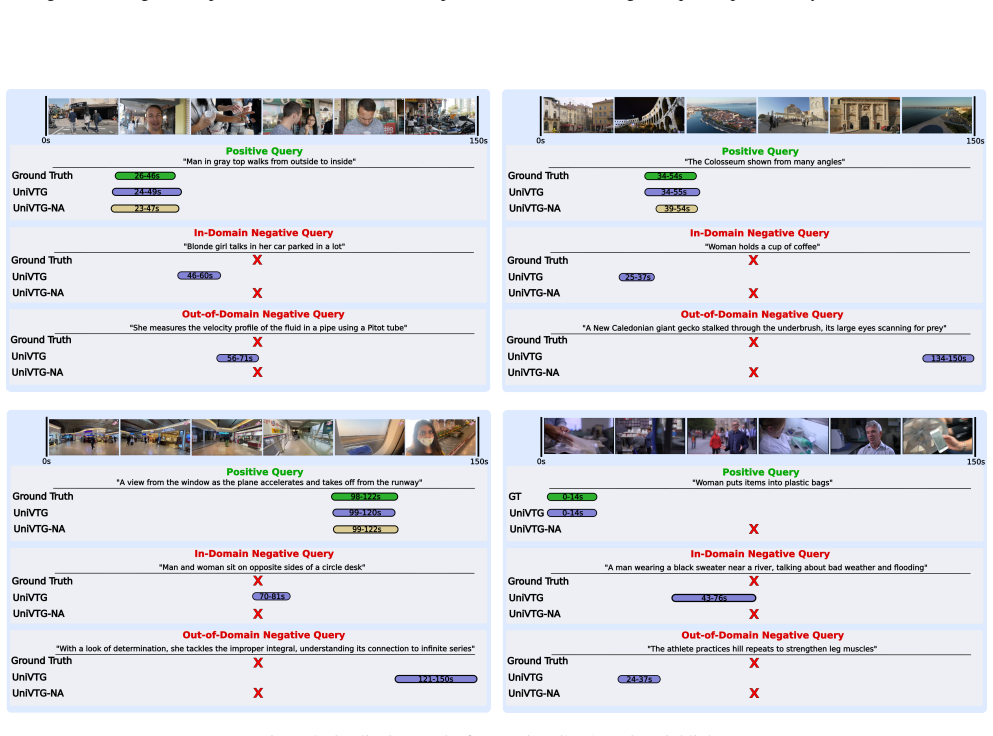
The paper's central claim is that current video moment retrieval methods cannot tell positive from negative queries, and that this can be fixed by training with explicitly sampled negatives and a binary classification head. The paper shows that the indicator score used to rank moments is nearly non-separable between positives and negatives, while saliency scores carry more signal but still overlap. Its solution keeps the base model's heads and adds a classification head that takes the sum (for UniVTG) or concatenation (for QD-DETR and CG-DETR) of indicator and saliency scores, passes them through an RNN and a feed-forward layer, and outputs a positive-versus-negative prediction. A binary cross-entropy loss, together with adapted losses that push indicator and saliency scores toward zero for negatives, trains this head. Across QVHighlights and Charades-STA, UniVTG-NA retains most moment retrieval accuracy while rejecting an average of 98.4% of negatives, with out-of-domain rejection near 100% on both datasets. An ablation shows that in-domain and out-of-domain negatives provide complementary training signal: training with only one type leaves a large rejection gap.
Load-bearing premise
The benchmarks assume that the automatically constructed negative queries really do not match anything in the videos they are assigned to, and this is never verified by human annotation.
Editorial extensions
If this is right
- Moment-DETR-based models can be made negative-aware by adding a small classification head and training with negative queries, without changing the base architecture.
- Standard video moment retrieval benchmarks overstate practical reliability because they never include queries that do not match the video.
- Training with both in-domain and out-of-domain negatives is necessary; either type alone leaves a large gap in rejection accuracy.
- The rejection ability transfers to out-of-domain scenarios not seen in training, as shown by high rejection accuracy on the unseen 'musician performance' category.
- There is an inherent trade-off: adding rejection lowers moment recall slightly, and datasets without ground-truth saliency scores show weaker in-domain rejection.
Reading between the lines
- Editorial inference: if rejection accuracy reflects genuine video-query mismatch, the classification head's score could double as a confidence or abstention signal for downstream video search and question answering, not just a binary reject.
- Editorial inference: the ID-negative construction relies on CLIP pseudo-similarity and is never human-verified; a small human audit of the negative pairs would establish whether the benchmark itself is sound.
- Editorial inference: the same summation or concatenation head could likely be applied to newer grounding architectures beyond the tested Moment-DETR family, but the head input would need to adapt to models that do not produce saliency scores.
- Editorial inference: a natural testable extension is joint training with Video Corpus Moment Retrieval, where rejecting queries absent from the whole corpus is a more difficult version of the same problem.
Editorial analysis
A structured set of objections, weighed in public.
Referee Report
Summary. The paper introduces Negative-Aware Video Moment Retrieval (NA-VMR), a task formulation in which a model must both localize moments for positive queries and reject irrelevant (negative) queries. The authors propose a distinction between in-domain (ID) negatives, obtained by shuffling video-sentence pairs, and out-of-domain (OOD) negatives, generated by LLMs from scenarios assumed to be absent from the target datasets. They construct new evaluation benchmarks on QVHighlights and Charades-STA, evaluate three existing moment-retrieval methods (UniVTG, CG-DETR, QD-DETR) with threshold- and SVM-based rejection, and propose a simple modification (adding a classification head over indicator and saliency scores) that yields "negative-aware" variants. The main result is that UniVTG-NA achieves high rejection accuracy on the new benchmarks while retaining most moment-retrieval performance; an additional OOD generalization test on 'musician performances' is reported.
Significance. If the benchmarks are accepted as clean, the paper makes a useful contribution: it is the first systematic study of negative-query robustness in video moment retrieval, it introduces a clear task distinction between ID and OOD negatives, and it shows that a lightweight classification head on top of existing indicator and saliency scores provides a practical adaptation that generalizes to an unseen OOD scenario. The code and dataset splits are released, which supports reproducibility. The main caveat is that all reported rejection accuracies rest on negative sets whose validity is not verified by human annotation and whose construction may select artificially easy negatives; as a result, the headline numbers should be treated as upper-bound estimates until the benchmark is validated.
major comments (2)
- [Sec. 3.3 (In-Domain negatives)] The ID negative set is constructed by keeping only shuffled video-sentence pairs whose CLIP pseudo-similarity falls in the lowest 50th percentile for the sentence. This deliberately removes the harder half of possible shuffled negatives, so the ID rejection accuracies in Tables 1, 2, 3, and 8 are upper bounds for arbitrary irrelevant queries and do not directly support the stated ability to 'differentiate specific details in videos' from Sec. 3.2. No results are reported on a random subset or on the excluded higher-similarity half, and no human verification is provided that the remaining shuffled pairs are truly negative. Because CLIP sentence-sentence similarity is only a proxy for whether a moment is present, a shuffled sentence can still describe a moment in its newly assigned video; if any test negative is actually positive, the reported rejection accuracy is inflated. This is load-bearing for the central claim of high rejection accuracy.
- [Sec. 3.3 (Out-of-Domain negatives)] The OOD negative set consists of LLM-generated sentences about competitive sport, animal behaviour, physics laboratory, and mathematics class, under the assumption that these are 'extremely unlikely' to occur in QVHighlights and Charades-STA. However, QVHighlights contains news and vlog footage where such content can appear, and Charades-STA is unscripted home video, not a closed domain. The paper reports no automatic or human check that any of the 1550 OOD test pairs are actually negative, nor for the additional 'musician performances' generalisation set in Table 8. If even a small fraction of these queries are accidentally present in their paired videos, the near-100% OOD rejection accuracies in Tables 2, 3, and 8 overstate the model's true rejection ability and unfairly penalise the baselines. The authors should validate a sample of OOD and ID negatives (e.g., through human annotation) or provide a quantitative analysis of the false-negative rate.
minor comments (4)
- [Abstract] The abstract's claim of 'avg. 98.4%' rejection accuracy is only the average of the ID and OOD numbers for QVHighlights (96.84 and 100.0); on Charades-STA the ID rejection accuracy is 64.11%, and the 'within 3.87% Recall@1' retention is also specific to QVHighlights R1@0.5. The abstract should qualify these numbers by dataset and metric.
- [Sec. 3.4, Eq. (1)] The decision threshold for the sigmoid classification output is never stated. The paper should specify the threshold used to convert continuous predictions into accept/reject decisions for computing Rejection Accuracy, and should state whether this threshold is the default 0.5 or a tuned hyperparameter.
- [Sec. C.3] The loss weights (lambda_p, lambda_ID, lambda_OOD, lambda_s) are chosen separately for each dataset and each negative type, but no sensitivity analysis or selection criterion is reported. Adding a small ablation over these weights would help assess how robust the reported trade-off between retrieval and rejection is.
- [Throughout] There are several typos and formatting issues, e.g., 'incoporates' in the Conclusion, 'QVHighights' in the Appendix, and a missing space in Sec. 4.1 ('methods treat positives and negatives the same way .'). These should be corrected before publication.
Circularity Check
No significant circularity: the negative-rejection results come from held-out supervised evaluation, not from a self-referential derivation.
full rationale
The paper's derivation chain is self-contained. The NA classification head (Eq. 1) is trained with a BCE loss (Eq. 2) on separately generated ID and OOD negatives, and the headline rejection-accuracy numbers (Table 2) are measured on held-out negative queries produced by the same construction pipeline. That is standard supervised benchmarking, not a case where a fitted parameter is renamed a prediction. The threshold baselines in Table 1 are calibrated only on the positive training set's 0.5th percentile, so their poor rejection accuracy is not forced by tuning to the test negatives; the SVM baseline is likewise trained and tested on disjoint pairs. The unseen 'musician performance' OOD scenario (Table 8) provides external evidence that OOD rejection is not solely memorization of the four training scenarios. No load-bearing step reduces to a self-citation: the cited pair-shuffling idea [32] is an external method, and the authors invoke no prior results of their own as justification for the central claim. The main caveat—that ID and OOD negatives are selected by CLIP-similarity filters and LLM generation rather than human verification, so rejection accuracy could be inflated or misstated—is a benchmark-validity and correctness risk, not a circularity of the derivation. Therefore no step meets the threshold for circularity.
Assumptions & free parameters
free parameters (6)
- Loss weights lambda_plus, lambda_ID, lambda_OOD, lambda_p =
e.g., lambda_ID=0.1, lambda_OOD=0.1, lambda_p=1 for QVHighlights; lambda_ID=0.5, lambda_OOD=0.5 for Charades-STA
- RNN hidden dimension =
50
- CLIP pseudo-similarity percentile threshold for ID negative selection =
lowest 50th percentile
- Classification decision threshold for y =
not reported
- Baseline threshold percentile =
0.5th percentile of positive scores
- OOD negative scenarios =
Competitive sport, animal behaviour, physics laboratory, mathematics class
assumptions (4)
- domain assumption The CLIP-based pseudo-similarity filter ensures shuffled sentences are true negatives.
- domain assumption LLM-generated out-of-domain sentences never occur in the target videos.
- domain assumption Indicator and saliency scores carry enough signal to separate positive from negative queries.
- domain assumption Current VMR models can be treated as Moment-DETR-style with indicator and saliency heads.
Cite this review
Pith. "Pith review of Moment of Untruth: Dealing with Negative Queries in Video Moment Retrieval." pith.science (2026). https://pith.science/paper/LGBJZRQI
@misc{pith2026250208544,
  author       = {Pith},
  title        = {Pith review of: Moment of Untruth: Dealing with Negative Queries in Video Moment Retrieval},
  year         = {2026},
  howpublished = {\url{https://pith.science/paper/LGBJZRQI}},
  note         = {Machine review of arXiv:2502.08544}
}
abstract
Video Moment Retrieval is a common task to evaluate the performance of visual-language models - it involves localising start and end times of moments in videos from query sentences. The current task formulation assumes that the queried moment is present in the video, resulting in false positive moment predictions when irrelevant query sentences are provided. In this paper we propose the task of Negative-Aware Video Moment Retrieval (NA-VMR), which considers both moment retrieval accuracy and negative query rejection accuracy. We make the distinction between In-Domain and Out-of-Domain negative queries and provide new evaluation benchmarks for two popular video moment retrieval datasets: QVHighlights and Charades-STA. We analyse the ability of current SOTA video moment retrieval approaches to adapt to Negative-Aware Video Moment Retrieval and propose UniVTG-NA, an adaptation of UniVTG designed to tackle NA-VMR. UniVTG-NA achieves high negative rejection accuracy (avg. $98.4\%$) scores while retaining moment retrieval scores to within $3.87\%$ Recall@1. Dataset splits and code are available at https://github.com/keflanagan/MomentofUntruth
Figures


Figures from the paper (6 more)



Reference graph
Works this paper leans on
-
[1]
Localizing mo- ments in video with natural language
Lisa Anne Hendricks, Oliver Wang, Eli Shechtman, Josef Sivic, Trevor Darrell, and Bryan Russell. Localizing mo- ments in video with natural language. In ICCV, 2017. 2
work page 2017
-
[2]
On pursuit of designing multi-modal trans- former for video grounding
Meng Cao, Long Chen, Mike Zheng Shou, Can Zhang, and Yuexian Zou. On pursuit of designing multi-modal trans- former for video grounding. In EMNLP, 2021. 2
work page 2021
-
[3]
End-to- end object detection with transformers
Nicolas Carion, Francisco Massa, Gabriel Synnaeve, Nicolas Usunier, Alexander Kirillov, and Sergey Zagoruyko. End-to- end object detection with transformers. In ECCV, 2020. 2
2020
-
[4]
Temporally grounding natural sentence in video
Jingyuan Chen, Xinpeng Chen, Lin Ma, Zequn Jie, and Tat- Seng Chua. Temporally grounding natural sentence in video. In EMNLP, 2018. 2
work page 2018
-
[5]
Bench- marking large language models in retrieval-augmented gen- eration
Jiawei Chen, Hongyu Lin, Xianpei Han, and Le Sun. Bench- marking large language models in retrieval-augmented gen- eration. In AAAI, 2024. 3
work page 2024
-
[6]
Rethinking the bottom-up frame- work for query-based video localization
Long Chen, Chujie Lu, Siliang Tang, Jun Xiao, Dong Zhang, Chilie Tan, and Xiaolin Li. Rethinking the bottom-up frame- work for query-based video localization. In AAAI, 2020. 2
work page 2020
-
[7]
Learning modality interaction for temporal sentence localization and event captioning in videos
Shaoxiang Chen, Wenhao Jiang, Wei Liu, and Yu-Gang Jiang. Learning modality interaction for temporal sentence localization and event captioning in videos. In ECCV, 2020. 2
work page 2020
-
[8]
Hierarchical visual- textual graph for temporal activity localization via language
Shaoxiang Chen and Yu-Gang Jiang. Hierarchical visual- textual graph for temporal activity localization via language. In ECCV, 2020. 2
work page 2020
Show all 52 references
-
[9]
End- to-end multi-modal video temporal grounding
Yi-Wen Chen, Yi-Hsuan Tsai, and Ming-Hsuan Yang. End- to-end multi-modal video temporal grounding. NeurIPS,
-
[10]
Victor Escorcia, Mattia Soldan, Josef Sivic, Bernard Ghanem, and Bryan C. Russell. Temporal localization of moments in video collections with natural language. CoRR abs/1907.12763, 2019. 2
1907 arXiv
-
[11]
Optimal strategies for reject option classifiers
V ojtech Franc, Daniel Prusa, and Vaclav V oracek. Optimal strategies for reject option classifiers. JMLR, 2023. 3
2023
-
[12]
Tall: Temporal activity localization via language query
Jiyang Gao, Chen Sun, Zhenheng Yang, and Ram Nevatia. Tall: Temporal activity localization via language query. In ICCV, 2017. 2, 5, 6, 11, 13
2017
-
[13]
Mac: Mining activity concepts for language-based temporal local- ization
Runzhou Ge, Jiyang Gao, Kan Chen, and Ram Nevatia. Mac: Mining activity concepts for language-based temporal local- ization. In WACV, 2019. 2
2019
-
[14]
Unleash the potential of clip for video highlight detection
Donghoon Han, Seunghyeon Seo, Eunhwan Park, Seong-Uk Nam, and Nojun Kwak. Unleash the potential of clip for video highlight detection. In CVPR ELVM Workshop, 2024. 2
2024
-
[15]
Query-aware video encoder for video moment retrieval
Jiachang Hao, Haifeng Sun, Pengfei Ren, Jingyu Wang, Qi Qi, and Jianxin Liao. Query-aware video encoder for video moment retrieval. Neurocomputing, 2022. 2
2022
-
[16]
Radu Herbei and Marten H. Wegkamp. Classification with reject option. Can. J. Stat., 2006. 3
2006
-
[17]
Conquer: Contextual query-aware ranking for video corpus moment retrieval
Zhijian Hou, Chong-Wah Ngo, and Wing Kwong Chan. Conquer: Contextual query-aware ranking for video corpus moment retrieval. In ACM MM, 2021. 2
2021
-
[18]
Knowing where to focus: Event-aware transformer for video grounding
Jinhyun Jang, Jungin Park, Jin Kim, Hyeongjun Kwon, and Kwanghoon Sohn. Knowing where to focus: Event-aware transformer for video grounding. In ICCV, 2023. 2
2023
-
[19]
Cross- modal video moment retrieval with spatial and language- temporal attention
Bin Jiang, Xin Huang, Chao Yang, and Junsong Yuan. Cross- modal video moment retrieval with spatial and language- temporal attention. In ICMR, pages 217–225, 2019. 2
2019
-
[20]
Bam-detr: Boundary- aligned moment detection transformer for temporal sentence grounding in videos
Pilhyeon Lee and Hyeran Byun. Bam-detr: Boundary- aligned moment detection transformer for temporal sentence grounding in videos. In ECCV, 2024. 2
2024
-
[21]
Berg, and Bansal
Jei Lei, Tamara L. Berg, and Bansal. Qvhighlights: Detect- ing moments and highlights in videos via natural language queries. In NeurIPS, 2021. 2, 4, 5, 6, 11, 13
2021
-
[22]
Tvr: A large-scale dataset for video-subtitle moment retrieval
Jie Lei, Licheng Yu, Tamara L Berg, and Mohit Bansal. Tvr: A large-scale dataset for video-subtitle moment retrieval. In ECCV, 2020. 2
2020
-
[23]
Univtg: Towards unified video- language temporal grounding
Kevin Qinghong Lin, Pengchuan Zhang, Joya Chen, Shra- man Pramanick, Difei Gao, Alex Jinpeng Wang, Rui Yan, and Mike Zheng Shou. Univtg: Towards unified video- language temporal grounding. In ICCV, 2023. 2, 4, 5, 6, 7, 11, 14
2023
-
[24]
Memory-guided semantic learning network for temporal sentence grounding
Daizong Liu, Xiaoye Qu, Xing Di, Yu Cheng, Zichuan Xu, and Pan Zhou. Memory-guided semantic learning network for temporal sentence grounding. In AAAI, 2022. 2
2022
-
[25]
Context-aware biaffine localizing network for temporal sentence grounding
Daizong Liu, Xiaoye Qu, Jianfeng Dong, Pan Zhou, Yu Cheng, Wei Wei, Zichuan Xu, and Yulai Xie. Context-aware biaffine localizing network for temporal sentence grounding. In CVPR, 2021. 2
2021
-
[26]
Explor- ing motion and appearance information for temporal sen- tence grounding
Daizong Liu, Xiaoye Qu, Pan Zhou, and Yang Liu. Explor- ing motion and appearance information for temporal sen- tence grounding. In AAAI, 2022. 2
2022
-
[27]
Cross-modal moment localiza- tion in videos
Meng Liu, Xiang Wang, Liqiang Nie, Qi Tian, Baoquan Chen, and Tat-Seng Chua. Cross-modal moment localiza- tion in videos. In MM, 2018. 2
2018
-
[28]
In ECCV, 2024
Ye Liu, Jixuan He, Wanhua Li, Junsik Kim, Donglai Wei, Hanspeter Pfister, and Chang Wen Chen.r2-tuning: Efficient image-to-video transfer learning for video temporal ground- ing. In ECCV, 2024. 2
2024
-
[29]
Umt: Unified multi-modal transformers for joint video moment retrieval and highlight detection
Ye Liu, Siyuan Li, Yang Wu, Chang-Wen Chen, Ying Shan, and Xiaohu Qie. Umt: Unified multi-modal transformers for joint video moment retrieval and highlight detection. In CVPR, 2022. 2
2022
-
[30]
Debug: A dense bottom-up grounding approach for natural language video localization
Chujie Lu, Long Chen, Chilie Tan, Xiaolin Li, and Jun Xiao. Debug: A dense bottom-up grounding approach for natural language video localization. In EMNLP-IJCNLP, 2019. 2
2019
-
[31]
Correlation-guided query-dependency calibration in video representation learning for temporal grounding
WonJun Moon, Sangeek Hyun, SuBeen Lee, and Jae-Pil Heo. Correlation-guided query-dependency calibration in video representation learning for temporal grounding. CoRR abs/2311.08835, 2024. 2, 5, 6, 11, 14
2024 arXiv
-
[32]
Query-dependent video representa- tion for moment retrieval and highlight detection
WonJun Moon, Sangeek Hyun, SangUk Park, Dongchan Park, and Jae-Pil Heo. Query-dependent video representa- tion for moment retrieval and highlight detection. In CVPR,
-
[33]
Interventional video grounding with dual contrastive learning
Guoshun Nan, Rui Qiao, Yao Xiao, Jun Liu, Sicong Leng, Hao Zhang, and Wei Lu. Interventional video grounding with dual contrastive learning. In CVPR, 2021. 2
2021
-
[34]
Verbeek, and Cordelia Schmid
Dan Oneat ¸˘a, Jakob J. Verbeek, and Cordelia Schmid. Ac- tion and event recognition with fisher vectors on a compact feature set. ICCV, 2013. 2
2013
-
[35]
Pudil, J
P. Pudil, J. Novovicova, S. Blaha, and J. Kittler. Multi- stage pattern recognition with reject option. In Proceedings., 11th IAPR International Conference on Pattern Recognition. V ol.II. Conference B: Pattern Recognition Methodology and Systems, 1992. 3
1992
-
[36]
Fine-grained itera- tive attention network for temporal language localization in videos
Xiaoye Qu, Pengwei Tang, Zhikang Zou, Yu Cheng, Jian- feng Dong, Pan Zhou, and Zichuan Xu. Fine-grained itera- tive attention network for temporal language localization in videos. In MM, 2020. 2
2020
-
[37]
Proposal-free tem- poral moment localization of a natural-language query in video using guided attention
Cristian Rodriguez, Edison Marrese-Taylor, Fatemeh Sadat Saleh, Hongdong Li, and Stephen Gould. Proposal-free tem- poral moment localization of a natural-language query in video using guided attention. In WACV, 2020. 2
2020
-
[38]
Temporal action localization in untrimmed videos via multi-stage cnns
Zheng Shou, Dongang Wang, and Shih-Fu Chang. Temporal action localization in untrimmed videos via multi-stage cnns. In CVPR, 2016. 2
2016
-
[39]
Tr- detr: Task-reciprocal transformer for joint moment retrieval and highlight detection
Hao Sun, Mingyao Zhou, Wenjing Chen, and Wei Xie. Tr- detr: Task-reciprocal transformer for joint moment retrieval and highlight detection. In AAAI, 2024. 2
2024
-
[40]
Tempo- rally grounding language queries in videos by contextual boundary-aware prediction
Jingwen Wang, Lin Ma, and Wenhao Jiang. Tempo- rally grounding language queries in videos by contextual boundary-aware prediction. In AAAI, 2020. 2
2020
-
[41]
Agnostic selective classifica- tion
Yair Wiener and Ran El-Yaniv. Agnostic selective classifica- tion. In NeurIPS, 2011. 3
2011
-
[42]
Bridging the gap: A unified video comprehension framework for moment re- trieval and highlight detection
Yicheng Xiao, Zhuoyan Luo, Yong Liu, Yue Ma, Hengwei Bian, Yatai Ji, Yujiu Yang, and Xiu Li. Bridging the gap: A unified video comprehension framework for moment re- trieval and highlight detection. In CVPR, 2024. 2
2024
-
[43]
Multilevel language and vision integration for text-to-clip retrieval
Huijuan Xu, Kun He, Bryan A Plummer, Leonid Sigal, Stan Sclaroff, and Kate Saenko. Multilevel language and vision integration for text-to-clip retrieval. In AAAI, 2019. 2
2019
-
[44]
Mh-detr: Video moment and highlight detec- tion with cross-modal transformer
Yifang Xu, Yunzhuo Sun, Yang Li, Yilei Shi, Xiaoxiang Zhu, and Sidan Du. Mh-detr: Video moment and highlight detec- tion with cross-modal transformer. In IJCNN, 2024. 2
2024
-
[45]
To find where you talk: Temporal sentence localization in video with attention based location regression
Yitian Yuan, Tao Mei, and Wenwu Zhu. To find where you talk: Temporal sentence localization in video with attention based location regression. In AAAI, 2019. 2
2019
-
[46]
Unimd: Towards unifying moment retrieval and temporal ac- tion detection
Yingsen Zeng, Yujie Zhong, Chengjian Feng, and Lin Ma. Unimd: Towards unifying moment retrieval and temporal ac- tion detection. ECCV, 2024. 11, 13
2024
-
[47]
Video corpus moment retrieval with contrastive learning
Hao Zhang, Aixin Sun, Wei Jing, Guoshun Nan, Liangli Zhen, Joey Tianyi Zhou, and Rick Siow Mong Goh. Video corpus moment retrieval with contrastive learning. InSIGIR,
-
[48]
Natural language video localization: A revisit in span-based question answering framework
Hao Zhang, Aixin Sun, Wei Jing, Liangli Zhen, Joey Tianyi Zhou, and Rick Siow Mong Goh. Natural language video localization: A revisit in span-based question answering framework. TPAMI, 2021. 2
2021
-
[49]
Span-based localizing network for natural language video lo- calization
Hao Zhang, Aixin Sun, Wei Jing, and Joey Tianyi Zhou. Span-based localizing network for natural language video lo- calization. arXiv preprint arXiv:2004.13931, 2020. 2
2004 arXiv
-
[50]
Learning 2d temporal adjacent networks for moment local- ization with natural language
Songyang Zhang, Houwen Peng, Jianlong Fu, and Jiebo Luo. Learning 2d temporal adjacent networks for moment local- ization with natural language. In AAAI, 2019. 2
2019
-
[51]
competitive sport
Peisen Zhao, Lingxi Xie, Chen Ju, Ya Zhang, Yanfeng Wang, and Qi Tian. Bottom-up temporal action localization with mutual regularization. In ECCV, 2020. 2 Appendix We provide more information about the dataset creation in Sec. A, describing the process of generating the out- o...
2020
-
[2023]
2, 4, 5, 6, 7, 11, 14
Reviewed August 8, 2026 · model on record in the stance chip above.
Discussion (0). Continue with ORCID to comment.