Barycentric Projections of Optimal Transport Plans on Riemannian Manifolds
Pith reviewed 2026-06-27 19:30 UTC · model grok-4.3
The pith
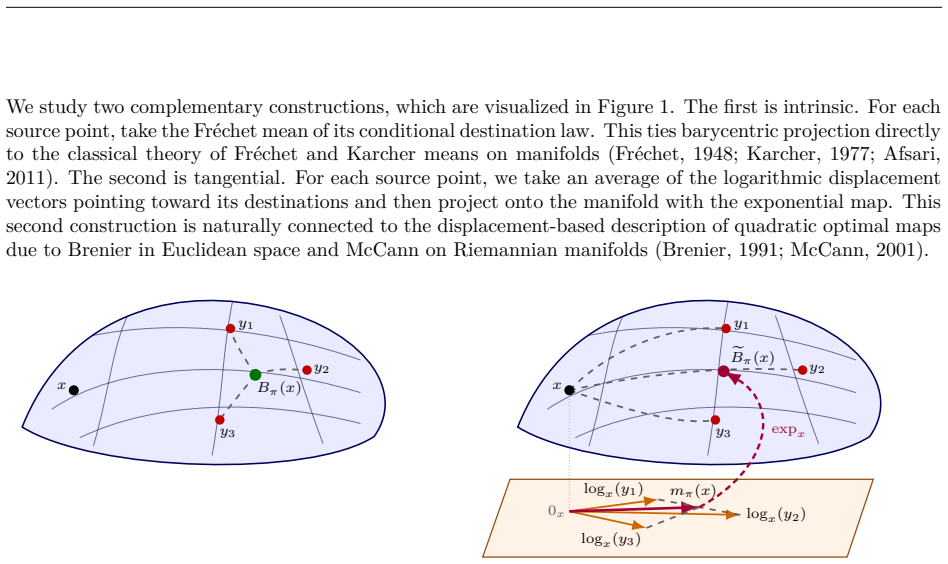
On Riemannian manifolds the intrinsic barycentric projection maps each source point to the conditional Fréchet mean of its destination law and minimizes squared geodesic loss.
A machine-rendered reading of the paper's core claim, the machinery that carries it, and where it could break.
Core claim
The intrinsic projection maps each source point to the conditional Fréchet mean of its destination law and is shown to be the best deterministic representative under squared geodesic loss. The corresponding minimum value is an integrated conditional Fréchet variance, which vanishes exactly for map-induced couplings and therefore defines a conditional-variance Monge defect. The tangential log-exp projection is Euclidean exact, compatible with Brenier-McCann maps, and equals the first unit Riemannian gradient step for the intrinsic objective. For discrete couplings both constructions decompose row-wise into weighted Fréchet mean and log-exp problems.
What carries the argument
The intrinsic projection, which replaces each conditional law by its Fréchet mean on the manifold.
If this is right
- Discrete couplings reduce row-wise to independent weighted Fréchet mean problems.
- The tangential projection recovers the exact Euclidean barycentric map and agrees with Brenier-McCann maps in the Monge case.
- The conditional Fréchet variance supplies a numerical diagnostic that is zero precisely when the coupling is deterministic.
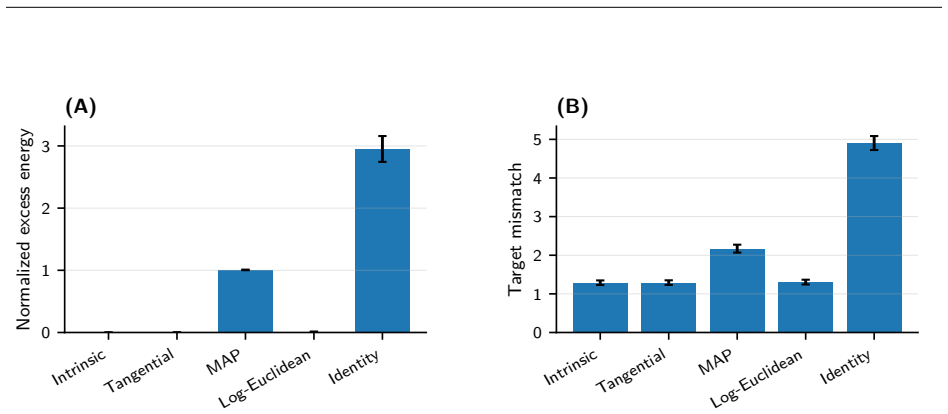
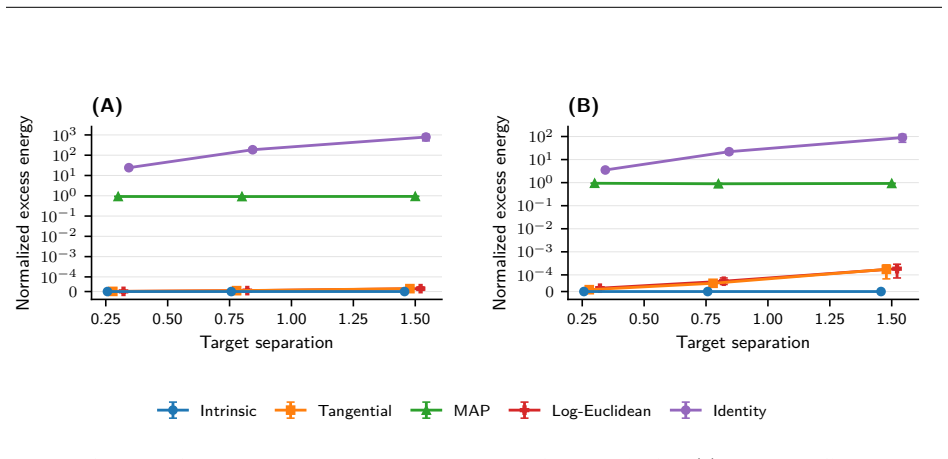
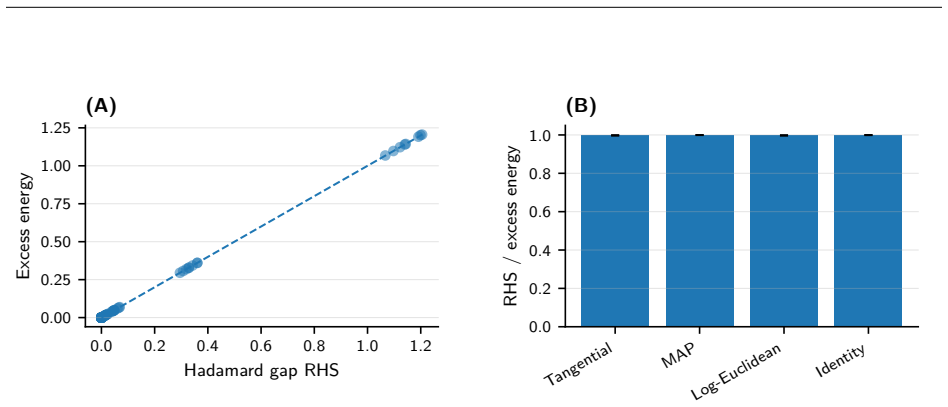
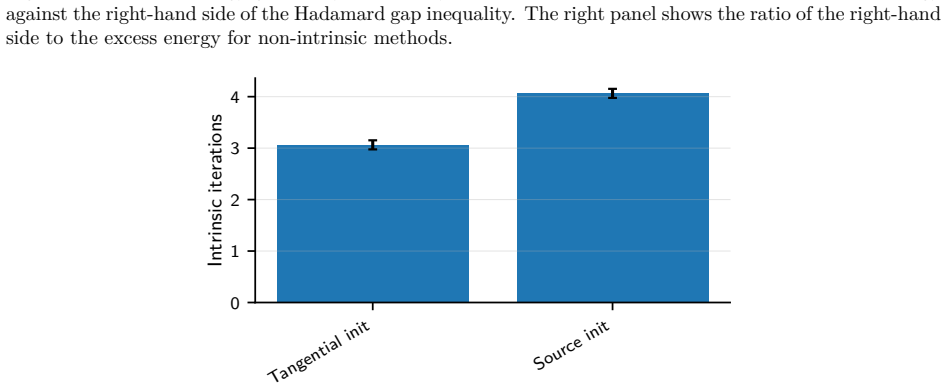
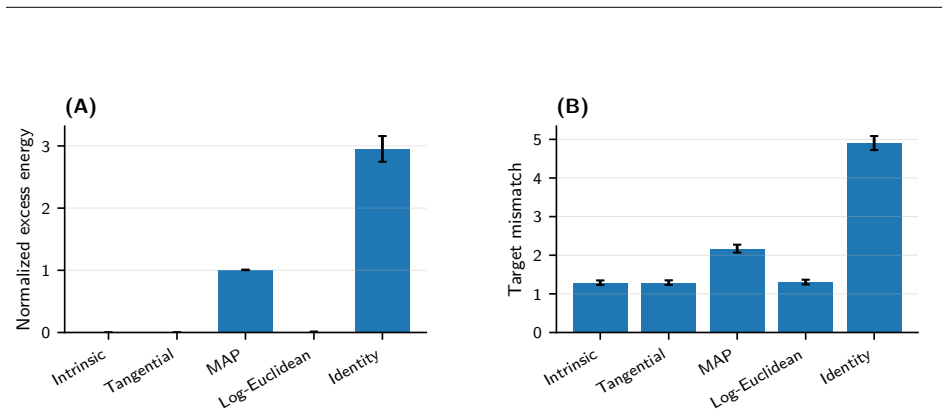
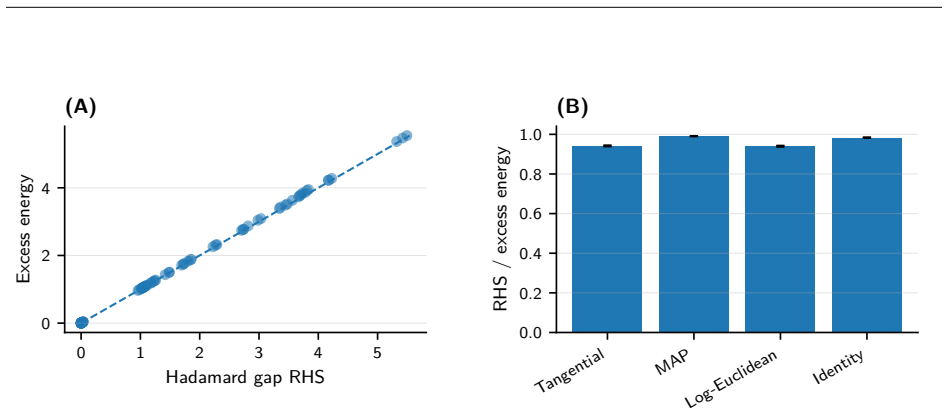
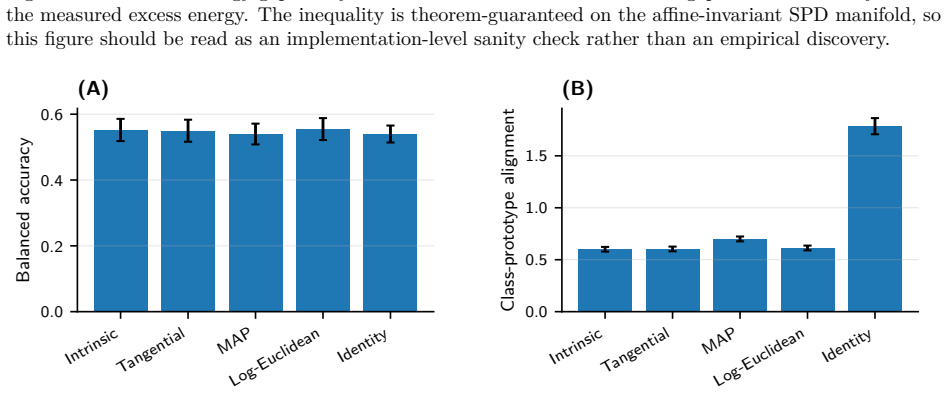
- Experiments on spherical data, SPD matrices and EEG covariances illustrate the distinct roles of the two projections.
Where Pith is reading between the lines
- The variance defect can be used as a stopping criterion or regularizer when learning transport maps on manifolds.
- The first-order gradient interpretation suggests iterative refinement schemes that stay on the manifold.
- The row-wise decomposition immediately yields scalable algorithms once a Fréchet-mean solver is available.
Load-bearing premise
Conditional destination laws on the manifold admit unique Fréchet means despite curvature and cut loci.
What would settle it
A concrete coupling on the sphere for which some other deterministic map achieves strictly smaller integrated squared geodesic distance than the map of conditional Fréchet means.
Figures
read the original abstract
Optimal transport couplings are probabilistic objects, while many learning pipelines require deterministic maps. In Euclidean space, barycentric projection converts a coupling into a map by taking conditional expectations, but on a Riemannian manifold curvature and cut loci make this operation nontrivial. We develop a framework for barycentric projections of transport couplings on Riemannian manifolds. The intrinsic projection maps each source point to the conditional Fr\'echet mean of its destination law and is shown to be the best deterministic representative under squared geodesic loss. The corresponding minimum value is an integrated conditional Fr\'echet variance, which vanishes exactly for map-induced couplings and therefore defines a conditional-variance Monge defect. We also study a tangential log-exp projection, prove its Euclidean exactness, its compatibility with Brenier-McCann maps in the Monge case, and its interpretation as the first unit Riemannian gradient update for the intrinsic objective. For discrete couplings, both constructions decompose row-wise into weighted Fr\'echet mean and log-exp problems. Experiments on spherical data, synthetic SPD data, and real EEG covariance matrices support the proposed division of roles: the intrinsic projection is the variational representative, while the tangential projection is a useful local displacement surrogate.
Editorial analysis
A structured set of objections, weighed in public.
Referee Report
Summary. The paper develops a framework for barycentric projections of optimal transport couplings on Riemannian manifolds. It defines an intrinsic projection that maps each source point to the conditional Fréchet mean of its destination law under the disintegration of the coupling, proves this is the minimizer of the expected squared geodesic distance to the destination, and shows that the resulting minimum value equals an integrated conditional Fréchet variance that vanishes precisely when the coupling is induced by a deterministic map (thereby defining a conditional-variance Monge defect). A tangential log-exp projection is also introduced and shown to be Euclidean-exact, compatible with Brenier-McCann maps, and interpretable as a first Riemannian gradient step; both projections admit row-wise decompositions for discrete couplings. Experiments on the sphere, synthetic SPD matrices, and real EEG covariances are presented to illustrate the constructions.
Significance. If the central claims hold, the work supplies a principled, loss-minimizing way to convert probabilistic OT plans into deterministic maps on manifolds, extending the Euclidean barycentric projection while introducing a new quantitative measure (the conditional Fréchet variance) of how far a coupling deviates from being Monge. This is directly relevant to manifold-valued learning pipelines that require maps rather than couplings. The decomposition into weighted Fréchet-mean and log-exp subproblems for discrete data is a practical strength.
major comments (2)
- [§3] §3 (definition of intrinsic projection): the construction assumes that the conditional Fréchet mean argmin_y ∫ d²(x,y) dπ(y|x) exists and is unique for π-almost every x. On manifolds with positive sectional curvature or nontrivial cut loci this argmin can be empty or set-valued for measures whose support is not contained in a strongly convex geodesic ball. The paper must state the precise geometric hypotheses (e.g., support restrictions or Hadamard assumption) under which the variational characterization and the vanishing property of the integrated conditional variance remain valid; without them the central claims are not meaningful for arbitrary couplings.
- [Experiments] Experiments section: the abstract and reader summary indicate that experiments on the sphere and SPD matrices are used to support the division of roles between intrinsic and tangential projections, yet no quantitative metrics, baselines, or error bars are supplied. Without these, it is impossible to verify whether the observed behavior is consistent with the claimed optimality or merely illustrative.
minor comments (2)
- Notation for the disintegration π(·|x) should be introduced explicitly before its first use in the definition of the intrinsic projection.
- The statement that the tangential projection is 'the first unit Riemannian gradient update' for the intrinsic objective would benefit from an explicit one-step calculation or reference to the Riemannian gradient of the squared geodesic loss.
Simulated Author's Rebuttal
We thank the referee for the careful reading and constructive suggestions. We address the two major comments below and will revise the manuscript accordingly to strengthen the geometric hypotheses and experimental validation.
read point-by-point responses
-
Referee: [§3] §3 (definition of intrinsic projection): the construction assumes that the conditional Fréchet mean argmin_y ∫ d²(x,y) dπ(y|x) exists and is unique for π-almost every x. On manifolds with positive sectional curvature or nontrivial cut loci this argmin can be empty or set-valued for measures whose support is not contained in a strongly convex geodesic ball. The paper must state the precise geometric hypotheses (e.g., support restrictions or Hadamard assumption) under which the variational characterization and the vanishing property of the integrated conditional variance remain valid; without them the central claims are not meaningful for arbitrary couplings.
Authors: We agree that the existence and uniqueness of the conditional Fréchet mean are not automatic on general Riemannian manifolds and require explicit hypotheses. In the revision we will add a dedicated paragraph in §3 stating the standing assumptions (e.g., the manifold is Hadamard, or the supports of the conditional measures π(·|x) lie inside a strongly convex geodesic ball of radius less than the injectivity radius). Under these conditions the variational characterization, the identification of the intrinsic projection as the minimizer of expected squared geodesic distance, and the vanishing of the integrated conditional Fréchet variance for Monge couplings all remain valid. We will also note that the results extend verbatim to the case of unique local minima when the support condition is satisfied locally. revision: yes
-
Referee: [Experiments] Experiments section: the abstract and reader summary indicate that experiments on the sphere and SPD matrices are used to support the division of roles between intrinsic and tangential projections, yet no quantitative metrics, baselines, or error bars are supplied. Without these, it is impossible to verify whether the observed behavior is consistent with the claimed optimality or merely illustrative.
Authors: The current experiments were intended as visual illustrations of the qualitative distinction between the two projections. We accept that quantitative support is needed. In the revised version we will augment the experimental section with (i) tabulated values of the integrated conditional Fréchet variance for both projections across the reported datasets, (ii) a simple baseline comparison (e.g., the identity map and a random selection from the support), and (iii) error bars obtained from repeated random subsampling of the discrete couplings. These additions will allow direct verification of the claimed optimality properties. revision: yes
Circularity Check
No significant circularity; derivation relies on standard definitions of Fréchet means
full rationale
The paper defines the intrinsic barycentric projection directly as the conditional Fréchet mean under squared geodesic distance and states its optimality property, which follows immediately from the definition of the Fréchet mean as the minimizer of expected squared distance; the integrated conditional variance vanishing on Monge couplings is likewise a direct consequence of the variance being zero for Dirac conditionals. No parameters are fitted and then relabeled as predictions, no self-citations are invoked as load-bearing uniqueness theorems, and no ansatz is smuggled via prior work. The framework is self-contained against the external benchmark of standard Riemannian geometry and optimal transport, yielding a score of 0.
Axiom & Free-Parameter Ledger
axioms (2)
- domain assumption Conditional laws on the manifold admit unique Fréchet means
- domain assumption The manifold supports geodesics and the exponential map outside cut loci
Reference graph
Works this paper leans on
-
[1]
doi: 10.1090/ S0002-9939-2010-10541-5
ISSN 0002-9939. doi: 10.1090/ S0002-9939-2010-10541-5. Yann Brenier. Polar factorization and monotone rearrangement of vector-valued functions.Communications on Pure and Applied Mathematics, 44(4):375–417, June
2010
-
[2]
ISSN 0010-3640, 1097-0312. doi: 10.1002/ cpa.3160440402. URLhttps://onlinelibrary.wiley.com/doi/10.1002/cpa.3160440402. Clemens Brunner, Robert Leeb, and Gernot Müller-Putz. BCI Competition 2008–Graz data set A,
-
[3]
ISSN 1053-587X, 1941-0476. doi: 10.1109/TSP.2010.2053029. URLhttp://ieeexplore.ieee.org/document/5484583/. chen_2010_ShrinkageAlgorithmsMMSE. Nicolas Courty, Rémi Flamary, Amaury Habrard, and Alain Rakotomamonjy. Joint distribution optimal transportation for domain adaptation. In I. Guyon, U. Von Luxburg, S. Bengio, H. Wallach, R. Fer- gus, S. Vishwanatha...
-
[4]
Maurice René Fréchet
URLhttps://proceedings.neurips.cc/paper/2017/file/ 0070d23b06b1486a538c0eaa45dd167a-Paper.pdf. Maurice René Fréchet. Les éléments aléatoires de nature quelconque dans un espace distancié.Annales de l’institut Henri Poincaré, 10(4):215–310,
2017
-
[5]
Vinay Jayaram and Alexandre Barachant. MOABB: trustworthy algorithm benchmarking for BCIs.Journal of Neural Engineering, 15(6):066011, December2018. ISSN1741-2560, 1741-2552. doi: 10.1088/1741-2552/ aadea0. L. Kantorovitch. On the Translocation of Masses.Management Science, 5(1):1–4, October
-
[6]
ISSN 0025-1909, 1526-5501. doi: 10.1287/mnsc.5.1.1. H. Karcher. Riemannian Center of Mass and Mollifier Smoothing.Communications on Pure and Applied Mathematics, 30(5):509–541, September
-
[7]
ISSN 0010-3640, 1097-0312. doi: 10.1002/cpa.3160300502. R.J. McCann. Polar factorization of maps on Riemannian manifolds:.Geometric and Functional Analysis, 11(3):589–608, August
-
[8]
ISSN 1016-443X. doi: 10.1007/PL00001679. Gaspard Monge.Mémoire sur la théorie des déblais et des remblais. De l’Imprimerie Royale,
-
[9]
doi: 10.1007/s10851-006-6228-4
ISSN 0924-9907, 1573-7683. doi: 10.1007/s10851-006-6228-4. Xavier Pennec, Pierre Fillard, and Nicholas Ayache. A Riemannian Framework for Tensor Computing. International Journal of Computer Vision, 66(1):41–66, January
-
[10]
doi: 10.1007/s11263-005-3222-z
ISSN 0920-5691, 1573-1405. doi: 10.1007/s11263-005-3222-z. URLhttp://link.springer.com/10.1007/s11263-005-3222-z. Michaël Perrot, Nicolas Courty, Rémi Flamary, and Amaury Habrard. Mapping estimation for discrete opti- mal transport. In D. Lee, M. Sugiyama, U. Luxburg, I. Guyon, and R. Garnett (eds.),Advances in Neural Information Processing Systems, volume
-
[11]
neurips.cc/paper_files/paper/2016/file/26f5bd4aa64fdadf96152ca6e6408068-Paper.pdf
URLhttps://proceedings. neurips.cc/paper_files/paper/2016/file/26f5bd4aa64fdadf96152ca6e6408068-Paper.pdf. Alexander Petersen and Hans-Georg Müller. Fréchet regression for random objects with Euclidean predictors. The Annals of Statistics, 47(2), April
2016
-
[12]
ISSN 0090-5364. doi: 10.1214/17-AOS1624. Gabriel Peyré and Marco Cuturi. Computational Optimal Transport: With Applications to Data Science. Foundations and Trends®in Machine Learning, 11(5-6):355–607,
-
[13]
ISSN 1935-8237, 1935-8245. doi: 10.1561/2200000073. Filippo Santambrogio.Optimal Transport for Applied Mathematicians: Calculus of Variations, PDEs, and Modeling, volume 87 ofProgress in Nonlinear Differential Equations and Their Applications. Springer International Publishing, Cham,
-
[14]
ISBN 978-0-8218-3383-4 978-0-8218- 7928-3. doi: 10.1090/conm/338/06080. URLhttp://www.ams.org/conm/338/. Michael Tangermann, Klaus-Robert Müller, Ad Aertsen, Niels Birbaumer, Christoph Braun, Clemens Brunner, Robert Leeb, Carsten Mehring, Kai J. Miller, Gernot R. Müller-Putz, Guido Nolte, Gert Pfurtscheller, Hubert Preissl, Gerwin Schalk, Alois Schlögl, C...
-
[15]
ISSN 1662-4548. doi: 10.3389/fnins.2012.00055. Cédric Villani.Optimal Transport: Old and New. Number 338 in Grundlehren der mathematischen Wis- senschaften. Springer, Berlin,
-
[16]
Strict convexity and uniqueness follow immediately
This gives the stated identity. Strict convexity and uniqueness follow immediately. A.12 Proof of Corollary 15 Proof.In Euclidean space,log x(y) =y−xandexpx(v) =x+v. Hence ˜Bπ(x) =x+ ∫ (y−x)dπ(y|x) = ∫ ydπ(y|x), which is the unique Euclidean minimizer ofz↦→1 2 ∫ ∥z−y∥2dπ(y|x). 24 A.13 Proof of Proposition 16 Proof.Ifπ= (id,T) #µ, thendπ(y|x) =δT(x) (dy)fo...
1977
discussion (0)
Sign in with ORCID, Apple, or X to comment. Anyone can read and Pith papers without signing in.