REVIEW 3 major objections 4 minor 75 references
Associated $Z^\prime$ production in the flavorful $U(1)$ scenario for $R_{K^{(*)}}$
T0 review · 3 major / 4 minor · reviewed 2026-08-14 · deepseek-v4-flash
Pith's one-line read The flavorful $Z'$ boson proposed to explain the $B$-meson anomalies would be discoverable at the 14 TeV proton-proton collider in the dimuon-plus-$b$-jet channel with 5-sigma significance for masses up to 500 GeV with 300 fb$^{-1}$ of…
desk verdict Solid Z' phenomenology with an internal tension: the 5-sigma b-channel projection is for parameter space already excluded by ATLAS dimuon data at 300-500 GeV. read the letter →
The pith
A machine-rendered reading of the paper's core claim, the machinery that carries it, and where it could break.
The reading
What carries the argument
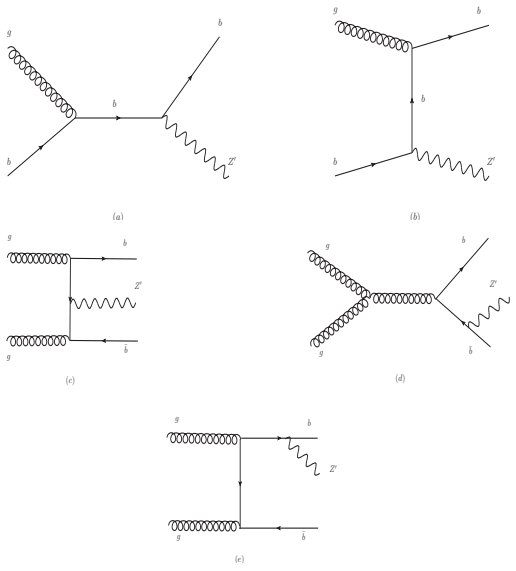
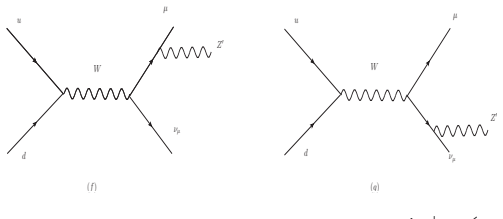
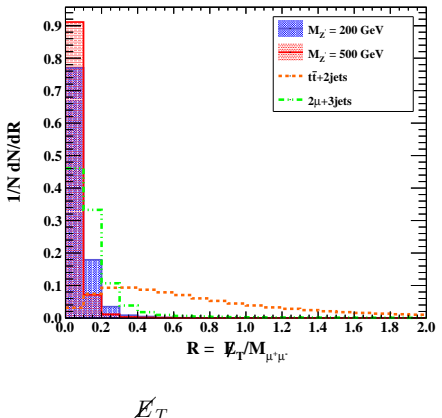
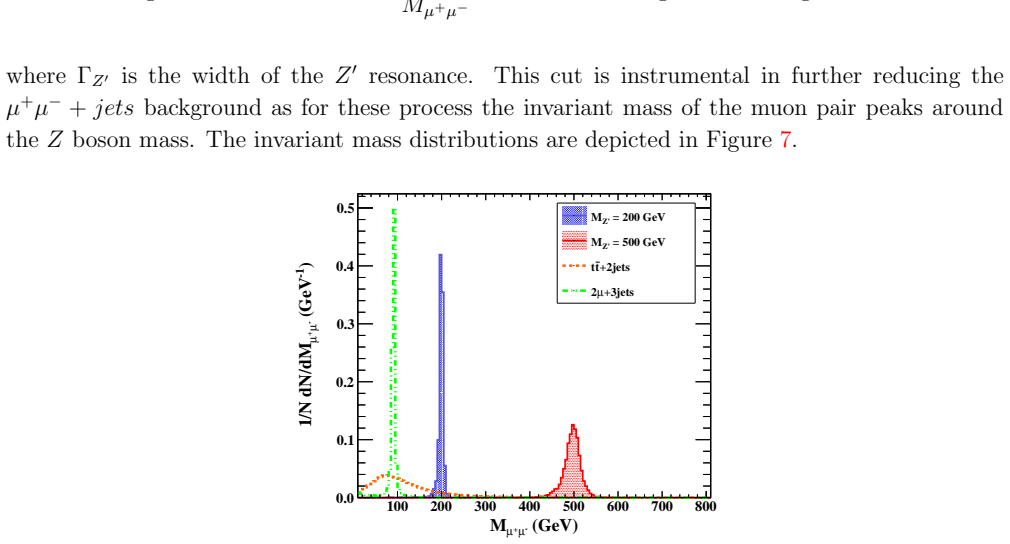
The load-bearing relation is the anti-correlation between the $Z'$ couplings to bottom quarks and muons: $g_{bb}g_{\mu\mu}/M_{Z'}^2 = 1/(6.9\,\mathrm{TeV})^2$ at 68% CL from the fit to $b\to s\mu^+\mu^-$ data, together with the neutrino-trident bound $g_{\mu\mu}^2/M_{Z'}^2 \lesssim 1/(330\,\mathrm{GeV})^2$ and the quark-mixing comparison bound $g_{bb}^2/M_{Z'}^2 \lesssim 1/(11.5\,\mathrm{TeV})^2$; these leave a narrow window of allowed couplings for each mass. The collider mechanism is associated production: a $b$-quark line radiates the $Z'$, which decays to $\mu^+\mu^-$, producing the distinctive $\mu^+\mu^- + b$-jet final state; alternatively the $Z'$ is radiated from a muon or neutrino in $W$-boson production, giving $3\mu+\not{E}_T$. The discriminating variables are the high-transverse-momentum muons, the small ratio $R=\not{E}_T/M_{\mu^+\mu^-}$ (which separates the signal from top-pair backgrounds), and the dimuon invariant-mass window $|M_{\mu^+\mu^-}-M_{Z'}|<6\Gamma_{Z'}$.
What would settle it
The decisive test is a direct search in the $\mu^+\mu^-+b$-jet channel at 14 TeV with 300 fb$^{-1}$: with the benchmark couplings $g_{\mu\mu}=0.20$, $g_{bb}=4.2\times10^{-3}$, $M_{Z'}=200$ GeV, the paper reports 0.92 fb of signal and 6.27 fb of background after all selection cuts (before $k$-factors), corresponding to $S=8.35$ at 300 fb$^{-1}$; observing no resonance-like excess in that final state with this sensitivity would refute the central claim. More broadly, the complete absence of a dimuon resonance below about 500 GeV in the full high-luminosity 14 TeV dataset would falsify the model's anomaly-favored parameter space.
Extended reading notes
Core claim
The central claim is that the flavorful $Z'$ model proposed to explain $R_{K^{(*)}}$ predicts a collider signature with discovery-level significance in the near term. In this model the $Z'$ couples to left-handed $b$ quarks, $s$ quarks, and muons, with $g_{bs}=V_{ts}g_{bb}$; the product $g_{bb}g_{\mu\mu}/M_{Z'}^2$ is fixed by the best-fit new-physics contribution $C_9^\mu=-C_{10}^\mu=-0.53\pm 0.09$, while $g_{\mu\mu}^2/M_{Z'}^2$ and $g_{bb}^2/M_{Z'}^2$ are bounded by neutrino trident production and by comparing $B_s$ mixing with $B\to D^*\ell\nu$ decays. Within this allowed region, the process $pp\to Z'+1b(2b)\to\mu^+\mu^-+1b(2b)$, with cuts on muon transverse momenta, on $R=\not{E}_T/M_{\mu^+\mu^-}<0.2$, and on the dimuon invariant mass around the $Z'$ resonance, yields significances exceeding $5\sigma$ for $M_{Z'}\lesssim 500$ GeV at 300 fb$^{-1}$ and $3\sigma$ sensitivity up to about 1 TeV. The complementary $3\mu+\not{E}_T$ channel, governed solely by $g_{\mu\mu}$, reaches $5\sigma$ only at 3000 fb$^{-1}$ for $M_{Z'}=200$ GeV. Together the two channels cover the low-energy-favored parameter space for $200\lesssim M_{Z'}\lesssim 500$ GeV, and the paper shows that existing dimuon resonance limits already exclude part of that space, with the new channels offering comparable and complementary coverage.
Load-bearing premise
The projected discovery reach rests on the assumption that the $B$-meson anomalies are genuinely caused by this $Z'$ with the coupling pattern used here, in particular that the product of its couplings to $b$ quarks and muons divided by its mass squared equals the 2019 best-fit value; if the anomalies have a different origin, the benchmark couplings and all projected significances change.
Editorial extensions
If this is right
- With 300 fb$^{-1}$ at 14 TeV, the $\mu^+\mu^-+b$-jet channel is projected to give a $5\sigma$ detection for $M_{Z'}\lesssim 500$ GeV at the couplings preferred by low-energy data.
- The same channel gives $3\sigma$ sensitivity up to about $M_{Z'}=1$ TeV with 300 fb$^{-1}$, so the absence of a signal there would exclude a large part of the anomaly-favored parameter space.
- The $\mu^+\mu^-+b$-jet channel and generic dimuon resonance searches cover overlapping parameter regions, so observing both would be strong evidence for the flavorful-$Z'$ interpretation rather than for a generic dilepton resonance.
- The $3\mu+\not{E}_T$ channel probes the complementary large-$g_{\mu\mu}$ region and, combined with the other searches, could exclude essentially all of the low-energy-favored parameter space for $M_{Z'}\lesssim 500$ GeV.
- Heavier $Z'$ bosons with $M_{Z'}\gtrsim 1$ TeV would likely remain out of reach at the high-luminosity 14 TeV collider in the parameter region preferred by the $B$-meson anomalies.
Reading between the lines
- A testable extension is to use the same $\mu^+\mu^-+b$-jet selection to distinguish the flavorful $Z'$ from other $Z'$ models, since the presence of associated bottom quarks directly tags the $b$-quark coupling that the anomaly fit requires.
- Because the model also couples to the left-handed top-bottom doublet, the analysis could be extended to $Z'$ production off top quarks, which would give a $\mu^+\mu^- + t\bar{t}$-like signature and could extend the mass reach beyond the $b$-jet channel.
- If a future global fit shifts the central value of $C_9^\mu=-C_{10}^\mu$, the benchmark couplings and therefore the projected significances would rescale roughly as the shift in the product $g_{bb}g_{\mu\mu}$; the same collider cuts would remain the appropriate test.
Editorial analysis
A structured set of objections, weighed in public.
Referee Report
Summary. The paper studies LHC signatures of a flavorful Z′ model proposed to address the R_K and R_K* anomalies, with couplings g_bb to left-handed third-generation quarks, g_μμ to left-handed muons, and g_bs = V_ts g_bb. Equation (2.2) fixes the product g_bb g_μμ / M_Z′^2 from the global b→s μμ fit, while neutrino trident and Δm_Bs/CKM constraints leave finite coupling intervals. Using MadGraph5, Pythia 8, and Delphes 3 with LO parton-level events and k-factors, the authors analyze pp→Z′+1b(2b)→μ+μ−+1b(2b) and pp→Z′μ±+MET→3μ+MET, reporting projected significances. They find that a 5σ discovery is possible in the first channel for M_Z′ ≲ 500 GeV at 300 fb−1 and 14 TeV in the parameter region preferred by the anomalies. Section 4 then compares with the ATLAS 139 fb−1 dimuon resonance search and states that for M_Z′ = 300 and 500 GeV the region preferred by the global fit is excluded by the LHC, leaving only a 2σ-allowed chunk of parameter space.
Significance. The study provides a transparent cut-flow analysis, explicit benchmark points, and a useful demonstration that the associated-production channels 2μ+b and 3μ+MET probe complementary coupling regions. The authors are also candid in Section 4 about the tension with current dimuon searches. However, the headline discovery claim is internally inconsistent with that candor: the 5σ curves and benchmarks are computed without imposing the ATLAS dimuon exclusion that the paper itself identifies. If the analysis is revised to present the projection in the currently surviving parameter space, the paper would be a valuable sensitivity study for HL-LHC; as written, the abstract and Section 3.1 overstate the discovery potential. The central methodology is defensible but the main claim needs substantial revision.
major comments (3)
- [Abstract; Section 3.1, Eq. (3.4); Section 4, Fig. 13] The abstract and Section 3.1 claim 5σ discovery in the parameter space "preferred by the b→s μμ anomalies and allowed by low-energy constraints," with benchmarks in Eq. (3.4) lying on the central hyperbola of Eq. (2.2). However, Section 4 (Fig. 13) states explicitly that for M_Z′ = 300 and 500 GeV the region preferred by the global fit is excluded at 95% CL by the ATLAS 139 fb−1 dimuon search. Because the significance curves in Fig. 8 are computed with g_bb fixed by Eq. (2.2) along this same band, the discovery claim is made in parameter space that the paper itself shows is excluded. Please recompute the discovery projections with the current dimuon limit imposed, report the significance only in the surviving 2σ-allowed region, and restate the abstract and Section 5 accordingly. If the projection is meant to be hypothetical (i.e., in the absence of current limits), that must be stated clearly and the claim "consistent with all other experimental constraints" must be removed.
- [Section 3.1, Eq. (3.3); Tables 2 and 3; Figures 8 and 12] The main significances use the purely statistical formula in Eq. (3.3) and the cut-flow tables list no systematic uncertainties. The dashed curves in Figures 8 and 12 are described only as "including systematics ∼10% in the background estimates," but the text does not explain how the 10% is propagated into the significance or which backgrounds it applies to. Since the paper's central claim is a 5σ discovery, please provide systematics-inclusive significances for at least the benchmark points in Eq. (3.4) and describe the procedure used to obtain the dashed bands.
- [Section 3.1 and Section 3.2, k-factors] All signal and background samples are generated at leading order and the NLO corrections are approximated by k-factors taken from other processes, with no uncertainty assigned. In particular, the 1.25 signal k-factor for the 3μ+MET channel is cited to Ref. [70], which reports an ATLAS search for doubly-charged Higgs bosons and does not appear to contain a k-factor for pp→Z′μν. Please justify each k-factor choice for the specific process, or provide a scale/PDF uncertainty estimate, because the projected significances in Eqs. (3.4) and (3.8) depend directly on these factors.
minor comments (4)
- [Section 3.1, page 10] The sentence "the discovery potential in this final state is more more pronounced for lower g_μμ" contains a duplicated word "more" and should be corrected.
- [Section 3.2, Table 3 caption] The caption reads "after each cut described in the next" and is incomplete; it should say "in the text" or refer to the specific paragraphs describing the cuts.
- [Section 3.2, Eq. (3.6)] The invariant-mass veto M_OSD < 75 GeV or M_OSD > 105 GeV is stated without mentioning how events with M_OSD near the Z′ mass are treated when M_Z′ is close to the Z mass; the assumption M_Z′ > M_Z is made in the text but should be stated explicitly at the point where the cut is introduced.
- [Section 4, Fig. 13] The figure would be easier to interpret if the 2σ-allowed chunk mentioned in the text were explicitly shaded or outlined in the (g_μμ, M_Z′) plane, since the subsequent discussion of future LHC runs relies on the location of this surviving region.
Circularity Check
No significant circularity: the LHC reach is a Monte Carlo projection evaluated at couplings imported from external low-energy fits, not a fit relabeled as a prediction.
full rationale
The derivation chain starts from the flavorful Z' Lagrangian (Eq. 2.1), adopted from Ref. [37], with g_bb and g_mumu constrained by the external b->s mu mu global fit (Eq. 2.2, Ref. [5]), the neutrino-trident bound (Eq. 2.3), and the CKM-consistency analysis of Ref. [53] (Eq. 2.4). These are imported inputs, not results derived in this paper. The collider analysis computes signal and background cross sections with MadGraph/PYTHIA/Delphes and evaluates significances via Eq. (3.3); the benchmark couplings in Eq. (3.4) are chosen on the central-fit hyperbola of Eq. (2.2). No fitted low-energy parameter is renamed as a collider prediction; the significances are genuine Monte Carlo outputs conditional on those couplings. The authors' self-citations (Refs. [37], [51], [53]) are not load-bearing in a circular sense: they are published, empirically anchored analyses that define the adopted model and constraints, and no uniqueness claim from the authors is invoked to exclude alternatives. The paper itself flags the main external limitation in Section 4, noting that 'the region preferred by the global fit to low-energy data is excluded by the LHC' for M=300-500 GeV; this is a consistency check against ATLAS dimuon data, not a circular step. While this exclusion undercuts the central-fit benchmarks in Eq. (3.4), it does not make the derivation equivalent to its inputs. The reach projections and the exclusion are both functions of the same imported couplings, but that is a conditional sensitivity statement rather than circularity.
Assumptions & free parameters
free parameters (3)
- g_mu_mu (Z' coupling to left-handed muons) =
Table 1 ranges: 0.040-0.61 for M_Z'=200 GeV up to 0.20-3.0 for M_Z'=1000 GeV
- g_bb (Z' coupling to left-handed b/t doublet) =
Fixed via Eq. (2.2) to the central anomaly-fit value; 99% CL ranges 0.0016-0.017 (200 GeV) to 0.0080-0.087 (1000 GeV)
- M_Z' (Z' mass) =
Benchmarks: 200, 300, 500, 750, 1000 GeV
assumptions (5)
- domain assumption The flavorful Z' Lagrangian of Eq. (2.1) with couplings only to q_L=(t_L,b_L) and L_L=(nu_mu,mu_L), and no other BSM states at LHC energies.
- domain assumption g_bs = |V_ts| g_bb and sign(g_bb)=sign(g_mu_mu), with |V_ts| ~ 0.04.
- domain assumption The global fit C9_mu = -C10_mu = -0.53 +/- 0.09 maps to Eq. (2.2): g_bb g_mu_mu / M_Z'^2 = 1.00 +/- 0.17 / (6.9 TeV)^2.
- domain assumption The trident and Delta m_Bs constraints of Eqs. (2.3)-(2.4), including the CKM-comparison analysis of Ref. [53], correctly characterize the low-energy bounds.
- standard math The simulation chain (NNPDF23LO1 PDFs, Pythia8, Delphes3, CMS b-tag functions) approximates the LHC detector response and background rates.
invented entities (1)
-
Z' boson
independent evidence
Cite this review
Pith. "Pith review of Associated $Z^\prime$ production in the flavorful $U(1)$ scenario for $R_{K^{(*)}}$." pith.science (2026). https://pith.science/paper/LGL24755
@misc{pith2026190803031,
  author       = {Pith},
  title        = {Pith review of: Associated $Z^\prime$ production in the flavorful $U(1)$ scenario for $R_K^(*)$},
  year         = {2026},
  howpublished = {\url{https://pith.science/paper/LGL24755}},
  note         = {Machine review of arXiv:1908.03031}
}
abstract
The flavorful $Z^\prime$ model with its couplings restricted to the left-handed second generation leptons and third generation quarks can potentially resolve the observed anomalies in $R_K$ and $R_{K^*}$. After examining the current limits on this model from various low-energy processes, we probe this scenario at 14 TeV high-luminosity run of the LHC using two complementary channels: one governed by the coupling of $Z'$ to $b$-quarks and the other to muons. We also discuss the implications of the latest LHC high mass resonance searches in the dimuon channel on the model parameter space of our interest.
Figures

Figures from the paper (10 more)






Reference graph
Works this paper leans on
-
[70]
ATLAS Collaboration, T. A. collaboration, Search for doubly-charged Higgs bosons in same-charge electron pair final states using proton-proton collisions at √s = 13 TeV with the ATLAS detector, ATLAS-CONF-2016-051,
work page 2016
-
[1]
Aaij et al., Search for lepton-universality violation in B+→K+𝓁+𝓁− decays, Phys
LHCb Collaboration, R. Aaij et al., Search for lepton-universality violation in B+→K+𝓁+𝓁− decays, Phys. Rev. Lett. 122 (2019), no. 19 191801, [ arXiv:1903.09252]
arXiv 2019
-
[2]
LHCb Collaboration, R. Aaij et al., Test of lepton universality with B0→K∗0𝓁+𝓁− decays, JHEP 08 (2017) 055, [ arXiv:1705.05802]
arXiv 2017
-
[3]
M. Alguer´ o, B. Capdevila, A. Crivellin, S. Descotes-Genon, P. Masjuan, J. Matias, and J. Virto, Addendum: ”Patterns of New Physics in b→s𝓁+𝓁− transitions in the light of recent data” and ”Are we overlooking Lepton Flavour Universal New Physics in b→s𝓁𝓁 ?”, arXiv:1903.09578
arXiv 1903
-
[4]
M. Ciuchini, A. M. Coutinho, M. Fedele, E. Franco, A. Paul, L. Silvestrini, and M. Valli, New Physics in b→s𝓁+𝓁− confronts new data on Lepton Universality , arXiv:1903.09632
arXiv 1903
-
[5]
J. Aebischer, W. Altmannshofer, D. Guadagnoli, M. Reboud, P. Stangl, and D. M. Straub, B-decay discrepancies after Moriond 2019 , arXiv:1903.10434
arXiv 2019
-
[6]
K. Kowalska, D. Kumar, and E. M. Sessolo, Implications for New Physics in b→sµµ transitions after recent measurements by Belle and LHCb , arXiv:1903.10932
arXiv 1903
- [7]
Show all 75 references
-
[8]
Gauld, F
R. Gauld, F. Goertz, and U. Haisch, On minimal Z′ explanations of the B→K∗µ+µ− anomaly, Phys. Rev. D89 (2014) 015005, [ arXiv:1308.1959]
2014 arXiv
-
[9]
A. J. Buras and J. Girrbach, Left-handedZ′ and Z FCNC quark couplings facing new b→sµ+µ− data, JHEP 12 (2013) 009, [ arXiv:1309.2466]
2013 arXiv
-
[10]
Altmannshofer, S
W. Altmannshofer, S. Gori, M. Pospelov, and I. Yavin, Quark flavor transitions in Lµ−Lτ models, Phys. Rev. D89 (2014) 095033, [ arXiv:1403.1269]
2014 arXiv
-
[11]
Crivellin, G
A. Crivellin, G. D’Ambrosio, and J. Heeck, Explaining h→µ±τ∓, B→K∗µ+µ− and B→Kµ+µ−/B→Ke+e− in a two-Higgs-doublet model with gauged Lµ−Lτ, Phys. Rev. Lett. 114 (2015) 151801, [ arXiv:1501.00993]
2015 arXiv
-
[12]
Crivellin, G
A. Crivellin, G. D’Ambrosio, and J. Heeck, Addressing the LHC flavor anomalies with horizontal gauge symmetries , Phys. Rev. D91 (2015), no. 7 075006, [ arXiv:1503.03477]. 18
2015 arXiv
-
[13]
Niehoff, P
C. Niehoff, P. Stangl, and D. M. Straub, Violation of lepton flavour universality in composite Higgs models, Phys. Lett. B747 (2015) 182–186, [ arXiv:1503.03865]
2015 arXiv
-
[14]
Celis, J
A. Celis, J. Fuentes-Martin, M. Jung, and H. Serodio, Family nonuniversal Z′ models with protected flavor-changing interactions, Phys. Rev. D92 (2015), no. 1 015007, [arXiv:1505.03079]
2015 arXiv
-
[15]
Greljo, G
A. Greljo, G. Isidori, and D. Marzocca, On the breaking of Lepton Flavor Universality in B decays, JHEP 07 (2015) 142, [ arXiv:1506.01705]
2015 arXiv
-
[16]
Niehoff, P
C. Niehoff, P. Stangl, and D. M. Straub, Direct and indirect signals of natural composite Higgs models, JHEP 01 (2016) 119, [ arXiv:1508.00569]
2016 arXiv
-
[17]
Altmannshofer and I
W. Altmannshofer and I. Yavin, Predictions for lepton flavor universality violation in rare B decays in models with gauged Lµ−Lτ, Phys. Rev. D92 (2015), no. 7 075022, [arXiv:1508.07009]
2015 arXiv
-
[18]
Falkowski, M
A. Falkowski, M. Nardecchia, and R. Ziegler, Lepton Flavor Non-Universality in B-meson Decays from a U(2) Flavor Model , JHEP 11 (2015) 173, [ arXiv:1509.01249]
2015 arXiv
-
[19]
Carmona and F
A. Carmona and F. Goertz, Lepton Flavor and Nonuniversality from Minimal Composite Higgs Setups, Phys. Rev. Lett. 116 (2016), no. 25 251801, [ arXiv:1510.07658]
2016 arXiv
-
[20]
Garcia Garcia, LHCb anomalies from a natural perspective , JHEP 03 (2017) 040, [arXiv:1611.03507]
I. Garcia Garcia, LHCb anomalies from a natural perspective , JHEP 03 (2017) 040, [arXiv:1611.03507]
2017 arXiv
-
[21]
Megias, G
E. Megias, G. Panico, O. Pujolas, and M. Quiros, A Natural origin for the LHCb anomalies , JHEP 09 (2016) 118, [ arXiv:1608.02362]
2016 arXiv
-
[22]
Chiang, X.-G
C.-W. Chiang, X.-G. He, and G. Valencia, Z′ model for b→s𝓁𝓁 flavor anomalies, Phys. Rev. D93 (2016), no. 7 074003, [ arXiv:1601.07328]
2016 arXiv
-
[23]
Altmannshofer, M
W. Altmannshofer, M. Carena, and A. Crivellin, Lµ−Lτ theory of Higgs flavor violation and (g− 2)µ, Phys. Rev. D94 (2016), no. 9 095026, [ arXiv:1604.08221]
2016 arXiv
-
[24]
S. M. Boucenna, A. Celis, J. Fuentes-Martin, A. Vicente, and J. Virto, Phenomenology of an SU (2)×SU (2)×U(1) model with lepton-flavour non-universality , JHEP 12 (2016) 059, [arXiv:1608.01349]
2016 arXiv
-
[25]
Foldenauer and J
P. Foldenauer and J. Jaeckel, Purely flavor-changing Z’ bosons and where they might hide , JHEP 05 (2017) 010, [ arXiv:1612.07789]
2017 arXiv
-
[26]
J. F. Kamenik, Y. Soreq, and J. Zupan, Lepton flavor universality violation without new sources of quark flavor violation , Phys. Rev. D97 (2018), no. 3 035002, [ arXiv:1704.06005]. 19
2018 arXiv
-
[27]
R. S. Chivukula, J. Isaacson, K. A. Mohan, D. Sengupta, and E. H. Simmons, RK anomalies and simplified limits on Z′ models at the LHC , Phys. Rev. D96 (2017), no. 7 075012, [arXiv:1706.06575]
2017 arXiv
-
[28]
Faisel and J
G. Faisel and J. Tandean, Connectingb→s𝓁𝓁 anomalies to enhanced rare nonleptonic B 0 s decays in Z′ model, JHEP 02 (2018) 074, [ arXiv:1710.11102]
2018 arXiv
-
[29]
Ellis, M
J. Ellis, M. Fairbairn, and P. Tunney, Anomaly-Free Models for Flavour Anomalies, arXiv:1705.03447
-
[30]
Alonso, P
R. Alonso, P. Cox, C. Han, and T. T. Yanagida, FlavouredB−L local symmetry and anomalous rare B decays, Phys. Lett. B774 (2017) 643–648, [ arXiv:1705.03858]
2017 arXiv
-
[31]
Carmona and F
A. Carmona and F. Goertz, Recent B Physics Anomalies - a First Hint for Compositeness? , arXiv:1712.02536
-
[32]
Abdullah, M
M. Abdullah, M. Dalchenko, B. Dutta, R. Eusebi, P. Huang, T. Kamon, D. Rathjens, and A. Thompson, Bottom-quark fusion processes at the LHC for probing Z′ models and B-meson decay anomalies, Phys. Rev. D97 (2018), no. 7 075035, [ arXiv:1707.07016]
2018 arXiv
-
[33]
Raby and A
S. Raby and A. Trautner, A ”Vector-like chiral” fourth family to explain muon anomalies , arXiv:1712.09360
-
[34]
Bian, S.-M
L. Bian, S.-M. Choi, Y.-J. Kang, and H. M. Lee, A minimal flavored U(1)′ for B-meson anomalies, Phys. Rev. D96 (2017), no. 7 075038, [ arXiv:1707.04811]
2017 arXiv
-
[35]
L. Bian, H. M. Lee, and C. B. Park, B-meson anomalies and Higgs physics in flavored U(1)′ model, arXiv:1711.08930
-
[36]
A. K. Alok, B. Bhattacharya, D. Kumar, J. Kumar, D. London, and S. U. Sankar, New physics in b→sµ+µ−: Distinguishing models through CP-violating effects , Phys. Rev. D96 (2017), no. 1 015034, [ arXiv:1703.09247]
2017 arXiv
-
[37]
Falkowski, S
A. Falkowski, S. F. King, E. Perdomo, and M. Pierre, Flavourful Z′ portal for vector-like neutrino Dark Matter and RK(∗), JHEP 08 (2018) 061, [ arXiv:1803.04430]
2018 arXiv
-
[38]
Kohda, T
M. Kohda, T. Modak, and A. Soffer, Identifying a Z′ behindb→s𝓁𝓁 anomalies at the LHC , Phys. Rev. D97 (2018), no. 11 115019, [ arXiv:1803.07492]
2018 arXiv
-
[39]
P. J. Fox, I. Low, and Y. Zhang, Top-philicZ′ Forces at the LHC, arXiv:1801.03505
-
[40]
Chala and M
M. Chala and M. Spannowsky, On the behaviour of composite resonances breaking lepton flavour universality, arXiv:1803.02364
-
[41]
Darm´ e, K
L. Darm´ e, K. Kowalska, L. Roszkowski, and E. M. Sessolo,Flavor anomalies and dark matter in SUSY with an extra U(1) , JHEP 10 (2018) 052, [ arXiv:1806.06036]. 20
2018 arXiv
-
[42]
B. C. Allanach, T. Corbett, M. J. Dolan, and T. You, Hadron collider sensitivity to fat flavourful Z’ for RK(∗), JHEP 03 (2019) 137, [ arXiv:1810.02166]
2019 arXiv
-
[43]
P. Ko, T. Nomura, and C. Yu, b→sµ+µ− anomalies and related phenomenology in U(1)B3−xµLµ−xτLτ flavor gauge models , JHEP 04 (2019) 102, [ arXiv:1902.06107]
2019 arXiv
-
[44]
Biswas and A
A. Biswas and A. Shaw, Reconciling dark matter, RK(∗) anomalies and (g− 2)µ in an Lµ−Lτ scenario, JHEP 05 (2019) 165, [ arXiv:1903.08745]
2019 arXiv
-
[45]
B. C. Allanach, J. M. Butterworth, and T. Corbett, Collider Constraints on Z′ Models for Neutral Current B−Anomalies, arXiv:1904.10954
1904 arXiv
-
[46]
A. K. Alok, A. Dighe, S. Gangal, and D. Kumar, Continuing search for new physics in b→sµµ decays: two operators at a time , JHEP 06 (2019) 089, [ arXiv:1903.09617]
2019 arXiv
-
[47]
Kawamura, S
J. Kawamura, S. Raby, and A. Trautner, Complete Vector-like Fourth Family and new U(1)′ for Muon Anomalies , arXiv:1906.11297
1906 arXiv
-
[48]
Geiregat et al., First observation of neutrino trident production, Phys
CHARM-II Collaboration, D. Geiregat et al., First observation of neutrino trident production, Phys. Lett. B245 (1990) 271–275
1990
-
[49]
CCFR Collaboration, S. R. Mishra et al., Neutrino tridents and W Z interference , Phys. Rev. Lett. 66 (1991) 3117–3120
1991
-
[50]
Altmannshofer, S
W. Altmannshofer, S. Gori, M. Pospelov, and I. Yavin, Neutrino Trident Production: A Powerful Probe of New Physics with Neutrino Beams , Phys. Rev. Lett. 113 (2014) 091801, [arXiv:1406.2332]
2014 arXiv
-
[51]
Falkowski, M
A. Falkowski, M. Gonz´ alez-Alonso, and K. Mimouni,Compilation of low-energy constraints on 4-fermion operators in the SMEFT , JHEP 08 (2017) 123, [ arXiv:1706.03783]
2017 arXiv
-
[52]
Charles, A
CKMfitter Group Collaboration, J. Charles, A. Hocker, H. Lacker, S. Laplace, F. R. Le Diberder, J. Malcles, J. Ocariz, M. Pivk, and L. Roos, CP violation and the CKM matrix: Assessing the impact of the asymmetric B factories, Eur. Phys. J. C41 (2005), no. 1 1–131, [hep-ph/0406184]
2005 arXiv
-
[53]
Descotes-Genon, A
S. Descotes-Genon, A. Falkowski, M. Fedele, M. Gonz´ alez-Alonso, and J. Virto, The CKM parameters in the SMEFT , JHEP 05 (2019) 172, [ arXiv:1812.08163]
2019 arXiv
-
[54]
Altmannshofer, S
W. Altmannshofer, S. Gori, S. Profumo, and F. S. Queiroz, Explaining dark matter and B decay anomalies with an Lµ−Lτ model, JHEP 12 (2016) 106, [ arXiv:1609.04026]
2016 arXiv
-
[55]
Alloul, N
A. Alloul, N. D. Christensen, C. Degrande, C. Duhr, and B. Fuks, FeynRules 2.0 - A complete toolbox for tree-level phenomenology, Comput. Phys. Commun. 185 (2014) 2250–2300, [arXiv:1310.1921]. 21
2014 arXiv
-
[56]
Alwall, R
J. Alwall, R. Frederix, S. Frixione, V. Hirschi, F. Maltoni, O. Mattelaer, H. S. Shao, T. Stelzer, P. Torrielli, and M. Zaro, The automated computation of tree-level and next-to-leading order differential cross sections, and their matching to parton shower simulations, JHEP 07 ...
2014 arXiv
-
[57]
NNPDF Collaboration, R. D. Ball et al., Parton distributions for the LHC Run II , JHEP 04 (2015) 040, [ arXiv:1410.8849]
2015 arXiv
-
[58]
Sjostrand, S
T. Sjostrand, S. Ask, J. R. Christiansen, R. Corke, N. Desai, P. Ilten, S. Mrenna, S. Prestel, C. O. Rasmussen, and P. Z. Skands, An Introduction to PYTHIA 8.2 , Comput. Phys. Commun. 191 (2015) 159–177, [ arXiv:1410.3012]
2015 arXiv
-
[59]
de Favereau, C
DELPHES 3 Collaboration, J. de Favereau, C. Delaere, P. Demin, A. Giammanco, V. Lema ˜A R©tre, A. Mertens, and M. Selvaggi, DELPHES 3, A modular framework for fast simulation of a generic collider experiment , JHEP 02 (2014) 057, [ arXiv:1307.6346]
2014 arXiv
-
[60]
Cacciari, G
M. Cacciari, G. P. Salam, and G. Soyez, The anti-kt jet clustering algorithm , JHEP 04 (2008) 063, [ arXiv:0802.1189]
2008 arXiv
-
[61]
M. L. Mangano, M. Moretti, F. Piccinini, and M. Treccani, Matching matrix elements and shower evolution for top-quark production in hadronic collisions , JHEP 01 (2007) 013, [hep-ph/0611129]
2007 arXiv
-
[62]
Hoeche, F
S. Hoeche, F. Krauss, N. Lavesson, L. Lonnblad, M. Mangano, A. Schalicke, and S. Schumann, Matching parton showers and matrix elements , in HERA and the LHC: A Workshop on the implications of HERA for LHC physics: Proceedings Part A , pp. 288–289,
-
[63]
Chatrchyan et al., Identification of b-quark jets with the CMS experiment, JINST 8 (2013) P04013, [ arXiv:1211.4462]
CMS Collaboration, S. Chatrchyan et al., Identification of b-quark jets with the CMS experiment, JINST 8 (2013) P04013, [ arXiv:1211.4462]
2013 arXiv
-
[64]
Cowan, K
G. Cowan, K. Cranmer, E. Gross, and O. Vitells, Asymptotic formulae for likelihood-based tests of new physics , Eur. Phys. J. C71 (2011) 1554, [ arXiv:1007.1727]. [Erratum: Eur. Phys. J.C73,2501(2013)]
2011 arXiv
-
[65]
J. M. Campbell, R. K. Ellis, F. Maltoni, and S. Willenbrock, Production of a Z boson and two jets with one heavy-quark tag , Phys. Rev. D73 (2006) 054007, [ hep-ph/0510362]. [Erratum: Phys. Rev.D77,019903(2008)]
2006 arXiv
-
[66]
Bern et al., The NLO multileg working group: Summary report , in Physics at TeV colliders, La physique du TeV aux collisionneurs, Les Houches 2007 : 11-29 June 2007 , pp
NLO Multileg Working Group Collaboration, Z. Bern et al., The NLO multileg working group: Summary report , in Physics at TeV colliders, La physique du TeV aux collisionneurs, Les Houches 2007 : 11-29 June 2007 , pp. 1–120, 2008. arXiv:0803.0494. 22
2007 arXiv
-
[67]
Catani, L
S. Catani, L. Cieri, G. Ferrera, D. de Florian, and M. Grazzini, Vector boson production at hadron colliders: a fully exclusive QCD calculation at NNLO , Phys. Rev. Lett. 103 (2009) 082001, [arXiv:0903.2120]
2009 arXiv
-
[68]
Chatrchyan et al., Search for anomalous production of events with three or more leptons in pp collisions at √ (s) = 8 TeV, Phys
CMS Collaboration, S. Chatrchyan et al., Search for anomalous production of events with three or more leptons in pp collisions at √ (s) = 8 TeV, Phys. Rev. D90 (2014) 032006, [arXiv:1404.5801]
2014 arXiv
-
[69]
CMS Collaboration, A. M. Sirunyan et al., Search for electroweak production of charginos and neutralinos in multilepton final states in proton-proton collisions at √s = 13 TeV, JHEP 03 (2018) 166, [ arXiv:1709.05406]
2018 arXiv
-
[71]
Grazzini, S
M. Grazzini, S. Kallweit, D. Rathlev, and M. Wiesemann, W±Z production at hadron colliders in NNLO QCD , Phys. Lett. B761 (2016) 179–183, [ arXiv:1604.08576]
2016 arXiv
-
[72]
Aaboud et al., Search for new phenomena in dijet events using 37 fb−1 of pp collision data collected at √s =13 TeV with the ATLAS detector , Phys
ATLAS Collaboration, M. Aaboud et al., Search for new phenomena in dijet events using 37 fb−1 of pp collision data collected at √s =13 TeV with the ATLAS detector , Phys. Rev. D96 (2017), no. 5 052004, [ arXiv:1703.09127]
2017 arXiv
-
[73]
Collaboration, Searches for dijet resonances in pp collisions at√s = 13 TeV using data collected in 2016,CMS-PAS-EXO-16-056 ,
CMS Collaboration, C. Collaboration, Searches for dijet resonances in pp collisions at√s = 13 TeV using data collected in 2016,CMS-PAS-EXO-16-056 ,
2016
-
[74]
ATLAS Collaboration, T. A. collaboration, Search for high-mass dilepton resonances using 139 fb−1 of pp collision data collected at √s = 13 TeV with the ATLAS detector,ATLAS-CONF-2019-001,
2019
-
[75]
Aad et al., Search for high-mass dilepton resonances using 139 fb−1 of pp collision data collected at √s =13 TeV with the ATLAS detector , arXiv:1903.06248
ATLAS Collaboration, G. Aad et al., Search for high-mass dilepton resonances using 139 fb−1 of pp collision data collected at √s =13 TeV with the ATLAS detector , arXiv:1903.06248. 23
1903 arXiv
Reviewed August 14, 2026 · model on record in the stance chip above.
Discussion (0). Continue with ORCID to comment.