REVIEW 3 major objections 5 minor 62 references
Superdielectrics: Disorder-induced perfect screening in insulators
T0 review · 3 major / 5 minor · reviewed 2026-08-05 · deepseek-v4-flash
Pith's one-line read Disorder-pinned zero-energy states can make an insulator's static electric susceptibility diverge while its quantum metric stays finite, defining a 'superdielectric' phase: perfect static screening with zero dc conductivity.
desk verdict Solid 1D result tying the quantum metric to the average localization length; the superdielectric phase is a plausible but under-supported extension that needs a careful referee. read the letter →
The pith
A machine-rendered reading of the paper's core claim, the machinery that carries it, and where it could break.
The reading
What carries the argument
The Fermi-surface susceptibility integral χ_FS = ∫ dE E^(-1) ν(E) |⟨ψ_E|x|ψ_-E⟩|², evaluated at the chiral-symmetry point E = 0. Its divergence is controlled by two power laws imported from the zero-mode resonance analysis: the density of states ν(E) ~ E^(-1+2δ) and the position matrix element ⟨ψ_E|x|ψ_-E⟩ ~ log E between hybridized partner states. The same machinery gives g ~ ξ_av, because the quantum metric is dominated by optical transitions between the same localized resonances; in the Anderson chain the relation g ≈ 0.1289 ξ_typ = 0.03223 ξ_av is obtained from a diagrammatic resummation of impurity scattering.
What would settle it
Compute the zero-energy density of states and χ_FS in the bond-disordered SSH chain with a small chiral-symmetry-breaking staggered potential; if the divergence turns into a finite peak for any nonzero breaking, the phase is not robust. Experimentally, measure the low-temperature static dielectric constant of Kekulé-distorted graphene with vacancies; if the capacitance shows a finite, saturating permittivity while the zero-energy density of states remains finite, the predicted perfect screening is absent.
Extended reading notes
Core claim
The paper proposes a new insulating phase, the superdielectric, in which the static electric susceptibility χ diverges even though the quantum metric g and the localization length remain finite. In the bond-disordered Su-Schrieffer-Heeger chain, chiral disorder pins impurity states at zero energy; rare pairs of these zero modes hybridize into long Mott-like resonances with exponentially small energy splittings. Because the low-energy density of states ν(E) ~ E^(-1+2δ) is singular and the position matrix element between partner states grows only as log E, the Fermi-surface susceptibility χ_FS = ∫ dE E^(-1) ν(E) |⟨ψ_E|x|ψ_-E⟩|² diverges for 0 < δ ≤ 1/2. This is perfect screening without any dc
Load-bearing premise
The load-bearing premise is that the low-energy density of states and the position-operator matrix elements really follow the singular power laws ν(E) ~ E^(-1+2δ) and |⟨ψ_E|x|ψ_-E⟩| ~ log E that are imported from earlier work; if chiral symmetry is broken or the singularities are cut off at any finite scale, the susceptibility stays finite and the superdielectric phase disappears.
Editorial extensions
If this is right
- In bond-disordered Su-Schrieffer-Heeger chains with dimerization 0 < δ ≤ 1/2, insulators are predicted to have zero dc conductivity but divergent static permittivity, so an applied static field is perfectly screened without charge transport.
- The quantum metric can serve as a numerically stable proxy for the average localization length in one-dimensional disordered systems near criticality, avoiding the non-self-averaging average conductance; in the Anderson chain g ≈ 0.1289 ξ_typ = 0.03223 ξ_av.
- In the superdielectric regime the average optical gap Δ = 2g/χ vanishes, so the system looks gapless for virtual interband processes even though the single-particle spectrum remains gapped.
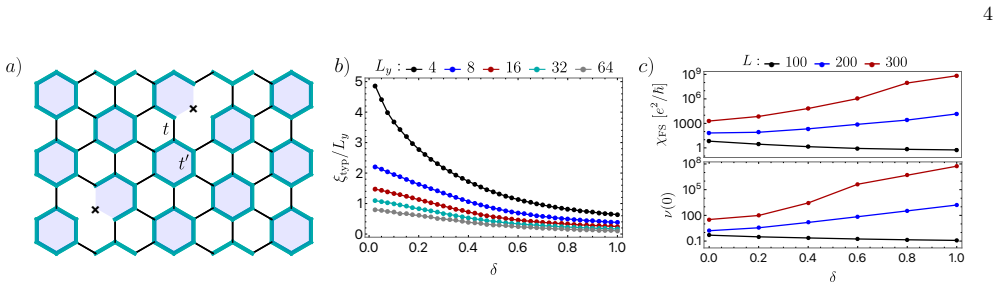
- Vacancy-doped graphene with Kekulé bond distortion is predicted to realize the superdielectric phase in two dimensions: its zero-energy density of states and Fermi-surface susceptibility diverge while the ribbon remains localized.
- Regular measurements of the dielectric constant through capacitance or reflectivity should be able to detect the superdielectric phase.
Reading between the lines
- Editorial extension: the superdielectric phase challenges the usual dichotomy that a divergent static susceptibility means metallicity; the discriminator is that the divergence comes from rare virtual zero-mode pairs, not free carriers.
- Editorial extension: any chiral-symmetric disordered insulator with zero-energy impurity states and a rare-region singularity in the density of states could host the phase, so the search could extend to other bipartite or topological materials beyond the examples given.
- Editorial extension: a practical experimental test is to combine capacitance and dc transport measurements—if the static permittivity diverges while the dc conductance vanishes, the screening is superdielectric rather than metallic.
- Editorial extension: the finite-size evidence leaves open whether the divergence survives exactly in the thermodynamic limit; a calculation with a small chiral-symmetry-breaking perturbation would settle that question.
Editorial analysis
A structured set of objections, weighed in public.
Referee Report
Summary. The paper argues that in one-dimensional disordered insulators the ground-state quantum metric g is proportional to the average localization length ξ_av, and uses this relation to identify a new 'superdielectric' phase. In the Anderson chain, a Berezinskii-diagram resummation gives g ≈ 0.1289 ξ_typ and the numerical ratio g/ξ_typ ≈ 0.14. In the bond-disordered SSH chain, the authors claim that for 0 < δ ≤ 1/2 the Fermi-surface susceptibility χ_FS diverges while g remains finite, leading to perfect static screening without dc conductivity. The same superdielectric behavior is claimed for vacancy-doped Kekulé-distorted graphene. The central input is the low-energy density of states ν(E) ∼ E^{−1+2δ} and the position-operator matrix element |⟨ψ_E|x|ψ_−E⟩| ∼ log E, taken from the companion paper [21] and [18], with numerical support from Figs. 2–4 and the Supplementary Information.
Significance. If the central claims hold, the paper establishes two useful results: the quantum metric is a numerically stable proxy for the average localization length (an otherwise non-self-averaging quantity), and a new insulating regime exists in which the static susceptibility diverges even though the quantum metric is finite. The Anderson-chain analysis is a genuine strength: the diagrammatic calculation is checked against an independent result for χ [24], the ratio g/ξ_typ is stable across disorder types and Fermi energies (Supplementary Table II), and the paper gives a falsifiable experimental prediction via capacitance/reflectivity. The superdielectric phase is more fragile: it relies on imported power laws for the DOS and matrix elements, and the finite-size numerical evidence alone is not conclusive. The 2D Kekulé-graphene realization also cites two papers that report chiral symmetry breaking, which is a concrete inconsistency in the argument.
major comments (3)
- [Superdielectric phase, Eqs. (10)–(11)] The divergence of χ_FS for δ ≤ 1/2 is driven entirely by ν(E) ∼ E^{−1+2δ} and |⟨ψ_E|x|ψ_−E⟩| ∼ log E. These are imported from the companion paper [21] and [18]; they are not derived or independently checked here. Equation (11) is a generic rare-region heuristic, and the identification αξ_typ = 2δ is not justified in the text. Because any reduction of the DOS exponent, any cutoff, or any chiral-symmetry-breaking term would make χ_FS converge, the superdielectric phase claim needs either a self-contained derivation of Eq. (10) or a direct numerical extraction of the small-E exponent in the thermodynamic limit.
- [Figs. 3 and 4] The finite-size data in Fig. 3 and Fig. 4(c) show growth with L, but the rare-region energy splitting is exponentially small in L, E ∼ e^{−L/ξ_typ}. The same data are therefore consistent both with a genuine divergence and with a large but finite peak controlled by this cutoff. Given that the theoretical input (Eq. (10)) is not independently established, the numerical evidence alone does not prove the infinite-volume divergence. A scaling collapse as a function of L/ξ_typ, or an analytic lower bound showing that χ_FS grows without bound as L → ∞, is needed.
- [Kekulé-graphene realization] The text states that the Kekulé bond distortion preserves the chiral symmetry that protects the zero-energy DOS singularity, and cites refs. [48,49]. Both cited papers are titled 'chiral symmetry breaking' and report the breaking of this symmetry in Kekulé-ordered graphene. This is a direct contradiction. If the tight-binding Kekulé-O model preserves sublattice symmetry despite those experiments, the citations should be corrected and the model's symmetry should be stated explicitly; if chiral symmetry is broken, the zero-energy singularity—and hence the superdielectric response—is not protected.
minor comments (5)
- [Introduction] Typo: 'where where' should be 'where' in the paragraph following Eq. (1).
- [Eq. (3) and Eq. (9)] The definition of g uses eigenstates |n⟩ with Em < EF < En, but the notation is not fully defined: are states labeled by both m and n, and is the sum over all pairs of occupied/unoccupied states? Clarifying the finite-size normalization would help the reader reproduce the numerics.
- [Table I] The table mixes entries for the SSH chain at EF = 0 and at δ = 0. A footnote or column header stating which parameters are varied would make the scaling comparisons easier to parse.
- [Supplementary Information] The heading 'T opological criticality' contains a typo ('T opological'). Also, the SI reproduces several results from [21]; indicating the overlap with the companion paper would improve transparency.
- [References] Ref. [21] is a companion paper by the same authors. The main text should explicitly state that the low-energy DOS and matrix-element expressions used in Eq. (10) are derived there, and that the present manuscript relies on those results.
Circularity Check
No significant circularity: the superdielectric divergence is backed by independent DOS results and fresh numerics; self-citations to companion paper [21] are non-circular though load-bearing for g~xi_av. The Kekulé chiral-symmetry citation is contradicted by its sources, a correctness issue rather than circularity.
full rationale
The derivation chain is not circular. The central new claim—the divergence of the Fermi-surface susceptibility chi_FS for 0<delta<=1/2 in the bond-disordered SSH chain—follows from Eq. (10), nu(E)~E^{-1+2delta} and |<psi_E|x|psi_-E>|~log|E|. Even if the self-cited matrix element from [21] were omitted, the DOS power law alone makes the integral ∫ dE E^{-1} nu(E) diverge for delta<=1/2. The DOS power law is attributed to [18] and the Dyson-singularity literature (cf. [37,62]), and it is independently supported by the finite-size numerics in Fig. 3. The g~xi_av relation in the SSH chain uses zero-mode hybridization expressions from the authors' companion paper [21], but this is verified by independent numerical simulation (Fig. 2) and agrees with the known scaling xi_av~delta^{-2} from [18,40,41]. The Anderson-chain coefficient g=0.1289 xi_typ is obtained from a Berezinskii-diagram calculation in the SI and checked numerically (g/xi_typ≈0.14), so it is not a fitted input. The rare-region DOS formula (11) is a standard Griffiths-region derivation and is cited to independent work [47] as well as [21]. No equation reduces to its own input by construction. One caveat: the Kekulé-graphene realization states that bond distortion preserves chiral symmetry, citing [48,49], but both cited papers report chiral symmetry breaking in Kekulé-ordered graphene; this is a load-bearing unsupported/contradicted citation and a correctness risk, not circularity.
Assumptions & free parameters
free parameters (2)
- rare-region exponent α =
α ~ |log(1-p)| (estimated, not fitted)
- Berezinskii frequency cutoff ω_0 =
50(ν(EF)ξ_typ)^{-1}
assumptions (7)
- domain assumption Berezinskii diagrammatic resummation (impurity-scattering diagrams to zeroth order in (k_F ξ_typ)^{-1}) gives the full ac conductivity of the 1D Anderson insulator
- domain assumption ξ_av = 4 ξ_typ in the 1D Anderson model
- domain assumption Low-energy DOS of the chiral-disordered SSH chain away from criticality: ν(E) ~ |E|^{-1+2δ}
- domain assumption Position-operator matrix elements between hybridized zero-mode resonances: |⟨ψ_E|x|ψ_-E⟩| ~ log²|E| at criticality and ~ log|E| away
- domain assumption Rare-region (Griffiths) statistics for zero-mode pairs: ν(E) ~ Σ_r e^{-αr} δ(E - E_0 e^{-r/ξ_typ}) ~ E^{-1+αξ_typ}
- domain assumption Chiral symmetry of the Kekulé-O distorted graphene Hamiltonian pins vacancy states at E=0 and protects the ν(0) divergence
- standard math Standard linear response: SWM sum rule (1), Kubo formulas (3) and (9), dynamical structure factor reduction (21)-(22)
Cite this review
Pith. "Pith review of Superdielectrics: Disorder-induced perfect screening in insulators." pith.science (2026). https://pith.science/paper/LGOXUPX5
@misc{pith2026250814962,
  author       = {Pith},
  title        = {Pith review of: Superdielectrics: Disorder-induced perfect screening in insulators},
  year         = {2026},
  howpublished = {\url{https://pith.science/paper/LGOXUPX5}},
  note         = {Machine review of arXiv:2508.14962}
}
read the original abstract
We study the relationship between the quantities that encode the insulating properties of matter: the ground-state quantum metric, the average localization length, and the electric susceptibility. By examining the one-dimensional Anderson insulator model and the Su-Schrieffer-Heeger chain with chiral disorder, we demonstrate that the former two measures are proportional in one-dimensional systems near criticality, and both are determined by the properties of the hybridized localized states around the Fermi energy. We employ these insights to demonstrate that the behavior of the electric susceptibility is drastically different in the bond-disordered SSH chain, with the possibility that it may diverge even when the localization length and the quantum metric remain finite. This divergence, caused by the proliferation of impurity resonances at a particular energy, leads to a novel regime that exhibits mixed characteristics of metals and insulators. We term this regime superdielectric: an insulating state characterized by a finite quantum metric and divergent static electric susceptibility, which implies perfect screening in the absence of the dc conductivity. We demonstrate that the superdielectric phase also emerges in higher-dimensional materials, such as graphene with vacancies and Kekul\'e bond distortion.
Figures


Reference graph
Works this paper leans on
-
[21]
Quantum Critical Dynamics Induced by Topological Zero Modes
I. Komissarov, T. Holder, and R. Queiroz, Quantum crit- ical dynamics induced by topological zero modes (2025), arXiv:2502.12233 [cond-mat.mes-hall]
work page Pith review arXiv 2025
-
[18]
Evers and A
F. Evers and A. D. Mirlin, Anderson transitions, Reviews of Modern Physics 80, 1355 (2008)
2008
-
[24]
M. V. Feigel’man, D. A. Ivanov, and E. Cuevas, Dielectric response of Anderson and pseudogapped insulators, New 6 Journal of Physics 20, 053045 (2018)
work page 2018
-
[1]
R. Resta, The insulating state of matter: a geometrical theory, The European Physical Journal B 79, 121–137 (2011)
work page 2011
-
[2]
Souza, T
I. Souza, T. Wilkens, and R. M. Martin, Polarization and localization in insulators: Generating function approach, Phys. Rev. B 62, 1666 (2000)
2000
-
[3]
R. Resta and S. Sorella, Electron localization in the insu- lating state, Phys. Rev. Lett. 82, 370 (1999)
work page 1999
-
[4]
Kohn, Theory of the insulating state, Phys
W. Kohn, Theory of the insulating state, Phys. Rev. 133, A171 (1964)
work page 1964
-
[5]
T¨ orm¨ a, Essay: Where can quantum geometry lead us?, Phys
P. T¨ orm¨ a, Essay: Where can quantum geometry lead us?, Phys. Rev. Lett. 131, 240001 (2023)
2023
Show all 62 references
-
[6]
J. Yu, B. A. Bernevig, R. Queiroz, E. Rossi, P. T¨ orm¨ a, and B.-J. Yang, Quantum geometry in quantum materials (2025), arXiv:2501.00098 [cond-mat.mes-hall]
2025 arXiv
-
[7]
Verma, P
N. Verma, P. J. W. Moll, T. Holder, and R. Queiroz, Quantum geometry: Revisiting electronic scales in quan- tum matter (2025), arXiv:2504.07173 [cond-mat.mtrl-sci]
2025
-
[8]
Peotta and P
S. Peotta and P. T¨ orm¨ a, Superfluidity in topologi- cally nontrivial flat bands, Nature Communications 6, 10.1038/ncomms9944 (2015)
2015 doi
-
[9]
Jiang, T
Y. Jiang, T. Holder, and B. Yan, Revealing quantum geom- etry in nonlinear quantum materials (2025), 2503.04943
2025 arXiv
-
[10]
A. Gao, N. Nagaosa, N. Ni, and S.-Y. Xu, Quantum geometry phenomena in condensed matter systems (2025), arXiv:2508.00469 [cond-mat.str-el]
2025 arXiv
-
[11]
E. K. Kudinov, Difference between the insulating and conducting states, Fizika Tverdogo Tela 33, 2306 (1991)
1991
-
[12]
Komissarov, T
I. Komissarov, T. Holder, and R. Queiroz, The quan- tum geometric origin of capacitance in insulators, Nature Communications 15, 10.1038/s41467-024-48808-x (2024)
2024 doi
-
[13]
Onishi and L
Y. Onishi and L. Fu, Fundamental bound on topological gap, Physical Review X 14, 10.1103/physrevx.14.011052 (2024)
2024 doi
-
[14]
Marsal and A
Q. Marsal and A. M. Black-Schaffer, Enhanced quantum metric due to vacancies in graphene (2024), arXiv:2406.01408
2024 arXiv
-
[15]
J. M. Romeral, A. W. Cummings, and S. Roche, Scaling of the quantum geometry metrics in disordered topological phases (2024), arXiv:2406.12677
2024 arXiv
-
[16]
G. L. Bendazzoli, S. Evangelisti, A. Monari, and R. Resta, Kohn’s localization in the insulating state: one- dimensional lattices, crystalline versus disordered, The Journal of Chemical Physics 133, 064703 (2010)
2010
-
[17]
MacKinnon and B
A. MacKinnon and B. Kramer, The scaling theory of elec- trons in disordered solids: Additional numerical results, Zeitschrift f¨ ur Physik B Condensed Matter53, 1 (1983)
1983
-
[19]
W. P. Su, J. R. Schrieffer, and A. J. Heeger, Solitons in polyacetylene, Phys. Rev. Lett. 42, 1698 (1979)
1979
-
[20]
V. L. Berezinskii, Kinetics of a quantum particle in a one-dimensional random potential, Sov. Phys. JETP 38, 620 (1974)
1974
-
[22]
E. N. Economou, Green ’s Functions in Quantum Physics, 3rd ed., Springer Series in Solid-State Sciences (Springer, Berlin, Heidelberg, 2006)
2006
-
[23]
See supplementary information for the list of notations, a summary of the diagrammatic resummation approach, the relation between the dynamical structure factor and the transport quantities, discussion of the zero mode resonances in the SSH chain, and details of transfer matri...
-
[25]
N. F. Mott, Metal-insulator transition, Rev. Mod. Phys. 40, 677 (1968)
1968
-
[26]
T. F. Rosenbaum, R. F. Milligan, M. A. Paalanen, G. A. Thomas, R. N. Bhatt, and W. Lin, Metal-insulator transition in a doped semiconductor, Phys. Rev. B 27, 7509 (1983)
1983
-
[27]
S. N. Evangelou, Spectral singularities and localisation in one- and quasi-one-dimensional systems with off-diagonal disorder, Journal of Physics C: Solid State Physics 19, 4291 (1986)
1986
-
[28]
M. Inui, S. A. Trugman, and E. Abrahams, Unusual properties of midband states in systems with off-diagonal disorder, Phys. Rev. B 49, 3190 (1994)
1994
-
[29]
Vojta, Quantum Griffiths effects and smeared phase transitions in metals: theory and experiment, Jour- nal of Low Temperature Physics 161, 299 (2010), arXiv:1005.2707 [cond-mat]
T. Vojta, Quantum Griffiths effects and smeared phase transitions in metals: theory and experiment, Jour- nal of Low Temperature Physics 161, 299 (2010), arXiv:1005.2707 [cond-mat]
2010 arXiv
-
[30]
H¨ afner, J
V. H¨ afner, J. Schindler, N. Weik, T. Mayer, S. Balakr- ishnan, R. Narayanan, S. Bera, and F. Evers, Density of States in Graphene with Vacancies: Midgap Power Law and Frozen Multifractality, Physical Review Letters 113, 186802 (2014)
2014
-
[31]
T. O. Wehling, S. Yuan, A. I. Lichtenstein, A. K. Geim, and M. I. Katsnelson, Resonant scattering by realistic impurities in graphene, Phys. Rev. Lett. 105, 056802 (2010)
2010
-
[32]
N. F. Mott and E. A. Davis, Electronic Processes in Non- Crystalline Materials, 2nd ed., Oxford Classic Texts in the Physical Sciences (OUP Oxford, 2012) p. 590, reprint of the second edition originally published in 1979
2012
-
[33]
Erd¨ os and R
P. Erd¨ os and R. C. Herndon, Theories of electrons in one-dimensional disordered systems, Advances in Physics 31, 65 (1982)
1982
-
[34]
Abrikosov, The paradox with the static conductivity of a one-dimensional metal, Solid State Communications 37, 997 (1981)
A. Abrikosov, The paradox with the static conductivity of a one-dimensional metal, Solid State Communications 37, 997 (1981)
1981
-
[35]
E. J. Meier, A. F. An, A. Dauphin, M. Maffei, P. Massig- nan, T. L. Hughes, and B. Gadway, Observation of the topological anderson insulator in disordered atomic wires, Science 362, 929 (2018), epub 2018 Oct 11, 30309909
2018
-
[36]
Mondragon-Shem, T
I. Mondragon-Shem, T. L. Hughes, J. Song, and E. Pro- dan, Topological criticality in the chiral-symmetric aiii class at strong disorder, Phys. Rev. Lett. 113, 046802 (2014)
2014
-
[37]
T. P. Eggarter and R. Riedinger, Singular behavior of tight-binding chains with off-diagonal disorder, Phys. Rev. B 18, 569 (1978)
1978
-
[38]
Theodorou and M
G. Theodorou and M. H. Cohen, Extended states in a one- demensional system with off-diagonal disorder, Physical Review B 13, 4597 (1976)
1976
-
[39]
The Wannier function localized on an i-th isolated dimer can be expressed as ∣wi⟩ = √ 2 −1 (∣i, A⟩+ ∣i, B⟩), and the quadratic spread is found as ⟨wi∣ˆx2∣wi⟩− (⟨wi∣ˆx∣wi⟩)2 = a2/4= 1/4
-
[40]
Gogolin, Singularities of localization lenght near the middle of the band and Mott’s hopping conductivity in 1d disordered metals, Solid State Communications 49, 183 (1984)
A. Gogolin, Singularities of localization lenght near the middle of the band and Mott’s hopping conductivity in 1d disordered metals, Solid State Communications 49, 183 (1984)
1984
-
[41]
Balents and M
L. Balents and M. P. A. Fisher, Delocalization transition via supersymmetry in one dimension, Physical Review B 56, 12970 (1997)
1997
-
[42]
Grosso and G
G. Grosso and G. P. Parravicini, Solid State Physics (Elsevier, 2000)
2000
-
[43]
Giuliani and G
G. Giuliani and G. Vignale, Quantum Theory of the Elec- tron Liquid (Cambridge University Press, 2005)
2005
-
[44]
Thill and D
M. Thill and D. Huse, Equilibrium behaviour of quantum ising spin glass, Physica A: Statistical Mechanics and its Applications 214, 321 (1995)
1995
-
[45]
M. Guo, R. N. Bhatt, and D. A. Huse, Quantum griffiths singularities in the transverse-field ising spin glass, Phys. Rev. B 54, 3336 (1996)
1996
-
[46]
Rieger and A
H. Rieger and A. P. Young, Griffiths singularities in the disordered phase of a quantum ising spin glass, Phys. Rev. B 54, 3328 (1996)
1996
-
[47]
Motrunich, K
O. Motrunich, K. Damle, and D. A. Huse, Particle-hole symmetric localization in two dimensions, Phys. Rev. B 65, 064206 (2002)
2002
-
[48]
C. Bao, H. Zhang, T. Zhang, X. Wu, L. Luo, S. Zhou, Q. Li, Y. Hou, W. Yao, L. Liu, P. Yu, J. Li, W. Duan, H. Yao, Y. Wang, and S. Zhou, Experimental evidence of chiral symmetry breaking in kekul´ e-ordered graphene, Phys. Rev. Lett. 126, 206804 (2021)
2021
-
[49]
Guti´ errez, C
C. Guti´ errez, C. J. Kim, L. Brown, T. Schiros, D. Nord- lund, E. B. Lochocki, K. M. Shen, J. Park, and A. N. Pasupathy, Imaging chiral symmetry breaking from kekule bond order in graphene, Nature Physics 12, 10.1038/NPHYS3776 (2016)
2016 doi
-
[50]
Bocquet and J
M. Bocquet and J. T. Chalker, Network models for local- ization problems belonging to the chiral symmetry classes, Phys. Rev. B 67, 054204 (2003)
2003
-
[51]
Resta, Quantum-mechanical position operator in ex- tended systems, Phys
R. Resta, Quantum-mechanical position operator in ex- tended systems, Phys. Rev. Lett. 80, 1800 (1998)
1998
-
[52]
A. A. Gogolin and V. I. Melnikov, Frequency Depen- dences of Conductivity and Dielectric Permeability of a One-Dimensional Disordered Conductor, Physica Status Solidi B Basic Research 88, 377 (1978)
1978
-
[53]
L. P. Gor’kov, N. Dorokhov, and F. V. Prigara, Structure of wave functions and ac conductivity in disordered one- dimensional conductors,
-
[54]
L. P. Gor’kov, N. Dorokhov, and F. V. Prigara, Energy level correlations in a disordered one-dimensional chain, (1983)
1983
-
[55]
D. A. Ivanov, M. A. Skvortsov, P. M. Ostrovsky, and Y. V. Fominov, Hybridization of wave functions in one- dimensional localization, Physical Review B 85, 035109 (2012)
2012
-
[56]
Solving this for d gives the Mott scale d(ω)
The hybridization energy split is exponentially small in the distance between the electronsω ∼ δξe−2d/ξtyp. Solving this for d gives the Mott scale d(ω)
-
[57]
I. M. Lifshitz, S. A. Gredeskul, and L. A. Pastur, Introduction to the Theory of Disordered Systems(Wiley- Interscience, 1988)
1988
-
[58]
V. L. Berezinskii and L. P. Gor’kov, On the theory of electrons localized in the field of defects, Soviet Journal of Experimental and Theoretical Physics 50, 1209 (1979)
1979
-
[59]
happens in the Anderson model at low disorder
Another way to reproduce the same expression is by as- suming that the dynamical structure factor S(E, ω, r) is E-independent, as e.g. happens in the Anderson model at low disorder
-
[60]
Abrikosov and I
A. Abrikosov and I. Ryzhkin, Conductivity of quasi-one- dimensional metal systems, Advances in Physics 27, 147 (1978)
1978
-
[61]
D. J. Thouless, A relation between the density of states and range of localization for one dimensional random systems, Journal of Physics C: Solid State Physics 5, 77 7 (1972)
1972
-
[62]
Superdielectrics: Disorder-induced perfect screening in insulators
A. Krishna and R. Bhatt, Beyond the universal dyson singularity for 1-d chains with hopping disorder, Annals of Physics 435, 168537 (2021). 8 Supplementary information for “Superdielectrics: Disorder-induced perfect screening in insulators” Ilia Komissarov, Tobias Holder, Raqu...
2021
Reviewed August 5, 2026 · model on record in the stance chip above.
Discussion (0). Continue with ORCID to comment.