The Quiescent Sloshing Core of Abell 496 with XRISM
Pith reviewed 2026-07-02 17:41 UTC · model grok-4.3
The pith
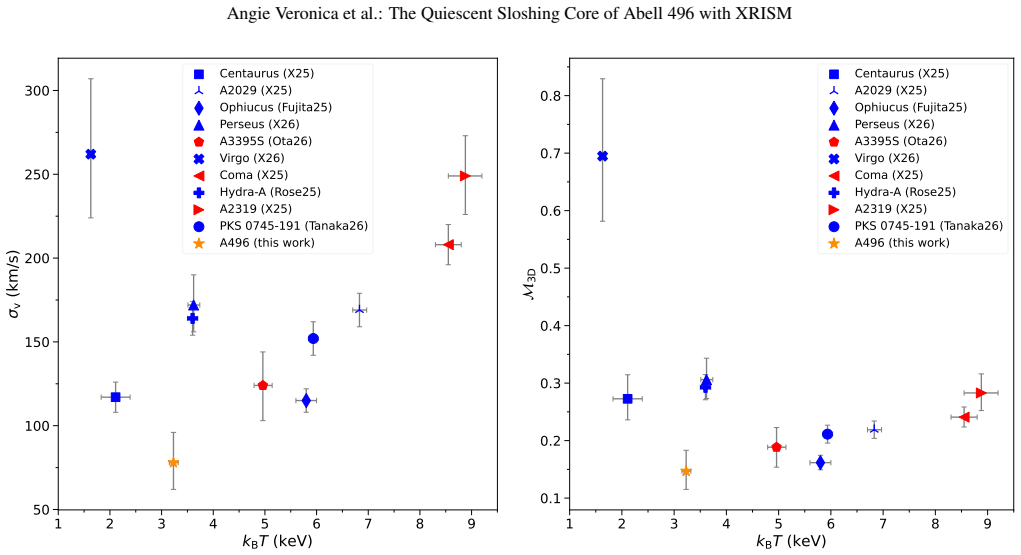
XRISM Resolve data show the core of Abell 496 has the lowest ICM turbulent velocity yet measured, at 78 km/s, with bulk motion of 69 km/s relative to the central galaxy.
A machine-rendered reading of the paper's core claim, the machinery that carries it, and where it could break.
Core claim
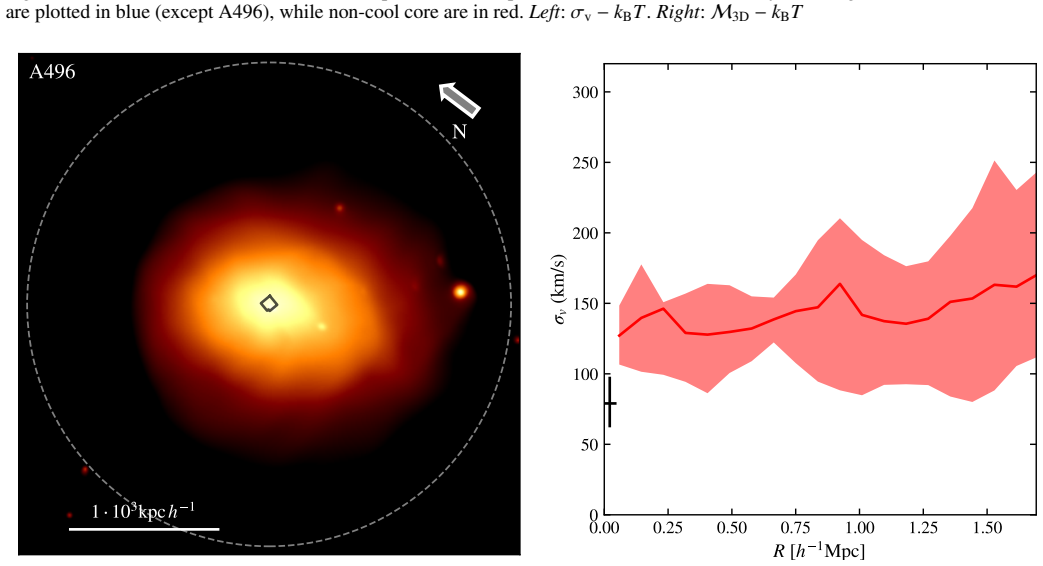
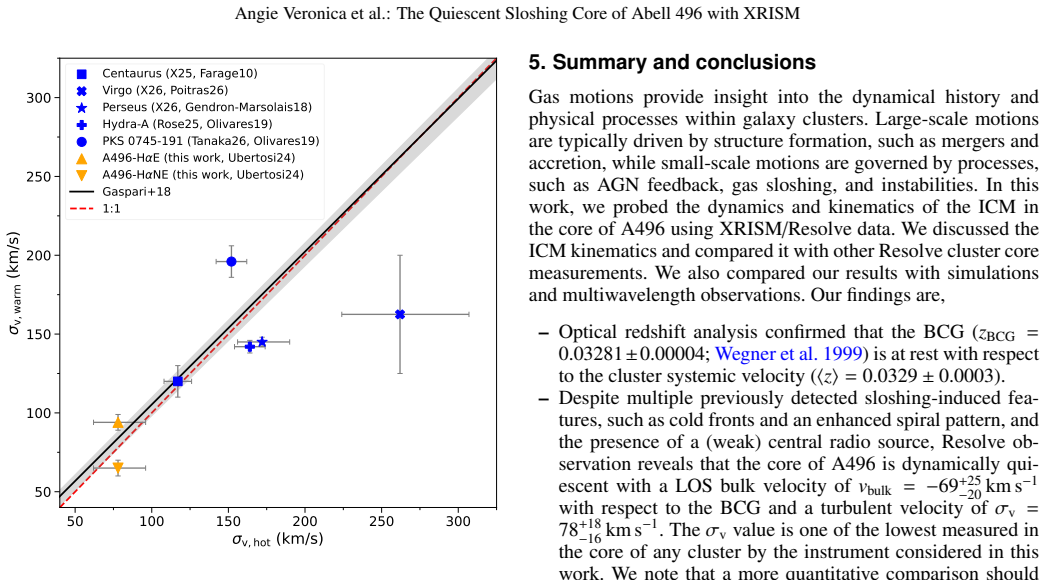
Resolve observation shows that the core of A496 is dynamically quiescent. The ICM is moving with respect to the BCG with a LOS bulk velocity of v_bulk=-69 km/s. We measured a turbulent velocity of σ_v=78 km/s, the lowest value reported by the instrument on a cluster core to date. This value is in good agreement with the velocity dispersion of the Hα filament in the core. Assuming isotropic turbulence, the ICM turbulent velocity corresponds to a subsonic 3D Mach number of 0.15 and a non-thermal pressure fraction of 1.2 percent. The mechanical AGN feedback from the recent activity of the central radio source is estimated to contribute about 7-9 percent to the ICM heating.
What carries the argument
Line-of-sight velocity and velocity-dispersion measurements from the Resolve micro-calorimeter spectra of the ICM emission lines.
If this is right
- The 1D line-of-sight bulk velocity from the SLOW simulation matches the observed value, indicating AGN feedback contributes negligibly to the bulk motion.
- The simulation turbulent velocity lies within 1.5 sigma of the measured 78 km/s despite being systematically higher.
- Mechanical energy input from the central radio source supplies only 7-9 percent of the heating needed to balance radiative losses.
- The match between the turbulent velocity and the Hα filament dispersion points to possible condensation of gas in the wake of the radio bubble.
Where Pith is reading between the lines
- If other sloshing cool cores also show comparably low turbulence, models linking cold fronts directly to strong mixing may need revision.
- The agreement between X-ray gas motions and optical filament velocities suggests a common origin that could be tested with deeper multi-wavelength mapping.
- Longer XRISM exposures on similar clusters could determine whether A496 is an outlier or representative of the quietest cores.
Load-bearing premise
The conversion from observed line-of-sight velocity dispersion to three-dimensional Mach number and non-thermal pressure fraction assumes that the turbulence is isotropic.
What would settle it
A map or spectrum showing clearly anisotropic velocity structure or a significantly higher dispersion measured in a perpendicular direction would invalidate the isotropic-turbulence conversion and the reported Mach number of 0.15.
Figures
read the original abstract
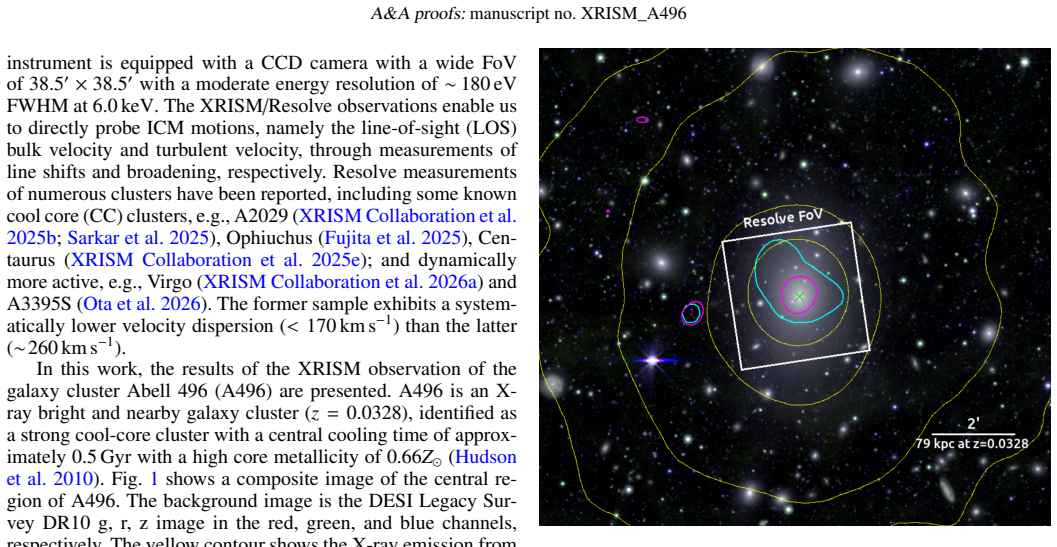
Gas motions provide insight into the dynamical history and physical processes within galaxy clusters. We investigate the kinematics of the ICM in the core of A496, a nearby, X-ray bright, strong cool-core cluster, using high-resolution data from the Resolve micro-calorimeter on board XRISM. We compared our measurement with other Resolve cluster core measurements and further compared our results with simulations and multiwavelength observations. From an optical redshift analysis, we found that the BCG is at rest with respect to the systemic velocity of the cluster. Despite multiple previously detected cold fronts and harboring a weak central radio source, Resolve observation shows that the core of A496 is dynamically quiescent. The ICM is moving with respect to the BCG with a LOS bulk velocity of $v_{\rm bulk}=-69_{-20}^{+25}\,\mathrm{km\,s}^{-1}$. We measured a turbulent velocity of $\sigma_{\rm v}=78_{-16}^{+18}\,\mathrm{km\,s}^{-1}$, the lowest value reported by the instrument on a cluster core to date. This value is in good agreement with the velocity dispersion of the H$\alpha$ filament in the core, which may indicate condensation of ICM in the wake of the radio bubble. Assuming isotropic turbulence, the ICM turbulent velocity corresponds to a subsonic 3D Mach number of $0.15_{-0.03}^{+0.04}$ and a non-thermal pressure fraction of $1.2_{-0.5}^{+0.6}\,\%$. The mechanical AGN feedback from the recent activity of the central radio source is estimated to contribute about 7-9% to the ICM heating. The 1D LOS bulk velocity from the SLOW constrained Universe simulation is consistent with the measured value, suggesting that AGN feedback has a negligible contribution. The A496 SLOW turbulent velocity, as in other reported Resolve--simulation comparisons, is higher, but remains within $1.5\sigma$ uncertainty. A496 may represent one of the most quiescent sloshing cores observed so far.
Editorial analysis
A structured set of objections, weighed in public.
Referee Report
Summary. The manuscript presents XRISM Resolve microcalorimeter spectroscopy of the ICM in the core of the cool-core cluster Abell 496. It reports a line-of-sight bulk velocity of the ICM relative to the BCG of v_bulk = -69_{-20}^{+25} km s^{-1} and a turbulent velocity dispersion of σ_v = 78_{-16}^{+18} km s^{-1}, the lowest Resolve value yet measured in a cluster core. The core is concluded to be dynamically quiescent despite prior detections of cold fronts and a weak central radio source; the isotropic-turbulence assumption is invoked only after the LOS measurements to derive a 3D Mach number of 0.15 and non-thermal pressure fraction of 1.2%. Comparisons are drawn to Hα filament velocities, SLOW simulations, and other Resolve cluster cores.
Significance. If the reported velocities hold, the result supplies one of the tightest direct constraints on ICM motions in a sloshing cool core, showing that AGN mechanical feedback contributes only ~7-9% to local heating and that non-thermal pressure support remains below 2%. The explicit statement of the isotropic assumption and the direct comparison to both multi-wavelength data and constrained simulations strengthen the utility of the measurement for calibrating feedback models.
major comments (1)
- [§4] §4 (Spectral Analysis): The manuscript does not report the precise extraction aperture, the treatment of the Resolve PSF, or the background model components used for the line-profile fits that yield v_bulk and σ_v; without these, it is impossible to assess whether the quoted uncertainties fully capture systematic contributions to the lowest-yet turbulent velocity.
minor comments (3)
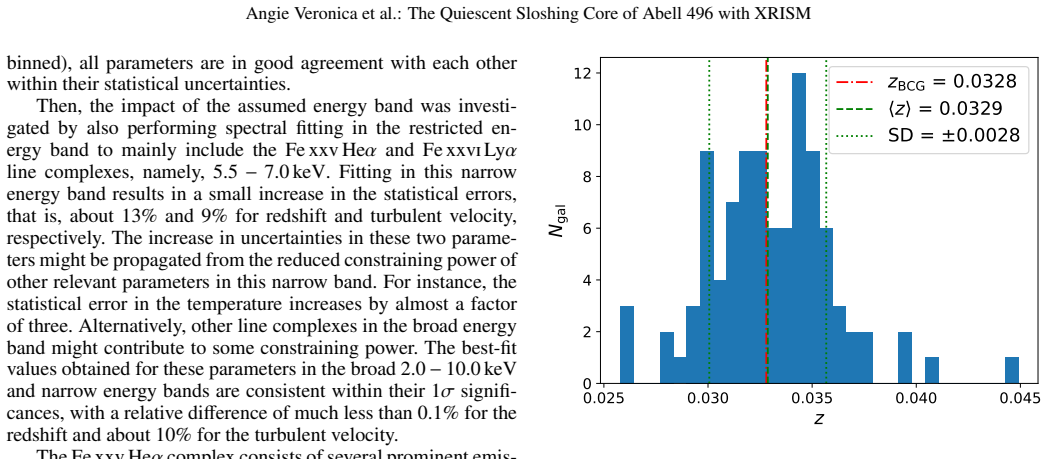
- [Optical redshift analysis] The abstract states that the BCG is at rest relative to the cluster systemic velocity from an optical redshift analysis, but the corresponding section does not quote the number of galaxies used or the velocity dispersion of the member sample.
- [Figure 3] Figure 3 (or equivalent) comparing Resolve σ_v values across clusters should include the exact reference values and uncertainties for the other clusters to support the claim that A496 is the lowest.
- [AGN feedback section] The mechanical power estimate of 7-9% from the central radio source is given without the adopted cavity age or enthalpy formula; a brief equation or reference would clarify the conversion.
Simulated Author's Rebuttal
We thank the referee for their careful reading of the manuscript and for highlighting the need for additional technical details in the spectral analysis. We address the single major comment below and will incorporate the requested information into the revised version of the paper.
read point-by-point responses
-
Referee: [§4] §4 (Spectral Analysis): The manuscript does not report the precise extraction aperture, the treatment of the Resolve PSF, or the background model components used for the line-profile fits that yield v_bulk and σ_v; without these, it is impossible to assess whether the quoted uncertainties fully capture systematic contributions to the lowest-yet turbulent velocity.
Authors: We agree that these methodological details are necessary to fully evaluate the measurements and their uncertainties. In the revised manuscript we will explicitly state the extraction aperture (including its radius, centering relative to the BCG, and any masking applied), describe the treatment of the Resolve PSF (including any convolution or response matrix adjustments used in the spectral fitting), and list the background model components (including their normalizations and any fixed or free parameters) employed in the line-profile analysis. These additions will allow readers to assess whether the reported uncertainties adequately account for systematic effects. revision: yes
Circularity Check
No significant circularity; direct spectroscopic measurements
full rationale
The paper's central claims are direct line-of-sight velocity measurements extracted from XRISM Resolve spectra of the A496 core. Bulk velocity and turbulent dispersion are obtained from spectral line shifts and broadening without any reduction to prior fitted parameters, self-citations, or internal ansatzes. The isotropic-turbulence assumption is invoked only after the LOS values are reported, solely to convert them into 3D Mach number and non-thermal pressure fraction, and is stated explicitly. Simulation comparisons and multiwavelength references are external benchmarks, not load-bearing inputs to the reported velocities. No self-definitional, fitted-input, or self-citation patterns appear in the derivation chain.
Axiom & Free-Parameter Ledger
axioms (2)
- domain assumption Line broadening and centroid shift in Resolve spectra directly trace bulk and turbulent motions in the ICM
- domain assumption Turbulence is isotropic when converting 1D LOS dispersion to 3D Mach number
Reference graph
Works this paper leans on
-
[1]
Arnaud, K. A. 1996, in Astronomical Society of the Pacific Conference Series, V ol. 101, Astronomical Data Analysis Software and Systems V , ed. G. H. Jacoby & J. Barnes, 17
1996
-
[2]
Bellomi, E., ZuHone, J. A., Truong, N., et al. 2025, arXiv e-prints, arXiv:2512.12754
-
[3]
2022, A&A, 661, A1
Brunner, H., Liu, T., Lamer, G., et al. 2022, A&A, 661, A1
2022
-
[4]
G., Pilipenko, S., et al
Dolag, K., Sorce, J. G., Pilipenko, S., et al. 2023, A&A, 677, A169
2023
-
[5]
E., & Bregman, J
Dupke, R., White, III, R. E., & Bregman, J. N. 2007, ApJ, 671, 181
2007
-
[6]
2019, A&A, 621, A40
Eckert, D., Ghirardini, V ., Ettori, S., et al. 2019, A&A, 621, A40
2019
-
[7]
Fabian, A. C. 2012, ARA&A, 50, 455
2012
-
[8]
L., McGregor, P
Farage, C. L., McGregor, P. J., Dopita, M. A., & Bicknell, G. V . 2010, ApJ, 724, 267
2010
-
[9]
R., Ji, L., Smith, R
Foster, A. R., Ji, L., Smith, R. K., & Brickhouse, N. S. 2012, ApJ, 756, 128
2012
-
[10]
2025, PASJ, 77, S270
Fujita, Y ., Fukushima, K., Sato, K., Fukazawa, Y ., & Kondo, M. 2025, PASJ, 77, S270
2025
-
[11]
L., et al
Gaspari, M., McDonald, M., Hamer, S. L., et al. 2018, ApJ, 854, 167
2018
-
[12]
Gaspari, M., Ruszkowski, M., & Oh, S. P. 2013, MNRAS, 432, 3401
2013
-
[13]
B., et al
Gendron-Marsolais, M., Hlavacek-Larrondo, J., Martin, T. B., et al. 2018, MN- RAS, 479, L28
2018
-
[14]
2014, A&A, 570, A117
Ghizzardi, S., De Grandi, S., & Molendi, S. 2014, A&A, 570, A117
2014
-
[15]
A., et al
Groth, F., Valentini, M., Seidel, B. A., et al. 2026, ApJ, 1000, 75
2026
-
[16]
Heckman, T. M. & Best, P. N. 2014, ARA&A, 52, 589 Hernández-Martínez, E., Dolag, K., Seidel, B., et al. 2024, A&A, 687, A253 HI4PI Collaboration, Ben Bekhti, N., Flöer, L., et al. 2016, A&A, 594, A116 Hitomi Collaboration, Aharonian, F., Akamatsu, H., et al. 2016, Nature, 535, 117 Hitomi Collaboration, Aharonian, F., Akamatsu, H., et al. 2018, PASJ, 70, 9
2014
-
[17]
2022, in Handbook of X-ray and Gamma-ray Astrophysics, ed
Hlavacek-Larrondo, J., Li, Y ., & Churazov, E. 2022, in Handbook of X-ray and Gamma-ray Astrophysics, ed. C. Bambi & A. Sangangelo, 5
2022
-
[18]
S., Mittal, R., Reiprich, T
Hudson, D. S., Mittal, R., Reiprich, T. H., et al. 2010, A&A, 513, A37
2010
-
[19]
T., Jagannathan, P., Mooley, K
Intema, H. T., Jagannathan, P., Mooley, K. P., & Frail, D. A. 2017, A&A, 598, A78
2017
-
[20]
L., Awaki, H., et al
Ishisaki, Y ., Kelley, R. L., Awaki, H., et al. 2022, in Space Telescopes and In- strumentation 2022: Ultraviolet to Gamma Ray, ed. J.-W. A. den Herder, S. Nikzad, & K. Nakazawa, V ol. 12181, International Society for Optics and Photonics (SPIE), 121811S
2022
-
[21]
Kravtsov, A. V . & Borgani, S. 2012, ARA&A, 50, 353 Laganá, T. F., Andrade-Santos, F., & Lima Neto, G. B. 2010, A&A, 511, A15 Laganá, T. F., Lima Neto, G. B., Andrade-Santos, F., & Cypriano, E. S. 2008, A&A, 485, 633
2012
-
[22]
2009, Landolt Börnstein, 4B, 712
Lodders, K., Palme, H., & Gail, H.-P. 2009, Landolt Börnstein, 4B, 712
2009
-
[23]
& Reiprich, T
Lovisari, L. & Reiprich, T. H. 2019, MNRAS, 483, 540
2019
-
[24]
& Vikhlinin, A
Markevitch, M. & Vikhlinin, A. 2007, Phys. Rep., 443, 1
2007
-
[25]
L., Lenc, E., et al
McConnell, D., Hale, C. L., Lenc, E., et al. 2020, PASA, 37, e048
2020
-
[26]
McDonald, M., Veilleux, S., Rupke, D. S. N., & Mushotzky, R. 2010, ApJ, 721, 1262
2010
-
[27]
2024, A&A, 682, A34
Merloni, A., Lamer, G., Liu, T., et al. 2024, A&A, 682, A34
2024
-
[28]
S., Reiprich, T
Mittal, R., Hudson, D. S., Reiprich, T. H., & Clarke, T. 2009, A&A, 501, 835
2009
-
[29]
2025, PASJ, 77, S10
Noda, H., Mori, K., Tomida, H., et al. 2025, PASJ, 77, S10
2025
-
[30]
2025, Nature Astronomy, 9, 449–457
Olivares, V ., Picquenot, A., Su, Y ., et al. 2025, Nature Astronomy, 9, 449–457
2025
-
[31]
2019, A&A, 631, A22
Olivares, V ., Salome, P., Combes, F., et al. 2019, A&A, 631, A22
2019
-
[32]
2026, A&A, 705, A249
Olivares, V ., Su, Y ., Temi, P., et al. 2026, A&A, 705, A249
2026
-
[33]
Ota, N., Veronica, A., Dietl, J., et al. 2026, arXiv e-prints, arXiv:2602.21580
work page internal anchor Pith review Pith/arXiv arXiv 2026
-
[34]
N., et al
Pasini, T., Brüggen, M., Hoang, D. N., et al. 2022, A&A, 661, A13
2022
-
[35]
2026, MNRAS, 545, staf1981
Poitras, C., Gendron-Marsolais, M.-L., Olivares, V ., et al. 2026, MNRAS, 545, staf1981
2026
-
[36]
2021, A&A, 647, A1
Predehl, P., Andritschke, R., Arefiev, V ., et al. 2021, A&A, 647, A1
2021
-
[37]
H., Basu, K., Ettori, S., et al
Reiprich, T. H., Basu, K., Ettori, S., et al. 2013, Space Sci. Rev., 177, 195
2013
-
[38]
Reiprich, T. H. & Böhringer, H. 2002, ApJ, 567, 716
2002
-
[39]
2012, MNRAS, 420, 3632
Roediger, E., Lovisari, L., Dupke, R., et al. 2012, MNRAS, 420, 3632
2012
-
[40]
R., Meunier, J., et al
Rose, T., McNamara, B. R., Meunier, J., et al. 2025, The Astrophysical Journal, 990, 42
2025
-
[41]
2025, PASJ, 77, S254 Article number, page 10 of 12 Angie Veronica et al.: The Quiescent Sloshing Core of Abell 496 with XRISM
Sarkar, A., Miller, E., Ota, N., et al. 2025, PASJ, 77, S254 Article number, page 10 of 12 Angie Veronica et al.: The Quiescent Sloshing Core of Abell 496 with XRISM
2025
-
[42]
1978, The Annals of Statistics, 6, 461
Schwarz, G. 1978, The Annals of Statistics, 6, 461
1978
-
[43]
Seidel, B., Dolag, K., & Sorce, J. G. 2026, arXiv e-prints, arXiv:2606.26230
work page internal anchor Pith review Pith/arXiv arXiv 2026
-
[44]
A., Dolag, K., Remus, R.-S., et al
Seidel, B. A., Dolag, K., Remus, R.-S., et al. 2025, A&A, 702, A243
2025
-
[45]
K., Brickhouse, N
Smith, R. K., Brickhouse, N. S., Liedahl, D. A., & Raymond, J. C. 2001, ApJ, 556, L91
2001
-
[46]
Sorce, J. G. 2018, MNRAS, 478, 5199
2018
-
[47]
2021, A&A, 656, A132
Sunyaev, R., Arefiev, V ., Babyshkin, V ., et al. 2021, A&A, 656, A132
2021
-
[48]
2016, in Space Telescopes and Instrumentation 2016: Ultraviolet to Gamma Ray, ed
Takahashi, T., Kokubun, M., Mitsuda, K., et al. 2016, in Space Telescopes and Instrumentation 2016: Ultraviolet to Gamma Ray, ed. J.-W. A. den Herder, T. Takahashi, & M. Bautz, V ol. 9905, International Society for Optics and Photonics (SPIE), 99050U
2016
-
[49]
2026, arXiv e-prints, arXiv:2603.16263
Tanaka, K., Eckart, M., Fukushima, K., et al. 2026, arXiv e-prints, arXiv:2603.16263
-
[50]
2006, PASJ, 58, 703
Tanaka, T., Kunieda, H., Hudaverdi, M., Furuzawa, A., & Tawara, Y . 2006, PASJ, 58, 703
2006
-
[51]
2025, PASJ, 77, S1
Tashiro, M., Kelley, R., Watanabe, S., et al. 2025, PASJ, 77, S1
2025
-
[52]
2024, A&A, 691, A294
Ubertosi, F., Giacintucci, S., Clarke, T., et al. 2024, A&A, 691, A294
2024
-
[53]
& Brunetti, G
Vazza, F. & Brunetti, G. 2026, A&A, 705, A129
2026
-
[54]
H., Pacaud, F., et al
Veronica, A., Reiprich, T. H., Pacaud, F., et al. 2026, PASA, 43, e001
2026
-
[55]
H., Pacaud, F., et al
Veronica, A., Reiprich, T. H., Pacaud, F., et al. 2024, A&A, 681, A108
2024
-
[56]
H., Pacaud, F., et al
Veronica, A., Reiprich, T. H., Pacaud, F., et al. 2025, A&A, 694, A168
2025
-
[57]
P., et al
Wegner, G., Colless, M., Saglia, R. P., et al. 1999, MNRAS, 305, 259
1999
-
[58]
Willingale, R., Starling, R. L. C., Beardmore, A. P., Tanvir, N. R., & O’Brien, P. T. 2013, MNRAS, 431, 394
2013
-
[59]
2000, ApJ, 542, 914 XRISM Collaboration, Audard, M., Awaki, H., et al
Wilms, J., Allen, A., & McCray, R. 2000, ApJ, 542, 914 XRISM Collaboration, Audard, M., Awaki, H., et al. 2025a, PASJ, 77, 1278 XRISM Collaboration, Audard, M., Awaki, H., et al. 2025b, ApJ, 982, L5 XRISM Collaboration, Audard, M., Awaki, H., et al. 2026a, ApJ, 998, 210 XRISM Collaboration, Audard, M., Awaki, H., et al. 2026b, Nature, 650, 309 XRISM Colla...
2000
-
[60]
exc. w-line
Zhuravleva, I., Churazov, E., Kravtsov, A., & Sunyaev, R. 2012, MNRAS, 422, 2712 Article number, page 11 of 12 A&A proofs:manuscript no. XRISM_A496 Appendix A: Resolve spectral analysis systematic tests 2 × 10 2 3 × 10 2 4 × 10 2 norm [cm 5] 0.0325 0.0326 0.0327z 3.0 3.5 4.0kBT [keV] 40 60 80 100turb [km s 1] 2.0-10.0 keV(default)5.5-7.0 keV2.0-10.0 keVex...
2012
discussion (0)
Sign in with ORCID, Apple, or X to comment. Anyone can read and Pith papers without signing in.