REVIEW 3 major objections 6 minor 5 references
A One-Dimensional Energy Balance Model Parameterization for the Formation of CO2 Ice on the Surfaces of Eccentric Extrasolar Planets
T0 review · 3 major / 6 minor · reviewed 2026-08-10 · deepseek-v4-flash
Pith's one-line read Adding CO2 ice albedo to a climate model raises the stellar flux F-dwarf planets need to deglaciate by 29%.
desk verdict A useful incremental EBM extension whose headline 29% F-dwarf deglaciation number is ambiguous because the cold-start CO2-to-water albedo switch is described two incompatible ways. read the letter →
The pith
A machine-rendered reading of the paper's core claim, the machinery that carries it, and where it could break.
The reading
What carries the argument
The load-bearing device is the CO2 ice-albedo parameterization: a temperature-threshold rule inside the energy balance model that replaces a latitude band's albedo with the SED-weighted reflectivity of pure CO2 ice, computed from laboratory spectra for grain sizes of 2, 20, 200, and 2000 μm, whenever the surface temperature falls below 131.06 K. Cold-start runs initialize the planet with CO2 ice everywhere and switch back to water ice as the planet warms. The parameterization carries the argument by raising the planet's albedo exactly in the cold state where ice-albedo feedback is strongest, which widens the climate hysteresis loop and pushes the deglaciation threshold to higher instellation, most strongly for F-, G-, and K-dwarf hosts whose stellar spectra overlap CO2 ice's high reflectivity.
What would settle it
Run a 3D general circulation model of an eccentric F-dwarf planet at e=0.5 with 400 ppm CO2 that predicts surface CO2 frost coverage, dust contamination, and sublimation: if deglaciation requires much less than 29% extra orbit-averaged flux, the pure-ice parameterization overstates the feedback, and if it requires more, the feedback is stronger.
Extended reading notes
Core claim
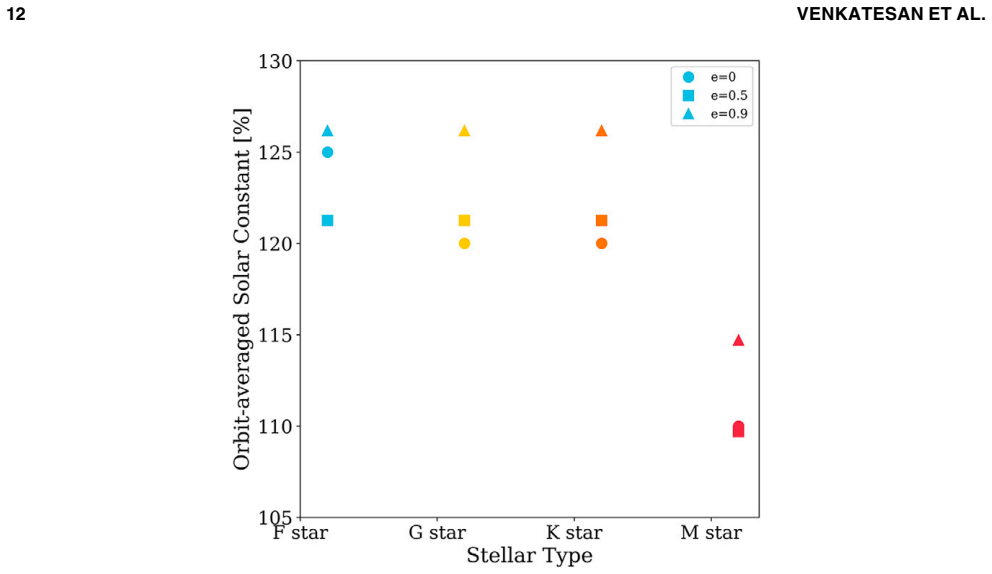
The paper finds that once a planet's zonal temperature falls below 131.06 K, the condensation point of 400 ppm CO2, its surface albedo should be replaced by the spectrally weighted reflectivity of pure CO2 ice. In cold-start simulations, F-dwarf planets require 29% more orbit-averaged flux to thaw out of global water ice cover than simulations using only the water ice-albedo parameterization; at zero eccentricity, F-dwarf planets require 30% more orbit-averaged flux than M-dwarf planets to exit a water snowball. The same physics makes the deglaciation threshold strongly grain-size dependent: a G-dwarf planet at eccentricity 0.5 needs 46.19% of the orbit-averaged solar constant with 2000 μm CO2 ice grains but 340.6% with 2 μm grains. Eccentric planets behave differently from circular ones: the two orders of magnitude higher flux received at periastron melts ice, so eccentric planets can leave a snowball with a smaller relative increase in instellation and sustain liquid-water or water-ice conditions over a wider range of orbit-averaged instellation.
Load-bearing premise
The quantitative thresholds assume that when the surface temperature falls below 131.06 K the entire surface becomes covered with pure, dust-free CO2 ice whose reflectivity is used as the planet's overall reflectivity, and that cold-start planets keep that CO2 ice until they reach water-ice melting temperatures; patchy, dusty, or earlier-subliming frost would shrink the 29% and 30% effects.
Editorial extensions
If this is right
- Habitability studies that use only a water ice-albedo parameterization underestimate the instellation needed for F-, G-, and K-dwarf planets to deglaciate; for F-dwarf planets the shortfall is 29%.
- Eccentric planets can remain in warm or partially ice-covered states across a broader range of orbit-averaged instellation because periastron heating melts ice, so the traditional circular-orbit snowball threshold may misclassify them.
- CO2 ice-grain size is a first-order climate parameter: going from 2 μm to 2000 μm grains changes the cold-start deglaciation flux for a G-dwarf planet at eccentricity 0.5 from 340.6% to 46.19% of the orbit-averaged solar constant.
- CO2 ice can condense on Earth-like planets at moderate eccentricity (0.5) and on low-instellation circular orbits, so the parameterization is relevant beyond highly eccentric cases.
- Warm-start, ice-free planets are largely insensitive to CO2 ice-grain size because water ice controls their albedo, meaning the CO2 ice effect matters most after global glaciation has occurred.
Reading between the lines
- Inference: The clean-ice numbers are likely the strongest version of the effect; real CO2 frost would carry dust and could be patchy, and lowering the albedo would shrink the 29% and 30% threshold shifts.
- Inference: The same albedo parameterization implies an observable phase-curve signature: a cold eccentric planet would brighten at visible and near-ultraviolet wavelengths near apoastron as CO2 frost forms, which future reflected-light observations could test.
- Inference: Grain metamorphosis over an orbit could make the deglaciation threshold time-dependent rather than fixed; fresh 2 μm frost at apoastron coarsening to larger grains would weaken the CO2 ice-albedo feedback before periastron.
Signed reviews
Editorial analysis
A structured set of objections, weighed in public.
Referee Report
Summary. The manuscript presents a modified one-dimensional energy balance model (North and Coakley 1979) that adds a wavelength-dependent CO2 ice surface albedo parameterization, using CO2 ice spectra from Hansen (1997) weighted by host-star spectral energy distributions. The model is applied to warm-start and cold-start climate hysteresis calculations for Earth-like planets around F2V, G2V, K2V, and M3V stars at eccentricities 0, 0.5, and 0.9, with a nominal 200 micron CO2 ice grain size and 400 ppmv CO2. The headline result is that cold-start F-dwarf planets require 29% more orbit-averaged flux to exit global water ice cover when CO2 ice albedo is included than with a water-ice-only albedo parameterization, with a 30% analogue for circular orbits; eccentric planets require smaller additional flux because of periastron heating. Additional results concern CO2 condensation thresholds, hysteresis widths, runaway greenhouse onset, and a strong sensitivity to CO2 grain size. The model is validated against Earth and Mars, and the discussion acknowledges several idealizations, including dust-free pure CO2 ice, a single CO2 abundance, and the absence of a dynamic OLR response.
Significance. The qualitative finding that CO2 ice albedo can materially affect snowball deglaciation on planets orbiting F and G stars is timely and would be a useful addition to EBM-based habitability studies. The work is not circular: the CO2 ice spectra, water ice albedos, and OLR parameterizations are externally sourced, no target threshold is fitted, and the Earth/Mars comparisons are independent. The grain-size sensitivity shown in Figure 14 is a genuinely informative result. However, the central quantitative claim is not uniquely determined by the text because the cold-start CO2-to-water albedo switch is described in two incompatible ways, and the 29% value is a point estimate without a sensitivity range around the acknowledged dust, coverage, and CO2-abundance idealizations. These issues affect the headline number rather than the basic premise, so the manuscript needs revision before the quantitative claims can be accepted.
major comments (3)
- [§2 and §3, Eq. (4)] The cold-start CO2-to-water albedo switch is described in two incompatible ways. §2 states that 'the albedo values of CO2 ice are decreased to that of water ice when the temperature reaches 271 K in the ocean and 273 K on land.' §3, Eq. (4), instead specifies CO2 ice albedo for T ≤ 131.06 K and water ice albedo for T > 131.06 K, and the prose following Eq. (4) repeats the 131.06 K switch. These rules are not equivalent: the F2V 200 micron CO2 albedo is 0.960 while the 50% snow/blue-marine water ice albedo is 0.536 (Table 2), so under the §2 rule the high CO2 albedo is applied across the entire water-ice melting branch, whereas under Eq. (4) it is active only below 131 K. The cold-start deglaciation threshold in Figure 8, which is the basis for the abstract's '29% more orbit-averaged flux' claim, depends directly on which rule was coded. Since no code is provided and the manuscript does not state the implemented rule, the headline percentage is not reproducible from the published text. Please specify the implemented algorithm, rerun the affected simulations if necessary, and restate the affected percentages.
- [Abstract, Fig. 8, §5] The 29% and 30% headline values are single point estimates. The paper's own Discussion acknowledges that Mars-like CO2 ice is dust-contaminated with albedo around 0.6, that pure dust-free CO2 ice is assumed, and that only 400 ppmv CO2 is tested; it also treats the CO2 ice surface albedo as an effective TOA albedo. Given that Figure 14 shows the deglaciation flux varying by roughly a factor of 7 between the 2 micron and 2000 micron grain sizes, the F-dwarf result is likely to be similarly sensitive to the assumed dust content, surface coverage, and CO2 abundance. Please add quantitative sensitivity tests, such as a dust-mixed CO2 albedo or partial surface coverage, or explicitly bracket the range within which the 29% and 30% values hold.
- [§4.4 and §5] Different sections report inconsistent numbers for the same G-dwarf, e = 0.5 cold-start grain-size calculations: §4.4 gives 340.6% (2 micron) and 46.19% (2000 micron) of the orbit-averaged solar constant for entry into the ice-free state, while §5 states 295% and 40%. Similarly, §4.3 says that e = 0.9 planets require 'considerably less' instellation for the runaway greenhouse transition than e = 0.5 planets, but the listed values are 126.18% versus 121.24%, which is more, not less. Please audit all reported percentages and make the abstract, results, and discussion mutually consistent.
minor comments (6)
- [Eq. (5)] Please specify the temperature units in Eq. (5); as printed, A + BT with A = 203.3 and B = 2.08 gives roughly 866 W m^-2 at 319 K if T is in kelvin, so the relationship to the 300 W m^-2 cap needs clarification.
- [Table 2] The K2V and M3V rows of Table 2 contain repeated '2 [micron]' entries and misaligned water-ice albedo labels; please reformat the table so that the CO2 ice and water ice columns are unambiguous.
- [§3.1] The Mars validation reports only that the model yielded a global mean temperature of 211 K; please provide the comparison value and its uncertainty, and state specifically which aspects of the CO2 ice parameterization are constrained by this comparison.
- [§2 and §5] The statement that when CO2 condenses 'the entire atmosphere, including water vapor, has condensed' is imprecise: at 400 ppmv CO2, CO2 condenses at 131.06 K, while water vapor would already have condensed at much higher temperatures. Please rephrase to describe the assumed layer structure accurately.
- [General] Please correct typographical errors such as '9GCMs' in Section 1, 'with can eccentricity' in Section 5, and the corrupted inequality symbol in Eq. (5).
- [Data Availability] The data availability statement lists spectra and data products but no model code; providing the EBM code, or at least a detailed decision-tree description of the cold-start albedo logic, would resolve the ambiguity raised in the first major comment.
Circularity Check
No significant circularity: the central 29% deglaciation claim is a with/without sensitivity experiment driven by externally sourced CO2 and water ice albedo spectra, not a fitted target; the same-group lineage of some inputs is not load-bearing.
full rationale
The paper's headline result is a difference between two model configurations: one with the CO2 ice-albedo parameterization and one with water ice albedo only. The CO2 surface albedos are computed from Hansen (1997) spectra via Eq. (2) and are not adjusted to reproduce the 29% threshold; water ice albedos come from Joshi and Haberle (2012) and Shields et al. (2013); no deglaciation threshold is used as a fitting target. The comparison isolates a feedback and could in principle have yielded a different sign or magnitude, so the result is not equivalent to its inputs by construction. Validation is external (Earth: CERES/ERA5; Mars: 211 K; heat transport comparisons), and the many self-citations (Shields et al. 2013, Rushby et al. 2019, Palubski et al. 2020) supply model coefficients and albedo tables rather than the deglaciation conclusion itself. One non-circular caveat must be flagged: Section 2 states that in cold-start cases the CO2 ice albedo is decreased to water ice when the temperature reaches 271 K in the ocean and 273 K on land, while Section 3 Eq. (4) and its surrounding prose switch to water ice albedo above 131.06 K. These two rules apply the high CO2 albedo over different temperature ranges on the thaw branch, so the published text does not uniquely determine the implemented rule behind the 29% F-dwarf figure. This is an internal consistency or omitted implementation detail, not a circularity.
Assumptions & free parameters
free parameters (5)
- Heat diffusion coefficient D =
0.44 W m^-2 K^-1
- OLR linearization coefficients A and B =
A=203.3 W m^-2, B=2.08 W m^-2 K^-1
- CO2 ice-grain size (nominal) =
200 µm
- Water ice mixture =
50% snow + blue marine ice
- CO2 condensation temperature =
131.06 K at 400 ppmv
assumptions (5)
- domain assumption The 1D EBM of North and Coakley (1979), including its diffusive heat transport parameterization, adequately represents planetary climate for this purpose.
- ad hoc to paper When CO2 condensation temperature is reached, the entire atmosphere including water vapor has condensed, with CO2 ice on the topmost layer.
- ad hoc to paper Surface albedo of pure CO2 ice can be treated as TOA albedo in the condensed regime because N2 and O2 radiative effects are negligible.
- domain assumption Earth-like 1 bar N2/O2 atmosphere with 400 ppmv CO2, modern land configuration, and 24 h rotation applies to all simulated planets.
- domain assumption Orbit-averaged instellation scaling (1-e^2)^-1/2 from prior studies is the correct normalization for eccentric orbit climates.
Cite this review
Pith. "Pith review of A One-Dimensional Energy Balance Model Parameterization for the Formation of CO2 Ice on the Surfaces of Eccentric Extrasolar Planets." pith.science (2026). https://pith.science/paper/LHB42GCY
@misc{pith2026250111667,
  author       = {Pith},
  title        = {Pith review of: A One-Dimensional Energy Balance Model Parameterization for the Formation of CO2 Ice on the Surfaces of Eccentric Extrasolar Planets},
  year         = {2026},
  howpublished = {\url{https://pith.science/paper/LHB42GCY}},
  note         = {Machine review of arXiv:2501.11667}
}
read the original abstract
Eccentric planets may spend a significant portion of their orbits at large distances from their host stars, where low temperatures can cause atmospheric CO2 to condense out onto the surface, similar to the polar ice caps on Mars. The radiative effects on the climates of these planets throughout their orbits would depend on the wavelength-dependent albedo of surface CO2 ice that may accumulate at or near apoastron and vary according to the spectral energy distribution of the host star. To explore these possible effects, we incorporated a CO2 ice-albedo parameterization into a one-dimensional energy balance climate model. With the inclusion of this parameterization, our simulations demonstrated that F-dwarf planets require 29% more orbit-averaged flux to thaw out of global water ice cover compared with simulations that solely use a traditional pure water ice-albedo parameterization. When no eccentricity is assumed, and host stars are varied, F-dwarf planets with higher bond albedos relative to their M-dwarf planet counterparts require 30% more orbit-averaged flux to exit a water snowball state. Additionally, the intense heat experienced at periastron aids eccentric planets in exiting a snowball state with a smaller increase in instellation compared with planets on circular orbits; this enables eccentric planets to exhibit warmer conditions along a broad range of instellation. This study emphasizes the significance of incorporating an albedo parameterization for the formation of CO2 ice into climate models to accurately assess the habitability of eccentric planets, as we show that, even at moderate eccentricities, planets with Earth-like atmospheres can reach surface temperatures cold enough for the condensation of CO2 onto their surfaces, as can planets receiving low amounts of instellation on circular orbits.
Figures


Figures from the paper (10 more)





Reference graph
Works this paper leans on
-
[1]
Mudball: Surface dust and Snowball Earth deglaciation
Abbot DS, Pierrehumbert RT. Mudball: Surface dust and Snowball Earth deglaciation. Journal of Geophysical Research (Atmos- pheres)2010;115(D3):D03104; doi: 10.1029/2009JD012007 Adams AD, Boos R, Wolf ET. Aquaplanet models on eccentric orbits: Effects of the rotation rate on observables. AJ 2019; 157(5):189; doi: 10.3847/1538-3881/ab107f Adolph AC, Albert ...
-
[514]
A super-Earth on an eccentric orbit moving in and out of the habitable zone. arXiv e-Prints, Art. arXiv 2022 2204.06376. Defrère D, Léger A, Absil O, et al. Space-based infrared inter- ferometry to study exoplanetary atmospheres. Exp Astron 2018;46(3):543–560; doi: 10.1007/s10686-018-9613-2 Deitrick R, Barnes R, Bitz C, et al. Exo-Milankovitch cycles. II....
work page Pith review arXiv 2022
-
[1061]
CO$_2$ ocean bistability on terrestrial exoplanets
Monthly Notices of the Royal Astronomical Society 2020;493(1):536–550; doi: 10 .1093/mnras/staa248 Dressing CD, Spiegel DS, Scharf CA, et al. Habitable climates: The in fluence of eccentricity. ApJ 2010;721(2):1295–1307; doi: 10.1088/0004-637X/721/2/1295 Engineering National Academies of Sciences and Medicine.Path- ways to Discovery in Astronomy and Astrop...
work page Pith review arXiv 2020
-
[1992]
Robustness and uncertainties in the new CMIP5
Knutti R, Sedlacek J. Robustness and uncertainties in the new CMIP5. Nature Clim Change 2013;3(4):369–373; doi: 10 .1038/nclimate1716 Kopparapu RK, Ramirez R, Kasting JF, et al. Habitable zones around main-sequence stars: New estimates. ApJ 2013; 765(2):131; doi: 10.1088/0004-637X/765/2/131 Kopparapu RK, Ramirez RM, SchottelKotte J, et al. Habitable zones...
arXiv 1975
-
[2010]
The evolution of the marine phosphate reservoir
Planavsky NJ, Rouxel OJ, Bekker A, et al. The evolution of the marine phosphate reservoir. Nature 2010;467(7319): 1088–1090; doi: 10.1038/nature09485 Ramirez RM. A more comprehensive habitable zone for finding life on other planets. Geosciences 2018;8(8):280; doi: 10 .3390/geosciences8080280 Ramirez RM. A new 2D energy balance model for simulating the clim...
arXiv 2010
Reviewed August 10, 2026 · model on record in the stance chip above.
Discussion (0). Continue with ORCID to comment.