REVIEW 3 major objections 5 minor 27 references
Shear Destruction of Frictional Aging and Memory
T0 review · 3 major / 5 minor · reviewed 2026-08-14 · deepseek-v4-flash
Pith's one-line read Static shear load accelerates frictional aging by tilting the interface, not by changing how contacts age.
desk verdict The central claim that shear-accelerated aging is a tilt artifact is probably right, but the paper's decisive null result relies on an unverified torque-balance assumption, and the key fits lack error bars. read the letter →
The pith
A machine-rendered reading of the paper's core claim, the machinery that carries it, and where it could break.
The reading
What carries the argument
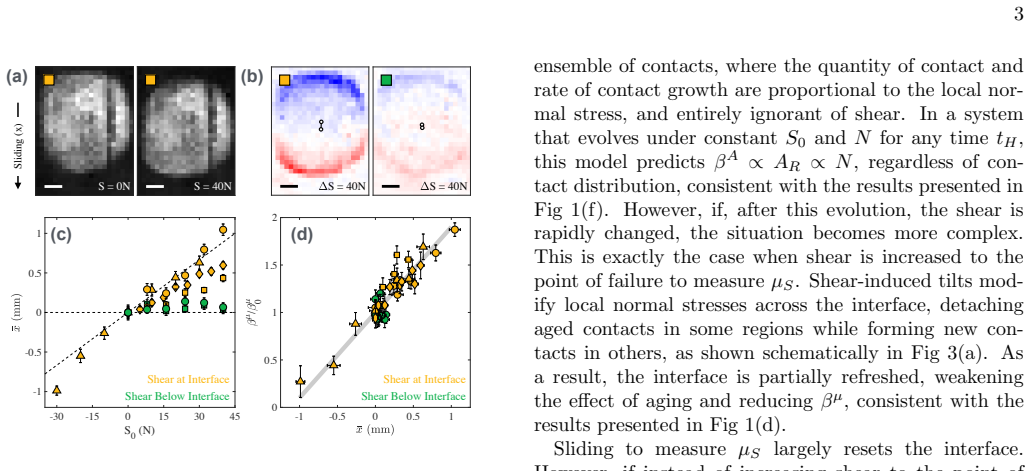
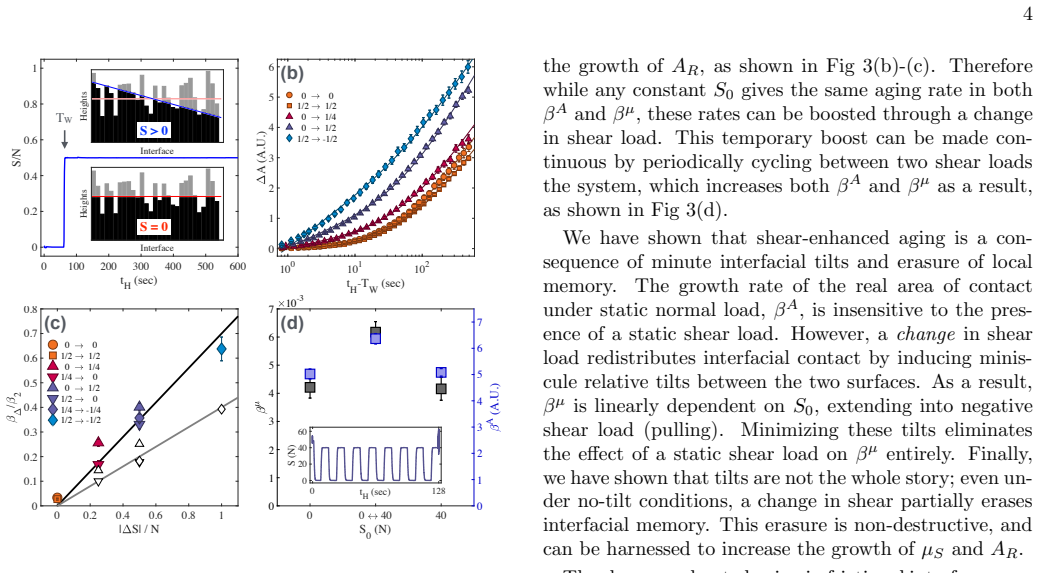
The key object is the center of contact $\bar{x}$, defined as the intensity-weighted position of the contact image. It moves linearly and monotonically with $S_0$ when shear is applied at the interface, and this motion tracks the friction aging rate $\beta_\mu$, showing that the apparent shear dependence is a redistribution of where contacts sit rather than a change in how total contact area grows. The second piece of machinery is the two-step shear protocol with the memory-refresh fraction $\varphi = \beta_\Delta / \beta_A$, which fits the post-step evolution of contact area as $\Delta A_R(t) = (\beta_A - \beta_\Delta)\log t + \beta_\Delta \log(t - t_H)$.
What would settle it
Measure the center of contact and the residual relative tilt between the blocks as a function of $S_0$ with shear applied 3 cm below the interface. If the center of contact still shifts substantially while $\beta_\mu$ stays flat, the flat $\beta_\mu$ could be a cancellation rather than proof of the geometric origin; conversely, if $\beta_A$ becomes shear-dependent under truly zero-tilt conditions, the claim that contact aging is always shear-insensitive fails.
Extended reading notes
Core claim
The central claim is that shear-accelerated frictional aging is caused by torque-induced relative tilts of the two blocks. When static shear is applied at the interface, even minute tilts near 0.01 degrees redistribute normal pressure, destroying aged contacts in some regions and creating fresh ones, so interfacial memory is partially erased. The measured frictional aging rate $\beta_\mu$ is linear in static shear $S_0$, while the contact aging rate $\beta_A$ is unaffected by shear. When shear is applied below the interface so the blocks tilt in tandem, $\beta_\mu$ becomes insensitive to $S_0$, reducing the coupling coefficient $\epsilon_\mu$ to zero. Separately, a rapid change in shear erases a fraction of the interface's memory even without tilts, with the erased fraction proportional to $|\Delta S|$, and repeated changes can be used to boost both friction and contact aging rates.
Load-bearing premise
The load-bearing premise is that applying shear 3 cm below the interface truly cancels torque-induced tilting at every static shear value, with no quantitative measurement of residual tilt, so the disappearance of shear-dependent frictional aging is evidence for the geometric mechanism rather than an accidental cancellation.
Editorial extensions
If this is right
- If $\beta_A$ is truly shear-independent, then the classical identification of static friction with total real contact area fails under shear; friction models must track contact distribution, not just total area.
- The linear dependence of $\beta_\mu$ on $S_0$, including negative shear, rules out hypotheses in which shear only accelerates contact aging.
- Torque-balanced loading removes shear-enhanced aging, so previously reported shear-accelerated aging rates may have been contaminated by apparatus geometry.
- A change in shear erases interfacial memory even without tilts, with the refreshed fraction proportional to $|\Delta S|$, so phenomenological friction laws must include shear-change-induced erasure, not just elapsed time.
- Cycling between two static shear loads continuously accelerates both friction and contact-area aging, offering a way to age interfaces faster than any constant load.
Reading between the lines
- Editorial inference: if this geometric mechanism generalizes, laboratory measurements of shear-dependent aging on rock and other materials may partly reflect the loading apparatus's tilt response, and torque-balanced experiments could yield different inferred fault constitutive parameters.
- Editorial inference: cycling shear loads could be used deliberately in engineered joints or tactile interfaces to stabilize contacts faster; a direct test would switch between two small shear loads repeatedly and compare the eventual static friction with the constant-load case.
- Editorial inference: the shear-change memory erasure that persists without tilts suggests contacts are directionally sensitive to the local stress vector; rotating the in-plane shear direction should erase memory even at zero net force change, which would be a clean experimental test.
Signed reviews
Editorial analysis
A structured set of objections, weighed in public.
Referee Report
Summary. This experimental paper reports simultaneous measurements of the static friction coefficient μS and the real area of contact AR in slide-hold-slide tests on PMMA interfaces under constant normal load and various static shear loads S0. The authors find that the frictional aging rate βμ increases linearly with positive S0 and decreases with negative S0, whereas the contact-area aging rate βA is insensitive to S0. They attribute the shear dependence of βμ to minute relative tilts between the two blocks caused by torque imbalance when shear is applied at the interface; these tilts redistribute normal pressure, destroying aged contacts and creating fresh ones. Supporting evidence includes the linear dependence of the center of contact displacement x on S0 and the collapse of βμ/βμ0 versus x for both shear-application geometries. Applying shear 3 cm below the interface is claimed to approximately balance the torques and reduce εμ to zero. The paper also identifies a secondary, non-geometric memory-erasure effect: even in regions with minimal tilt-induced contact change, a change in shear erases part of the interfacial memory, with the refreshed fraction φ ∝ |ΔS|. Exploiting this effect, the authors show that cycling between two shear loads accelerates both βA and βμ.
Significance. If the results hold, the paper makes a valuable contribution by resolving the long-standing puzzle of shear-accelerated frictional aging: it provides strong evidence that the effect is geometric in origin, caused by tilt-induced contact redistribution rather than by an intrinsic effect of shear on contact aging. The simultaneous measurement of μS and AR is a significant technical strength, as is the large dataset (about 4000 experiments for the βμ-versus-x collapse). The demonstration that βA is shear-insensitive while βμ is not challenges the classical equivalence between frictional strength and real area of contact. The secondary memory-erasure effect and the shear-cycling acceleration protocol are novel and potentially useful. The paper is clearly written and the central claims are falsifiable; however, the decisive null result (εμ → 0 for shear applied below the interface) depends on an unquantified torque-balance assumption, and the key fits lack stated uncertainties, which currently limits the strength of the conclusions.
major comments (3)
- [Fig 1(d) and 'Shear Below Interface' paragraph] The central claim that shear-accelerated frictional aging is purely geometrical rests on the null result εμ → 0 when shear is applied 3 cm below the interface. However, the paper only states that this loading point 'approximately balances torque-induced tilting' and provides no quantitative torque-balance calculation or direct measurement of residual tilt (for example, x versus S0 for the lower loading point) for each S0 value tested. Without such evidence, the null result could be explained by a residual tilt that is smaller than the experimental resolution, or by a fortuitous cancellation of tilt-induced erasure with another shear effect. Please provide a quantitative assessment of the torque balance, or a measurement of the residual contact redistribution at the lower loading point, and show that the extracted εμ is consistent with zero within the experimental uncertainty.
- [Fig 1(d),(f) and fits to Eqs. (2)-(3)] The key quantitative claims—that εμ is approximately constant across samples and that βA is independent of S0—are supported only by visual inspection of plots with no error bars, confidence intervals, or goodness-of-fit measures. The report states 'about 4000 total experiments' for the collapse in Fig. 2(d), but the number of independent measurements per point, the reproducibility across sample pairs, and the statistical significance of the εμ values in Fig. 1(d) are not reported. Please add error bars or uncertainty bands to all fitted quantities and specify the statistical methods used to infer that the below-interface εμ is consistent with zero.
- [Eq. (5) and Fig. 3(c)] The secondary memory-erasure effect is quantified through the parameter φ = βΔ/βA extracted from fits to Eq. (5). The paper states that φ ∝ |ΔS| from both full-interface and central-region data, but the fitting procedure, the number of experiments, and the uncertainty in φ are not given. In particular, the criteria for 'regions of the interface with less than 5% change in total contact' need to be specified precisely, and the robustness of the linear φ versus |ΔS| relation to those criteria should be demonstrated. This is a separate effect from the main geometric claim, but it is load-bearing for the proposed shear-cycling application.
minor comments (5)
- [Fig. 2 and text near Eq. (4)] The text says 'as seen by comparing Fig 1(d) and Fig 2(b). Indeed, the two values are equivalent, as shown in Fig 2(c).' This appears to be a typo: the collapse of βμ with x is shown in Fig. 2(d), while Fig. 2(c) shows x versus S0. Please revise the cross-references.
- [Fig. 3 caption and legend] In Fig. 3(c), the vertical axis is labeled 'βΔ/β2', but the text and Eq. (5) define φ = βΔ/βA. Please clarify whether 'β2' is the same as βA or a different quantity, and use consistent notation throughout.
- [Fig. 1(a) schematic] The 'Frictionless Rails' in the schematic are not described in the text. Please explain how frictionless rails are achieved and why they do not affect the torque balance.
- [Methods and randomization protocol] The randomization and averaging protocol is said to be 'identical to the protocol described in [19]'. Since this manuscript is self-contained enough to be evaluated, please briefly outline the protocol or include the key details in the main text or supplemental material.
- [Definitions in Eq. (4)] In Eq. (4), the variable x is defined as a center of contact displacement, but the text says 'x is linear and monotonic in S0'. Please clarify the units and how the constant C is chosen, and specify whether x is measured for the entire interface or for a central region.
Circularity Check
No significant circularity: central experimental claims are measured independently, with only minor non-load-bearing self-citation for methods and a prior model.
full rationale
The central claims are experimental measurements that do not reduce to their own inputs. The linear dependence of the frictional aging rate on static shear (Eq. 2) is obtained from slide-hold-slide measurements; the shear insensitivity of the contact-area aging rate (Eq. 3) is obtained from simultaneous area measurements; the center-of-contact coordinate (Eq. 4) is defined independently of the aging rates; and the null result at the 3 cm loading point is a direct measurement. None of these quantities is defined in terms of another, and no fitted parameter is renamed as a prediction. The prior model of Ref. [19] is cited for the measurement technique and for the functional form of Eq. 5, and the parameter beta_Delta is fitted to two-step shear data; however, the resulting proportionality phi proportional to |Delta S| is an empirical correlation not contained in the fitted functional form, so the interpretation is a test of a prior model against new data rather than a derivation that assumes the conclusion. The only load-bearing assumption, that the 3 cm offset approximately balances torque-induced tilts, is an experimental validity concern and not a circularity: an unverified or imperfect torque balance would weaken the geometric interpretation but does not make any equation equivalent to its input by construction. The self-citation to Ref. [19] is not load-bearing for the paper's primary new claims, which stand on the direct measurements shown in Figs. 1 and 2. Accordingly, the circularity score is 1, reflecting only a minor, non-circular reliance on the authors' prior methods and model.
Assumptions & free parameters
free parameters (2)
- epsilon_mu =
~0.017 N^-1
- beta_Delta (or phi = beta_Delta/beta_A) =
varies per protocol; phi up to ~0.4 to 0.8
assumptions (3)
- domain assumption The interface can be described by the linear model of Dillavou and Rubinstein 2018 [19], where contact growth rate at each point is proportional to local normal stress and independent of shear.
- domain assumption The total internal reflection intensity field I(x,y) is a monotonic measure of real area of contact AR.
- domain assumption Sliding at 0.33 mm/s before each experiment fully resets the interface.
Cite this review
Pith. "Pith review of Shear Destruction of Frictional Aging and Memory." pith.science (2026). https://pith.science/paper/LHHH4UBK
@misc{pith2026190802676,
  author       = {Pith},
  title        = {Pith review of: Shear Destruction of Frictional Aging and Memory},
  year         = {2026},
  howpublished = {\url{https://pith.science/paper/LHHH4UBK}},
  note         = {Machine review of arXiv:1908.02676}
}
read the original abstract
We simultaneously measure the static friction and the real area of contact between two solid bodies. Under static conditions both quantities increase logarithmically in time, a phenomenon coined aging. Indeed, frictional strength is traditionally considered equivalent to the real area of contact. Here we show that this equivalence breaks down when a static shear load is applied during aging. The addition of such a shear load accelerates frictional aging while the aging rate of the real area of contact is unaffected. Moreover, a negative static shear - pulling instead of pushing - slows frictional aging, but similarly does not affect the aging of contacts. The origin of this shear effect on aging is geometrical. When shear load is increased, minute relative tilts between the two blocks prematurely erase interfacial memory prior to sliding, negating the effect of aging. Modifying the loading point of the interface eliminates these tilts and as a result frictional aging rate becomes insensitive to shear. We also identify a secondary memory-erasure effect that remains even when all tilts are eliminated and show that this effect can be leveraged to accelerate aging by cycling between two static shear loads.
Figures

Reference graph
Works this paper leans on
-
[1]
P. Berthoud, T. Baumberger, C. G’sell, and J. M. Hiver, Phys. Rev. B 59 (1999)
work page 1999
-
[2]
Bocquet, E
L. Bocquet, E. Charlaix, S. Ciliberto, and J. Crassous, Nature 396, 735 (1998)
1998
-
[3]
K. M. Frye and C. Marone, J. Geophys. Res. 107, ETG 11 (2002)
work page 2002
-
[4]
S. L. Karner and C. Marone, Geophysical Research Let- ters 25, 4561 (1998)
work page 1998
-
[5]
S. L. Karner and C. Marone, Geophysical Monograph (2000)
work page 2000
-
[6]
S. L. Karner, C. M. J. o. G. R. Solid, and 2001, Wiley Online Library (2001)
work page 2001
-
[7]
T. Yamaguchi, Y. Sawae, and S. M. Rubinstein, Ext. Mech. Lett. 9, 331 (2016)
work page 2016
- [8]
Show all 27 references
-
[9]
F. P. Bowden and D. Tabor, The Friction and Lubrica- 5 tion of Solids (Clarendon Press Oxford, 1950)
1950
-
[10]
J. H. Dieterich, J. Geophys. Res. 84, 2161 (1979)
1979
-
[11]
J. R. Rice and A. Ruina, J. Appl. Mech. 50, 343 (1983)
1983
-
[12]
Ruina, J
A. Ruina, J. Geophys. Res. 88, 10359 (1983)
1983
-
[13]
Rabinowicz, Friction and Wear of Materials (1965)
E. Rabinowicz, Friction and Wear of Materials (1965)
1965
-
[14]
J. H. Dieterich, J. Geophys. Res. 77, 3690 (1972)
1972
-
[15]
to metal [13] to plastic [1] and even granular materi- als [4], the static coefficient of friction grows logarithmi- cally in time under constant normal load, often referred to as aging. This evolution is most often attributed to an increase in the real area of contact, AR, with...
1908 arXiv
-
[16]
Heslot, T
F. Heslot, T. Baumberger, B. Perrin, B. Caroli, and C. Caroli, Phys. Rev. E 49, 4973 (1994)
1994
-
[17]
J. H. Dieterich and B. D. Kilgore, US Geological Survey 143, 283 (1994)
1994
-
[18]
Baumberger and C
T. Baumberger and C. Caroli, Adv. Phys. 55, 279 (2006)
2006
-
[19]
Q. Li, T. E. Tullis, D. Goldsby, and R. W. Carpick, Nature 480, 233 (2011)
2011
-
[20]
Dillavou and S
S. Dillavou and S. M. Rubinstein, Phys. Rev. Lett. 120, 224101 (2018)
2018
-
[21]
A. Amir, Y. Oreg, and Y. Imry, PNAS 109, 1850 (2012)
2012
-
[22]
Lahini, O
Y. Lahini, O. Gottesman, A. Amir, and S. M. Rubin- stein, Phys. Rev. Lett. 118, 394 (2017)
2017
-
[23]
Nakatani and H
M. Nakatani and H. Mochizuki, Geophysical Research Letters 23, 869 (1996)
1996
-
[24]
Bureau, T
L. Bureau, T. Baumberger, and C. Caroli, Eur. Phys. J. E 8, 331 (2002)
2002
-
[25]
K. L. Ryan, J. Rivi` ere, and C. Marone, J. Geophys. Res. 123, 10,479 (2018)
2018
-
[26]
Nagata, M
K. Nagata, M. Nakatani, and S. Yoshida, (2012)
2012
- [27]
Reviewed August 14, 2026 · model on record in the stance chip above.
Discussion (0). Continue with ORCID to comment.