REVIEW 3 major objections 3 minor 30 references
A celestial reference frame derived from observations with the Very Long Baseline Interferometry Global Observing System
T0 review · 3 major / 3 minor · reviewed 2026-08-12 · deepseek-v4-flash
Pith's one-line read Five years of VGOS broadband VLBI data define a 418-source celestial frame with sub-50-microarcsecond formal errors that improves geodetic baseline analysis.
desk verdict First VGOS-only CRF with a public catalog and careful documentation, but the headline geodetic gain needs a holdout test to rule out self-consistency. read the letter →
The pith
A machine-rendered reading of the paper's core claim, the machinery that carries it, and where it could break.
The reading
What carries the argument
The load-bearing objects are the group delays from VGOS broadband sessions, estimated in a global adjustment with piece-wise linear offsets for clocks, zenith wet delay, tropospheric gradients, Earth-rotation parameters, and celestial pole offsets. The frame is aligned to ICRF3-SX through a no-net-rotation condition on 71 ICRF3 defining sources with more than 1000 observations, plus a zero-slope constraint in the declination difference. Comparisons are made with vector spherical harmonics (VSH) up to degree and order two, and with the normalized angular separation $D_n$ built from coordinate differences scaled by the combined formal errors; the VSH analysis is what turns raw position differences into statements about systematic rotation, dipole, and quadrupole distortions. In the geodetic evaluation, baseline-length wrms and the five Earth-orientation parameters computed with the frame fixed to VIE2023-VG versus ICRF3-SX form the quantitative bridge from astrometry to geodesy.
What would settle it
Split the 155 VGOS sessions into two disjoint halves, estimate VIE2023-VG-style CRFs from each half, fix each frame in the single-session analysis of the other half, and compare baseline-length and EOP wrms against ICRF3-SX; if the up-to-3 mm improvement disappears, the current comparison is largely a self-consistency effect. A second check is to remove the zero-slope declination constraint and see whether the VSH distortion terms grow, which would show that the constraint, rather than the data, is carrying the frame's declination alignment.
Extended reading notes
Core claim
The central claim is that VIE2023-VG, a global least-squares CRF estimated from VGOS group delays only, achieves source-position formal errors of 30 $\mu$as in $\alpha^*$ and 47 $\mu$as in $\delta$ (median over all 418 sources), and that using this VGOS-based frame as the fixed a priori in single-session geodetic analysis improves baseline-length repeatability by up to 3 mm on baselines longer than about 12,000 km, with weighted-mean baseline-length offsets up to 2 mm. In systematic terms, the largest vector-spherical-harmonic distortions relative to ICRF3-SX reach about 60 $\mu$as for degree and order up to two, and these reduce by roughly a factor of two when the 85 sources with normalized angular separation $D_n>5$ are removed, implicating source structure rather than a global frame defect. Because southern-hemisphere observations are scarce, the solution applies a zero-slope constraint on the declination difference versus ICRF3-SX on top of the no-net-rotation condition; the authors take this as evidence that adding southern VGOS stations is a prerequisite for a fully self-consistent VGOS frame.
Load-bearing premise
The evaluation of the frame's geodetic benefit assumes that fixing a frame derived from the same 155 VGOS sessions is a fair comparison; if the global solution absorbs session-specific errors, the reported baseline-length and EOP improvements would shrink or vanish when the frame is tested on data that did not contribute to it.
Editorial extensions
If this is right
- VGOS-only session analysis can replace ICRF3-SX as the operational a priori, improving the height and north components of station positions at essentially all stations.
- The source-centric scheduling strategy used in VR2301 and VR2302 should become the default for VGOS, since it roughly doubles source counts per session with a much more even scan distribution.
- The next bottleneck is southern sky coverage: frame distortions and the need for the zero-slope declination constraint will persist until more southern VGOS stations join the network.
- Denser tropospheric estimation (5–10 minute zenith wet delay) benefits mid-declination sources but hurts far-southern sources until southern stations gain better sky coverage.
- The outlier analysis implies that a combined S/X and VGOS frame would degrade the best VGOS-only positions, so frequency-separated frames, not one mixed frame, are the path to highest accuracy.
Reading between the lines
- If the baseline-length improvement is genuine and not a self-consistency artifact, then every geodetic analysis of VGOS data should adopt a VGOS-only CRF, and the 1 mm GGOS target depends less on the frame's formal precision than on southern network geometry.
- The roughly linear growth of the wrms improvement with baseline length (about 0.14 mm per megameter) suggests the gain is dominated by declination errors mapping into low-elevation observations and into the north component of station positions, which is testable by comparing north versus east station-position scatter.
- A stronger test would split the 155 sessions into two disjoint halves, estimate a CRF from each half, fix each frame in the single-session analysis of the other half, and re-measure the baseline-length and EOP gains; if the up-to-3 mm improvement survives disjoint estimation, it is a real frame-quality gain.
- The same VSH machinery applied to future VGOS frames with southern stations would show whether the roughly 60 $\mu$as distortion terms shrink or rotate, giving a quantitative check on how much the network geometry contributes to the frame.
Editorial analysis
A structured set of objections, weighed in public.
Referee Report
Summary. The paper constructs VIE2023-VG, a celestial reference frame estimated from 155 multi-baseline 24-hour VGOS sessions up to 2024.0, using 1.39 million group delays and yielding 418 source positions. It documents VGOS source selection and scheduling, compares the new frame with ICRF3-SX and with the S/X-based VIE2023sx frame using normalized angular separations and vector spherical harmonics, tests alternative tropospheric delay estimation intervals, and evaluates the frame geodetically by fixing source coordinates in single-session analyses to either VIE2023-VG or ICRF3-SX. The headline claims are median formal errors of 30 microarcseconds in right ascension and 47 microarcseconds in declination, VSH distortions up to about 60 microarcseconds relative to ICRF3-SX, and improvements in baseline-length weighted root mean square of up to 3 mm and in EOP wrms of approximately 10-15% when the VGOS-based frame is fixed instead of ICRF3-SX.
Significance. If the frame and its evaluation are accepted, the paper would be a timely and useful contribution to the VLBI transition to VGOS: it provides a publicly available VGOS-only CRF, carefully documents scheduling strategies, and quantifies the impact of source-position priors on geodetic products. The detailed treatment of the VGOS-R&D sessions and the source-centric scheduling approach is a genuine strength, as is the provision of the catalog through a DOI. However, the geodetic validation is not independent of the frame construction, because the same 155 sessions are used to estimate VIE2023-VG and then to test it, and the VSH comparisons are partially constrained by the datum definition. Those limitations do not invalidate the catalog itself, but they mean the headline accuracy improvements should be viewed as provisional until an independent validation is performed.
major comments (3)
- [Sect. 6.3, Table 8, Fig. 15] The central geodetic evaluation is self-referential: the VIE2023-VG CRF used in solutions S2 and S4 is estimated from exactly the same 155 VGOS sessions that are then analyzed session-wise with that frame fixed. Any session-specific systematic errors absorbed into the global source coordinates, for example from the sparse southern network or from tropospheric mismodeling, will be consistently re-absorbed when those coordinates are fixed in the single-session solutions, artificially reducing the baseline-length and EOP scatter relative to a comparison with ICRF3-SX, which shares no data with the VGOS sessions. The reported improvements of up to 3 mm in baseline length and 10-15% in EOP wrms are therefore not an independent measure of the frame's accuracy. I recommend either a holdout test (estimating the CRF from one subset of sessions and evaluating it on the remaining sessions) or a comparison against an independently estimated VGOS CRF from another analysis center, and the manuscript should state clearly that such validation has not yet been performed.
- [Sect. 4 and Sect. 6.1, Table 5] The VSH comparison with ICRF3-SX is partly forced by the datum definition. As described in Sect. 4, the global solution applies an NNR condition on 71 ICRF3 defining sources plus a zero-slope constraint on the declination differences with respect to ICRF3-SX. Consequently, the rotation and declination-slope components of the VSH fit in Table 5 are not free parameters, and their small or moderate values do not by themselves demonstrate that the frame has small systematic distortions relative to ICRF3-SX. The ambiguity is visible in the text: the 16-parameter VSH solution gives R1 = +56 +/- 16 microas, while the three-rotation-only solution gives R1 = -8 +/- 10 microas, confirming strong correlations among the VSH components. The abstract and conclusion statements that the largest systematic distortions 'reach about 60 microas' should be reworded to state which components are affected by the datum constraints and to avoid implying that the distortions are independently measured.
- [Sect. 5, Table 2, Abstract] The claim of 'excellent source position precision' rests on raw formal errors from the least-squares adjustment. The authors themselves note in Sect. 5 that a careful accuracy investigation is needed before reporting realistic uncertainties, and the ICRF3 analysis applies a 1.5 scaling factor and a 30 microas noise floor to formal errors. Given that the comparison with ICRF3-SX in Sect. 6.1 yields wrms differences of 80-100 microas for well-behaved sources, the median formal errors of 30/47 microas should not be presented without an explicit caveat that they are uncalibrated precision estimates. At minimum, the abstract should be changed from 'excellent source position precision' to a statement that the formal precision is excellent but unvalidated, or the paper should provide an independent accuracy assessment such as comparison with an external catalog that accounts for the datum and noise-floor issues.
minor comments (3)
- [Sects. 1-2] The paper refers to ten VGOS-R&D sessions, but Sect. 2 names VR2101, VR2201-VR2206, VR2301, VR2302, and VR2304 and excludes VR2303 because its database was not released; please state explicitly that the ten analyzed R&D sessions exclude VR2303.
- [Fig. 11] The figure legend uses 'gr180' while the text and Table 7 use 'zwd30gr180' or 'grd180'; unify the notation to avoid confusion.
- [Table 5 notes] The table note 'The second and third columns show comparisons...' is slightly ambiguous because the table has five numeric columns; rephrase to identify columns 2-3 and 4-5 by their headings (ICRF3-SX and VIE2023sx, for Dn<15 and Dn<5).
Circularity Check
Geodetic gains are an in-sample self-consistency statistic, and the VSH comparison is partially constrained to ICRF3-SX by construction.
-
fitted input called prediction
[Sect. 4 and Sect. 6.3 (Table 8, Figs. 15-19, Table 10)]
"The VIE2023-VG CRF was computed from all 24-hour multi-baseline VGOS sessions introduced in Sects. 2 and 3 ... which makes 155 VGOS sessions in total that are provided through the IVS. ... We analyzed the full set of VGOS-OPS and VGOS-R&D sessions until 2024.0 with the standard parameterization (Table 1) and created two groups of session-wise solutions: S1 with source coordinates fixed to ICRF3-SX, and S2 with source coordinates fixed to VIE2023-VG CRF."
The catalog evaluated in Sect. 6.3 was itself estimated from the same 155 VGOS sessions that are then re-analyzed in S2 with those source positions fixed. Any session-specific network, tropospheric, or source-position error absorbed into the global VIE2023-VG CRF will be consistently re-absorbed when the same positions are fixed in the single-session solutions, artificially reducing baseline-length and EOP wrms relative to S1. ICRF3-SX is not adjusted to VGOS, so the comparison is asymmetric. The reported up-to-3 mm baseline wrms improvement and 10-15% EOP wrms improvement are therefore in-sample self-consistency statistics rather than an independent geodetic prediction; no holdout sessions or independently estimated VGOS CRF are used.
-
self definitional
[Abstract, Sect. 4, Sect. 6.1 (Table 5), Conclusion 4]
"Because of the lack of observations in the southern hemisphere, a constraint for a zero slope in declination difference with respect to ICRF3-SX is imposed in the global adjustment. ... In addition, a constraint for a zero slope in declination estimates versus declination was applied."
The VIE2023-VG CRF is defined with a zero-slope-in-declination constraint relative to ICRF3-SX, so the corresponding systematic mode of the VIE2023-VG minus ICRF3-SX comparison is forced to zero by construction. Presenting the VSH analysis as an evaluation of 'systematic distortions versus ICRF3-SX' is therefore partly a restatement of the datum definition, not an independent check. The paper discloses this constraint clearly, which limits the severity, but the VSH numbers in Table 5 cannot be read as free outcomes of the VGOS data alone.
full rationale
Much of this paper is not circular: the source-selection statistics, scheduling-strategy comparisons, outlier time-series analysis, and tropospheric-parameterization tests are self-contained calculations with stated inputs, and the authors explicitly caution that raw formal errors are not calibrated accuracy. The main circularity concern is the headline geodetic evaluation in Sect. 6.3: VIE2023-VG was estimated from the same 155 VGOS sessions whose baseline-length and EOP wrms are then compared under S2 (fixed VIE2023-VG) versus S1 (fixed ICRF3-SX). This is an in-sample comparison, and because ICRF3-SX was not adjusted to VGOS data, the improvement could reflect self-consistency rather than independent gain. The paper also imposes a zero-slope-in-declination constraint with respect to ICRF3-SX, so the VSH comparison is partly a consequence of the datum definition; the paper acknowledges this constraint but still treats the VSH residuals as findings. A holdout test or a comparison against an independently estimated VGOS CRF would be needed to convert the reported 1-3 mm geodetic gains into an independent result. Because the constraints are disclosed and the geodetic improvement is not a deterministic identity but an in-sample statistic, the appropriate score is 6 rather than higher.
Assumptions & free parameters
free parameters (4)
- Declination slope constraint =
0 (forced)
- HOBART12 (Hb) down-weighting =
additional variance of (5 cm)^2
- Outlier thresholds =
Dn > 15 and Dn > 5
- Tropospheric estimation intervals =
zwd 30 min, gradients 3 h
assumptions (4)
- domain assumption VLBI group delays are unbiased astrometric observables after correlation and fringe fitting.
- domain assumption NNR datum definition using 71 ICRF3 defining sources, and ITRF2020/ICRF3-SX a priori positions, are accurate.
- domain assumption Tropospheric delays can be represented by piece-wise linear offsets with the chosen intervals and relative constraints.
- domain assumption Source structure is stable over time or accounted for by structure indices.
Cite this review
Pith. "Pith review of A celestial reference frame derived from observations with the Very Long Baseline Interferometry Global Observing System." pith.science (2026). https://pith.science/paper/LHSUG33Y
@misc{pith2026241114956,
  author       = {Pith},
  title        = {Pith review of: A celestial reference frame derived from observations with the Very Long Baseline Interferometry Global Observing System},
  year         = {2026},
  howpublished = {\url{https://pith.science/paper/LHSUG33Y}},
  note         = {Machine review of arXiv:2411.14956}
}
read the original abstract
Aims: We computed a celestial reference frame (CRF) from Very Long Baseline Interferometry (VLBI) Global Observing System (VGOS) data after five years of regular observations (155 multi-baseline 24-hour VGOS sessions until 2024.0). In this paper we document the source selection and scheduling strategies for the individual sessions, and investigate the effect of using this new VGOS CRF in the analysis of individual geodetic VLBI sessions. We carried out several comparisons with ICRF3-SX, and with VIE2023sx CRF which includes VLBI S/X data until 2024.0. Furthermore, we studied the effect of more frequent estimations of tropospheric parameters on the estimated CRF in the current VGOS network. We evaluated the VIE2023-VG CRF in the geodetic analysis of VGOS sessions where the source positions were fixed to either the VIE2023-VG CRF or to ICRF3-SX. Results: The current VIE2023-VG CRF is built with 1.39 million VGOS group delays and includes 418 radio sources, where 172 sources (41%) are introduced in only four research and development sessions alone. We show that the VIE2023-VG CRF has excellent source position precision. The median formal error from the least-squares adjustment is 30 microas for right ascension (scaled by cosine of declination) and 47 microas for declination. In terms of systematic distortions versus ICRF3-SX, the largest terms in the vector spherical harmonics up to the degree and order two, reach in absolute values around 60 microas, caused by correlations between the individual terms. Because of the lack of observations in the southern hemisphere, a constraint for a zero slope in declination difference with respect to ICRF3-SX is imposed in the global adjustment. Therefore, VGOS should prioritize the development of southern stations in order to limit the need for such constraints on the frame.
Figures
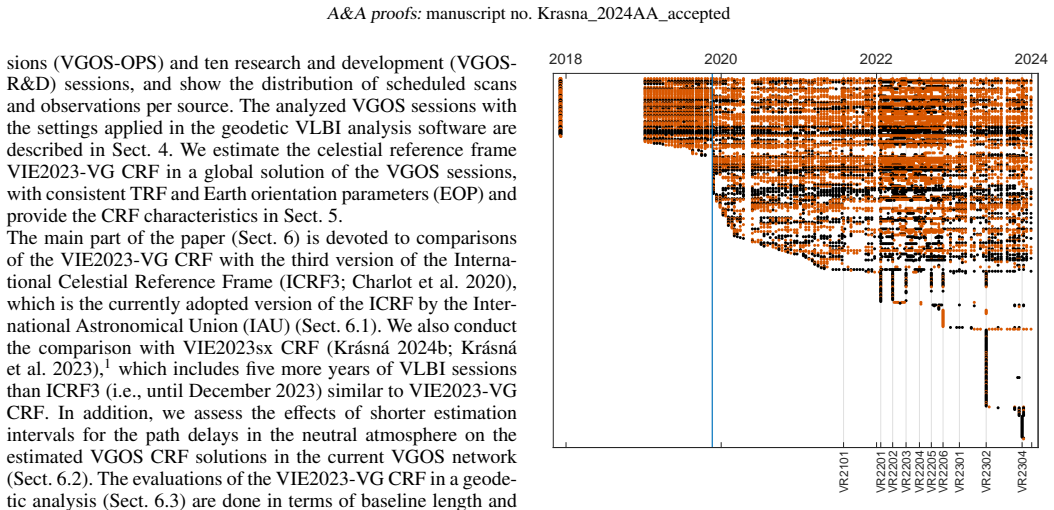


Figures from the paper (15 more)


Reference graph
Works this paper leans on
-
[1]
Altamimi, Z., Rebischung, P., Collilieux, X., Métivier, L., & Chanard, K. 2023, J Geod, 97
work page 2023
-
[2]
Blewitt, G., Altamimi, Z., Davis, J., et al. 2010, Geodetic Observations and Global Reference Frame Contributions to Understanding Sea-Level Rise and Variability (John Wiley and Sons, Ltd), 256–284 Böhm, J., Böhm, S., Boisits, J., et al. 2018, Publ Astron Soc Pac, 130, 044503
work page 2010
-
[3]
2014, in IVS GM Proceedings, ed
Cappallo, R. 2014, in IVS GM Proceedings, ed. D. Behrend, K. D. Baver, & K. L. Armstrong (Science Press, Beijing), 91–96
work page 2014
-
[4]
Charlot, P., Jacobs, C. S., Gordon, D., et al. 2020, Astron Astrophys, 644, A159
work page 2020
-
[5]
Collioud, A. & Charlot, P. 2019, in Proceedings of the 24th European VLBI Group for Geodesy and Astrometry Working Meeting, ed. R. Haas, S. Garcia- Espada, & J. A. López-Fernández, 219–223
work page 2019
- [6]
-
[7]
Fey, A. L. & Charlot, P. 1997, ApJS, 111, 95
work page 1997
-
[8]
2010, in IVS GM Proceedings, ed
Gipson, J. 2010, in IVS GM Proceedings, ed. D. Behrend & K. Baver (NASA), 77–84
work page 2010
Show all 30 references
-
[9]
& IVS Working Group IV on Data Structures
Gipson, J. & IVS Working Group IV on Data Structures. 2021, 141
2021
-
[10]
2008, in IVS GM Proceedings, ed
Gipson, J., MacMillan, D., & Petrov, L. 2008, in IVS GM Proceedings, ed. A. Finkelstein & D. Behrend, 157–162 Gómez, M. E., Fernández, L. I., & Hase, H. 2024, J Geod, 98, 87
2008
-
[11]
& Pedreros, F
Hase, H. & Pedreros, F. 2014, J Geod, 88, 989
2014
-
[12]
2022, in IAG Symposia (Springer Berlin Heidelberg), 1–11
Hellmers, H., Modiri, S., Bachmann, S., et al. 2022, in IAG Symposia (Springer Berlin Heidelberg), 1–11
2022
-
[13]
2010, in IVS GM Proceedings, ed
Jacobs, C., Heflin, M., Lanyi, G., Sovers, O., & Steppe, J. 2010, in IVS GM Proceedings, ed. D. Behrend & K. D. Baver (NASA), 305–309 Krásná, H. 2024a, Celestial reference frame 2023 from VGOS sessions, (1.0.0) [Data set]. TU Wien. https://doi.org/10.48436/m6j36-s1082 Krásná, ...
2010 doi
-
[14]
& Malkin, Z
Lambert, S. & Malkin, Z. 2023, A&A, 669, A138
2023
-
[15]
MacMillan, D. S. & Ma, C. 1997, Geophys Res Lett, 24, 453
1997
-
[16]
2008, J Geod, 82, 325
Malkin, Z. 2008, J Geod, 82, 325
2008
-
[17]
2024, Astron J, 167, 229
Malkin, Z. 2024, Astron J, 167, 229
2024
-
[18]
2014, Acta Geod Geophys, 49, 313–325
Mayer, D., Böhm, J., Combrinck, L., Botai, J., & Böhm, S. 2014, Acta Geod Geophys, 49, 313–325
2014
-
[19]
& Klioner, S
Mignard, F. & Klioner, S. 2012, Astron Astrophys, 547, A59
2012
-
[20]
2016, A&A, 595, A5
Mignard, F., Klioner, S., Lindegren, L., et al. 2016, A&A, 595, A5
2016
-
[21]
2018, Radio Science, 53, 1269
Niell, A., Barrett, J., Burns, A., et al. 2018, Radio Science, 53, 1269
2018
-
[22]
2017, J Geod, 91(7), 711
Nothnagel, A., Artz, T., Behrend, D., & Malkin, Z. 2017, J Geod, 91(7), 711
2017
-
[23]
2009, Design Aspects of the VLBI2010 System
Petrachenko, B., Niell, A., Behrend, D., et al. 2009, Design Aspects of the VLBI2010 System. Progress Report of the VLBI2010 Committee, Technical Memorandum NASA/TM-2009-214180
2009
-
[24]
E., Corey, B
Petrachenko, B., Niell, A. E., Corey, B. E., et al. 2012, in Geodesy for planet Earth, ed. S. Kenyon, M. C. Pacino, & U. Marti (Berlin, Heidelberg: Springer Berlin Heidelberg), 999–1005
2012
-
[25]
2024, Astron J, 168, 76
Petrov, L. 2024, Astron J, 168, 76
2024
-
[26]
& Böhm, J
Schartner, M. & Böhm, J. 2019, Publ Astron Soc Pac, 131, 084501
2019
-
[27]
H., & Soja, B
Schartner, M., Collioud, A., Charlot, P., Xu, M. H., & Soja, B. 2023, J Geod, 97
2023
-
[28]
2024, ArXiv e-prints [arXiv:2407.13323]
Schartner, M., Petrachenko, B., Titus, M., et al. 2024, ArXiv e-prints [arXiv:2407.13323]
2024 arXiv
-
[29]
2002, in IVS Annual Report 2001, ed
Schuh, H., Charlot, P., Hase, H., et al. 2002, in IVS Annual Report 2001, ed. B. Vandenberg (NASA), 13–45
2002
-
[30]
H., Savolainen, T., Anderson, J
Xu, M. H., Savolainen, T., Anderson, J. M., et al. 2022, A&A, 663, A83 Article number, page 16 of 16
2022
Reviewed August 12, 2026 · model on record in the stance chip above.
Discussion (0). Continue with ORCID to comment.