REVIEW 3 major objections 6 minor 14 references
First Experimental Demonstration of Probabilistic Enumerative Sphere Shaping in Optical Fiber Communications
T0 review · 3 major / 6 minor · reviewed 2026-08-14 · deepseek-v4-flash
Pith's one-line read First experimental demonstration of probabilistic enumerative sphere shaping in optical fiber: ESS-200 transmits 350 Gbit/s over 1610 km, a 15% reach increase over CCDM-200.
desk verdict A credible first experimental ESS-vs-CCDM comparison in fiber, with a robust qualitative ordering; the headline 15% reach gain is real but softer than the abstract implies because it flows through an assumed HD-FEC threshold. read the letter →
The pith
A machine-rendered reading of the paper's core claim, the machinery that carries it, and where it could break.
The reading
What carries the argument
The key object is enumerative sphere shaping (ESS): a shaping algorithm that selects output amplitude sequences whose total energy lies below a maximum bound, rather than sequences with exactly the same empirical amplitude distribution. Geometrically, CCDM addresses sequences on the shell of an n-sphere, while ESS addresses all sequences in that shell plus all inner shells. This lets ESS encode more input bits per block, lowering rate loss, and the authors show its short-blocklength advantage in AIR holds across launch powers. ESS is combined with probabilistic amplitude shaping, DVB-S2 LDPC encoding, and a finite-length AIR formula that subtracts rate loss from the bit-metric decoding rate.
What would settle it
Implement the outer staircase decoder from reference [14] on the captured received data, count post-FEC block errors for ESS-200 and CCDM-200 across distances, and see whether the distance at which the 4.5e-3 BER threshold is crossed still yields a 210 km gap; a gap much smaller than 15% would show that the reach claim is an artifact of the assumed threshold.
Extended reading notes
Core claim
The central claim is that enumerative sphere shaping, which maps input bits to bounded-energy amplitude sequences rather than to a fixed composition, retains most of the shaping gain at short blocklengths and adds nonlinear tolerance. In the experiment, at the optimal launch power of 9.5 dBm and after 1610 km of standard single-mode fiber, ESS-200 yields a post-shaping BER below the 4.5e-3 threshold of the assumed staircase outer code, while CCDM-200 fails at 1400 km. The corresponding reach gain is 15%, or 210 km; an AIR-based calculation gives a 205 km gain. The authors also report that ESS-200 slightly outperforms CCDM-3600, so the trade-off between low complexity and performance does not require sacrificing reach.
Load-bearing premise
The 15% reach comparison assumes an outer hard-decision staircase code with rate 0.9373 and BER threshold 4.5e-3 taken from the literature, and that threshold is not measured in this experiment; with a different outer code the reach numbers and the size of the gain would change.
Editorial extensions
If this is right
- At equal blocklength 200, ESS-200 gives a 15% reach increase over CCDM-200, translating to 210 km at 350 Gbit/s over SSMF.
- ESS-200 slightly outperforms CCDM-3600 in post-shaping BER, so short-block ESS offers the reach of long-block CCDM at lower implementation complexity.
- ESS-200 offers roughly the same AIR-based reach as CCDM-3600, meaning an ideal PAS with short blocks loses no information-theoretic reach.
- The shaping gain of ESS relative to CCDM-200 appears independent of launch power, so it applies in both linear and nonlinear transmission regimes.
- At the chosen rate, ESS enables 350 Gbit/s per channel with blocklength 200, a regime relevant for low-latency optical transceivers.
Reading between the lines
- Beyond the paper: because the ESS gain comes from lower rate loss rather than a code-specific property, the same class of gain should appear for other QAM orders and rates, provided the blocklength is short enough that CCDM's rate loss is large; this can be tested by repeating the loop experiment with 16-QAM or 256-QAM.
- Beyond the paper: the bounded-energy constraint of ESS could be tuned span by span, effectively co-optimizing shaping and peak-power limits; the authors do not explore this, but the mechanism they validate makes it a natural next step.
- Beyond the paper: the AIR-based reach estimate (205 km gain) is close to the BER-threshold estimate (210 km), which suggests the claimed 15% advantage is robust to the exact outer FEC choice, although only one FEC threshold was used in the paper.
- Beyond the paper: since ESS-200 already matches CCDM-3600, an even shorter blocklength could be tested to find the complexity-performance frontier; at blocklengths near 100 the rate-loss advantage of ESS over CCDM may grow.
Signed reviews
Editorial analysis
A structured set of objections, weighed in public.
Referee Report
Summary. The paper reports an experimental comparison of probabilistic enumerative sphere shaping (ESS) with blocklength 200 against constant-composition distribution matching (CCDM) with blocklengths 200 and 3600, and against uniform signaling, in a 350 Gbit/s/channel dual-polarization 64-QAM PAS system over standard single-mode fiber. The central claim is that ESS-200 achieves a 15% reach increase (210 km) over CCDM-200 at the same blocklength, while performing comparably to or slightly better than CCDM-3600. The results are presented via measured BER, effective SNR, and achievable information rate (AIR) as functions of launch power and distance.
Significance. If the results hold, this is the first experimental validation of ESS in optical fiber communications, showing that a short blocklength shaping scheme can approach the performance of long-blocklength CCDM while reducing complexity. The paper's strength is the direct experimental comparison with 1000 received LDPC blocks per setting, multiple performance metrics (BER, AIR, effective SNR), and consistency with the authors' prior simulations. The work is relevant to the design of low-latency, high-throughput optical transceivers using probabilistic shaping.
major comments (3)
- [Section IV, Fig. 3c] The central quantitative claim of a 15% reach increase (210 km) is obtained by intersecting the measured post-LDPC BER curves with the error-free threshold of an assumed outer staircase code (rate 0.9373, BER 4.5e-3) taken from Ref. [14]. This outer code is not implemented or decoded in the experiment. The validity of applying this threshold to the present shaped signals is not justified, because the error distribution at the input of the outer code depends on the inner LDPC code, the shaping algorithm, and the blocklength. To support the abstract claim of a 'demonstrated' reach increase, the authors should either implement the outer FEC or provide a sensitivity analysis showing how the reach gain changes with the chosen threshold, and explicitly state that the absolute reach values are based on an assumed FEC.
- [Section IV, Figs. 3c and 3d] No error bars or confidence intervals are reported for any measured BER or AIR value, despite the statement that 1000 received LDPC blocks were captured per launch power setting and per distance. The claimed 210 km gain is derived by interpolating between measurement points (e.g., between 1500 and 1800 km), and without a measure of statistical spread it is not possible to assess whether the observed difference between ESS-200 and CCDM-200 is significant. Please provide confidence intervals (e.g., based on binomial statistics for BER) and describe the interpolation/extrapolation procedure used to obtain reach values.
- [Section III, Fig. 3] The launch power is optimized at 1500 km (20 spans) and then fixed to 9.5 dBm for all transmission distances in Figs. 3c and 3d. If the optimal launch power depends on distance due to accumulated nonlinear effects, the comparison at other distances may not reflect each scheme's best performance, which could bias the relative reach. The authors should justify the use of a single launch power or show that small variations around 9.5 dBm do not affect the conclusions.
minor comments (6)
- [Abstract] The word 'demonstrated' overstates the result given that the reach gain is computed via an assumed outer FEC; consider using 'estimated' or 'predicted' to match the body text.
- [Section I] The term 'probabilistic enumerative sphere shaping' may be misleading because ESS as described is a bounded-energy sequence selection that induces a nonuniform distribution; consider clarifying that ESS is not inherently probabilistic in its encoding.
- [Section III, Fig. 3a] The text refers to 'black arrows' in Fig. 3a, but the arrows are not visible in the figure; please add or describe the annotations so the reader can identify the indicated performance gaps.
- [Section IV, Eq. (1)] The notation H(CCC) is used in Eq. (1) but CCC is defined only in the equation itself; please define it in the surrounding text for clarity.
- [Section IV, Fig. 3c] The horizontal dashed line labeled 'HD-FEC with rate 0.9373' should be explicitly identified in the caption as the assumed threshold from Ref. [14], not a measured result.
- [Section V] The conclusion calls ESS a 'low-complexity' alternative, but no complexity analysis is provided in the paper; please either provide a qualitative or quantitative complexity comparison or soften the claim.
Circularity Check
No circularity: the claimed reach gain is an independent measured result, evaluated against an external FEC benchmark rather than derived from the paper's own inputs.
full rationale
The paper's central claim is an experimental comparison of ESS-200 against CCDM-200 and CCDM-3600 at equal net rate. The shaping algorithms are taken from prior literature (refs. [4], [10]-[12]), the finite-length BMD AIR formula is quoted from ref. [5], and the HD-FEC threshold (rate 0.9373, BER 4.5e-3) is taken from the external staircase-code paper [14]. None of these inputs is fitted to the measured data, and none is defined in terms of the claimed 15% reach increase. The reach numbers in Fig. 3(c) are obtained by intersecting measured post-LDPC BER curves with a fixed external threshold; the AIR-based estimate in Fig. 3(d) independently gives 205 km, close to the 210 km BER-based estimate, showing that the qualitative gain is not an artifact of one metric. Although refs. [11] and [12] are authored by overlapping groups and motivate ESS, the experiment's outcome is a measured transmission result, not a derivation from those simulations; the self-citations are contextual and historical, not load-bearing. The main caveat is that the absolute 15% figure depends on an assumed outer staircase code that was not implemented, but this is an external-benchmark validity concern, not circularity.
Assumptions & free parameters
free parameters (2)
- Target shaping entropy =
9 bit/4D-sym
- Launch power =
9.5 dBm
assumptions (4)
- domain assumption The outer HD-FEC staircase code with rate 0.9373 has a BER threshold of 4.5e-3, as reported in reference [14].
- standard math The AIR formula (Eq. 1) from reference [5] correctly models the achievable information rate for finite-length bit-metric decoding with PAS.
- domain assumption The effective SNR metric from reference [13, Eq. 4] is appropriate for comparing nonlinear tolerance across shaping schemes.
- domain assumption Offline equalization using training symbols is equally fair to all shaping schemes and does not favor one method over another.
Cite this review
Pith. "Pith review of First Experimental Demonstration of Probabilistic Enumerative Sphere Shaping in Optical Fiber Communications." pith.science (2026). https://pith.science/paper/LHX3TICR
@misc{pith2026190800453,
  author       = {Pith},
  title        = {Pith review of: First Experimental Demonstration of Probabilistic Enumerative Sphere Shaping in Optical Fiber Communications},
  year         = {2026},
  howpublished = {\url{https://pith.science/paper/LHX3TICR}},
  note         = {Machine review of arXiv:1908.00453}
}
read the original abstract
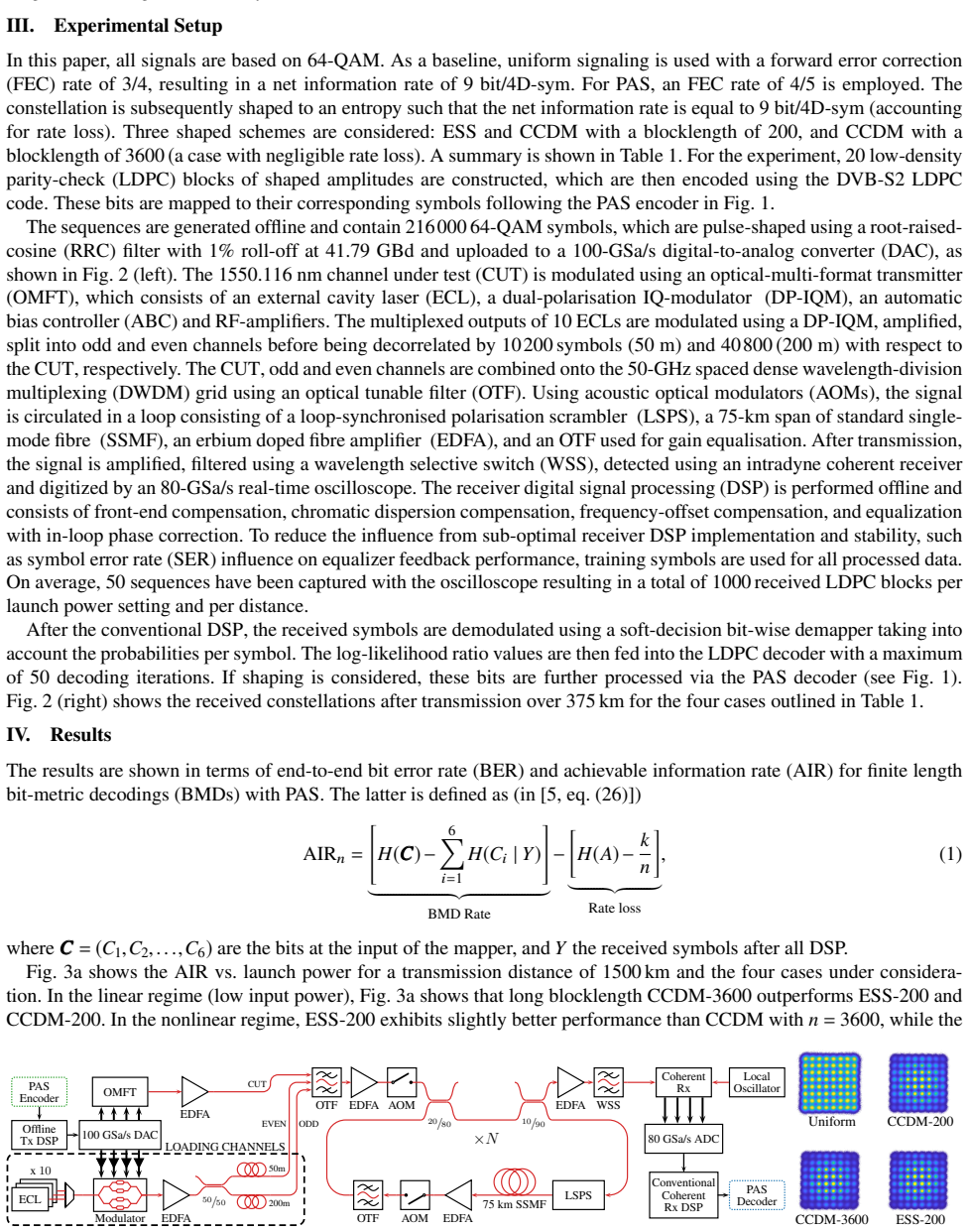
We transmit probabilistic enumerative sphere shaped dual-polarization 64-QAM at 350Gbit/s/channel over 1610km SSMF using a short blocklength of 200. A reach increase of 15% over constant composition distribution matching with identical blocklength is demonstrated.
Figures


Reference graph
Works this paper leans on
-
[12]
Introducing Enumerative Sphere Shaping for Optical Communication Systems with Short Blocklengths,
A. Amari et al. , “Introducing Enumerative Sphere Shaping for Optical Communication Systems with Short Blocklengths,” arXiv:1904.06601 (2019)
arXiv 2019
-
[14]
Staircase Codes: FEC for 100 Gb/s OTN,
B. P. Smith et al., “Staircase Codes: FEC for 100 Gb/s OTN,” JLT30, 110–117 (2012)
work page 2012
-
[1]
From scaling disparities to integrated parallelism: A decathlon for a decade,
P. J. Winzer et al., “From scaling disparities to integrated parallelism: A decathlon for a decade,” JLT35, 1099–1115 (2017)
work page 2017
-
[2]
Efficient modulation for band-limited channels,
G. Forney et al., “Efficient modulation for band-limited channels,” IEEE Journal on Selected Areas in Communications (1984)
work page 1984
-
[3]
On shaping gain in the nonlinear fiber-optic channel,
R. Dar et al., “On shaping gain in the nonlinear fiber-optic channel,” in “IEEE Int. Symposium on Information Theory,” (2014)
work page 2014
-
[4]
Bandwidth efficient and rate-matched low-density parity-check coded modulation,
G. B ¨ocherer et al., “Bandwidth efficient and rate-matched low-density parity-check coded modulation,” IEEE Trans. on Comm. (2015)
work page 2015
-
[5]
Multiset-partition distribution matching,
T. Fehenberger et al., “Multiset-partition distribution matching,” IEEE Transactions on Communications67, 1885–1893 (2019)
work page 2019
-
[6]
F. Buchali et al., “Rate adaptation and reach increase by probabilistically shaped 64-qam: An experimental demonstration,” JLT (2016)
work page 2016
Show all 14 references
-
[7]
On probabilistic shaping of quadrature amplitude modulation for the nonlinear fiber channel,
T. Fehenberger et al., “On probabilistic shaping of quadrature amplitude modulation for the nonlinear fiber channel,” JLT (2016)
2016
-
[8]
Szczecinski et al., Bit-interleaved coded modulation: fundamentals, analysis and design (Wiley-Blackwell, United States, 2015)
L. Szczecinski et al., Bit-interleaved coded modulation: fundamentals, analysis and design (Wiley-Blackwell, United States, 2015)
2015
-
[9]
Constant composition distribution matching,
P. Schulte et al., “Constant composition distribution matching,” IEEE Transactions on Information Theory62, 430–434 (2016)
2016
-
[10]
A pragmatic approach to shaped coded modulation,
F. M. J. Willems et al., “A pragmatic approach to shaped coded modulation,” in “IEEE 1st Symp. on Commun. and Veh. Tech.”, (1993)
1993
-
[11]
Enumerative Sphere Shaping for Wireless Communications with Short Packets,
Y . C. G¨ultekin et al., “Enumerative Sphere Shaping for Wireless Communications with Short Packets,” arXiv:1903.10244 (2019)
2019 arXiv
-
[13]
Experimental comparison of probabilistic shaping methods for unrepeated fiber transmission,
J. Renner et al., “Experimental comparison of probabilistic shaping methods for unrepeated fiber transmission,” Journal of Lightwave Technology 35, 4871–4879 (2017)
2017
Reviewed August 14, 2026 · model on record in the stance chip above.
Discussion (0). Continue with ORCID to comment.