Data Efficient Complex Feature Fusion Network For Hyperspectral Image Classification
Pith reviewed 2026-06-28 07:09 UTC · model grok-4.3
The pith
A lighter dual-branch network using factor analysis and halved filters matches original hyperspectral classification performance with reduced size and speed.
A machine-rendered reading of the paper's core claim, the machinery that carries it, and where it could break.
Core claim
The authors establish that replacing principal component analysis with factor analysis and successively halving the filter counts in both the real-valued and complex-valued 3D convolutional streams of the dual-branch network produces a model whose classification performance on hyperspectral images remains competitive with the original while achieving large reductions in model size, memory consumption, and inference latency.
What carries the argument
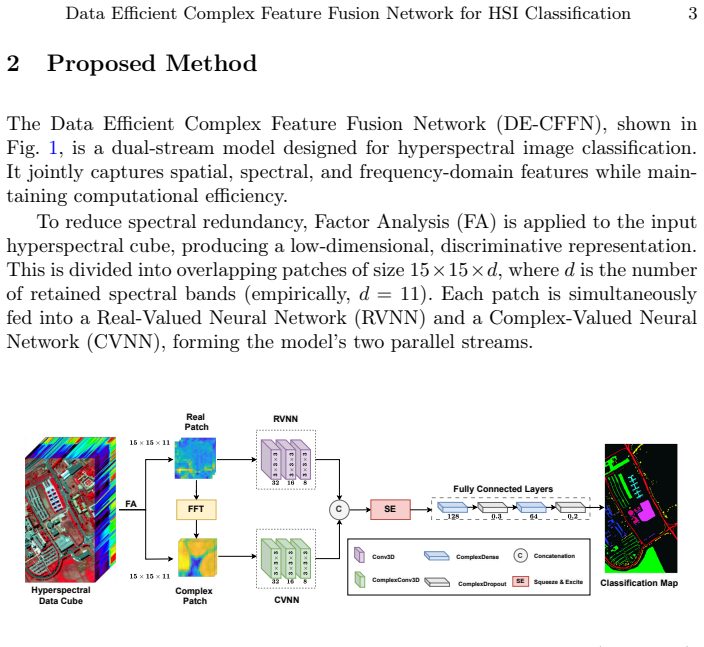
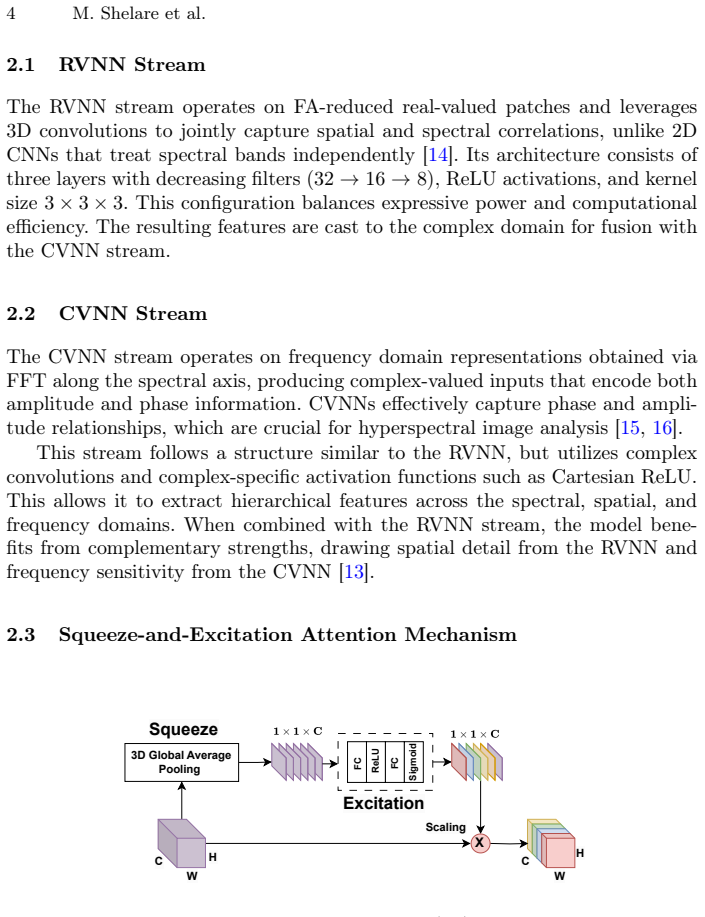
The dual real-complex branch architecture with factor analysis dimensionality reduction and halved 3D convolutional filters, followed by concatenation and squeeze-and-excitation refinement.
If this is right
- DE-CFFN enables real-time hyperspectral imaging applications due to lower inference latency.
- The reduced model size and memory consumption allow deployment on resource-constrained devices.
- Performance remains comparable on standard datasets like Pavia University and Salinas, indicating preserved feature quality.
- The modifications to the feature extraction process maintain the benefits of the complex-valued branch without full computational cost.
Where Pith is reading between the lines
- Similar efficiency techniques could apply to other dual-branch or complex-valued networks in signal processing tasks.
- Further reductions might be possible by exploring additional compression methods while monitoring accuracy.
- Validation on additional hyperspectral datasets would strengthen the case for broad applicability.
Load-bearing premise
That halving the 3D convolutional filters and using factor analysis instead of PCA will preserve enough feature quality in the real and complex branches for the final model to perform comparably.
What would settle it
If on the Pavia University dataset the overall accuracy of DE-CFFN is more than 2-3 percentage points lower than CFFN while model size is reduced by half, or if inference latency does not decrease noticeably.
Figures
read the original abstract
This work presents a data-efficient variant of the Attention-Based Dual-Branch Complex Feature Fusion Network (CFFN) for hyperspectral image classification. The proposed model, termed DE-CFFN, retains the original two-stream structure: the Real-Valued Neural Network (RVNN) processes standard hyperspectral patches, while the Complex-Valued Neural Network (CVNN) handles their Fourier-transformed counterparts. The main contribution of this work lies in the feature extraction process and architectural enhancement. Factor Analysis is used for dimensionality reduction, offering improved latent feature representation over Principal Component Analysis. Additionally, both the RVNN and CVNN streams are structurally modified by successively halving the number of filters in the 3D convolutional layers to reduce complexity. The outputs of both branches are concatenated and passed through a Squeeze and Excitation (SE) block to enhance joint feature representation. Evaluated on the Pavia University and Salinas datasets, DE-CFFN achieves classification performance comparable to CFFN, while significantly reducing model size, memory consumption, and inference latency, making it suitable for real-time hyperspectral imaging applications.
Editorial analysis
A structured set of objections, weighed in public.
Referee Report
Summary. The paper introduces DE-CFFN as a data-efficient variant of the prior CFFN model for hyperspectral image classification. It retains the dual-branch structure (RVNN on raw patches, CVNN on Fourier patches) but replaces PCA with Factor Analysis for dimensionality reduction and successively halves the number of 3D-convolutional filters in both branches. The concatenated features are refined by an SE block. On the Pavia University and Salinas datasets, the authors claim classification accuracy comparable to CFFN while achieving substantial reductions in model size, memory usage, and inference latency.
Significance. If the accuracy claims hold under the described modifications, the work would provide a practical efficiency improvement for real-time hyperspectral applications. The use of Factor Analysis and filter halving directly targets the computational bottlenecks of complex-valued networks, and reproducible results on standard public datasets would strengthen the contribution.
major comments (3)
- [§3] §3 (Method): The central claim that halving 3D-conv filter counts in both RVNN and CVNN branches plus switching to Factor Analysis preserves sufficient feature quality for comparable accuracy is load-bearing, yet no ablation isolating the effect of each change (filter halving vs. FA vs. original PCA) is presented; without this, it is impossible to confirm that the concatenated representation after the SE block remains competitive.
- [§4] §4 (Experiments): The reported classification results on Pavia University and Salinas are stated as 'comparable' to CFFN, but the text supplies neither per-class accuracies, overall accuracy with standard deviations across multiple runs, nor statistical significance tests; this leaves open whether the observed differences fall within experimental variability.
- [§3.1] §3.1 (Dimensionality reduction): The assertion that Factor Analysis offers 'improved latent feature representation' over PCA is presented without any quantitative comparison (e.g., reconstruction error, class separability metrics) on the same patches used for training; this directly affects the weakest assumption identified in the stress test.
minor comments (2)
- The abstract and §4 refer to 'significantly reducing' model size and latency, but no absolute numbers (parameters, FLOPs, ms/inference) or hardware platform are given in the main text; these should be added to Table 1 or a new table.
- Notation for the complex-valued branch (e.g., how the Fourier patches are represented as complex tensors) is introduced without an explicit equation; a short definition in §2 would improve clarity.
Simulated Author's Rebuttal
We thank the referee for the constructive and detailed comments on our manuscript. We address each major point below and will incorporate revisions to improve the rigor of the presentation.
read point-by-point responses
-
Referee: [§3] §3 (Method): The central claim that halving 3D-conv filter counts in both RVNN and CVNN branches plus switching to Factor Analysis preserves sufficient feature quality for comparable accuracy is load-bearing, yet no ablation isolating the effect of each change (filter halving vs. FA vs. original PCA) is presented; without this, it is impossible to confirm that the concatenated representation after the SE block remains competitive.
Authors: We agree that isolating the individual contributions of Factor Analysis, filter halving, and the SE block would strengthen the central claim. In the revised manuscript we will add a dedicated ablation study in §3 that reports overall accuracy for (i) the original CFFN, (ii) CFFN with only Factor Analysis, (iii) CFFN with only halved filter counts, and (iv) the full DE-CFFN, thereby demonstrating the effect of each modification on the final concatenated representation. revision: yes
-
Referee: [§4] §4 (Experiments): The reported classification results on Pavia University and Salinas are stated as 'comparable' to CFFN, but the text supplies neither per-class accuracies, overall accuracy with standard deviations across multiple runs, nor statistical significance tests; this leaves open whether the observed differences fall within experimental variability.
Authors: We acknowledge that the current experimental reporting lacks the statistical detail needed to substantiate the comparability claim. The revised §4 will include per-class accuracies, overall accuracy reported as mean ± standard deviation over multiple independent runs, and statistical significance tests (paired t-tests) between DE-CFFN and CFFN to confirm that any observed differences lie within experimental variability. revision: yes
-
Referee: [§3.1] §3.1 (Dimensionality reduction): The assertion that Factor Analysis offers 'improved latent feature representation' over PCA is presented without any quantitative comparison (e.g., reconstruction error, class separability metrics) on the same patches used for training; this directly affects the weakest assumption identified in the stress test.
Authors: While the choice of Factor Analysis is motivated by existing literature, we agree that a direct quantitative comparison on the training patches is necessary. In the revised §3.1 we will report reconstruction error and class-separability metrics (e.g., between-class scatter) for both PCA and Factor Analysis applied to the identical patches, thereby providing empirical support for the dimensionality-reduction step. revision: yes
Circularity Check
No circularity; purely empirical architecture comparison
full rationale
The paper describes an empirical modification of the prior CFFN model (halving 3D-conv filter counts and replacing PCA with Factor Analysis) followed by direct accuracy/latency measurements on the Pavia University and Salinas datasets. No equations, derivations, fitted parameters renamed as predictions, or self-referential uniqueness theorems appear. The central claim (comparable accuracy at lower cost) is validated by external benchmark results rather than reducing to its own inputs by construction. Any self-citations to CFFN are not load-bearing for the efficiency claims.
Axiom & Free-Parameter Ledger
Reference graph
Works this paper leans on
-
[1]
Classification of hyperspectral imagery using a fully complex-valued wavelet neural network with deep convolutional features
Peker, Musa. Classification of hyperspectral imagery using a fully complex-valued wavelet neural network with deep convolutional features. Expert Syst. Appl
-
[2]
Deep Learning for Hyperspectral Image Analysis and Classification , ISBN =
Tao, Linmi and Mughees, Atif , year =. Deep Learning for Hyperspectral Image Analysis and Classification , ISBN =. doi:10.1007/978-981-33-4420-4 , journal =
-
[3]
given-i=M, given=Murali, family=Kanthi and given-i=TH, given=. A 3d-Deep CNN Based Feature Extraction and Hyperspectral Image Classification , url =. doi:10.1109/ingarss48198.2020.9358920 , journaltitle =
-
[4]
and Marshall, Stephen and Zabalza, Jaime and Al Ahmad, Hussain , booktitle=
Aburaed, Nour and Alkhatib, Mohammed Q. and Marshall, Stephen and Zabalza, Jaime and Al Ahmad, Hussain , booktitle=. 3D Expansion of SRCNN for Spatial Enhancement of Hyperspectral Remote Sensing Images , year=
-
[5]
given-i=MQ, given=. Attention Based Dual-Branch Complex Feature Fusion Network for Hyperspectral Image Classification , url =. doi:10.1109/whispers61460.2023.10431224 , journaltitle =
-
[6]
Squeeze-and-Excitation networks , url =
given-i=J, given=Jie, family=Hu and given-i=L, given=Li, family=Shen and given-i=S, given=Samuel, family=Albanie and given-i=G, given=Gang, family=Sun and given-i=E, given=Enhua, family=Wu , date =. Squeeze-and-Excitation networks , url =. doi:10.1109/tpami.2019.2913372 , journaltitle =
-
[7]
Hyperspectral Image Classification—Traditional to Deep Models: A Survey for Future Prospects , url =
given-i=M, given=Muhammad, family=Ahmad and given-i=S, given=Sidrah, family=Shabbir and given-i=SK, given=. Hyperspectral Image Classification—Traditional to Deep Models: A Survey for Future Prospects , url =. doi:10.1109/jstars.2021.3133021 , journaltitle =
-
[8]
Deep Learning for hyperspectral Image Classification: An Overview , url =
given-i=S, given=Shutao, family=Li and given-i=W, given=Weiwei, family=Song and given-i=L, given=Leyuan, family=Fang and given-i=Y, given=Yushi, family=Chen and given-i=P, given=Pedram, family=Ghamisi and given-i=JA, given=. Deep Learning for hyperspectral Image Classification: An Overview , url =. doi:10.1109/tgrs.2019.2907932 , journaltitle =
-
[9]
given-i=R, given=Reaya, family=Grewal and given-i=SS, given=. Machine Learning and Deep Learning Techniques for Spectral Spatial Classification of hyperspectral images: A Comprehensive survey , url =. doi:10.3390/electronics12030488 , journaltitle =
-
[10]
Deep recurrent neural networks for hyperspectral image classification , url =
given-i=L, given=Lichao, family=Mou and given-i=P, given=Pedram, family=Ghamisi and given-i=XX, given=. Deep recurrent neural networks for hyperspectral image classification , url =. doi:10.1109/tgrs.2016.2636241 , journaltitle =
-
[11]
Hyperspectral image classification with Squeeze MultiBias Network , url =
given-i=L, given=Leyuan, family=Fang and given-i=G, given=Guangyun, family=Liu and given-i=S, given=Shutao, family=Li and given-i=P, given=Pedram, family=Ghamisi and given-i=JA, given=. Hyperspectral image classification with Squeeze MultiBias Network , url =. doi:10.1109/tgrs.2018.2865953 , journaltitle =
-
[12]
given-i=J, given=Jie, family=Feng and given-i=Y, given=Yu, family=Hyeong-Keun and given-i=L, given=Lin, family=Wang and given-i=X, given=Xin, family=Cao and given-i=X, given=Xiangrong, family=Zhang and given-i=L, given=Licheng, family=Jiao , date =. Classification of hyperspectral images based on multiclass Spatial–Spectral generative adversarial networks...
-
[13]
given-i=C, given=Chunyan, family=Yu and given-i=R, given=Rui, family=Han and given-i=M, given=Ming, family=Song and given-i=C, given=Caiyu, family=Liu and given-i=C, given=Chein‐I, family=Chang , date =. A simplified 2D-3D CNN architecture for hyperspectral image classification based on Spatial–Spectral fusion , url =. doi:10.1109/jstars.2020.2983224 , jo...
-
[14]
HybridSN: Exploring 3-D–2-D CNN feature hierarchy for Hyperspectral Image Classification , url =
given-i=SK, given=. HybridSN: Exploring 3-D–2-D CNN feature hierarchy for Hyperspectral Image Classification , url =. doi:10.1109/lgrs.2019.2918719 , journaltitle =
-
[15]
2021 , eprint=
SpectralNET: Exploring Spatial-Spectral WaveletCNN for Hyperspectral Image Classification , author=. 2021 , eprint=
2021
-
[16]
given-i=YE, given=. An examination on the effect of CVNN parameters while classifying the real-valued balanced and unbalanced data , url =. doi:10.1109/idap.2018.8620907 , journaltitle =
-
[17]
doi:10.1007/978-3-642-27632-3 , title =
given-i=A, given=Akira, family=Hirose , date =. doi:10.1007/978-3-642-27632-3 , title =
-
[18]
Remote Sensing , VOLUME =
Li, Wenmei and Xia, Hao and Zhang, Jiadong and Wang, Yu and Jia, Yan and He, Yuhong , TITLE =. Remote Sensing , VOLUME =. 2024 , NUMBER =
2024
-
[19]
Deep Feature Extraction and Classification of Hyperspectral Images Based on Convolutional Neural Networks , year=
Chen, Yushi and Jiang, Hanlu and Li, Chunyang and Jia, Xiuping and Ghamisi, Pedram , journal=. Deep Feature Extraction and Classification of Hyperspectral Images Based on Convolutional Neural Networks , year=
discussion (0)
Sign in with ORCID, Apple, or X to comment. Anyone can read and Pith papers without signing in.